Home Blog Page 72

Multifamily Rent Growth Turned Negative In November

Multifamily rent growth turned negative in November as the economy softened, demand for apartment units slowed and the rising interest rates. Yardi Matrix reports

Multifamily rent growth finally took a turn downward in November due to the economy softening, demand for apartment units slowing and rising interest rates, Yardi Matrix says in their November National Multifamily Report.

“The average U.S. multifamily rent fell $9 to $1,719 in November, the largest one-month decline in rents in well over a decade,” Yardi Matrix writes in the report.

  • All of Yardi Matrix’s top 30 metros continue to display positive rent growth year-over-year, though more recent performance shows some weakness.
  • Almost two-thirds of the top 30 had negative growth over the last three months and more than 90 percent had negative growth over the last month.
  • The single-family rental market is following the same pattern. The average U.S. asking rent dropped $5 in November to $2,091, while the year-over-year increase fell by 80 basis points to 5.9 percent.

Deterioration in rents not unexpected

The rent decline is not necessarily a signal of a deep recession, the report says.

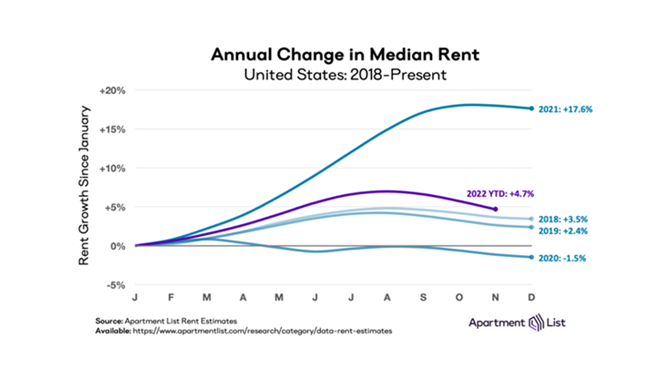
“Rent increases have far exceeded normal growth patterns for nearly two years. Average asking rents increased by 22 percent nationally between January 2021 and October 2022, a rate that would be unsustainable under optimal conditions.

“Now, however, the decades-high inflation rate has left household balance sheets in a weaker position than a year ago, while economic growth is slowing as the Federal Reserve raises interest rates,” Yardi Matrix says in the report.

Renewing leases is a focus now

“National renewal rents continue to show strength, increasing 11.1 percent year-over-year through September, up slightly from August, as property owners were still in the process of bringing rents of existing tenants closer to asking rates.

“However, as asking rates for new tenants have turned negative, the growth in renewal rents will certainly slow in coming months,” the report says.

Slowdown in transaction activity

“Property sales, a big source of originations, have come to a screeching halt as the bid-ask spread has widened,” the report says.

Another sign of the slowdown is that “government-sponsored enterprises Fannie Mae and Freddie Mac may not lend all the capital allocated to them by the federal government.” This also slows refinancing.

Read the full report here.

Yardi Matrix: Multifamily rent growth turned negative in November as the economy softened, demand for apartment units slowed and the rising interest rates.
November report from Yardi Matrix

18 Months of Outstanding Rent Growth Coming to An End

About Yardi Matrix

Yardi Matrix researches and reports on multifamily, office and self-storage properties across the United States, serving the needs of a variety of industry professionals. Yardi Matrix Multifamily provides accurate data on 18+ million units, covering more than 90 percent of the U.S. population. Contact the company at (480) 663-1149.

Sign Up For Our Weekly Newsletter And Get Rental Property And Apartment News And Helpful, Useful Content Each Week.

* indicates required

Multifamily Rents ‘Hit the Brakes’ in September

Rental Price Drops Around The Country

Five Steps for a Fair-Housing-Friendly 2023

Here are five steps on how to be fair-housing friendly in 2023 from the Fair Housing Institute and keep up with changes in 2023.

Here are five steps on how to be fair-housing friendly in 2023 from the Fair Housing Institute.

By The Fair Housing Institute

As we come to the end of another eventful year, it makes sense to take a moment and reflect  on what we have accomplished and begin to set goals for the future. Part of this should include an overview of your fair housing practices. This article will share five quick steps to help you get started toward having a fair-housing-friendly 2023.

Step1: Stay Up to Date on New or Changing Fair Housing Laws

As we all know, fair housing laws can and do change. It is essential that every property management professional is aware of how these changes may impact them. In addition, you also need to remember that there is more to fair housing than just federal laws or oversight. You also need to stay current on state and city/municipal levels.

Doing your own research is possible but can be time-consuming. Subscribing to your local fair housing organization is an efficient way to stay up to date, or you can consult an attorney that specializes in fair housing.

Step 2: Review Your Policies and Procedures

As stated above, fair housing laws are ever-evolving. As a result, an excellent and often necessary best practice is regularly reviewing your policies and procedures. Ask yourself: Are they up-to-date? Could they be considered too broad or restrictive? Do they follow the law?

Your policies and procedures do not need to be complicated or lengthy. But they do need to be clear and follow the laws that pertain to them. Again if you are unsure, consulting an attorney is always a good idea to ensure compliance.

Step 3: Update Your Documentation and Forms

When was the last time you reviewed your forms? Are they still one-size-fits-all or pretty generic? While these definitely can be used, they can leave you a little more exposed to mistakes or oversights.

As we know, not every request requires the same information. For example, a request for an assistance animal is going to require more information than a request for an accessible parking spot. Having forms that are specific to the many different requests we come across will help expedite the process and get you the right information you need while creating consistent documentation should a question or fair housing claim ever happen.

Step 4: Ensure Fair-Housing-Friendly Marketing and Advertising

Marketing and advertising continue to be a challenge for the property management industry. Why? While, of course, we want to attract that perfect resident to our property, we need to do it in a way that is fair, equitable, and inclusive.

Marketing and advertising can take on many different shapes and forms. From advertisements around the community and social media to the types of photos and decorations in our leasing offices, just to name a few. Whatever outlets we choose, caution is needed to establish a standard of being diverse and accessible to everyone to avoid even the smallest appearance of discrimination.

Step 5: Investing in Fair Housing Training and Education

Of course, we can’t forget about targeted fair housing education and training! Without this, you are just asking for trouble. Every individual in your organization should have access to education and training that at least covers the basics of fair housing.

Currently, there is a wide variety of training options available to help fit each individual’s learning style. From webinars and online self-directed learning, to—finally—the availability to rejoin in-person education sessions. All of these can aid in staff having a thorough understanding of fair housing laws and help avoid potential problems.

These five steps serve as a high-level overview to help you quickly identify any potential gaps. Naturally, there are more granular items that need to be addressed. Keeping that in mind, we encourage everyone to continue to stay current in our dynamic industry through ongoing training and education and wish everyone a fair-housing-friendly 2023!

About the author:
In 2005, The Fair Housing Institute was founded as a company with one goal: to provide educational and entertaining fair-housing compliance training at an affordable price at the click of a button.

Sign Up For Our Weekly Newsletter And Get Rental Property And Apartment News And Helpful, Useful Content Each Week.

* indicates required

How Can I Get A Tenant To Stop Smoking In My Non-Smoking Unit?

How Can I Get A Tenant To Stop Smoking In Non-Smoking Unit Landlord Hank?

A property manager asks this week how to stop tenant smoking in a non-smoking unit, is a question that comes up often. So  how to prove tenant smoking is the question for Ask Landlord Hank. Remember Hank is not an attorney and he is not offering legal advice. If you have a question for him please fill out the form below.

Dear Landlord Hank,

I am a property manager for two complexes, and we are having issues with tenant smoking. I saw your article in RHJ last year about tenants smoking and hope you can help me.

At one of my properties we have an elderly lady who has been said to be smoking in her unit. The complex has only four units per building, and from this building we haven’t had complaints before until this tenant moved in four months ago.

When my maintenance supervisor and my leasing agent performed our annual inspections one month ago, they did mention it smelled like cigarettes, but there were also a fair amount of plug-in citrus air fresheners.

This tenant doesn’t respond to my messages about not smoking in her unit. (She is not my biggest fan, because I enforce lease-agreement rules.)

What can I do to prove she is smoking in her unit and stop tenant smoking when she denies it Please help.

-Melissa

Dear Landlady Melissa,

Some folks just don’t want to abide by the rules even though they agreed, in writing, that they would. So you aren’t popular with this smoking tenant because you enforce the lease that forbids smoking!

And you’re looking for some proof that you could take to court to prove this tenant is smoking.

I wish we could bottle the air for the judge to smell, but that’s not possible right now. You will have to rely on witness testimony, and photographic proof. I would inspect the unit again with your maintenance supervisor and leasing agent, and have cameras ready and take photos of any evidence.

I’d look for ashtrays, as well as stains on walls, furniture, lamp shades, counters, curtains or blinds, and take photos. I’d also look for cigarette butts, burns in flooring, counters, tubs, etc., and any visible residue or color change in paint on walls.

The biggest clue is the smell. Someone may be able to take a photo of her smoking on her balcony and maintenance can check the hallway in the evening to see if any smoke smell is coming from her door.

I would put a three-day notice on her door that says she is in violation of the no-smoking terms of the lease. If she continues to smoke, then it’s time to file eviction.

She is damaging your property, in addition to violating the lease. If  you do nothing, other tenants may complain or move out due to the air pollution – or others may start to smoke in their units too. Don’t delay, get on this right away and stop tenant smoking.

Sincerely,

Hank Rossi

How Can I Stop Tenant Smoking In Non-Smoking Unit?
Landlord Hank says, “ISomeone may be able to take a photo of her smoking on her balcony and maintenance can check the hallway in the evening to see if any smoke smell is coming from her door.”

Ask Landlord Hank Your Question

Ask veteran landlord and property manager Hank Rossi your questions from tenant screening to leases to pets and more! He provides answers each week to landlords.

  • This field is for validation purposes and should be left unchanged.

Can I Monitor Tenant Smoking In My No-Smoking Rental?

Ask Landlord Hank: I Think My Tenants Have Been Smoking Inside; How Do I Prove it?

Do I Have to Paint and Replace Flooring for a Long-Term Tenant?

Sign Up For Our Newsletter And Get Rental Housing And Apartment News And Helpful, Useful Content Each Week.

* indicates required

As a child, Hank Rossi watched his father take care of the family rental-maintenance business, and sometimes became his assistant. In the mid-’90s he got into the rental business for himself. After he retired, Hank managed only his own investments for the next 10 years, but then started a real-estate brokerage business with his sister that focuses on property management and leasing. He continues to manage his portfolio in Florida and Atlanta. Visit Landlord Hank’s website: https://rentsrq.com.


Why Regular Furnace Filter Replacement is Crucial for Property Owners and Landlords

Regular furnace filter replacement for rental property owners and landlords as preventative maintenance it has the most impact.

Regular furnace filter replacement is crucial for rental property owners and landlords because of all the preventative maintenance services it has the most impact.

By Greg Wells

Landlords and property managers are tasked with continually ensuring the homes and units they rent out are safe, comfortable and suitable for tenants.

Of course, this includes taking care of everything that can go wrong with plumbing, heating and air conditioning, but it also includes preventative maintenance on these systems that can halt a problem before it even starts. In most cases, it is that preemptive work that costs less than a major issue down the line.

Of all the preventative maintenance services required for HVAC and plumbing equipment, furnace-filter replacement arguably has the most impact.

If a furnace filter is not replaced regularly, air quality can diminish, damage can be done to heating-system components or the entire system, and in the worst-case scenario, a system breakdown can occur. With that in mind, here are all the reasons to replace the furnace air filter in your properties, and advice on how and when to do it.

Regular furnace filter replacement for rental property owners and landlords as preventative maintenance it has the most impact.
Dirty air filters can also cause severe problems, the worst of which is likely an overheated motor.

How Often Should a Furnace Filter be Replaced?

A furnace air filter should be replaced every three months, especially in summer and winter when the furnace or air conditioner is running most frequently. Replacing every three months is a good standard to keep up with, though circumstances may change that recommendation.

For example, if construction is happening within the property, or you allow pets in the property, more frequent replacement is advisable. Keep in mind that heating, ventilation, and air conditioning (HVAC) professionals will often change out the furnace air filter for you if the property is under an HVAC maintenance plan.

Why Should a Furnace Filter Be Replaced?

There are three primary reasons to replace a furnace filter: for the health of your tenants, for the health of the property’s systems, and to save money.

Regular furnace-filter replacement prolongs the life of an HVAC system. This is because the system has to work harder to produce heat if the air filter is dirty, causing a litany of potential problems. Dirty air filters can also cause severe problems, the worst of which is likely an overheated motor. If the motor overheats, and there are wiring issues in the system present, serious damage to the furnace or property can happen. This is both costly and obviously dangerous for tenants.

From the tenant standpoint, furnace-filter replacement can improve their quality of living. Regular replacement keeps the air in the property cleaner and helps eliminate foul odors. Additionally, regular filter replacement can reduce hazards, such as mold spores, soot, bacteria, and allergen buildup, both in the HVAC system and in the ductwork of the home.

Finally, regular furnace-filter replacement can provide cost savings. The filters are relatively inexpensive, and they can improve furnace efficiency, often resulting in a lower energy bill. Whether it’s the landlord or the tenant paying the utility bills, it is a meaningful benefit.

What is the Best Furnace Filter?

There are three things to focus on when purchasing furnace filters. These include:

  • MERV rating: In addition to having the right size, property managers and landlords will want to take note of the minimum efficiency reporting value (MERV) rating. According to the Environmental Protection Agency, you should select a filter with as high a MERV rating as your system fan and filter slot can accommodate (you may need to consult with a professional technician to determine this number).
  • Size: Believe Believe it or not, size does matter when shopping for furnaces. The best furnace filter is the one that best fits your system. Trying to jam in a filter that is too big or too small will negatively affect the effectiveness, and can cause additional problems. A good tip is to write down your filter size on the furnace door so you’ll always remember what size you need to purchase.
  • Price: The price of your property’s furnace filters will go along with your maintenance budgets, and thankfully many models are affordable. With high-quality filters, you’ll see the value for your money. Low-cost filters typically won’t hold up as long and will need to be replaced more frequently. Buy wisely.

When considering rental costs for 2023 and beyond, add furnace-filter replacements every three months for each property to the list. While it may seem like an added expense, it’s actually cost-saving over time and vital for the safety and quality of life for your tenants.

About the author:

Greg Wells is the president of MAX Service Group, which operates Williams Comfort Air and Mr. Plumber in central Indiana, Thomas & Galbraith Heating, Cooling & Plumbing in greater Cincinnati, Buckeye Heating, Cooling & Plumbing in greater Columbus, Ohio and Jarboe’s Heating, Cooling & Plumbing in greater Louisville, Kentucky.


Sign Up For Our Weekly Newsletter And Get Rental Property And Apartment News And Helpful, Useful Content Each Week.

* indicates required

Apartment EV Charging: A Progressive, Sustainable Management Strategy

Apartment hunting can be challenging for electric vehicle owners since they see apartment ev charging as a necessity, not a property amenity.

Apartment hunting can be challenging for electric vehicle owners since they see charging stations as a necessity, not an amenity, in the community. Electric vehicle charging stations, and other next-gen amenities, can be effective tools for marketing a property, but only if used effectively.

By Diane Batayeh
CEO, Village Green

The landscape of property management and ownership is expected to undergo many significant changes in the next few years.

Technology is progressing faster than ever and soon, prospective residents will be looking for more in an apartment than a great location and functional layout.

What once were ‘next-gen’ amenities are now becoming standard with a new wave of luxury options that have entered the multifamily industry in recent years such as co-working spaces, demonstration kitchens and pet spas. Apartment managers and owners will need to proactively address the wants and needs of current and future residents if they want to stay ahead of their competitors.

Next-gen amenities tend to embrace technology, encourage community and neighborhood engagement, and add intrinsic value for residents. While not every apartment community offers next-gen amenities, the times are changing, and soon enough, residents will expect certain amenities to be standard in any apartment they consider residing in.

A good example of a trending next-gen amenity is the inclusion and installation of electric vehicle charging stations. As EVs become more affordable and accessible nationwide, there are certain considerations to be made, particularly around charging stations.

One of the largest complaints from EV owners is that it can be inconvenient to own an electric vehicle while living in an apartment, or anything other than a single-family home, due to placement of charging stations.

Apartment hunting can be challenging for EV owners since they see charging stations as a necessity, not an amenity. Property managers and owners should take note of what their customers are looking for in their living experience and seriously consider the benefits of installing electric vehicle charging stations. Those include:

  • Appealing to a new audience of prospective residents
  • Increasing the quality of life for current residents
  • Becoming an ‘early adopter’ in EV charging technology

Charging stations installation require an organized and efficient plan of action. It’s imperative to commit to the entire process while gauging the individualized needs of your property and residents.

Do your research

Before committing to the process, first consider the property layout, electricity capacity and business potential. Depending on the location, a substantial amount of structural reconfiguration may be necessary. Additionally, consider that EV charging stations will not be needed in every market at the same time.

A property owner in southern California may have more incentive to install charging stations than an owner in rural Kansas due to the sheer number of electric vehicles on the road and the likely adoption by other apartment owners in that market.

However, a good strategy for the Kansas property owner is to become an ‘early adopter’ and provide a service to a small, but potentially underserved group of prospective renters. This could help the Kansas property owner differentiate themselves and believe it’s worth the investment.

Property managers and owners should also investigate what, if any, rebate programs are available for EV charging station installation. Many utility companies around the country offer certain programs to residential customers looking to install chargers and can help facilitate the installation process.

Additionally, grass roots research efforts can provide valuable information when considering EV charger installation. Asking current residents if they own an electric vehicle or if they plan to purchase one soon can provide excellent insight into current and future resident needs.

Trust the process

After assessing the logistics and needs of the residents, property owners may make the decision to install a charging station. If they decide to forge ahead, it will likely be up to the property manager to advise and guide them through the process. Doing  due diligence is vital for a property manager to provide insights including how many chargers to install, which types of chargers will be best suited for the property, and how to effectively communicate with residents about the installation and use process.

Arguably one of the most central aspects to installation is policy and resource cultivation.

To maintain organizational intelligence and awareness, develop procedures and rules surrounding charger usage before the launch. This includes things like ensuring credit card or other payment options are available, selecting an appropriate location and establishing a strategy to organize usage schedules and communicate with residents who are utilizing the technology. Additionally, there should be a well thought out plan for the possibility of adding more chargers as electric vehicles become the norm and the need is justified.

Plan in action

Electric vehicle charging stations, and other next-gen amenities, can be effective tools for marketing a property, but only if used effectively.

Develop a marketing plan that considers everything from physical signage, a resident letter, a strategy for social media, a FAQ document for residents and anything else that ensures the entire community is aware of the new amenity and how to access it.

Next-gen amenities like EV charging stations and smart and sustainable technologies are slowly but surely transitioning from luxury to necessity for many prospective residents.

While not every property  may be a good fit to implement next-gen amenities early on, recognizing early consumer demand signals, and having the ability to effectively assess the potential benefits to your property and residents by virtue of a thoughtful return on investment assessment is an important first step.

About the author

Apartment hunting can be challenging for electric vehicle owners since they see apartment ev charging as a necessity, not a property amenity.
“Property managers and owners should take note of what their customers are looking for in their living experience and seriously consider the benefits of installing electric vehicle charging stations.”

Diane Batayeh is CEO at Southfield, Mich.-based Village Green Holding, a more than 100-year old multifamily company that manages a portfolio valued in excess of $10 billion and 40,000+ units nationwide.

Sign Up For Our Weekly Newsletter And Get Rental Property And Apartment News And Helpful, Useful Content Each Week.

* indicates required

The Investment Outlook For Multifamily Properties In 2023

The investment outlook for multifamily properties in 2023 is good as steady occupancy and high rents gives landlords of multifamily properties a reason to look forward to 2023.

The investment outlook for multifamily properties in 2023 is good as steady occupancy and high rents gives landlords of multifamily properties a reason to look forward to 2023.

By Lazer Sternhell, CEO
Cignature Realty

Short-term cash flow, long-term appreciation, and tax benefits have made multifamily properties an appealing option to investors for decades. As we approach 2023, however, the opportunity for investors has never been better.

Apartment buildings, duplexes, and triplexes are being snapped up by investors and renters alike. Here, I help explain why investors are jumping on this rising trend.

The investment outlook for multifamily properties in 2023

Last year, real estate and rental rates skyrocketed. The annual 20% increase for single-family homes put dreams of home ownership out of reach for most of the population. As droves of would-be home buyers turned to renting, affordable multifamily properties were in short supply. Thanks to the rising demand, rent climbed at least 10% in 65 of 150 large cities.

What’s more, increasing rent did not slow the steady stream of renters. In fact, the National Apartment Association found that the US occupancy rate rose to 96.5%, surpassing 2000’s record high. In essence, people are paying higher rents and staying in their apartments longer.

What does all this mean for you as an investor in multifamily properties? For one, the expanding pool of renters means low vacancy rates. Renters pounce on affordable units as soon as they open, and a steady stream of renters leads to stable cash flow. In the past, multifamily investors learned to anticipate months of vacancy in their budgets, but in 2023, the risk for that hazard remains low.

However, if you invest in multifamily in 2023, there are a few things to watch. Rising inflation is partly responsible for the windfall in rents, but it can have a downside for investors, too. As it drives up your operational expenses and repairs, you may pocket less of the profit. On the other hand, the benefit of short-term leases allows you to adjust rents to compensate for higher costs in labor and materials.

Remember, the increasing interest rates are driving renters to your door, but as an investor, they impact you as well. If you purchased investment properties with variable mortgages, prepare to account for those rates in your annual budget. In addition, if you are looking for properties, those rising interest rates make bargains in the multifamily market far more difficult to find. Deals will still be out there in 2023, but you’ll either need to do some digging to find them or you’ll need to refinance.

Investing in multifamily properties in 2023

The fastest and easiest way to jump on 2023’s multifamily investing trend is through real estate syndications. These companies provide a path for you to contribute capital toward multifamily properties without requiring you to manage them. As an investor, you can reap the rewards while putting in far less time and money.

Managing multifamily properties can be a full-time job. You are responsible for maintenance and upkeep on all the units you rent. Either you will do the plumbing, electrical, and repair work yourself or know who to contract for this. Investing in multifamily properties through a real estate syndication company allows you to put those potential headaches into someone else’s hands.

Real estate syndication companies also allow you to join the action with less of an upfront investment. Multifamily properties are a good value over time, but pricey to acquire. Duplexes cost as much or more than a single-family home, and you’ll need a 20% down payment on hand.

If you have the capital and the experience you need, owning your own multifamily property can offer a higher return. The process for investing on your own is nearly as simple and straightforward as buying your first home.

The economy and real estate market have been notoriously tricky to predict, but all signs point to a good year for multifamily investments. While experts say home prices and rent will continue to rise, they predict a slower climb over the next 12 months. Mortgage interest rates probably won’t climb but will remain high, locking out first-time home buyers for another year. While rental prices aren’t expected to hit the peaks of 2022, they are still rising year over year.

The combination of steady occupancy and high rents gives landlords of multifamily properties a reason to look forward to 2023. In the short term, your investment has the potential to be a great source of passive income. In the long term, it will likely continue to appreciate as other investors scramble to get in on the trend.

About the author:

Lazer Sternhell was intrigued by the potential of real estate early on, having grown up in a family of commercial real estate owners. Working for his family’s business in the mid-1990s, he gained invaluable knowledge while cultivating his natural talent for sales. Lazer went on to establish and run several successful businesses in other industries. His own familiarity with commercial spaces for his companies ultimately inspired him to enter the world of real estate from the brokerage stand point, and use the seasoned skills he had amassed to benefit his clients. Honoring his accomplishments and contributions, Lazer was awarded CoStar Power Broker status. Lazer lives in Rockland County with his wife and five sons.

Sign Up For Our Weekly Newsletter And Get Rental Property And Apartment News And Helpful, Useful Content Each Week.

* indicates required

7 Rental Market Trends To Watch In 2023


Packages Piling Up Can Be A Headache For Apartment Property Managers

Packages piling up in the rental office from online orders by tenants can be a real headache this time of year for property managers.

As more and more people order online and more and more boxes are delivered by Amazon and others, the issue is growing for property managers who are sometimes dodging packages left for tenants in the property management office.

Package security is a concern for all and thus folks in apartments many times have only the property management office as a solution and place to have their packages sent.

“Package delivery continues to be on the rise and this trend isn’t going to let up anytime soon. It’s evident a solution is needed now more than ever to provide both apartment management and residents alike the most robust and convenient package management solutions,” Georgianna W. Oliver, general manager and founder of Package Concierge, said in a release.

“When residents can access their packages whenever is convenient for them. It’s win-win for the industry. Leasing teams will take back their time to focus on customer service instead of package management, and residents have ultimate freedom with shipping and receiving deliveries,” Oliver said.

Her company sells a package concierge room which includes a surface-mounted kiosk that includes a 7-inch touch screen, barcode reader, still camera and effortless technology is used to control the package room. Automation with property management software creates efficiency for onsite staff and package carriers, allowing for easy drop-off or retrieval abilities. Residents have 24-hour access to retrieve and return packages with the ease of mobile app technology, according to the release.

Packages piling up for tenants

The Washington Post talked to three people in the property management industry about this problem.

    • “This is one of the biggest puzzles in the apartment industry,” Rick Haughey, a vice president at the National Multifamily Housing Council, a Washington nonprofit group, told the Washington Post. “How do you manage hundreds of packages every day?”
    • “People are buying everything online — even furniture, which means our offices end up looking like West Elm warehouses,” Luanne McNulty, vice president of ZRS Management, an Orlando-based property-management company told the Post.  “Sorting all of that out is easily a full-time job.”
    • “Some days I’m crawling over packages — they’ll be all around my desk, on the tables, on the shelves,” Greenwald, the manager of Gelmarc Towers, a 1950s building that has 166 units, told the newspaper. “It can feel like an obstacle course.”

A National Multifamily Housing Council (NMHC) resident survey ranked access to packages as the second most important amenity, right after fitness centers. The reasons for the high importance ranking are clear: consumers don’t want to miss deliveries because they’re not home; they want to know their packages are safe and secure; and they want to have access to their packages at convenient times.

Amazon hub for packages

Packages piling up in the rental office this time of year can be a headache for property managers

Earlier this year, Amazon launched a new locker product for apartment buildings to help with this problem called The Hub.

Amazon has launched a new delivery locker product, called “the Hub,” for apartment buildings so residents can securely receive bulky packages and pick them up at convenient times for the tenants, according to Amazon.

Amazon is pitching the lockers to apartment owners and property managers saying, ”Your residents will thank you.

“Accepting deliveries from all carriers, Hub by Amazon can free you and your staff from daily package management.  It’s convenient and easy to use, making the Hub an amenity your residents will love.

“Self-service delivery and trusted customer support come together to create a solution you can count on,” the company says.

Large property owners such as AvalonBay Communities Inc., Equity Residential, Greystar and Bozzuto Group are on board with Amazon’s plan to install wireless-connected locker units both inside and outside of high-traffic apartment buildings, according to reports.

Holiday Package Volume Means Hectic Season for Property Teams

Sign Up For Our Weekly Newsletter And Get Rental Property And Apartment News And Helpful, Useful Content Each Week.

* indicates required

Investigation Called For Over RealPage Rent-Setting Software

National Rents Take Big Drop in November

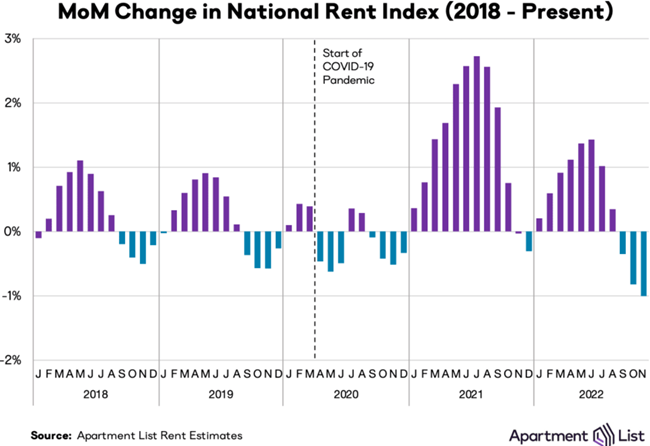
The national rents index fell by 1 percent over the course of November, marking the third straight month-over-month decline.

The national rents index fell by 1 percent over the course of November, marking the third straight month-over-month decline, and the largest single month dip in the history of the Apartment List index, going back to 2017, according to the December report from Apartment List.

The report says rents are likely to continue to dip in the coming winter months as well.

“The timing of the recent cooldown in the rental market is consistent with the typical seasonal trend, but its magnitude has been notably sharper than what we’ve seen in the past, suggesting that the recent swing to falling rents is reflective of a broader shift in market conditions beyond seasonality alone,” the research team writes in the report.

Year-over-year rent growth has slowed considerably since the first of the year and is close to matching pre-pandemic levels.

The national rents index fell by 1 percent over the course of November, marking the third straight month-over-month decline,

Seattle Sees Biggest Rent Drop in November

Rents decreased in 93 of the nation’s 100 largest cities that Apartment List measured.

Among large metros nationwide, Seattle saw the sharpest decline in November, with prices down by 2.6 percent month-over-month.

“And over a longer horizon, we are continuing to see an ongoing cooldown in many of the recently booming Sun Belt markets. Las Vegas, Phoenix, Jacksonville (Fla.), and Riverside (Calif.) have all seen rent growth of 30 percent or more since March 2020, but none of these metros has seen rents increase by more than 1 percent over the past twelve months,” the report says.

“This year’s dip has so far been sharper than what we typically see. Prices have now fallen by a total of 2.2 percent since August, which is the sharpest three-month decline in the history of our index.

“The recent dip suggests that we may be entering a new phase of the rental-market rollercoaster, with changing economic conditions now driving a cooldown rental demand just as supply constraints are easing. It’s likely that rents will decline further in the months ahead, as rental market activity continues to slow during the winter months,” the research team writes.

Vacancy rate continues to climb

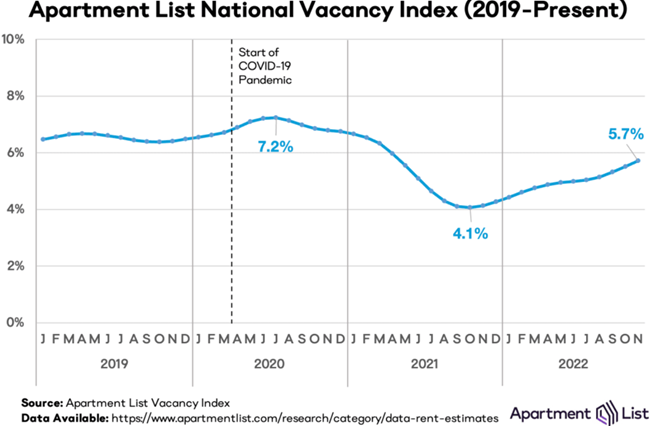
The report says the pace at which the vacancy rate is easing has been picking up a bit of steam in recent months, as rent growth has turned negative.

From April through August, the vacancy index ticked up by a total of just 0.2 percentage points, from 5.1 percent to 5.3 percent. But from August through November, it has increased by 0.6 percentage points, reaching 5.7 percent this month.

The national rents index fell by 1 percent over the course of November, marking the third straight month-over-month decline,

Conclusion

The report summarizes that the recent rent declines are “still quite modest in comparison to the skyrocketing growth of last year, and the national median rent is still 23 percent higher than it was in January 2021.”

Read the full Apartment List report here.

7 Rental Market Trends To Watch In 2023

Sign Up For Our Weekly Newsletter And Get Rental Property And Apartment News And Helpful, Useful Content Each Week.

* indicates required

10 Reasons Investors Should Consider FedEx as a Tenant for DST 1031 Exchange Investment in 2023

By Dwight Kay, Founder & CEO of Kay Properties & Investments

When investors evaluate potential opportunities for their 1031 Exchanges, they should not only consider Delaware Statutory Trust offerings, but also those DST offerings that feature one major distribution and logistics tenant: FedEx. While no one has a crystal ball and can predict the performance of any real estate asset, we are encouraged by one corporation that leases thousands of locations across the country: FedEx.

According to the American Association of Independent Investors (AAII) FedEx Corporation (FedEx) provides a robust portfolio of transportation, e-commerce and business services and operational units under the FedEx brand umbrella, including:

  • FedEx Express:

The FedEx Express segment offers a range of United States domestic and international shipping services for delivery of packages and freight.

  • FedEx Ground:

The FedEx Ground segment provides small-package ground delivery services, which includes day-certain service to any business address in the United States and Canada, as well as residential delivery services through its FedEx Home Delivery service.

  • FedEx Freight:

The FedEx Freight segment offers less-than-truckload (LTL) freight services.

  • FedEx Services:

The FedEx Services segment provides sales, marketing, information technology, communications, customer service, technical support, billing and collection services, and certain back-office functions that support the Company’s operating segments.

As a corporate backed-net lease tenant, Kay Properties likes FedEx for a number of fundamental reasons, including FedEx has a market capitalization of $58.40 Billion making them a very well capitalized tenant to help investors sleep well at night that they have a tenant on a long-term lease that will likely be able to pay rent each month*. Again, while all real estate investments contain no guarantees of monthly distributions and investors should read each PPM paying special attention to the risk section prior to considering an investment, Kay Properties likes FedEx as a tenant for DST properties, especially during turbulent times that need an anchor tenant like FedEx.

Here are ten reasons Key Properties likes FedEx for DST 1031 investments in 2022.

  1. Up, Up and Up – According to a recent article in MarketWatch, FedEx stock continues to soar, reaching its biggest one day gain in 29 years on June 14 th , 2022, resulting in a 14.4% increase in share price. This type of growth occurring during a bear market and at a time when many public companies’ share prices are plummeting, is worth taking note.
  2. Shareholder Heaven: FedEx also just raised its shareholder dividend by 53%…. Again, this occurred during a bear market when the broader stock market is taking a beating.
  3. DST Essential: Over the years, Kay Properties has provided several FedEx DST investments for our investors. While past performance does not guarantee or indicate the likelihood of future results, each FedEx DST investment provided regular monthly rental distributions for our client each and every month – even during COVID-19 pandemic. The essential nature of the FedEx business makes it a popular choice for DST investments.
  4. Just Order it Online: E-Commerce Logistics Market Is Booming Worldwide and FedEx is a recipient of this growth trajectory. An article in Digitaljournal reports that this hyper-growth is being fueled by the increased consumer adoption using e-commerce as a convenient and viable purchasing practice. Additionally, the internet continues to penetrate pockets of consumers worldwide which allows cross-border e-commerce activities, and a growing number of e-commerce business models being developed worldwide. All of this feeds into the need for a reliable, logistics company as FedEx.
  5. More Trucks, Please! Parcel volumes continue to grow. According to Pitney Bowes, a technology company that is known for its postage meters and other mailing equipment, FedEx saw its revenue swell to $62 billion in 2021 while growing its market share. The Pitney Bowes survey also found that 23% of American shoppers are shopping more online than ever in their lives, and that nearly 40% of all purchases are now being conducted online.
  6. Expense Inflation Protection Potential – DST investments with long-term leases to tenants like FedEx are often Net Leased whereby the tenant and not the landlord is responsible for the majority, if not all of, the property level maintenance, taxes and insurance costs. This can be a very nice thing in an inflationary environment when your tenant is responsible for increased costs due to inflation and not you as the landlord. This is not the case with many DST investment asset classes such as multifamily, self storage and others whereby the landlord is responsible for all maintenance, taxes and insurance cost increases due to rising inflation.
  7. A high-margin business model. FedEx has done a remarkable job leveraging its reliable and growing pick-up and delivery (P&D) routes, its linehaul run routes, and its efficient expense management practices. As a result, FedEx continues to deliver higher than average profit margins within the logistics and delivery industries, and presents a real challenge for any competitor to attempt to penetrate its business model.
  8. Room to Grow: FedEx has a “lucrative backdoor” that can grow into a larger role in e-commerce. According to a Citigroup analyst, FedEx can boost its profits by $1 billion annually just by leveraging its recent takeover of ShopRunner and the technology prowess of Microsoft. By doing this, explained the Citigroup analyst, FedEx could become e-commerce’s universal shipping cart that would attract a base of millions of subscribers that would receive free expedited shipping.
  9. The Anchor to a DST 1031 Investors Portfolio – A DST with a long-term lease to a company like FedEx can be a potential anchor to an investors DST 1031 portfolio in turbulent times. With a pending recession and uncertainty throughout the world, having a long-term net lease with one of the world’s largest companies can be an anchor for an investors DST 1031 portfolio. Although all investments have risks and investors should read each Private Placement Memorandum (PPM) carefully, investors are deciding that a piece of their DST 1031 investments in a debt-free FedEx DST property makes a lot of sense in today’s uncertain economic climate.
  10. Demand for Industrial Land Surges: The exponential growth of e-commerce has created a huge need for warehouse and data center space. According to a recent Wall Street Journal article, the e-commerce boom has already turned warehouses and fulfillment centers into one of the hottest property types on the planet. This lack of available space suitable for logistics operations has also meant that rents are surging while vacancy rates are some of the lowest in history.

Ask Bill Exeter

Ask Bill Exeter and his team your questions about 1031 exchanges and he and his team will get back to you.

Name

About Kay Properties and www.kpi1031.com

Kay Properties & Investments is a national Delaware Statutory Trust (DST) investment firm. The www.kpi1031.com platform provides access to the marketplace of DSTs from over 25 different sponsor companies, custom DSTs only available to Kay clients, independent advice on DST sponsor companies, full due diligence and vetting on each DST (typically 20-40 DSTs) and a DST secondary market. Kay Properties team members collectively have over 150 years of real estate experience, are licensed in all 50 states, and have participated in over $30 Billion of DST 1031 investments.

* Past performance does not guarantee or indicate the likelihood of future results.

* No representation is made that any DST investment will or is likely to achieve profits or losses similar to those achieved in the past or that losses will not be incurred on future offerings.

Diversification does not guarantee profits or protect against losses. All real estate investments provide no guarantees for cash flow, distributions or appreciation as well as could result in a full loss of invested principal. Please read the entire Private Placement Memorandum (PPM) prior to making an investment. This case study may not be representative of the outcome of past or future offerings. Please speak with your attorney and CPA before considering an investment.

There are material risks associated with investing in real estate, Delaware Statutory Trust (DST) properties and real estate securities including illiquidity, tenant vacancies, general market conditions and competition, lack of operating history, interest rate risks, the risk of new supply coming to market and softening rental rates, general risks of owning/operating commercial and multifamily properties, short term leases associated with multifamily properties, financing risks, potential adverse tax consequences, general economic risks, development risks and long hold periods. All offerings discussed are Regulation D, Rule 506c offerings. There is a risk of loss of the entire investment principal. Past performance is not a guarantee of future results. Potential distributions, potential returns and potential appreciation are not guaranteed. For an investor to qualify for any type of investment, there are both financial requirements and suitability requirements that must match specific objectives, goals, and risk tolerances. Securities offered through FNEX Capital, member FINRA, SIPC.

Why Delaware Statutory Trust Investors Should Practice “The Anchor and the Buoy Investment Strategy”

Why Real Estate Syndication Is Important for Delaware Statutory Trust 1031 Exchange Real Estate Investors

Six Ways to Ensure Your 1031 Exchange is Successfully Completed

Kay Properties & Investments Has Record Year With $610 Million In Equity Placed

What To Expect When Hiring a Property Manager

What to expect when hiring a property manager in residential management - some concepts apply to commercial as well.

What to expect when hiring a property manager in residential management – some concepts apply to commercial as well.

Mark Christianson

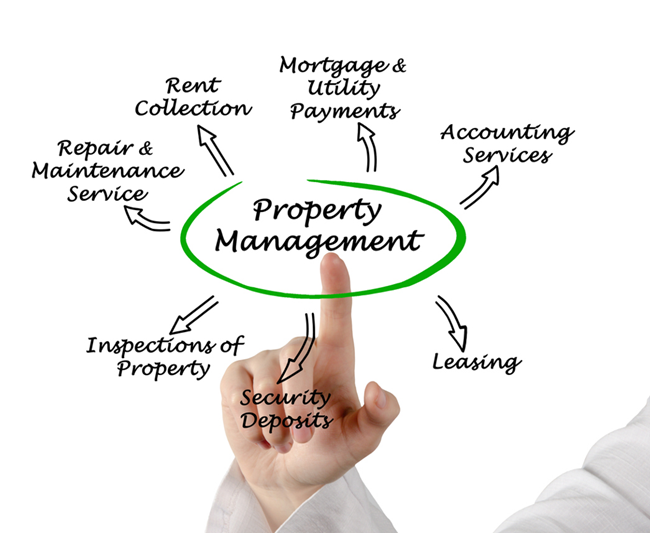
Every property manager or management company is different, with different skills and different goals, but in general property management services are designed to take the work out of owning rental property for an owner.

These are my short answers to some common questions I am asked by potential clients. And remember- this is NOT legal advice!

What does a property management company do for me?

Owning an investment property is very much like owning a small business. You have income and expenses, products and services, warranties and obligations, contracts, legal requirements and so on. Depending on the property this can be an extremely time consuming process. Not only must you handle financial, maintenance and tenant issues, but you should stay abreast of all landlord/tenant and other legal requirements relating to rental properties. A property manager (PM) can take care of all of these issues for you.

During COVID the rules in Oregon were changing several times a year, and rarely with sufficient notification to the public. A good property manager will keep abreast of the law and work to keep you and your tenants in compliance.

An owner should receive monthly financial reports, be contacted if unexpected expenses arise, and be the person steering the boat instead of the one paddling.

 How can I be sure I get good renters in our investment property?

Application screening is the process that ensures that an applicant has the resources to pay the rent that is required and that they have a history of stability and good tenancy. A good property manager will screen every application it receives to ensure that they meet with the companies’ rental criteria. Usually this includes credit, criminal history, SSI check, employment history, rental history and more.

Remember, nobody can guarantee that a tenant will comply with the terms of the rental agreement or lease. It is also important to remember all of the factors that attract good tenants. A clean, nice, updated home will attract more applicants than one that unkempt or in various stages of disrepair. Lower rates attract more applicants and higher rates tend to attract persons in a higher income bracket. Allowing pets may also attract more potential applicants. Longer leases typically attract fewer people, and shorter leases (1 year or less), or month-to-month tenancies, are typically more attractive. The more restrictive the rental criteria are the fewer people will be attracted to rent your property

Also remember that Federal Law prohibits discrimination against protected classes of people. While most people don’t intend to discriminate, it can be easy to do so by accident when advertising or talking to applicants. And the penalties can be severe. Property Managers are trained in how to avoid accidentally discriminating.

When I hire a property manager, will they do everything to take care of the investment?

The short answer is “they can”. The scope of the property manager’s authority is usually negotiated between the owner and the property manager, and is reduced to writing in the property management agreement. This document is the basis from which all future actions are based and you should read it carefully. Typically an Owner will pre-authorize some actions, often with spending limits for various potential maintenance issues.

Some owners prefer a very “hands-on” approach to handling their investments. Others prefer monthly financial reports and occasional phone calls. How much work you want the property manager to cover for you should be discussed in detail so both parties know what to expect.

Do I give up my authority when I sign a management agreement?

Typically you do not “give up” your authority; you confer the authority to the PM to make decisions and act in the best interests of you and the property. You are creating an “agency” relationship with your PM, and you are authorizing them to make daily decisions for you in the manner they believe best address’s your needs. The property management agreement is the basis for the PM’s authority, so you should read it carefully.

It’s important to remember that your property manager cannot break the law for you, and that some things are such an integral part of their policies that they cannot accommodate unusual requests in those areas. Further, they are running a business too. They will not likely do anything that negatively impacts their income. However, you are in control. A last resort is to terminate the management agreement.

Is the property manager financially responsible for making the home or apartment ready to rent, and for all advertising costs?

These questions should be answered in the property management agreement, but usually the answer is No. The PM is responsible for making sure the home is rentable (maintenance, cleaning, safety and habitability problems and so on), for insuring that the bills are paid and that the rent is collected. They are NOT responsible for the financial requirements to make these things happen. In short, the PM will do the legwork and make sure the issues are addressed, but the owner is responsible for the financial burden.

In other words- If the tenant does not pay rent the PM will take appropriate actions but will not cover the missing rent payment. If a tenant damages your rental the PM will schedule repairs but the cost of the work is paid by the property owner. Sometimes those costs can be recovered from the tenant, but if not the cost is paid from the owners funds.

Is the property manager responsible if they don’t collect the rent, or if the tenant damages my property?

Your PM cannot make the tenant do anything. Your PM can negotiate with tenants, remind them of legal obligations, and serve notices and so on to pressure them into conforming to the terms of their agreement. But they have no rights that a property owner does not have- they are acting as your agent.

Remember that the short and long term benefits of investment property ownership are the owners, not the PM’s. The tax benefits, cash flow, appreciation and equity enjoyed by the owner are completely unavailable to the PM. They are paid for their services based on the terms of the management agreement. Because an owner stands to make a considerable sum from an investment property over time, it only makes sense that the Owner is the one who should financially maintain the investment.

How long will it take to rent out any vacant space? How much rent can I charge?

A current market study of the rental prices in an area will give you a good starting point, and most PM’s do this regularly or shortly after a notice to vacate is received. How long renting will take depends on many factors. These include rent rate, interior quality, neighborhood, amount of deposits or prepaid rent (total move-in costs), pet and other restrictions, advertising platforms, availability, the season or time of year and so on.

Remember that this is a sales function, and that likely someone out there that will rent regardless of the situation. The real question is- how long will you wait for them. The best tactic is to advertise early (once a completion or move-in date is established), set the rent rate to a reasonable amount and use signage and online platforms to get the word out.

What happens if the tenant is evicted? Will I ever see the money they owe me?

Though any number of things might occur during the eviction process, typically the tenant moves out or is locked out by the sheriff. In many cases the home will require a considerable amount of work including trash hauling, painting and cleaning, often some minor or major maintenance. Typically it takes 3-5 weeks to evict a tenant, and you can plan on some additional time to make the unit rentable again.

There is usually plenty of documentation supporting the claim of the landlord against the tenant. Some companies will pursue tenants for a short while and then transfer the account to a collection agency. Or, an owner may take the file to small claims court (or civil court). However, the sad truth is that owners rarely see payments from past tenants. It is often such a small amount that owners often decide not to spend the money to pursue legal action.

Can I instruct the PM to do or not do specific things with my property or the tenants?

Yes. Your PM is your agent and they have an obligation to assist you in meeting your needs. However, keep in mind that they are also required to follow the law, that they are regulated and overseen in ways an Owner is not, and that they have a reputation of their own to maintain. If you insist that they do something that is against the law or is detrimental to their own business, they will most likely refuse or even terminate the management agreement.

I am very pleased with the performance of my management company. What should I do?

Tell all your friends and business associates!!! Word of mouth is the best advertising. If you are happy with your property manager, help them out by telling others about your experience.

About the author:

Mark Christianson is principal broker at Markus & Associates, a property management and real estate sales company. 503-646-4909

Property Management Groups Sue Over $10 Cap On Screening Fees

Sign Up For Our Weekly Newsletter And Get Rental Property And Apartment News And Helpful, Useful Content Each Week.

* indicates required