The State of Arizona and City of Tucson have gotten into a spat over the city’s source of income protection ordinance for renters passed in September of 2022.
Former Arizona Attorney General Mark Brnovich ordered the City of Tucson to rescind a law that prohibits landlords from discriminating against renters who receive government assistance, after he deemed it unconstitutional in a non-binding legal opinion, the Arizona Republic reported.
“As mayor and council, we unanimously approved the source of income protection because we know we need a layered approach to find solutions for homelessness and lack of affordability in our state,” Tucson Mayor Regina Romero told Kgun9.com.
Romero says they have plans to meet with the newly elected Attorney General Kris Mayes, to discuss a hopeful reconsideration of Brnovich’s call on the 1487 complaint.
“To put out such a complaint, a 1487 complaint, when in fact the City of Tucson is trying to house more individuals – I thought it was very heartless and cold,” Romero said.
If Tucson does not rescind its ordinance, the attorney general’s office will notify the state treasurer, who will withhold the city’s portion of state shared revenue until it comes into compliance, said Brittni Thomason, a spokesperson for the Arizona Attorney General’s Office.
In the meantime, Romero says to protect the state-shared revenue, the ordinance will not be in effect.
Romero says oftentimes people confuse the source of income protection with the City of Tucson forcing landlords to rent to anyone when in fact it prevents landlords from denying Tucsonans just because they have a Section 8 voucher or receiving social security.
“Without even looking at their background, many people were being denied for the only reason of them having vouchers and that’s why the source of income protection is important for Tucsonans,” Romero said. Once the order of protection was passed, Romero says they saw an immediate increase in landlords accepting renters who had vouchers.
The investigation into the legality of the ordinance began in November from a request made by House speaker-elect and state Rep. Ben Toma of Peoria, who is a real estate agent.
Sewer line issues to your rental properties can get very expensive, very quickly and the city is not going to come fix them for free, so here are some things to know about the trouble sewer lines can cause from Leak Locators.
No. 1 Roots: Fast-growing roots seek out moisture and water. It will find its way to cracked main line sewers, creating a total blockage to sewer lines. It’s so important to have regular sewer scope inspections to help prevent repairs that will be more expensive over time.
No. 2 Settling: Sewer lines can gradually begin to sag due to age. This will create a belly where sewage can build up and create blockages.
No. 3 Ground shifting: Excavating and seismic activity can cause misaligned sewer lines.
No. 4 Sewer pipe materials: Pipe clay and concrete pipes in older homes are much more susceptible to issues than plastic pipes used in newer homes. To spot poor pipe materials, schedule a sewer scope inspection.
No. 5 Poor installation: This can also lead to crack pipes and pipe collapses. It’s important to identify if your sewer line is poorly installed and schedule a repair as soon as possible.
Sewer line inspections ensure you find potential sewer line issues and problems before they cause costly sewer backups, giving you the information needed to schedule estimates for sewer line repairs.
Many rental property insurance companies offer landlord insurance to cover problems with sewer line issues so best to check with your insurance company.
Blocked drains and clogged sewers in rental properties are some of the most common areas of dispute between landlords and tenants because it can be very difficult to apportion blame or responsibility in terms of how the blockage was originally caused.
These issues can worsen over time. It is always best to consult with a professional.
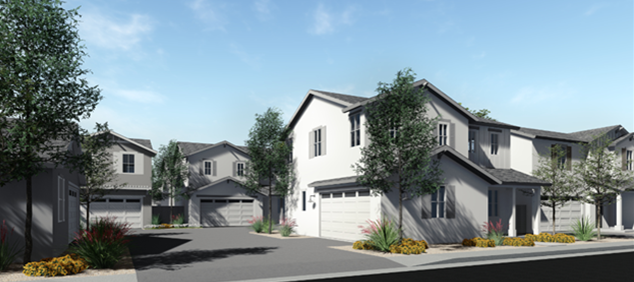
Phoenix’s build-to-rent communities are filling the space between renting and owning, and it is growing by popular demand.
Commonly referred to as single-family rentals, they offer another option for renters who do not want to live in traditional multifamily housing, without the commitment or responsibility of home buying.
Here are the top reasons why build-to-rent homes have become a popular choice in Phoenix metro.
The best of both worlds
Build-to-rent communities offer renters everything they need for a modern and worry-free lifestyle. Like an entry-level starter home, these housing communities are the perfect solution for many residents. Combining convenience and style, these homes were designed to streamline everyday living experiences. They offer a lock-and-leave, maintenance-free, resort-style environment with all the amenities of traditional multifamily housing options.
With single-family rentals, residents can enjoy the same amenities and quality of apartment living, while having the space and privacy of having a home. That said, it is important to keep service quality the same as if they were renting a traditional apartment. Here are some things to prioritize when managing a build-to-rent community:
Uphold the same high standard of customer service
Remember that the resident comes first
Although they are renting, this is still someone’s home – treat it as such
A shift in market trends
Population growth has been an influential component of Phoenix’s latest market trends. In turn, many up-and-coming submarkets have developed throughout the Metro area which is causing the need for more housing options. Rising interest rates have led the home buying environment to shift, driving demand for multifamily options like build-to-rent communities. Additionally, it continues to be difficult for some to qualify for mortgages as home prices remain at an all-time high. Build-to-rent communities have become an ideal option for many as an alternative.
Unique investment opportunity
Build-to-rent communities are a new space where competition is different, drawing the attention of investors alike. With a market that has consistently performed in recent years, it has set the stage for innovative investment opportunities to succeed.
Build-to-rent is the hottest development sector in the Phoenix metro, accounting for nearly 40 percent of all new products anticipated in 2023. Other markets have yet to explore the build-to-rent segment to this extent, making this area a sweet spot and a unique investment opportunity. Furthermore, these communities are seeing a significantly lower turnover rate compared to traditional multifamily housing because of the high-growth segment that is generating higher rental rates.
Geographical advantages
Phoenix has the luxury of building out, as opposed to east coast cities that have no other choice than to build up. Simply put, there is more opportunity for it here than in other markets because of the combination of geographical and market advantages.
About the Author
Natalie Jones, Managing Director of Multifamily Investments at Mark-Taylor, is a trusted leader within the industry. Handling the investments and assets of our clients, Natalie offers consistent communication to achieve optimal financial success across the Mark-Taylor portfolio.
It is time to let landlords be a partner in the housing crisis process because renters and landlords want the same outcome, affordable housing.
By Renee Larsen and Josh Lloyd
A recent poll commissioned by The Oregonian/OregonLive.com showed homelessness and cost of living were among the top issues for voters in the November election. Rightly so.
Oregon is growing less affordable for families, and we are seeing the impacts of housing instability play out. People are relocating to places farther from urban centers, are moving in with family or taking on roommates. We’re seeing maxed-out shelters and camps under bridges. The signs of our region’s housing crisis are all around us.
As an association representing nearly one thousand members with a collective 275,000 apartments, condominiums and homes that are rented out to Oregon tenants, we have a vested interest in stabilizing housing. But to do so, we need a fresh approach. Oregon is preparing to swear in a new governor – one who pledged to tackle this issue with the urgency it demands. We applaud Tina Kotek for that. Our request to her, and the record number of new lawmakers coming to Salem next year, is simple.
Bring everyone to the table. Rather than dismiss landlords with valid concerns about new rental regulations, include them – as well as economists, land-use experts, and tenants – in crafting new approaches.
Renters and landlords want the same outcome: Affordable homes for Oregon families. While we might have different ideas on how to achieve that goal, we encourage our elected leaders to solicit feedback on policy solutions from stakeholders across the spectrum.
Rental housing providers would not be in this business if we did not want to house Oregonians. Contrary to popular belief, landlords are trying to act judiciously. Although state law has allowed rent increases as much as 9.9% in 2022, the most recent Multifamily NW Apartment Report, shows that rents increased at an average of about 5% last year.
And we have much to offer in helping explore innovative solutions to housing instability – just look to the north, where the Alaska Housing Finance Corporation is providing low-interest loans for affordable housing development and significantly contributing to the state’s General Fund through an inventive public-private partnership. We are also aligned strongly with tenant organizations advocating for increased rental assistance programs.
While any economist will tell you that rising rents stem from a lack of new home production, as leaders in the state’s rental housing industry, we know there are several factors that contribute to the state’s undersupply.
Well-intended programs and new policies designed to make housing more affordable for Oregonians are instead driving away existing housing providers and discouraging potential ones.
Statewide rent control, new rules around security deposits and screening fees, ineffective rent assistance programs – compounded by steady increases in the cost of insurance, utilities, payroll, and local tax burdens have created the situation we find ourselves in. Indeed, a growing number of rental housing providers in the Portland-metro area are selling their units as the business of renting has become overly complex and burdensome. An economic study released last March found a nearly 4,000-unit reduction in the number of single-family rentals between 2017 and 2020 in the tri-county region – that’s not housing stability.
But elected leaders don’t need to take our word for it. On the heels of these problematic trends, comes a clarion call for an urgent course correction.
The Oregon Housing Needs Analysis, produced by the Department of Land Conservation and Development and Oregon Housing and Community Services for the Legislature, sounds the alarm on our lack of supply. It recommends clear, necessary regulatory fixes that are designed to boost housing production in communities across the state. The report states: “Our current system plans for and invests in too little housing. The outcome is undersupply, rising home prices, segregation and displacement in some communities, and deepening inequities across all communities.”
But policymakers must recognize that ensuring a sufficient supply of housing also means keeping the hundreds of thousands of rental units we already have.
All of these problems – lack of supply, patchwork overregulation, lack of ongoing rental assistance and insufficient collaboration on how to address these issues – culminate in the serious housing crisis our families are experiencing right now.
Oregon families can’t afford another legislative session where those in power listen to just one side of this issue. Housing providers stand ready to make real progress on stabilizing housing for Oregonians.
About the authors:
Renee Larsen is the vice president at Capital Property Management and the outgoing president of the Multifamily NW Board of Directors. Josh Lloyd is the senior vice president at Wood Partners and the incoming president of the board.
There are a number of potential benefits associated with exchanging into a Delaware Statutory Trust (DST) 1031 property.
However, it is important to note that these potential benefits should also always be carefully weighed with the potential risks that are possible with DST investments, and as with all real estate investments, investors should consult their tax attorney and or Certified Public Account before investing in DSTs.
Still, DSTs continue to grow in popularity especially among aging baby boomers who are tired of managing their own properties and are looking for a way to transition into a passive income stream. DST investments not only provide investors the potential for passive income, but also the following six benefits as well:
Benefit One:
Tax deferral using the 1031 exchange
Many real estate investors have wanted to sell their apartments, rentals and commercial properties for years but haven’t been able to find a property to exchange into and just can’t stomach the tax bill after adding up federal capital gains tax, state capital gains tax, depreciation recapture tax and the Medicare surtax. The DST 1031 property solution provides investors an ability to move from an active to a passive role of real estate ownership on a tax-deferred basis.
Benefit Two:
Eliminating the day-to-day headaches of property management
Because many DST investors are at or near retirement, they are simply tired of the hassles that real estate ownership and management often bring. They are tired of the tenants, toilets and trash and are wanting to move away from actively managing properties. The DST 1031 property provides a passive ownership structure, allowing them to enjoy retirement, grandkids, travel and leisure, as well as to focus on other things that they are more passionate about instead of property management headaches.
Benefit Three:
Increased cash flow potential
Many investors are receiving a lower amount of cash flow on their current properties than they could be, due to their properties having under-market rents, properties that have multiple vacancies and/or that are raw or vacant land sitting idle. DST 1031 exchange properties provide an opportunity for investors to potentially increase their cash flow on their real estate holdings via a tax deferred 1031 exchange.
Benefit Four:
Portfolio diversification by geography and property types
Oftentimes, 1031 investors are selling a property that comprises a substantial amount of their net worth. They want to reduce their potential risk and instead of buying one property (such as another apartment building) or one NNN building (such as a Walgreens pharmacy or Taco Bell restaurant) they decide that investing into a diversified portfolio of DST 1031 properties with multiple locations, asset classes (property types) and tenants is a better fit for their goals and objectives.
This is similar to how investors tend to invest retirement funds in mutual funds and Exchange Traded Funds (ETFs), as opposed to placing their entire retirement savings into the stock of one particular company. However, it is important to note that there are no assurances that diversification will produce profits or guarantee against loss.
Benefit Five:
Long-term non-recourse financing locked and in place to satisfy debt replacement requirements of the 1031 exchange
One of the requirements for a 1031 exchange is to take on “equal or greater debt” in the replacement property to what you had in the relinquished property (the property you are selling). In today’s lending environment, it is often hard for investors to obtain non-recourse financing at an acceptable interest rate and terms. Due to the DST 1031 properties’ sponsors typically having strong lending relationships, they are able to secure non-recourse financing at some of the best terms available in the marketplace. The DST 1031 investors are the direct recipient of these financing terms that they would otherwise often not be able to obtain on their own.
Benefit Six:
Access to Institutional Grade Real Estate
DST 1031 properties provide access to large, institutional-grade real estate that is often otherwise outside of an individual investor’s price point. With the typical minimum investment of $100,000, investors are still able to purchase an ownership interest in large $20 million-plus apartment communities, $5 million-plus pharmacies or $15 million grocery stores, for example. This allows investors access to a level of real estate that they just would not have been able to exchange into before.
That being said, we also have had many clients with very large 1031 exchanges opt to invest in DST 1031 properties because they did not want to place “all their eggs into one basket” by purchasing one single, large investment property.
Please scan the QR code to learn more about Kay Properties, receive your FREE 1031 exchange Toolkit, and review a current list of 1031 Exchange eligible properties:
Ask Bill Exeter
Ask Bill Exeter and his team your questions about 1031 exchanges and he and his team will get back to you.
About Kay Properties & Investments
Kay Properties & Investments is a national Delaware Statutory Trust (DST) investment firm. The Kay Properties platform provides access to the marketplace of DSTs from over 25 different sponsor companies, custom DSTs only available to Kay clients, independent advice on DST sponsor companies, full due diligence and vetting on each DST (typically 20-40 DSTs) and a DST secondary market. Kay Properties team members collectively have over 400 years of real estate experience, are licensed in all 50 states, and have participated in over $30 Billion of DST 1031 investments.
Disclaimer: This material is not to be considered tax or legal advice. Please speak with your own CPA and attorney for all tax and legal advice prior to considering an investment. All real estate and DST properties contain risk.
Securities offered through FNEX Capital, member FINRA, SIPC.
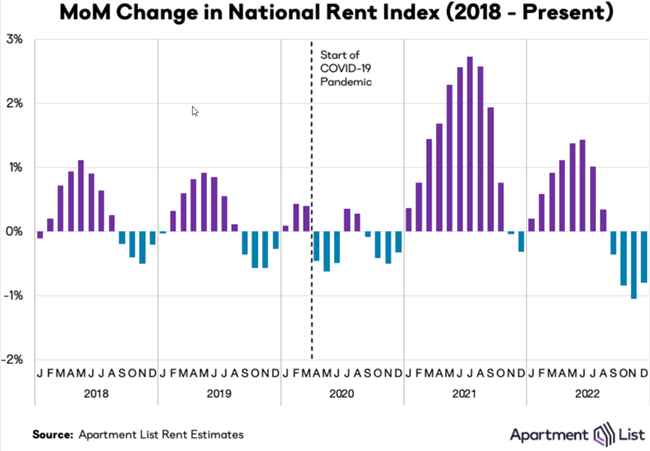
National rents dropped 0.8 percent in December, the fourth straight month of decline.
The national month-over-month rent change is plotted in the chart here, shows how this winter’s price declines are steeper than those of previous years, the report says.
“We expect that 2023 will see bargaining power shift back to renters, and that rent prices this year will grow only modestly, if at all,” the Apartment List research team writes.
“The recent slowdown has been geographically widespread. Rents decreased in December in 90 of the nation’s 100 largest cities. New York City saw the nation’s sharpest decline, with prices down by 3 percent month-over-month.
“And over a longer horizon, we are continuing to see an ongoing cooldown in many of the recently booming Sun Belt markets. Las Vegas, Phoenix, Jacksonville, and Riverside all rank in the top 10 for fastest rent growth since March 2020, but none of these metros has seen rents increase by more than 1 percent over the past twelve months.
Vacancy rate continues to rise
The cooldown in rent growth is being mirrored by continued easing on the supply side of the market.
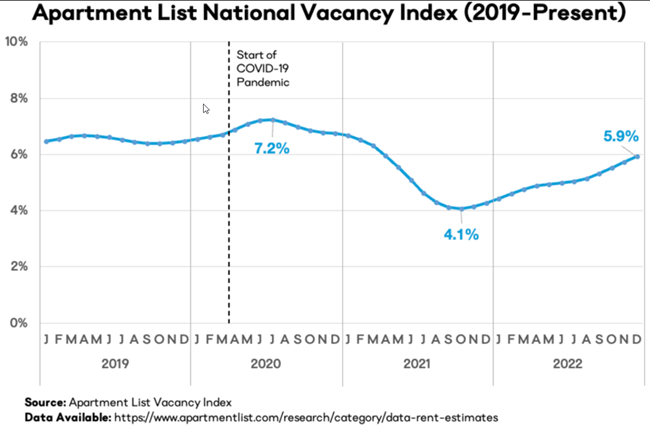
“Our vacancy index now stands at 5.9 percent, after more than a year of gradual increases from a low of 4.1 percent last fall. And in the past four months, this easing of the vacancy rate has picked up steam again, after plateauing a bit over the course of last summer.
“Today’s vacancy rate still remains slightly below the pre-pandemic norm, but is quickly approaching that benchmark,” the report says.
In the most recent four months from August through November, the vacancy rate has increased by 0.8 percentage points, reaching 5.9 percent in December 2022.
“After a prolonged period of skyrocketing rent growth, and with non-housing related costs also getting more expensive as a result of broad-based inflation, it seems that some Americans are moving back in with family or roommates, or delaying striking out on their own. At the same time, new apartment construction is picking up steam again after facing pandemic-related delays in recent years,” the report says.
Conclusion
“This seasonal dip is likely to persist through the winter, but as moving activity picks back up in the spring and summer, we are likely to see a return to positive rent growth. We expect that 2023 will be a year of flat to modest rent growth, but it is unlikely that prices will fall significantly throughout the year,” the report says.
Non-seasonal decreases in average asking rents are coming, Yardi Matrix says in a special multifamily rent forecast for 2023.
Yardi Matrix says interest rates that continue to rise, “will, eventually, take their toll on the job market, and rather than adding more jobs than economists expected every month, there will almost certainly be job destruction and the requisite pothole in household formation, leading to a non-seasonal decrease in average asking rents.”
Highlights of the report
“We now find ourselves at a juncture where more companies are pushing for at least a partial return to office,
Layoffs are broadly hitting the tech sector
Interest rates have been hiked dramatically
The single-family housing market is paralyzed
Yet the job market continues to beat consensus expectations almost every month.
“Household formation is intrinsically tied to job creation, so a robust job market fuels demand for housing, and conversely, a weaker job market depresses housing demand,” Andrew Semmes, Senior Research Analyst, writes in the report.
“Our view is that we are likely to start seeing job destruction and experience a recession beginning in the third or fourth quarter of next year, but that it will not be particularly deep or lengthy. At that point we will likely start to see broad declines or stagnation in average asking rents, but not enough to offset the gains that we expect in the first half of 2023,” Semmes writes in the report.
Rent Forecast for 2023 revised downward
Yardi Matrix has revised their 2023 forecast downward to 3.1 percent from 3.5 percent.
“We expect to see all of that growth in the first two to three quarters” of 2023, the report says.
“We have revised 2024 upward to 4.1 percent from 3.3 percent, as we expect economic growth to pick back up in the beginning to middle of the year.”
Yardi Matrix researches and reports on multifamily, office and self-storage properties across the United States, serving the needs of a variety of industry professionals. Yardi Matrix Multifamily provides accurate data on 18+ million units, covering more than 90 percent of the U.S. population. Contact the company at (480) 663-1149.
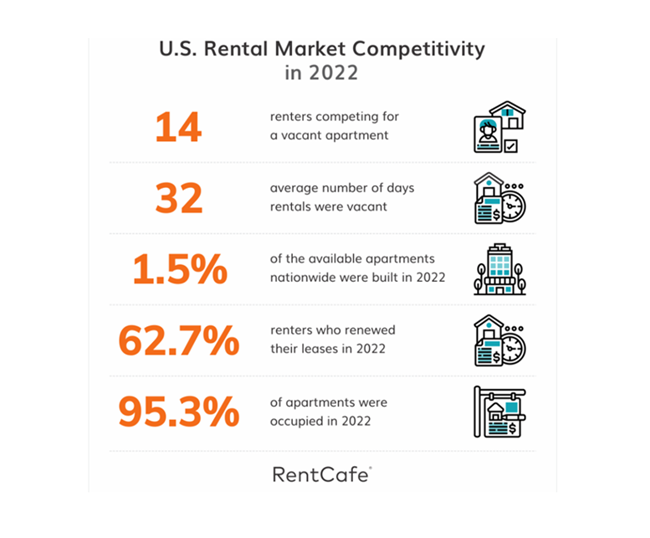
Almost two-thirds of renters renewed leases in 2022 in a market that’s still hindered by record home prices and surging interest rates, RentCafé says in their year-end report for 2022.
At the national level, vacant apartments were occupied within 32 days, on average and as many as 14 prospective renters competed to secure a lease for a rental apartment in 2022.
The reason so many leases were renewed is because 95.3 percent of apartments were already occupied, so finding a new rental was not easy in 2022 — especially because newly built units only represented 1.5 percent of the nation’s total housing supply, the RentCafe report says.
Where were hottest rental markets in 2022
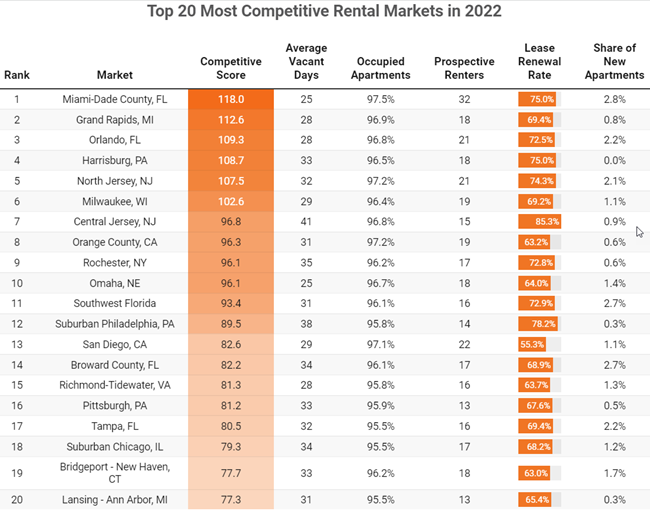
To find out the hottest rental markets in 2022 RentCafe.com analyzed the 135 largest markets in the U.S. where data was available. Specifically looking at five important metrics that affect a location’s competitivity:
the number of days apartments were vacant
what percentage of rentals were occupied
the number of prospective renters competing for an apartment
what percentage of renters renewed their leases
the share of apartments completed this year
Based on these metrics, “we calculated a Rental Competitivity Index (RCI), which shows how competitive the rental market was this year,” the report says.
The national RCI score was 59.9 in 2022.
The most competitive rental markets in 2022 scored over 100 out of 130.
“Boasting an RCI of 118, Miami was by far the hottest rental market in the U.S., due to record-high occupancy and high lease renewal rates. Here, a combination of factors — including the lack of state income tax, business-friendly climate and booming tech scene — attracted droves of millennials and even Gen Zers looking to work and live in the Sunshine State,” the report says.
Chart courtesy of RentCafé
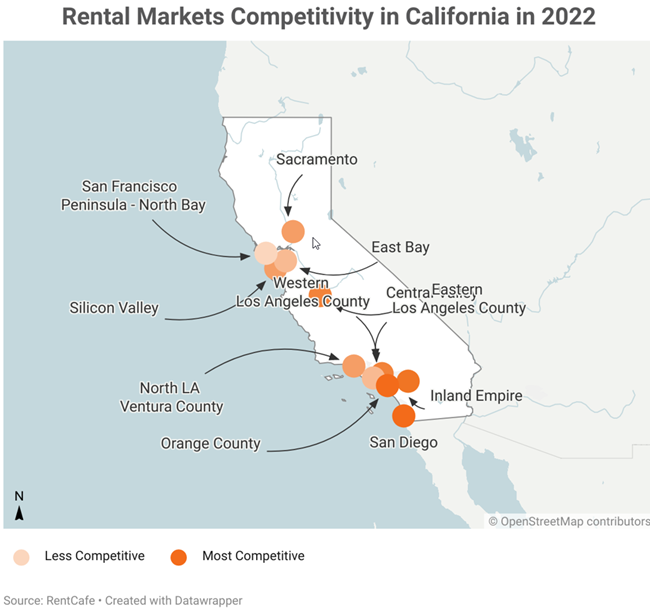
Low-supply Orange County is the hottest renting spot in SoCal
It’s no secret that the ever-increasing cost of living in Los Angeles and rising housing prices are pushing many renters to seek new homes in less expensive locations in Southern California — with a preference for apartments in Orange County. And, with a strong economy and diverse job pool fueled by the booming e-commerce sector, the OC is overheated due to low supply.
Another competitive location in SoCal was San Diego. Yet, despite consistently being ranked as one of the most expensive places in the country, it’s still not as expensive as Los Angeles or San Francisco. Notably, the median age is around 35 and high-level job opportunities abound in high tech, education, research, military, defense and health care.
As we close out the year, the Apartment List research team has rounded up a summary of the key rental market trends that defined 2022 and those expected to define 2023.
Here is a look at national trends, regional trends and key themes for 2023 to help make you more informed about 2023.
No. 1 – Rent growth comes back to earth
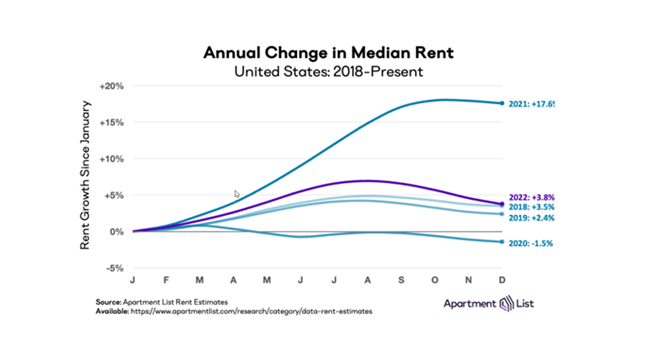
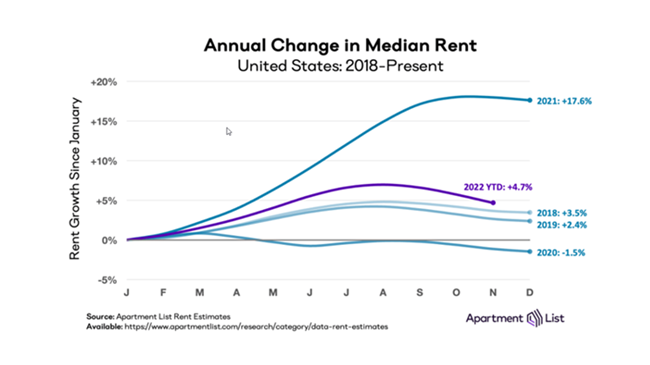
In the first six months of 2022, rents increased by 5.5 percent nationally, a growth rate that represented a notable slowdown from the 2022.
But in the back half of the year half of this year, rent growth has cooled even further, and apartment prices have now actually been falling since August. It’s typical to see a dip in rents in the fall and winter, when fewer renters are looking to move, but it appears the recent decline is reflecting more than just seasonality.
No. 2 – More options for renters
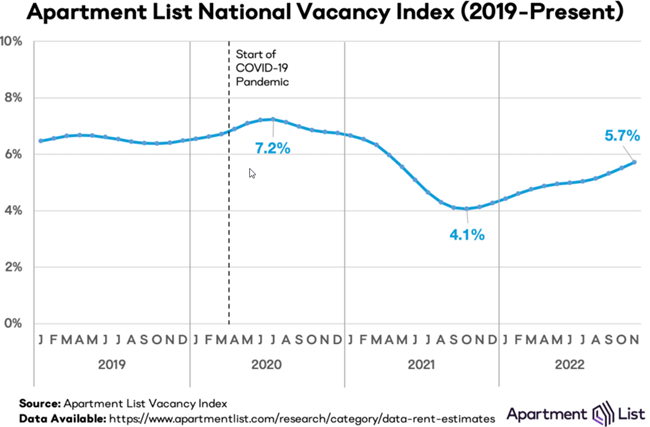
The vacancy index has been steadily ticking back up, meaning that more supply has been coming available.
In recent months, the rate of supply easing has picked up steam.
For renters looking to move, this means they should now see more options and less competition than at the outset of this year.
Chart courtesy of Apartment List
No. 3 – Lack of household formation drives cooling demand
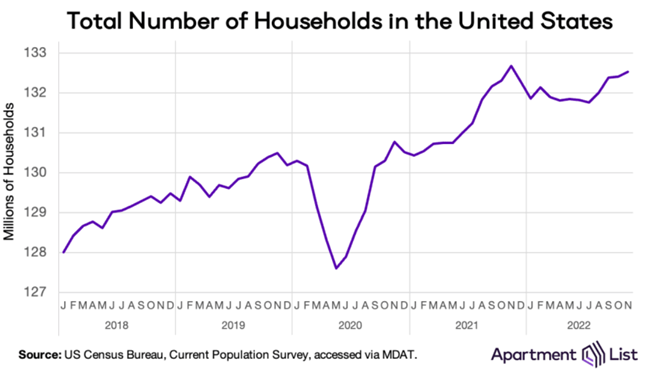
During the pandemic, especially in the early months, there was a sharp contraction in the number of households as people moved in with family and friends.
By late 2020, most of these households had re-formed, and that was followed by a surge in new households in 2021, as Gen Z struck out on their own and roommate households broke apart to find their own places. In just a year and a half, the number of households in the U.S. increased by more than 5 million, from a pandemic low of 127.7 million, to a peak of 132.7 million in November 2021.
However, in 2022, new household formation has been relatively flat. As of last month, the total number of households stood at 132.5 million, down by 143,000 compared to last year’s peak. It appears that renters are exhibiting much more caution in striking out on their own, as higher housing costs and general inflation have eroded their budgets, and as fears of a potential 2023 recession loom large in the public’s economic sentiment.
No. 4 – The Sun Belt boom stalls out as the Midwest picks up steam
After the spike in Sun Belt rents, the Midwest may now be the nation’s last bastion of rental affordability, and seems to be drawing interest from price-conscious and geographically flexible renters.
The St. Louis, Indianapolis, Kansas City, and Cincinnati metros all rank among the top 10 for fastest rent growth in 2022. Rent growth in each of the markets has been slower this year than it was last year, but this is largely reflective of the broad cooldown in the national rental market as a whole.
No. 5 – Early pandemic price convergence is still holding
Pandemic-era rent growth has been correlated with pre-pandemic rent prices, with affordable cities tending to see faster rent growth and more expensive ones tending to experience slower growth.
Because of this divergence in rent growth, the price gap between the nation’s most expensive cities and its most affordable ones has narrowed.
Take, for example, San Francisco and Phoenix – in March 2020, the median rent in San Francisco ($2,556) was 2.5 times greater than that of Phoenix ($1,013); as of November 2022, that gap has narrowed to 1.6 times ($2,308 vs $1,421). This price convergence can be seen most clearly in Sun Belt cities, but as described above, this trend may now be extending to the Midwest as well.
From March 2020 through November 2022, the core cities of the nation’s large metro areas have seen prices rise by a total of 14.5 percent, on average. Over that same period, prices are up by 20.7 percent in the closest suburbs, 24.1 percent in the mid-distance suburbs, and 27.7 percent in the furthest suburbs.
The further you move from the urban core, the faster the rent growth. With many workers retaining at least hybrid remote flexibility, proximity to job centers has grown relatively less important, and this has driven a shift in preferences that continues to persist.
No. 7 – Renters back in the driver’s seat for 2023
“Looking ahead to next year, we expect that the most notable trend in the rental market will be a shift in bargaining power away from property owners and back to renters,” the Apartment List economists write in the report.
it’s important to note that “the trajectory of the market next year is largely dependent on broader macroeconomic conditions. If the economy were to experience a recession next year, it’s possible that rents could decline meaningfully (though even then, it’s highly unlikely that we’d see anything close to a return to 2020 rent levels).
“On the other hand, there have been recent signs that inflation is abating while the labor market remains fairly strong. If renter confidence bounces back and demand improves, rent growth could be faster than anticipated.”
No. 8 – Remote work faces its biggest test in 2023
In 2023, we’ll also have our eye on the next chapter of the remote work revolution.
Remote work remains prevalent, especially hybrid arrangements. Recent research suggests that 29 percent of workers currently have hybrid working arrangements in which they work from home on some days and go into the office on others, while 13 percent of employees work entirely from home.
If these levels of remote work persist in the long term, it could have significant implications for the housing market.
In a recent survey, 44 percent of workers with full or hybrid remote flexibility told us that they’re planning to move in the upcoming year, compared to just 28 percent of on-site workers.
As office leases expire, many companies may significantly downsize their footprints and redesign their spaces to better suit a hybrid workforce. This would have significant implications for the commercial real estate market, as well as the broader economic outlook for the central business districts of major cities.
However, it’s also possible that in the case of a recession or even just a weakening of the labor market, executives who are skeptical of remote work could leverage increased bargaining power to force workers back to the office full time.
“In any case, by the end of 2023, we should have a clearer picture of the long-term future of remote work and its implications for housing,” the Apartment List report says.
No. 9 – Official estimates of housing inflation will reflect the cooling “that our index has long been showing”
The 2023 prediction “that we have perhaps the highest confidence in is related to the highest profile economic storyline of 2022 – inflation. As we’ve noted throughout this report, our rent estimates have shown that the market has been consistently cooling off throughout the past year.
“We expect that the official measure of housing inflation will turn a corner in the first half of 2023 and begin to gradually fall.
“Thankfully, the topline inflation numbers have already started to cool off, even with the housing component still keeping CPI (Consumer Price Index) propped up. Next year, when the CPI’s housing measure begins to reflect the rapid cooldown in the rental market that we see in our index, it should contribute to further moderation of inflation overall.” The economists write.
Conclusion
“As we close out the year and look ahead to 2023, the rental market is showing some positive signs for renters.
“Rent prices are now dipping after a year and a half of record-setting growth. And with a record number of new apartment units in the construction pipeline, 2023 will bring more options for renters than they’ve had in years.
“As new supply meets cooling demand, renters may finally have the upper hand in the market, while property owners will be the ones competing to fill their vacancies.
“That said, the broader macroeconomic environment remains somewhat uncertain, and that backdrop will be a key factor in determining the trajectory of the rental market in 2023,” the Apartment List economists write.
The Apartment List Research Team is a small but mighty group of economists and analysts dedicated to understanding the rental market as it evolves rapidly. On our blog we publish original research reports and offer robust data products for public use.
California became the world’s largest legal marijuana market. When pot is legal in a state, what issues does this present to property managers and landlords of rental properties? Can a property manager say “no pot in my apartments.”
By John Triplett
Rental Housing Journal
Property managers are often confused and seeking to better understand how to handle the issues of legal marijuana and medical marijuana when it comes to tenants and rental housing in their states.
Laws are changing all the time in many states, just as California did on January 1, 2018, as voters approve different levels of permission when it comes to marijuana. This leaves property managers trying to figure out what should be in their leases around the issue.
You may be able to ban smoking, but do you really know what your tenants are eating or growing in their apartments? Do you really want to know if they are good paying tenants?
Rental Housing Journal did an interview with Seattle, Washington attorney Bret Sachter, an expert in tracking the progression and transformation of marijuana laws, to discuss some common questions property managers have about marijuana and tenants.
“I’ve been asked this a lot,” Sachter said, “but it does not come up as often as you might think. The overarching issue here is that, with few exceptions, people can do what they want to protect their property, even if the prohibited behavior is not illegal. You can prohibit smoking, prohibit pets, but with marijuana it’s much easier because it is federally illegal. So you can pretty much prohibit it if you want to no matter what, even medical marijuana,” Sachter said.
4 questions about pot, tenants and apartment leases
Sachter says in terms of Fair Housing issues, and the U.S. Department of Housing and Urban Development (HUD) it is a situation where HUD wants it in the lease that marijuana is illegal but enforcement is another issue, he said. It is not so much that HUD wants landlords to evict over marijuana, but that you have something in the lease language that allows for eviction in the instance of marijuana use on the property. “So it is pretty clear as far as HUD is concerned,” he said. Here are his answers to four questions on pot and apartments.
No. 1 – Tenants with a disability and medical marijuana
Question: If a tenant comes in and says I have a disability, here is a note from my doctor, I use medical marijuana, which is legal in this state, and I want to rent your apartment. Can a landlord prohibit that?
Answer: “A landlord can absolutely prohibit that because marijuana is illegal under federal law.” The landlord can say, “I understand our state allows medical marijuana but as it is still a Schedule 1 drug and I prohibit it on my premises.”
No. 2 – Marijuana is legal in my state – but what does the lease say?
Question: What if a tenant says marijuana is legal and they should be allowed to use it?
Answer: “If your lease prohibits smoking and prohibits use of illegal drugs, then the legality of marijuana at the state level is irrelevant because under federal law marijuana is illegal. If your lease does not have those types of clauses, you should talk to an attorney in your state or city to find the best solution for your lease.”
There is no law about reasonable accommodation for marijuana users, federal laws do not require it. As far as the federal government is concerned it is not ok.
“One thing I would say, and it is important, I would encourage landlords just to make everything clear,” in the leases, he said. “Clarify in a lease that you must abide by all laws state and federal.”
That is the case in residential. He said it can be different in commercial. (There was a commercial case in Oakland, California and you can read more about it here.)
“But In residential it is not as tricky, and I am speaking very generally here,” Sachter said. “The states may have their own thing going on with legal marijuana laws, but it is still federally illegal. Make it crystal clear in your leases is my best advice,” he said. “How can you attract tenants in a state where it is legal yet protect the owners of the property? You cannot have it both ways.”
“I know in Seattle there are Airbnb bed and breakfasts that specifically market themselves accordingly, as part of marijuana tourism to come and stay in our place where it is legal.” But if a property manager doesn’t want that going on, then they have to be up front in the lease.
“If your tenant is Airbnbing to a tenant who is then using marijuana – well if you can’t catch them you cannot do anything about it. You have to prove they are doing this. They are going to be using marijuana regardless of what the lease says.”
No. 3 – What if the tenant using marijuana is a well-paying, good tenant?
“Landlords can certainly put a no-waiver clause in the lease. If I say, ‘Here is a list of prohibited things’ and if you do these prohibited things in the lease, you are subject to eviction,” he said.
“However, any time I waive any of these things does not constitute an overall waiver. It basically means you should not ever do it again,” he said. “Just because you get away with it once, does not mean you get away with it every time,” Sachter said.
“Landlords can certainly put a no-waiver clause in the lease. If I say, ‘Here is a list of prohibited things’ and if you do these prohibited things in the lease, you are subject to eviction,” he saidPhoto by Raihan Rana via creative commons
No. 4 – Can I say ‘no pot in my apartments?”
“Usually if you say, ‘No pot in my apartment’ and you find a tenant using marijuana and you haul them into court, more than likely the judge is going to say, ‘Have you stopped?’ to the tenant and ‘Are you going to do it again?’ and the tenant is going to say ‘No.” And then judge will say, ‘Ok, dismissed.”
To put a more legalistic term on it, usually a court will be in favor of “allowing the tenant to cure the defect,” rather than evict for most things like that, Sachter said.
Technically, in Washington, a landlord would serve a 10-Day notice to comply or vacate with the terms of the lease. This process, therefore, gives the tenant a chance to “cure” the violation before the landlord can evict. Check your local state laws on this.
What one experienced property manager says about pot
Sam Driver, Product Director for Buildium.com, and an experienced property manager at the property management software company, said as far as marijuana use in apartments, due to the newness of the legislation, the federal laws that supersede state and county laws, and liability concerns, it is not a topic that comes up a lot – yet.
“Generally, the safest solution is to choose the most conservative path-impose a no-smoking policy, which can in some cased cover outside areas, and a crime provision that includes local, state and federal laws. In many states, there are setbacks from doors, and it is particularly important if the building is a place of work which a multi-unit apartment building certainly is. So your lease should contain a provision explicitly banning smoking and illegal activity. Because the feds still outlaw it, this should be sufficient,” Driver said.
“This of course only covers the smoking angle. If a resident consumes it in another way, you’d likely never know,” he said.
Growing marijuana could put a power load on your apartments
“As for growing, that’s less clear. But in general, unless the electrical system is designed for it, the loads grow lights put on the apartment unit could be excessive. I’d consider a reasonable use clause that specifies all high load equipment, including lights, air conditioners and any kind of pump be approved by you tramadult.com.
“This would put you in a position to take action if they are putting too much load, without specifically calling out the use of the equipment. Pumps are a good area for monitoring, because of the intermittent load, they trip breakers, and anyone who is using a hydroponic system would need several,” Driver said.
What if I want to market my apartment to marijuana users?
“If, however, you wanted to roll the dice and market to this crowd, assuming your state laws allow it, remember that the federal laws would cover any bank deposits from proceeds,” Driver said.
“In this case, you’d be able to do it, assuming no federal intervention, in compliance with local laws. No insurer would provide EO&E (errors and omissions excepted) insurance to you, and you wouldn’t be able to deposit any funds into a federally-accredited bank. So you’d have to self-insure, and run an entirely cash business, but you could do it, risking only federal enforcement.
“The big question is, ‘Would the premium rents be worth the risk of forfeiture?’ If you run afoul of the federal drug laws, the asset seizure possibility is a huge risk. You could lose the building.
“If you’re managing other owners’ properties, then you’d be risking their assets even if you used different leases, unless you kept fully separate books, bank accounts, and co-mingled nothing. So I’d say it would be all-or-nothing,” he said.
“The timing is tricky, too. Leases contain a provision that stipulates that the contract is in force in a specific jurisdiction. If they change the laws rendering your lease out of compliance, what happens during the remaining time of the lease? Is it invalidated? Or does the contract remain in force until it expires?
“Good questions for your lawyer,” Driver said.
How to keep up with status of pot laws in the different states
ProCon.org, a 501(c)(3) nonprofit nonpartisan public charity, provides professionally-researched pro, con, and related information on more than 50 controversial issues from gun control and death penalty to illegal immigration and marijuana laws across the country. “Using the fair, FREE, and unbiased resources at ProCon.org, millions of people each year learn new facts, think critically about both sides of important issues, and strengthen their minds and opinions,” according to the company’s website.
Here are where the pot laws stand for medical and recreational marijuana in several states, how it was passed, and what is permissible in the possession limit, according to procon.org. You can see their excellent full chart here state by state. Keep this link as they update the ever-changing pot laws in the different states.
Can I Say ‘No Pot In My Apartments’ When It’s Legal
Here are what some some states are doing with links to more information on each state’s pot laws.
Oregon: Ballot measure 67, 24 oz usable; 24 plants, 6 matures and 12 immature
Photo credit up top Natan Bolckmans via istock.com
About Bret Sachter:
As a Presidential Scholarship recipient, Bret received his law degree from the Seattle University School of Law. In addition to his law degree, Bret holds a bachelor’s degree in evolutionary psychology and master’s degree in psychology. Bret has taken an interest in tracking the progression and transformation of marijuana laws, as they are among the most recent and highest-profile legal issues affecting entrepreneurs in Washington and, increasingly, all around the country. You can call him at 206-295-2547 or visit his website here.