Home Blog Page 177

Millennials’ Expectations Driving Maintenance Changes

A study by a new company found millennials’ service expectations in apartments and rental homes are driving changes in both property maintenance and maintenance staff and the tools used to perform their jobs.

By John Triplett

High turnover in the maintenance ranks is a problem in multifamily housing, especially among millennial maintenance personnel. They like easy-to-use technology applications on their smart phones and not old paper-based maintenance processes. That is why the company, Facilgo, did the study to research these questions.

    • How do millennials’ expectations for faster maintenance affect property management maintenance organizations?
    • Are millennial maintenance personnel leaving multifamily due to the lack of technology solutions available in their day-to-day jobs?  What can be done to retain them?
    • What strategies are companies using to make their maintenance processes more efficient?
    • How will these new strategies help retain millennial maintenance personnel and satisfy millennial residents?
    • What will happen if companies don’t do anything to cater to millennials’ needs?

In an interview with Rental Housing Journal, Ken Murai, founder and CEO of FacilGo said, “There is a greater degree of expectation that we respond faster, we communicate better, and we get things fixed quickly.

“And if we don’t, then they’re going to shout from the mountaintops through social media to let us know about that, and that’s really putting the pressure on making sure that we do a good job the first time,” Murai said.

Fighting turnover among millennial maintenance employees

“There’s so much turnover in the maintenance ranks right now that executing company processes needs to be really easy for staff to do.  In fact, they almost need to be trained as a part of doing the process.

“Paper and pencil and running back to the maintenance shop to log something on the computer, it’s just not going to cut it,” Murai said which is why he founded the company.

“The thing I’m hearing from a lot of the larger owners whenever we talk about maintenance and turnover, is that staff turnover is so high and that makes them frustrated. The thing that’s really astounding is that they’ll hire someone  and train them but after  six months,  they’ll quit and move to a different industry because the work environment is paper-based. They’re using their phone for social stuff, communicating, entertaining, getting things done, and then they get to their job and they’re handed a clipboard. It’s really demoralizing and frustrating for them,” he said.

Millennials’ expectations driving maintenance change

To be a successful and continual improve, there needs to be “support for the entire process from start to finish. You need to use mobile devices or computers within the process to capture pictures and comments in order to get the job done,” Murai said.

“Use that documentation to communicate with your residents because it’s not just fixing the problem that’s important. You have to fix it and communicate well about it, or else nobody’s going to be happy,” he said.

“The problem that we’re seeing with other solutions out there today is that they may solve one piece of the puzzle. If you don’t build a process that leverages one step to the next, it becomes disjointed and is tough. You’re having to redo things and not do things efficiently. Even if you stitch together a bunch of solutions, it will be far from optimal. Even if you usie one of the large property management solutions and they have some of the functionality needed to manage maintenance, they still may lack the ability to “help” your employees follow your process from one step to the next; it’s  still a problem.

Lack of innovation was most surprising find in the study

Murai said the most surprising lesson from the study was “the lack of innovation.”

“After I left Realpage and was doing other consulting work, I hadn’t paid attention to all the different efforts that were happening with maintenance and procurement systems. When I was asked to look at the maintenance and procurement market once again, I saw that there really hadn’t been much evolution in the systems since I left the space.

“I think we’ve seen a lot more evolution on the leasing side of the business, but on maintenance and operations, it’s been a part of the business that has been left behind. There is so much more that can be done. In FacilGo®, we have a great system, and we’re finding that by supporting the entire operational process, we can really help people get things done more efficiently and get the right things done.”

Most maintenance transactions are service related

Millennials Expectations Driving Maintenance Changes

“What I found from analyzing multifamily data is more of the transactions are service-related than product-related, especially for turns,” Murai said.

“We’ve built our platform to work with services in a way that other platforms do not.

“For example, with floor covering, we handle not only scheduling the service, but also include pricing, your negotiated price per square yard, your floor plan measurements, the amount of carpet  needed for a given floor plan by room,  seaming diagrams, and you can order by the room with accurate measurements rather than having to do a full replacement. Everybody else does estimates. We have your company’s flooring information accurate, down to the room,” he said. And the applicable flooring can be purchased directly through his company’s app. “We have a mobile-enabled website and  a web application. So, we have everything you need, wherever you need it, to get the job done.

Describing his pricing, Murai said, “Our pricing model is  unit-based pricing, and very dependent on what solution modules our clients utilize.  Some solution modules can be used very cost-effectively, or you can use our entire suite.

“We have several mid-sized multifamily and single-family home customers, and we’re actually on track to start part pilots with several larger multifamily customers this quarter. We also have some of the largest suppliers in the industry on the platform,” Murai said.

Question and answer with Ken Murai

Q: How do millennials’ expectations for faster maintenance affect property management maintenance organizations?

A: Our challenge is to get maintenance issues solved more quickly and efficiently than ever before.  If not, we are going to hear about it on social media.  How do you speed up you processes and improve communication with your residents?  You need to have the people and tools to help you track, document, assign, and get the right products/services/work done, and you need to help them collaborate.

“People need to know what to do, when and how, as well as get access to the right help when the time is appropriate.  Instead, maintenance staff often spend a lot of time figuring out what they need to do or buy.

“This is heightened when you have new employees, since they don’t know what to do.  By providing them with tools that guide them to work with the right people, buy the right things, document problems and solutions with pictures, etc. it will help them get the work get done faster.

“They’ll be able to get help from vendors or other staff, leverage past solutions, plan for the future, and ensure that customer issues are not lost or fixed too slowly.  In addition, you’ll be able to provide better communication with your residents.  Remember, it’s not just the solving of the problem that matters, but also the communication of the resolution.

Millennials Expectations Driving Maintenance Changes

 Q: Are millennial maintenance personnel leaving the multifamily industry due to the lack of technology solutions available in their day-to-day jobs? What can be done to retain them?

A: Millennials use their phones to socialize, communicate, entertain themselves, and get things done.  Millennials are the top smart phone users with Facebook, Facebook Messenger and YouTube (according to Nielson) being the top 3 apps.  The Bank of America Trends in Consumer Mobility report interviewed 1,000 adults and found that smartphones were more important to millennials than deodorant.  These devices are an integral part of millennials’ daily lives.

In speaking to various management companies, we have anecdotally heard that many recently hired millennials quit their jobs to move into jobs in other industries.  Why?  Because, they were frustrated by the lack of tools on their smartphones that the property management companies provided to get things done.  They hate using paper and property management is full of paper processes. Who is going to hire them in the future based upon their expertise in running a paper based process?  As a result, the millennial workforce will continue to migrate to other industries that have tools that allow them to do their jobs more efficiently unless we as an industry evolve.

As a starting step, many companies are starting to adopt “bring your own phone policies.” While this means that pictures and texting are being used for communication and tracking, the lack of integration of this information into their property management systems means that information is isolated, collaboration is difficult, and tasks are left undone.  In other words, it’s a good baby step, but this like any other siloed system doesn’t provide nearly as much help as a collaboration platform.

 Q: What strategies are companies using to make their maintenance processes more efficient?

A: The best companies are focusing on supporting an entire business process instead of providing point solutions that help solve a sliver of that process. That means they need to be able to support multiple processes (not just ordering or invoice processing or inspections or work orders).

For example, one company we spoke to talked about using an application to do due diligence inspections. At the end of the process they had a lot of great pictures and data, but then didn’t know what to do next, since the data resided in their app, and didn’t support any of their other processes or work with their property management system.

The most efficient companies are using software platforms that support the entire maintenance process where they collaborate with their staff and suppliers, and leverage past data to make the process more efficient.

Inspections lead to work orders, quote requests or orders and everything is tied together.  Being easy-to-use, they require less training and support, and guide the staff through the process.  So, you’re getting the benefit of requiring little training on the application and the process!  That’s something that not just millennials want, but all people in the organization.

Another comment on mobile.  Given that real estate is a distributed operation, mobile applications are required so people can get the work done at the location where the issue exists.  With mobile, staff and suppliers are able to record notes, take pictures and record them in a system where the information can be shared, trigger additional actions and used for reporting.

Some of the baby steps we are seeing companies take are policies that allow staff to text each other and their vendors with messages and pictures.  It’s a start, but the information is isolated on a person’s phone and isn’t leveraged for future actions by the entire organization.

We’re also seeing some companies adopt virtual turn boards using Google Spreadsheets or Microsoft Sharepoint.  Again, it’s a great solution that solves one piece of the pie, but often falls short around updates and scheduling.  We believe that it’s most efficient to have virtual turn boards that tie into your turn schedule, inspections, work orders, quotes, contracts, orders, and invoices, which allows you to support your entire process.

We’ve also seen a trend for companies having maintenance personnel handle more units than before and they aren’t necessarily outsourcing more work to vendors.  Unless they provide tools and software that makes them more efficient, they will both slip on their quality of service and lose residents.

We’ve also seen some outsourcing tasks to key vendor partners, but those who are doing so tend to be smaller property management companies with smaller properties.

 Q: How will these new strategies help to retain millennial maintenance personnel and satisfy millennial residents?

Millennials Expectations Driving Maintenance Changes

A: Nielsen reports that 97-98% of millennials have smart phones. They are using them for social media, messaging, YouTube, maps, search and more.  They are constantly on their phones and can’t stand using paper or the dusty old PC in the maintenance shop.

“If you are thinking of allowing them to use their phones to text and take pictures, just remember that if their phones are not connected to the rest of the property maintenance platform, they’re going to have to use some paper and transpose that data into a computer.  It’s wasteful, they know it, and it’s frustrating.  Plus, it doesn’t help them gain the skills to help them be competitive with future jobs.

By using mobile and web software that helps support the entire maintenance process, you’re able to help your staff get things done faster and more efficiently and communicate much more effectively.  Who doesn’t want have the satisfaction of getting things done.  And, if they’re happy, they’ll stay.

 Q: What will happen if companies don’t do anything to cater to millennials’ needs?

A: Millennial staff become frustrated when using antiquated methods.  Tools that support their entire process and help them collaborate not only allow the maintenance personnel to have more job satisfaction, they are more efficient, collaborative and social, and learn faster.

Just using their phones is the first step, but being able to use their phones to work with existing processes is what they are looking for, and what will keep them from running away to other industries that use more technology.  Continuous improvement leveraging tools is key to retention

 Q: How does FacilGo® help property management companies and their suppliers not only operate more efficiently, but also help improve maintenance personnel’s job satisfaction?

A: “FacilGo® is built to support the entire turn and maintenance process from when you identify a problem, figure out how to solve it, get the work done (with internal or external staff) and order parts, process the invoice and payment, and then charge back residents.

“We believe that a platform must do more than one step of a process. In fact, your software should leverage one step of the process to help you with the next step, so your staff does the right thing quickly and efficiently.

“ We find that companies initially adopt some of our easier-to-implement solutions like inspections and move out closing statements, then start adding on work orders, contract management, procurement, invoice processing, fixed asset, and inventory management.  We also have functionality such as budgets, supplier ratings, job cost and CAM charges, so we offer a very robust set of features and functions to support your operations and maintenance processes.”

About Ken Murai

Ken was the Vice President of Product Development and Client Management at OpsTechnology, where he was responsible for designing and developing the OpsTechnology product and oversaw its client management team from initial deployment to acquisition by RealPage and beyond. Ken has experience creating procurement organizations and managing strategic technology initiatives for executive teams in the multifamily industry. Ken graduated from the University of California, Davis with a B.S. in Electrical Engineering, and an M.B.A. from the University of California, Berkeley, Haas School of Business. He has been working in the technology industry for 25 years, in areas including product development, sales, marketing and management.

About Facilgo

FacilGo® provides a solution to property management organizations who are frustrated by their turn and maintenance processes. Our property maintenance platform and private marketplace streamlines operations and saves money by offering an integrated inspection to invoice process through which you manage your turns and maintenance processes. Unlike other software that provide piece-meal solutions, FacilGo® offers an integrated process where your staff is presented with what to do and buy based upon their inspection and work order results. Instead of spending time figuring out what to do, staff can spend time collaborating with suppliers to get things done.


 

Lying About An Emotional Support Animal In Utah May Become A Misdemeanor

Lying About An Emotional Support Animal In Utah May Become A Misdemeanor

Utah lawmakers are close to passing legislation penalizing renters for lying about owning an emotional support animal, according to reports.

The lawmakers say the legislation is for the benefit of both landlords and people with legitimate disabilities, but disability groups say the legislation could be intimidating to people who legitimately need an emotional-support animal in their residence.

The Utah House has passed the bill to make it a misdemeanor to falsely claim to a landlord that a tenant has an emotional-support animal; it has received favorable recommendation in the Utah Senate.

The bill, HB43, was proposed by Rep. Jim Dunnigan, R-Taylorsville, and makes a clear distinction between service animals and emotional-support animals.

According to Dunnigan, there is no penalty under the current law for a tenant falsely claiming to a landlord that he or she has an emotional-support animal, and this bill changes that.

“It’s becoming a problem, I’ve heard a lot from service-animal owners that the people with emotional-support animals are kind of damaging their brand, because more and more people are saying, ‘I qualify for an emotional-support animal, you need to rent housing to me,’ when they do not,” Dunnigan told KSL.com.

The bill’s primary function would be to impose criminal penalties on people who seek housing and lie about having a medical need for an emotional-support animal.

Under current state law, people who lie about having a “service animal” can be charged with a class B misdemeanor, but no such penalty exists for “emotional-support animals.”

Disability group sees problems with the legislation

Ogden-based disability advocacy group Roads to Independence sees problems with the bill.

“They say that it will be used as a deterrent, but our concern is that deterrent, if you want to call it that, is intimidation,” said Roads to Independence Director Andy Curry during a public hearing before the Senate Health and Human Services Committee, according to the St. George News.

“When you do intimidation, you’re catching the whole gamut of people,” Curry said. “You’re catching the people that have the disability and you’re catching people that don’t.”

Curry suggested that there are alternatives to taking a law enforcement approach, such as awareness training for landlords.

Andrew Riggle, a public policy advocate with the Disability Law Center, also spoke in opposition to the bill.

“As part of our fair-housing work, the DLC takes hundreds of calls and represents hundreds of clients every year facing barriers to their ability to live independently,” Riggle said, according to the newspaper.

“Clients with support animals are people with debilitating anxiety, PTSD, postpartum depression, bipolar disorder or severe depression,” he explained. “These people need their support animals so badly that many of them would be unable to live independently without (them).

“These people, real people with disabilities with real needs, face denials of their requests for accommodation every single day.”

Riggle said people making fraudulent claims about service or support animals are “exceedingly rare” in the experience of the Disability Law Center, arguing that legislation of this nature would just serve as yet another barrier to these people seeking living accommodations.


Resources:

Lawmakers advance bill penalizing people for lying about emotional support animals

Bill to make lying about emotional support animals a misdemeanor passes in Utah House

Bill to make lying about emotional support animals a misdemeanor passes in Utah House

NMHC Multifamily Housing Quarterly Survey Shows Little Overall Change

NMHC Multifamily Housing Quarterly Survey Shows Little Overall Change

A majority of industry leaders cite tariffs as a cause of higher costs as a survey shows apartment market conditions were mixed in the National Multifamily Housing Council’s (NMHC) Quarterly Survey of Apartment Market Conditions for January.

The Market Tightness (46) and Equity Financing (50) indexes showed little change in those conditions from October, while the Debt Financing Index (59) showed improving conditions. By contrast, the Sales Volume Index (33) showed further slowing in property sales, according to a release.

Notably, a significant majority of respondents found that recent tariffs have driven up costs across the board and in a variety of markets throughout the country.

“While the four indexes each changed somewhat over the last quarter, overall market conditions remained fairly static. Debt-market financing conditions improved somewhat over the last three months,” said NMHC Chief Economist Mark Obrinsky in the release.

“By contrast, equity-market financing conditions are little changed, as considerable capital continues to seek investment in the apartment sector.”

Highlights of the quarterly multifamily housing survey

NMHC Multifamily Housing Quarterly Survey Shows Little Overall Change

The Market Tightness Index increased from 41 to 46. Less than one-quarter (22 percent) of respondents reported looser market conditions than three months prior, compared to 13 percent who  reported tighter conditions. Nearly two-thirds (64 percent) of respondents felt that conditions were no different from last quarter.

The Sales Volume Index fell from 44 to 33. This continues the nearly unbroken declining sales volumes that began in October 2016. Slightly less than half of respondents (49 percent) reported lower sales volume from three months earlier, while almost one-third (31 percent) noted unchanged volume. Fifteen percent of respondents, on the other hand, reported higher sales volume.

The Equity Financing Index slid slightly from 51 to 50. Twelve percent thought equity financing was more available than in the three months prior, compared with 13 percent who believed equity financing was less available. For the eighth consecutive quarter, most respondents (62 percent) reported unchanged conditions in the equity market.

The Debt Financing Index rose from 22 to 59. About one-third of respondents (34 percent) reported better conditions for debt financing compared to the three months prior. Over one-third (39 percent) of respondents reported unchanged conditions, while 15 percent thought that conditions for debt financing had become less favorable.

Similar to last quarter, there was a general consensus that tariffs have driven up costs by some amount, but that tariff-induced delays (and especially cancellations) were less common. The majority (84 percent) of respondents reported higher costs due to tariffs (excluding the 26 percent of respondents who reported “Don’t know/not applicable”).

More specifically, 59 percent of respondents saw tariff-related costs rise by a little (less than 5%), while another 25 percent saw costs rise by more than 5%; only 16 percent did not observe higher costs from tariffs. Yet, well over half (61 percent) of respondents (excluding 37 percent who reported “Don’t know/not applicable”) indicated that tariffs had not caused them any project cancellations or delays. Almost a third (31 percent) reported that tariffs had caused delays but not cancellations, while 8 percent experienced both cancellations and delays.

About the Survey:

The January 2019 Quarterly Survey of Apartment Market Conditions was conducted January 15-22, 2019; 112 CEOs and other senior executives of apartment-related firms nationwide responded.

View the full data online.

Based in Washington, D.C., the National Multifamily Housing Council (NMHC) is the leadership of the trillion-dollar apartment industry. We bring together the prominent apartment owners, managers and developers who help create thriving communities by providing apartment homes for 39 million Americans. NMHC provides a forum for insight, advocacy and action that enables both members and the communities they help build to thrive. For more information, contact NMHC at 202/974-2300, e-mail the Council at info@nmhc.org, or visit NMHC’s web site at www.nmhc.org.


Republicans Ask to Amend Oregon Rent Control Bill In The House

Republicans Ask to Amend Oregon Rent Control Bill In The House
Senator Tim Knopp (R) Bend, Oregon

Republicans in the Oregon House of Representatives have asked to amend the Oregon rent control bill, Senate Bill 608, which has passed the Senate and is now up for consideration in the House, according to a release.

The Senate approved the bill over bipartisan opposition, 17-11, with Democrat Betsy Johnson joining with Republicans in voting against the legislation.

“The bill that will do renters more harm than good was whisked through the Senate Housing Committee with utter disregard for five amendments offered by Vice Chair Fred Girod (R-Stayton). A request to remove the emergency clause, allowing property owners time to prepare for the impact of the legislation, was denied,” according to the release from House Republicans.

“Oregon is piling on regulation upon regulation, which is essentially causing the problem, so the response to failed regulation from this chamber is to add more regulation,” said Sen. Tim Knopp (R-Bend) in the release.

“And when that doesn’t work, the response is going to be ‘we didn’t go far enough, we need even more regulation on the housing industry’. I think the most likely outcome of this bill is negative consequences for the very people the proponents of this bill want to help,” Knopp said.

“When the House Human Services Committee takes up SB 608 on Feb. 18, House Republicans hope the majority party will afford the bipartisan spirit promised in January. Only then will the intended beneficiaries truly be helped,” the Republicans said in the release.

What Oregon Senate Bill 608 Does

  • Prohibits a landlord from terminating month-to-month tenancy without cause after 12 months of occupancy. Provides exception for certain tenancies on a building or lot used by a landlord as residence.
  • Allows a landlord to terminate tenancy with 90 days’ written notice and payment of one month’s rent under certain conditions. Exempts landlords who manage four or fewer units from payment of one month’s rent.
  • Provides that fixed-term tenancy becomes month-to-month tenancy upon ending date if not renewed or terminated.
  • Allows landlord to not renew fixed-term tenancy if tenant receives three lease-violation warnings within 12 months during term and landlord gives 90 days’ notice.
  • Limits rent increases for residential tenancies to one per year.
  • Limits maximum annual rent increase to 7 percent above annual change in consumer price index.
  • Requires Oregon Department of Administrative Services to publish maximum annual rent increase percentage.
  • Declares emergency, effective on passage.


Apartment Maintenance Technician Jobs In High Demand In Portland And Seattle

Apartment Maintenance Technician Jobs In High Demand In Portland And Seattle

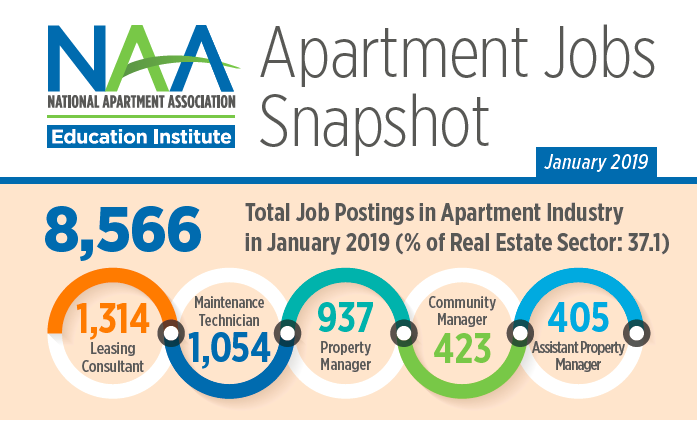
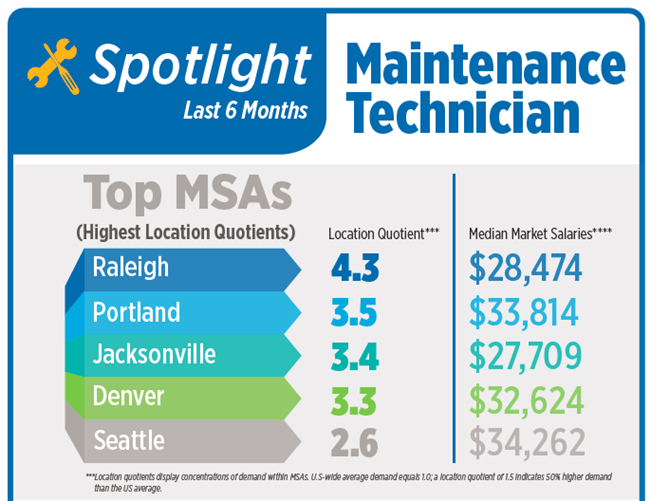
This month’s jobs report from the National Apartment Association (NAA) shows that apartment maintenance technician jobs in Portland and Seattle had the highest demand across the country.

The need for people to fill apartment-maintenance technician positions were more than three times the U.S. average in Raleigh, Portland, Jacksonville, Denver and Seattle, according to the National Apartment Association Education Institute (NAAEI) Apartment Jobs Snapshot January 2019.

Median market salaries for apartment-maintenance technician jobs was $33,814 in Portland and $34,262 in Seattle. Most jobs required only up to two years or less experience.

Apartment Maintenance Technician Jobs In High Demand In Portland And Seattle

Apartment Maintenance Technician Jobs In High Demand In Portland And Seattle

High number of jobs in rental housing

The apartment-industry labor market held its momentum from late last year into 2019, with apartment jobs representing more than 37 percent of job openings in the real estate sector.

Jobs available in the rental-housing industry rose from an average of 35 percent last year to more than 37 percent of the real estate sector in January.

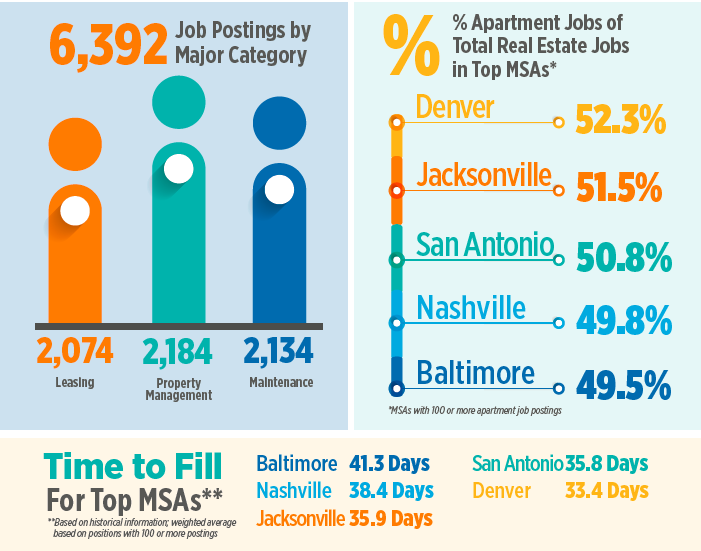
Days-to-fill were particularly challenging in Baltimore, where the unemployment rate fell to post-recession lows at the end of last year, and Nashville, which currently boasts the tightest labor market of major metro areas across the United States.

Apartment Maintenance Technician Jobs In High Demand In Portland And Seattle

Maintenance-tech skill set still highly sought as titles change

 The change in the proportion of job titles over the past five years is not only reflective of demand, i.e. the highly sought-after maintenance tech, but of recruiters providing more focused and appealing titles, the NAA report says.

The generic “apartment manager” has given way to “community manager,” while the surge of assistant property managers and maintenance supervisors reveals a clear career path within those sectors.

The greatest increases in skills desired for all types of positions included both specialized skills such as Yardi Matrix software, and soft skills, particularly writing and collaboration.

National apartment association jobs report background

 The jobs report focuses on jobs that are being advertised in the apartment industry as being available, according to Paula Munger, Director, Industry Research and Analysis, for the National Apartment Association’s Education Institute.

“Our education institute is a credentialing body for the apartment industry. They hear often that one of the biggest problems keeping our industry leaders up at night is the difficulty in finding talent, attracting talent and retaining talent,” Munger said.  “Labor-market issues are happening in a lot of industries, certainly with the tight labor market we have.”

NAA partnered with Burning Glass Technologies. “They have a labor-job posting database that is proprietary,” she said, and they can “layer on data from the Bureau of Labor Statistics (BLS). We looked at that and thought we could do something that is really going to help the industry and help benchmark job titles and trends as we go forward,” Munger said.

Customer Relationship Management In Multifamily Has Skyrocketed

Oregon Rent Control Bill Passes The Senate

Rent Control Still Not the Solution to Housing Affordability

The Oregon Senate has passed SB 608, a rent-control and evictions bill, which limits landlords’ rights in Oregon.

The Senate majority leader’s office released a statement after the bill passed, saying, “Rent stabilization will help prevent price gouging,” and that “healthy and thriving families need safe and stable housing.”

The bill is designed to help rein in soaring rental increases for working families across the state, according to the release.

The bill would eliminate “no-cause” evictions after tenants have completed their first year of occupancy. It also would cap annual rental increases for buildings more than 15 years old.

The bill was co-carried by Sen. Shemia Fagan, D-Portland, and Sen. Laurie Monnes Anderson, D-Gresham, on the Senate floor.

“Last December, I met an 83-year-old renter who was afraid to ask maintenance to fix her lights for fear of eviction or a rent spike,” Fagan said in the release. “She had lived in the dark for 3 months by the time I met her. SB 608 protects her and hundreds of thousands of Oregonians who deserve safe and stable rental housing.”

Oregon Republicans Say Democrats are Ignoring Affordable Housing Issue

The Oregon Senate Republicans issued a statement following passage of the bill, saying, “the majority party followed through on their promise to pass rent control early in session, without bipartisan support. SB 608, which will cap rent increases statewide, will lead to fewer available affordable housing units statewide.

“The overwhelming message during the public hearing on rent control was that there is not enough affordable housing in Oregon, yet this bill does nothing to address the real problem,” said Senate Minority Leader Herman Baertschiger, Jr., R-Grants Pass, in the release.

“If we actually want to address the issue of housing in Oregon, then it’s time to take a good hard look at the barriers in place that limit developing more affordable housing.”

“This bill will not accomplish the goal that the proponents have set,” said Senator Tim Knopp, R-Bend, in the release.  “The likely outcome from this legislation will be fewer affordable housing units, and increased rent throughout the state.”

The problem was created in Portland

The rent-control bill was written with urban Oregon in mind and does not offer any alternatives for rural or frontier communities, the Republican statement said.

“This is a problem that was created by Portland, and this legislation is designed for Portland,” said Senator Fred Girod, R-Stayton, in the release. “Instead of addressing the real issues here, this bill will only create more problems throughout the state.”

The bill would protect Oregon’s renters by ensuring they won’t face enormous, unforeseen rent increases or be kicked out of their homes after they’ve lived there for at least a year, according to the release from the Senate majority leader’s office.

“Safe and stable housing is a central requirement for healthy families to thrive and for children to excel in school,” the release states.

The bill prohibits landlords from terminating month-to-month tenancies without cause after one year of occupancy. Tenants would be entitled to 90 days’ notice of eviction and a relocation assistance payment in the amount of one month’s rent. Landlords with four or fewer units would not be required to make relocation assistance payments.

What Oregon Senate Bill 608 Does

  • Prohibits a landlord from terminating month-to-month tenancy without cause after 12 months of occupancy. Provides exception for certain tenancies on a building or lot used by a landlord as residence.
  • Allows a landlord to terminate tenancy with 90 days’ written notice and payment of one month’s rent under certain conditions. Exempts landlords who manage four or fewer units from payment of one month’s rent.
  • Provides that fixed-term tenancy becomes month-to-month tenancy upon ending date if not renewed or terminated.
  • Allows landlord to not renew fixed-term tenancy if tenant receives three lease-violation warnings within 12 months during term and landlord gives 90 days’ notice.
  • Limits rent increases for residential tenancies to one per year.
  • Limits maximum annual rent increase to 7 percent above annual change in consumer price index.
  • Requires Oregon Department of Administrative Services to publish maximum annual rent increase percentage.
  • Declares emergency, effective on passage.

Resources:

Oregon Senate passes rent-control bill

Oregon Senate Passes Statewide Rent Control Bill


How to Educate Tenants On Septic Systems

septic systems and rental property

How to help tenants understand septic systems and what it takes to maintain them to avoid problems is the maintenance checkup this week provided by Keepe.

If your rental property has a septic system, you must learn the warning signs that can save you and your tenants a lot of trouble – and expense.

Let’s explore the most common issues in septic systems and rental property that are likely to arise:

  • As a property manager or landlord, you are responsible for maintaining your building’s septic tank. Regular plumbing every three to four years, depending on your tank, is the key to maintenance to avoid premature failing of septic systems.
  • You can give your tenants a list of do’s and don’ts for what to put and not to put down the toilet or kitchen sink drain.
  • In addition, give tenants information on the common symptoms they might see when a septic tank is failing to ensure you can identify the problem quickly before more damage happens.
septic systems and rental property
Tenants should also avoid very long showers, use the washing machine no more than once a day, and refrain from excessive use of garbage disposals.

Drain Maintenance Habits

Do not put these items down a drain (including toilets, sinks, tubs and showers) since they can trigger a septic-system failure:

  • Baby wipes and diapers
  • Large amounts of food waste
  • Any kind of grease. When needed, use alternative cleaning solutions that are septic-safe (like vinegar).

Tenants should also avoid very long showers, use the washing machine no more than once a day, and refrain from excessive use of garbage disposals. Tenants should know to report any drain issues as soon as possible. Being aware of these bad habits can keep tenants informed and aware if any issues were to arise.

Most Common Signs of Septic Systems And Rental Property Failures

septic systems and rental property
Sewer smells can be an indication of an issue with the septic system.

Septic systems are fragile, and issues are bound to arise at some point. Be proactive by keeping an eye out for the most common problems that occur with septic systems:

  1. Backed-up toilet: An overflowing toilet might be a sign that your septic tank is failing, but in most cases, it’s easy to plunge or snake the toilet to drain any buildup.
  2. Sewer smells: Sewer odors are likely to arise if your tank is overflowing. Other reasons might be due to a pump malfunction, such as a transfer pump that has stopped working. In this case, you’d have to have the system inspected to verify the issue. Another reason for a smelly sewer could be due to frozen rank or outflow pipes. If the weather is cold in your region, your septic tank may have frozen. In this case, you would need your tank pumped.
  3. Drain cleaners: Drain cleaners such as toilet disinfecting products that sit in the tank and dissolve slowly might actually have a negative effect on your drain. Also, hazardous chemicals, paints, solvents, antifreeze, and other drain cleaners can have a similar negative effect. Encourage tenants to avoid using these products.
septic systems and rental property
Let tenants know where your septic field is so tenants can enjoy outdoor activities and plant gardens away from the area to avoid contamination.

Other Warnings

 As a property manager, make sure to communicate the status of your septic tank to tenants to avoid related septic issues such as the following:

  • Limited-capacity tank: If your septic tank’s capacity is limited, let your tenants know so they can limit how many guests they have during gatherings in the building.
  • Septic field location: Let tenants know where your septic field is so tenants can enjoy outdoor activities and plant gardens away from the area to avoid contamination.

Other recent rental property maintenance Keepe posts you may have missed:

4 Outdoor Flooring Options For Your Rentals

20 Easy, Affordable Maintenance Projects To Update Your Rentals

7 Tech Gadgets For A Safer And More Efficient Rental Property

5 Maintenance Tips For Long-Lasting Rental Carpet Flooring

Is The Water Heater At Your Rental Property Ready For The Big One?

7 Types Of Kitchen Countertops For Your Apartments

Which Cooktop Is Best For Your Rental Property?

A Guide To 4 Types Of Flat Roof Systems

6 Ways To Trash Your Apartment Waste Management Issues

About Keepe:

Keepe is an on-demand maintenance solution for property managers and independent landlords. The company makes a network of hundreds of independent contractors and handymen available for maintenance projects at rental properties. Keepe is available in the Greater Seattle area, Greater Phoenix area, San Francisco Bay area, Portland, San Diego and is coming soon to an area near you. Learn more about Keepe at https://www.keepe.com


Washington State Bill Would Make Washington Evictions Harder For Landlords

Evictions: They Are Not The Terrible Landlords Fault

Companion bills in the Washington State Senate, SB 5600, and the Washington House of Representatives, HB 1453, would support new tenant protections and make Washington evictions harder for landlords.

The Senate bill would make a number of changes to the Landlord-Tenant Act. It proposes to:

  • Extend the 3-day notice for default in rent payment to 14 days’ notice for tenancies under the Residential Landlord-Tenant Act.
  • Require the 14-day notice be written in plain language and include information on civil legal aid resources available, if any, to the tenant.
  • Extend the mandatory-notice period from 30 to 60 days when landlords propose a change in the amount of rent. Requires a landlord to first apply any tenant payment to rent before applying the payment toward other charges.
  • Prohibit continued tenancy and relief from forfeiture to be conditioned upon tenant payment or satisfaction of any monetary amount other than rent.
  • Provide the court with discretion to provide relief from forfeiture or to stay a writ of restitution.
  • Require a landlord to provide a tenant with documentation regarding any damages for which the landlord intends to retain any of the deposit amount.

Seattle tech companies support the Washington evictions bill

The general counsels of Amazon, Microsoft, Expedia, RealNetworks, and other Seattle-area tech companies have sent a letter to the Washington legislature and Gov. Jay Inslee supporting Senate Bill 5600 and its companion House Bill 1453.

“Simply stated, Washington’s eviction laws are a root cause of our homelessness problems, and we can take a significant step toward addressing them now – at minimal cost to taxpayers – by simply updating them in some common-sense ways this legislative session,” says the letter, a copy of which was obtained by GeekWire.

The Seattle region is experiencing a homelessness crisis, driven by rapidly increasing housing costs associated with job growth in tech. The tech industry has started to be more vocal about mitigating the crisis. Last month, Microsoft announced a $500 million fund to accelerate the development of affordable housing in the area.

Washington State Bill Would Make Washington Evictions Harder For Landlords
The legislature provided pro and con statements on the bill based on testimony.

The legislative staff also provides a pro-and-con summary of testimony taken on the bill.

The staff summary of testimony for the bill:

“There is a need to overhaul our statewide approach to housing and homelessness by focusing on prevention as opposed to being primarily reactive.

“Inflexible eviction policies are a major source of housing instability around our state. If we are serious about long-term prevention, we must address this primary driver of homelessness. Currently, 26 states and the District of Columbia have pay-or-vacate notice periods longer than three days, including some with a 14-day notice. Washington State is outside the norm and for individuals living paycheck to paycheck, which is now nearly half of all Americans, these extensions of notice matter.

“We should also offer resources, flexibility, and compassion to help, since one unexpected medical bill or car accident or government shutdown can lead to an eviction. The bill gives tenants more time to pay rent, although 21 days would probably be best to a deal with most medical emergencies since it can take several weeks or even months to heal and be able to deal with outside responsibilities like paying rent. Housing stability is crucial for healing https://propfinast.com.

“Emergencies happen to everyone at all income levels and we all need flexibility to deal with emergencies. Over three quarters of the tenants in King County end up vacating their apartments, with about 10 percent being unaccounted for.

“The leading cause for eviction in a recent survey revealed tenants were behind a month or less or rent, and most of those tenants were either in western Washington, but not Seattle, or in eastern Washington. The reforms in the bill are not going to increase housing costs. Some landlords will apply rent payments to overdue utilities instead of rent.

“The rental system is literally designed to kick people when they are down; in contrast, when a homeowner becomes delinquent on their mortgage payment, they have at least 90 days before issuance of a notice of default.”

Washington evictions systems a mismatch for homelessness interventions

“Our eviction system is a complete mismatch with homelessness interventions,” the bill summary says.

“There is not nearly enough time for a tenant to get rental assistance to their landlord before the costs and the risks escalate. Attempting to get legal aid might eat up two days, so the current time period is not long enough. Once the paperwork is filed, the tenant is almost always forced to pay extremely expensive attorneys’ fees in court costs as well as late fees. Some tenants might be lucky enough to get homelessness assistance to help pay off these costs.

“Ohio and New York City allow judges to consider circumstances as to why a tenant fell behind on rent. Seventy-one percent of the lowest-income households in Washington State are paying over 50 percent of their income towards rent, which means that one small household crisis can lead to the inability to pay rent on the first of the month. Judges have little discretion over the process and tenants often leave court owing much more in court costs and attorneys’ fees than they ever owed.

“The Legislature must seriously consider the significant race and gender issues at stake – female-headed households and people of color are much more likely to face eviction in Washington State. Black women are four to five times more likely to face eviction.

“If we are going to get Washington State ahead of our homelessness crisis we must keep people in their homes and protect tenants. Over the past five years, 132,000 adults have had been formally evicted in Washington, which is 1.8 percent of the state’s population. Informal evictions are even higher. Nine percent of the black adult population in King County has an eviction; in Pierce County, 17 percent of the black adult population has had an eviction. Across the state, women are evicted 50 percent more than men. Forty-six percent of renters are rent-burdened.

“The number of individuals becoming homeless continues to outpace our efforts. Extending the current three-day notice to allow up to 14 days for rent to be paid would make a significant difference in preventing homelessness for these households. It is going to be adequate for the tenant to go to a program do the intake, verify the debt, contact the landlord, and make the payment.

“We also need to ensure all eviction notices have information about legal resources and we need to allow courts to come up with alternatives,” the staff report summary states.

The staff summary of testimony against the bill:

“The attrition rate of landlords show that they are getting out of the business because they can no longer afford it or handle the risk.

“Landlords are selling by the thousands in a market that is fairly high right now.

“This is going to devastate the amount of rental-housing inventory.

“Landlords are also one medical trip to the hospital or one crisis away from having the same sort of issues as tenants. Many are struggling day-to-day as well. Many landlords’ profit-loss statements for one year do not show that they are making money.

“With property taxes and operating costs, landlords are just one late mortgage payment away from losing their building.

“By the time that tenant replies to a three-day notice, there is an additional 10 days for them to come up with funds or work with the landlord, of which many do work with their tenants.

“Communication between the tenant and the landlord is critical. Many landlords do not want the vacant unit or to have turnover costs, so landlords want to keep these tenants in the units and keep them maintained in a good working order.

“Some landlords offer payment plans or provide education information about the consequences of not paying rent,” the bill summary says.

Washington evictions bill could reduce landlords flexibility to work with tenants

“There is concern that the remedies proposed in the bill may reduce a landlord’s flexibility to work with tenants,” the bill summary says.

“Many of the remedies proposed may not actually address the true causes of homelessness or housing availability and affordability, which is more of a supply-and-demand issue.

“Landlords are not interested in arbitrarily terminating a tenancy since it costs money to do so.

“The Legislature should work with both landlords and tenants to create a regulatory environment that is fair and protective. The Legislature needs to put together a work group to look at all of the landlord-tenant bills and solve the issues before the end of this session.

“The plain-language requirement for the 14-day notice should be written into the statute. Lawyers should not have to argue in court as to whether or not a particular notice is in plain language. Both the landlord and tenant lose if eviction notices have to be issued.

“Many landlords try to work with the tenant in multiple ways over an extended period of time and use eviction as a last-case scenario. If the bill passes as is, all tenants will eventually absorb the resulting costs and unintended consequences. The bill would force landlords to stop working with tenants and immediately start the eviction process as a result of the increase in time frames and costs.

“The three-day notice is only a nuclear option for some landlords. Most tenants respond when they get a three-day notice on their door. Extending the notice to 14 days is going to cause landlords to be more aggressive with tenants.

“One alternative is to only allow a longer notice period for first-time late rent or fees. Language regarding a term lease not coming to an end is concerning. A lot of landlords own one single rental property but because of a work reassignment they have to rent out their home but plan to move back into it.

“Also, having a month-to-month renewal on fixed-term leases is difficult for landlords of student housing since the transition of students year after year without automatic renewal allows students to know that housing will always be available.

“Language regarding the provision of written estimates for move-out costs is also concerning. Some repairs are custom jobs and not done through a vendor. There needs to be a distinction made between single-family homes versus a 1,000-unit apartment community. It is problematic to have the same rules apply to very different types of rental housing,” the staff summary states.

Resources:

Senate Bill Report SB 5600 analysis

Civil Rights & Judiciary Committee HB1453 Analysis

Eviction reform from a landlord’s perspective

Amazon, Microsoft, Expedia and other tech giants urge Washington State to pass eviction reform


Sexual Harassment In Housing And Unwelcome Comments And Requests

Sexual Harassment In Housing And Unwelcome Comments And Requests

Sexual harassment in housing happens thousands of times each year so the Grace Hill training tip this week focuses on the issue of sexual harassment and its many forms in housing.

By Ellen Clark

While harassment of any kind is illegal, the topic of sexual harassment warrants special consideration. Every year, thousands of people face unwelcome comments and requests for sexual favors from landlords, property managers, maintenance workers, and security guards.

The Department of Housing and Urban Development (HUD) and the Department of Justice (DOJ) recognize two types of sexual harassment: quid pro quo sexual harassment and hostile environment sexual harassment.

  • Quid pro quo sexual harassment is an unwelcome request or demand to engage in conduct where the submission is either explicitly or implicitly made a condition related to the terms, conditions, or privileges of the sale or rental. An unwelcome request or demand may constitute quid pro quo harassment even if the person agrees to the unwelcome request or demand. A property manager telling a prospective resident that she’ll waive the pet fee if he goes on a date with her is an example of quid pro quo sexual harassment.
  • Hostile environment sexual harassment is unwelcome conduct that is sufficiently severe or pervasive enough to interfere with the use or enjoyment of the apartment home or other facilities. Determining a hostile environment depends on many factors, including nature, severity, frequency, duration, context, and location of the conduct. An example of hostile environment sexual harassment would be a leasing consultant making frequent comments about a resident’s body while she is at the swimming pool to the point where his behavior makes her stop visiting the swimming pool.

Considering the attention sexual harassment has gotten lately, you may be feeling nervous or confused about what is and isn’t appropriate.

Here are some tips on the issue of sexual harassment in housing

  • Take a moment to think about how others may perceive actions you consider friendly.
  • In general, do not initiate hugs or kisses with customers and coworkers.Even if you are just an affectionate person and don’t mean anything by it, it could make people uncomfortable, and they may be too polite to tell you so. You can still be friendly—try a big smile and a positive greeting instead.
  • In general, avoid commenting on how customers and coworkers look, like telling a customer she looks great in her jeans or telling a co-worker he’s “looking hot.” What may seem like a harmless compliment to you could be unwanted attention for that person.
  • If you see harassing behavior happening, don’t play along and don’t ignore it. The person doing the harassing may think your silence or nervous laughter means that you are OK with the behavior. If you don’t feel safe speaking up, at least report the behavior to your supervisor or the HR department.
  • If you are a supervisor, immediately investigate and respond to any complaints of harassment.

The increased spotlight on sexual harassment is not going away. HUD is serious about investigating complaints of sexual harassment, and owners and operators of rental housing communities are paying the price.

Make sure your employees are aware of the laws, but more importantly make sure they are trained in what is appropriate, respectful behavior that should be shown at all times.

Sexual harassment in housing a HUD and Justice Department initiative

“This important initiative is giving a voice to victims of sexual harassment in housing. It also sends the strong message that the Department is listening to victims and taking action against landlords and managers who attempt to prey on vulnerable individuals all over the country,”  Acting Assistant Attorney General John Gore for the Civil Rights Division said in a release last year. “The Justice Department remains committed to our goal to make more people aware that no one should have to choose between a home and the right to be free from sexual harassment.”

“A home can never be a place of peace and comfort for individuals who are subjected to sexual harassment,” Anna María Farías, HUD’s Assistant Secretary for Fair Housing and Equal Opportunity, said in a release last year. “We still have work to do, but the initiative has taken tremendous steps this past year toward addressing this unlawful behavior and the Justice Department and HUD remain committed to doing even more to inform the public about their housing rights.”

Read Ellen’s blog here.

Recent Grace Hill training tips you may have missed:

What Do You Do When Assistance Animals Break The Rules?

7 Ways To Stay Out Of Trouble When Checking Criminal History

5 Ways To Protect Applicants, Residents And Employees From Sexual Harassment

Do You Have A Smoke-Free Policy That Adequately Protects Residents?

How To Handle Suspicious Documentation For Assistance Animals

How A No Pet Policy Can Be Discriminatory

Property Management Cyber attack Risks Overlooked, Underestimated

Do You Know How To Respond To a Sexual Harassment Complaint?

Have You Reviewed Your Criminal Background Checks Policy Lately?

Multifamily Managers And Marijuana: Caught In A Pot Crossfire

Fair Housing Discrimination Against Someone You’ve Never Talked To?

4 Ways To Avoid Screening Pitfalls With Applicants

Red Flags In Evaluating Documentation For Assistance Animals

About the author:

Ellen Clark is the Director of Assessment at Grace Hill. Her work has spanned the entire learner lifecycle, from elementary school through professional education. She spent more than 10 years working with K12 Inc.’s network of online charter schools – measuring learning, developing learning improvement plans using evidence-based strategies, and conducting learning studies. Later, at Kaplan Inc., she worked in the vocational education and job-training divisions, improving online, blended and face-to-face training programs, and working directly with business leadership and trainers to improve learner outcomes and job performance. Ellen lives and works in Maryland, where she was born and raised.

About Grace Hill

For nearly two decades, Grace Hill has been developing best-in-class online training courseware and administration solely for the Property Management Industry, designed to help people, teams and companies improve performance and reduce risk. Contact Grace Hill at 866.472.2344 to hear more.


HUD Charges Landlords With Discrimination Against Combat Veteran With Assistance Animal

Landlords who refused to waive the pet deposit for the dog of a combat veteran with an assistance animal have been charged with discrimination and violating the Fair Housing Act, by the U.S. Department of Housing and Urban Development (HUD), according to a release.

The veteran was renting a single-family home in Moore, Oklahoma, and asked that the $250 pet deposit be waived because his dog was an emotional support animal needed to assist him with his disability. The veteran provided landlords a letter from his doctor, according to the complaint.

Under the law, assistance animals are not considered pets.

According to the charge, the combat veteran is diagnosed with service-connected Post Traumatic Stress Disorder (PTSD) and Major Depressive Disorder (MDD). These mental impairments substantially limit his personal, work, and social life. His disability symptoms include anxiety, isolation, avoidance, and a difficulty in public, as well as difficulty with interpersonal relationships and insomnia. He is an individual with a disability as defined by the Fair Housing Act https://holisticdental.org/ambien-treat-insomnia/.

In the letter to the landlords, the doctor stated that the veteran was diagnosed with PTSD following a combat tour of deployment and he was being treated at Oklahoma City Veterans Administration Medical Center. The letter further stated that dogs can often provide combat veterans support when PTSD symptoms escalate, and that veteran’s dog often keeps his PTSD symptoms in check.

The complaint says the dog, an emotional support animal, improves the veteran’s insomnia, gets him out of the house because he has to walk the dog, improves his mood, and provides comfort and support because he has a limited social system.

The veteran asked that pet deposit be waived citing the law

Pet deposit issue over emotional support animal leads to HUD discrimination charge against landlord

The tenant complained that AMH 2015-1 Borrower, LLC, and its management company, AH4R Management – OK, LLC, refused to waive their pet deposit fee.

The leasing agent told the veteran, according to the complaint, ” … Unfortunately my broker said only service dogs are waived. I’m sorry I tried.”

The veteran then provided a link to websites with information on emotional support animals in rental housing units that included an example demonstrating landlords should not charge pet deposits for assistance animals and included the statement “Landlords cannot… [a]sk a tenant to pay a deposit, fee, or surcharge in exchange for having a service or emotional support animal, even if they require such a practice from owners who wish to obtain pets in their dwelling,” the complaint states.

After the company refused, the veteran paid the pet deposit and moved into the property.

The rental management told the veteran they had been advised by their attorney that the deposit had to be paid and that he “accepted their decision to not waive the pet deposit fee when he signed the lease and moved into the property,” according to the complaint.

The veteran replied that he was not OK with that decision, and he filed a complaint. The management company has since refunded his $250 deposit.

However in the complaint HUD is asking for $16,000 in civil penalties from the management company for discrimination and violation of the Fair Housing Act “when they refused to waive the pet deposit for complainant’s emotional support animal,” according to the complaint.

Fair Housing Act and pet deposits for tenants with disabilities

The Fair Housing Act prohibits housing providers from denying or limiting housing to persons with disabilities, or from refusing to make reasonable accommodations in policies or practices for people with disabilities. This includes waiving pet fees for persons with disabilities who use assistance animals.

Disability is the most common basis of fair housing complaints filed with HUD and its partner agencies, according to the release. Last year alone, HUD and its partners considered over 4,900 disability-related complaints, or more than 58 percent of all fair housing complaints.

HUD’s charge will be heard by a United States Administrative Law Judge unless any party to the charge elects to have the case heard in federal district court. If an administrative law judge finds after a hearing that discrimination has occurred, he or she may award damages to the complainant for their loss as a result of the discrimination. The judge may also order injunctive relief and other equitable relief, as well as payment of attorney fees. In addition, the judge may impose civil penalties in order to vindicate the public interest. If the case is heard in federal court, the judge may also award punitive damages to the complainant.

Matthew Wildman from The Humane Society of the United States provided this question and answer on pets:

A question and answer on pets and pet-friendly apartments with the Humane Society of the U.S.

No. 1- Question: I am confused over the terminology of service animal, assistance animal and companion animal. Tenants use different terms such as these to refer to their pets. How do I as a landlord know which is which?

Answer: “Companion animals” or “companion pets” are interchangeable terms with the most common term, “pets.” For some reason, the term “companion animal” is perceived by many in the multifamily housing industry to mean something different than a “pet,” but there is no difference. The terms that are of relevance to housing providers encountering requests for reasonable accommodation are “assistance animals” (also commonly referred to as “emotional support animals”) and “service animals.” An assistance animal can be any animal who is commonly referred to as a pet, but the difference is that their owner has a disability for which the animal is needed to either provide assistance in managing activities of daily living, and/or provides support that alleviates the symptoms or effects of the person’s disability. An “emotional support animal” is a type of assistance animal that provides emotional support that improves the symptoms of an individual’s disability.

According to the Department of Justice, a “service animal” may be a dog or miniature horse who has been trained to perform a specific task(s). Under the Americans with Disabilities Act, individuals living with a disability are legally entitled to bring these animals into places of public accommodation as well as their residence regardless of any pet restrictions. The most common example of a service animal is a Seeing-Eye dog, but not all disabilities requiring service animals are obvious. For example, individuals suffering from PTSD may need their dog with them at all times. This dog may be trained to sit calmly beside their owner.

It’s helpful to keep in mind that service and assistance animals are not considered pets, meaning that pet rules – such as no-pet policies, breed and size restrictions, pet deposits and fees – don’t apply to them, but owners are responsible for any damage they cause. Read more of the question and answer session here.

Photo Credits:

By English: Erin A. Kirk-Cuomo [Public domain], via Wikimedia Commons

Dog in training photo by Crjs452 via creative commons license

Resources:

Increasing housing options for renters with pets

Information for renters with pets The Humane Society of the United States

7 questions landlords have about pets and pet-friendly apartments

HUD Charges Oklahoma Landlords With Discriminating Against Veteran With Disabilities

HUD Charges Oklahoma Landlords With Discrimination

HUD charge of discrimination document

The Fair Housing Act


Get our pet guide and find out more about pet deposits and emotional support animals.