Home Blog Page 178

Upgrades That Can Lead To Rent Increases

Upgrades That Can Lead To Rent Increases

Property managers and landlords are always looks for the types of upgrades that can lead to rent increases so here are some ideas.

By Lucas Bergman

It’s in your best interest, as a landlord, to keep your rental property in top shape.

While in most cases this requires periodic overhauls, there are some relatively affordable upgrades that allow you to increase the rent at each lease renewal period. So, whether you’re managing an apartment building or a multifamily home, here are some of the sure-fire upgrades that tenants are going to fall for.

Add another bedroom

While adding a bedroom without increasing the home’s square footage isn’t always possible, if you can squeeze it in, it would be a great way to increase the unit’s potential income. Keep in mind, though, that there are building codes that specifically determine what can be considered a bedroom, so you may want to check that out before you start, unless you want to end up with an extra storage room.

This kind of upgrade requires obtaining a permit from your local building department. For most codes, a bedroom needs to have a door, a closet and a widow to the outside. If your rental unit has a room of another purpose, you may even modify it to fit into the bedroom role.

Upgrades That Can Lead To Rent Increases

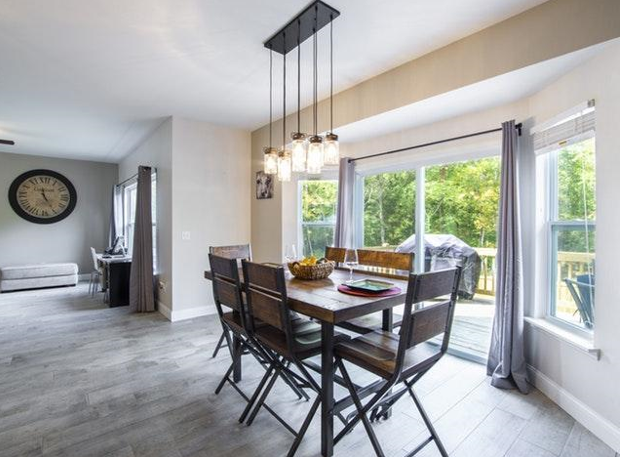
Update your flooring

Although carpet and vinyl are the typical choices for many landlords, they don’t scream either luxury or style. They are inexpensive, durable, and most importantly, cheap, but if you’re looking to increase the rent in the next lease period, you need something more attractive. Wood flooring is a premier high-end option that will surely appeal to renters, however, laminate flooring is not only more affordable, but also more durable for rental situations, which often include a bit of furniture-moving and reorganization. So, while laminate floors don’t have the same value-retaining curve as wood flooring, in general it’s a better investment for landlords.

Focus on kitchen and bathroom

If you’ve ever wondered which space adds most value to rentals buck for a buck, it’s the kitchen and bathroom.

You can make them much more attractive to prospective renters if you declutter them, clean them thoroughly, refinish the surfaces, and modernize the appliances. Such an updated kitchen will typically give you better ROI than other renovations, as well as lower your maintenance requests, so you won’t only save time, but also money in the long run. And here’s an unexpected bonus: if you make the effort to integrate green upgrades such as low-flow toilets, Energy Star water heaters, and dual-flush plumbing, you can even apply for government grants for energy-efficient upgrades or have them depreciate against your taxable income.

Give it a new roof

This often overlooked upgrade comes with many benefits for both the renters and the owner. However, in most cases, it’s the difficult access and the amount of work that turns landlords from roof updates. In order to upgrade your property you might want to speak with a contractor, or, if you’re handy, you might decide to do it yourself. You’ll have to find a reliable crane hire company before everything else. With the right crane, you’ll be able to move the materials and access even those tricky places.

However, in most cases it’s the difficult access and the amount of work that discourages landlords from roof updates. New roofing and underroof insulation give your tenants an opportunity to lower the heating and cooling costs, at the same time improving the building’s resale value.

Don’t forget the landscape

For many renters, the home’s exterior is almost as important as the interior, especially in the suburban neighborhoods, where people are likely to spend a healthy share of time in the back yard. So, if you want to spruce up your curb appeal and landscape in general, you’ll want to fill those dry lawn patches with new grass, trim overgrown bushes and trees, and clean up any garden debris. If you want to go an extra mile, consider including low-water landscaping elements, such as native grasses and plants, stones, and gravel mulch in flowerbeds, which prevents weeds from taking root.

Rental properties are long-term investments that don’t always increase the landlord’s margin as much as planned, especially if the monthly mortgage rent draws near the maximum rent that can be charged each month.

The key in renovating for higher rent is to choose upgrades that potential renters will recognize as life-improving, so they are willing to pay the extra buck for them. (And no, that saltwater aquarium isn’t the best idea.)

How To Deal With The Most Common Pests In Rental Housing

How To Deal With The Most Common Pests In Rental Housing

Pests in rental housing can be a real headache for property managers so here is a guide to the common pests and how to deal with them.

When you start thinking about pest control as a management philosophy instead of just triage in an emergency, it is good to give a little thought about what your policy is going to be as a property manager in dealing with the common pests in rental housing.

Giving some thought to integrated pest management and how you are going to communicate that to your owners, your tenants and your employees. Pests in rental housing was the topic during a recent webinar by Darcy Jacobsen, director of content for Buildium.com. Buildium.com has put together a guide called Infestation 101: A property manager’s guide and shared several things from the guide on the webinar covering pests in rental housing.

Pest control prevention in rental housing for property managers

“Using Integrated pest management as a preventive is a key. There really is never one magic bullet. There is no one site that has the same treatment solution, so using integrated pest management allows you to work up a plan,” said Kari Warberg-Block, CEO and pest prevention expert at EarthKind.com.

Property managers may want to consider a philosophy gaining ground these days called integrated pest management to deal with pests in rental housing. It is an environmentally friendly common-sense approach to:

    • Identify pests and monitor infestations
    • Set thresholds for interventions
    • Prevent new infestation
    • Control current outbreaks

What is the biggest pest problem in rental housing?

“Rodents is where we started and about 28% of the population has that issue, and more so in urban areas around dumpsters and on farms. They are a public health risk. So they need to be taken seriously,” Block said.

9 most common pests in rental properties

During the webinar, Jacobson and Block took a poll of property managers and asked them to identify the top pest issues they see in their properties.

Pests om rental housing

Then they broke out the nine most common pests in rental properties.

No. 1 – Pests In Rental Housing – Rodents

Pests in rental housing


“You will see little brown droppings that look like rice. Sounds in the walls and ceilings will freak your tenants out. You will find shredded paper,” Jacobsen said. Traditional options such as traps and poisons can end up with a dead animal in your walls, she said. No one wants dead animals in their walls.

“Repellents are the best option because poisons alone are rarely effective,” said Block. “The rodents die and they keep coming back. Repellents can be effective – it is how I got my start – if they are put in a place where rodents go to nest or where they are going to go and chew on wiring. It is good preventative maintenance because they won’t move in in the first place,” Block said. Also rodents can get in through very small openings, so even the smallest holes are worth sealing up.

No. 2 – Ants

Pests in rental housing

Ants are more of a nuisance than a hazard, but they can ruin food stores. “The gross-out factor is high with these pests for residents. They take a psychological toll. This might be one you get called on frequently,” Jacobsen said. There are certain conditions that make ants come out of the ground after heavy rains, and anywhere there is going to be food. If you can find the path in, then that is a huge step in controlling them,” Block said. In terms of maintenance for pests in rental housing keep ants away look first at windowsills, seal cracks and crevices, in walls and foundations, trimming the trees and shrubs back from the exterior walls and minimizing water around your foundation.“Ants are drawn to water, and so are many of these bugs. If you take away water sources they are less likely to come around – leaks, air conditioners dripping, etc.” Jacobsen said.

No. 3 – Fleas

Fleas How To Deal With The Most Common Pests In Rental Housing

Obviously fleas pose a health risk to animals, dogs and cats especially. A lot of people also have allergies. What do we look for? “So look for pets scratching themselves that’s a sure sign, or fast moving black/brown insects in fur especially near the eyes. In some cases you may see black dirt or dried blood where pets sleep. “Prevention options include treating the pets with spot applications. Avoid feeding or taking in stray animals,” Block said. Anywhere also where animals are coming into contact with each other you want to be vigilant, especially if you have a multifamily pet area. Fleas, Jacobsen said, are really one of those things that it’s up to your residents more to keep up with as the tenant behavior in taking care of the pet is important so you want to educate them if you have a known problem and if fleas are common in the area. Traditional treatments are a residual insecticide around baseboards, lawns, flea collars, baths and bombs. Biologically safe treatments include frequent vacuuming and emptying the bag immediately – one of those common sense things that makes a huge difference. You want to get the eggs out of the carpet and sleeping areas and bedding. There are growth regulator pesticides with an active ingredient and using flea combs on pet fur.

No. 4 – Wasps

wasps How To Deal With The Most Common Pests In Rental Housing

“Wasps, fleas and mosquitoes are three of the top things searched on the internet because people are so freaked out about them. There is a heightened sensitivity to them. So when you hear about it from a tenant take it seriously because there is also an emotional component – whether real or perceived. So some of the signs to look for are nests in eaves, light fixtures and even underground. Wasps will congregate around picnic tables and trash bins. If you get complaints from your tenants, you need to look in the lights, in the eaves, and around the trash and if you are seeing a lot there you may have an infestation,” Jacobsen said. Block suggested taking a flashlight with red cellophane over the cover to look for nests so the wasps are not attracted to bright light of a regular flashlight.  Also trash areas with old sweet, soft drinks can be a magnet for wasps as well as other pests in rental housing.

No. 4 – Bedbugs

bed bugs How To Deal With The Most Common Pests In Rental Housing

“This can be a terrifying infestation – not because they do a lot of damage – but because of the stigma. Plus the loss of property in having to replace your mattress, plus they do bite,” Jacobsen said. “Bed bugs feed on human blood,” Block said, “so look for dark spots the size of a pinhead or red stains on sheets or mattresses. If your tenants suspect they might have bedbugs, how do you treat that when they arise? “The best prevention is not to take on used mattresses or used furniture,” Jacobsen said. Exterminators are recommended. “You have to rely on your tenants. Your tenants are bringing this in, so you need to be sure they are not staying somewhere they will bring these in. It is good to educate your tenants and used mattresses seem to be the number one culprit,” Jacobsen said. “Do you have to disclose to the next tenant that you had bedbugs? Yes some jurisdictions require that. So show the steps you have taken and document your pest protocol.”

No. 5 – Cockroaches

cockroaches and How To Deal With The Most Common Pests In Rental Housing


“Another bug that is really gross, and terrifies residents,” Jacobson said. Roaches are more active at night. A lot of people confuse roaches with other bugs. Roaches have a moist, musty smell like a basement. “Cockroaches seem particularly drawn to appliances, especially microwaves because of food droppings. A really great habitat for them,” Block said. Inspect any used appliances. “If you have one cockroach in a multifamily unit, you should really consider a plan for your whole building. Because with cockroaches, if you have them in one unit chances are they are in others as well.”

No. 6 – Beetles and other invaders

beetles and How To Deal With The Most Common Pests In Rental Housing

“We have lumped several types in here, including stinkbugs, which are horrible. Then there are carpet beetles that like wool, hair and feathers and they will destroy clothing and carpet. They can get up inside furniture and upholstery was well. How do we know they are there? Knowing where to look is most of it. They tend to lurk in dark areas. A good prevention option is frequent vacuuming and empty the bag immediately and fixing holes in screens. “You may have to talk to residents about replacing their furniture. It is good to have communication around where the responsibility lies for these types of issues, as bugs are rarely covered even in renters insurance. It is good to have policies set out in your leases. So if you get bedbugs whose responsibility is it to replace the mattress? “Jacobsen said.

No. 7 – Moths

moths and How To Deal With The Most Common Pests In Rental Housing

“Of all these bugs, this is the one that dogs me the most. I used to live in Seattle, and I bought some beautiful wool rugs. I don’t know if they (moths) came in the rugs or were in the very old apartment in Seattle I was living in. But when I came back to Boston I brought the rugs with me and put them underneath my bed. And about three months later my apartment was filled with moths! I could not figure out what was going on and then finally I dragged those rugs out from underneath the bed and they were infested with moth larva. All of my clothes had holes in them and it was just awful,” Jacobsen said. Moths can hide in the food pantry, dense closet spaces that are tight and dark. They will chew holes in carpets, natural fiber clothing. How do you find them? “They prefer dark,” Block said. “And unused areas like basements and attics. One red flag is seeing tiny moths. Also look around near food sources such as birdseed and dog food. Cardboard boxes can be a common area where they are found. Sometimes people will move in and leave things in boxes, and moths can get in between the layers of cardboard. They really like natural fibers.”

No. 8 – Mosquitoes

Pest control and mosquitoes

“This is very much in the news. It is becoming more and more something residents have been concerned about, especially in the southeast. They are the most deadly critter on earth because they spread diseases that kill more than one million people annually,” Jacobsen said.  The Zika virus many are terrified about. They are also just generally a nuisance. There are things you can do on your property to try and minimize the damage. Look for any standing water on property – including water in flower pots –  and check vegetation and keep it trimmed back also cleaning gutters and removing any potential wet breeding grounds and keep screens in good repair. Certain types of plants can also deter mosquitoes such a mint and the citronella plant, she said.

No. 9 –Termites

Pest control and termites

This is one of highest risk critters for damage to structures. Look for the presence of insect wings and mud tubes on foundations and near wood piles. Annual inspection of property is the best way to prevent an infestation of termites. Also remove any wood or wood piles and elevated above the soil and far away from any structures, Jacobsen said.

“Find a pest management pro (PMP) which we used to call an exterminator. State regulatory offices have a lot of information because they regulate the area. Online reviews can be very helpful. And, the national pesticide information center,” she said. Block suggested asking the following questions:

Questions to ask a professional pest management company

    • How many years have you been in business?
    • What is the EPA registration number of the product to be used?
    • Do you charge for an initial inspection?
    • What methods and pesticides do you use?
    • What do you charge and what services do you provide?
    • What is your guarantee?
    • Do you have an entomologist on staff?
    • Do you practice integrated pest management?
    • Do you carry insurance?
    • What are your safety measures and protocols?

“Create a seasonal pest maintenance checklist as part of your regular maintenance program,” Jacobsen said. “It is something you can make a part of your records if you ever find yourself in a lawsuit. It is something you can show incoming residents and show evidence of past pest outbreaks and how they were handled. You want to document what services were performed. Document what pesticides were used, and include all of that in your property management software such as buildium.com. The reports from your vendors should be clear on the extent of the infestation, and the level and extent of tenant cooperation. Include photos wherever you can,” Jacobsen said.

Also follow up with residents afterward to check resident satisfaction with the action taken to make sure there is no recurring problem. Keep staff up to date on how to spot and treat problems.

In the guide is a long section on health risks, ethics, how to contact insurance companies, what types of liability policies you should have in place. Also the dangers of toxins particularly for children and pets. As many residents could be more concerned about those issues than the pests.

Then also how to communicate with owners and tenants.

How to talk to tenants about pests

“Arming your tenants with information to spot pests is highly effective. Tenants are your early-warning sign. And pest information from them can make a huge difference in whether you are able to deter a full-scale pest invasion. Educate them about the signs and common pests when they move in. Managing concerns and expectations during an infestation is key. People can get grossed out and panicky,” Jacobsen said. She suggested the following:

    • Educate yourself and your staff on how to answer questions calmly.
    • Share you plans to get buy-in from your tenants on your methods. If a reluctant tenant undermines your treatment plan, it can backfire.
    • Have a liability plan in place as some infestations destroy personal property and could render the property temporarily inhabitable.
    • Be sure to have a policy where you can direct tenants for reimbursement or alternative lodging
    • In terms of infestations, check local laws, but many jurisdictions require disclosure to new tenants regarding some pests.
    • It is ethical to inform tenants if pest control activity has taken place, especially if toxins were employed.

5 questions for property managers about pests in rental properties

No. 1 – Will you take a toxic and/or non-toxic/ environmentally friendly approach to pest infestation?

No. 2 – How will you educate residents about spotting and preventing pests?

No. 3 – What proactive maintenance, prevention and inspections will you conduct?

No. 4- How will you train staff, and when will you call in vendors and experts?

No. 5- How might you use your comprehensive pest strategy as a marketing and promotional tool?

Resources:

National Pesticide Information Center at Oregon State University

Infestation 101: a property manager’s guide

How to Rent a Pest-Free Home to Your Tenants

Sign Up For Our Newsletter And Get Apartment News And Helpful, Useful Content Each Week.

* indicates required


U.S. Multifamily Outlook Holds Strong and Shines Bright On Multifamily Landscape

U.S. Multifamily Outlook Holds Strong and Shines Bright On Multifamily Landscape

Multifamily-industry observers are optimistic that the sector will continue performing strongly and remain popular as an investment vehicle, according to a new multifamily outlook report from Yardi Matrix.

“The National Multifamily Housing Council (NMHC) gathered in temperate San Diego last week as much of the country was blasted by extreme cold,” the report says.

“The juxtaposition could be seen as a metaphor for the multifamily sector, which remains a bright spot on the investment landscape relative to other sectors both inside and outside commercial real estate,” it said.

Highlights of the multifamily outlook

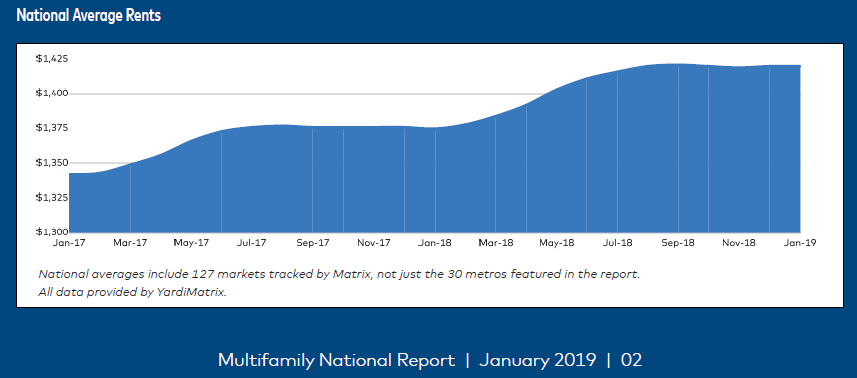
U.S. multifamily rents did not change in January, remaining at $1,420, while year-over-year growth rose 10 basis points to 3.3%. Rents are at the same level they were in August.

■ Market players are largely optimistic about the prospects for the sector’s performance in 2019, based on the discussion at the conference in San Diego. Demand trends are expected to remain strong.

■ Las Vegas (7.9%), Phoenix (6.5%) and Atlanta (5.9%) comprise the top 3 metros, with each producing growth in the normally slow winter season.

A January survey of 127 major U.S. real estate markets showed that despite flat rent performance, which is normal for winter, year-over-year rent growth increased by 10 basis points to 3.3%, the sixth consecutive month above 3%.

“Such performance gives no indication that multifamily rent growth is on its last legs in the cycle,” the report says.

Older renters staying put, rental households growing in ages 20-34

Panelists at the NMHC conference were bullish on multifamily.

Speakers by and large expect demand to remain strong along the age spectrum. The 20-34 age category, which has the highest percentage of renter households, will continue to grow for several more years, the report says.

“Some speakers noted that household renters above that age group are increasingly remaining in rental housing (both single-family homes and multifamily) rather than purchasing homes. One noted that the demographic of some luxury apartment buildings encompasses an average age above 40 and average income above $200,000. Retirees are also downsizing from suburban homes and divorcing at a faster rate, which creates apartment demand,” the Yardi Matrix report says.

U.S. Multifamily Outlook Holds Strong and Shines Bright On Multifamily Landscape

Forecast rent growth, occupancy and yield expectations

Here are some highlights of this portion of the report:

  • One topic of conversation at the NMHC conference was the lower yield expectations among investors. Appreciation gains are likely to be modest in coming years.
  • Fannie Mae and Freddie Mac are expected to operate as normal in 2019, but new regulatory leadership could change the way they operate starting in 2020.
  • The ability to develop affordable housing con­tinues to be a sore spot. NMHC panelists talked about frustration with inconsistent enforcement of regulations and the high costs of building.

View the full Yardi Matrix multifamily national report for January 2019 for additional detail and insight into 127 major markets.

Yardi Matrix offers the industry’s most comprehensive market intelligence tool for investment professionals, equity investors, lenders and property managers who underwrite and manage investments in commercial real estate. Yardi Matrix covers multifamily, industrial, office and self- storage property types. Email matrix@yardi.com, call 480-663-1149 or visit yardimatrix.com to learn more.


Rent Payment Issues Primarily Send Property Managers To Court

Rent Payment Issues Primarily Send Property Managers To Court

It’s simple economics when rents go up, rent payment issues go up, because it becomes harder for people to afford leasing an apartment.

By Ellen Calmas

For for most typical renters, working class families, recent college graduates, and young professionals climbing the career ladder, qualifying for a new apartment lease just gets tougher as monthly rents increase.

And asking applicants for more money in upfront in security deposits only shows they can come up with that cash, while likely setting them up to be cash-strapped at some point in the lease.

That is why residents often pay rent late or fall behind completely, resulting in unwanted action by community staff who are just doing their jobs in enforcing a lease.

Rent payment issues send property managers to court

While owners and managers look diligently at opportunities to renew residents and keep them at their properties longer, payment issues are typically the straw that sends hard working assistant community managers to court to earn their stripes in fighting for what is due from delinquent residents.

In the high flying rent market of San Francisco, for example, the March 2016 Rent Board Annual Eviction Report showed some 30 percent of evictions in the past year were due to habitual late payment, non-payment or breech of rental agreement.

According to published articles, the next most common way to end up in eviction court is when there is evidence of a violent or antisocial criminal act or a drug-related offense that merits a felony conviction, or less serious though equally problematic issues related to specific lease violations.

Huge amounts of time in court to correct residents’ wrongs cannot possibly be a favorite part of the job, especially when a typical community of 300 units can have as many as five to eight residents who need to be brought to court in a month, or 60 to 86 residents in court in a year. At thousands of dollars per incident, costs add up quickly, and take their toll on community staff who also have a full load of non-court related responsibilities to attend to.

Industry statistics on payment performance and evictions are easier to come by than those on employee retention. Also hard to find are exit interviews with community management burned out by the negative aspects of the job. But it doesn’t take a statistician to know that people generally dislike conflict and are not emotionally equipped to manage it on a continual basis.

Payment issues send property managers to court most often says Ellen Calmas in her blog

How to solve rent payment issue problems

What is a community to do to maintain good payment performance and, in turn, resident retention as well as that of community staff?

That is where innovative new programs in rent delivery have been proven effective, especially at B and C communities in markets where credit and rising rents may be in conflict.

One such program focuses on rent from payroll from NPS Rent Assurance. According to an analysis the company completed of 6,597 conditionally approved applicants, skip and eviction rates went down a whopping 77 percent — 9.37 percent to a 2.12 percent — when rent from payroll is utilized by residents who present with higher payment risk based on credit. For instance, that is 30 to 35 percent of all rental prospects conditionally approved.

Based on industry estimates of $4,000 in court costs, staff time, lost revenue, make-ready and marketing costs for a vacant unit to achieve new occupancy, the cost of unexpected move-outs drops by more than $250,000 for every 1,000 conditionally approved move-ins on a rent from payroll program.

As a result of significantly improved payment performance, residents on rent from payroll programs have decreased bad turns and bolstered renewal rates by the fact that they tend to stay in their units 66 percent longer than conditionally approved residents who moved in with extra deposits. That is  a win-win for residents and community staff and solves rent payment issues.

For more information on eliminating friction in the rent process, download the latest report on rent from payroll here.

About the author:

Ellen Calmas is co-founder and executive vice president of Neighborhood Pay Services, LLC / NPS Rent Assurance and brings 25+ years marketing communications experience with Fortune 500 and entrepreneurial companies to her role in strategic planning and marketing and sales support. She is also responsible for brand positioning, outbound marketing and digital networking as well as coordination of partner programs. Ellen has held senior management positions for marketing communications firms serving such clients as GlaxoWellcome, Bausch & Lomb, Avon Products, Heinz USA, AT&T, The House of Seagram, among others. She actively supports numerous health, civic and arts organizations throughout the Boston area and currently holds board positions for Silent Spring Institute, a leading research and advocacy group dedicated to identifying links between women’s health and the environment. She received her B.S. from the Roy H. Park School of Communications at Ithaca College. She can be reached at 617.209.3048 ext 104.


Oregon Rent Control Bill Moving Forward In The Senate

Oregon Rent Control Bill Moving Forward In The Senate

Landlords this week gave their views on the Oregon rent-control and evictions bill to a Senate committee, which is sending the bill to the full Senate for a vote, according to reports.

Senate Bill 608 had a hearing that lasted for several hours before the Senate Housing Committee. Powerful house and senate leaders have lined up behind the bill, which looks to pass in this legislative session.

Here is what some landlord groups had to say about the bill:

“At best, Senate Bill 608 will have no effect,” said Deborah Imse, executive director of Multifamily NW in an interview with OregonLive.com, “but at worst it will make housing less affordable in the long run.”

Multifamily NW opposes the bill, as did many landlords who testified on their own behalf. They argued it would hurt business and discourage investment, resulting in substandard housing.

“There’s a lot here for landlords to dislike,” said Jim Straub, the legislative director for the Oregon Rental Housing Association, to OregonLive. “But I’d also like to recognize it for what it isn’t: an industry killer. As written, I do not believe it will be catastrophic to our livelihood.”

The Rental Housing Alliance Oregon and the Oregon Rental Housing Association are both remaining neutral.

The committee room was packed with people who felt the bill didn’t go far enough — arguing the 7 percent cap was too high — as well as others who said it would end up causing rents to increase in the long run, according to reports from opb.org.

Punishing landlords?

“It is beyond my comprehension how smart people think punishing landlords is going to increase the number of rental units in the state,” wrote Dianne Cassidy, a landlord in Gladstone, to the committee.

“Instead, the state is seriously considering putting a cap on our businesses’ income, which is a disincentive to be in the rental market altogether,” Cassidy wrote, according to opb.org.

A bill dealing with many of these same issues failed in the Oregon legislature last year.

“Oregonians cannot afford to wait another year … They are losing their housing now,” testified House Speaker Tina Kotek, a key lawmaker behind Senate Bill 608, to members of the newly-created Senate Committee on Housing, according to opb.org.

What Oregon Senate Bill 608 Does

  • Prohibits a landlord from terminating month-to-month tenancy without cause after 12 months of occupancy. Provides exception for certain tenancies on a building or lot used by a landlord as residence.
  • Allows a landlord to terminate tenancy with 90 days’ written notice and payment of one month’s rent under certain conditions. Exempts landlord managing four or fewer units from payment of one month’s rent.
  • Provides that fixed-term tenancy becomes month-to-month tenancy upon ending date if not renewed or terminated.
  • Allows landlord to not renew fixed-term tenancy if tenant receives three lease-violation warnings within 12 months during term and landlord gives 90 days’ notice.
  • Limits rent increases for residential tenancies to one per year.
  • Limits maximum annual rent increase to 7 percent above annual change in consumer price index.
  • Requires Oregon Department of Administrative Services to publish maximum annual rent increase percentage.
  • Declares emergency, effective on passage.

Resources:

Lawmakers Gear Up To Make Oregon The 1st With Statewide Rent Control

Rent control, eviction protection bill advances in Oregon Senate

Creating A Civil And Respectful Multifamily Workplace

Creating A Civil And Respectful Workplace

The Grace Hill training tip this week focuses on the issue of creating a civil and respectful workplace in your multifamily business.

By Ellen Clark

Teams function better and employees are healthier and more engaged in a civil and respectful environment.

Civility is a collection of positive behaviors that include treating people with respect, courtesy, consideration, and kindness. These behaviors produce feelings of respect, dignity, and trust. Teams function better and employees are healthier and more engaged in such environments. On the other hand, when civility is lacking in a workplace, performance, morale, and creativity suffer.

As a leader, how can you help foster a culture of civility and respect in your workplace? Here are some tips:

  • Be an active listener. Focus on the person speaking to you, and listen without interrupting. Use brief, positive responses to keep conversations going and to show you are listening. Ask clarifying questions and summarize responses back to check your understanding. Be aware of your body language and your tone throughout conversations.
  • Create an inclusive environment. An inclusive work environment is one in which all employees can make use of their particular skills, talents, and experiences, and where ideas and contributions are valued and sought after by management and other team members. Ultimately, the goal of embracing diversity is creating a team where people from all backgrounds are encouraged to share their unique talents.

Creating a civil and respectful workplace

Training employees on the importance of civility, and providing training opportunities, creates a respectful workplace.

  • Acknowledge people.  Don’t assume people know you appreciate them or respect their contributions. Instead, make a plan to acknowledge people. From small gestures like a “hello” in the hallway or a thank-you note, to things like recognition in a meeting or an annual award, acknowledgment is important. However, make sure acknowledgments are sincere; if employees feel they are not genuine, they can be counterproductive.
  • Remember that actions can speak louder than words. Delegating important tasks, being open to contributions and feedback, and letting employees pursue creative ideas can show them that you trust and respect them. It is also important to actively support your employees—they need to know you have their backs.
  • Set a good example. As a leader, you can spread civility. You’d be surprised how much your example can influence others. In addition to focusing on positive behaviors, make sure to avoid the tendency to engage in gossip or other forms of negative communication.
  • Provide civility training. Don’t assume people naturally know how to be civil and respectful. Even well-intentioned people may not have the skills or role models of civility in their lives. Training employees by being explicit about the importance of civility, providing examples of civil and uncivil behavior, and giving opportunities to practice using real-world scenarios is important.

Creating a civil and respectful workplace takes purposeful, ongoing effort, but the rewards will be well worth it.

Read Ellen’s blog post here.

Recent Grace Hill training tips you may have missed:

What Do You Do When Assistance Animals Break The Rules?

7 Ways To Stay Out Of Trouble When Checking Criminal History

5 Ways To Protect Applicants, Residents And Employees From Sexual Harassment

Do You Have A Smoke-Free Policy That Adequately Protects Residents?

How To Handle Suspicious Documentation For Assistance Animals

How A No Pet Policy Can Be Discriminatory

Property Management Cyber attack Risks Overlooked, Underestimated

Do You Know How To Respond To a Sexual Harassment Complaint?

Have You Reviewed Your Criminal Background Checks Policy Lately?

Multifamily Managers And Marijuana: Caught In A Pot Crossfire

Fair Housing Discrimination Against Someone You’ve Never Talked To?

4 Ways To Avoid Screening Pitfalls With Applicants

Red Flags In Evaluating Documentation For Assistance Animals

About the author:

Ellen Clark is the Director of Assessment at Grace Hill. Her work has spanned the entire learner lifecycle, from elementary school through professional education. She spent more than 10 years working with K12 Inc.’s network of online charter schools – measuring learning, developing learning improvement plans using evidence-based strategies, and conducting learning studies. Later, at Kaplan Inc., she worked in the vocational education and job-training divisions, improving online, blended and face-to-face training programs, and working directly with business leadership and trainers to improve learner outcomes and job performance. Ellen lives and works in Maryland, where she was born and raised.

About Grace Hill

For nearly two decades, Grace Hill has been developing best-in-class online training courseware and administration solely for the Property Management Industry, designed to help people, teams and companies improve performance and reduce risk. Contact Grace Hill at 866.472.2344 to hear more.


Smart Home Automation For Multifamily

Smart Home Automation For Multifamily

Sponsored Blog

Sean Miller
President, PointCentral

Smart Apartment Control is a subset of the worldwide Internet of Things (IoT) movement, in which products are constantly being introduced that allow the remote control of components in a home or apartment.

A Focus on Smart HVAC Control

HVAC is an abbreviation for Heating, Ventilation, and Air Conditioning. Most apartment units have them, and they are the most expensive appliances on the property.

The investment in an HVAC system can run into the tens of thousands of dollars, and the nuances of such a system often are misunderstood by the average consumer (particularly residents). Therefore, it makes sense to add some level of control to the HVAC system to prevent misuse and abuse, and  to extend the life of this costly appliance.

What is Smart HVAC Control?

Smart HVAC Control adds the ability to monitor and control smart thermostats remotely. Adding schedules, defining acceptable set-point ranges, enabling extreme temperature notifications and monitoring humidity are all components of the smart HVAC control.

How Does Smart HVAC Control Help You?

1. By establishing acceptable set-point ranges to avoid damage.

Some people believe that if you turn an air conditioner to 60 degrees, the apartment will cool faster. They don’t understand that the property cools at the same rate (typically 1 to 2 degrees per hour) regardless of how low the set-point is. So, turning a thermostat to 60 degrees just means the HVAC system is going to run longer. And if it is left at 60 degrees, often an air conditioner will freeze up, resulting in thousands of dollars in repair costs.

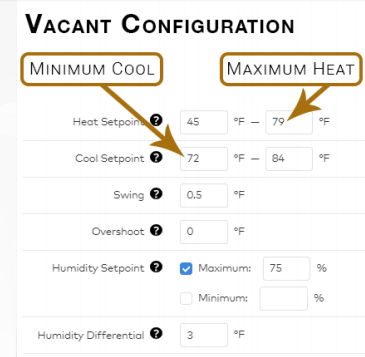
Smart-thermostat control systems allow your property manager to define a minimum cooling set-point and a maximum heating set-point. This can typically be done through a web portal and wirelessly communicated to the thermostat in your apartment.

Smart Home Automation For Multifamily

By defining minimum cooling and maximum heating set-points for occupied apartments, the resident will be restricted as to how high or low they can adjust the thermostat.

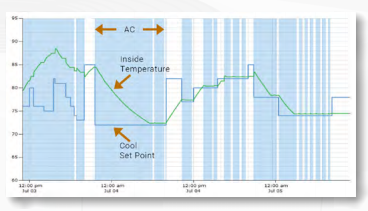
HVAC Analytics identifies small problems before they become big ones. Smart thermostats are continually communicating securely with the web. Data points such as current set-point, actual room temperature and HVAC mode (heating/cooling) are tracked on a per-apartment basis in the cloud.

Algorithms have been developed that analyze this data in conjunction with the apartment address and outside temperature to determine if an HVAC system is operating properly. In a situation where the system is not running efficiently, a notification is sent to the property manager.

This notification allows the property manager to schedule maintenance before it becomes an emergency, saving significant costs.

Smart Home Automation For Multifamily

The above graph allows a property manager to see what the thermostat settings are should a resident call and complain about the heating or cooling system. By looking at the graph, an assessment can be made as to whether an HVAC system needs maintenance or is responding appropriately given the outside temperature.

2. By using schedules for vacant apartments

As the apartment manager, you’re paying the energy bill when an apartment goes vacant. While well-intentioned, many vendors, showing agents and prospective residents will adjust a thermostat to a comfort setting (cooler in the summer, warmer in the winter) while working in or viewing your apartment. If they forget to return the thermostat to an energy-saving mode, you spend money cooling or heating an empty unit.

Smart Home Automation For Multifamily

With web-enabled schedules (see graphic above) added to your thermostat, you can be assured that at the end of the day, your thermostat will be reset to the energy-saving mode. By doing so, you eliminate the risk of excessively cooling or heating a vacant apartment, and save the wear and tear on your HVAC system.

3. By monitoring and controlling humidity

High humidity can result in significant property damage and loss of comfort. A smart thermostat’s humidity-monitoring capability can automatically adjust the humidity levels in an apartment by running the air conditioning when humidity thresholds are exceeded.

Will My Residents Benefit (or Care)?

Residents can use HVAC schedules to save money on energy bills. Just as using online schedules during vacancy will save you money, they will also allow your residents to save money on their energy bills. ENERGY STAR has confirmed savings of 9% to 16% when heating and 15% to 23% when cooling. These savings, along with the convenience of controlling the thermostat through a mobile app, will provide the incentive for residents to pay a monthly fee for this service.

Wakefield Research showed that 86% of millennials and 65% of baby boomers are willing to pay more for a rental unit outfitted with smart apartment devices.

Download the PDF here of  Smart Automation For Multifamily

smart home automation

PointCentral is the property management-focused division of Alarm.com, the largest Smart Apartment provider in the world. PointCentral’s Property-Automation system is based around a cellular gateway installed in the apartment. This device utilizes a cellular radio that communicates securely with the web, and allows online control of a vacant unit.


Seattle Rents Increased Over the Past Month

Seattle Rents Increased Over the Past Month

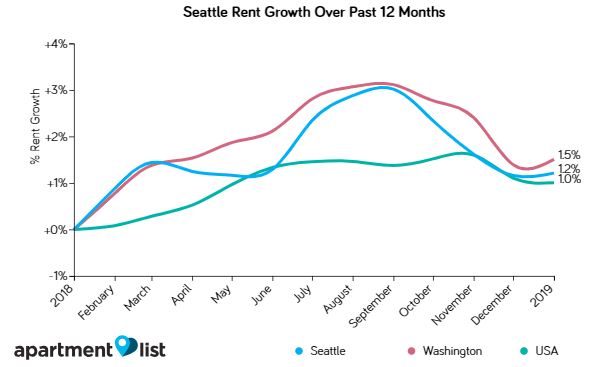
Seattle rents have remained flat over the past month; however, they are up slightly by 1.2% year-over-year, according to Apartment List.

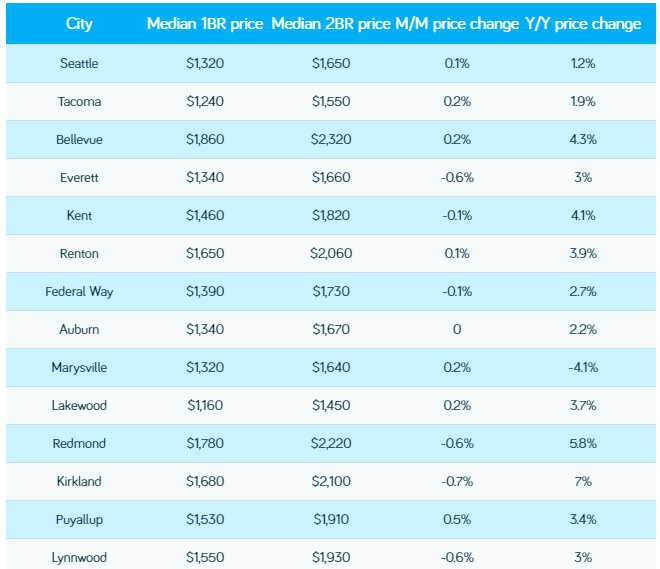
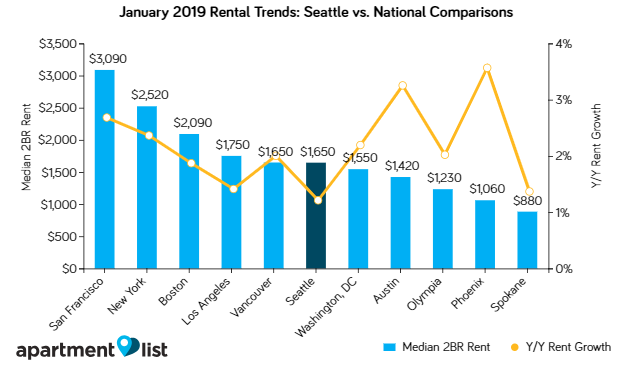
Currently, median rents in Seattle stand at $1,320 for a one-bedroom apartment and $1,650 for a two-bedroom.

Seattle’s year-over-year rent growth lags the state average of 1.5%, but exceeds the national average of 1.0%.

Rents rising across the Seattle Metro

Seattle Rents Increased Over the Past Month

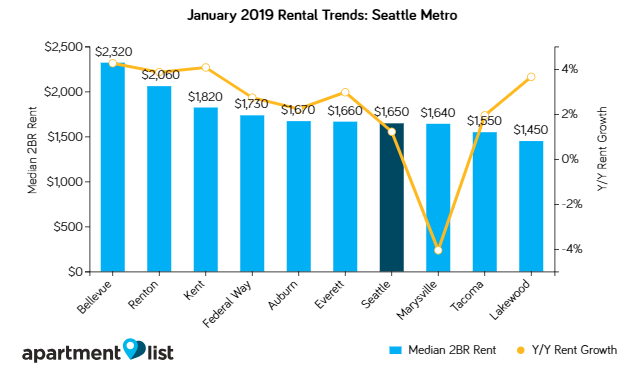
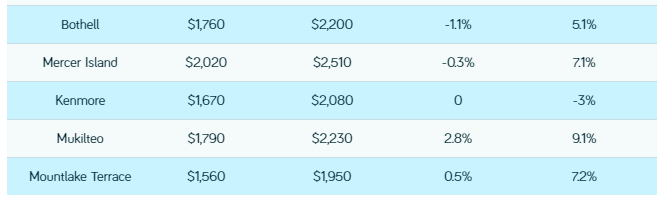
Throughout the past year, rent increases have been occurring not just in the city of Seattle, but across the entire metro. Of the largest 10 cities that we have data for in the Seattle metro, nine have seen prices rise. Here’s a look at how rents compare across some of the largest cities in the metro:

  • Bellevue has the most expensive rents in the Seattle metro, with a two-bedroom median of $2,320; the city has also seen rent growth of 4.3% over the past year, the fastest in the metro.
  • Over the past year, Marysville is the only city in the metro that has seen rents fall, with a decline of 4.1%. Median two-bedrooms there cost $1,640, while one-bedrooms go for $1,320.

Seattle Rents Increased Over the Past Month

Other large cities nationwide show more affordable rents than Seattle

As rents have increased slightly in Seattle, a few other large cities nationwide have also seen rents grow modestly. Compared to most similar cities across the country, Seattle is less affordable for renters:

  • Rents increased slightly in other cities across the state, with Washington as a whole logging rent growth of 1.5% over the past year. For example, rents have grown by 2.0% in Vancouver and 1.4% in Spokane.
  • Seattle’s median two-bedroom rent of $1,650 is above the national average of $1,170. Nationwide, rents have grown by 1.0% over the past year compared to the 1.2% rise in Seattle.
  • While Seattle’s rents rose slightly over the past year, many cities nationwide also saw increases, including Phoenix (+3.6%), Austin (+3.3%), and San Francisco (+2.7%).
  • Renters will generally find more expensive prices in Seattle than in most other large cities. For example, Spokane has a median 2BR rent of $880, where Seattle is more than one-and-a-half times that price.

Seattle Rents Increased Over the Past Month

Methodology

Data from private listing sites, including our own, tends to skew towards luxury apartments, introducing sample bias. In order to address these limitations and provide the most accurate rent estimates available, we now start with reliable median rent statistics from the Census Bureau, then extrapolate forward based on our own rental listing data, using a same-unit analysis similar to Case-Shiller’s approach, which compares only units that are available across both time periods to provide an accurate picture of rent growth in cities across the country.

Apartment List

Apartment List is a growing online apartment rental marketplace on a mission to make finding a home an easy and delightful process.

How to Maintain Clean Sliding Door Tracks For Your Rental Property

How to Maintain Clean Sliding Door Tracks For Your Rental Property

How to clean and maintain sliding door tracks is the rental property maintenance checkup this week provided by Keepe.

Has dirt built up in the tracks of your sliding doors?

Dirt can easily build up in sliding tracks, letting water seep in and making doors difficult to use. To keep your doors operating smoothly, it helps to know the best tips and tricks to use to clean sliding-door and -window tracks.

Protect your property by ensuring soil and grime doesn’t accumulate on your tracks by regularly cleaning the area. Over time, dirt can build up and become harder to clean and maintain. Here are 3 ways you can clean your sliding tracks and maintain function.

Cleaning the Sliding Door Tracks

Weekly maintenance: For regular sliding track maintenance, use this solution:

  1. Vacuum the tracks whenever you are cleaning your home. Use a small vacuum attachment to reach into the hard-to-reach corners of the tracks. Remove the larger pieces of dirt to ease the cleaning process.
  2. Scrub the tracks with a wire brush and cleaning solution.  A wire brush, toothbrush or any similar tool would work well. As for the cleaning solution, use any cleaner, denatured alcohol, or dish soap, and combine with warm water.
  3. Wipe down the tracks with a rag or paper towel. Remove any last bits of dirt with a dry towel.

How to Maintain Clean Sliding Door Tracks For Your Rental Property

For stubborn dirt that has accumulated over longer periods of time, use this cleaning method instead:

  1. Mix cold water and white vinegar. Before using this combination, sprinkle baking soda onto the tracks over any dirt.
  2. Next, soak the entire track in the vinegar solution, and allow 10 minutes of soaking time to let the solution loosen any dirt and material stuck in the tracks.
  3. Scrub the area down with a toothbrush or wire brush.
  4. Wipe down the area with a paper towel or rag.

Monthly maintenance: Every two months, lubricate sliding tracks to maintain optimal functionality.

  1. Clean your tracks using one of the methods mentioned earlier before lubricating your tracks.
  2. Spray a silicone lubricant onto the tracks and wipe down the excess lubricant with a rag.
  3. Open and close the door several times to spread the lubricant across the doors.

How to Maintain Clean Sliding Door Tracks For Your Rental Property

Other recent rental property maintenance Keepe posts you may have missed:

4 Outdoor Flooring Options For Your Rentals

20 Easy, Affordable Maintenance Projects To Update Your Rentals

7 Tech Gadgets For A Safer And More Efficient Rental Property

5 Maintenance Tips For Long-Lasting Rental Carpet Flooring

Is The Water Heater At Your Rental Property Ready For The Big One?

7 Types Of Kitchen Countertops For Your Apartments

Which Cooktop Is Best For Your Rental Property?

A Guide To 4 Types Of Flat Roof Systems

6 Ways To Trash Your Apartment Waste Management Issues

About Keepe:

Keepe is an on-demand maintenance solution for property managers and independent landlords. The company makes a network of hundreds of independent contractors and handymen available for maintenance projects at rental properties. Keepe is available in the Greater Seattle area, Greater Phoenix area, San Francisco Bay area, Portland, San Diego and is coming soon to an area near you. Learn more about Keepe at https://www.keepe.com


Massachusetts Joins Cities In Fight Against Airbnb Short-Term Rentals

Portland regulators, through the city’s revenue department,t have reached a memorandum of understanding with Airbnb

Massachusetts may be the first state to trying to curb and regulate short-term home rentals with a law set to go into effect this summer that is the toughest one in the country so far.

The law, set to take effect in July, requires short-term rentals to register with the state, carry a minimum of $1 million in insurance, and pay a 5 percent tax to the state.

The law also allows local municipalities to assess an additional 6 percent tax and creates a state-run affordable housing fund, which will funnel money from another 3 percent tax on property owners with two or more short-term rentals in the same municipality, according to Governing.com.

The legislation also creates a first-of-its-kind statewide registry for short-term rentals.

Massachusetts scrambling to figure out new law

The state’s decision last month to enact a law with some of the nation’s toughest rules on short-term rentals has thousands of people scrambling to figure out how to comply.

From Cape Cod to Boston to the Berkshires, individual hosts and corporate owners are sorting through the state regulations, which establish taxes and registration requirements for units that aren’t covered by traditional one-year leases. In Boston, separate rules that sharply restrict who can rent homes for the short term add another layer of complexity, according to the Boston Globe.

Together, the regulations could transform — and, some say, inhibit — an industry that has grown rapidly in recent years, thanks to online platforms such as Airbnb and HomeAway.

Airbnb had a record year in Massachusetts

Airbnb says the Massachusetts law is flawed, and has not ruled out challenging it in court. At the same time, the company said there were 1.2 million people who stayed in Airbnb rentals in Massachusetts in 2018, and hosts in the state earned more than $256 million, according to a WBUR.org report citing Airbnb.

There are now more than 15,700 Airbnb hosts in the state who typically earn at least $7,800 annually, according to the company. Andrew Kalloch, the head of public policy for Airbnb in Massachusetts, said the “record numbers” show that Airbnb is an “economic engine” in Massachusetts.

“We see millions of guests across the country and around the world who want to come to Massachusetts and spend time in different parts of the state coming to Airbnb as a first option and seeing the value that home-sharing can provide to them,” Kalloch said in a phone interview with WBUR.org.

The law defines short-term rentals as “occupied property” where at least one “room or unit is rented out by an operator through the use of advance reservations.” That includes apartments, houses, cottages, and condominiums.

The definition does not include hotels, motels, and other lodging establishments providing accommodations to guests; nor does it include time-shares or month-to-month leases.

“A short-term rental is a rental that is not for more than 31 consecutive calendar days,” says the Department of Revenue.

The law applies whether property owners rent out the property themselves or use an intermediary, like a broker or hosting platform (i.e. Airbnb, Homeaway, or any other online apps or websites).

However, the new tax does not apply to people who rent out their homes infrequently. After negotiations between the Baker administration and state legislators, a compromise bill was reached to exempt people who rent out their homes for 14 days or less in a calendar year.

New Orleans also tightening regulations

In mid-January, the New Orleans City Council unanimously approved a package that permanently extends the nine-month ban on short-term rentals in the French Quarter and Garden District, according to governing.com.  In an effort to preserve retail space, the new rules also prevent Airbnb operators in commercial zones from renting first-floor units. And in residentially zoned neighborhoods, people can only rent out rooms in homes that they occupy.

Airbnb, which did not respond to an emailed request for comment, has said that it plans to sue New Orleans, according to governing.com.

Portland Mayor To Take On Short-Term Fake Rental Owners And Airbnb

Resources:

Mass. hosts scrambling to comply with tough new short-term rental rules

As Airbnb Battles Cities Trying to Regulate It, One State Joins the Fight

With Regulations Looming, Airbnb Says It Had A Record Year In Mass.