Home Blog Page 176

Renters Over 60 Grew By 43 Percent Over The Past Decade

Renters Over 60 Grew By 43 Percent Over The Past Decade

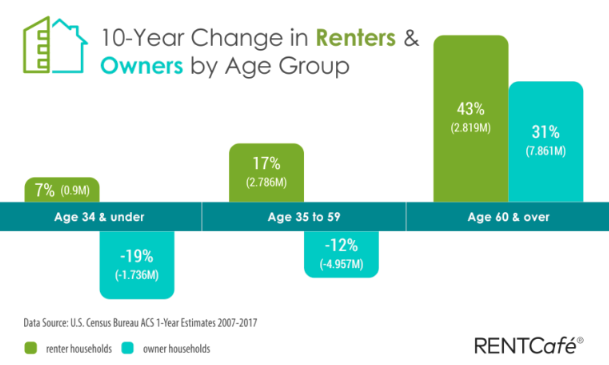
Renters over 60 now represent the third largest group of renter households at 22 percent, according to new research from RentCafé.

And the trend is expected to increase. as renters over 60 are the fastest-growing group of renters among all age groups in the last 10 years. With a 43 percent increase, senior renters have outpaced even their fellow homeowners.

Driven by a decline in home ownership, RentCafé researchers’ estimate that by 2035, seniors will make up 31% of the total number of renters, outnumbering Gen Z renters.

Past studies conducted show that the older population is no longer enthusiastic about homeownership, with many seniors starting to downsize and move into rentals. As their children move out, they find themselves alone, often in a big house that costs a lot to maintain. All these factors cause them to rethink their housing choices.

Key findings about renters over 60

  • With a 43% increase, renter households over 60 drove the past decade’s surge in renters, greatly outpacing younger age groups.
  • When looking at the largest gains, renters over 60 are still in the lead, with 2.81 million households added over the last 10 years.
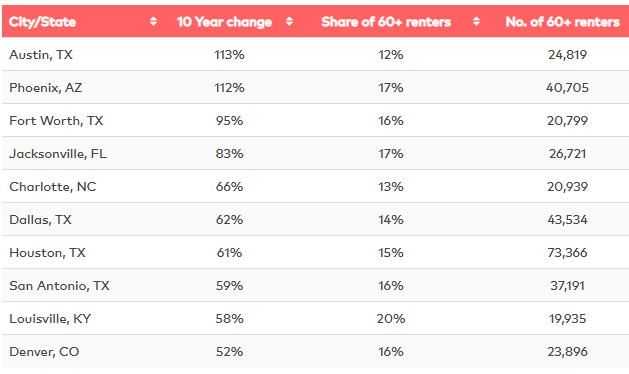
  • Zooming in, at a city level, Austin boasts the highest increase in the share of 60+ renters, 113%, followed by Phoenix (112%) and Fort Worth (95%).
  • Think New York City is known only for young and hip millennials? Well, think again. Out of the top 30 largest U.S. cities, the Big Apple has the largest share of senior-renter households, 27%. Thanks to a 10-year growth rate of 20%, this age group managed to outrun even those under 34.
  • Projections based on the trend witnessed between 2007 and 2017 predict that the year 2035 will mark a major demographic shift. The share of seniors will cover about one third of the U.S. rental market and will become the second largest group of renter households.

Austin boasts the highest 10-year percentage change in the share of older-renter households

Renters Over 60 Grew By 43 Percent Over The Past Decade

Out of the 30 most populous cities in the United States, 16 experienced an increase of over 40% in the 60+ renter household share between 2007 and 2017.

Austin takes the first place as the city with the highest percentage change in the share of 60+ renter households, increasing by 113% in the 10-year period. Phoenix is also present in this top with the second highest increase of 112%; it’s followed by Fort Worth, with 95%.

The oldest U.S. cities by median age are popular retirement spots

Renters Over 60 Grew By 43 Percent Over The Past Decade

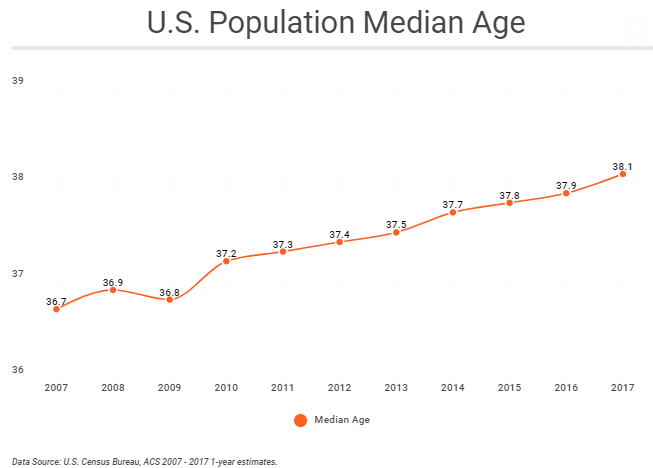
The top 30 oldest cities in the study all have a median age over 39.6 and are mostly retirement cities in Florida, California, or Arizona.

In fact, Florida is home to 12 of the oldest cities, with Cape Coral, first, with a median age of 47.9, followed by Hialeah, with 46.5.  In Arizona, sunny Scottsdale is third, with a median age of 46, proving once more its high popularity among retirees in search of warm days and entertainment.

Summary

This growing share of older Americans is bound to have an impact on the U.S. real estate market.

This is a cohort of people that witnessed firsthand the impact of the 2007 housing crisis and the re-shaping of the economy, forcing many of them to give up their homeowner status and move into rental properties.

It’s important for developers to acknowledge the particular housing needs of older renters and make sure that they are being met, says RentCafé.

Methodology

  • This report was compiled by RentCafe.com, a nationwide apartment search website. Tenure of occupied housing units by age was obtained from Census ACS 1-year estimates for 2001-2017 at national and city level. Median age by population at U.S and city level was obtained from the same sources. In order to compare data, 3 age groups were created, aggregated from existing age groups and compared resulting data from 2007 & 2017. For this research, more than 300 cities with a population of over 100,000 were analyzed. For the 2035 projection, data was used  from Census – American Community Survey 1-year estimates: 2007 to 2017, Households by tenure and Age estimates. The projection on historical trends y-o-y from 2007 & 2017 was done and kept the homeownership rate at 2017 level for each age group. While the future growth in older households is confirmed by other sources, the results should be considered rough estimates and are subjected to change.

How to Choose the Right Baseboards For Your Rental Property

How to Choose the Right Baseboards for Your Rental Property

A good way to impress tenants and perhaps get a nice rent increase is to upgrade the baseboards for your rental property to give it a nicer look and that is the maintenance checkup this week provided by Keepe.

Baseboards for your rental property are a great way to update a room or put a finishing touch on a remodeled unit.

Base molding –  the small trim that goes along the lowest and highest parts of interior wall of a room –  can elevate the space of a unit and offer a stylish transition from wall to floor.

To find the best molding trim, select a baseboard that coordinates with your property’s style while staying within your budget.

Types of Baseboard Styles

  1. Old-fashioned: Old-fashioned baseboards are often made out of pine or fir wood. This style can add a dramatic Victorian or colonial style to your building, but the project can end up being very pricey. For example, a colonial-style trim shows a vintage and elegant style, often found in colonial-inspired living and dining rooms. This style brings a unique character to a room. If your property is old-fashioned, try incorporating a similar style for the molding, or contrast the building style with a modern baseboard trim.
  2. Modern: A modern molding is suitable for relaxed spaces, perfect for contemporary multifamily buildings. Subtle molding such as thin-base moldings are a great way to streamline the interior of a property, giving a modern, minimalistic look to any interior. Flat baseboard trims are optimal for an apartment. Extra-tall baseboards give a higher-end finish quality to any property.
How to Choose the Right Baseboards for Your Rental Property
A modern molding is suitable for relaxed spaces.

Types of Baseboard Material

  1. Medium-Density Fiberboard: MDF is comprised of wood fibers, resin and other products. MDF is easy to shape into various designs due to its material. MDF is also easy to paint or stain, and costs less compared to the majority of other materials. MDF baseboards are flexible and are one of the most popular types in the market. This material is a great option for property managers who want to repaint their baseboards during a rental turn.
  2. Wood: Oak is the most popular wood-trim type, especially since it’s able to match any wood in your house. Wood can be vulnerable to warping, so double-check your trim before purchasing. Wood offers a high-end look to any property and you can find a wide range of price options, depending on what kind you buy. Hardwood also fits in easily with existing molding, making installation cheap and easy. You can have a classic neutral look with a painted-wood baseboard or rustic look by leaving it unpainted.
  3. Plastic: Plastic baseboards can easily be styled and colored, but not as easily as wood. Plastic baseboards are less expensive than vinyl or wood. On the other hand, the material is not very flexible, so it can easily be damaged.
  4. Vinyl: Vinyl-trim molding is a great option for a ceiling that meets the stairs for an upper floor. The flexible material is great for a unit that has a vintage or classic style throughout the property. Vinyl baseboards also suit bathrooms well, since they can put up with dampness. Vinyl is durable, easy to install and replace, and is less expensive than hardwood. The negatives: vinyl baseboard tends to attract mildew, and the material can’t be painted.

How to Choose the Right Baseboards for Your Rental Property

Other recent rental property maintenance Keepe posts you may have missed:

4 Outdoor Flooring Options For Your Rentals

20 Easy, Affordable Maintenance Projects To Update Your Rentals

7 Tech Gadgets For A Safer And More Efficient Rental Property

5 Maintenance Tips For Long-Lasting Rental Carpet Flooring

Is The Water Heater At Your Rental Property Ready For The Big One?

7 Types Of Kitchen Countertops For Your Apartments

Which Cooktop Is Best For Your Rental Property?

A Guide To 4 Types Of Flat Roof Systems

6 Ways To Trash Your Apartment Waste Management Issues

About Keepe:

Keepe is an on-demand maintenance solution for property managers and independent landlords. The company makes a network of hundreds of independent contractors and handymen available for maintenance projects at rental properties. Keepe is available in the Greater Seattle area, Greater Phoenix area, San Francisco Bay area, Portland, San Diego and is coming soon to an area near you. Learn more about Keepe at https://www.keepe.com


Did You Know Hoarding Is A Disability Protected By Fair Housing?

Ask Landlord Hank: What Should We Do About A Hoarder?

Hoarding is a disability protected by Fair Housing Laws so the Grace Hill training tip this week focuses on this issue to help landlords who encounter this problem with tenants.

By Ellen Clark

People with a hoarding disability are protected by Fair Housing laws and are entitled to reasonable accommodations.

People with disabilities face particular challenges when it comes to housing and have special protections under fair housing law. Disabilities include both physical and mental impairments. It may not always be obvious that someone has a disability, which can make complying with fair housing law in this area a little tricky.

In order for people with disabilities to fully enjoy their homes in your community, it may be necessary for you to make changes to community rules, policies, procedures, services, or physical structures. These changes are called reasonable accommodations and modifications.

Hoarding is a mental disability

Hoarding is a mental disability you may encounter as you work on a property. People who suffer from hoarding are protected under fair housing law and are entitled to reasonable accommodations in the same way people with other mental or physical disabilities are https://livingwellnessmedicalcenter.com/ativan-lorazepam/.

In general, you should not initiate conversations with residents with disabilities about what accommodations they may need. Instead, you should wait for them to make a request. Hoarding is a little different because it is a case where you may need to initiate discussions with the resident because the situation is dangerous or unsanitary and must be addressed.

Here are some tips to help you work with people with hoarding disabilities in a way that complies with fair housing law.

Make sure you and all employees understand that hoarding is a disability

Do not immediately begin the eviction process. People with a hoarding disability are protected by fair housing laws and are entitled to the same care and consideration you would give people with other types of disabilities.

The most common accommodation, for a person with hoarding disorder, is the written plan of action.

  • Document the condition of the hoarder’s home. Using a standard assessment such as those provided by the Institute for Challenging Disorganization or the International OCD Foundation can help you do an objective evaluation. Make sure to note specific lease and code violations. Use caution and be aware of potential threats to health and safety.
  • Involve your legal counsel. You will need to understand what state and local laws apply to your specific situation, and how to apply them appropriately. Do not overlook the importance of getting good legal guidance when working with hoarding situations.
  • Give the resident a chance to rectify the situation. If the resident agrees to clean their home and/or seek help,develop a written plan of action. For a person with hoarding disorder, the most common accommodation is the written plan of action, which gives the resident a chance to rectify the situation at a pace that is conducive with long-term success.

Depending on state and local laws, you may be able to proceed with an eviction if the resident is hoarding animals, explosives, blocking emergency exits, or directly damaging the apartment home. Again, be sure to consult your legal counsel before proceeding with an eviction, as this can be a complicated issue to navigate with residents.

Hoarding is a mental health problem

Mental health experts say that about 15 million Americans suffer from the mental health problem of hoarding. Some interesting facts about hoarders:

  • They make up 2-5% of the population;
  • Anyone can be a hoarder – men, women, and even children as young as 13;
  • Elderly women are the most likely hoarders;
  • Hoarders are not lazy, nasty or defiant;
  • The behavior usually has occurred for a long time and there is no quick fix;
  • Hoarders are usually very intelligent;
  • Hoarders may have a mental disability and must be given the opportunity for a reasonable accommodation, even if they do not specifically request one;
    • The accommodation may be in the form of more time to bring the dwelling unit up to code before termination of the lease agreement;
    • Early intervention is the best plan; and
    • Trying to solve the problem without the individual’s cooperation will usually make the problem worse.

Recent Grace Hill training tips you may have missed:

What Do You Do When Assistance Animals Break The Rules?

7 Ways To Stay Out Of Trouble When Checking Criminal History

5 Ways To Protect Applicants, Residents And Employees From Sexual Harassment

Do You Have A Smoke-Free Policy That Adequately Protects Residents?

How To Handle Suspicious Documentation For Assistance Animals

How A No Pet Policy Can Be Discriminatory

Property Management Cyber attack Risks Overlooked, Underestimated

Do You Know How To Respond To a Sexual Harassment Complaint?

Have You Reviewed Your Criminal Background Checks Policy Lately?

Multifamily Managers And Marijuana: Caught In A Pot Crossfire

Fair Housing Discrimination Against Someone You’ve Never Talked To?

4 Ways To Avoid Screening Pitfalls With Applicants

Red Flags In Evaluating Documentation For Assistance Animals

About the author:

Ellen Clark is the Director of Assessment at Grace Hill. Her work has spanned the entire learner lifecycle, from elementary school through professional education. She spent more than 10 years working with K12 Inc.’s network of online charter schools – measuring learning, developing learning improvement plans using evidence-based strategies, and conducting learning studies. Later, at Kaplan Inc., she worked in the vocational education and job-training divisions, improving online, blended and face-to-face training programs, and working directly with business leadership and trainers to improve learner outcomes and job performance. Ellen lives and works in Maryland, where she was born and raised.

About Grace Hill

For nearly two decades, Grace Hill has been developing best-in-class online training courseware and administration solely for the Property Management Industry, designed to help people, teams and companies improve performance and reduce risk. Contact Grace Hill at 866.472.2344 to hear more.


Apartment Water Conservation Focuses On Toilets For These Brothers

Apartment water conservation – which provides a quick return on investment for apartment owners and property managers – is the passion of two brothers who have become the toilet “property brothers” of the multifamily industry.

By John Triplett

The story of two brothers’ latest project, at the Silverbrook Apartments in Grand Prairie, Texas, is a winner.

It will save the property 36 million gallons of water and more than $365,000 annually, representing a 65% savings in water usage and cost, and an eight-month return on their investment.

Above, Lawrence Lamondin, left in blue shirt, and brother Richard.

And It will save the tenants money on their bills, too.

EcoSystems, owned by brothers Lawrence and Richard Lamondin – who are becoming the toilet “property brothers” of the multifamily industry – designs and implements water conservation programs for apartment complexes. They partner with BH Management Services LLC, a division of BH Companies that acquires, improves and manages apartment communities.

936 toilets replaced to achieve apartment water conservation

The conservation efforts at the apartment complex included 936 bathroom upgrades, ridding Silverbrook of old and wasteful toilets, showerheads and aerators. The installation was done over 22 days, about a month’s worth of work.

The efficient solution turns a quick return on investment (ROI) for property owners, typically saving 30 to 50 percent on water and sewer bills, and seeing returns in less than 18 months. In this case, the savings achieved the largest ROI to date.

In an interview, Lawrence Lamondin talked about both the impact these projects have on the environment in terms of water savings and the savings to tenants and property managers.

Property managers can provide feedback to owners on water-saving needs

“Any good owner is going to listen to what the troops they put in place, such as their property managers, tell them,” Lamondin said. In fact, the Silverbrook project came from the property-manager level, he said.

“The first time I walked into that office, the manager – and even in her initial email to me when she first got the bills – really didn’t quite grasp how much money and how much water a program like this could save.

“I think it’s really important at a property-manager level. They are the ones that are collecting the bills. They’re the ones that are fielding the residents’ complaints when it comes to their water costs monthly. I think it’s really important to take that into consideration,” he said.


An Ecosystems crew member putting old toilets in dumpster.

Tenants’ rising water bills can cause turnover      

“Basically, what the manager had told me is that these residents were paying somewhere around $70 dollars per month for water and it was causing turnover at their property. With water rates rising 7 percent a year nationally on average, this is something that is only going to become more prominent in the future.

“So from a property management standpoint, they are the best representation of your tenant base. They are the best representation in terms of who is going to stay on top of the budgets. They are in charge of making sure the property is profitable. So that’s really where they come from and where they come into the picture.”

Leaking toilets can be a hidden apartment water conservation issue

Silverbrook had a combination of 1.6-gallon-per-flush and 3.5-gallon-per-flush toilets. “Most likely in the early 2000s, they began turning units and upgrading those fixtures,” he said.

“With that said, the flappers start leaking after just a few years. So we see properties that had replaced their toilets just a few years ago with problems. You walk those properties, do the tests, and you find that toilets are still leaking.

“They are not always visual. They’re not always audible.”

“Sometimes you have to either test them with blue dye or you find out as you go and find a handle that might get stuck and it stays up. Really, after a couple of years of that you could start seeing faulty product in your toilet,” Lamondin said.

Maintenance personnel aren’t focused on apartment water conservation

“In my experience, the maintenance personnel are generalists. They are good at everything but a master at not really anything, for the most part,” he said.

“Maintenance in general in this industry has a lot of turnover. Most of our clients realize that even though they have these techs on site and they are up keeping the property, their focus is not water conservation.”

“I think what could be done is training of both existing and new maintenance staff as they are onboarded. They need to be trained in what to look for and what could be done. They don’t realize that a running flapper in Atlanta could cost you $200 dollars a month. That goes for a lot of Texas cities as well. I think it’s really a matter of education and training on the maintenance standpoint.”

When tenants pay vs. when management pays

Lamondin said motivation for change is sometimes higher when tenants are billed individually for water instead of management using a system of paying the bills for everyone based on a utility billing ratio.

“We find that when you’re billing residents on a ratio, they still kind of have that communal effect. They don’t really take it as if they are paying for the water.”

“But when you have a meter you find that a water bill, with even no conservation efforts by the ownership, drops about 20 percent, just because they start reporting toilet flappers. They start reporting drips in the tub.”

“On that same token, there’s only so much that you can do with old products, and really where the savings come into play is when you start retrofitting,” he said.

Apartment water conservation

The Ecosystems crew outside a job site in Texas.

Apartment water conservation summary

“When we started this company in 2012, it was a big educational push for us. A lot of water was about 50 percent less expensive then than it is now.”

“We spend a lot of time educating our clients,” he said. There are an increasing number of apartment owners and property managers who now recognize the need. And, that need and recognition is mostly “driven by increasing water bills and a push by their residents,” he said.

“Going green is no longer a buzzword. It’s not something that should be optional in a business plan. It’s something that is absolutely necessary if they want to stay competitive. It not only helps them from their budgeting standpoint but it helps the residents. It also ultimately, and most importantly, helps the environment.”

“That’s generally our message as a company that we push to clients. I think it’s important that people really start paying attention to what effects water conservation can have now and in the future – and it’s not that far in the future.”

Resources:

Michigan State Study Affordable Water In The U.S. – A Burgeoning Crisis

A Nationwide Assessment of the Geography of Water Affordability in the United States

The great Denver toilet payback

EcoSystems

BH Management Services

Freddie Mac Multifamily Green Advantage

Four ways Miami startups are trying to save the planet


Governor Kate Brown Signs Landmark Oregon Rent Control Bill

Governor Extends Oregon Foreclosure Moratorium to End Of The Year

Governor Kate Brown has signed a landmark first-in-the-nation rent-control bill, SB 608, which she said which provides protections for renters related to no-cause evictions and rent increases.

“This legislation will provide some immediate relief to Oregonians struggling to keep up with rising rents and a tight rental market,” the Governor said in a release.

“But it does not work alone. It will take much more to ensure that every Oregonian, in communities large and small, has access to housing choices that allow them and their families to thrive,” Brown said in the release.

The Governor’s 2019-21 budget includes $400 million in new investments aimed at ending homelessness for Oregon’s children, providing permanent supportive housing for the chronically homeless, housing Oregon’s veterans, and accelerating the growth of housing supply by tripling the existing pipeline of affordable housing by 2023, according to the release.

Brown has made affordable housing a priority, but cautioned the bill could lead to “a lot of headaches” if not paired with a $20 million funding package, according to reports. The funding package included in Brown’s proposed budget, for instance, would pay for technical assistance in the form of a help line and legal aid for landlords and renters, according to the Statesman-Journal.

Democrats released a statement saying the legislation will “protect renters from rent-gouging and no-cause evictions.

Senate Bill 608 “creates a fairer system that will provide predictability and stability to renters throughout the state, while not discouraging new construction,” the statement reads.

Rep. Mark Meek (D-Oregon City), a realtor and property manager, carried the legislation on the floor.

He told the story of his own experiences as a child dealing with housing instability.

“I have lived both sides of this issue,” Meek said in the release. “I’ve experienced homelessness and extreme hunger. I remember couch-surfing throughout the Los Angeles area with my mother after being evicted from our apartment. We’d sleep in a motel when we could afford them, and when we couldn’t, we’d sleep in our car.

“My story is one example of what displacement looks like. Displacement is devastating. It stifles a child’s ability to be successful. It is no small miracle that I am standing here before this esteemed body today,” Meek said in the release.

Senate Bill 608 will establish a statewide limit on rent increases, keeping them to no more than 7 percent plus the consumer price index during a 12-month period.

It would also ban no-cause evictions following the first 12 months of occupancy.

Passage of SB 608 erodes private property rights and fixes nothing

Oregon House Republicans released a statement saying, “It is evident supply is necessary to alleviate the affordable housing shortage.

“Passage of this bill also raises a more serious question: If a property owner can’t decide who lives in their apartments and houses, who really owns the property? Certainly, it is no longer the one who pays the property taxes.

“Moreover, the bill doesn’t address the real problem, the supply of affordable housing. The super-majority party contends the legislation will rein in rising rents caused by a housing crisis.

“But over and over, rent control in cities across the country has demonstrated otherwise. The answer to the housing crisis is not rent control, the answer is increasing the available number of houses and apartments. SB 608 neither encourages the building of new housing supply, nor does it provide real incentives to maintain existing rental property.

“Investment dollars that would have provided more housing will now go elsewhere. The Democrats’ unwillingness to seriously consider common-sense amendments will damage the mom-and-pop property owners, many of whom have invested their retirement dollars into the rental market.

“The consequences of this legislation will ripple far beyond the urban areas to Oregon’s small communities, where the housing shortage is just as real as in urban areas. It is also an assault on private property rights, effectively removing property owners’ ability to do what they wish with their own assets.

“This bill is just one of many aimed to further regulate Oregonians, while doing little to solve the problems it purports to fix. The virtual elimination of single-family zoning ensconced in HB 2001 and the explicit promise in HB 2020 of a new “economic system” for households, businesses and workers demonstrate the true intentions of Oregon’s ruling party,” the Republicans’ statement said.

National Multifamily Housing Council and National Apartment Association Warn of Negative Consequences of SB 608

“There is no doubt that housing affordability is a crisis in Oregon. However, SB 608 will worsen the imbalance between housing supply and demand by allowing for rent control across the state,” said Doug Bibby, President of the National Multifamily Housing Council, in a release.

“While the intent of rent-control laws is to assist lower-income populations, history has shown that rent control exacerbates shortages, makes it harder for apartment owners to make upgrades and disproportionately benefits higher-income households.

“That is why Oregon and a majority of other states have laws in place that explicitly prohibit local municipalities from implementing rent-control laws. Reversing course is counterproductive and will not solve the crisis.

“Oregon lawmakers should focus on holistic solutions that encourage more housing supply, facilitate public-private partnerships to tackle many of the existing barriers, and increase direct assistance to renters,” Bibby said in the release.

“Today’s regrettable action by the Oregon State House of Representatives on SB 608 will lead to unintended, but pre-eminently predictable negative consequences for housing affordability in the state,” said Robert Pinnegar, CAE, President and CEO of the National Apartment Association, in a release.

“Rather than focusing on the onerous regulatory environment that constricts the diversity of housing needed to meet the surging demand for rental housing, Oregon’s public officials chose to slide backward by enacting a failed policy that has historically proven to hurt residents and housing supply alike.

“The National Apartment Association and the National Multifamily Housing Council will continue to promote sustainable, responsible solutions that lead to more apartment construction, and oppose reckless and ill-advised policy approaches like rent control,” Pinnegar said in the release.

Oregon Democrats Praise Bill

The Oregon Democrats’ release said, “Senate Bill 608 builds on years of work to address Oregon’s housing crisis, including a law passed in 2017 that prohibits rent increases in the first year of month-to-month tenancy and requires that landlords provide 90-day notice of rent increases. “

Meek added in the release, “I am a landlord and will remain one after this bill becomes law. Becoming a property manager in Oregon is a great investment, and providing fair protection to renters with Senate Bill 608 does not change that.”

The non-partisan Office of Economic Analysis said in a memo that the regulations instituted by Senate Bill 608 will not negatively impact new housing supply.

Rep. Tiffiny Mitchell (D-Astoria) spoke about the need for protections in rural communities throughout Oregon. In recent years, rents statewide have increased by 14 percent, and in towns like Talent, Oregon, one in three residents spends more than half of their income on housing.

“As someone who has spent the last year talking to countless rural Oregonian tenants about the stress they face every day from a rental market in crises, I know how critical this legislation is towards helping them find the stability they deserve,” Mitchell said in the release.

Rep. Tawna Sanchez (D-Portland) stressed how important the legislation is for protecting the most vulnerable and underserved Oregonians.

“In every corner of Oregon, individuals are facing an emergency,” Sanchez said in the release. “From women fleeing domestic violence, to working families in communities big and small trying to get by, to indigenous people who struggle to find a safe and secure home, this crisis touches all of us.”

“Oregon House Democrats continue to work to ensure more Oregonians have access to an affordable, stable place to call home. This legislation is an important and significant step forward, and it is one part of a broad range of solutions needed to address this statewide crisis,” the release states.

Senate Bill 608 passed the Oregon House of Representatives by a 35-25 with three Democrats joining Republicans to vote against it.

Rent Control is Coming to Oregon, So Lawmakers Must Offer Direction and Resources

Rent Control is Coming to Oregon, So Lawmakers Must Offer Direction and Resources

Rent control is coming to Oregon, so Deborah Imse, executive director of MultiFamily NW, offers her thoughts and opinions and urges lawmakers to offer direction and resources.

By Deborah Imse
Multifamily NW

 The Oregonian/OregonLive Editorial Board offered several thoughtful suggestions regarding Oregon’s move toward statewide rent control (“Restrained rent control bill offers a temporary salve,” Feb. 17). We hope lawmakers in Salem are listening.

Whether renting or buying, we at Multifamily NW — the largest rental provider organization in Oregon — agree that the biggest reason homes are largely unaffordable is lack of supply. We need more from the legislature to address this issue. House Speaker Tina Kotek’s multifamily zoning bill is a good start, but it’s not nearly enough. To lower housing costs, policy makers statewide need to put more attention into increasing supply.

We also appreciate that The Oregonian called out the novel, untested nature of the rent-control method proposed in Senate Bill 608. No other state has implemented statewide rent control. And no other state has enacted a 7 percent increase plus inflation — as measured by the consumer price index. If state lawmakers choose to enact an approach that has never been implemented or tested anywhere else in the nation, it is crucial that the state also measure the impact and report back regularly to determine if investment in rental construction decreases. At Multifamily, we will track the effects of this policy on our membership.

The state should also monitor the impact of limiting notices to terminate tenancies — sometimes called “no-cause notices.” SB 608 allows termination of a lease for no cause in the first 12 months, but not after. “End-of-tenancy” notices help rental providers create safe rental properties by ensuring people who are harassing other residents can be removed, even if their actions don’t rise to the level of a for-cause eviction. It’s actually a form of tenant protection that serves our most vulnerable populations. So let’s also monitor the impact of limiting this tool.

In addition, if this truly is going to be a different kind of rent control in Oregon, it’s crucial that lawmakers commit to the 7 percent cap and ensure there is no ratcheting down. As Speaker Kotek has noted, this is a fragile compromise. Both sides are unhappy. And both sides will be working in the future to get more of what they want. How can we ensure that 7 percent doesn’t become 5 percent in the future, or lower? We would like to see lawmakers offer assurances to investors that Oregon is still a smart, predictable place to invest in the rental market. This will support efforts to increase supply.

Finally, Speaker Kotek has noted that this is one of four bills she plans to introduce to address housing problems in Oregon. One of those four may be a housing subsidy program, but the details have not yet emerged. We encourage lawmakers to look at programs like LIVE Denver, a low-income voucher equity program that is a public-private partnership with employers, foundations and the city.

Rent control is coming to Oregon. So, Oregon lawmakers need to offer the direction and resources necessary to measure the short-term and long-term impacts of this approach and show Oregonians that rent control offers all of the touted benefits, without the drawbacks.

About the author:

Deborah Imse is the executive director of MultiFamily NW, which represents individuals, families and businesses that provide more than 250,000 rental homes throughout Oregon.

Living With A Roommate Can Save Renters $515 A Month

Living With A Roommate Can Save Renters $515 A Month

Renters in the most expensive markets typically save the most by living with a roommate and renting a room in a shared home or apartment, according to a release from HotPads’ first Rooms for Rent Index.

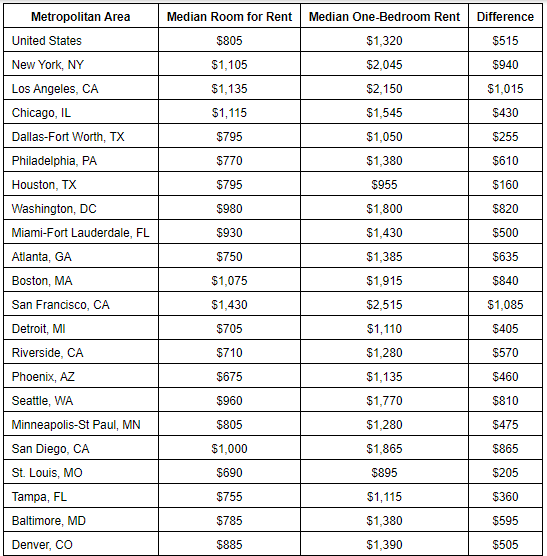
  • The median rent for a single bedroom in a shared home or apartment is $805 in the United States, compared to $1,320 for the median one-bedroom unit.
  • As rent prices increase, having a roommate saves renters more money. San Francisco and Los Angeles renters can save more than $1,000 on their rent each month by renting a room and sharing common areas.
  • Of renters in the 25 largest markets, renters in Houston and St. Louis save the least by getting a roommate.

“Privacy comes at a price in the rental market, and increasingly it’s a price that renters are unwilling or unable to pay,” said Joshua Clark, economist at HotPads, in the release.

“For the past 30 years, wages have stagnated while rent prices and student-loan debt have been on the rise. Finding a roommate or renting out that extra bedroom can help renters keep up with these rising expenses – particularly in expensive rental markets where housing affordability is a major concern,” Clark said.

Living with a roommate best in expensive markets

Renters in the country’s most expensive rental markets can save the most by renting a single room instead of an entire unit. San Francisco and Los Angeles renters can typically spend more than $2,100 per month on a typical one-bedroom apartment and more than $1,100 per month on a room for rent – about a $1,000 difference. Meanwhile, renters in New York City can expect to save about $940 each month by having a roommate, according to the release.

As rent prices rise and housing affordability continue to be a top concern, many renters pair up with roommates to cut down on housing costs. About 30 percent of U.S. renters lived with a roommate in 2017, up from about 28 percent of renters in 2012 and 24 percent of renters in 2007.

One-bedroom rent prices vary widely across the country – in the top 25 metro areas, the median one-bedroom rent ranges from $895 to $2,515 per month. In comparison, the typical cost of a room for rent is fairly steady – the median asking price for a room for rent in the top 25 metro areas ranges from $670 to $1,430 per month. Because one-bedroom rent prices are more variable, getting a roommate in the most expensive rental markets becomes more economical as rent prices rise.

However, renters in some Southern and Midwestern markets where one-bedroom apartments are relatively affordable save less when they split the rent. Renters in Houston save $160 per month by sharing their home or apartment with a roommate instead of renting an entire one-bedroom unit, while renters in St. Louis save $205 per month.

Cost of rooms for rent and one-bedroom rents

Living With A Roommate Can Save Renters $515 A Month

HotPads is a Zillow® Group-owned apartment- and home-search platform for renters in urban areas across the United States. Renters can use a map-based search to find homes and apartments available for rent, as well as individual rooms listed for rent. For more information, visit HotPads.com.


Senate Bill 608: Landlords Proceed With Caution

Lawmakers Extend Oregon Eviction Moratorium Through End of September

A Portland attorney shares some thoughts and opinions on Senate Bill 608, the rent control bill, moving through the Oregon legislature.
By Brad Kraus
Special to Rental Housing Journal

Currently advancing through the Oregon legislature—with no sign of stopping, and with the votes to pass—is a radical set of amendments to the Oregon Residential Landlord Tenant Act known as Senate Bill 608.

If passed without amendments, Senate Bill 608 will drastically amend ORS 90.427 (the termination statute), ORS 90.323 (the rent-increase statute), and other statutes, thereby fundamentally changing your rights as a landlord.

While it would be impossible to touch on every legal issue presented by the Senate Bill 608’s statutory amendments, there are a couple that deserve your immediate attention:

  • First, Senate Bill 608 will effectively eliminate the ability to serve no-cause notices after the first year of occupancy, unless the landlord has a “qualifying” reason (as detailed in the bill), or the landlord occupies the premises with his/her/their tenant. Even worse, service of a no-cause notice without qualifying for any of the exceptions will (a) trigger statutory penalties, including the payment of three months’ rent to the tenant, and (b) provide the tenant a defense to any eviction action filed pursuant to that no-cause notice.
  • Looking deeper into Senate Bill 608, you’ll see that it applies to “[t]erminations of month-to-month tenancies occurring on or after the 30th day after the effective date of this 2019 act.” As of this writing, it’s unclear when that 30th day will be. Therefore, it may be presently difficult (if not impossible) to determine whether your no-cause notice will trigger the new damages provision imposed by Senate Bill 608.

Senate Bill 608 also will cap rent increases during any 12-month period at seven percent plus the consumer price index above the existing rent

The consumer price index changes periodically, but the amount a landlord may raise rent in excess of the seven percent is chained to the figure published by the Bureau of Labor Statistics of the United States Department of Labor in September of the prior calendar year.

Therefore, landlords are capped with the September, 2018 figure throughout 2019. Finally, as of this writing, Senate Bill 608 indicates that the amendments only affect rent-increase notices served on or after the bill’s effective date.

All of the foregoing comments predate the passage of Senate Bill 608 and these are but a few of the drastic changes coming to the Landlord/Tenant Act.

Given the hostility landlords now face in the legislature, you should conduct ample due diligence and seek competent legal advice prior to serving any notices of termination or notices of rent increase.

About the author:

Senate Bill 608: Landlords Proceed With Caution
Bradley Kraus, Portland attorney

Bradley Kraus is an associate at Warren Allen and is a member of the firm’s landlord/tenant practice. A graduate of the University of Minnesota, he attended law school and graduated cum laude from Lewis and Clark Law School. Along with landlord/tenant law, Mr. Kraus assists clients in various litigation, probate, and family law matters.

Senate Bill 608: Landlords Proceed With Caution
Photo credit zrfphoto via istockphoto.com

High-Income Renters Are Fastest-Growing Housing Segment With Multifamily Leading

High-Income Renters Are Fastest-Growing Housing Segment

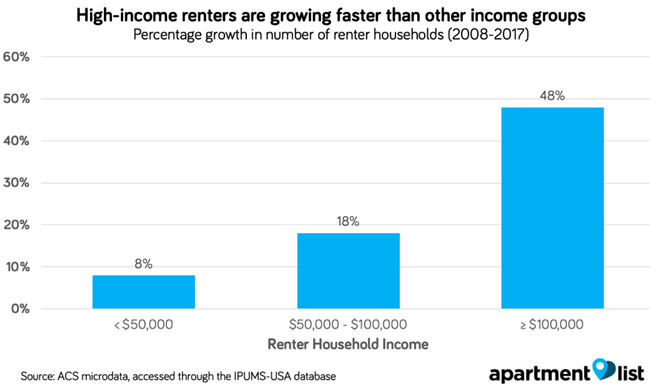
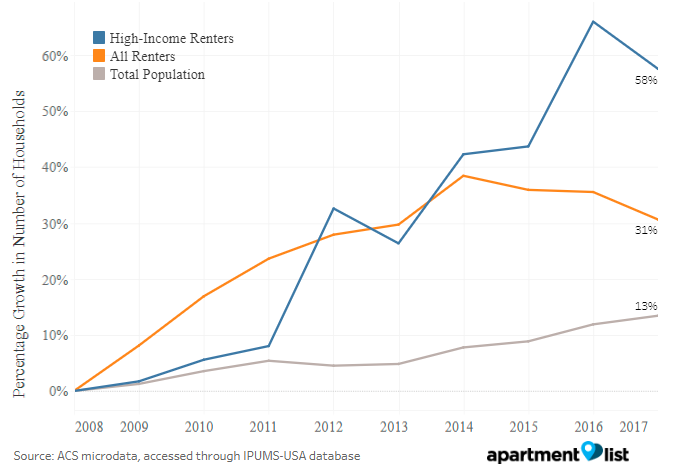
High-income renters are the fastest-growing housing segment in the United States, representing renters with six-figure incomes who choose to continue to rent rather than buy, according to new research from Apartment List.

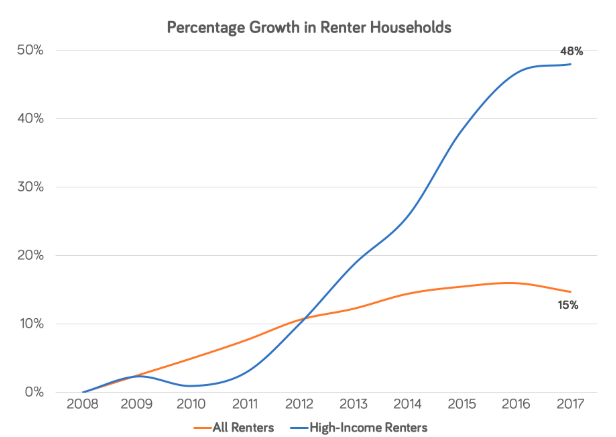
Across the United States there has been an increase of 48% in the number of renters who earn at least $100,000 per year. Growth in this segment in the future is expected to be much faster in multifamily homes than in single-family homes.

High-Income Renters Are Fastest-Growing Housing Segment

What is driving the high-income renters market

There are interacting supply-and-demand forces that are encouraging high-income households to rent instead of buy:

  • Growing supply: In the wake of the Great Recession, rental housing is booming across multifamily and single-family markets.
  • Growing demand: Now more than ever, even wealthy Americans are demanding rental options as they struggle to afford homes and increasingly value the flexibility of renting.

High-Income Renters Are Fastest-Growing Housing Segment

Why the surge in high-income renters in multifamily?

During the first three years of the recession, as single-family rentals were surging across American suburbs, funding for new housing construction had mostly evaporated.

But in 2011, the multifamily sector came back to life and brought new renter-friendly housing to dense urban cores. As Apartment List previously analyzed, multifamily construction quadrupled between 2010-2017 and has returned to pre-recession spending levels.

Most of this supply was geared towards the higher end of the market, providing new amenities for high-income renters at a time when single-family home construction lagged.

High-Income Renters Are Fastest-Growing Housing Segment

High-income multifamily renters growing faster

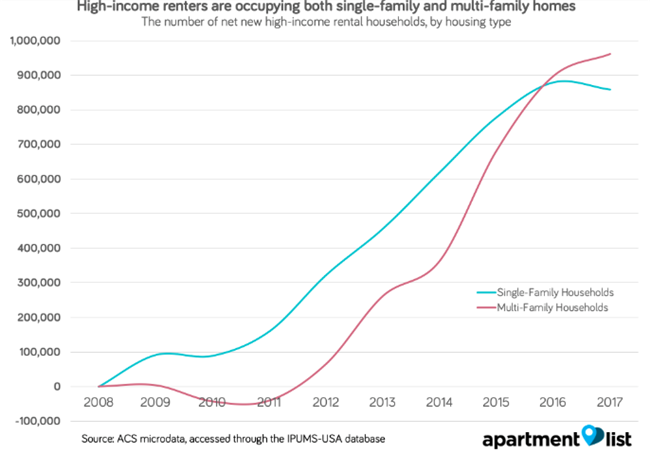
From 2008-2011, high-income renters left multifamily homes in favor of the vacant single-family homes left behind from the Great Recession, according to the Apartment List research. Then, following the resurrection of multifamily construction in 2011, high-income households moved into these homes at such a fast rate that they overtook single-family in just five years.

By 2017, there were 1.8 million new high-income renter households – 960,000 occupying multifamily and 860,000 occupying single-family.

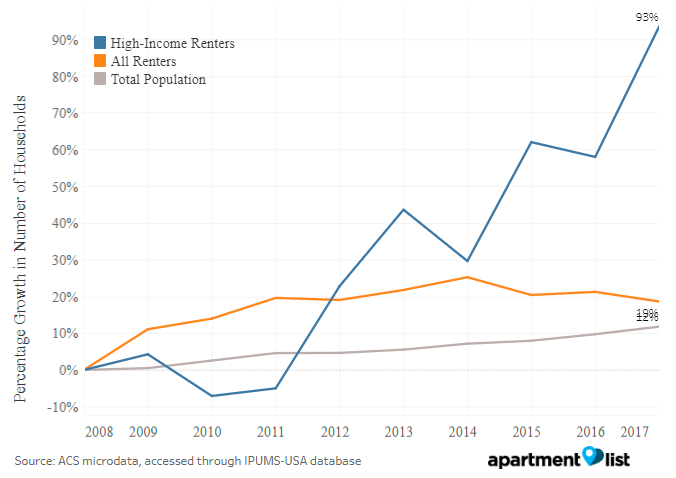
Portland Oregon High-Income Renters

High-Income Renters

Conclusion

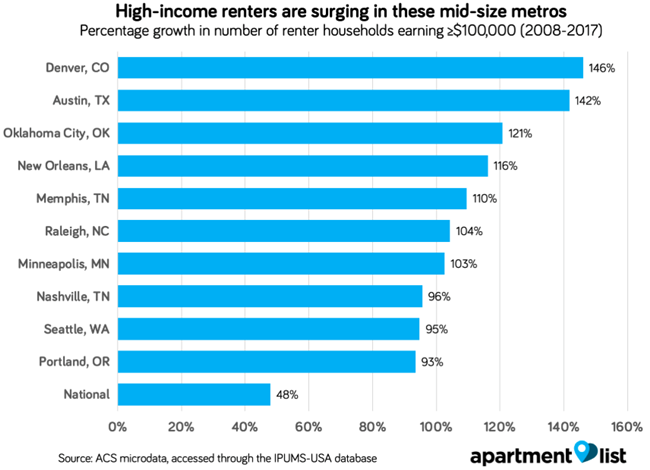
High-earning renters have multiplied especially quickly in mid-size, supply-abundant cities with strong economies.

What does this mean for the future of the housing market?

  • In the short-term, Apartment List economists expect the influx of high-earning households into multifamily rentals to continue, as multifamily construction remains strong and workers value the job opportunities and amenities of living in urban areas. With higher incomes, these households will demand new amenities from their homes and neighborhoods. High-income-renter growth in the single-family segment began to level off last year, but it will take a major shift in housing affordability to completely reverse the trend.
  • In the medium-term, economists expect the growth of high-income renters to create both policy challenges and opportunities. On one hand, the trend will likely lead to greater inequality within the rental market. As cities debate solutions to disappearing affordability and gentrification, high earners are increasingly competing with everyone else for finite city space. On the other hand, these high-earning households may bring new momentum for policies that affect all renters. This may even solicit policy response at the federal level, which is currently a quiet topic but one that expected to ramp up in the near future.
  • In the long-term, this decade’s trend may be indicative of changing norms around how we pay for our housing. If today’s high-earning families increasingly value the centrality of living in cities or the flexibility of renting instead of owning, the traditional paradigm of homeownership as a paramount metric for financial success may begin to evolve, the Apartment List report says.

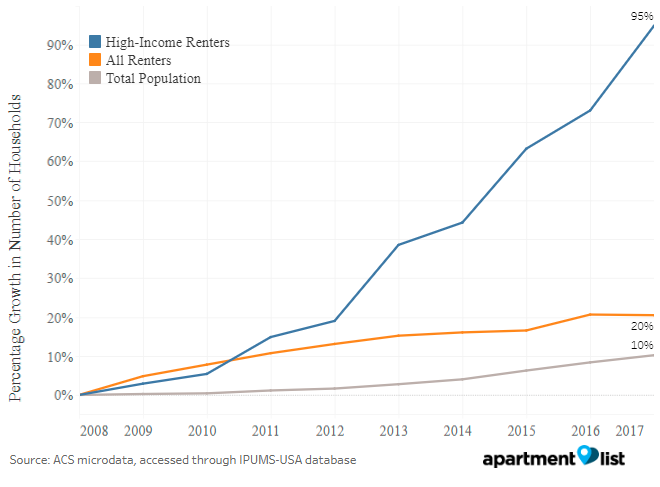
Seattle High-Income Renters

High-Income Renters Are Fastest-Growing Housing Segment

High-Income Renters Phoenix

High-Income Renters Are Fastest-Growing Housing Segment

About Apartment List

Apartment List is a fast-growing online apartment rental marketplace “on a mission to make finding a home an easy and delightful process,” according to the company. The company currently has over four million units on the platform and has reached more than 150 million users in over 40 cities since launch.

4 Things To Check In A Chimney Inspection In Your Rentals

4 Things To Check In A Chimney Inspection In Your Rentals

The importance of a chimney inspection in your rental property is the maintenance checkup this week provided by Keepe.

A chimney inspection, including cleaning and inspecting your chimney flue, should be done regularly to prevent chimney fires.

Even if tenants don’t regularly use the fireplace, it’s best to have a chimney sweep check at least once a year to avoid preventable damage.

4 Things To Check In A Chimney Inspection In Your Rentals
Chimney caps protect your fireplace from rain, birds, animals and debris so check the caps regularly.

Annual chimney maintenance removes flammable creosote, the major cause of chimney fires, and identifies other performance problems.

Creosote is a natural byproduct of burning wood. As fireplaces get used, the more likely it is that your fireplace venting can become impaired. In addition to being a fire hazard, creosote build-up can also lead to harmful smoke coming inside the building.

 Chimney inspection
Creosote is a natural byproduct of burning wood. As fireplaces get used, the more likely it is that your fireplace venting can become impaired.

Even if you don’t burn much, these inspections will ensure that your chimney is safe to use.

 4 things you should do during a chimney inspection

  1. Have the chimney caps checked: Chimney caps protect your fireplace from rain, animals and debris. These caps can also protect your roof and reduce fire risk by trapping embers and sparks. If you don’t have a cap, or notice that it is loose or needs to be replaced, be sure it gets done during a chimney sweep with a maintenance professional.
  2. Schedule follow-up inspections: Every tenant and building has different burning habits. If the chimney is used often at your property, be sure to schedule more than one yearly inspection. Chimneys can be checked and cleaned at any time of the year.
  3. Encourage responsible use: Tenants should only burn dry, cured wood. Other treated wood releases chemicals into your building, compromising your air quality. For a safe fire, build it slowly, only adding more wood as the heat decreases. Educate tenants on proper fireplace use to avoid safety issues.
  4. Boost efficiency: When the fireplace is not being used, make sure tenants close their dampers to prevent heat loss. Replace any poorly sealing dampers during your chimney inspection and cleaning appointment.
4 Things To Check In A Chimney Inspection In Your Rentals
When the fireplace is not being used, make sure tenants close their dampers.

Other recent rental property maintenance Keepe posts you may have missed:

4 Outdoor Flooring Options For Your Rentals

20 Easy, Affordable Maintenance Projects To Update Your Rentals

7 Tech Gadgets For A Safer And More Efficient Rental Property

5 Maintenance Tips For Long-Lasting Rental Carpet Flooring

Is The Water Heater At Your Rental Property Ready For The Big One?

7 Types Of Kitchen Countertops For Your Apartments

Which Cooktop Is Best For Your Rental Property?

A Guide To 4 Types Of Flat Roof Systems

6 Ways To Trash Your Apartment Waste Management Issues

About Keepe:

Keepe is an on-demand maintenance solution for property managers and independent landlords. The company makes a network of hundreds of independent contractors and handymen available for maintenance projects at rental properties. Keepe is available in the Greater Seattle area, Greater Phoenix area, San Francisco Bay area, Portland, San Diego and is coming soon to an area near you. Learn more about Keepe at https://www.keepe.com