
Home Blog Page 141

Cities That Keep the Most Jobs During Downturns

durable jobs and Cities That Keep the Most Jobs During Downturns

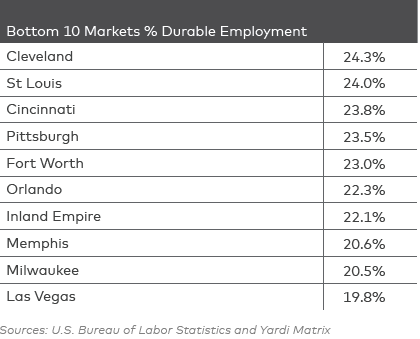
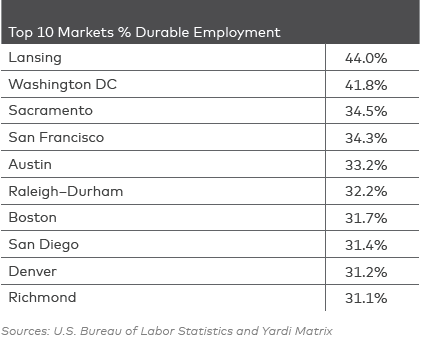
Keeping jobs during downturns, often called “durable employment,” shows up much more in some cities than in others, according to new research from Yardi Matrix.

Job stability is key to tenants being able to pay rent in the multifamily industry, as well as to landlords who are struggling to collect rent during the pandemic.

Employment losses caused by the COVID-19 pandemic have been unevenly spread across the economy, so  Yardi Matrix  studied which metros have the highest concentration of jobs in finance, professional and technical services, and government—sectors that have lost the lowest proportion of jobs.

“Metros with the highest percentage of durable jobs generally are home to a government cap­ital, state university and/or strong presence of knowledge-based industries,” the report says.

Metros with the most durable jobs

  • Lansing, Mich. – 44 percent
  • Washington, D.C. – 41 percent
  • Sacramento – 34.5 percent

“All of which include fed­eral or state government capitals. The Lansing/ Ann Arbor metro also is home to the University of Michigan and Michigan State University.

“Washington has for decades been among the most consistently performing U.S. metro for com­mercial real estate because of the stability afford­ed by being the capital of the U.S. government. The presence of government-related industries that include lobbying, legal, trade groups, founda­tions, think tanks, etc., gives the metro an employ­ment base that is extremely stable,” the report says.
Cities That Keep the Most Jobs During Downturns

Finance jobs also help keep cities stable

Jobs in banking, insurance and real estate also help with “durable” jobs.

Roughly two-thirds (33) of the Yardi Matrix top 50 metros are above the na­tional average, which reflects the concentration of financial jobs in urban centers.

Metros with the highest percentage of jobs in this sector are:

  • New Haven, Conn. – 9.5 percent
  • Dallas – 9.3 percent
  • Jacksonville – 9.3 percent
  • Phoenix – 9.2 percent
  • Tampa – 8.8 percent

Jobs During Downturns Conclusion

“The goal of this study was to determine metros’ exposure to the job segments that have per­formed the best at the outset of the pandemic. The upshot is that having a base of government jobs (including state universities) and/or concen­trations of knowledge-based industries including (but not limited to) finance and technology should help metros weather the downturn,” the report says.

“Questions remain about the economy in com­ing quarters. Our study was based on jobs lost through April, and the composition of job losses may evolve. For example, government has lost rel­atively few jobs so far, but we could see massive layoffs of state employees if the federal govern­ment doesn’t provide aid to states. And the job picture could change rapidly as states begin to re­open. Most unemployment claims have been filed by furloughed workers that are subject to call­backs as the economies of those states reopen,” Yardi Matrix says in the report.

Download the full report here: Special research bulletin: Which Metros Have the Most Durable Employment Sectors?

Job Postings Still Strong for Apartment Industry

Sign Up For Our Newsletter And Get Apartment News And Helpful, Useful Content Each Week.

* indicates required


4 Types of Problem Tenants and How to Deal with Them

4 Types of Problem Tenants and How to Deal with Them

Problem tenants are time-consuming so here are some suggestions on how to handle things from Keepe the maintenance company.

Every property manager will at some point have to deal with a problem tenant. In fact, you might already be dealing with a few of them. If so, you know how challenging it can be to get them to modify their behavior so that things go back to being copasetic for you, them, and the other tenants in the building.

In this article, we go over a few types of problem tenants and the steps you should take when dealing with them.

No. 1 – Noisy Tenants

Every rental property has one or two tenants who are known for their loud music, chattering, and disturbance.

If your tenant is intentionally or unintentionally disturbing their neighbors, ask them why they’re doing it and come up with a compromise. For example, if they are musicians and their practice sessions are too loud, ask them to either rent a studio or install soundproofing sheets to their wall. If the issue continues, you may request that they leave the apartment based on failure to adhere to peaceful living conditions.

No. 2 – Late-Rent Payment or Non-Paying Tenants

Everybody faces financial problems at some point in their life.

But what happens when your tenant is always weeks or even months behind on their rent payments? Do you evict them at once or continue giving them a period of grace? While your humane side may want to provide them with more time to pay, especially if it is their first time, maintaining a rental property costs money.

The best ways to handle this issue is to offer your tenants the option to include roommates in the lease agreement to split the rent or allow the tenant to break the lease by simply asking them to leave.

No 3 – The Complainers

Some renters, you hardly hear from.

Others call regularly, making one unnecessary request after another: The AC doesn’t seem to be working quite right (though it’s been checked out twice in three days); there’s not enough hot water; a door is sticking – and so on. There are calls even about minor things you’d expect them to handle themselves or the lease require that they do.

The best way to handle these types of tenants or issues is to politely but firmly address the tenant about the lease and their responsibilities.

No. 4 – Destroyers

On the list of most common problems with renters, property damage comes right after late rent payers.

A common and costly mistake that most property managers make is to rush into action and lock the tenant out of the apartment without taking the proper steps and precautions.

You may end up losing the entire security deposit and even get sued by the tenant for spoiled food and utility bills. In some states, you may be fined up to $100 per day if the tenant is locked out of the rental.

If your tenant is still in the apartment, you’ll need to provide a notice-of-intent-to-enter-the-premises form, which will allow you to document any damages. Upon documentation of the damages, you may request that the tenant leave the unit.

Problem tenants conclusion

Dealing with problem tenants can be tiring and time-consuming. The best way to avoid renting your property to problem tenants is to prequalify all intending renters.

About Keepe:

Keepe is an on-demand maintenance solution for property managers and independent landlords. The company makes a network of hundreds of independent contractors and handymen available for maintenance projects at rental properties. Keepe is available in the Greater Seattle area, Greater Phoenix area, San Francisco Bay area, Portland, San Diego and is coming soon to an area near you. Learn more about Keepe at https://www.keepe.com.

4 Types of Problem Tenants and How to Deal with Them
Photo credit Concepts via istockphoto.com

Common Tenant Complaints and How to Handle Them

Sign Up For Our Newsletter And Get Apartment News And Helpful, Useful Content Each Week.

* indicates required


Residential Rental Companies Lose $4.6 Million Annually to Fraudulent Rental Applications

Are Fraudulent Rental Applications a Risk to Your Business?

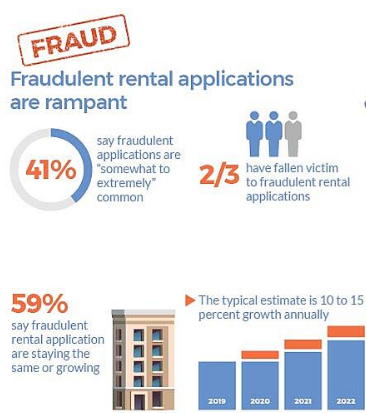
Two-thirds of property managers say they’ve fallen victim to fraudulent rental applications, which drive higher evictions, property damage, and criminal activity, according to a new survey.

Applicant fraud has increased nine percent month-over-month since the COVID-19 crisis hit—a likely response to the current economic climate as well as recent changes to local and state eviction moratoriums, according to the 2020 Fraud in the Rental Industry Survey from Snappt.

The typical property manager reports that 15 percent of their online rental applications exhibit obvious fraud, with an additional 10 percent of fraudulent applications slipping through unnoticed.

“There are a number of factors that are fueling the increase in fraudulent rental applications,” said Daniel Berlind, CEO and co-founder of Snappt, in the release.

“The increasing number of self-employed applicants, a move to online rental applications, and the increasing availability of tools to fraudulently alter financial documentation, all make the problem more common,” he said.

Two in five (41 percent) property managers say fraudulent applications are somewhat to extremely common; they report an annual eviction rate of 12 percent.

Thirty-four percent reported annual eviction rates of 20 percent or higher.

Residential Rental Companies Lose $4.6 Million Annually to Fraudulent Rental Applications

Fraudulent rental applications can involve document alterations

According to the survey, one of the biggest issues is spotting fraudulent documents. Using the documents provided by applicants, property managers must look for alterations manually.

The survey said that those taking the survey report it takes four hours to vet an application and one in five report it takes more than 10 hours. Fifty-eight percent rate this task as somewhat to extremely challenging and half say it takes too long to do manually.

Top rental application issues

The top five problems reported by property managers who allowed tenants slip through with fraudulent rental applications in leases include:

  • Costs associated with having to evict bad tenants
  • Physical damage to the property
  • Missing out on renting to good tenants
  • Criminal activity at the property
  • Loss of reputation

The full ‘2020 Fraud in the Rental Industry’ survey is available at www.snappt.com/confronting-costs-tenant-fraud

About Snappt

Snappt, a Los Angeles based real estate technology company, provides data-driven fraud detection services that can accurately spot fraudulent documentation. Snappt is used by three of the top six property management firms in the country, the company says.

Are Fraudulent Rental Applications a Risk to Your Business?

Sign Up For Our Newsletter And Get Apartment News And Helpful, Useful Content Each Week.

* indicates required


In a 1031 Exchange? Why waiting until after COVID-19 to complete your exchange could potentially be a bad idea

Kay Properties and 1031 and 1033 exchanges and eminent domain options details

As a result of the COVID-19 pandemic the IRS issued Notice 2020-23 which provided a multitude of tax extensions including the extension of the 1031 exchange deadlines. The typical investor in a 1031 exchange will have 45 days from the sale date to identify a replacement property, and 180 days to complete the purchase of that same property. With the IRS’ notice the 45-day, and 180-day deadline has been extended until July 15th 2020 for anyone who originally had their 45th day, or their 180th day fall between April 1, 2020 and July 15th 2020.

One example of how this could affect someone in a 1031 exchange would be if they had sold their property on April 3, 2020 their 45th day would have been May 18, 2020 and they would have had to formally identify their replacement property by then. Under the new guidelines if they completed their sale on April 3, 2020 they would have until July 15, 2020 to identify a replacement property.

While the extensions were provided for good reason, the unintended consequence may result in demand for quality exchangeable real estate exceeding the available supply in the first two weeks of July. Alex Madden, Vice President with Kay Properties and Investments explained “The sale of a property often requires many months to complete and we have seen many of those sales move forward during COVID-19, but very few new offerings have come to the market for 1031 exchange investors to use as a replacement property. With exchangers extending their identification and purchase dates until July 15th it is a very real possibility that they may face fierce competition over replacement properties when they do finally need to complete their exchange. I don’t think we have ever had a time in America where every single 1031 exchanger had the same deadline date.”

Many localities have seen a significant drop in real estate listings since the outbreak of COVID-19 which means there may be less properties available for investors who are in the midst of a 1031 exchange. With less real estate coming to market one potential outcome for affected 1031 exchangers may result in overpaying for a replacement property.

Madden went on to say “We have seen a slowdown in the real estate sector during COVID-19, and a result may potentially be that ‘turn-key’ 1031 exchange solutions like Delaware Statutory Trust offerings (DSTs) could become more scare. 1031 exchange investors may prefer products like the DST as the deadline approaches because the financing, and due-diligence are already in place and it’s possible to complete a purchase in three to five business days typically.”

Many 1031 exchange investors are rightly taking a re-evaluation of the marketplace in the midst of the COVID-19 pandemic, but with every 1031 exchanger in America facing the exact same deadline on July 15th there is a very real potential for overpayment, deals to fall through, and maybe even failed exchanges for those who wait until the last moment due to inventory running dry.

About Kay Properties and www.kpi1031.com

 Kay Properties is a national Delaware Statutory Trust (DST) investment firm. The www.kpi1031.com platform provides access to the marketplace of DSTs from over 25 different sponsor companies, custom DSTs only available to Kay clients, independent advice on DST sponsor companies, full due diligence and vetting on each DST (typically 20-40 DSTs) and a DST secondary market.  Kay Properties team members collectively have over 115 years of real estate experience, are licensed in all 50 states, and have participated in over 15 Billion of DST 1031 investments.

This material does not constitute an offer to sell nor a solicitation of an offer to buy any security. Such offers can be made only by the confidential Private Placement Memorandum (the “Memorandum”). Please read the entire Memorandum paying special attention to the risk section prior investing.  IRC Section 1031, IRC Section 1033 and IRC Section 721 are complex tax codes therefore you should consult your tax or legal professional for details regarding your situation.  There are material risks associated with investing in real estate securities including illiquidity, vacancies, general market conditions and competition, lack of operating history, interest rate risks, general risks of owning/operating commercial and multifamily properties, financing risks, potential adverse tax consequences, general economic risks, development risks and long hold periods. There is a risk of loss of the entire investment principal. Past performance is not a guarantee of future results. Potential cash flow, potential returns and potential appreciation are not guaranteed.

Securities offered through WealthForge Securities, LLC. Member FINRA/SIPC. Kay Properties and Investments, LLC and WealthForge Securities, LLC are separate entities.

Job Postings Still Strong for Apartment Industry

Job Postings Still Strong for Apartment Industry

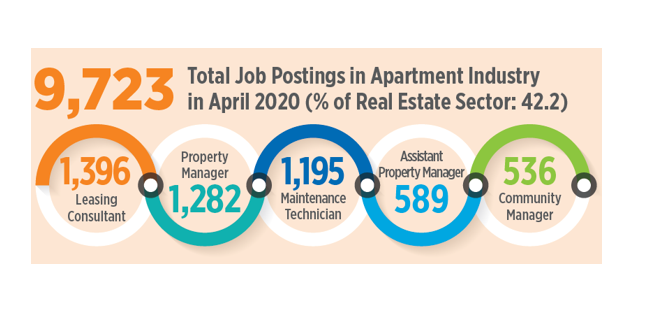
Job postings for the apartment industry have seen little fluctuation during the pandemic so far, as more than 9,700 apartment jobs were available during April, accounting for 42.2 percent of the broader real estate sector, according to the National Apartment Association.

While the coronavirus has caused devastating effects on the labor market – the U.S unemployment rate in April experienced the largest monthly increase in history, climbing 10.3 percentage points to 14.7 percent – the apartment industry did not see the same impact.

According to data from Burning Glass Technologies, between mid-March and the second week of April, online job postings declined by 30 percent compared to the beginning of 2020, according to the NAAEI Apartment Jobs Snapshot April 2020.

Markets that ranked highest for vacancies included San Antonio, Houston, Austin, Kansas City, and San Diego.

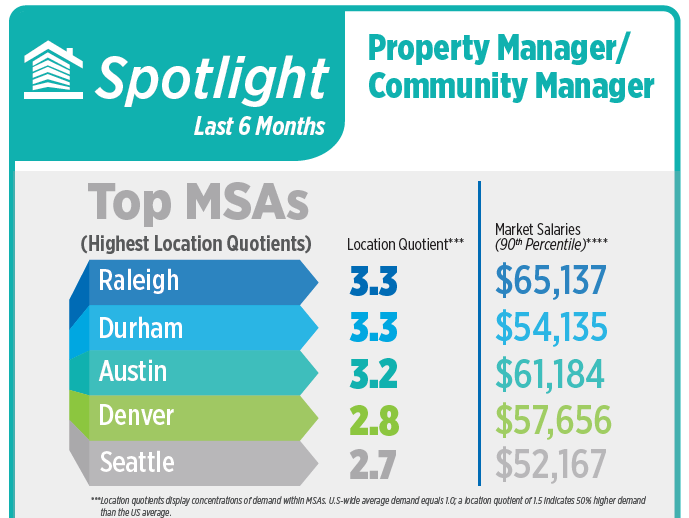
This month’s edition of the jobs report highlights property manager/community manager positions, with a median salary of $58,411.

In addition to property-management experience, employers are seeking candidates with strong budgeting skills, staff-management skills, and experience with propert- management software.

Salaries for property managers were particularly competitive in Raleigh, as demand for experienced professionals was more than three times the national average.

Job Postings Still Strong for Apartment Industry

National apartment association jobs report background

“Our education institute is a credentialing body for the apartment industry. They hear often that one of the biggest problems keeping our industry leaders up at night is the difficulty in finding talent, attracting talent and retaining talent,” NAAEI’s Paula Munger said.  “Labor-market issues are happening in a lot of industries, certainly with the tight labor market we have.”

Assistant Property Manager Jobs In Demand

So NAA partnered with Burning Glass Technologies. “They have a labor-job posting database that is proprietary,” she said, and they can “layer on data from the Bureau of Labor Statistics (BLS). We looked at that and thought we could do something that is really going to help the industry and help benchmark job titles and trends as we go forward.”

Demand for Apartment Jobs Reached Record Levels In 2019

Sign Up For Our Newsletter And Get Apartment News And Helpful, Useful Content Each Week.

* indicates required


Ask Landlord Hank: How Do We Get Our Renters to Move So Family Can Move In?

Ask Landlord Hank: How Do We Get Our Renters to Move So Family Can Move In?

In this week’s Ask Landlord Hank question, he gives his thoughts on  how to get renters to move out so family can move in the time of eviction moratoria and covid-19.

Dear Landlord Hank: I generously gave my current renters three months’ notice in February, as I have family I need to rent to. The tenants were agreeable, but then the virus hit and they hadn’t been looking because they thought they had plenty of time.

They are now refusing to leave, despite having the money to pay rent, saying that there is nothing I can do because of the moratorium. My brother has been affected and needs a place to live as soon as possible. Is there a way I can legally evict them for landlord causes? It sounded like the moratorium potentially could go until August!

-Jennifer

Dear Landlady Jennifer,

The Federal Housing Finance Agency recently announced that the eviction moratorium on single-family homes would be extended until June 30, 2020.

This only applies if you have a mortgage held by Fannie Mae or Freddie Mac.  “During this national health emergency, no one should be forced from their home,” wrote FHFA Director Mark Calabria. “Extending the foreclosure and eviction moratoriums protects homeowners and renters with an enterprise-backed mortgage, and provides certainty for families.”

All that being said, this is for single-family homes. Do you have a multifamily structure, OR a single-family home with no mortgage or a mortgage NOT held by Fannie Mae or Freddie Mac?

I would contact my local court system and talk to someone there for advice, then call the local sheriff’s department to see if they are enforcing dispossessory actions right now.

Depending upon what you find out, if you don’t get the information you need, then contact an attorney that specializes in landlord-tenant law.

This is a very tough time for all of us right now. The good part of this equation is that you are still receiving your rent on this property.

Sincerely,

Hank Rossi

Renting during the moratorium ask Landlord Hank

Ask Landlord Hank Your Question

Ask veteran landlord and property manager Hank Rossi your questions from tenant screening to leases to pets and more! He provides answers each week to landlords.

  • This field is for validation purposes and should be left unchanged.

Visit the Ask Landlord Hank Page Here For More Questions And Answers

Ask Landlord Hank: What Should We Do About A Hoarder?

Sign Up For Our Newsletter And Get Apartment News And Helpful, Useful Content Each Week.

* indicates required


Manage in the Past and Forget the Present

Property management advice from David PickronManage in the Past and Forget the Present

Property management advice from expert David Pickron suggests looking to the past to find the renters who will pay you in the future, and put emphasis on three things when you are qualifying applicants.

By David Pickron
RentPefect

There is a famous statement that reads, “Live in the present and forget the past.”  Rarely do we hear “live in the past and forget the present,” but right now we find ourselves in tough times, managing our properties in a slightly different way than we used to.

Everyone is focused on social distancing in showings, move-in or move-out inspections, and work orders. But I want you to think about this question: “Is an eviction from April 2020 to August 2020 the same as an eviction a year ago, when we saw the best economic numbers this nation has ever seen?”

Unemployment was at a record low in all categories and the jobs market was booming for all income levels.  Now we find ourselves looking at 36 million unemployment claims to date and only growing.

Businesses have been forced to close by state governments to stop the spread of Covid-19.  Many state governors have stopped evictions, and the Federal Cares Act prohibits filing evictions for 120 days ending July 26, 2020.  In all estimates, this country will see record eviction filings in August, when landlords who were limited by the Cares Act have the green light to process evictions on those who are delinquent.

Most people won’t be able to get from under three to four months of past-due rent.  Will good people get caught up in this mess?  Yes.  Will many of them be great renters in the future?  Yes.  So my property management advice is maybe it’s time to look to the past – and forget the present – to find those next renters who will be with you paying rent for the next five years.

Property management advice?

Consider putting more weight on these three items as you qualify your applicants over the next couple years:

  • First, pay attention to time. How were the applicants doing prior to March of 2020?  Did they have any blemishes or an eviction in the previous?  Did they have any judgments or negative credit prior to COVID-19?  Would you have rented to them in February of 2020?
  • Second, analyze their employment. Were they employed throughout COVID-19 but still had an eviction?  Maybe they took advantage of the situation when it was presented to them.  That is much different from a restaurant worker whose job was taken by government mandate.  No matter what the situation is, can they pay the rent today?  Do they have a current stable job moving forward?  Check their paycheck stubs; specifically their year-to-date totals, to get an idea of how long they have been working.  A call to the employer might be necessary if a paycheck stub cannot be produced.  I personally ask for two paycheck stubs.  It’s easy to doctor up one, but to change two paycheck stubs and make all the year-to-date figures match is too much work for a scam artist. An emergency-room nurse in my neighborhood was furloughed by the local hospital because no one was coming to the emergency room.  You might think all medical personnel should have kept their jobs, but with elective surgeries stopped by most governors, all trades were affected, not just restaurants, tattoo shops and bowling alleys.  Steady employment through these times is going to be hard to find in the rental world for the next couple years.
  • Third, a good rental verification will give you information a credit bureau cannot. Last-year evictions were removed from credit bureaus.  There are only two ways to find evictions now: doing a direct court search of civil filings, or calling past landlords.  Many landlords have been coached by their attorney to only give out move-in and move-out data, but other landlords will give you more than you want.  Most of the time if a landlord did not get their rent, they want to protect other landlords and will spill the beans.  But be cautious because if a tenant is really bad, a current landlord will say anything to get rid of them.  I always advise my clients to go two landlords back to get the truth.  A past landlord has nothing to lose and the truth will come out.

In 2009, I took a chance on three families who had lost their homes to foreclosure. They are still with me 10 years later.  These were people who had homeowner mentalities, renting my homes.  They went through a tough time with their homes being underwater and losing those homes, but they kept their heads high and knew that they were caught up in in forces outside their control.

We will find people in the same situation here.  I believe some of our best renters will come from people who had a great past, but rocky present.

About the author:

Property management advice from David Pickron

David Pickron is the President of Crimshield and Rent Perfect in Mesa, Arizona.

7 Issues And Answers About Renting To Felons

Sign Up For Our Newsletter And Get Apartment News And Helpful, Useful Content Each Week.

* indicates required


Tips for Controlling Your Insurance Costs

Tips for Controlling Your Insurance Costs

With property and liability rates continuing to rise after several years of costly catastrophes, not to mention the current financial challenges of the COVID-19 pandemic, investment property owners are likely looking for ways to control insurance costs and maximize ROI.

So, how do you control your insurance costs without jeopardizing coverage?

Shop your rates with multiple carriers

Work with an independent agent that is contracted with several carriers and programs AND understands your unique needs as an investor.

This allows your property to be considered by several different carriers that may have a very different approach to the risk in question. Carefully review the differences between the cost options presented to you, as cheaper is not always better. Know what is and is not covered, and what you are giving up for a lower rate. Never jeopardize peace of mind to save a few bucks.
Be sure you know what type of loss settlement method you will be subject to in the event of a loss – Replacement Cost or Actual Cash Value. Replacement Cost can be a 20-25% higher rate but provides you the opportunity to recover depreciation. Consider your plan for the property in the event of a total loss. If you would choose not to rebuild, you would be overpaying with Replacement Cost coverage. Just be sure you are adhering to any requirements from your lending institution.

Consider a higher deductible

Your deductible is the amount you are comfortable self-insuring.

And the higher your deductible, the lower your insurance rate. Increasing your property deductible from $1,000 to $5,000 could save you as much as 25%.
For a good gauge on the deductible you may be comfortable with, consider the minimum claim you would turn in, then double it. Look also at opportunities to increase the deductible on certain perils, such as Wind/Hail or Water Damage, especially if you have past claims for these types of losses.
Carefully consider what claims you file. A property claim (regardless of size) can increase your premium for as much as five years following a loss. This means you may pay more in increased premiums over time than you would by just paying out-of-pocket for a $500 or $1,000 loss.

Make your property more resistant to a loss

By properly managing your investment properties you may be able to avoid preventable losses and demonstrate to your insurer that you are serious about risk management.

Many carriers will provide credits on their rates for working hardwired smoke detectors, central station burglar alarms and sprinkler systems. Install Carbon Monoxide detectors and fire extinguishers. Upgrade old electrical systems, furnace, and HVACs.
Be sure that you or your property manager are regularly visiting the property to perform routine inspections and maintenance.

Where not to cut corners

While property damage represents more controllable or “known” expenses, do not skimp on Liability coverage, where potential losses are unknown.

Carry as much as you can afford, with a minimum of $1,000,000 per occurrence and $2,000,000 aggregate annually. Lower limits save little money and can leave you and your business dangerously exposed in the event of a serious liability suit.
If your policy has co-insurance, don’t be tempted to insure your property to a lower value to save on premium. This can come back to bite you in a loss.

What other coverage you should consider

Cyber crimes like social engineering, hacking and wire fraud increasingly target small and mid-size businesses.

As a landlord or property manager, you are exposed to cyber risk every time you send or receive an email, collect rent online, or use an online tenant screening tool. Cyber insurance can provide coverage for the cost to respond and recover from a data breach.
Following the 9/11 attacks, insurers increasingly began excluding acts of terrorism from a standard commercial insurance policy. If you own a large number of properties in a concentrated geographic area, standalone Terrorism coverage to fill this gap may be a consideration for you.
Depending on the location of your rental properties, consider additional endorsements for excluded natural disasters. Flooding is the number one natural disaster risk in the United States; and the risk is increasing. Earthquakes and sinkholes are also excluded perils you may consider a separate policy for, though not always available in all states.

Now is the time to work with your agent and take all necessary measures you can to control your insurance costs.

National Real Estate Insurance Group is a national, independent insurance agency, offering the largest Insurance Program in the country built specifically to meet the needs of rental property owners and their property managers. The Program allows investors or their property managers to manage property and liability insurance for portfolios of any size, on one or multiple accounts, on the same schedule, with monthly reporting and payment options. To get your no obligation proposal, visit nreig.com/rentalhousingjournal or call 887-741-8454.

A Rise in Work From Home Could Lead to a New Suburban Boom

A Rise in Work From Home Could Lead to a New Suburban Boom

Now that more than half of employed Americans (56 percent) have had the opportunity to work from home, a vast majority want to continue, at least occasionally, according to a new survey from Zillow.

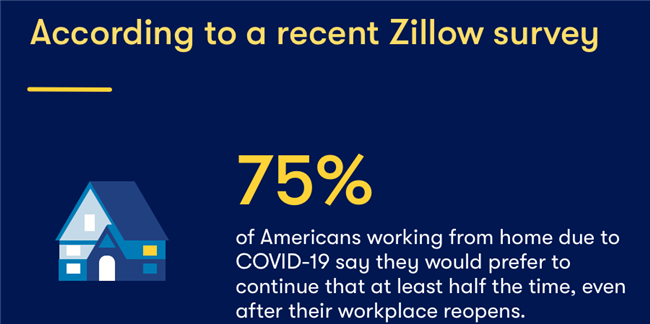
The survey, conducted last week by The Harris Poll, finds that 75 percent of Americans working from home due to COVID-19 say they would prefer to continue that at least half the time, if given the option, after the pandemic subsides.

Two-thirds of employees working from home due to COVID-19 (66 percent) would be at least somewhat likely to consider moving if they had the flexibility to work from home as often as they want.  Only 24 percent of Americans overall say they thought about moving as a result of spending more time at home due to social-distancing recommendations.

The Pew Research Center found that prior to COVID-19, only seven percent of civilian workers in the United States had the option to work from home as a workplace benefit, though 40 percent worked in jobs that could potentially be performed remotely.

Recent Zillow research suggests more Americans are at least looking at their housing options. In mid-April, page views of for-sale listings on Zillow were 18 percent higher than in 2019.

A Rise in Work From Home Could Lead to a New Suburban Boom

A Rise in Work From Home Could Lead to a New Suburban Boom

Work from home opens new location opportunity

Where people choose to live has traditionally been tied to where they work, a dynamic that through the past decade spurred extreme home-value growth and an affordability crisis in coastal job centers.

But the post-pandemic recovery could mitigate or even produce the opposite effect and drive a boom in secondary cities and exurbs, prompted not by a fear of density but by a seismic shift toward remote work.

Many employed Americans are trying to square the desire to work remotely with the functionality and size of their existing homes.  Among employees who would be likely to consider moving, If given the flexibility to work from home when they want, nearly a third say they would consider moving in order to live in a home with a dedicated office space (31 percent), to live in a larger home (30 percent), and to live in a home with more rooms (29 percent).

A Zillow analysis finds 46 percent of current households have a spare bedroom that could be used as an office.  But that percentage drops off by more than 10 points in dense, expensive metros such as Los Angeles, New York, San Jose, San Francisco and San Diego, where far fewer homes have spare rooms.

When it comes time to move, homebuyers who can work remotely may seek out more space — both indoor and outdoor — farther outside city limits, where they can find larger homes within their budgets.

“Moving away from the central core has traditionally offered affordability at the cost of your time and gas money. Relaxing those costs by working remotely could mean more households choose those larger homes farther out, easing price pressure on urban and inner-suburban areas,” said Zillow senior principal economist, Skylar Olsen, in a release. “However, that means they’d also be moving farther from a wider variety of restaurants, shops, yoga studios and art galleries. Given the value many place on access to such amenities, we’re not talking about the rise of the rural homesteader on a large scale. Future growth under broader remote work would still favor suburban communities or secondary cities that offer those amenities along with more spacious homes and larger lots,” Olsen said.

“We are seeing more buyers looking to leave the city,” said Bic DeCaro, a member of Zillow’s Agent Advisory Board serving Washington, D.C., and Northern Virginia, in the release.

“Buyers, who just a few months ago were looking for walkability, are now looking for extra land to go along with more square footage.”

No daily commute sets up new work from home options

Previous Zillow research found that renters, buyers and sellers overwhelmingly agree that the longest one-way commute they’d be willing to accept when considering a new home or job was 30 minutes.

This new survey from Zillow and The Harris Poll finds those priorities appear to change if people have the flexibility to work from home regularly. When given that option, half of those who are able to do their job from home (50 percent) say they would be open to a commute that was up to 45 minutes or longer.

In most major cities, living close to downtown comes at a price. A previous Zillow analysis found that in 29 of the nation’s 33 largest metro markets, buyers can expect to pay more per square foot for a home within a 15-minute rush-hour drive to the downtown core.

If buyers and renters are not burdened by a five-day-a-week commute, housing in the exurbs, secondary cities and remote bedroom communities may become viable and affordable options.

5 Online Tools for Managing Your Rental Properties Remotely

Sign Up For Our Newsletter And Get Apartment News And Helpful, Useful Content Each Week.

* indicates required


Seattle City Council Sets Rules for Unpaid-Rent Installment Payments

Seattle City Council Sets Rules for Unpaid-Rent Installment Payments

The Seattle City Council has approved rules to create rent installment payment plans between renters and landlords to pay back rent that has become overdue during the coronavirus pandemic, according to a release.

Council Bill 119788 creates rental-payment plans on a specific installment schedule, setting tenants on a path toward becoming current on overdue rent and meeting their contractual obligations.

“I’ve heard from many renters that are worried about a lump sum due once moratoriums on evictions are lifted,” said Council President M. Lorena González in the release.

“Coupled with Seattle’s defense for evictions, this legislation gives renters more time to become current on their rent, and clearly spells out payment plans between renters and landlords based on a best practice already being used by the industry.

“Those that are able to pay their rent, should. But for those who face financial hardships and are unable to pay their rent, this legislation will ensure that tenants can stay in their homes and landlords can be made financially whole. For every eviction we’re able to prevent, that means more stability for workers and families who need more time to find their footing as our region recovers from this health crisis and the economic fallout,” González said.

Rent installment payment plan

The legislation was drafted in collaboration with Councilmember Lisa Herbold (District 1, West Seattle & South Park), who proposed tenants should not have to pay late fees and interest associated with non-payment of rent for a year to provide tenants more time to recover.

“Local and state eviction moratoriums have encouraged tenants to work on developing payment plans with their landlords, without providing details or advice. This legislation is a common-sense approach that gives more concrete guidance through a default plan, one that is good for both landlords and tenants,” Herbold said in the release.

Tenants and landlords are able to come up with and agree on their own payment plans, but if necessary, the legislation outlines a “default plan.”

The default plan requires that if the tenant is overdue on rent, they must pay it back in set, consecutive, equal monthly installments as follows:

  • Up to one month or less of rent must be paid back in three installments;
  • Over one month and up to two months of rent must be paid back in five installments; and
  • Over two months of rent must be paid back in six installments.

The legislation builds up González’s eviction defense for renters, which was passed by the council on May 4.

The legislation also complements Gov. Jay Inslee’s existing moratorium on evictions and direction for landlords and tenants to use payment plans.

Seattle Adds an Inability-to-Pay Defense to Eviction Protection For Six Months

Seattle City Council Sets Rules for Unpaid-Rent Installment Payments
Photo credit Pra-chid via istockphoto.com

Sign Up For Our Newsletter And Get Apartment News And Helpful, Useful Content Each Week.

* indicates required