Home Blog Page 142

Rent Growth Shows Significant 1-Month Decline

Coronavirus Causes Biggest Annual Rent-Growth Slowdown in at Least 5 Years

Top metro markets are showing negative rent growth on a month-over-month basis, according to the latest Multifamily National Report from Yardi Matrix.

“With April’s unemployment rate soaring to 14.7 percent, further pain is likely in the coming months,” Yardi Matrix says in the report.

“April rents signaled the beginning of trouble, growing by 1.6 percent on a year-over-year basis but declining eight dollars from March. This marks the biggest one-month decline in our dataset, including during the Great Recession, and puts rents right back where they were in August 2019.

“The pain in rents is likely to be intensified for the lifestyle-asset class, as major cities struggle with younger people extinguishing their leases and moving home,” the report says.

Rent-growth report highlights

  • April rent growth began to show signs of reversal, as the country moved into month two of stay-at home orders. April collections were strong, based on data published by the National Multifamily Housing Council, despite more than 33 million Americans filing for unemployment in the last seven weeks.
  • Many states have begun to relax their shelter-in-place rules, but returning to life outside of lockdown will require changes to normal daily life for some time, absent http://www.papsociety.org/accutane-isotretinoin/ a pharmaceutical solution.
  • Major gateway markets and tech hubs have already seen declining rents on a month-over-month basis. Many of these markets have had some of the highest COVID-19 infections in the country, while others seemed unscathed. While pain will be felt nationwide, tourist-based and oil-heavy markets will likely be the hardest hit.

The report points out that while reports show 90 percent of residents made rent payments in April, and May looks strong as well, it was likely that stimulus checks and unemployment payments helped tenants make those payments.

The report cautions that “with the additional $600 in unemployment insurance provided through the CARES Act ending in July, many renters might choose to conserve their cash in the coming months as evictions are paused in many cities and states.

“Residents’ notices to vacate are down in the renter-by-necessity class, as well, as they choose to stay put, especially in more affordable units,” the report says.

As states and cities start to relax rules and non-essential businesses begin to reopen their doors, “the question remains whether Americans will want to return to work in the short term.

“Right now, 38 states replace at least 100 percent of lost income through unemployment insurance,” the report says. “Plus with the CARES Act providing an additional $600 weekly on top of this through July, “the short-term incentive to work is diminishing—especially in lower-cost states.”

April Rent Collection Better Than Expected; May is a Concern

Sign Up For Our Newsletter And Get Apartment News And Helpful, Useful Content Each Week.

* indicates required


Common Tenant Complaints and How to Handle Them

Common Tenant Complaints and How to Handle Them

Working as a property manager requires you to deal with common tenant complaints and  tenants’ requests  around the clock, so here are some suggestions on how to handle things from Keepe the maintenance company.

Handling tenants’ complaints quickly and in the right manner can go a long way in improving tenant satisfaction and retention rates. Below are some of the most common tenant complaints and how you can handle them as a property manager.

Maintenance Complaint

 With maintenance issues being the major problem affecting tenants, the first step to handling this type of complaint is to create an effective maintenance-complaint communication channel.

An easy way is to have a lease that includes specific instructions on how to raise a maintenance request, the expected response time, and what to do in case of an emergency.

For example, many property-management companies now ask their tenants to send in an online maintenance request in order to simplify the process and allow easy tracking. Most importantly, remember to keep all tenant maintenance complaints in writing to the event of future disputes.

Lack of Communication

 In any relationship, communication is key. Property manager-tenant relationships are no different, and they require regular communication. No tenants want to deal with a property manager who is unavailable, rarely answers the phone, or doesn’t respond to email.

While some complaints may be unimportant, it is important that you acknowledge the emails or calls depending on your availability. You can set up an email autoresponder that acknowledges email if there’s a need. Good tenants are difficult to find and if you fail to communicate with yours, then another property manager will win them over.

Noisy Neighbors

 In the United States, there are roughly 111 million people living in rental buildings. Going by this number, clashes are bound to occur among tenants and fellow residents. If a tenant complains about another tenant, it is best you attend to the complaint quickly and avoid taking sides.

Take for instance, if a tenant complains about another tenant’s loud music, animal, or loud chattering. Begin by addressing the tenants separately, to avoid escalating the dispute. If you fail to address the complaint, you likely are going to lose one tenant or create unwanted chaos between the two.

Lack of Privacy

 Tenants tend to become very displeased if the property manager comes barging in too often, or with too little notice.

It’s not just a matter of respect and politeness. You are required by law to notify a tenant at least 24 hours before entering. The only exception is if there’s a direct emergency and the property is jeopardized.

Always make sure to announce your visits well ahead of time, and ensure that the tenant receives the notice. It’s good to use trackable methods, in order to avoid confusion. This will help you avoid disputes and tenant complaints in the future.

Pests

 Pest infestation is a serious situation that must be handled at once.

There are many pests that will make your tenants uncomfortable. They often constitute a real health hazard, and tenants won’t be happy if they feel like you don’t care about their health and safety.

These infestations can make living in the residence unbearable and force people from their homes. In many cases, your property itself is also in danger. Keep this in mind and invest in preventing pests. And make sure that infestations get dealt with right away, to minimize tenant complaints.

About Keepe:

Keepe is an on-demand maintenance solution for property managers and independent landlords. The company makes a network of hundreds of independent contractors and handymen available for maintenance projects at rental properties. Keepe is available in the Greater Seattle area, Greater Phoenix area, San Francisco Bay area, Portland, San Diego and is coming soon to an area near you. Learn more about Keepe at https://www.keepe.com

5 Ways to Stay Connected To Tenants During Social Distancing

5 Online Tools for Managing Your Rental Properties Remotely

Common Tenant Complaints and How to Handle Them
Photo credit fizkes via istockimages.com

Sign Up For Our Newsletter And Get Apartment News And Helpful, Useful Content Each Week.

* indicates required


Landlord Regulations – Should I Just Give Up?

Landlord Regulations – Should I Just Give Up?

Veteran property manager Cory Brewer weighs in on landlord regulations.

By Cory Brewer

Here in Washington, and specifically in Seattle, the residential rental-housing community has faced wave after wave of new legislation over the past five years or so.

Similar things have been taking place with our neighbors to the south, in Oregon and California with landlord regulations.

Anecdotally, we hear “enough is enough, I’m selling,” from rental-housing providers in the area, and we have even heard this from our own clients.

But I am here to offer some words of encouragement to the landlord who is thinking about walking away from his or her investment property. I’ll start with this: “Don’t panic.”

Rather than get too specific (details of the Seattle winter-eviction ban, and last year’s SB 5600 “eviction reform” bill, have been well-documented), I’d like to speak in more of a general sense about what I see happening in the local legal community. There is a very vocal group (or groups) of people who have identified landlords – scratch that, HOUSING PROVIDERS – as a key contributor to the very real homelessness problem that we face in our region.

They paint a very unfortunate “Us-vs.-Them” picture.

Time after time, lawmakers and policy drafters are looking for a solution by manipulating the relationship between landlords and tenants with landlord regulations. I suppose it’s an easy target, and an easy public-opinion campaign to manipulate. But the reality is that a unique chain of events takes place for each person that ultimately faces eviction or homelessness, and there are other ways that lawmakers can attempt to assist without placing unfair risk in the laps of landlords. Many of those other solutions, such as providing more mental-health counseling, http://affectivebrain.com/?attachment_id=5775 are far more complicated than slapping a new restriction on a landlord.

That said, I am encouraged by what I have seen transpire in legal proceedings thus far in 2020.

While the winter-eviction ban still poses some serious questions about infringement upon property owners’ rights, the perspective of the “small landlord” is fortunately being heard in a more significant way than in years past.

Thanks in large part to grass- roots efforts by landlords, property managers, and professional organizations such as the Rental Housing Association (RHAWA) and NARPM, the voice of the “small landlord” is being heard.

Representation of the “small landlord” is my primary objective in my role at my property management firm, and that is the perspective I write from.

As a quick example, the original proposal for a winter eviction ban in Seattle would have captured all rental properties across the board. What ended up passing makes an exemption for landlords who own four or fewer rental housing units. So there is a silver lining for your everyday, “regular” investor (as opposed to large corporations). I am by no means endorsing the winter eviction ban be applied to landlords of any shape or size, I’m just saying that the mom-and-pop types were factored heavily in the final version of the law.

We are seeing this type of consideration at the state level, as well.

Landlord regulations

Bills were introduced this year covering a wide range of aspects within the landlord/tenant relationship, chiefly among them rent control and just cause. I think we’re all familiar with the concept of rent control, so I will not elaborate here other than to say it was voted down and is not an immediate concern in Washington (we’ll talk again next year), and that the version passed recently in Oregon is more of an anti-gouging measure, at least in its initial roll-out.

Just as importantly, there was a bill proposed that would effectively turn every term lease into a month-to-month tenancy after the first 12 months, and thus subject to a just-cause eviction process. This would have been a potentially devastating blow to the stock of single-family rental-housing supply, and fortunately there were enough lawmakers in Washington wise enough to recognize this.

It’s not uncommon for a small landlord to put a home up for rent on a temporary basis – say a year or two – while they move out of the area on a work assignment. They intend to move back, so they don’t want to sell and they don’t want it to sit empty, either (their insurance provider might not be too happy about it if they did!). So they offer the home into the pool of available rental housing, and in the process they do the community a much-needed favor. It is crucial that this homeowner be allowed to set very specific term-expiration dates on their leases. Compare this situation to a large corporate landlord running thousands of apartment units … their goals for tenant occupancy two to three years down the road are quite different from the goals of the small, temporary landlord described here.

Every time I’ve personally had a chance to speak to a lawmaker in Washington, on any level, I continue to make the argument that blanket policy on landlord regulations does not work.

Considerations have to be made for the different types of landlords out there, the different types of properties that are being offered for rent, and the different priorities and perspectives that people have.

I am encouraged that this message seems to be resonating. And my message to the housing provider who is worried about what legislation might come along next? To them, I say “Perhaps it’s time you speak with a property manager.” We are doing everything we can to ensure that rental property remains a solid investment option, which translates to contribution of housing supply. A win-win!

The personal involvement of housing providers is important, too. Write your representatives when you have concerns, and tell your side of the story. Often times these policies are proposed without a thorough review of the unintended consequences. As we’ve seen so far in 2020, the more we can band together and make our voices heard, the better.

We should all be working together – landlords, tenants, and lawmakers alike – toward the common goal of sufficient, successful, affordable housing for everyone, and policies that incentivize investors to make the supply of rental housing available in the first place.

About the author:

Cory Brewer is the General Manager at Windermere Property Management / Lori Gill & Associates. Cory oversees a team of property managers in the Greater Seattle Area with a portfolio of approximately 1,500 rental properties. Active in the local real-estate community since 2003, he has held his current position since 2011. Cory may be reached via www.wpmnorthwest.com or coryb@windermere.com

Seattle City Council Member Wants City Rent Control

Seattle Mayor Signs Emergency Order Placing Moratorium on Evictions

Sign Up For Our Newsletter And Get Apartment News And Helpful, Useful Content Each Week.

* indicates required


More Americans Missed Housing Payments in May

More Americans Missed Housing Payments in May

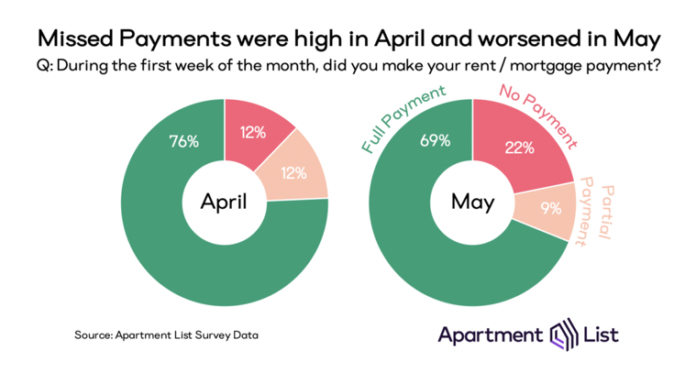
A recent survey shows missed housing payments jumped in May, showing that 31 percent failed to make their full housing payment compared to 24 percent in April, Apartment List says in the survey.

“Our May survey paints an even more distressing picture than the data we collected in April. The share of housing payments made in full during the first week of the month fell by seven percentage points, from the 76 percent in April to 69 percent in May,” Apartment List says in the survey report.

“The number of Americans unable to make any first-week housing payments shot up by over 80 percent. Fortunately, we continue to see landlords and lenders agreeing to concessions to arrive at alternative arrangements in light of widespread income loss.

“Also. seven percent of mortgage loans are now in forbearance, and 10 percent of renters state that their landlord or property manager proactively lowered their May rent. Forty percent of renters who have not paid their May rent report that they have agreed to terms for reduced or deferred rent with their landlord,” the report says.

Key findings from the missed housing payments report:

  • 22 percent of respondents have not yet made a housing payment for May, and an additional nine percent have made only a partial payment. Missed payments remain common for renters and homeowners alike.
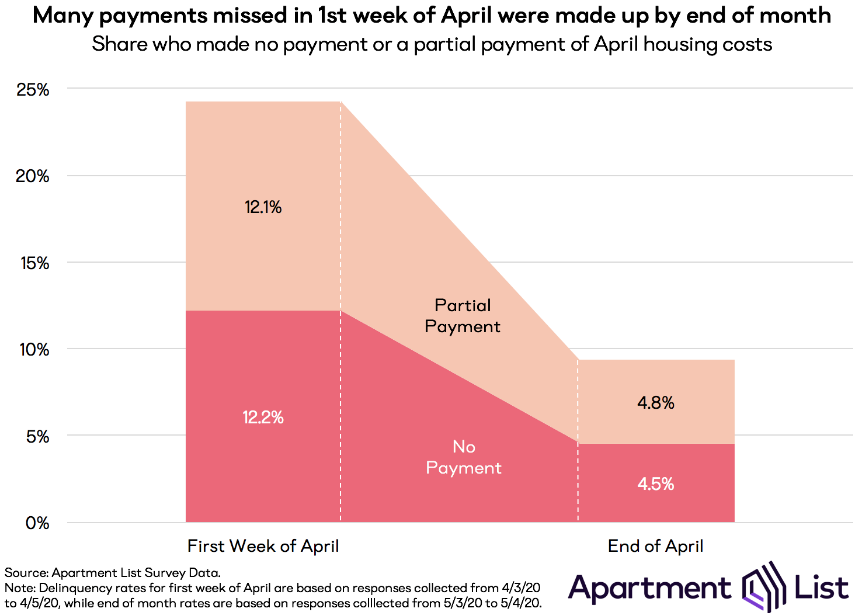
  • More than half of households that couldn’t pay their April bill on time eventually closed the gap with late payments. By the end of the month, just nine percent of Americans left a portion of their April rent or mortgage unpaid.
  • Working from home continues to be a key factor in affording rent or mortgage. Remote workers had the lowest May delinquency rate (20 percent) among any group surveyed.
  • Despite May’s missed payments, optimism is improving. This month, a greater share of respondents said they are confident they will be able to continue affording housing through June, despite shelter-in-place restrictions.

“While it’s certainly promising that many missed April payments were made up over the course of the month, we see evidence that renters and homeowners who struggled last month are continuing to have difficulty.

More Americans Missed Housing Payments in May

“In fact, financial strain is spreading even to those that made their April payment in full. For those who made their April payment but needed extra time to do so, 70 percent were unable to make a full housing payment in early May. And for those who were not able to complete their April payments, the May non-payment rate skyrockets to 92 percent.

“May is proving to be a challenging month even for those who were in a good financial position in April,” the report says.

April Rent Collection Better Than Expected; May is a Concern

Sign Up For Our Newsletter And Get Apartment News And Helpful, Useful Content Each Week.

* indicates required


5 Ways to Stay Connected To Tenants During Social Distancing

5 Ways to Stay Connected To Tenants During Social Distancing

Staying connected to tenants can be difficult under current quarantine guidelines, with many tenants beginning to experience cabin fever as a result of the lack of constant connection so here are some ideas from Keepe.com the maintenance company.

Property managers are used to regularly engaging in person with their residents — and social distancing has made this increasingly difficult. Without face-to-face communication, some tenants may feel isolated or lonely, which is why it’s essential to stay connected and to build a sense of community.

One of the significant challenges faced by property managers is keeping their residents, owners, and themselves connected while still providing excellent service. Fortunately, technology has become a bridge over social distances.

Below are creative new ways to maintain a sense of community with your tenants while adhering to social distancing.

Organize Games for Your Community Online

Just because you and your tenants are social distancing doesn’t mean you can’t have fun. You can start by organizing a game night once a week to engage your residents in a fun, friendly competition via online games. You can send out multiplayer-game app invitations to your tenants to join in the fun. Games such as Uno & FriendsWords with Friends, and Bunch can be easy to play and accommodate multiple players. Additionally, you can also organize an online trivia or Taboo night if your residents are not tech-savvy, using a chat service like Skype or Kahoot.

Organize Virtual Exercise 

Exercise not only helps you and your tenants stay in shape; it improves your immune system. A great way to help your tenants stay active while indoors is by sharing virtual fitness resources. You can also offer your tenants a free monthly fitness membership to live-streaming fitness platforms. Websites such as Peloton AppCorepower Yoga, or Beachbody On Demand are great options for virtual group fitness.

Keep Your Tenant Kids Occupied

Due to the lockdown, the majority of your tenants’ kids are at home and likely not engaging in any educational-related activity. You can start by sending online educational resources or games to their parents to keep their kids busy. Online learning platform such as PBSCool Math 4 Kids, and Arcademics contains educational resources to keep their children engaged.

Give Back to Your Tenants 

Staying connected to your tenants goes beyond playing online game with your tenants. It involves giving back to those tenants who have been with you over the years. The shutdown of businesses has led to a massive layoff of workers across the country. Tenants are continually worried about their finances and welfare. Some of the best ways to give back to your tenants could include sharing groceries or giving them rent breaks.

Video calls 

The advent of online video-messaging platforms has made it easy for people around the world to connect via the internet. You can engage in a video conference with your tenants via apps such as Facebook live, Skype, and Zoom. This allows you to see and hear directly from your tenants about any maintenance, welfare, and health issues they may be facing. You can participate in celebrations with your tenants via video calls.

In conclusion

In times of hardship, community is everything. With digital technology and a little creativity, you can find unique ways to continue to engage with your tenants — and do so safely. Be sure to provide plenty of resources and to stay in touch virtually, so they know you’re in this together.

About Keepe:

Keepe is an on-demand maintenance solution for property managers and independent landlords. The company makes a network of hundreds of independent contractors and handymen available for maintenance projects at rental properties. Keepe is available in the Greater Seattle area, Greater Phoenix area, San Francisco Bay area, Portland, San Diego and is coming soon to an area near you. Learn more about Keepe at https://www.keepe.com

5 Online Tools for Managing Your Rental Properties Remotely

Sign Up For Our Newsletter And Get Apartment News And Helpful, Useful Content Each Week.

* indicates required


Seattle Adds an Inability-to-Pay Defense to Eviction Protection For Six Months

Seattle Adds an Inability-to-Pay Defense to Eviction Protection For Six Months

In an effort to provide renters with more protection against evictions, the Seattle City Council created an inability-to-pay defense that renters can use in eviction court for six months after the city’s eviction moratorium ends on June 4.

This new legislation provides an additional eviction defense for an additional six months after the City’s eviction moratorium is lifted, according to a release.

Council President M. Lorena González said in the release, “After the immediate health crisis is over, we know the economic ripple effects will be felt for some time. Tenants who have lost their jobs or seen their income significantly dropped during this pandemic need time to find their way back to economic stability.

“This legislation provides tenants recovering from this crisis an additional six months of housing stability through an added defense in eviction proceedings after the city’s eviction moratorium ends. Tenants may use this defense if needed, but this bill does not release renters of their contractual obligations to pay their monthly rent. If you are a tenant who can afford to pay your rent in full, you absolutely should.”

Council Bill 119784 provides Seattle renters eviction protection in several ways.

  1. After the city’s moratorium on residential evictions ends, the legislation provides a defense a tenant may use for six months should a landlord take their tenant to eviction court.
  2. The tenant can use non-payment of rent for any reason as a defense to eviction, as long as they submit a declaration of financial hardship to the court.

Additionally, González introduced a second bill that would more clearly set up payment plans for back rent between tenants and landlords.

Council Bill 119788, which creates payment plans during the COVID-19 crisis and six months afterwards for tenants to use payment plans on a specific installment schedule towards becoming current on overdue rent and meeting their contractual obligations. This legislation was modeled after ‘best practices’ currently used by landlords and tenants.

“The goal of these two pieces of legislation is to create more breathing room and flexibility for tenants as thousands wait for unemployment insurance as well as cash and/or rental assistance,” González said in the release.

“It is my hope that we can continue to invest in programs like Home Base at the City and I will continue to advocate for tenants, homeowners, and small landlords with partners in state and federal government in COVID-19 relief packages for more rental assistance and mortgage relief.  My office has heard from many constituents impacted by this crisis, and while we know that relief is on the way, we need additional tools to keep people housed and not further exacerbate the homelessness and affordable housing shortage crisis in Seattle.”

Seattle Mayor Signs Emergency Order Placing Moratorium on Evictions

Sign Up For Our Newsletter And Get Apartment News And Helpful, Useful Content Each Week.

* indicates required


5 Ways Property Managers Can Help Tenants Who Have Been Laid Off

5 Ways Property Managers Can Help Tenants Who Have Been Laid Off

Here are 5 ways property managers can help tenants who might be struggling right now.

By Justin Becker
Property Manager

There is no denying that the coronavirus has come crashing into the world and changed it forever. It is amazing how this virus has affected almost every aspect of our day-to-day lives.

From our jobs to the way we grocery shop, no matter where you turn, everything is just a bit different these days. If you were trying to move, finding apartments for rent is a bit more difficult, because getting in to view available apartments can be hard. Another option is to search for mobile homes for rent, as these might give you a bit more space during this time of social distancing.

When it comes to jobs, there are a record number of Americans currently on unemployment. It can be scary not knowing when or if you are going to get another paycheck.

Additionally, property managers are taking a hit as they do not know for sure that they are going to be receiving rent checks from many of their tenants. If you currently have tenants that have been laid off, it is important to make sure that you are keeping an open mind and trying to help these tenants however you can. So here are 5 ways property managers can help tenants.

1. Rental-Assistance Programs

As a property manager, the chances are high that you rely on rent payments to pay your bills. When your tenants are unable to pay their rent, you suffer as well.

Offering information about the different rental-assistance programs that are available in your community can be extremely helpful. There is a good chance that many of your tenants are not aware of these types of programs.

You can print up flyers with information about these rental-assistance programs and place them in common areas of your apartment complex. You might even slide the flyers under doors or put them in mailboxes to ensure that your tenants receive this information.

2. Post Job Opportunities

With most of the economy shut down, jobs can be difficult to come by. However, there are still some places that are hiring.

Many grocery stores are hiring temporary employees to help out, as stores are currently seeing more and more business.

Restaurants that offer delivery and carryout are often still hiring as well. Many factories are still running their operations and are likely hiring. Perhaps you need some part-time help around the property and can hire a tenant to do the jobs as a form of their rent payment. As a property manager, you know your area well.

Reach out to some of the larger businesses in town and ask if they are currently hiring. You can post ads around your apartment complex each week as a way to let people know that there are jobs available in your area.

3. Provide a List of Local Food Banks

Along with being unable to pay their rent in full, many of your tenants might also be struggling with having enough food to eat.

Local food banks are seeing a rise in the number of people needing their services. If your tenants are unemployed or laid off, there is a good chance that they are struggling with buying food. Providing information about the local food banks offering services in your area is a good idea. This can help your tenants find resources for getting the food that they need during this time.

Additionally, there is a chance that you have tenants who are still working and have a bit extra to give right now. Organizing a food drive to donate to your local food banks is a great way to help out at this time. You might even want to volunteer at these organizations, as they are really needing some extra help.

4. Encourage Communication

It is very important to make sure that you keep the lines of communication open with your tenants.

You need people to know that you are willing to work with them in these unprecedented times. Offer assistance when necessary.

Perhaps your tenants can make partial payments each week. Some type of payment -plan agreement can be helpful to those who are struggling and can help ensure that you still have some sort of income coming in.

Not only should you be communicating with your tenants about their rent, but you should let them know all of the extra steps you are taking to help keep the area safe. Some of the safety measures you are taking might include the extra cleaning that is being done, offering sanitizer in public areas such as the mailboxes, and keeping amenities such as gyms, pools, basketball and tennis courts, closed during this time. Here are some more tips.

5. Community Challenges

This type of social distancing is hard on everyone. After all, we are social beings and enjoy spending time with other humans.

One way that you could bring your rental community together is to create a community challenge. This could be something like a nicest-yard challenge or a best-decorated-window challenge. You could even try a scavenger hunt where participants have to find things, and post them on your website.

There are many different creative games and other things that you can come up with in order to engage your tenants and let them know that you are here to help. The prize could be a credit towards their next rental payment. This can be a fun way to provide your renters with a bit of relief.

5 Ways Property Managers Can Help Tenants Conclusion

When it comes to helping your tenants who have lost their jobs, permanently or temporarily, there are many creative ways that you can help them make their rental payments and take a little pressure off both them and you during the current environment.

5 Tips to Keep Your Rental Safe and Healthy During COVID-19 

Sign Up For Our Newsletter And Get Apartment News And Helpful, Useful Content Each Week.

* indicates required


How To Update And Improve Fitness Equipment And Facilities During Covid-19

How To Update And Improve Fitness Equipment And Facilities During Covid-19

Ruben Mejia
SportsArt

Apartment residents across the United States are currently confined to their apartments due to COVID-19 stay-at-home orders.

As a result, fitness rooms, rooftop, ground and indoor pools are closed. That’s why this is the perfect time for building owners, landlords and management companies to reevaluate which updates can be made to the apartment buildings or apartment complexes.

High-speed wifi, updated fitness equipment and cleaning enhancements are amenities that owners should consider updating now, while the gyms are vacant.  New and existing tenants will benefit from these upgrades.

Fitness Centers

For building owners who want to upgrade their fitness centers and equipment, adding sustainable gym equipment is an option they should consider. These environmentally friendly machines enable users to produce electricity for the fitness center they work out at, while offsetting their own carbon footprint. This type of energy-producing equipment can be plugged into a standard outlet and generate watts that are converted to AC power and sent back into the power grid. The energy that is produced will help power lights, fans, TVs and other appliances connected to the same power grid. Through SportsArt’s SA Well+, a green fitness brand that develops sustainable gym equipment, users are able to track their workout and how much energy they produced.

Bacteria and Equipment

This may astound you, as it did me when I first read about a study conducted by FitRated. According to the study, the average exercise bike has 39 times more bacteria than a cafeteria tray; free weights have 362 times more germs that a toilet seat.

That’s why disinfectant-wipe stations should be available throughout buildings and fitness centers, as a way for tenants working out to clean their equipment when finished. Another feature to consider adding to the fitness center that can help assure health safety is rubber floors. Rubber mats are easy to sanitize with a mop, are water-resistant and help prevent mildew and mold from forming. Wipe stations and rubber flooring are easy additions to make while your building’s fitness center is closed, and they also ensure safety of the users once reopened.

How To Update And Improve Fitness Equipment And Facilities During Covid-19

Updating existing amenities

Tenants rely on reliable internet connections, especially these days because their homes have suddenly turned into their offices.

In an effort to make working from home easier and the transition smoother for tenants, building owners should consider looking into high speed wifi connections. Good and fast internet are necessary for everything tenants do, now more than ever before. Additional amenities to consider updating during this time include bike racks, laundry facilities and outdoor facilities (such as grilling stations and landscaping). As people are looking for excuses to get outside while we’re cooped up inside all day, having an outdoor space for an escape is a huge plus. According to Scientific Reports, at least 120 minutes a week spent outside is associated with good health and well-being. Simply providing benches, grills and gardens that tenants can escape to can reduce stress and anxiousness when these feelings are at an all-time high.

Building owners who are looking for ways to spice up their amenity offerings have an opportunity to plan and make updates that can promote better health and wellbeing for their tenants. As we are all living in uncertain times, tenants are appreciative to see their owners taking concerns and safety into consideration. This down time is a great way to reevaluate offerings and see what improvements can be made.

About the author:

How To Update And Improve Fitness Equipment And Facilities During Covid-19

Ruben Mejia, Executive Vice President for SportsArt Americas, has five years of experience in the fitness industry, previously holding the title of chief technology officer (CTO) at SportsArt. Prior to his work at the company, Mejia held leadership roles within the technology and ecommerce spaces. In 2000, after serving four years of active duty in the Army, Mejia began working in the corporate IT and telecommunications fields for the Department of Defense, launching his career and interest in the technology industry as a whole.


Ask Landlord Hank: What Should We Do About A Hoarder?

Ask Landlord Hank: What Should We Do About A Hoarder?

In this week’s Ask Landlord Hank question, he gives his thoughts on dealing with a hoarder tenant in the time of eviction moratoria and covid-19.

Dear Landlord Hank:

Twenty years ago, we rented the lower part of a duplex to a couple. After about 15 years, she died. Her husband stayed and has really trashed this apartment with his hoarding illness. He has stacks of newspapers that he refuses to recycle, saying “I haven’t read them yet.” The kitchen is all stacked with stuff that makes it unusable. There is a two-foot path through the whole place. He is a smoker, which doubles our worry about this hoarder situation. I didn’t mention that the unit is in Ohio. Does that make a difference in whether he is protected from being evicted in Ohio?

-Beth

Dear Landlady Beth,

I hope you have a lease with your tenant. Most leases will have a section regarding “Use of Premises,” usually saying that the tenant shall maintain the premises in a clean and sanitary condition and not disturb surrounding residents or the peaceful and quiet enjoyment of the premises or surrounding premises.

The hoarding, which in some states is considered a mental health disorder, would clearly be in violation of this section of the lease https://www.pharmacybc.com/valium-diazepam/.

I would put a “Notice to Cure” on the tenant’s door or hand it to him, stating that the tenant has 10 days to comply with the lease provision or he could be evicted.

Depending upon Ohio state statutes and local ordinances, the hoarding could be considered a “public nuisance” and your tenant could face the prospect of conviction of a misdemeanor.

I would act today to take care of this and either have the tenant clean up or move out.

You will most likely have to evict and clean up yourself. An older person who is a smoker, in a paper-filled environment, seems like a recipe for disaster to me. Good luck.

Sincerely,

Hank Rossi

Ask Landlord Hank Your Question

Ask veteran landlord and property manager Hank Rossi your questions from tenant screening to leases to pets and more! He provides answers each week to landlords.

  • This field is for validation purposes and should be left unchanged.

Dealing with a hoarder who is a tenant during the moratorium ask Landlord Hank

Ask Landlord Hank: What’s Your Advice On Renting During the Moratorium on Evictions?

Unintended Issues Presented by COVID-19 Moratoria

Unintended Issues Presented by COVID-19 Moratoria

Bradley S. Kraus
Attorney at Law, Warren Allen, LLP

There is an old saying often uttered by attorneys: “Bad facts make bad law.” If COVID-19 has taught landlords anything, it can be summarized by playing off that phrase; as in, “bad laws make for bad situations for everyone.”

When I use the phrase “bad laws,” it is not to suggest that things like the current eviction moratoria do not serve a purpose. The problem with such laws/moratoria is that they are crafted by lawmakers who fail to see—or understand—the entirety of the picture. When that occurs, there are unintended consequences, two of which come to mind.

1. Fiscal Issues Related to COVID-19 Moratoria

Landlords are no doubt keeping watch on cries for rent waivers and rent strikes. As I stated in a previous article, such a concept would quickly be challenged, assuming adequate reciprocal protections for landlords were not in place.

Rent strikes have no legal basis and would send harmful ripple effects through our society beyond the scope of this article.

Many landlords have asked me about how they should approach the continual build-up of past-due balances related to rent and utilities.

As to rent, it is important to note that rent remains due under every moratoria in place as of this writing, meaning you will not waive your ability to collect the unpaid rent, even if you don’t communicate with your tenants regarding the same.

As to other amounts, waiver could become an issue, should you potentially trigger the waiver statute. If you are concerned about waiver as to these amounts, speak to your attorney regarding a waiver-prevention notice under ORS 90.412. This will allow you to (a) preserve your ability to act on the debt down the road, and (b) allow you to accept rent without fear of waiving those amounts.
Finally, it is important for landlords to understand the benefits of individualized advice and forms in these odd times. Many landlords with properties in other states may seek to use a “one-size-fits-all” form for issues regarding their Oregon properties.

While some may work, others may contain legally inaccurate language. I have noticed a rise in tenants’ attorneys attacking these forms in various ways and threatening legal action. Such problems can be avoided with up-to-date advice.

2. Conduct Issues during COVID-19

One of the bigger unintended consequences of the COVID-19 court shutdowns is the inability to deal with bad tenants.

Contrary to misconceptions held by some lawmakers, bad tenants are not just a landlord problem. Bad tenants make life miserable for other tenants, who want nothing more then to live peacefully.

At this juncture, with courts setting cases out to June, even if a landlord were to serve a termination notice upon a bad tenant and file an eviction action based upon the same, that bad tenant will likely receive weeks to continue to make life miserable for other tenants and the landlord.

What should a landlord do in that situation?

  • First, do not let the current court closures prevent you from taking actions to protect other tenants. This includes service of notices of termination as allowed by law. While tenants and landlords affected by COVID-19 deserve protections, bad tenants should not reap the benefits of the same.
  • Second, keep in mind that your other tenants may seek to point the finger at you if you sit on your hands and allow bad tenants to run rampant. While the inability to get into court due to moratoria likely presents a landlord a solid defense, exercising what rights you currently have—and/or contacting the proper authorities where needed—will hopefully keep the victim tenants happy and cause them to direct their anger to the appropriate party.

Final Thoughts On Unintended Issues Of Covid-19

COVID-19 is fundamentally changing every aspect of our society.

While I believe landlords are taking more than their fair share of the problems that stem from COVID-19, the current holding pattern in which we find ourselves will pass in time. Staying on top of your books and holding problem tenants accountable to the extent you are able will set you up for success when we resume our new normal.

About the author:

Brad Kraus Portland Attorney Unintended Issues Presented by COVID-19 Moratoria
Brad Kraus

kraus@warrenallen.com
503-255-8795

Brad Kraus is an attorney at Warren Allen LLP. His primary practice area is Landlord/Tenant law, but he also assists clients with various litigation matters, probate matters, real estate disputes, and family law matters. A native of New Ulm, Minnesota, he continues to root for Minnesota sports teams in his free time. He is an avid sports fan, enjoys exercise, spending time friends and his fiancée, Vicky. You can reach Mr. Kraus via email at kraus@warrenallen.com, or by phone at 503-255-8795.

COVID-19: Landlord/Tenant Law in the Age of Global Pandemic

Unintended Issues Presented by COVID-19 Moratoria
Photo credit designer491 via istockphoto.com