This week the question for Ask Landlord Hank comes from a landlord asking whether he can evict tenants who have damaged his rental. Remember Hank is not an attorney and is not giving legal advice.
Dear Landlord Hank,
Tenants of 10 years have done substantial damage to the home, not normal wear and tear, but that could be subjective upon the beliefs of a judge.
The home needs a complete renovation that cannot be completed with tenants living in the home. Can they be evicted because the home has become unsafe to continue to inhabit? Without being responsible to pay their rent or moving costs for them to move out?
–Yvonne
Dear Landlady Yvonne,
We now have a federal moratorium on evictions until the end of the year, and the interpretation of the order varies from one jurisdiction to another and from one judge to another.
If these tenants are paying rent and are satisfied to stay in their rental for now, I would not rock the boat.
You can always renovate when their lease is up.
When the eviction moratorium has ended, the courts will likely be packed – meaning the time it normally takes to evict a tenant will be substantially increased, and it could take months.
If you feel that you can’t wait and want to move forward now, I would engage an attorney that specializes in landlord/tenant law, as they will be up to date on the situation in your county. Good luck.
Sincerely,
Hank Rossi
On the question of whether to evict tenants due to damage Hank says, “If these tenants are paying rent and are satisfied to stay in their rental for now, I would not rock the boat.”
Ask Landlord Hank Your Question
Ask veteran landlord and property manager Hank Rossi your questions from tenant screening to leases to pets and more! He provides answers each week to landlords.
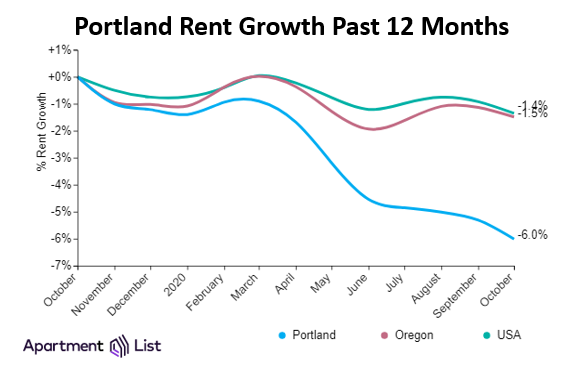
Portland rents declined again last month for the seventh straight month, while rent continues to increase in some cities in the metro area, according to the latest report from Apartment List.
Portland rents were down 0.7 percent over the past month, and have decreased sharply by 6.0 percent year-over-year.
Portland’s year-over-year rent growth lags the state average of -1.5 percent, as well as the national average of -1.4 percent.
Median rents in Portland are $1,146 for a one-bedroom apartment and $1,336 for a two-bedroom.
“As the COVID-19 pandemic and its ensuing economic fallout continue to overwhelm renters across the country, our monthly rent estimates paint the picture of a protracted national slowdown and uneven recovery,” said Chris Salviati, housing economist at Apartment List.
“Our national rent index is down 1.4 percent year-over-year, but there is tremendous regional variation beneath the surface. San Francisco and New York City continue to lead the nation in pandemic rent drops, while smaller markets like Boise and Colorado Springs are heating up,” Salviati said.
While Portland rents declined, the metro was a different story.
Rents rising across cities in the Portland Metro
While rent decreases have been occurring in the city of Portland over the past year, cities in the rest of the metro are seeing the opposite trend.
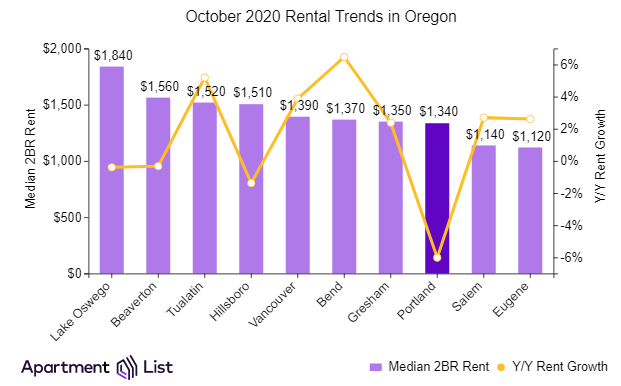
Rents are up in six of the 10 cities in the Portland metro for which Apartment List has data.
For example, Tualatin rents have increased 0.6 percent over the past month, and have increased significantly by 5.2 percent in comparison to the same time last year. Median rents in Tualatin are $1,404 for a one-bedroom apartment and $1,519 for a two-bedroom.
This is the fourth straight month that the city has seen rent increases.
And in Vancouver, rents have increased 0.4 percent over the past month, and have increased moderately by 3.9 percent year-over-year. Median rents in Vancouver are $1,180 for a one-bedroom apartment and $1,394 for a two-bedroom. This is the fifth straight month that the city has seen rent increases.
However, Beaverton and Lake Oswego, two of the more expensive rent locations in the metro, have both seen declines. Beaverton was down 0.7 percent in the past month and Lake Oswego down 0.6 percent.
Eugene, Salem Rents Continue Steady Growth
Eugene rents have increased 0.2 percent over the past month, and are up moderately by 2.6 percent year-over-year, according to the most recent report from Apartment List.
This is the eleventh straight month that the city has seen rent increases.
Currently, median rents in Eugene are $843 for a one-bedroom apartment and $1,120 for a two-bedroom.
Salem rent trends were flat over the past month
While Salem rents remained flat over the past month they have increased moderately by 2.7 percent year-over-year.
Currently, median rents in Salem stand at $874 for a one-bedroom apartment and $1,138 for a two-bedroom.
Tenants spending more time indoors can mean issues for landlords such as tenant-on-tenant discrimination which attorney Bradley Kraus takes on this month.
As the calendar turns, 2020 rages on towards its eventual—and merciful—end. Winter is almost upon us, which means many people are indoors more often than not. Unfortunately, that increased indoor time can mean more tenant-on-tenant disputes. While seasoned landlords are no strangers to handling such situations, one particular situation, tenant-on-tenant discrimination, requires additional discussion—and immediate action.
Buried within the Oregon Administrative Rules is OAR 839-005-0206, which details specific theories of discrimination involving housing in Oregon. One particular section involves landlords:
(5) Tenant-on-tenant harassment: A housing provider is liable for a resident’s harassment of another resident when the housing provider knew or should have known of the conduct, unless the housing provider took immediate and appropriate corrective action.
What this administrative rule reads as is a theory of liability for tenants against their landlord if they are harassed by other tenants, based on a protected status if the landlord did not take “immediate and appropriate corrective action.” Such exposure may seem strange, but some courts have already previously determined that the Fair Housing Act contains the same protections for tenants. If the landlord knew, or should have known, of tenant-on-tenant discrimination, and failed to take action, the victim tenant may sue the landlord based on this discrimination.
Tenant-on- tenant discrimination – what does this mean for landlords?
First, a landlord should do as they always do with tenant disputes. If complaints or disputes between tenants arise, take proper investigative measures to determine what actually happened. This would involve interviewing the parties, witnesses, and reviewing any other written statements or documents provided.
Second, creating a log book and/or incident report can assist down the road in recreating what, if anything, happened. Landlords should utilize/create such items anyway as a best practice, as they are infinitely helpful in the event of litigation.
If it appears or is discovered that discriminatory language and/or conduct occurred, a landlord should take immediate action. This would include the property-termination notices under Oregon law. In the event of a he-said/she-said situation, it may behoove the landlord to defer on the side of aggressive action, as opposed to inaction. Fair Housing lawsuits are no laughing matter, often involving substantial attorney fees, costs, and stressful discovery processes, all of which could potentially be avoided through affirmative action.
As a landlord’s attorney, I have learned that not all tenant disputes are created equal.
Some are petty, and/or involve people that cannot be placated or made happy unless they live entirely away from one another. Some involve racism, discrimination, and/or bigotry, which should have no place in our world. While these are two extremes that do not encompass the entirety of tenant-on-tenant disputes, if a landlord finds himself or herself facing the latter of these two scenarios, working with your attorney on an aggressive response can be the difference between resolution and litigation.
About the author:
Brad Kraus is an attorney at Warren Allen LLP. His primary practice area is landlord/tenant law, but he also assists clients with various litigation matters, probate matters, real estate disputes, and family law matters. A native of New Ulm, Minnesota, he continues to root for Minnesota sports teams in his free time. He is an avid sports fan, enjoys exercise, and spending time with friends and his fiancée, Vicky. You can reach Mr. Kraus via email at kraus@warrenallen.com or by phone by 503-255-8795.
Western Wealth Capital recently acquired a 659-unit Tempe apartment complex, its 54th acquisition in the Phoenix market, and CEO Janet LePage discussed the current environment in a recent interview with Rental Housing Journal because we thought our readers would like to get to know her a little better.
The company is the second-largest Phoenix multifamily property owner, and LePage said, “Our investment there has been consistent. I mean, we took a pause with COVID. Everybody did, just to feel out what’s happening. For years I’ve spoken the same thing, that Phoenix is poised for growth and it’s poised for job growth.
“It’s an affordable city. It is a tax-attractive city. It really depends on what you’re coming there for. It’s affordable and it has remained that way. I think there’s a lot of runway before someone declares it not affordable when you’re comparing it to a San Francisco, L.A., New York or even Denver. I think there’s still a long runway before it’s declared not affordable.
CEO Janet LePage said, “For years I’ve spoken the same thing, that Phoenix is poised for growth and it’s poised for job growth.”
“We’ve always been in the workforce-housing space. The only thing that I’ve seen change with this COVID and everything is, the desirability for multifamily is only going up,” LePage said.
“You look at commercial and you look at retail and if you’re a real estate deployment fund of any kind, and you’ve been buying retail, you’re not buying it probably right now. Or, your strategy certainly changed (to) commercial too. Don’t know how to underwrite. Don’t know what the occupancy levels are going to be. We’re already seeing a shift into even more demand into the industrial and multifamily spaces.”
LePage said the other thing she is seeing is that in New York, California and some other states, collections have not been as strong.
“For more certainty, you’re seeing a shift in that demand is even more so coming into places like Phoenix. I’ve seen that in the open-market bidding, for sure. I think between the job market and affordability, Phoenix has performed incredibly well with respect to collections.
“The only worry I have is whether or not I’m going to be able to afford to keep buying there because people with a lot cheaper equity are coming in to compete. That’s what we’re seeing,” LePage said.
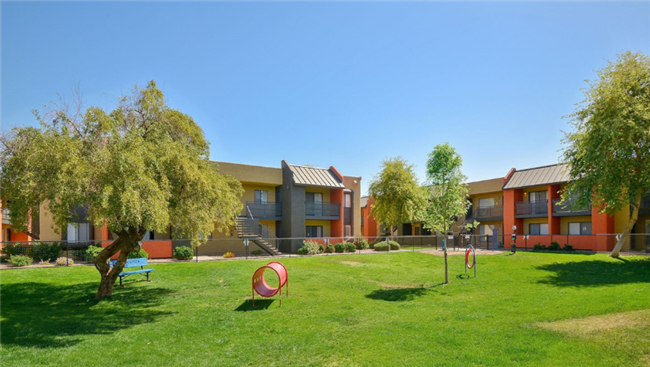
Western Wealth Capital acquired Onnix, a 659-unit apartment community in Tempe at 1500 E. Broadway Road.
How Did You Get Started In The Business?
Coming from Canada, LePage says she now considers Phoenix “our homeland.”
“I actually bought my first two investment homes in Phoenix during what I thought was a great market in 2008. The dollar was at par,” she said. Living in Vancouver, Canada, at the time, you couldn’t find “cash flow. The concept of cash flow didn’t exist.”
In 2008, even in the recession, “the fundamentals of Phoenix even at that time were strong,” she said. “We didn’t realize how much more of a recession was going to come to be.
“Those didn’t end up being the two best investments that I made. But I was spending a lot of time down there. I started flipping auction homes and I did that for two years while I worked full-time. Then I bought my first apartment building in Phoenix. “How much can you own up here in Canada?” she asks.
She said Phoenix has always been her favorite city in which to invest, and in early 2014, she left her corporate position and went forward just buying Phoenix multifamily properties. The company expanded outside Phoenix in late-2016 and early-2017. It now owns 78 multifamily properties; in addition to Phoenix, they are located in Houston, Dallas, Atlanta, and San Antonio.
Onnix was built in 1984 and features 38 apartment buildings, in addition to abundant parking. The community offers studio, one- and two-bedroom apartments with vaulted ceilings, oversized closets, private balconies or patios, granite countertops in kitchens, wood-style flooring and stainless-steel appliances.
Launch of the property management business
LePage said that up until a recently, the company only used third-party property management.
But in May, they launched Western Wealth Communities, their own property-management company, and now a third of their portfolio is managed by that company. Western Wealth Capital still uses third-party management for the other properties.
“I believe technology is such a big part of the future of property management. Quite frankly, technology’s very archaic in the property management industry. COVID has basically propelled that forward five years.”
LePage said that such things as the concept of virtual tours, contactless leases and paying by text became necessities because of the pandemic. She said the evolution was a priority because of limitations of some of the property-management companies they worked with.
“We’re able to remake it with today’s technology from top to bottom. I have seen huge value in the capabilities presented to us” due to the pandemic.
“Quite frankly, it should have changed a long time ago. The idea that you have to meet somebody during banking hours, Monday to Friday” to then tour a place to rent and print out paper to sign, “it’s not how the world works. Yet we’re still doing it in general terms in the property-management industry,” LePage said. “It wasn’t to change everything, but it’s certainly been a really good learning (experience) and we’ve seen great value in those technologies.”
When asked what LePage sees as the biggest challenge today in property management, she noted that the answer is different depending on whether you look at it from the owner’s side and the property-management side.
“As an owner, I would make different decisions than I would from the perspective of a property-management company,” LePage said. “Because both of you are paid differently. Multiple times I’ve crossed the bridge with property-management relationships” with the question, “How do we align this?
“Because you taking a fee (as a property-management company) versus what our NOI (net operating income) is, are two totally different drivers, and neither is wrong, but they actually don’t align. They just don’t, because the real wealth that my company and my investment partners make, isn’t the cash yield in that given year. It’s the value change in the overall property.”
She said having a good relationship with a property-management company certainly helps because “it’s a lean business. It’s a margin business. There’s not a ton of margin in there to make. We didn’t bridge that with the relationships we had. We had tight ones that understood it, but we never solved the complete alignment with it. I think that if property-management companies could get there that would be a huge win, a huge one.”
Onnix amenities include four resort-style pools with hammocks, barbeque grills, cabanas, a clubhouse featuring a full kitchen, large-screen television, full-size pool table and shuffleboard, as well as a sauna, dog park, yoga studio, tennis courts and sand volleyball courts. “One goal of this acquisition is to add value to the community as we maximize returns for investors and create an even better place to live for residents. Upgrades are planned for the property’s common areas to heighten their usability and desirability, which is part of the partnership’s focus on community engagement and resident programs,” said WWC CEO Janet LePage. “We are thrilled to add Onnix to our growing national portfolio.”
Property managers collecting rent are heroes right now
One thing the pandemic has also made LePage more aware of is property-management employees. She said property management companies must advocate for their employees.
“If a decision was made to close an office, because they thought that was best, was it best for the owner? There’s that trade-off, right?”
Another point she made is to look at the core competencies of relationships, knowing no one company can do it all. Some are better at some pieces, such as sales, but not all the elements of property management.
“Of course a company says it can do it all, but none of us are built that way. As we’re taking over our management, I’m not doing it on certain assets, unless that’s a core competency of ours. We have different diversified reasons for doing it.”
LePage said the hardest thing about property management is that “you have to wear your heart and your sword on the line at the same time.”
As to the property managers having to collect rent during the pandemic: “I mean, they’re heroes in my mind. The employees on site every day, they’re heroes, because (a) it’s scary, (b) it’s sad, and (c) they still need to collect rent. It’s this misconception that somehow, just because you’re an apartment building, there’s a ton of money there. It’s not, it’s leveraged by debts and expenses. Like the margin is tiny, but to go out and face that every day, that’s a challenge.
“I have so much respect for everyone who does it. So that’s been a big part of being an owner is recognizing – even though they’re not our employees- they’re still in my eyes, they’re still part of our team and recognizing them and motivating them is important because it’s really hard.”
She said her company tries hard as owners to let property managers know they are appreciated. “We recognize them and we buy lunches and gift cards. I’ve had people say, ‘For 28 years, I’ve never had an owner recognize me or know my name.’
“And I think to myself, that’s the easiest thing I could do to drive value for my company, or my asset, is if they go that bit above and beyond. It’s can be astronomical to the value of my company, like fixing the plumbing problem and caring enough to not call the plumber.”
Janet LePage is the co-founder and CEO of Western Wealth Capital. For the past decade, she has been focused on creating wealth through well-selected real estate investments. She has grown her precise business strategy from more than 50 residential transactions in Arizona to the purchase of multifamily buildings. Under LePage’s leadership, WWC has acquired 70+ multifamily properties, comprising more than 16,000 rental units, with a transactional value of more than $2.3 billion. In 2019, Janet was recognized in Canada’s Top 40 Under 40 for Business and RBC’s 2019 Canadian Female Entrepreneur of the Year.
Rental housing market fundamentals have remained strong despite COVID-19, and a new study shows the 20 healthiest rental housing markets in the United States.
For the study, Mynd Management analyzed occupancy-rate growth nationwide over the course of one year, from the second quarter of 2019 through the second quarter of 2020.
Healthy rental housing markets
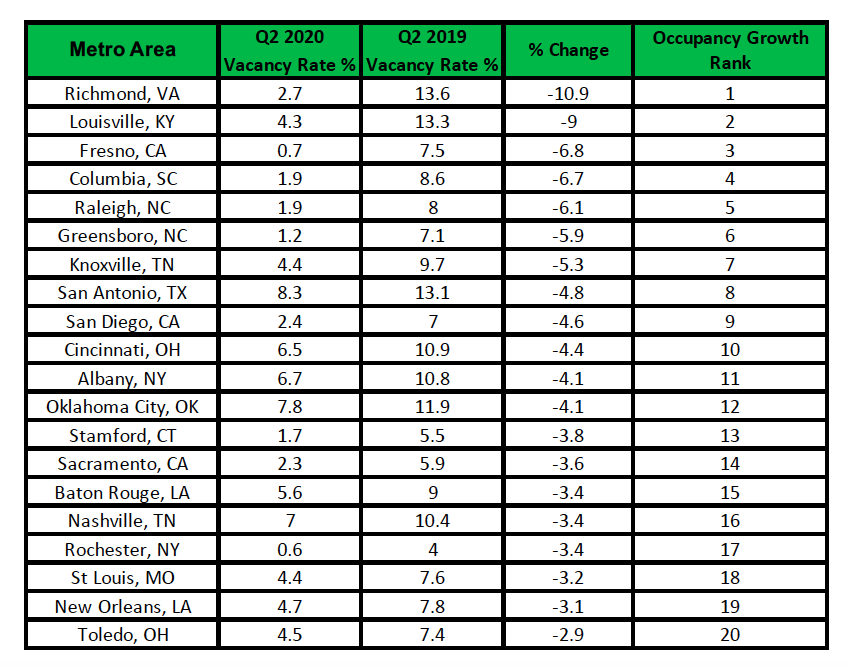
The three healthiest metros based on the highest occupancy-rate growth are Richmond, Va.; Louisville, Ky; and Fresno, Calif.
Richmond’s vacancy rate fell to 2.7 percent, a 10.9 percent drop since the second quarter of 2019. Louisville’s 4.3 percent vacancy rate in the second quarter of 2020 represents a decline of nine percentage points year-over-year. In Fresno, the vacancy rate declined 6.8 percent to a scant 0.7 percent year-over-year. A city-imposed eviction ban and suburban flight from the Bay Area to Fresno likely contributed to the metro area’s historically low vacancy rate.
“This is an unprecedented trend: The top two metros in our study are located in Appalachia, a region that traditionally flies under the radar for many real-estate investors,” said Doug Brien, CEO and co-founder of Mynd Management, in a release. “However, the health of this area isn’t surprising given the state of rental housing. In spite of the coronavirus pandemic, rental demand remains healthy and the national vacancy rate declined 1.1 percent year-over-year to 5.7 percent in the second quarter.
“While some of these low vacancy rates can be attributed to metro areas with eviction moratoriums in place, we remain bullish on the rental-housing sector. According to Mynd’s Rental Housing Tracker, rents have increased 7.2 percent as of mid-September across our portfolio of properties in 19 U.S. metro areas. Strong supply-and-demand fundamentals, low mortgage rates and ongoing stock-market fluctuation make now an opportune time to invest in residential real estate.”
Below is a list of the 20 healthiest rental housing markets based on occupancy rate growth through the second quarter of 2020. Mynd manages and sells single-family rental (SFR) properties in many of these areas through its Investimate platform:
Metro areas with traditionally low vacancies and limited supply, such as San Francisco and New York, ranked in the middle of this study. San Francisco ranked 34th with a 1.7 percent decline in vacancy to 3.0 percent in 2020, while New York ranked 38th with a 3.3 percent vacancy rate in the second quarter, a 1.3 percent decline.
About Mynd Management
Mynd Management is a tech-enabled property-management and real-estate investment company serving the non-institutional sector of the single-family rental housing market.
Tenants these days are expecting immediate response when they have a maintenance need. Here are four small maintenance tools any landlord or property manager can use to save money and provide immediate customer service.
Property management companies that run efficiently have significant systems in place for each phase of operations.
Further, there is emphasis on responsibility centers that do not overlap (yes- we are leaving “cross-training” behind for the moment). In so doing, the company maintains specialization and focus. This is the way of the world for large well-heeled organizations. Then, there is everybody else.
The property management business is fragmented to the nth degree from ivory tower suits to Grandma acting as manager of her fourplex with three paying residents.
Following is a reminder about small tools that anyone at the site level can utilize to save money and provide immediate customer service. Dollars saved means increased NOI. A happy customer (resident) means less turnover and longer leases- a win-win.
Like with a medical situation, sometimes what is needed more than anything else is triage- stopping the bleeding “now” until the patient can receive better treatment with https://valtvalacyc.com more proficiency. Sometimes it just a scratch and other times life threatening; distinguishing between the two is the first order of business.
All manner of little things (and not so little) can break a budget; carpet, paint, light bulbs and batteries growing legs and walking off, silent running toilets, a neighboring property tying into your electrical panel for security light (hey- their contractor did not know or care it was the wrong panel).
Some things that need repair are hard to find, others, not so much. For those items that you can “find and fix” while a work order is the way of the world getting the fix accomplished is the thing particularly when it comes to stopping water, or removing a potential hazard to public safety.
Please note that use of these tools does not and should not represent elimination of a service call by your maintenance team or service provider every time. These suggestions are simply a way to provide some immediate relief for the matter at hand until addressed more fully. However, sometimes, the simple tool does the trick.
No. 1 – Garbage disposal wrench crank for maintenance
It does not seem to matter who says it or how many times it’s said, people put “everything” into the kitchen sink and through the sink disposal. This simple tool un-sticks a non-turning disposal. Or not. If yes, then a formal service call can follow later. This later time means we can schedule it with another related matter and more cost effectively address two maintenance request with a single visit- thus reducing our overall costs.
No. 2 – Drain Fisher
There are various kinds but they all do the same thing- seek and often find the thing stopping up a bathroom sink or tub drain. Yes, it’s usually some gunk where removal creates free-flowing water. Again, you have eliminated an emergency service call turning it into a scheduled service call thereby reducing our operating costs.
No. 3 – Flash lights
Flashlights find things. Namely, running water and other things we miss with the naked eye. Most of the things found we want to know about so shining a little light on a dark corner can assist in avoiding a bigger problem from occurring at an inopportune time.
No. 4 – Screw driver
Loose socket covers, door handles, locks and closet knobs. All done with a simple screwdriver in short order.
In each case, you should still have the matter reviewed by maintenance to assure the issue is in order going forward. These quick fixes provide immediate customer service by site personnel allowing management added time to schedule maintenance in the normal flow of operations while avoiding the higher costs of emergency and after hour’s maintenance calls.
Here are 5 inexpensive ways you might find helpful to attract new tenants from Keepe, the on-demand maintenance company.
Your primary role as a property manager is to fill your vacancies with new renters. This can become a costly prospect if you are not careful, between running advertisements and marketing materials. So to keep cost down but still attract new residents, here are five inexpensive ways to attract new tenants and potential renters.
Real estate listing sites
The internet has made it easier than ever to market your listing. You need to take advantage of all the free listing sites that are available. Trulia and Zillow are two well-known options, and they don’t charge you to list on their sites.
It is important that you have an idea of where your average renter comes from. Most renters in today’s market will probably start their search online. The quality of the pictures and description goes a long way in the effectiveness of your listing.
Social media advertisements
Social media platforms are great resources for building interest in your property; and the best part is they are completely free. Post ads on Facebook, Twitter, and Instagram and make sure that everything you create is shareable so people can see the properties and share them through their networks.
You can also use these platforms to speak directly with potential renters and really pique their interest. Plus, publishing information on social media doesn’t take a lot of time, so you can save money there as well.
Open houses
One of the most important things you can do if you are looking for tenants is to allow yourself enough time to find one. This means that you need to start your search while your departing tenants are still in the property.
Ideally, you will have an understanding with them to keep the property clean and that you will need a few hours every other weekend. This gives you the opportunity to keep the house open. Anyone in the area with an interest in the property should be allowed to see it. Create an atmosphere that puts the property’s best foot forward.
Resident Referrals
If you have great residents, more than likely they know great potential renters in their network. Offer a referral program with a great reward like discounted rent or even a gift card to a local restaurant. That way your residents do the work for you. Most people want to live in a community with their friends, so it is a win-win solution to finding new renters.
Make The Exterior Attractive
It is not very expensive to do a little bit of landscaping that will make a property look well-maintained and inviting. Make a front flower bed, put out potted flowers, or put in some landscaping rocks. Make sure the lawn is cut and that the yard is neat and tidy.
Final Thoughts
Before waving the white flag and enlisting the services of a real estate agent, try these inexpensive ways to attract new tenants first. It is important to stay consistent and do something to find tenants every day. With all of the options available, this is something you should be able to do on your own.
About Keepe:
Keepe is an on-demand maintenance solution for property managers and independent landlords. The company makes a network of hundreds of independent contractors and handymen available for maintenance projects at rental properties. Keepe is available in the Greater Seattle area, Greater Phoenix area, San Francisco Bay area, Portland, San Diego and is coming soon to an area near you. Learn more about Keepe at https://www.keepe.com
In this time of the pandemic many tenants are facing challenges, leading some to look at subleasing, also called subletting, their current rental property in order to move. Here are some tips for landlords and property managers on the issue.
By Evelyn Long
Finding a good tenant can be a challenge, so what happens if they ask to sublet? Subletting or subleasing can feel risky and unpredictable, so it’s important to weigh the advantages and disadvantages before making any major decisions. Only after evaluating the options should a choice be made. If subletting, the same as subleasing, is the best course of action, then there are steps you can take to minimize the risk.
Keep reading to learn more.
What Is Subletting?
Subletting is when a current tenant rents the property — or a portion of it — to someone else.
This process is also known as subleasing, and it is legal in most states as long as the landlord is made aware and the contract supports it. In this case, the tenant becomes the sublessor, and the person they sublease to becomes the sublessee. Typically, a tenant may approach a landlord about subletting if they are on a yearly contract and intend to be away for an extended period.
What Are the Advantages and Disadvantages?
As a landlord, there are pros and cons in allowing a tenant to sublet. It’s important to be aware of the risks before making a decision.
Advantages
The major advantage of subletting is that money continues flowing even when the tenant is out of town. Also, since they’ve kept the lease agreement, there’s no hassle involved in negotiating new terms.
The landlord is not responsible for finding a new tenant because the current renter will be the one finding the sublessee. If the sublessor is reliable and has a strong relationship with the owner, it could be in everyone’s best interest to use subleasing as a short-term solution.
If you allow subletting and your current tenant decides to move out, the sublessee may sign up to renew the lease agreement, which would save the time and energy required to market the property.
Disadvantages of subletting
Adding a new person to the mix complicates matters. They will be unfamiliar, which could make repairs awkward or uncomfortable. Without requiring a background check, the landlord won’t know anything about the sublessee’s past. Are they a criminal? Do they pay their bills on time and have a high credit score? These are questions that might remain unanswered.
The sublessee could damage the space or commit a crime on the property, leaving the landlord with a mess to handle. Even though the tenant becomes the sublessor and is legally responsible for making payments, the proprietor could be left with the bills if the tenant is nowhere to be found.
If you allow subletting and your current tenant decides to move out, the sublessee may sign up to renew the lease agreement, which would save the time and energy required to market the property.
How to Proceed With Ease
If you’ve decided to allow your tenant to sublet the property, taking steps before move-in day will simplify the process. Here are four steps to managing tenant sublets with minimal risk.
1. Set specific lease clauses
To ensure a subletting arrangement that satisfies each party’s needs, lay out specific clauses in the tenant contract. The contract will describe the rules and expectations of the rental agreement. This contract could be referenced in court, so make sure it is thorough enough to protect the property’s assets.
Once a tenant decides to sublet, draw up a sublease agreement that outlines the original renter’s rights and the responsibilities of the sublessee. Make sure you have a signed copy of this agreement on file.
2. Require a screening process
Some states demand a sublessee-screening process, but since this varies by state, be sure to require it as part of the contractual agreement.
This process provides the opportunity to turn away potential sublessees who could be problematic. It provides a layer of additional protection for the landlord and offers an initial impression of the new renter. Asking questions in advance reduces the risk of choosing a sublessee who would be a poor match for the property.
3. Learn state and local laws
Almost half of the states in the continental United States do not have laws governing subleasing. That means the contract between the landlord and tenant dictates the legality of subletting. This can be confusing in localities that have unclear or changing requirements. However, some research can help property managers cover their bases.
By learning state and local laws, a landlord can ensure they know their rights. This also guarantees the situation follows legal guidelines. If the tenant and property owner are both aware of legal repercussions, there will be less confusion or debate. Knowing which rights are protected will help guarantee that the landlord won’t be sued for violations.
4. Arrange online payments with your tenant
One of the greatest risks of subletting is the potential for missed rent payments. Ultimately, the sublessor is responsible for these payments under contract — regardless of whether their sublessee pays.
To eliminate the chances of confusion, late payments or a sob story, request automated online payments. That will guarantee the installments arrive on time each month.
Feel confident when subletting
After evaluating the advantages and disadvantages, it’s clear that subletting can be complex at times. However, it’s possible to manage tenant sublets with minimal risk by implementing these four steps. Subletting provides the opportunity for a positive experience when handled with experience and confidence.
About the Author:
Evelyn Long is the editor-in-chief of Renovated, where she shares real-estate market and maintenance advice for investors and their tenants. Based in Baltimore, Evelyn is enthusiastic about both brownstones and crab cakes.
Government policy response to the pandemic has also created the conditions for the spread of rent regulation such as rent freezes and rent cancellation in many places, the National Apartment Association (NAA) writes this month.
The NAA says they expect more state legislatures to propose rent regulation on an emergency basis, opening the door for consideration of more permanent legislative changes.
At the state and local level, several jurisdictions have considered or enacted temporary rent freeze or rent cancellation policies during COVID-19. California and New York have seen rent cancellation bills introduced and gain some support. Washington State, Los Angeles, CA, Washington, DC, as well as Baltimore, Howard County, and Salisbury in Maryland have passed temporary rent freezes through the end of their local emergencies via either executive order or city council ordinance. The Massachusetts legislature is considering similar legislation that would allow cities and towns to implement a rent freeze or rent control for the duration of the state and federal state of emergency declarations due to COVID-19.
“The economic effects of COVID-19 have spurred policymakers at all levels of government to employ eviction moratoriums of varying lengths to protect renters, particularly those of low or moderate-income, from displacement,” the NAA writes.
“While these restrictions have largely achieved that aim – at the expense of the rental housing industry – the results are merely temporary and have led renters to accumulate large amounts of debt that, based on past industry experience, will never fully be repaid.
“Unpaid rent will eventually come due and, when it does, renters who have not received rental assistance dollars will be on the hook. In response, renters’ rights advocates have promoted various types of rent regulations as one of a group of policies intended to protect renters from eviction and displacement.”
Housing is healthcare argument
The NAA cites as an example Our Homes, Our Health is a renter advocacy group that has been pushing for drastic policy changes to protect renters during COVID-19, leaning on the argument that “housing is health care.”
Recently, these advocacy groups have begun using a “price-gouging” argument to push for removing rent control preemptions and passing rent cancelation legislation.
“They contend that COVID-19 and the economic instability it has wrought necessitates regulating rent increases to prevent widespread displacement. With additional aid from Congress looking increasingly unlikely until at least after the election, policymakers could see aggressive rent regulation policies as a low-cost option for cash strapped jurisdictions searching for ways to protect vulnerable renters.
“While there are only six states that have either enacted statewide rent regulation or allow for local rent regulation, price gouging laws are much more common, with 36 states having such laws on the books. Generally, price gouging laws prohibit the sale of “necessities” for an excessive price during state and local emergency declarations. COVID-19, and the substantial job losses that have resulted, has bolstered the case for making it more explicit that housing is a necessity covered by price gouging measures or going a step further, enacting even more stringent rent regulation laws,” the NAA writes.
Advocacy Strategy
To help combat the ongoing push for increased rent regulation, the rental housing industry will have to use multiple tactics and messages. One example is to articulate the pivotal role apartment properties play in supporting municipal tax bases. Nationwide, apartments contribute $58 billion in taxes to the local economy each year. Cities across the country are facing massive budget shortfalls from the COVID-19 pandemic, increasing the importance of these tax contributions.
Continuing to push for the funding of rental assistance programs will also be crucial to staving off rent regulation policies. If designed appropriately, these programs support struggling renters and housing providers equally and preserve tax contributions and the 17.5 million of jobs supported by the rental housing industry, reducing the perceived need for rent regulation.
Like eviction moratoria, rent control and other rent regulation policies fail to address the ongoing housing and financial instability of renters. Eviction and rent restrictions will only exacerbate the housing affordability crisis by placing increased financial pressure on housing providers, especially small mom and pop owners who operate much of the nation’s naturally occurring affordable housing. Balanced housing policy is needed to address the supply and demand imbalance that inflates rents and facilitate the construction of more housing at affordable price points.
To learn more about rent regulation, please contact Alex Rossello, Manager of Public Policy or visit the Rent Regulation Policy Page on the NAA website. For more information on the newest research tools on rent regulation and eviction moratoria from NAA’s research team, please contact Leah Cuffy, Research Analyst.
Is your rental housing burglary proof is the maintenance check up this week provided by Keepe to be sure you are your protecting your investment and income as well as your tenants.
A burglary at a rental property “freaks out” the tenants and puts your income and investment at risk.
A burglary is one of the scariest events that can happen at a rental property.
Even worse, absent proper precautions, it can expose the landlord to potential liability claims.
Good security can also be a major factor for tenants or buyers choosing a property.
There are a number of things that property managers and landlords can do to address and mitigate this risk.
First, what are the real facts from the FBI on rental housing burglary?
One in every 36 homes in the United States are burglarized each year.
Two million home burglaries are reported each year in the United States.
30 percent are through an open or unlocked window or door.
Burglars tend to avoid homes with security systems.
Houses that do not have security systems installed are up to 2.7 times more likely to be targeted by a burglar.
Hopefully these statistics will motivate you to take action.
Below are 3 steps that you can take to secure your property as well as steps tenants can take to secure the property.
1. Secure doors
Make sure all entry and exit doors from the property can be properly secured and locked at all times to avoid rental housing burglary, and remind the tenants to do so:
Door Construction. Use doors built from heavy-duty materials, such as steel or solid wood. Avoid flimsy wood doors or hollow doors that can be kicked or smashed in. Also avoid doors with windows or any type of glass that can be broken.
Deadbolt Locks. Use an extra lock, beyond the standard one. This lock should ideally be a double cylinder deadbolt. You can purchase a deadlock that doesn’t have a door handle, or you can buy one incorporated into the handset. Remember if, for any reason, you need to change keys it is cheaper to get the locks rekeyed, instead of changing them all together.
Chain Locks. In addition, install chain locks on the doors that lead to the tenants’ apartments. This way, the tenant will be able to crack the door open but still be protected.
Peepholes. The peephole will allow your tenant to see who is outside without having to open the door.
Intercom System. These systems are recommended if you own a multifamily property and you want the tenant to control who is allowed to enter the building and who is not.
No. 2 – Secure windows
Thieves can use windows as their entry point for rental housing burglary, so you have to secure them also.
Locks. All windows, no matter the floor, should be provided with mechanisms which prevent the windows from being opened from outside.
Security Bars. Adding security bars to your first-floor windows is also an option. It is true they don’t contribute to the curb appeal but they might be necessary.
Window sensors. Instead of security bars, you can use window sensors that sound an alarm and/or alert you via the smartphone when the security of your property has been breached.
No. 3 – Install a home security alarm system
It is a great idea to install a home security system that can detect home intrusions and alert the police. The signs outside the home also serve as a deterrent to rental housing burglary..
With these security devices installed you will reduce drastically the risk of being burglarized and increase your peace of mind.
About Keepe:
Keepe is an on-demand maintenance solution for property managers and independent landlords. Keepe makes a network of hundreds of independent contractors and handymen available for maintenance projects at rental properties. Keepe is available in the Greater Seattle area, Greater Phoenix area, San Francisco Bay area, and is coming soon to an area near you. Learn more about Keepe at https://www.keepe.com