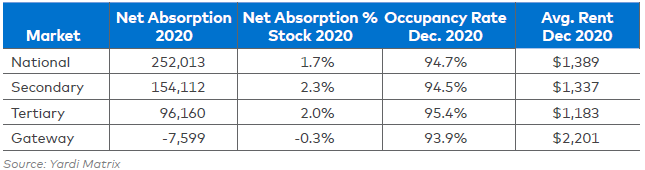
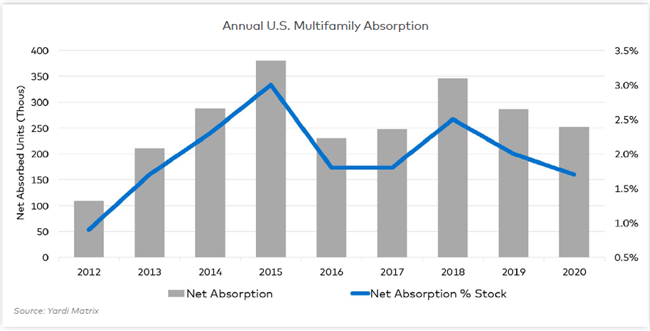
Despite a pandemic that restricted many routine activities, some 252,000 apartment units, or 1.7 percent of total stock, were absorbed in the United States in 2020, according to a review of Yardi Matrix’s database.
“Fast-growing secondary metros such as Dallas, Atlanta and Denver saw the highest absorption, while growth was negative in high-cost coastal metros. Although the industry faces challenges in 2021, the durability of demand is a good sign moving forward,” the report says.
The absorption, or net change in occupied units, was broadly distributed.
While the Bay Area and New York saw negative absorption, “net absorption was in the black in 25 of the 30 largest metros, led by Dallas, Atlanta, Denver and Phoenix. Those top 25 metros accounted for 158,300 units absorbed, more than 60 percent of total U.S. net absorption.”
On a regional level, renters continued to flock to the:
Southeast: 96,700 units absorbed, or 2.4 percent of total stock
Southwest: 56,800 units, 2.1 percent of stock
West: 57,100 units, 1.9 percent of stock
Image courtesy of Yardi Matrix.
Issues still ahead in 2021 for apartment units
While the absorption rate and demand was better than expected, multifamily real estate still faces a number of issues in 2021:
Renter support: Industry trade groups estimate that renters are behind on payments by as much as $70 billion. Some tenants will make up the payments over time, and some property owners will be reimbursed through a $25 billion federal renter subsidy passed by Congress, but many owners will have to deal with payment shortfalls.
Multifamily delinquency rates remain low, but in some cases that is because of forbearance by lenders that will be dealt with after the pandemic.
Some state- and city-level jurisdictions have implemented eviction bans that increase the difficulty of collecting rents
Conclusion
“By and large, though, the signs going forward are encouraging. The availability of COVID-19 vaccines makes it likely that normal activity will be possible by the end of 2021, or maybe in 2022,” the review said.
“When downtown office buildings and urban entertainment venues reopen, some of those who left are sure to return.
Yardi Matrix researches and reports on multifamily, office and self-storage properties across the United States, serving the needs of a variety of industry professionals. Yardi Matrix Multifamily provides accurate data on 18+ million units, covering more than 90 percent of the U.S. population. Contact the company at (480) 663-1149.
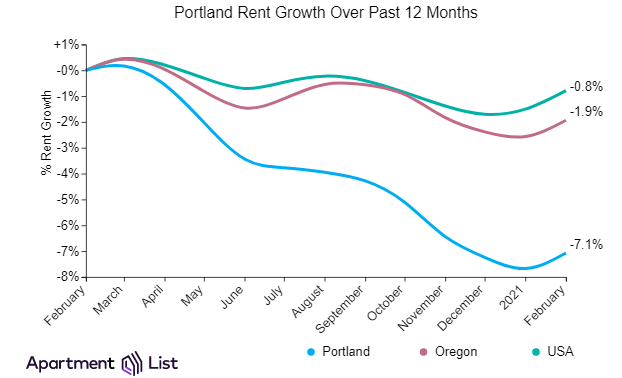
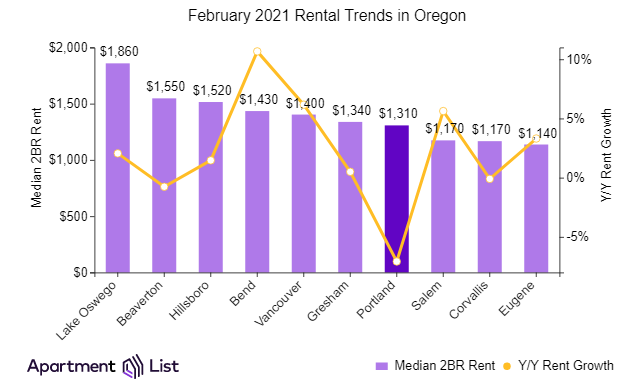
Portland rent growth is starting up again as rents have jumped 0.6 percent in February in the Oregon city, joining a growing trend of data representing the clearest indication yet that rent prices are rebounding in markets across the country, according to the latest report from Apartment List.
“The days of plummeting rents in pricey coastal markets appear to be coming to an end, with cities such as San Francisco, Seattle and Portland experiencing positive month-over-month growth for the first time since the start of the pandemic,” Apartment List said in the report.
Igor Popov, chief economist for Apartment List, said, “Though I don’t have a crystal ball, I do think we’ve seen rents bottom out,” in the bigger cities, including Portland, Oregon.
While rents are starting to rebound, Portland Oregon rents are still down 7.1 percent year-over-year.
Median rents in Portland are $1,121 for a one-bedroom apartment and $1,308 for a two-bedroom.
Rents starting to increase where they had fallen
“We’re seeing a similar trend play out in nearly all of the cities where rents have been falling fastest,” the report said. “Nine of the 10 cities with the sharpest year-over-year rent declines experienced positive rent growth this month (February). For five of these cities, this was the first monthly increase since the start of the pandemic, while the other four are continuing a trend that began last month.”
Since the start of the pandemic, “we have witnessed significant disruptions to rental markets across the country. Social distancing and remote work changed what people want in a home, while many renters were thrust into immediate and unexpected financial hardship as layoffs and furloughs rippled through the economy.
“These sudden changes to budgets and preferences led to a convergence in rental prices across the U.S. — the most expensive markets saw rents fall rapidly, while a number of more affordable mid-sized cities experienced accelerating rent growth.
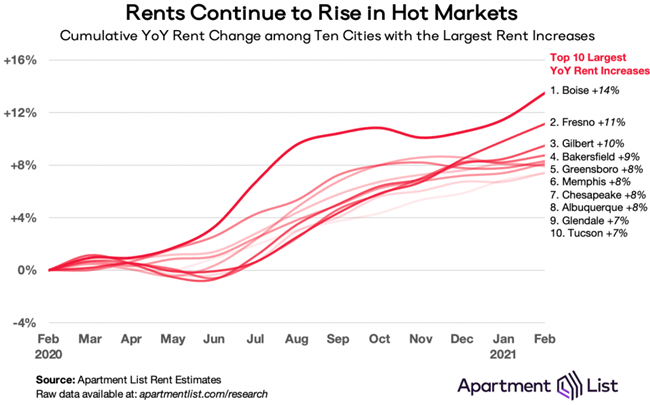
“This month’s data indicates that the markets where rents have been falling rapidly have reached a turn point. The booming markets (led by Boise, Fresno and Gilbert) are still seeing prices rise, but in many cases, that growth is flattening somewhat. While remote work and economic fallout of the pandemic will undoubtedly continue to impact local rental markets going forward, the way that these trends continue to play out may now start to become more nuanced and gradual,” Apartment List said in the report.
If you are a struggling landlord right now, fellow landlord David Pickron suggests three things you should think about if you are dealing with a tenant who is not paying you and feels entitled to be in your property.
By David Pickron
I recently came home from work and saw my teary-eyed daughter sitting defeatedly on the couch. This was abnormal for her, and signaled something was wrong. She is tough, handles stress well and has been an athlete playing high-level golf since age 14. If any game can break you, it’s golf, and last night was her breaking point. Trying to qualify for her first tournament as a college freshman, she started strong on the first three holes with a series of great shots. Things started to crumble on hole No. 4 with a shot into the lake. This rattled her so much that over the remaining holes she struggled and ended up scoring her highest round of golf since her freshman days in high school. As she sat there looking back at me, suspecting her score wouldn’t help her qualify, she said, “it’s just too hard, I want to quit.”
If you’ve been a landlord for any amount of time, you may have felt like throwing in the towel at some point. Last week, one of my tenant’s children decided to get on the roof and pour gas down two stories to a mobile firepit. The neighbor was watching and filmed the entire incident. (I love having a relationship with the neighbors of my tenants). No adult supervision and balls of flames crawling up my walls; definitely grounds for an eviction. I sent the video to my tenant and told them our relationship had come to an end and that they would be receiving notice to leave. Can you guess the answer? “I have COVID so you can’t evict me.” If there were ever a reason to give up on being a landlord, this might qualify.
As a private investigator and seasoned landlord, I ask myself, “How did I get here?” This same family has been a consistent tenant for more than 10 years, never missing a payment. I screened them well, followed best practices and even after all of that, I find myself in a situation where I have lost control of my own property because of a regulation passed by our local, state, and federal government.
Knowing what I know now, would I do it all over again? Absolutely! Even when we do everything right, sometimes things still go wrong. You have a right to be mad, stomp around, and even feel sorry for yourself; but then you’ve got to get over it. If you are a struggling landlord right now, let me suggest three things you should think about if you are dealing with a tenant who is not paying you and feels entitled to be in your property.
Hire a Team of Professionals
Form a great relationship with a landlord/tenant attorney. Most of the good ones can be found through your local landlord associations. These professionals follow all federal and local laws and have the resources necessary to manage different requirements coming from different jurisdictions. Time and time again I have seen people panic over a new regulation, only to find out the regulation was already in force by a federal rule or really did not have any impact at all. For example, Louisville just came out with a city ordinance adding individuals with criminal histories as a protected class, only to take away any “teeth” from the ordinance by exempting any crime that would affect the health and safety of the landlords. I don’t know a landlord who would penalize an applicant for underage drinking five years ago, but robbery or drugs is another story.
Get with a professional mortgage broker who understands your landlord strategy and can help maximize your returns with the right type of loan.
Align with a collection agency and create a program to send delinquent tenant accounts to collection and put it on their credit. There are no rules requiring a tenant to be out of the home in order to send a file to collections.
Establish a relationship with a professional realtor who can analyze whether selling your home would bring you a great sales price.
A professional accountant can let you know how refinancing or selling your property will affect your income, capital gains etc. Let the professionals do what they do best and guide you through this process.
Analyze Your Onboarding Practice
Do you have a specific criteria? If not, get one today. We have samples at Rent Perfect that will help you design an efficient onboarding process. If you do not have a criteria, then everyone qualifies, and you know that just can’t be true. The whole onboarding process starts with putting your criteria on paper.
More than ever, a call to a potential tenant’s last two landlords is critical. Though painful and time-consuming, do not skip this step. How tenants left their prior homes is probably how they will leave your home. If you can’t reach a landlord and have doubts about what the prospective tenant is telling you, require canceled checks or bank statements that show they paid rent for the last 12 months. If they paid rent through this COVID-19 crisis, there is a good chance it will continue. We can’t afford to make a mistake during onboarding.
Remember Why You Became a Landlord
No other business allows you to buy something, have someone else pay for it, and at the end you still own it (with maybe even a little cash flow on the side). A declining mortgage and appreciating asset are your ticket to long-term wealth. A recent TV show called “Undercover Billionaire” dumps each contestant into a random city where they receive $100, a phone and a car, with the challenge to create a business worth a million dollars in less than 90 days. All three contestants chose real estate! That’s why you became a landlord. Don’t ever forget this!
Sitting on the couch sulking because the last year wasn’t fair won’t get you anywhere. So, get up, align yourself with professionals, review and modify your onboarding practices, and get in the game to grow your wealth. My daughter knew deep down that quitting was not an option. She was too invested to walk away (by the way, she shot one of her best rounds ever a few days later), and you will be, too.
About the author
David Pickron is president of Rent Perfect, a private investigator, and a fellow landlord who manages several short- and long-term rentals. Subscribe to his weekly Rent Perfect Podcast (available on YouTube, Spotify, and Apple Podcasts) to stay up to date on the latest industry news and for expert tips on how to manage your properties.
This week the question for Ask Landlord Hank is about unpaid back rent and the eviction ban. Remember Hank is not an attorney and is not giving legal advice so check your local ordinances. (Editors note: This answer was before the passage of the new American Rescue Plan and its details which are not all known for impact on landlords.)
Dear Landlord Hank,
I have a tenant who owes me $8,800 in unpaid back rent cumulated over the last 10 months. He repeatedly missed payments of our payment plan. It’s causing me emotional stress and affecting my health. I’m in Washington state, which has an eviction ban in place until March 31. What should I do?
-Tammy
Dear Landlord Tammy,
The FHA has extended the eviction moratorium through June 30, 2021. BUT if your property doesn’t have a loan then you may still be able to evict this tenant.
Has the tenant given you any paperwork saying they have COVID-19 or have been affected by COVID-19?
I would contact a local attorney that handles landlord/tenant law in your area to see if you can successfully evict this tenant.
You could also contact your magistrate court and get some answers. You don’t want to win an eviction hearing only to have the sheriff’s department not dispossessing tenants.
So that is one part of the issue, the other part is the unpaid back rent and lost rent of $8,800.
Last April, the first COVID-19 relief package passed Congress, the CARES act. This act included more than $350 billion for new Small Business Administration programs, including the Paycheck Protection Program and the Economic Injury Disaster Loans.
Last December, Congress appropriated even more funds, and there is a loan-forgiveness process in place for those borrowing less than $150,000. Both of these programs have been extended until Sept 30, 2021.
So I would look into that as well. Perhaps you can have your tenant evicted and get help from the federal government for your unpaid back rent losses. Best of luck to you in these trying times.
Sincerely,
Hank Rossi
Landlord Hank says, “I would contact a local attorney that handles landlord/tenant law in your area to see if you can successfully evict this tenant.”
Ask Landlord Hank Your Question
Ask veteran landlord and property manager Hank Rossi your questions from tenant screening to leases to pets and more! He provides answers each week to landlords.
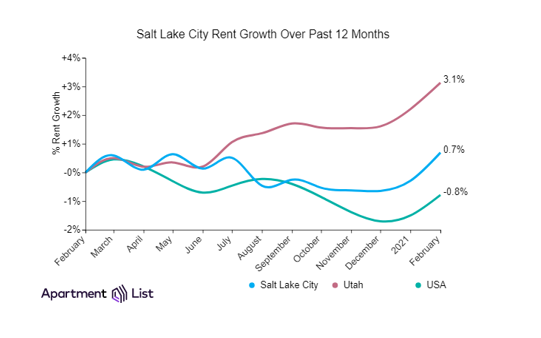
Salt Lake City rents have increased 1.0 percent over the past month according to the latest report from Apartment List.
Rents in the city have increased slightly by 0.7 percent year-over-year.
Currently, median rents in Salt Lake City are $927 for a one-bedroom apartment and $1,185 for a two-bedroom.
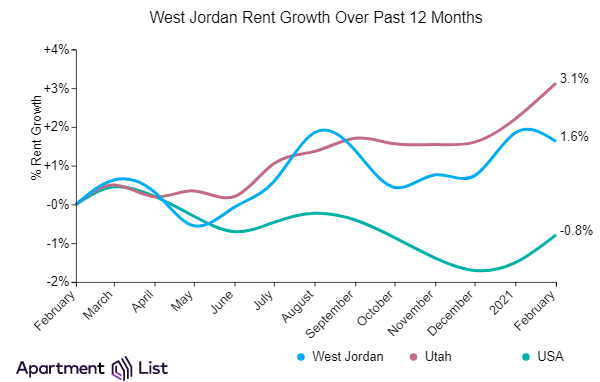
This is the second straight month that the city has seen rent increases after a decline in December of last year. Salt Lake City’s year-over-year rent growth lags the state average of 3.1 percent, but exceeds the national average of -0.8 percent.
West Valley City rents also increase sharply
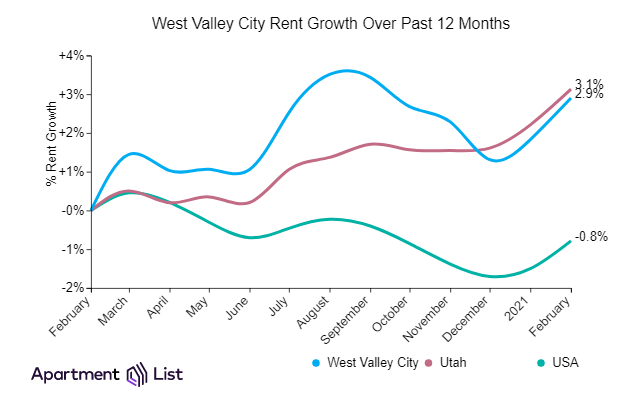
West Valley City rents have increased 1.1% percent over the past month, and are up moderately by 2.9 percent in comparison to the same time last year.
Currently, median rents in West Valley City are $1,056 for a one-bedroom apartment and $1,245 for a two-bedroom.
This is the second straight month that the city has seen rent increases after a decline in December of last year.
West Jordan rents declined slightly over the past month
West Jordan rents have declined 0.2 percent in February.
However rents are up by 1.6 percent year-over-year.
Currently, median rents in West Jordan are $1,156 for a one-bedroom apartment and $1,408 for a two-bedroom.
Apartment rents trending up nationally
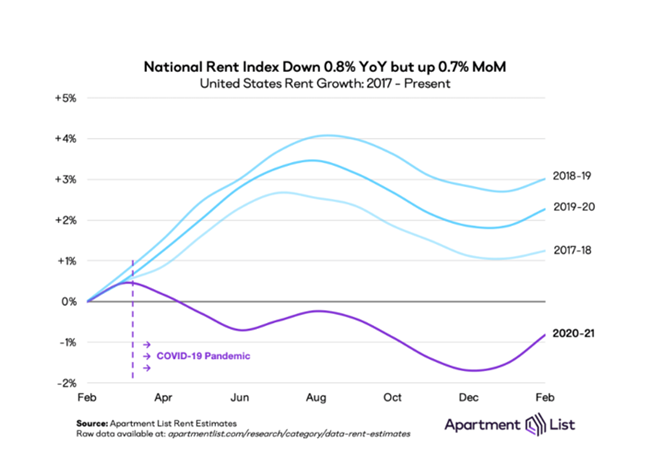
“This month’s data represents the clearest indication yet that rent prices are rebounding in markets across the country,” Apartment List said in the report. “For comparison, in the previous three years, the average month-over-month rent growth in February was 0.3 percent. In other words, the month’s increase was more than double the prior-year average for this time of year.
“The data continue to exhibit significant regional variation, but the days of plummeting rents in pricey coastal markets appear to be coming to an end, with cities such as San Francisco and Seattle experiencing positive month-over-month growth for the first time since the start of the pandemic.”
The national rent index is up by 0.7 percent month-over-month, representing the second straight month of positive rent price growth and the largest monthly increase since June 2019 when the market was in the middle of the summer boom, according to the Apartment List national monthly report.
“This month’s data represents the clearest indication yet that rent prices are rebounding in markets across the country,” Apartment List said in the report. “For comparison, in the previous three years, the average month-over-month rent growth in February was 0.3 percent. In other words, the month’s increase was more than double the prior-year average for this time of year.
“The data continue to exhibit significant regional variation, but the days of plummeting rents in pricey coastal markets appear to be coming to an end, with cities such as San Francisco and Seattle experiencing positive month-over-month growth for the first time since the start of the pandemic.”
The rent index report says the latest month appears to be the month where steep rent declines are bottoming out, but booming markets are continuing to see prices climb, such as many of the mid-sized markets that have seen rents grow rapidly through the pandemic, showing that there’s still steam left in the current boom.
Big Cities with Sharp Rent Declines Show Positive Growth
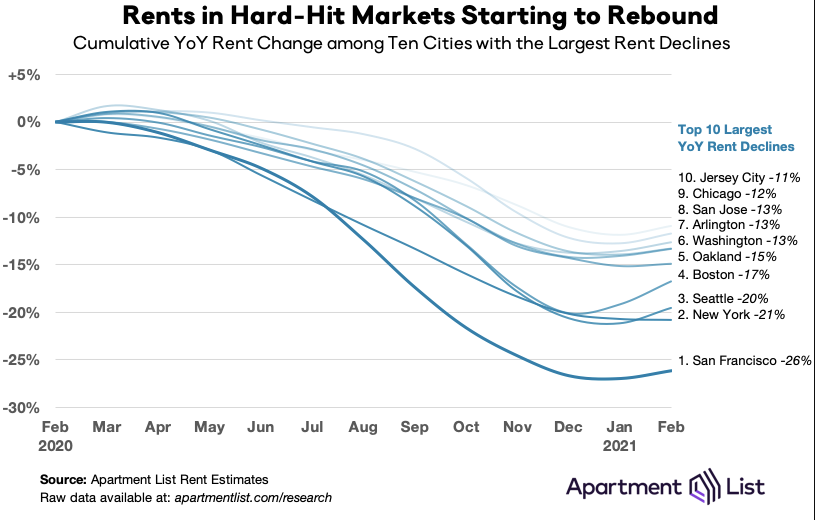
Nine of the 10 cities with the sharpest year-over-year rent declines experienced positive rent price growth this month, the Apartment List rent index report shows.
For five of these cities, this was the first monthly increase since the start of the pandemic, while the other four are continuing a trend that began last month. In Boston, rents jumped by 3 percent month-over-month, the largest increase among the nation’s 100 largest cities. New York City is the only market on this list where rents continued to fall this month, but even there, the decline was just 0.1 percent, compared to an average monthly decline of 2.4 percent in the preceding nine months.
Rent Index Conclusion
“Since the start of the COVID-19 pandemic, we have witnessed significant disruptions to rental markets across the country. Social distancing and remote work changed what people want in a home, while many renters were thrust into immediate and unexpected financial hardship as layoffs and furloughs rippled through the economy.
“These sudden changes to budgets and preferences led to a convergence in rental prices across the U.S. – the most expensive markets saw rents fall rapidly while a number of more affordable mid-sized cities experienced accelerating rent growth.
“This month’s data indicates that the markets where rents have been falling rapidly have reached a turning point. The booming markets are still seeing prices rise, but in many cases, that growth is flattening somewhat. While remote work and economic fallout of the pandemic will undoubtedly continue to impact local rental markets going forward, the way that these trends continue to play out may now start to become more nuanced and gradual,” Apartment List said in the report
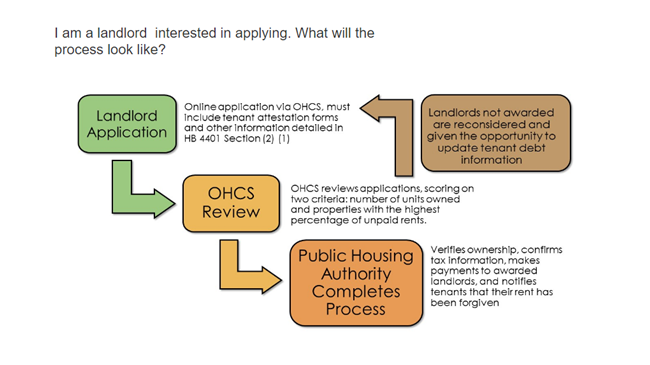
The Landlord Compensation Fund is now accepting applications in Oregon to assist landlords with the massive amounts of unpaid rent that currently exist.
Regular readers of this series likely noted last month’s mention of the Landlord Compensation Fund, a key piece of the recent House Bill 4401. As that article was drafted, the Landlord Compensation fund had not yet materialized. Shortly after it was published, the wheels began to turn. As of this article’s drafting, the Landlord Compensation Fund is now accepting applications to assist landlords with the massive amounts of unpaid rent that currently exist.
It is important to note that landlords are not automatically eligible for the fund. Landlords must submit completed Declarations of Financial Hardship forms, procured directly from the tenants, who owe rent for any or all months since April 2020. This presents challenges related to getting the forms from some tenants who either (a) refuse to communicate, (b) do not believe they owe rent, or (c) do not believe they should have to assist the landlord in getting the rent they owe. In these instances, landlords now have options.
First, HB 4401 allows for a balance-due notice, with which the landlord must include both the declaration form and the notice of tenants’ rights form, in order to comply with the statutory requirements. While a balance-due notice is not a requirement for unpaid rent to remain due and owing, it creates a viable method for landlords to get the declaration form in front of tenants and perhaps jump-start the conversation.
While many landlords use this approach, it is important to note that landlords should be cautious in their communications with their tenants. There is no statutory definition or form for what constitutes a balance-due notice. That ambiguity provides an opportunity for tenants to argue that certain written communications to the tenant may qualify as a de facto balance-due notice. If a landlord does not include the declaration form and notice of tenants’ rights with that innocuous communication—because they may not believe it to be required—potential issues could result.
Landlord compensation fund and tenants who refuse
The other option provided for in HB 4401 for tenants who simply refuse to provide the declaration form is the service of 10-day non-payment-of-rent notices. While landlords should consult legal counsel to assist in the crafting of these notices, it is imperative to note that these notices, when served, must also include the declaration form and notice of tenants’ rights. Once the tenant is served with the notice, they can return the declaration form, at which time (a) the landlord must cease their eviction process, and (b) the tenant’s grace period and emergency period are extended through June 30, 2021. In other words, if the form is returned, they will have until June 30, 2021 to repay the landlord and cannot be evicted through that date, but the landlord now has their declaration form, with which they can apply to the fund.
If the tenant still refuses to return the form, a landlord could file an eviction action with their non-payment notice. The summons of any eviction filed must include the declaration form and notice of tenants’ rights, as per HB 4401. The failure to do so renders the landlord’s eviction action defective, extends the grace period and emergency period by law, and presents exposure. However, the required inclusion of this form provides the tenant another opportunity to return it to the landlord to access the fund and avoid eviction and payment.
Oregon landlord compensation fund downsides
It is also important to keep in mind the downsides to the Landlord Compensation Fund in Oregon.
Oregon has unveiled a scoring system to determine how funding is distributed, prioritizing smaller landlords with the largest amount of unpaid rent. Landlords also cannot evict tenants without cause or for non-payment through the pendency of the distribution application, a time frame which is currently unknown. This could interfere with a landlord’s plans to potentially sell the property or have a family member move in. Oregon landlords must also provide the state with any documents they request related to the application. Finally, 20 percent of the tenant’s unpaid balance must be forgiven.
Landlords are not required to engage in the compensation fund. Once the moratoriums lift, landlords could technically sue their tenants for the unpaid amounts. However, if your tenant has been affected by COVID-19, the fund may be a landlord’s one opportunity to recover some of those amounts, provided the funding meets the need. Given the scope of the need, that is unlikely to be the case.
Bradley Kraus, Portland attorney
Brad Kraus is a partner at Warren Allen LLP. His primary practice area is landlord/tenant law, but he also assists clients with various litigation matters, probate matters, real estate disputes, and family-law matters. A native of New Ulm, Minnesota, he continues to root for Minnesota sports teams in his free time. You can reach him via email kraus@warrenallen.com or 503-255-8795.
Ask the attorney is a new feature we are starting with month with attorney Bradley S. Kraus over how to terminate a lease. If you have a question for him, please feel out the form below.
Ask Attorney Brad:
I have tenants on a month-to-month occupancy. They have been there two years.
Since the pandemic began, they have told me that they do not have to pay the rent or late fees and I cannot do anything about it. They have paid the rent late, up until February, which they will not pay.
Meanwhile, they have obtained cats and several chickens. They refuse to complete the pet agreement or pay the pet fee.
They signed a no-smoking addendum that covers the entire property, but continue to smoke outside the home (this will be difficult to prove). If I sit outside to take a picture I’ll be breaking the law for harassment.
They requested to have someone else move into the home with them, which I denied. They claim they have not done this, but there are now four cars there on a daily basis (they claim that all are theirs). Yet all four cars are gone each morning when I drive by on my way to the office.
I believe they have moved in their grown child, husband, and two children, but I can’t prove it.
I have served them with notice regarding unauthorized pets, smoking and unauthorized occupants; the only thing they admit to is the chickens.
Do I have enough to terminate a lease with cause, considering I can’t prove smoking or unauthorized occupants?
– Yvonne
Dear Yvonne:
There are a lot of items worth addressing in your prompt. I’ll try to cover all of them.
First, while it’s true that during the emergency period as set forth in applicable law that late fees could not be charged, that emergency period may or may not currently apply to you. For example, if your tenants have turned in a declaration of financial hardship, it would. If they have not, you may be able to charge them late fees for their late payments in 2021.
With regard to the rest of the items you describe, these are all potential defaults of the rental agreement, and the language of your rental agreement will control that. If you have a solid rental agreement, which contains prohibitions against unauthorized pets without landlord consent, smoking, unauthorized occupants or . . . chickens, you may have rights. Having a seasoned attorney evaluate the same will be important to determine whether or not you have rights on that point.
As to your final question, whether or not you have enough evidence to explore whether you can terminate a lease depends on your proof.
Remember, if your termination notice is challenged, you have the burden of proving those defaults. That means bringing in witnesses to testify based upon personal knowledge about those items. For things like smoking and unauthorized occupants, it may prove challenging. If the tenants admitted to having unauthorized chickens, that admission may be used against them.
In short, you may know that the tenants are violating the rental agreement. But in court, it’s not about what you know . . . it’s what you can prove.
Sincerely,
Brad Kraus
Brad Kraus is a partner at Warren Allen LLP. His primary practice area is landlord/tenant law, but he also assists clients with various litigation matters, probate matters, real estate disputes, and family-law matters. A native of New Ulm, Minnesota, he continues to root for Minnesota sports teams in his free time.
Ask Attorney Brad
Please enter your rental housing management question below for Ask Attorney Brad Kraus. Unfortunately he cannot answer questions from tenants.
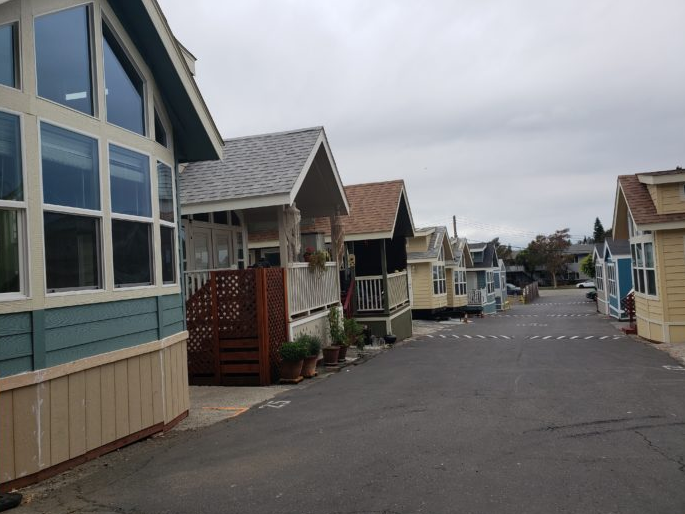
Here are 5 ways manufactured-housing communities, especially in hard-hit California, can reduce wildfire threats.
By Matthew Davies
Following years of wildfire devastation that destroyed 8,100 dwellings, many California homeowners are facing a new threat: a lack of affordable and adequate home-insurance coverage.
The Camp Fire that spread through Paradise, California in 2018 caused more than $9 billion in losses to insured property. In response, insurers refused to renew insurance policies for 235,250 homes in 2019, a 31 percent increase from the previous year. In zip codes with a moderate to very high fire risk, the rate of non-renewals jumped to 61 percent.
This move prompted Insurance Commissioner Ricardo Lara to issue a moratorium on insurance non-renewals in December 2019. That moratorium still exists today, giving needed protections to homeowners at risk of losing coverage. But what happens when manufactured homes, which don’t legally require insurance, are damaged by fire?
As the owner and operator of a manufactured-housing community, here are five things you can do to help homeowners in your communities prepare for natural disasters like wildfires.
1. Require insurance for all residences in your community in the lease agreement
Though insuring a manufactured or tiny home is not required by law, some property management companies require homeowners to insure their homes whether they occupy or rent them. Most mortgages require insurance, though some manufactured homeowners may own their home outright, meaning they may opt out of coverage unless it is required by their community. Tiny homes, while more affordable than their larger, site-built counterparts, still cost an average of $60,000, making them an investment worth protecting.
2. Understand what is and isn’t covered
When it comes to natural disasters, some companies exclude different types of damage – like fire or flood damage – in certain high-risk regions, so it’s important to confirm wildfire coverage. Standard residential insurance policies will cover damage from fire and smoke, including:
Damage to the dwelling structure and additional structures;
Landscaping and backyard items;
Reimbursement for the cost of temporary housing, such as a hotel or apartment if the home is deemed unlivable during repairs;
Removal of debris;
Upgrades intended to bring the home up to current building-code standards; and
Personal property.
3. Include tree and brush removal in your manufactured community’s routine maintenance plan
Or also require that residents remove or reduce fire hazards from the property in the lease.
Wildfires can spread quickly through brush and limbs, so whenever possible, create what foresters call “defensible space” around the homes in your community. This includes clearing away brush, trees, long grasses, and bushes adjacent to the home; lopping off low tree limbs; and removing leaves from gutters.
Since 2005, California has required homeowners who live in high-risk areas to maintain a 100-foot defensible space – that is, free of flammable materials such as brush and vegetation – around their homes. Since 2008, California law also requires new homes to be constructed with fire-resistant materials such as dual-pane windows, fire-resistant roofing, and enclosed eaves. While this amount of space may not be feasible in manufactured-housing communities, you can still take steps to ensure that fire hazards are kept as far away from dwellings as possible.
Find a list of other tips on making homes wildfire-ready here.
California’s Mobilehome Parks Act requires every park to have a representative accessible by phone or in person to respond to emergencies.
4. Establish an evacuation plan
Create an evacuation plan that takes into consideration the density of the park and the age and mobility of residents. The plan should include emergency-contact lists and a list of residents with special needs or disabilities who may need assistance in an emergency. A template evacuation plan can be found here.
Further, California’s Mobilehome Parks Act requires every park to have a representative accessible by phone or in person to respond to emergencies. In parks with more than 50 units, a representative should reside onsite. Finally, when feasible, having two exits from busy parks can prevent bottlenecks in the event of an evacuation during a wildfire threat.
5. Research before you buy
Before you invest in a new community, assess the site’s wildfire threat risk. You can view maps and zip-code listings of areas with the highest wildfire risk exposure on the HUD website. If a property is surrounded by forest or seated on a slope where a wildfire is likely to run, it’s particularly important to do your due diligence.
Scientists anticipate the danger of wildfires will increase as the climate changes, leaving millions of homes in heavily forested areas of the western United States vulnerable. The time to act is now.
About the Author: Matthew Davies is the founder of Stockton, CA-based Harmony Communities, which owns and operates thirty-eight manufactured-housing communities in the western United States. An investor and community-development professional working for affordable housing solutions, Davies’ goal is to help bring the opportunity for homeownership to people in his home state who otherwise could not afford to buy a home.
This week the question for Ask Landlord Hank is about a hoarder and whether an eviction can happen during covid-19. Remember Hank is not an attorney and is not giving legal advice so check your local ordinances.
Dear Landlord Hank:
How can I evict a hoarder during COVID-19?
–Valerie
Dear Landlord Valerie:
If your tenant is truly a hoarder, then they may be protected under the Fair Housing Act, as hoarding is considered a mental disorder that is recognized by the American Psychiatric Association.
So you won’t be able to evict for hoarding.
Also, you need to be able to tell the difference between hoarding and being a slob and poor housekeeper.
Hoarding normally goes way beyond being messy and disorganized and having too much stuff. Often there is only a narrow walkway to get through the property as you wind through mountains of items.
Are entry and exits blocked, are items blocking ventilation, or have food items began attracting rats and vermin?
If the tenant has been paying rent, there may be an eviction moratorium as well.
Please contact a local attorney who deals in landlord/tenant law to see where you stand and what options you have with a hoarder.
If you truly think the property condition is a safety hazard, try for photo documentation, then contact your local fire department and health department for guidance.
Be respectful of your tenant, and don’t threaten them. That will only make matters worse.
Sincerely,
Hank Rossi
Landlord Hank says, “If your tenant is truly a hoarder, then they may be protected under the Fair Housing Act, as hoarding is considered a mental disorder that is recognized by the American Psychiatric Association. So you won’t be able to evict for hoarding.”
Ask Landlord Hank Your Question
Ask veteran landlord and property manager Hank Rossi your questions from tenant screening to leases to pets and more! He provides answers each week to landlords.