Home Blog Page 117

My Tenant’s Moving Out Before Lease Ends, What Should I Do?

Ask Landlord Hank - My Tenant’s Moving Out Before Lease Ends, What Should I Do?

If the tenant tells you they are moving out before lease ends, what should you do is the question for Ask Landlord Hank this week.

Dear Landlord Hank,

My tenant signed a six-month lease and is planning on moving out after five months has told/emailed me of his intent, but sent no 30-day notice to me or acknowledged my email back to him.

What should I do from here? I did send a certified letter stating their responsibilities.

–Lori

Dear Landlady Lori,

What does your lease say about early termination?

Do you have last month’s rent, or is that still owed to you?

Do you have a security deposit?

It’s good that you sent a certified letter stating tenant responsibilities. Everything is different now with the pandemic.

I would talk to the tenant, in person, if that makes sense, and find out why they are leaving (did they lose their employment, etc.) and let them know that you will try to rent the property for their last month, to remove that responsibility from them.

I would also try to determine a firm date for when the tenants will vacate. Then you can have their assurance that you can freely show the property to potential tenants and hopefully rent the unit.

Your lease will ultimately control tenant responsibility. Try to maintain a good relationship through this bump in the road.

Sincerely,

Hank Rossi

Ask Landlord Hank - My Tenant’s Moving Out Before Lease Ends, What Should I Do?
Landlord Hank says try and maintain a good relationship with this tenant through this bump in the road if you can and be sure your lease says what it needs to say.

Landlord Hank Rossi says tenant utilities should be connected by the tenant before move in day.

Ask Landlord Hank Your Question

Ask veteran landlord and property manager Hank Rossi your questions from tenant screening to leases to pets and more! He provides answers each week to landlords.

  • This field is for validation purposes and should be left unchanged.

Do I Have to Paint and Replace Flooring for a Long-Term Tenant?

Sign Up For Our Newsletter And Get Apartment News And Helpful, Useful Content Each Week.

* indicates required

Should I Turn On The Utilities and Power For New Tenant Moving In?

Can a Landlord Charge a Non-Refundable Pet Deposit for Support Animal?

Can a Landlord Charge a Non-Refundable Pet Deposit for Support Animal?

This week the question for Ask Landlord Hank is about a non-refundable pet deposit and support animal. Remember Hank is not an attorney and is not giving legal advice so check your local ordinances.

Dear Landlord Hank: Can a landlord charge a non-refundable pet deposit if the animal in question is not classified as a pet, but as a support animal?

-Frank

Hi Frank:

In Florida, no-pet rules don’t matter for legitimate emotional-support animals.

A tenant or applicant must have real documentation stating that applicant is disabled, that the disability affects a major life function (and what that function is), and how the animal reduces the effects of the disability.

If an applicant or tenant provides fraudulent information or documentation, he or she is committing a 2nd degree misdemeanor with consequences.

Also, even if the animal has been classified as a support animal, the animal must be required by the tenant.

Lastly, the provider producing the documentation for you must have personal knowledge of the tenant (this means an online certificate won’t work) and be knowledgeable in the area of the tenant’s disability.

In other words, a podiatrist can’t say you need an emotional support animal for psychological issues.

Sincerely,

Hank Rossi

Can a Landlord Charge a Non-Refundable Pet Deposit for a Support Animal?
Landlord Hank says, “A tenant or applicant must have real documentation stating that applicant is disabled, that the disability affects a major life function (and what that function is), and how the animal reduces the effects of the disability.”

Ask Landlord Hank Your Question

Ask veteran landlord and property manager Hank Rossi your questions from tenant screening to leases to pets and more! He provides answers each week to landlords.

  • This field is for validation purposes and should be left unchanged.

Do I Have to Paint and Replace Flooring for a Long-Term Tenant?

Sign Up For Our Newsletter And Get Apartment News And Helpful, Useful Content Each Week.

* indicates required


Ask Attorney Brad: Why Can’t A Landlord Give a 30-Day Notice to Vacate?

Ask Attorney Brad: Why Can’t A Landlord Give a 30-Day Notice to Vacate?

Ask the attorney is a new feature we are starting with attorney Bradley S. Kraus and this week the question is about notice to vacate rules. If you have a question for him, please feel out the form below.

Ask Attorney Brad:

Brad, why can’t Yvonne in the previous example about the unauthorized chickens just refuse to renew her tenants’ month-to-month and just say she is not going to renew the lease, and give them a 30-day notice to vacate?

-Don

Dear Don,

The first line of Yvonne’s question stated that she has month-to-month tenants who have been living in the property for two years.

That (likely) means their tenancy is after the “first year of occupancy,” requiring either (a) cause or (b) a qualifying landlord exemption under ORS 90.427 to terminate the tenancy.

Prior to Senate Bill 608, a landlord could serve 60-day no-cause notices.  The passage of that law dramatically curtailed the no-cause rights of Oregon landlords.

It’s important to note a couple things as well: (a) current eviction moratoria must be analyzed, so these answers are not to be taken in a vacuum, and (b) local jurisdictional rules may apply to your particular situation.

Sincerely,

Brad Kraus

Ask Attorney Brad: Why Can’t A Landlord Give a 30-Day Notice to Vacate?
Bradley Kraus, Portland attorney

Brad Kraus is a partner at Warren Allen LLP. His primary practice area is landlord/tenant law, but he also assists clients with various litigation matters, probate matters, real estate disputes, and family-law matters. A native of New Ulm, Minnesota, he continues to root for Minnesota sports teams in his free time.

Ask Attorney Brad

Please enter your rental housing management question below for Ask Attorney Brad Kraus. Unfortunately he cannot answer questions from tenants.

  • This field is for validation purposes and should be left unchanged.

HB 4401 and the Landlord Compensation Fund: How to Manage Your Right to Funding

Sign Up For Our Newsletter And Get Apartment News And Helpful, Useful Content Each Week.

* indicates required


4 Ways To Be Proactive In Rental Property Maintenance

4 Ways To Be Proactive In Rental Property Maintenance

Wish you had been more proactive in your rental property maintenance when you get that maintenance call or text from a tenant? The maintenance checkup this week provided by Keepe helps make sure you are your protecting your investment and income as well as your tenants.

Many property managers and landlords deal with maintenance in a reactive manner. They wait for tenants to report maintenance issues and/or waiting for the property to turn over before addressing maintenance issues.

This is natural because if you view rental properties as a pure investment, then maintenance is the cost center. It is a negative charge on investment income. The human tendency is to be proactive about positives and to be reactive about negatives.

Do you ever turnover a rental property and think, “I would have taken care of that if I knew it was broken?”

I’m sure it has happened to the best of us.

Here is an example from our experience. One tenant used a plastic fork to prevent the microwave from running constantly because the open/close latch was broken. Rather than reporting it, the tenant chose to ignore (or even worse, hide) it. A new microwave can run a couple hundred dollars plus the cost of installation, but can be well worth the cost. When things start to break, it affects the overall quality of the home and can have a negative effect on tenant satisfaction and quality.

Why keep up with rental property maintenance? Because it:

    • Helps reduce tenant turnover
    • Preserves the value of the property
    • Prevents more costly issues such as fire or flood

Tenants don’t always report rental property maintenance issues.

So how do you make sure your rental  property is properly maintained? Here are a few suggestions:

1. Provide tenants with information when they move in

Outline what types of maintenance issues to bring to property management versus what they are responsible for.

Examples: Changing light bulbs are generally the responsibility of the tenant. A broken appliance is addressed by property management. Water leaks or floods should be reported right away to property management. Is there an emergency number? Provide it to them when they move in, so they know what to do in an emergency maintenance situation.

2. Maintain a checklist of items and the frequency to inspect

For example, roof and siding might only need to be checked every two to five years depending on age and type, but tile grout should be sealed annually. Keeping up on external paint can help prolong the life of siding.

Maintaining a short-term/long-term maintenance checklist can prepare you for future expenses and help you take a proactive approach to address certain items during rental turns minimizing tenant disruptions during occupancy.

3. Maintain a communication cadence with tenants

It could be an annual inspection to make sure everything is in working order or it can be a bi-annual email/mail communication checking in to see that everything is in working order.

The check in serves two purposes: one, it lets them know that you are a proactive property manager and two, it allows you to stay on top of maintenance issues to prevent costly deferred maintenance.

4. Another idea is to send them an annual happy holidays card

This will let them know that you care about them as a property manager and open the lines of communication, so they are more likely to come to you if there is an issue.

There are many ways to implement regular rental property maintenance updates and check-ins. Whatever you decide to implement, know it will lead to low tenant turnover, maintain or increase the property value and prevent costly surprises down the road.

About Keepe:

Keepe is an on-demand maintenance solution for property managers and independent landlords. The company makes a network of hundreds of independent contractors and handymen available for maintenance projects at rental properties. Keepe is available in the Greater Seattle area, Greater Phoenix area, San Francisco Bay area, Portland, San Diego and is coming soon to an area near you. Learn more about Keepe at https://www.keepe.com

Sign Up For Our Newsletter And Get Apartment News And Helpful, Useful Content Each Week.

* indicates required


4 Kinds Of Front Doors For Your Rental And Pros And Cons Of Each


7 Checklist Items Outside For Spring Rental Property Maintenance


Apartment Job Openings Strong in Seattle, Portland

Apartment Job Openings Strong in Seattle, Portland

Apartment job openings in Seattle and Portland were strong in the most recent report from the National Apartment Association’s Education Institute.

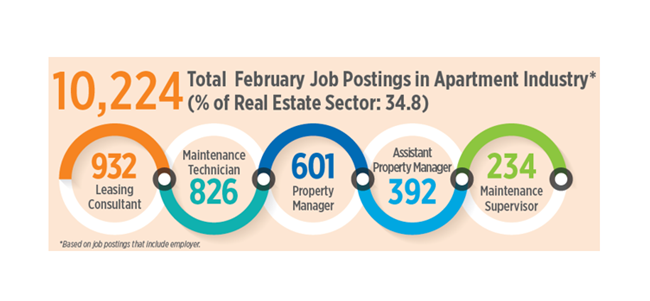
The Apartment Jobs Snapshot showed 10,224 apartment jobs were available, accounting for 34.8 percent of the broader real estate sector.

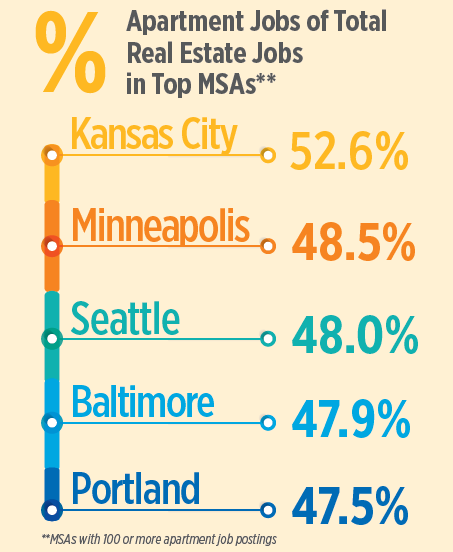
Seattle and Portland, along with Kansas City, Minneapolis, and Baltimore, had the highest share of apartment job openings.

Apartment Job Openings Strong in Seattle, Portland

time to fill jobs in Seattle and Portland

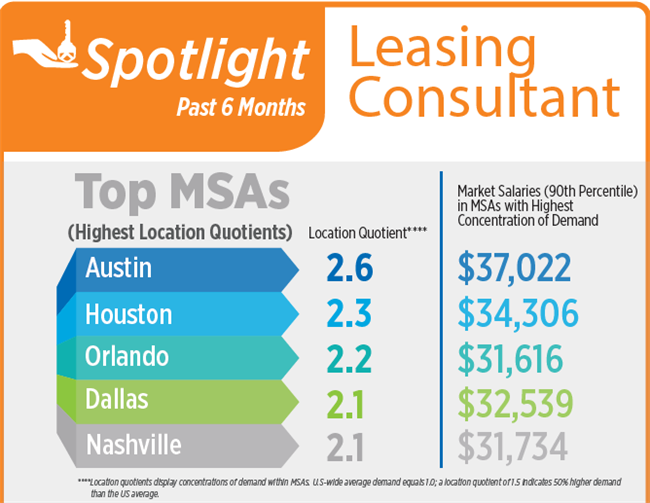
This month’s edition highlights leasing consultants, with market salaries in the 90th percentile reaching $34,047.

The demand for skilled leasing consultants was more than twice the U.S. average in Austin, Houston, Orlando, Dallas and Nashville.

leasing consultant jobs in Seattle and Portland

In addition to requiring typical leasing skills, employers are seeking experience with Yardi Software, Microsoft Office, Microsoft Excel, and computer literacy skills.

Apartment industry jobs

The NAA says on their website, “The apartment industry offers a wealth of meaningful career opportunities that use a variety of skills and capabilities. Regardless of whether you are graduating from high school or college, leaving the military, or switching careers, the industry has a job that’s just right for you.”

Apartment Job Openings

National apartment association jobs report background

“Our education institute is a credentialing body for the apartment industry. They hear often that one of the biggest problems keeping our industry leaders up at night is the difficulty in finding talent, attracting talent and retaining talent,” NAAEI’s Paula Munger said.

Assistant Property Manager Jobs In Demand

So NAA partnered with Burning Glass Technologies. “They have a labor-job posting database that is proprietary,” she said, and they can “layer on data from the Bureau of Labor Statistics (BLS). We looked at that and thought we could do something that is really going to help the industry and help benchmark job titles and trends as we go forward.”

Strong Leasing Leads To Increased Apartment Jobs Demand

Sign Up For Our Newsletter And Get Apartment News And Helpful, Useful Content Each Week.

* indicates required


Is Your Rental Housing A Target For Unwanted Bird Nests?

Is Your Rental Housing A Target For Unwanted Bird Nests?

The maintenance check up this week, provided by Keepe,  asks whether your rental housing may be a target for unwanted bird nests.

You wake up on a Saturday, make yourself some coffee and a bagel, open up the newspaper and start reading. Suddenly, you hear the dreaded beeping of your phone.

It is the tenant at your rental property complaining about bird poop all around the front porch and backyard.

A bird family has set up nest inside the vent. Your tenants can’t use the microwave oven or the vent fan for fear of hurting the little hatchlings. You decide to call bird control to remove the nest.

But one thing weighs on your mind – you really don’t want to hurt the birds or their babies. Maybe they will just fly away in a few weeks?

Bird nests common in the Northwest

This is an all too common scenario in many parts of Seattle and the Greater Northwest. It may be time for a maintenance check up to focus on nests.

Migratory birds (robins, tree swallows, tanagers, etc.) nest during late winter and early spring. With loss of habitat, and low winter temperatures, birds have begun nesting inside the warmer confines of household dryer vents. This keeps them safe from the extreme climate and allows them to prepare for the arrival of their hatchlings.

While it is easy to fall in love with the notion of sharing your home with other harmless living beings (in some eastern cultures, a bird building it’s nest in/around your home is considered a good omen), there are numerous downsides to letting this happen as well.

The obvious ones are visible bird droppings (aka bird-poop), and loud noises. Newborn birds often die and are abandoned in the vents causing serious odor problems throughout the house. Even worse, these nests can become extremely dirty and be a haven for lice and bacteria.

Maintenance check up: Install bird guards over vents

The best solution for this problem is prevention.

You can get a bird guard installed on your dryer vents. These are widely available on Amazon or any home department store like Home Depot or Lowes. Bird guards cover dryer vents and prevent mother birds from nesting in dangerous environments.

If you are unable to install it yourself, then ask your handyman or maintenance provider to install it for you.

October and November are the best times to do a maintenance check up and be proactive about installation so that you don’t have to clean up after the birds have already set up nest, or even worse, after the hatchlings are born.

This allows the mother bird time to find a nest in a tree or somewhere else where they won’t be disturbed.

About Keepe:

Keepe is an on-demand maintenance solution for property managers and independent landlords. The company makes a network of hundreds of independent contractors and handymen available for maintenance projects at rental properties. Keepe is available in the Greater Seattle area, Greater Phoenix area, San Francisco Bay area, Portland, San Diego and is coming soon to an area near you. Learn more about Keepe at https://www.keepe.com

Sign Up For Our Newsletter And Get Apartment News And Helpful, Useful Content Each Week.

* indicates required


4 Kinds Of Front Doors For Your Rental And Pros And Cons Of Each

7 Checklist Items Outside For Spring Rental Property Maintenance


Ask The Attorney: Is it About What You Know, or What You Can Prove?

Ask The Attorney Brad Kraus Is it About What You Know, or What You Can Prove about tenants

Ask the attorney is a new feature we are starting with month with attorney Bradley S. Kraus and this week the question and his answer is a follow up to an answer last week in which he said, ” In short, you may know that the tenants are violating the rental agreement. But in court, it’s not about what you know . . . it’s what you can prove.”  If you have a question for him, please feel out the form below.

Question:

As a property manager, I have had concerns from owners similar to your last column who are unhappy with their tenants and just want them out! It seems like your summation that “it’s not about what you know… it’s what you can prove” is true, but it falls short; giving the impression that, maybe, it’s worth trying to evict on these grounds – with nothing to lose.

But doesn’t Oregon’s statute include language of a rebuttable presumption that a landlord’s termination for cause is retaliatory?

This creates a defense for the tenant to obfuscate the facts, and also comes with penalties to the owner – making the for-cause eviction on minor grounds a much bigger liability than it may be worth.

–Ron

Dear Ron:

Thank you for your question.

Every situation is different. The analysis given herein certainly doesn’t take risk assessment into account. Those discussions must be had between attorney and client, and involve a variety of factors that lead up to a strategy going forward.

The retaliation statute you reference, ORS 90.385, does exist, and can provide a defense to certain terminations. The presumption is not automatic, outside of certain circumstances, although there is current legislation proposed which may add new layers to this.

Still, cost, risk/reward, evidence, and long-term goals are all part of the equation.

It’s all about your facts – what you can prove – and yes, the severity of the default does come into the discussion. There are too many layers to landlord/tenant law to get into in every response, so no response should be viewed in a vacuum.

Sincerely,

Brad Kraus

Brad Kraus Portland Attorney Ask The Attorney: Is it About What You Know, or What You Can Prove tenants are doing
Brad Kraus is a partner at Warren Allen LLP. His primary practice area is landlord/tenant law, but he also assists clients with various litigation matters, probate matters, real estate disputes, and family-law matters. A native of New Ulm, Minnesota, he continues to root for Minnesota sports teams in his free time.

Ask Attorney Brad

Please enter your rental housing management question below for Ask Attorney Brad Kraus. Unfortunately he cannot answer questions from tenants.

  • This field is for validation purposes and should be left unchanged.

Sign Up For Our Newsletter And Get Apartment News And Helpful, Useful Content Each Week.

* indicates required


Ask The Attorney: Can I Terminate A Lease For Cause Over Chickens?

HUD Charges Landlords with Sexual Harassment, Retaliation

HUD Charges Landlords with Sexual Harassment, Retaliation

A Pennsylvania apartment owner who allegedly groped and tried to forcibly kiss a female tenant when he was in her unit to perform electrical repairs has been charged with sexual harassment and retaliation, according to a release.

The U.S. Department of Housing and Urban Development (HUD) announced it is charging Allen and Heidi Woodcock, the husband-and-wife owners of apartments in Oil City, Penn., with sexual harassment and retaliation against a female resident. HUD’s charge alleges that the husband groped and tried to forcibly kiss the female tenant and further alleges that the owners retaliated against the woman and her infant child after she told the wife about the husband’s harassment.

The complaint says Allen Woodcock went to the tenant’s unit to perform repairs and to get her to sign a housing-choice voucher. He placed the voucher on the washing machine and asked the tenant to review it.

“When she went to the washing machine to review the paperwork, Mr. Woodcock came up behind her and placed his arms around her, rubbed his hands up and down her legs, and tried to kiss her. Mr. Woodcock’s actions were unsolicited and unwelcomed by (the tenant) who asked Mr. Woodcock to stop. She then quickly signed the HCV paperwork and moved away from Mr. Woodcock,” the complaint says.

A little later during the same visit, “Woodcock asked (the tenant) to come upstairs to help him with an electrical repair that required him to turn off the power. Once upstairs, Mr. Woodcock grabbed (the tenant’s) arm, pushed her against the wall, and forcibly tried to kiss her again,” the complaint says. The tenant then “put her hands on his chest to push him away, again telling him to stop.”

The Fair Housing Act prohibits harassment of tenants and other forms of housing discrimination because of race, sex, color, national origin, disability, religion and familial status.

HUD: Women are entitled to be safe in their own home

“Home is the place where we all should feel safe. Unfortunately, too many women are not safe in their own homes because their housing providers or maintenance personnel subject them to unwelcome sexual advances,” said Jeanine Worden, HUD’s Acting Assistant Secretary for Fair Housing and Equal Opportunity, in the release.

“This is particularly true for women who reside in low-income households. Today’s action demonstrates HUD’s strong and continuing commitment to use the Fair Housing Act to combat sexual harassment in housing,” she said.

“Women should be free from sexual harassment in their own homes,” said Damon Y. Smith, HUD’s Principal Deputy General Counsel, in the release.

“HUD will vigorously enforce women’s right to enjoy their homes free from harassment or intimidation, including unwanted sexual advances.”

HUD’s charge will be heard by a United States administrative law judge unless any party elects for the case to be heard in federal court. If the administrative law judge finds after a hearing that discrimination has occurred, the judge may award damages to the complainant for losses that have resulted from the discrimination. The judge may also order injunctive relief and other equitable relief, as well as payment of attorney fees. In addition, the judge may impose civil penalties in order to vindicate the public interest.

Read the full HUD complaint here.

Sign Up For Our Newsletter And Get Apartment News And Helpful, Useful Content Each Week.

* indicates required


Property Manager Charging Pet Fee for Assistance Animal Leads to HUD Discrimination Charge

Federal Judge Rules Landlords Do Not Have To Provide Free Housing

A federal judge in Ohio has ruled that the Centers for Disease Control and Prevention overstepped its authority in issuing a nationwide eviction ban

A federal judge in Ohio has ruled that the Centers for Disease Control and Prevention overstepped its authority in issuing a nationwide eviction ban, according to a release.

The ruling is a victory for a group of Ohio landlords and the National Association of Home Builders, who challenged the moratorium in October.

The decision in Skyworks v. Centers for Disease Control  “allows evictions to resume, restoring the landlords’ rights to remove tenants who don’t honor their lease obligation to pay rent,” according to the release from the Pacific Legal Foundation. (PLF). “This is a victory for the rule of law,” said Steve Simpson, a senior attorney at Pacific Legal Foundation – which represented the landlords –  in the release.

“This decision makes clear that federal agencies can’t exercise power Congress has not given them. Now our clients no longer have to provide housing for free.”

President Joe Biden issued an executive order on Jan. 20 extending eviction ban protections for the country’s 44 million rental households until March 31.

U.S. District Court for the Northern District of Ohio Judge Philip Calabrese’s declaratory judgment held that the CDC lacks the statutory authority to promulgate the eviction ban, writing, “Without question, effective pandemic response depends on the judgment of reliable science—not political science. But that obvious truism does not empower agencies or their officials to exceed the mandate Congress gives them.

“One may view the CDC’s eviction moratorium as good and essential public policy or the opposite. But those considerations are not for the Court,” wrote Calabrese in his opinion. “Nor may the Court decide this case based on its own personal or policy preferences or its views of the competing public interests involved. Instead, this dispute presents a narrower question. This case turns on whether Congress has authorized the CDC to adopt a nationwide eviction moratorium.” The judge said that on that question, he found that Congress had not given that authority.

The National Association of Home Builders (NAHB) said in a release, “Because the court determines that the statute is unambiguous and, by issuing a nationwide eviction moratorium, CDC exceeded the authority Congress gave it in Section 361, the court holds that action unlawful and sets it aside, as the APA [Administrative Procedures Act] requires,” the court ruling stated.

“On the second question, the judge explained that all Congress did was extend the moratorium, but never reviewed CDC’s authority to issue the order and certainly never ratified it.

“The government is now in a very difficult position because the court made clear that it was setting aside the eviction moratorium order under the APA.

“At this point, it is unclear whether the federal government will seek to limit the decision only to the plaintiffs involved, or to Ohio,” the NAHB said in the release.

A federal judge in Memphis, Tennessee, Judge Mark Norris, ruled the government overstepped its bounds when it put evictions on hold last year. In his ruling, Norris said the government’s order is unenforceable in West Tennessee. The landlords involved in the case own more than 5,000 rental units across the area.

Another PLF case challenging the CDC’s eviction ban— Chambless v. CDC — is on appeal to the 5th Circuit. Another case against the CDC, litigated by Texas Public Policy Foundation and Southeastern Legal Foundation, received a favorable ruling from a district court judge. A case litigated by the New Civil Liberties Alliance is on appeal at the 11th Circuit.

7 Insights for Landlords on the Federal Eviction Moratorium

Sign Up For Our Newsletter And Get Apartment News And Helpful, Useful Content Each Week.

* indicates required

Renters’ Priorities Shift from Lower Cost to More Space

renters priorities in apartment search

Renters’ priorities have shifted, and now “more space” beats “cheaper.” In their apartment search prospective renters are looking for better apartment deals with open-air amenities and more living space, preferably in the city in which they  already live, according to a new survey from RentCafe.

How the pandemic has affected renters’ priorities in the rental-housing and apartment-selection process was the topic of the survey. It showed the move to larger apartments from price and safety.

“It seems as though renters are coping with the monotony of spending most of their time at home by looking for a change in scenery, more space, open-air amenities and better local deals,” RentCafé said in the survey results.

More than 10,000 people participated in the survey while looking for an apartment on the company’s website. “In particular, respondents shared how their preferences had changed after a year of staying at home, what their main concern was while moving, or how the pandemic had affected their rental selection process.

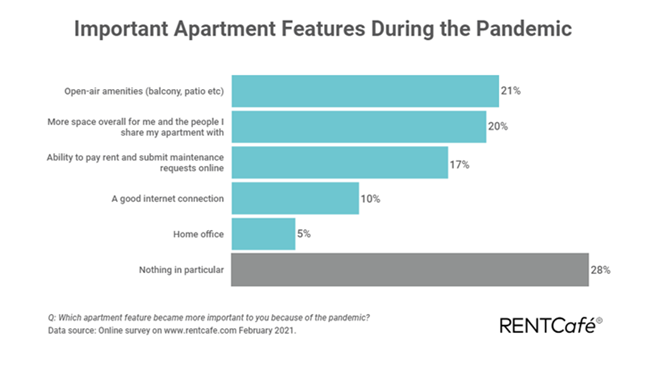
“The survey showed that lifestyle improvement was the main motivator for those looking to rent now, as the top features people search for in an apartment after one year of living in a pandemic are open-air amenities (21 percent) and more space (20 percent).

Details about how the pandemic affected the apartment search process

Renters’ priorities in the apartment search process included the following highlights:

  • Lifestyle improvement is the main motivator for those looking to rent after a year of pandemic living; 41 percent of renters picked open-air amenities and more space as their most essential apartment features in 2021, far outranking work-from-home amenities such as “home office” (five percent) or “good internet connection” (10 percent).
  • The reasons for moving are within the same spectrum; “looking for better deals” was the top answer for 29 percent of renters, followed by “the need for a change of scenery” (25 percent).
  • When asked how the pandemic affected their apartment-selection process, 28 percent of renters said they prefer a place to live by themselves. “Something cheaper” (25 percent) and “something larger” (19 percent) were next on the priority list.
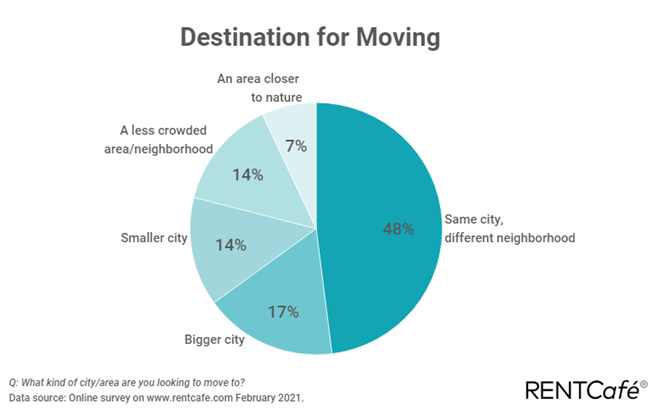
  • Ninety percent of renters look for long-term rentals. Moreover, 48 percent wish to remain in the same city they are currently in, which once again shows that improving housing conditions is the goal, not necessarily a drastic change like moving to a different city.
  • Many of those who moved in the spring of 2020 seemed to have done so out of need, not because they wanted to. “Expiring lease” was the main reason for moving (26 percent), while a significant share of renters was concerned whether they’d be “able to pay rent during this time” (32 percent).

Renters’ Priorities in apartment search Shift from Lower Cost to More Space

Summary Renters’ Priorities

Last year, the RentCafé March 2020 renter survey showed the top renter preference in apartment search was price and the top concern was safety.

“And, while plans and preferences may have changed since last March and the first stay-at-home orders, one thing has remained the same – the optimistic, carry-on attitude of the average renter.

“Twelve months apart, both RentCafé surveys have shown that, whether by choice or necessity, people keep on moving. And, as we enter the second year of the pandemic, spending time at home has become the norm – prompting increasing numbers of renters to look for better deals and amenities that make it more pleasant to be there,” the company said.

Gen Z Renters Drawn to Vibrant Smaller Towns over Urban Centers

Top Suburbs with the Most New Apartments In Last 5 Years

Sign Up For Our Newsletter And Get Apartment News And Helpful, Useful Content Each Week.

* indicates required