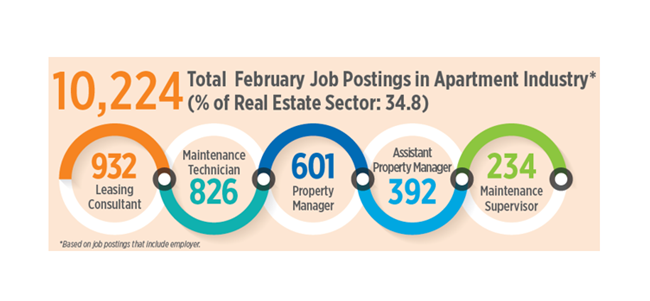
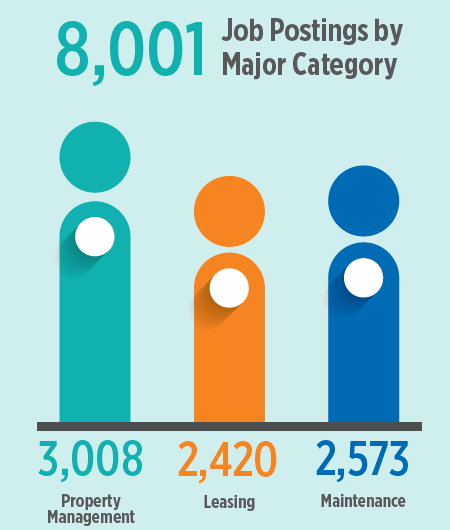
The Apartment Jobs Snapshot showed 10,224 apartment jobs were available, accounting for 34.8 percent of the broader real estate sector.
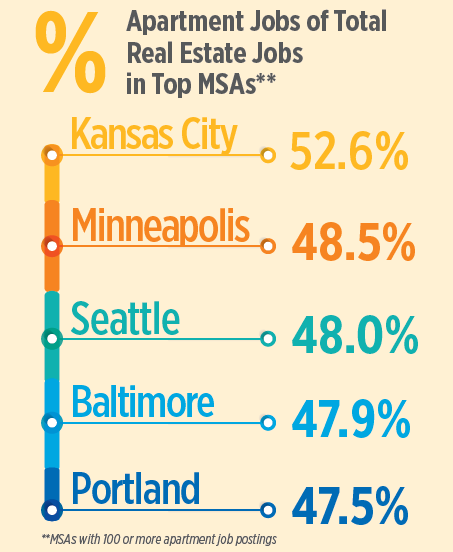
Seattle and Portland, along with Kansas City, Minneapolis, and Baltimore, had the highest share of apartment job openings.
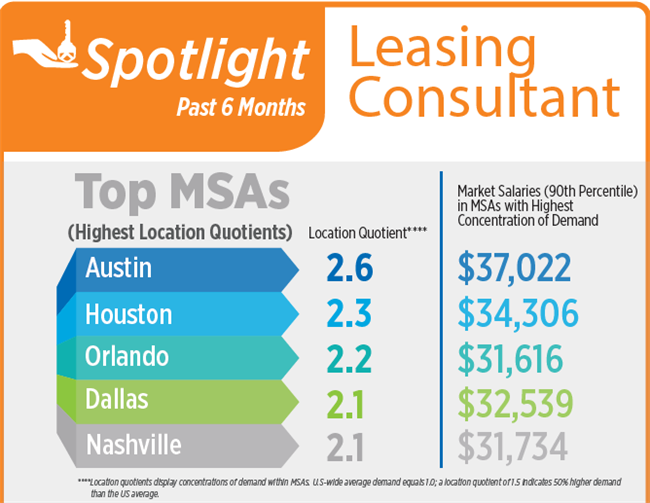
This month’s edition highlights leasing consultants, with market salaries in the 90th percentile reaching $34,047.
The demand for skilled leasing consultants was more than twice the U.S. average in Austin, Houston, Orlando, Dallas and Nashville.
In addition to requiring typical leasing skills, employers are seeking experience with Yardi Software, Microsoft Office, Microsoft Excel, and computer literacy skills.
Apartment industry jobs
The NAA says on their website, “The apartment industry offers a wealth of meaningful career opportunities that use a variety of skills and capabilities. Regardless of whether you are graduating from high school or college, leaving the military, or switching careers, the industry has a job that’s just right for you.”
National apartment association jobs report background
“Our education institute is a credentialing body for the apartment industry. They hear often that one of the biggest problems keeping our industry leaders up at night is the difficulty in finding talent, attracting talent and retaining talent,” NAAEI’s Paula Munger said.
So NAA partnered with Burning Glass Technologies. “They have a labor-job posting database that is proprietary,” she said, and they can “layer on data from the Bureau of Labor Statistics (BLS). We looked at that and thought we could do something that is really going to help the industry and help benchmark job titles and trends as we go forward.”
The maintenance check up this week, provided by Keepe, asks whether your rental housing may be a target for unwanted bird nests.
You wake up on a Saturday, make yourself some coffee and a bagel, open up the newspaper and start reading. Suddenly, you hear the dreaded beeping of your phone.
It is the tenant at your rental property complaining about bird poop all around the front porch and backyard.
A bird family has set up nest inside the vent. Your tenants can’t use the microwave oven or the vent fan for fear of hurting the little hatchlings. You decide to call bird control to remove the nest.
But one thing weighs on your mind – you really don’t want to hurt the birds or their babies. Maybe they will just fly away in a few weeks?
Bird nests common in the Northwest
This is an all too common scenario in many parts of Seattle and the Greater Northwest. It may be time for a maintenance check up to focus on nests.
Migratory birds (robins, tree swallows, tanagers, etc.) nest during late winter and early spring. With loss of habitat, and low winter temperatures, birds have begun nesting inside the warmer confines of household dryer vents. This keeps them safe from the extreme climate and allows them to prepare for the arrival of their hatchlings.
While it is easy to fall in love with the notion of sharing your home with other harmless living beings (in some eastern cultures, a bird building it’s nest in/around your home is considered a good omen), there are numerous downsides to letting this happen as well.
The obvious ones are visible bird droppings (aka bird-poop), and loud noises. Newborn birds often die and are abandoned in the vents causing serious odor problems throughout the house. Even worse, these nests can become extremely dirty and be a haven for lice and bacteria.
Maintenance check up: Install bird guards over vents
The best solution for this problem is prevention.
You can get a bird guard installed on your dryer vents. These are widely available on Amazon or any home department store like Home Depot or Lowes. Bird guards cover dryer vents and prevent mother birds from nesting in dangerous environments.
If you are unable to install it yourself, then ask your handyman or maintenance provider to install it for you.
October and November are the best times to do a maintenance check up and be proactive about installation so that you don’t have to clean up after the birds have already set up nest, or even worse, after the hatchlings are born.
This allows the mother bird time to find a nest in a tree or somewhere else where they won’t be disturbed.
About Keepe:
Keepe is an on-demand maintenance solution for property managers and independent landlords. The company makes a network of hundreds of independent contractors and handymen available for maintenance projects at rental properties. Keepe is available in the Greater Seattle area, Greater Phoenix area, San Francisco Bay area, Portland, San Diego and is coming soon to an area near you. Learn more about Keepe at https://www.keepe.com
Ask the attorney is a new feature we are starting with month with attorney Bradley S. Kraus and this week the question and his answer is a follow up to an answer last week in which he said, ” In short, you may know that the tenants are violating the rental agreement. But in court, it’s not about what you know . . . it’s what you can prove.” If you have a question for him, please feel out the form below.
Question:
As a property manager, I have had concerns from owners similar to your last column who are unhappy with their tenants and just want them out! It seems like your summation that “it’s not about what you know… it’s what you can prove” is true, but it falls short; giving the impression that, maybe, it’s worth trying to evict on these grounds – with nothing to lose.
But doesn’t Oregon’s statute include language of a rebuttable presumption that a landlord’s termination for cause is retaliatory?
This creates a defense for the tenant to obfuscate the facts, and also comes with penalties to the owner – making the for-cause eviction on minor grounds a much bigger liability than it may be worth.
–Ron
Dear Ron:
Thank you for your question.
Every situation is different. The analysis given herein certainly doesn’t take risk assessment into account. Those discussions must be had between attorney and client, and involve a variety of factors that lead up to a strategy going forward.
The retaliation statute you reference, ORS 90.385, does exist, and can provide a defense to certain terminations. The presumption is not automatic, outside of certain circumstances, although there is current legislation proposed which may add new layers to this.
Still, cost, risk/reward, evidence, and long-term goals are all part of the equation.
It’s all about your facts – what you can prove – and yes, the severity of the default does come into the discussion. There are too many layers to landlord/tenant law to get into in every response, so no response should be viewed in a vacuum.
Sincerely,
Brad Kraus
Brad Kraus is a partner at Warren Allen LLP. His primary practice area is landlord/tenant law, but he also assists clients with various litigation matters, probate matters, real estate disputes, and family-law matters. A native of New Ulm, Minnesota, he continues to root for Minnesota sports teams in his free time.
Ask Attorney Brad
Please enter your rental housing management question below for Ask Attorney Brad Kraus. Unfortunately he cannot answer questions from tenants.
A Pennsylvania apartment owner who allegedly groped and tried to forcibly kiss a female tenant when he was in her unit to perform electrical repairs has been charged with sexual harassment and retaliation, according to a release.
The U.S. Department of Housing and Urban Development (HUD) announced it is charging Allen and Heidi Woodcock, the husband-and-wife owners of apartments in Oil City, Penn., with sexual harassment and retaliation against a female resident. HUD’s charge alleges that the husband groped and tried to forcibly kiss the female tenant and further alleges that the owners retaliated against the woman and her infant child after she told the wife about the husband’s harassment.
The complaint says Allen Woodcock went to the tenant’s unit to perform repairs and to get her to sign a housing-choice voucher. He placed the voucher on the washing machine and asked the tenant to review it.
“When she went to the washing machine to review the paperwork, Mr. Woodcock came up behind her and placed his arms around her, rubbed his hands up and down her legs, and tried to kiss her. Mr. Woodcock’s actions were unsolicited and unwelcomed by (the tenant) who asked Mr. Woodcock to stop. She then quickly signed the HCV paperwork and moved away from Mr. Woodcock,” the complaint says.
A little later during the same visit, “Woodcock asked (the tenant) to come upstairs to help him with an electrical repair that required him to turn off the power. Once upstairs, Mr. Woodcock grabbed (the tenant’s) arm, pushed her against the wall, and forcibly tried to kiss her again,” the complaint says. The tenant then “put her hands on his chest to push him away, again telling him to stop.”
The Fair Housing Act prohibits harassment of tenants and other forms of housing discrimination because of race, sex, color, national origin, disability, religion and familial status.
HUD: Women are entitled to be safe in their own home
“Home is the place where we all should feel safe. Unfortunately, too many women are not safe in their own homes because their housing providers or maintenance personnel subject them to unwelcome sexual advances,” said Jeanine Worden, HUD’s Acting Assistant Secretary for Fair Housing and Equal Opportunity, in the release.
“This is particularly true for women who reside in low-income households. Today’s action demonstrates HUD’s strong and continuing commitment to use the Fair Housing Act to combat sexual harassment in housing,” she said.
“Women should be free from sexual harassment in their own homes,” said Damon Y. Smith, HUD’s Principal Deputy General Counsel, in the release.
“HUD will vigorously enforce women’s right to enjoy their homes free from harassment or intimidation, including unwanted sexual advances.”
HUD’s charge will be heard by a United States administrative law judge unless any party elects for the case to be heard in federal court. If the administrative law judge finds after a hearing that discrimination has occurred, the judge may award damages to the complainant for losses that have resulted from the discrimination. The judge may also order injunctive relief and other equitable relief, as well as payment of attorney fees. In addition, the judge may impose civil penalties in order to vindicate the public interest.
A federal judge in Ohio has ruled that the Centers for Disease Control and Prevention overstepped its authority in issuing a nationwide eviction ban, according to a release.
The decision in Skyworks v. Centers for Disease Control “allows evictions to resume, restoring the landlords’ rights to remove tenants who don’t honor their lease obligation to pay rent,” according to the release from the Pacific Legal Foundation. (PLF). “This is a victory for the rule of law,” said Steve Simpson, a senior attorney at Pacific Legal Foundation – which represented the landlords – in the release.
“This decision makes clear that federal agencies can’t exercise power Congress has not given them. Now our clients no longer have to provide housing for free.”
President Joe Biden issued an executive order on Jan. 20 extending eviction ban protections for the country’s 44 million rental households until March 31.
U.S. District Court for the Northern District of Ohio Judge Philip Calabrese’s declaratory judgment held that the CDC lacks the statutory authority to promulgate the eviction ban, writing, “Without question, effective pandemic response depends on the judgment of reliable science—not political science. But that obvious truism does not empower agencies or their officials to exceed the mandate Congress gives them.
“One may view the CDC’s eviction moratorium as good and essential public policy or the opposite. But those considerations are not for the Court,” wrote Calabrese in his opinion. “Nor may the Court decide this case based on its own personal or policy preferences or its views of the competing public interests involved. Instead, this dispute presents a narrower question. This case turns on whether Congress has authorized the CDC to adopt a nationwide eviction moratorium.” The judge said that on that question, he found that Congress had not given that authority.
The National Association of Home Builders (NAHB) said in a release, “Because the court determines that the statute is unambiguous and, by issuing a nationwide eviction moratorium, CDC exceeded the authority Congress gave it in Section 361, the court holds that action unlawful and sets it aside, as the APA [Administrative Procedures Act] requires,” the court ruling stated.
“On the second question, the judge explained that all Congress did was extend the moratorium, but never reviewed CDC’s authority to issue the order and certainly never ratified it.
“The government is now in a very difficult position because the court made clear that it was setting aside the eviction moratorium order under the APA.
“At this point, it is unclear whether the federal government will seek to limit the decision only to the plaintiffs involved, or to Ohio,” the NAHB said in the release.
A federal judge in Memphis, Tennessee, Judge Mark Norris, ruled the government overstepped its bounds when it put evictions on hold last year. In his ruling, Norris said the government’s order is unenforceable in West Tennessee. The landlords involved in the case own more than 5,000 rental units across the area.
Another PLF case challenging the CDC’s eviction ban— Chambless v. CDC — is on appeal to the 5th Circuit. Another case against the CDC, litigated by Texas Public Policy Foundation and Southeastern Legal Foundation, received a favorable ruling from a district court judge. A case litigated by the New Civil Liberties Alliance is on appeal at the 11th Circuit.
Renters’ priorities have shifted, and now “more space” beats “cheaper.” In their apartment search prospective renters are looking for better apartment deals with open-air amenities and more living space, preferably in the city in which they already live, according to a new survey from RentCafe.
How the pandemic has affected renters’ priorities in the rental-housing and apartment-selection process was the topic of the survey. It showed the move to larger apartments from price and safety.
“It seems as though renters are coping with the monotony of spending most of their time at home by looking for a change in scenery, more space, open-air amenities and better local deals,” RentCafé said in the survey results.
More than 10,000 people participated in the survey while looking for an apartment on the company’s website. “In particular, respondents shared how their preferences had changed after a year of staying at home, what their main concern was while moving, or how the pandemic had affected their rental selection process.
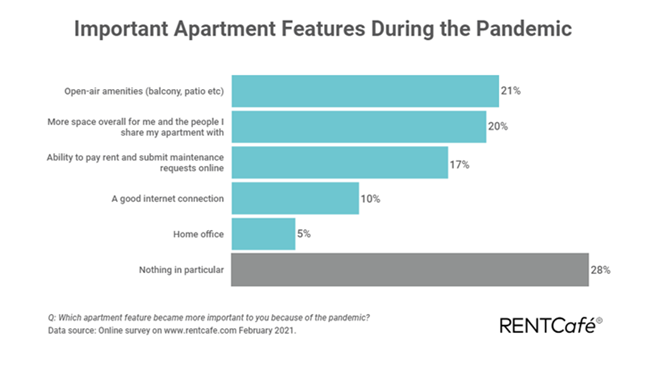
“The survey showed that lifestyle improvement was the main motivator for those looking to rent now, as the top features people search for in an apartment after one year of living in a pandemic are open-air amenities (21 percent) and more space (20 percent).
Details about how the pandemic affected the apartment search process
Renters’ priorities in the apartment search process included the following highlights:
Lifestyle improvement is the main motivator for those looking to rent after a year of pandemic living; 41 percent of renters picked open-air amenities and more space as their most essential apartment features in 2021, far outranking work-from-home amenities such as “home office” (five percent) or “good internet connection” (10 percent).
The reasons for moving are within the same spectrum; “looking for better deals” was the top answer for 29 percent of renters, followed by “the need for a change of scenery” (25 percent).
When asked how the pandemic affected their apartment-selection process, 28 percent of renters said they prefer a place to live by themselves. “Something cheaper” (25 percent) and “something larger” (19 percent) were next on the priority list.
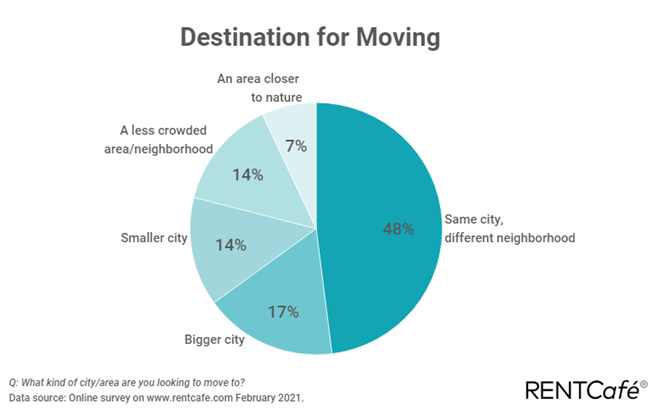
Ninety percent of renters look for long-term rentals. Moreover, 48 percent wish to remain in the same city they are currently in, which once again shows that improving housing conditions is the goal, not necessarily a drastic change like moving to a different city.
Many of those who moved in the spring of 2020 seemed to have done so out of need, not because they wanted to. “Expiring lease” was the main reason for moving (26 percent), while a significant share of renters was concerned whether they’d be “able to pay rent during this time” (32 percent).
Summary Renters’ Priorities
Last year, the RentCafé March 2020 renter survey showed the top renter preference in apartment search was price and the top concern was safety.
“And, while plans and preferences may have changed since last March and the first stay-at-home orders, one thing has remained the same – the optimistic, carry-on attitude of the average renter.
“Twelve months apart, both RentCafé surveys have shown that, whether by choice or necessity, people keep on moving. And, as we enter the second year of the pandemic, spending time at home has become the norm – prompting increasing numbers of renters to look for better deals and amenities that make it more pleasant to be there,” the company said.
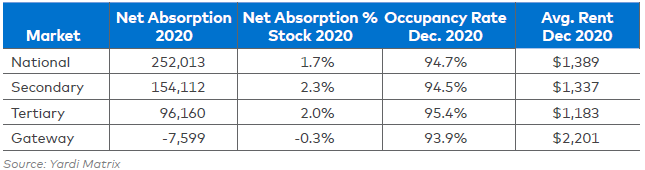
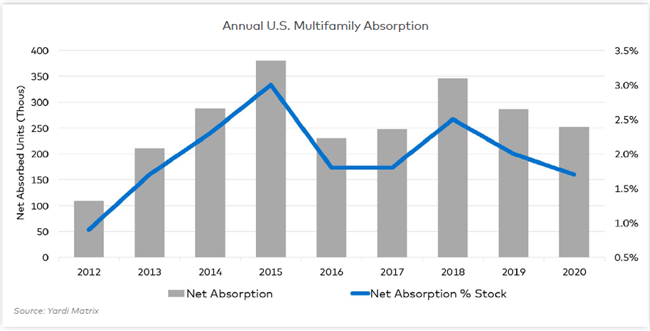
Despite a pandemic that restricted many routine activities, some 252,000 apartment units, or 1.7 percent of total stock, were absorbed in the United States in 2020, according to a review of Yardi Matrix’s database.
“Fast-growing secondary metros such as Dallas, Atlanta and Denver saw the highest absorption, while growth was negative in high-cost coastal metros. Although the industry faces challenges in 2021, the durability of demand is a good sign moving forward,” the report says.
The absorption, or net change in occupied units, was broadly distributed.
While the Bay Area and New York saw negative absorption, “net absorption was in the black in 25 of the 30 largest metros, led by Dallas, Atlanta, Denver and Phoenix. Those top 25 metros accounted for 158,300 units absorbed, more than 60 percent of total U.S. net absorption.”
On a regional level, renters continued to flock to the:
Southeast: 96,700 units absorbed, or 2.4 percent of total stock
Southwest: 56,800 units, 2.1 percent of stock
West: 57,100 units, 1.9 percent of stock
Image courtesy of Yardi Matrix.
Issues still ahead in 2021 for apartment units
While the absorption rate and demand was better than expected, multifamily real estate still faces a number of issues in 2021:
Renter support: Industry trade groups estimate that renters are behind on payments by as much as $70 billion. Some tenants will make up the payments over time, and some property owners will be reimbursed through a $25 billion federal renter subsidy passed by Congress, but many owners will have to deal with payment shortfalls.
Multifamily delinquency rates remain low, but in some cases that is because of forbearance by lenders that will be dealt with after the pandemic.
Some state- and city-level jurisdictions have implemented eviction bans that increase the difficulty of collecting rents
Conclusion
“By and large, though, the signs going forward are encouraging. The availability of COVID-19 vaccines makes it likely that normal activity will be possible by the end of 2021, or maybe in 2022,” the review said.
“When downtown office buildings and urban entertainment venues reopen, some of those who left are sure to return.
Yardi Matrix researches and reports on multifamily, office and self-storage properties across the United States, serving the needs of a variety of industry professionals. Yardi Matrix Multifamily provides accurate data on 18+ million units, covering more than 90 percent of the U.S. population. Contact the company at (480) 663-1149.
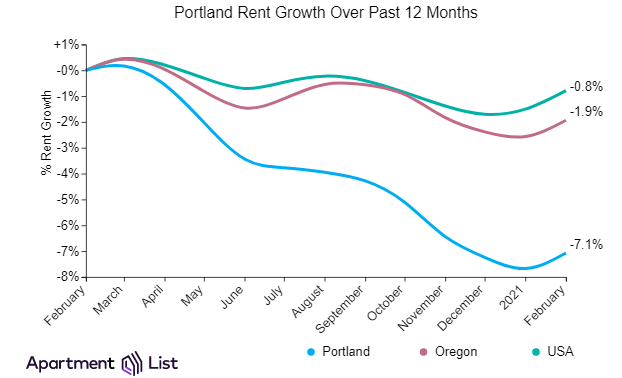
Portland rent growth is starting up again as rents have jumped 0.6 percent in February in the Oregon city, joining a growing trend of data representing the clearest indication yet that rent prices are rebounding in markets across the country, according to the latest report from Apartment List.
“The days of plummeting rents in pricey coastal markets appear to be coming to an end, with cities such as San Francisco, Seattle and Portland experiencing positive month-over-month growth for the first time since the start of the pandemic,” Apartment List said in the report.
Igor Popov, chief economist for Apartment List, said, “Though I don’t have a crystal ball, I do think we’ve seen rents bottom out,” in the bigger cities, including Portland, Oregon.
While rents are starting to rebound, Portland Oregon rents are still down 7.1 percent year-over-year.
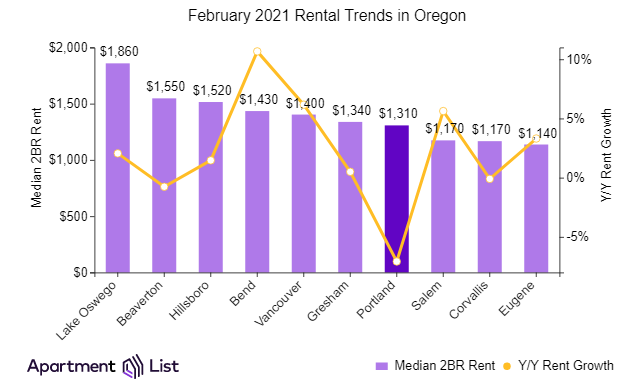
Median rents in Portland are $1,121 for a one-bedroom apartment and $1,308 for a two-bedroom.
Rents starting to increase where they had fallen
“We’re seeing a similar trend play out in nearly all of the cities where rents have been falling fastest,” the report said. “Nine of the 10 cities with the sharpest year-over-year rent declines experienced positive rent growth this month (February). For five of these cities, this was the first monthly increase since the start of the pandemic, while the other four are continuing a trend that began last month.”
Since the start of the pandemic, “we have witnessed significant disruptions to rental markets across the country. Social distancing and remote work changed what people want in a home, while many renters were thrust into immediate and unexpected financial hardship as layoffs and furloughs rippled through the economy.
“These sudden changes to budgets and preferences led to a convergence in rental prices across the U.S. — the most expensive markets saw rents fall rapidly, while a number of more affordable mid-sized cities experienced accelerating rent growth.
“This month’s data indicates that the markets where rents have been falling rapidly have reached a turn point. The booming markets (led by Boise, Fresno and Gilbert) are still seeing prices rise, but in many cases, that growth is flattening somewhat. While remote work and economic fallout of the pandemic will undoubtedly continue to impact local rental markets going forward, the way that these trends continue to play out may now start to become more nuanced and gradual,” Apartment List said in the report.
If you are a struggling landlord right now, fellow landlord David Pickron suggests three things you should think about if you are dealing with a tenant who is not paying you and feels entitled to be in your property.
By David Pickron
I recently came home from work and saw my teary-eyed daughter sitting defeatedly on the couch. This was abnormal for her, and signaled something was wrong. She is tough, handles stress well and has been an athlete playing high-level golf since age 14. If any game can break you, it’s golf, and last night was her breaking point. Trying to qualify for her first tournament as a college freshman, she started strong on the first three holes with a series of great shots. Things started to crumble on hole No. 4 with a shot into the lake. This rattled her so much that over the remaining holes she struggled and ended up scoring her highest round of golf since her freshman days in high school. As she sat there looking back at me, suspecting her score wouldn’t help her qualify, she said, “it’s just too hard, I want to quit.”
If you’ve been a landlord for any amount of time, you may have felt like throwing in the towel at some point. Last week, one of my tenant’s children decided to get on the roof and pour gas down two stories to a mobile firepit. The neighbor was watching and filmed the entire incident. (I love having a relationship with the neighbors of my tenants). No adult supervision and balls of flames crawling up my walls; definitely grounds for an eviction. I sent the video to my tenant and told them our relationship had come to an end and that they would be receiving notice to leave. Can you guess the answer? “I have COVID so you can’t evict me.” If there were ever a reason to give up on being a landlord, this might qualify.
As a private investigator and seasoned landlord, I ask myself, “How did I get here?” This same family has been a consistent tenant for more than 10 years, never missing a payment. I screened them well, followed best practices and even after all of that, I find myself in a situation where I have lost control of my own property because of a regulation passed by our local, state, and federal government.
Knowing what I know now, would I do it all over again? Absolutely! Even when we do everything right, sometimes things still go wrong. You have a right to be mad, stomp around, and even feel sorry for yourself; but then you’ve got to get over it. If you are a struggling landlord right now, let me suggest three things you should think about if you are dealing with a tenant who is not paying you and feels entitled to be in your property.
Hire a Team of Professionals
Form a great relationship with a landlord/tenant attorney. Most of the good ones can be found through your local landlord associations. These professionals follow all federal and local laws and have the resources necessary to manage different requirements coming from different jurisdictions. Time and time again I have seen people panic over a new regulation, only to find out the regulation was already in force by a federal rule or really did not have any impact at all. For example, Louisville just came out with a city ordinance adding individuals with criminal histories as a protected class, only to take away any “teeth” from the ordinance by exempting any crime that would affect the health and safety of the landlords. I don’t know a landlord who would penalize an applicant for underage drinking five years ago, but robbery or drugs is another story.
Get with a professional mortgage broker who understands your landlord strategy and can help maximize your returns with the right type of loan.
Align with a collection agency and create a program to send delinquent tenant accounts to collection and put it on their credit. There are no rules requiring a tenant to be out of the home in order to send a file to collections.
Establish a relationship with a professional realtor who can analyze whether selling your home would bring you a great sales price.
A professional accountant can let you know how refinancing or selling your property will affect your income, capital gains etc. Let the professionals do what they do best and guide you through this process.
Analyze Your Onboarding Practice
Do you have a specific criteria? If not, get one today. We have samples at Rent Perfect that will help you design an efficient onboarding process. If you do not have a criteria, then everyone qualifies, and you know that just can’t be true. The whole onboarding process starts with putting your criteria on paper.
More than ever, a call to a potential tenant’s last two landlords is critical. Though painful and time-consuming, do not skip this step. How tenants left their prior homes is probably how they will leave your home. If you can’t reach a landlord and have doubts about what the prospective tenant is telling you, require canceled checks or bank statements that show they paid rent for the last 12 months. If they paid rent through this COVID-19 crisis, there is a good chance it will continue. We can’t afford to make a mistake during onboarding.
Remember Why You Became a Landlord
No other business allows you to buy something, have someone else pay for it, and at the end you still own it (with maybe even a little cash flow on the side). A declining mortgage and appreciating asset are your ticket to long-term wealth. A recent TV show called “Undercover Billionaire” dumps each contestant into a random city where they receive $100, a phone and a car, with the challenge to create a business worth a million dollars in less than 90 days. All three contestants chose real estate! That’s why you became a landlord. Don’t ever forget this!
Sitting on the couch sulking because the last year wasn’t fair won’t get you anywhere. So, get up, align yourself with professionals, review and modify your onboarding practices, and get in the game to grow your wealth. My daughter knew deep down that quitting was not an option. She was too invested to walk away (by the way, she shot one of her best rounds ever a few days later), and you will be, too.
About the author
David Pickron is president of Rent Perfect, a private investigator, and a fellow landlord who manages several short- and long-term rentals. Subscribe to his weekly Rent Perfect Podcast (available on YouTube, Spotify, and Apple Podcasts) to stay up to date on the latest industry news and for expert tips on how to manage your properties.
This week the question for Ask Landlord Hank is about unpaid back rent and the eviction ban. Remember Hank is not an attorney and is not giving legal advice so check your local ordinances. (Editors note: This answer was before the passage of the new American Rescue Plan and its details which are not all known for impact on landlords.)
Dear Landlord Hank,
I have a tenant who owes me $8,800 in unpaid back rent cumulated over the last 10 months. He repeatedly missed payments of our payment plan. It’s causing me emotional stress and affecting my health. I’m in Washington state, which has an eviction ban in place until March 31. What should I do?
-Tammy
Dear Landlord Tammy,
The FHA has extended the eviction moratorium through June 30, 2021. BUT if your property doesn’t have a loan then you may still be able to evict this tenant.
Has the tenant given you any paperwork saying they have COVID-19 or have been affected by COVID-19?
I would contact a local attorney that handles landlord/tenant law in your area to see if you can successfully evict this tenant.
You could also contact your magistrate court and get some answers. You don’t want to win an eviction hearing only to have the sheriff’s department not dispossessing tenants.
So that is one part of the issue, the other part is the unpaid back rent and lost rent of $8,800.
Last April, the first COVID-19 relief package passed Congress, the CARES act. This act included more than $350 billion for new Small Business Administration programs, including the Paycheck Protection Program and the Economic Injury Disaster Loans.
Last December, Congress appropriated even more funds, and there is a loan-forgiveness process in place for those borrowing less than $150,000. Both of these programs have been extended until Sept 30, 2021.
So I would look into that as well. Perhaps you can have your tenant evicted and get help from the federal government for your unpaid back rent losses. Best of luck to you in these trying times.
Sincerely,
Hank Rossi
Landlord Hank says, “I would contact a local attorney that handles landlord/tenant law in your area to see if you can successfully evict this tenant.”
Ask Landlord Hank Your Question
Ask veteran landlord and property manager Hank Rossi your questions from tenant screening to leases to pets and more! He provides answers each week to landlords.