Home Blog Page 74

Record Number of Office-to-Apartment Conversions

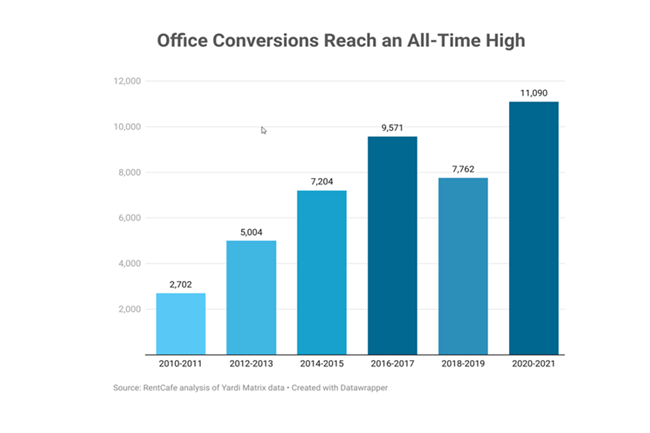
Apartment conversions from office buildings to apartments are at an all-time high, with 11,000 office conversions in the last two years

Conversions from office buildings to apartments are at an all-time high, having made way for 11,000 apartments in just the last two years, according to a report from RentCafé.

The report also says there are 77,000 apartments under conversion, setting up the stage for a boom in adaptive reuse in the upcoming years.

“This increasingly popular real estate niche brought a total of 28,000 new rentals in 2020-2021, well above the pre-pandemic years of 2018-2019 when 22,300 apartments were brought to life through adaptive reuse. Amid an ever-growing need for housing, adaptive reuse picked up speed in America’s largest cities, according to the latest data from Yardi Matrix,” the report says.

“Existing building architecture is the critical starting point. Not all buildings are equally threatened by the work-from-home revolution. Larger office buildings in abandoned central business districts are better suited to conversion than the often-smaller office complexes distributed around the suburbs,” said Doug Ressler, manager of business intelligence at Yardi Matrix.
Apartment conversions from office buildings to apartments are at an all-time high, with 11,000 apartment conversions in the last two years
Chart courtesy of RentCafé

Here are the main findings:

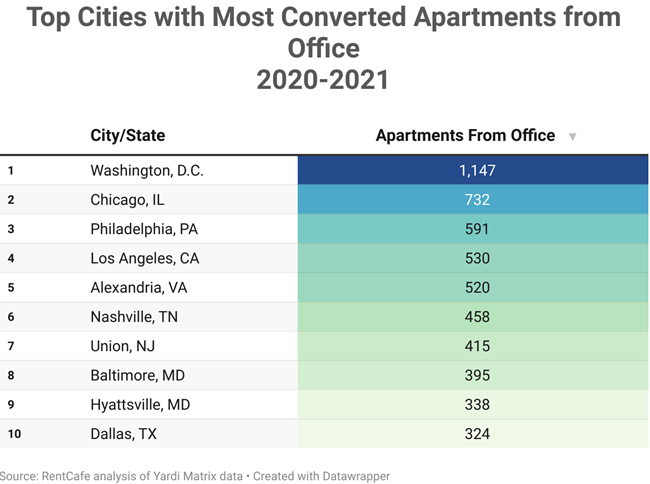
  • The 25 percent jump in converted apartments compared to pre-pandemic years roughly translates into 28,000 new rentals delivered nationwide in 2020 and 2021 combined. Washington, D.C., Philadelphia, and Chicago are the leaders when it comes to repurposed buildings during the pandemic, boasting a combined 15 percent of all apartment conversions in the United States.
  • Adaptive-reuse apartments grew faster than new apartments — 25 percent versus 10 percent — during the same timeframe. After maintaining a steady pace of growth of around 35 percent  each year between 2012 and 2017, adaptive reuse saw a dramatic decrease of 24 percent between 2018-2019. By the start of 2020, conversions picked up speed again.
  • Conversions from office to apartment hit a record high, with 11,090 apartments delivered in 2020 and 2021 alone. That’s a 43 percent uptick compared to the previous two-year interval (2018-2019). Washington, D.C., Philadelphia and Chicago lead the way in this category as well.
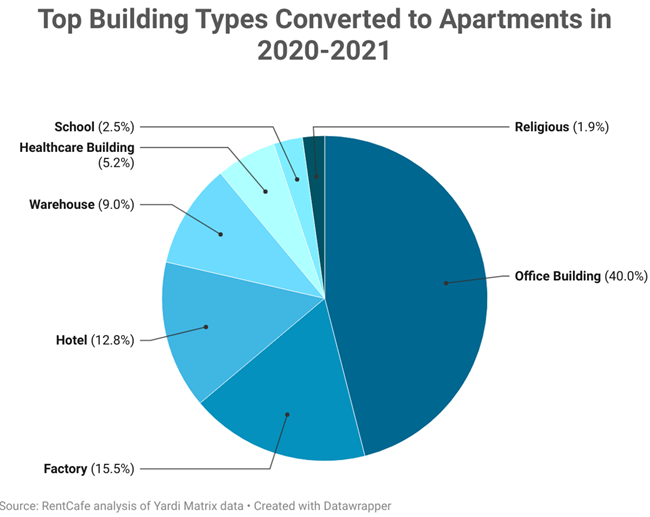
  • Office buildings are the most popular type post-pandemic, making up 40 percent of all adaptive-reuse apartments. However, smaller niches such as former healthcare buildings are growing at a staggering pace. The number of apartments converted from healthcare buildings more than tripled during the pandemic compared to the 2018-2019 period, increasing by 212 percent. Next up come the religious buildings, with a 73 percent increase, followed by hotel conversions, which grew by 65.6 percent. The next conversion niches are former factories, warehouses and school buildings.
  • 77,000 converted apartments are expected to be opened over the next several years. As a matter of fact, nowhere is the future development of adaptive reuse more evident than in Los Angeles, where a total of 4,130 apartments resulting from conversions are expected. As many as 1,242 apartments came online between January and June in Los Angeles, making this year the best one in the last decade.
Apartment conversions from office buildings to apartments are at an all-time high, with 11,000 apartment conversions in the last two years

When it comes to future projects, office conversions are projected to represent 28% of total apartments under conversion — the largest share of all building types under conversion, according to Yardi Matrix. Hotels represent the second-largest share (22% of future projects), while factories (that make up 16% of the total) are in third place.
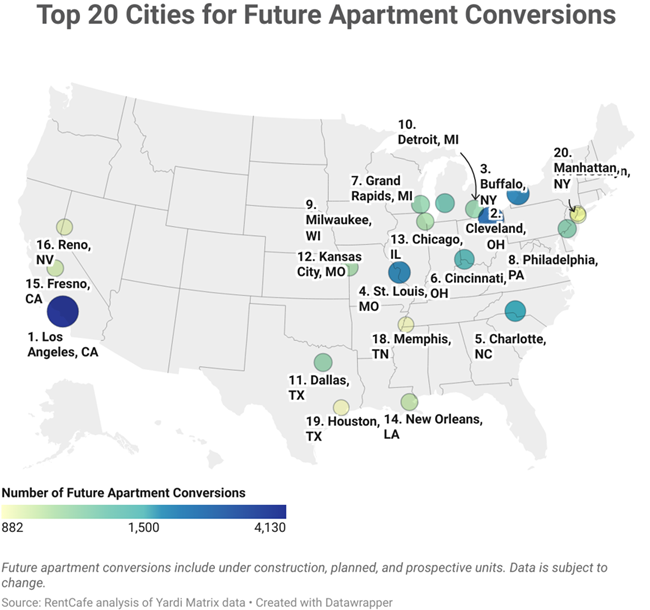
top cities for future apartment conversions

About Yardi Matrix

Yardi Matrix researches and reports on multifamily, office and self-storage properties across the United States, serving the needs of a variety of industry professionals. Yardi Matrix Multifamily provides accurate data on 18+ million units, covering more than 90 percent of the U.S. population. Contact the company at (480) 663-1149.


Sign Up For Our Weekly Newsletter And Get Rental Property And Apartment News And Helpful, Useful Content Each Week.

* indicates required

Rental Price Drops Around The Country

Portland Rents Increase Again In October

Should I Give Separate Leases to Roommate Tenants?

Should a landlord give separate leases to roommate tenants is the question this week for Ask Landlord Hank. 

Should a landlord give separate leases to roommate tenants is the question this week for Ask Landlord Hank. Remember Hank is not an attorney and is not offering legal advice. If you have a question for him please fill out his form below.

Dear Landlord Hank,

I have a tenant who is unhappy with their roommate, whom they choose. The tenant is asking to sign separate leases so they would not be held responsible for damages or unpaid rent by the other. Is that a thing now? Is it legal in Washington?

– Deb

Dear Landlady Deb,

Roommates on a lease are a tricky situation that often goes bad.

If your current tenant requested someone new to be added to the lease as a new tenant (hopefully you did credit and background screening), then she is still fully responsible for the lease, as is the roommate.

If someone violates the lease, then you could and probably should evict both.

You’ll need to check the laws in your state though. Do NOT give each person their own lease. That would make each tenant responsible for only half the rent and if one leaves or breaks the lease, you’d have to replace that tenant.

Sincerely,
Hank Rossi

Each week I answer questions from landlords and property managers across the country in my “Dear Landlord Hank” blog in the digital magazine Rental Housing Journal.    https://rentalhousingjournal.com/asklandlordhank/


 Should a landlord give separate leases to roommate tenants is the question this week for Landlord Hank.
Landlord Hank working on renovation in one of his rentals. Hank says, “Do not give each person their own lease.”

Ask Landlord Hank Your Question

Ask veteran landlord and property manager Hank Rossi your questions from tenant screening to leases to pets and more! He provides answers each week to landlords.

  • This field is for validation purposes and should be left unchanged.

Do I Have to Paint and Replace Flooring for a Long-Term Tenant?

A Tenant Poured Grease Down Drain Who Is Responsible?

Sign Up For Our Newsletter And Get Rental Housing And Apartment News And Helpful, Useful Content Each Week.

* indicates required

Trends Is Tuesday! Register Now For the Biggest Property And Innovations Conference In The Northwest

Time is running out to register for Trends the biggest one-day property and innovations conference in the Northwest November 29 in Seattle.

Time is running out to register for Trends the biggest one-day property and innovations conference in the Northwest on Tuesday, November 29 in Seattle.

Trends is a diverse conference and offers a variety of benefits for everyone within the rental housing industry, whether that’s finding new business, networking with new partners, building your contact list or learning best practices and how you should prepare for the future of our industry.

There will be in person this year sponsors, vendor partners, and expert speakers for the largest gathering of housing industry stakeholders on the West Coast where more than 1,500 attendees are expected.

The 38th annual event will be held from 8:30 a.m. to 4 p.m. PST on Nov. 29, 2022, at the Seattle Convention Center, 705 Pike St., Seattle, WA 98101.

Who Should Attend?

Trends is a diverse conference and offers a variety of benefits for a everyone within the rental housing industry, whether that’s finding new business, networking with new partners, building your contact list or learning best practices and how you should prepare for the future of our industry.

Large and Small Property Owners and Their Representatives

  • Property Managers
  • On-site Leasing and Management Personnel
  • Apartment Maintenance Personnel
  • Government Housing Authorities
  • Condo Association Managers
  • Developers and Builders
  • Investors and Portfolio Managers

Register Today at www.TrendsTradeShow.com

  Admission

Event registration includes access to education workshops taught by the best local, regional and national presenters.


How To Have a Fair Housing-Friendly Holiday Season

Some helpful, useful tips on how to help you and your tenants have a happy fair-housing friendly holiday season.

Some helpful, useful tips on how to help you and your tenants have a happy fair-housing friendly holiday season.

By The Fair Housing Institute

The holiday season is upon us, and we should all be preparing to ensure an inclusive and diverse environment for our communities.

This article will share some fantastic tips to help you and your community get ready and have a happy fair housing-friendly holiday season!

Leasing Office Decorations

Many of us have personal opinions about what is and is not acceptable concerning holiday decorations; it’s best to take a step back and see what the law says and then consider some best practices based on that.

On January 9th, 1995, a memorandum was released by HUD (Housing and Urban Development) that in part addressed Fair Housing holiday decorations. The subject was “Guidance Regarding Advertisements Under 804(c) of the Fair Housing Act”. Here is a direct quote from that document.

“The use of secularized terms or symbols relating to religious holidays such as Santa Claus, Easter Bunny, or St.Valentine’s Day images, or phrases such as Merry Christmas, Happy Easter, or the like does not constitute a violation of the Act.”

So does this mean we can throw caution to the wind? As a professional in the housing industry, you may be faced with holiday-related items that are simply viewed as potentially offensive or insensitive but that are not against Fair Housing laws.

While using these secular terms and items may not be a direct violation, they are related to the protected class of religion. So discretion is needed to make certain that no one person feels discriminated against. To help, ask yourself these questions if you are going to decorate your leasing office:

  • Will everyone be comfortable in this space?
  • Are the choice of decorations inclusive, or do they only represent certain religions?
  • Do the decorations promote a sense of equality and community?

Community-Based Holiday Parties

Having neutral policies and procedures in place regarding the use of community common areas ahead of time is a must. In other words, if your policies allow for religious activities, make sure your policy covers all religions. If someone wants to reserve the common area for an activity, it should not be limited because it is not appropriate for the rest of the residents. The limits should only be for disturbing activities, for example, being too loud. All the limits should be equal for every resident.

Resident Decorations

Here again, is where your community policies and procedures come into play. If you do allow residents to hang things on their doors or perhaps decorate the patios or balconies of their apartments, there should be house rules to cover all decorations. This will keep it from being viewed as discrimination against religious or cultural decorations.

Fair Housing Holiday Final Take-Away

By focusing on building an environment focused on inclusivity and diversity, we can help everyone feel welcome and appreciated. However, sometimes despite our best efforts, someone may still complain. Do not dismiss this as holiday stress or burnout. Take every complaint seriously and document everything!

Now would be a great time to add some additional fair housing training for your staff that focuses on the holidays to help make sure everyone is on the same page and ready to spread some holiday cheer!

About the author:
In 2005, The Fair Housing Institute was founded as a company with one goal: to provide educational and entertaining fair-housing compliance training at an affordable price at the click of a button.

Sign Up For Our Weekly Newsletter And Get Rental Property And Apartment News And Helpful, Useful Content Each Week.

* indicates required

Property Management Groups Sue Over $10 Cap On Screening Fees

An Oregon judge has sided with landlords over the City of Eugene’s attempt to cap tenant screening fees at $10, according to reports.
Property management groups sue city.

Two property management groups have sued the City of Eugene over a city-imposed $10 cap on rental applicant screening fees.

Thorin Properties and Jennings Group, Inc charge in the lawsuit that Oregon law grants landlords the right to collect applicant screening charges sufficient “to cover the costs of obtaining information about an applicant.”

The property management groups say they told Eugene officials that application screening “typically costs four to five times more” than the $10 cap, according to the Eugene Register-Guard.

The city can’t preempt state law by requiring housing providers to charge less than the cost of screenings, said Gary Fisher, deputy executive director of Multifamily NW, the state’s largest association of housing providers and a strong supporter of the lawsuit.

“These regulations are essentially a tax on housing providers and will only cause housing costs to rise throughout the city,” Fisher said in a statement.

Fisher added housing providers have felt left out as the city considers renter protections and saw the legal system as a “last resort” after putting out ideas and compromises and being ignored.

The city is unable to comment on the lawsuit, a spokesperson said.

Thorin Properties is an Oregon Limited Partnership. It owns 16 properties in Eugene, Oregon, consisting of 82 apartment units and six stand-alone rental homes.

Jennings Group, Inc., is an Oregon corporation which is licensed as a property management firm. It manages 1,595 residential department units in the City of Eugene.

Eugene passed the rental applicant screening fees ordinance in July.

“Plaintiffs are adversely affected by the enactment and enforcement of the amendments contained the ordinance, which restricts the amount they are allowed to charge tenants in the screening process and prevents them from recovering their actual screening costs,” the lawsuit says.

Sign Up For Our Weekly Newsletter And Get Rental Property And Apartment News And Helpful, Useful Content Each Week.

* indicates required

Investigation Called For Over RealPage Rent-Setting Software

An investigation has been called for over RealPage rent-setting software and if it is helping landlords coordinate rental pricing

Seventeen Democratic members of the U.S. House of Representatives have sent a letter to the Department of Justice and the Federal Trade Commission asking the agencies to investigate RealPage’s rent-setting software, according to ProPublica.

The Justice Department and Federal Trade Commission have not responded to the request.

ProPublica is reporting that RealPage, a Texas-based real estate tech company, is facing a new barrage of questions about whether its software is helping landlords coordinate rental pricing in violation of antitrust laws.

In an Oct. 15 story, ProPublica detailed how RealPage’s pricing algorithm uses competitor data to suggest new prices daily for available apartments. ProPublica raised concerns that the software, sold by RealPage, is potentially pushing rent prices above competitive levels, facilitating price fixing or both.

In the letter, Reps. Jesús “Chuy” García and Jan Schakowsky, both from Illinois, and other Democratic leaders said that if big property managers and RealPage formed a cartel to artificially inflate rents and decrease the supply of apartments, they could face “potential criminal prosecution.”

“Our constituents cannot afford to have anticompetitive — and potentially per se illegal — practices drive up prices for essential goods and services at a time when a full-time, minimum-wage salary does not provide a worker enough money to rent a two-bedroom apartment in any city across this country,” they told ProPublica.

RealPage’s rent-setting software uses an  algorithm-based price optimization model. The rent-setting software is called YieldStar and is being used by a growing number of property managers and landlords.

RealPage’s software applies a complex set of mathematical rules to a vast trove of data collected by the company from landlords who are its clients. That data includes the otherwise private data of nearby competitors.

Class action pressure growing with more lawsuits filed

The House letter adds to growing legal and regulatory pressure on RealPage. U.S. Sen. Sherrod Brown recently sent a similar request to the FTC calling for a review of the company’s practices.

“Renters should have the power to negotiate fairly priced housing, free from illicit collusion and deceptive pricing techniques,” Brown said in his letter. “Troublingly, ProPublica reported that a former RealPage executive stated that the data could give insight into how competitors within a half-mile or mile radius are pricing their units,” said the letter, which was addressed to FTC chair Lina Khan.

RealPage has said the data fed into its pricing tool is anonymized and aggregated. It said the company “uses aggregated market data from a variety of sources in a legally compliant manner.”

In a statement, the company said it had not seen the Brown letter, “but we are always willing to engage with policy stakeholders to ensure they have the facts about the competitive dynamics of the housing market and the value and benefits that RealPage creates for renters and housing providers.”

A lawsuit filed  on behalf of two Seattle renters alleges a broad pattern of collusive behavior by RealPage and a group of 10 large property managers.

In one neighborhood in Seattle, ProPublica found, 70 percent of apartments were overseen by just 10 property managers, all of which used pricing software sold by RealPage in at least some of their buildings.

The lawsuit says that in addition to using RealPage software to inflate rents in downtown Seattle, property managers had employees call competitors regularly seeking detailed nonpublic information on what they were charging — which the employees would change their prices to match.

Sign Up For Our Weekly Newsletter And Get Rental Property And Apartment News And Helpful, Useful Content Each Week.

* indicates required

Rental Price Drops Around The Country

Portland Rents Increase Again In October

Landlord Asks About Reporting Tenants To Credit Bureaus

A landlord asks about reporting tenants to credit bureaus as the question this week for Ask Landlord Hank.

A landlord asks about reporting tenants to credit bureaus as the question this week for Ask Landlord Hank. Remember Hank is not an attorney and he is not offering legal advice. If you have a question for him please fill out the form below.

Dear Landlord Hank,

I own a rental house and am new to this rental ownership. I would like to know if I need to report the tenant’s rental payment to the credit bureau?

If so, any recommended credit bureau reporting system I can use? Thanks in advance.

– Sun

Hello New Landlord Sun,

In the past, rent payment was not included in a tenant’s credit report but it is a good tool to help a good tenant keep a good credit score.

If you as a landlord want to help your tenants this way you can sign up fee for service with ClearNow.com, PayYourRent.com, Esusurent.com or several other companies.

Some report to all three major credit bureaus, others don’t.

Tenants are able to sign up too- Pinata.ai is a free service but there are also services tenants can pay for like RentReporters.com, RentalKharma.com and Levelcredit.com.

Sincerely,

Hank Rossi

Each week I answer questions from landlords and property managers across the country in my “Dear Landlord Hank” blog in the digital magazine Rental Housing Journal.  https://rentalhousingjournal.com/asklandlordhank/


A landlord asks about reporting tenants to credit bureaus
Landlord Hank says, “In the past, rent payment was not included in a tenant’s credit report but it is a good tool to help a good tenant keep a good credit score.”

Ask Landlord Hank Your Question

Ask veteran landlord and property manager Hank Rossi your questions from tenant screening to leases to pets and more! He provides answers each week to landlords.

  • This field is for validation purposes and should be left unchanged.

Do I Have to Paint and Replace Flooring for a Long-Term Tenant?

Sign Up For Our Newsletter And Get Rental Housing And Apartment News And Helpful, Useful Content Each Week.

* indicates required

Rents Rise Modestly As Interest-Rate Hikes Take Center Stage

Rents Rise Modestly As Interest-Rate Hikes Take Center Stage

Multifamily asking rents rose modestly moving up a bit in October, according to the October National Multifamily Rent and Supply Report from Yardi Matrix, as everyone is watching the Federal Reserve’s big increases in short-term interest rates.

“The Fed’s actions have roiled the housing market, which is sure to impact multifamily demand, property values and investment strategies,” the report says.

While overall multifamily asking rents continued to decline in October, there was a small increase over the previous month in the average U.S. asking rent. This slight increase was seen in a few markets led by New York (0.8 percent), Indianapolis (0.7 percent), Kansas City (0.6 percent) and Portland (0.5 percent).

“These metros benefit from low levels of new supply that are less than the national average,” Yardi Matrix said.

Highlights of the report:

  • Multifamily rents rose modestly in October amid weakening demand and decelerating year-over-year growth. U.S. asking rents increased $3 in October to $1,727. Year-over-year growth fell to 8.2 percent, the lowest level since the summer of 2021.
  • The deceleration in asking rents remains gradual, as every one of the Matrix top 30 metros produced year-over-year rent increases. But there are worries about how the multifamily market will react to the rapid increase in short-term interest rates as the Federal Reserve attempts to reduce inflation.
  • The single-family rental market is cooling from its recent red-hot performance. The average U.S. asking rent was unchanged at $2,088 in October, while the year-over-year increase fell by 160 basis points to 6.6 percent.

On the supply-and-demand side

“The multifamily market has changed dramatically in recent months. Rising rates have weakened demand and rent growth, while transaction activity is slowing as market players gauge how far values are dropping.”

The Fed’s aggressive moves to contain inflation have led commercial real estate investors to downgrade the economic outlook, increasing the likelihood of a recession and the expected depth of that downturn.

Lease renewals continue to decline

National lease renewals fell in September to 60.2 percent, continuing a slide from the peak of 68.0 percent in the fourth quarter of 2021.

The lower renewal numbers reflect a general weakening of overall demand and waning levels of affordability.

Get the full Yardi Matrix report here.

About Yardi Matrix

Yardi Matrix researches and reports on multifamily, office and self-storage properties across the United States, serving the needs of a variety of industry professionals. Yardi Matrix Multifamily provides accurate data on 18+ million units, covering more than 90 percent of the U.S. population. Contact the company at (480) 663-1149.
Sign Up For Our Weekly Newsletter And Get Rental Property And Apartment News And Helpful, Useful Content Each Week.

* indicates required

Multifamily Rents ‘Hit the Brakes’ in September

Rental Price Drops Around The Country

Portland Rents Increase Again In October

Dealing with Habitability issues and Substitute Housing

Dealing with habitability issues and substitute housing as even the smallest of molehills can be made into a mountain by unreasonable individuals.

Dealing with habitability issues and substitute housing as even the smallest of molehills can be made into a mountain by unreasonable individuals.

Bradley S. Kraus
Partner, Warren Allen LLP

Life happens. Common sense tells us that things inevitably break, require replacement, and/or cause issues. This fact also exists in the landlord/tenant context, as fixtures/appliances break, require replacement, and cause irritation to everyone. Most of the time, these repairs/replacements are no big deal, and are quickly and painlessly resolved.

However, even the smallest of molehills can be made into a mountain by unreasonable individuals. As a landlord’s attorney, I have seen cases wherein a simple light bulb being out causes the other side to melt down and claim the premises is uninhabitable. While this is obviously an extreme case, there’s obviously varying degrees of these cases.

Sometimes, a flood or fire occurs, which does in fact render the premises uninhabitable. Landlords intrinsically understand that these problems need to be addressed, as ORS 90.320 requires. However, acting without a plan can create a scattered process—which can paint us in a bad light, should the tenant decide to pursue damages.

As an initial matter, I should go without saying that any reasonable maintenance request should be addressed with as much haste as possible. Varying degrees exist, as a light bulb being out does not have the same urgency as a shower leak. However, when a maintenance request comes that requires action, an entry should be requested from the tenant if the tenant makes a verbal maintenance request. That request should be documented, and if the tenant denies consent to enter, then (a) that should be noted, as it clearly is not severe, and (b) a Notice of Intent to Enter should be served to inspect and document the issues.

If the maintenance request is in writing, then ORS 90.322(1)(c) allows the landlord to enter upon demand to make the repairs without further notice or consent. Many landlords still do request or inquire as to a good time to enter, simply out of courtesy, but the statute would not require it. Once inspecting, photos should be taken of the issue and placed in the file, providing the landlord with evidence of the issues. If they are significant and/or require an outside vendor, those requests/calls should be made immediately and documented.

If the issues/repairs render the place uninhabitable or unusable, then substitute housing may be something to explore, depending on the circumstances (more on that below). If substitute housing is appropriate, then it is important that landlords control this process. If the landlord has a comparable unit available, that should be offered to the tenant with a temporary transfer agreement. It is important that this understanding be put in writing, as I have seen cases wherein tenants refuse to leave their new place of occupancy, even after the repairs are made. Having this agreement in writing is important to spell out what will occur, and when, if the tenant fails to vacate.

Landlords also want to control this process to control the cost. In the context of substitute housing, tenants are only entitled to “comparable housing” which has a specific definition under ORS 90.365. When landlords do not have control, cases can arise wherein tenants decide it is appropriate to stay at the Ritz Carlton. While ORS 90.365 says that they can do this as long as they pay for the additional cost, litigation often arises as to “who pays what” which can be just as expensive.

Finally, keep in mind that the cost of repairs, or the requirement of substitute housing, are only borne by the landlord if the tenant did not cause the issues which necessitated the repairs. In other words, if the tenant causes a flood, then (a) they are responsible for those damages, and (b) the landlord is not required to provide substitute housing. Due to this fact, it is important to quickly identify any issues in the premises, completely document the same, and, if necessary, have a third-party expert/vendor determine the cause and/or extent of the issue. Doing so can set you up for success if litigation arises and save you money in the long run.

About the author:

Bradley S. Kraus is an attorney at Warren Allen LLP. His primary practice area is landlord/tenant law, but he also assists clients with various litigation matters, probate matters, real estate disputes, and family law matters. You can reach him at [email protected] or at 503-255-8795.
Dealing with habitability issues and substitute housing as even the smallest of molehills can be made into a mountain by some individuals.
Bradley Kraus, Portland attorney

Sign Up For Our Weekly Newsletter And Get Apartment News And Helpful, Useful Content Each Week.

* indicates required


Portland Update: Changes to FAIR Ordinance Bring (Some) Necessary Changes

Three Must-Know Property Management Trends For 2023

Three must-know property management trends for 2023 include portfolio expansion as a top item, according to Buildium’s report

Three must-know property management trends for 2023 include portfolio expansion as a top item, according to Buildium’s 2023 Property Management Industry Report .

Here are three of the property management industry trends that the report says will exert major influence over the way in which small and mid-sized companies do business in 2023 and beyond.

No. 1 – Property management portfolio growth

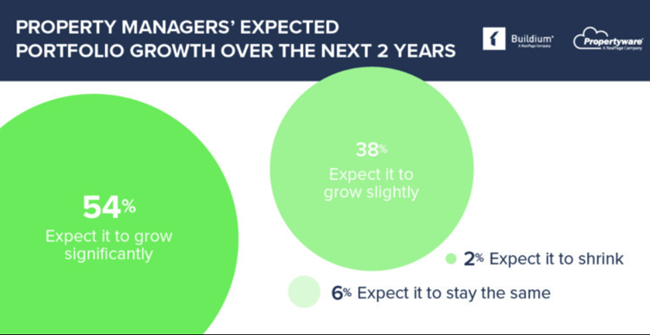
The report says, “Looking specifically at small property management companies who manage rental properties owned by third parties, 92 percent plan to add new doors to their portfolios in 2023 and 2024.

A majority of respondents “said their companies plan to grow by a significant amount—a term that most respondents defined as an increase in the size of their portfolios by between 26 percent  and 50 percent.

Three must-know property management trends for 2023 include portfolio expansion as a top item, according to Buildium’s 2023 Property Management Industry Report .
Charts courtesy of Buildium.

These portfolio expansion growth plans represent a more normal return to business which was seen pre-pandemic.

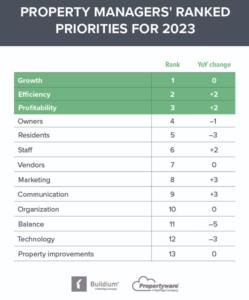
While portfolio expansion took the top spot in Buildium’s report, “efficiency and profitability took second and third place—two priorities that had fallen down the list during the pandemic as issues related to rental owners and renters took priority.”

Three must-know property management trends for 2023 include portfolio expansion as a top item, according to Buildium’s report

No. 2 – Demand for property management services

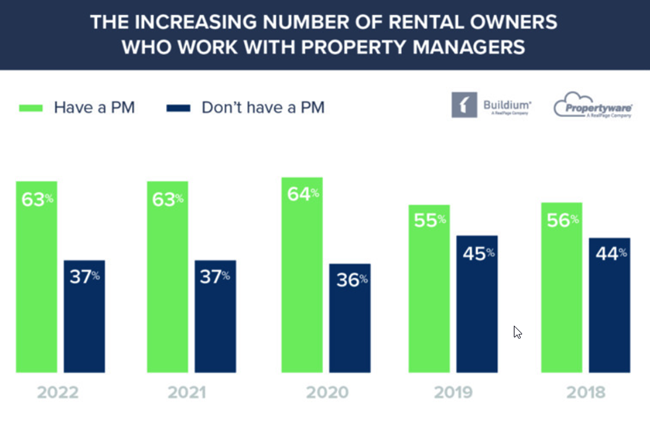
The industry report says rental owners’ demand for property managers’ expertise remains elevated above the pre-pandemic period.

The number of rental owners who reported that they currently had a property manager jumped from 55 percent in 2019 to 64 percent in 2020, and held steady at 63 percent throughout 2021 and 2022.

“The good news is that our surveys have found that for small real estate investors, enlisting an expert’s help in these areas dramatically reduces their stress levels. So, in spite of the temptation to keep costs low by managing their properties themselves, Small-Portfolio Investors and Accidental Landlords alike continue to see the value in professional property management services,” Buildium says in the report.

“Our survey found that this is particularly true when it comes to collections, maintenance, leasing, regulatory compliance, financial reporting, and local market expertise.”

Three must-know property management trends for 2023 include portfolio expansion as a top item, according to Buildium’s 2023 Property Management Industry Report .
Chart courtesy of Buildium.

No. 3 – Competition in the property management industry

One of the keys to staying competitive is technology which is helping small property management companies stay competitive and profitable during the labor shortage.

National firms and institutional investors have expanded into popular markets—particularly in the Sun Belt—to seize the opportunity that those appealing cities present, often acquiring local property management companies for their portfolios, the report says.

“This has been particularly stressful for small property management companies, who have less room to compete on price than larger firms do,” Buildium says in the report.

So, one of the key elements of competition can be embracing more technology, such as:

  • Take on more properties than they otherwise would have been able to.
  • Focus more of their energy on relationships, helping them to attract higher-quality, longer-term clients and tenants.
  • Get rid of their offices, allowing them to reduce their costs significantly while increasing their organization, efficiency, and consistency.
  • Improve team members’ enjoyment of their jobs, allowing them to spend less time on repetitive tasks so they can focus on more impactful and fulfilling work.

Get the full report from Buildium here.

Sign Up For Our Weekly Newsletter And Get Rental Property And Apartment News And Helpful, Useful Content Each Week.

* indicates required

18 Months of Outstanding Rent Growth Coming to An End

Multifamily Rents ‘Hit the Brakes’ in September

Rental Price Drops Around The Country

Portland Rents Increase Again In October