Home Blog Page 7

Automation Takes Over at Multifamily OpTech Conference

Automation and where the multifamily apartment industry is heading was a major topic at the OpTech conference along with Ai.
Robotics is involved in 20 of the 25 venture capital deals I’m working on right now,” said panelist KP Reddy, a venture capital leader and proptech investor at Shadow Ventures.

Automation and where the multifamily industry is heading was a major topic at the National Multifamily Housing Council OpTech conference along with Ai.

By Paul Bergeron

The messaging at the National Multifamily Housing Council’s (NMHC)recent OpTech conference was dominated by automation. Whether through artificial intelligence (AI) used in advanced software platforms or other products, it’s where the apartment industry is heading – if not already there.

Appwork was among the leading companies demonstrating such advancement. Its ability to proactively manage maintenance workflow and take companies out of the pen-and-paper – and even a spreadsheet approach – comes from its intuitive mobile app technology.

“Don’t track your maintenance work orders with pen and paper or whiteboards. You don’t have to,” said Dani Black, speaking at one session.

“Giving teams such technology is also boosting retention – a seemingly forever challenge for operators,” said Black, the firm’s chief revenue officer.

For example, the industry’s turnover rate for maintenance techs is 38%, but only 26% for those using AppWork, Black said, because these employees thrive when using software designed with their client maintenance techs’ feedback.

Operators benefit because it costs $10,000 to $15,000 to replace maintenance techs.

Technicians are measured, highlighted, and celebrated through the software based on their performance time and review remarks, Black said. The system assigns technicians who have demonstrated specialization in specific work orders to those service requests.

Mike DiBenedetto, chief information officer at apartment operator Northland, speaking on another panel, said, “Our apartment-industry technology providers need to allow integration with their products on our property management software when it comes to AI.”

NMHC Unveils Industry AI Standards

The AI revolution is driving efficiency by significantly reducing the time required to perform everyday onsite tasks, such as interpreting information, creating highlight summaries from lengthy content, and generating performance and forecast reports. It’s also effective at problem-solving.

Companies must be mindful of AI’s uses, according to Whitney Kidd, senior vice president of technology and innovation at Preiss, a multifamily and student housing operator.

“Monitoring your employees’ AI large language models (LLMs) use during work hours reminds me of a generation ago when we had to do that to police them from spending too much time on Facebook,” Kidd said.

Kidd is a member of NMHC’s AI Working Committee, which unveiled a new industry AI governance document during OpTech.

Local and state legislation intended to address AI has become somewhat of a hindrance for multi-state operators.

“We do need a federal rule [for governance],” DiBenedetto said. “There’s no reason to have 50 different state laws when it comes to how you are applying AI.”

Whitney Kidd, Senior Vice President of Innovation and Technology, The Preiss Company, an industry leader speaking with the microphone, Mike DiBenedetto Chief Information Officer at Northland and far right Scott Pechersky, Chief Technology Officer, RPM Living.

Robots ‘Get with the Program’

Robots are on the horizon, bringing greater efficiency during the apartment construction process and other areas.

“Robotics is involved in 20 of the 25 venture capital deals I’m working on right now,” said panelist KP Reddy, a venture capital leader and proptech investor at Shadow Ventures.

Eight months ago, Preiss and IRIS Technologies introduced D.O.N.N.A., the industry’s first humanoid robot.

“We created ours for $30,000; it might cost up to $50,000 with the add-ons,” Kidd said.

Kidd said the price of robots, including used ones, is coming down. She said they can be found on eBay for between $5,000 and $8,000.

Operators must then program or reprogram them with ChatGPT. What used to take two months to program can be done in 10 minutes, the panel said.

Preiss’ D.O.N.N.A. can revolutionize day-to-day operations at properties, from leasing to maintenance and beyond, according to Kidd.

“This is just the beginning of what’s possible with AI and robotics in student housing,” Kidd said on the launch date.

Community mapping and access are the most formidable challenges faced when deploying robotics, Kidd said.

“If you’re going to deploy robots on your property, you might have to rethink the design,” Reddy said.

For example, is your landscaping designed so that a robotic lawnmower can get around and do the job?

Robots can also be used to flip all the circuit breakers when a property opens, reducing the risk of electrocution for your team members, the panel said.

About the author:

Paul Bergeron is a freelance writer.

Sign Up For Our Weekly Newsletter And Get Rental Property And Apartment News And Helpful, Useful Content Each Week.

* indicates required

Greystar To Pay $24 Million And Stop Deceptive Practices

The Federal Trade Commission is seeking written public comment on proposed rules involving potentially unfair rental housing fees

Greystar, the nation’s largest multi-family rental property manager, has agreed to pay $23 million to the Federal Trade Commission (FTC) and $1 million to the state of Colorado over deceptive practices.

The FTC said Greystar will stop its deceptive advertising practices to resolve charges that the company misled consumers about monthly rent costs by tacking on hidden fees on top of advertised prices, according to a release from the Federal Trade Commission.

The proposed order also requires the company to clearly and conspicuously display total monthly leasing prices and mandatory fees.

“Greystar misled consumers by advertising low rent prices and then adding mandatory fees at the end of the sales process,” said Christopher Mufarrige, director of the FTC’s Bureau of Consumer Protection, in the release.

“At a time when Americans are struggling to find affordable housing, the FTC is focused on monitoring the housing marketplace to ensure that competitors are meaningfully competing on price and that consumers receive transparent pricing.”

In January 2025, the FTC and Colorado alleged Greystar misrepresented the true cost of renting a Greystar property by displaying a deceptively low rental price.

The deceptive prices excluded several fixed, mandatory monthly fees, instead of the total monthly price that people would have to pay, in violation of the FTC Act, the Gramm-Leach-Bliley Act, and the Colorado Consumer Protection Act, according to the release.

In addition to paying $24 million, of which $23 million would be used to refund consumers harmed by Greystar’s actions.

The proposed order would require Greystar to:

  • Refrain from misrepresenting the total monthly leasing price of a rental unit, pricing information related to fees charged at a rental property, and any material aspects of its home rental services;
  • Make particular disclosures when it makes certain representations. Specifically, when Greystar advertises base rent or another partial pricing, it is required to more prominently disclose the total monthly leasing price of that unit; and
  • Before taking any payment, such as a nonrefundable application fee, clearly and conspicuously provide details about all fees, including the amount and purpose of the fee and whether it is mandatory, and disclose the total monthly leasing price.

The FTC and Colorado filed the order in the U.S. District Court for the District of Colorado.

Sign Up For Our Weekly Newsletter And Get Rental Property And Apartment News And Helpful, Useful Content Each Week.

* indicates required

Is Rent Dip Seasonal Or A Jobs And Consumer Confidence Issue?

The November rent dip that marked four straight months of declines may be seasonal or a larger issue around jobs and consumer confidence

The rent dip in November that marked four straight months of rent declines may be a seasonal issue or a larger issue around jobs and consumer confidence, Yardi Matrix says in the most recent Multifamily Report.

Rents are well off the summer peak and 90% of the Yardi Matrix top 30 metros posted negative growth over the last three months.

“The question is whether the performance is seasonal or the result of weakening job growth and consumer confidence,” Yardi Matrix writes in the report.

Highlights of the report

  • With job growth and consumer confidence weakening, multifamily rents and demand are struggling. The average U.S. advertised rent fell $8 to $1,740 in November, while year-over-year growth dropped 30 basis points to 0.2%.
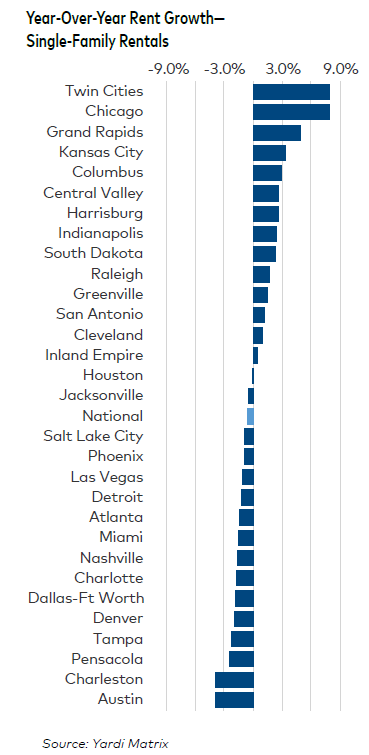
  • Rent growth has been weak for two years in high-supply markets, but the recent malaise is more widespread. Over the last three months, advertised rents have been negative in 90% of the Matrix top 30, with the Twin Cities the only major metro to produce positive growth.
  • Single-family build-to-rent advertised rates likewise are exhibiting weakness, dropping for the fourth straight month. The average BTR advertised rent declined by $10 in November to $2,185, while the year-over-year growth rate fell to -0.5%.

“The recent drop is less than ideal, but more worrisome is how widespread the decline is. There are several possibilities why rents are dropping,” Yardi Matrix writes

Seasonality in the winter months could be one issue

The report points out that rents have dropped in each of the past four Novembers but showed modest recovery in the first quarter of the next year.

“Another possibility is that rent growth will be weak for a while due to the supply-demand imbalance. The large delivery pipeline is being absorbed as demand flags. Immigration policy, weak consumer confidence and slowing job growth have caused absorption to decelerate.

“While year-to-date absorption is strong, the number of apartment units absorbed in October was the lowest in several years,” the report says.

The Top Markets Performance

Advertised rents have been negative for a year or more in metros such as Austin, Denver, Phoenix and Dallas that are dealing with a glut of supply that has lowered occupancy rates despite strong absorption.”

But In November “metros such as Columbus, Indianapolis, New Jersey, San Jose and San Francisco saw advertised rents turn from positive to negative. Not only are these metros among the top-performing markets in rent growth over the last couple of years but most sport occupancy rates at or above the national average, so the poor performance cannot be attributed to weak overall conditions,” the report says.

The November rent dip that marked four straight months of declines may be seasonal or a larger issue around jobs and consumer confidence

Read the full Yardi Matrix report here.

Sign Up For Our Weekly Newsletter And Get Rental Property And Apartment News And Helpful, Useful Content Each Week.

* indicates required

Rent Drop Continues, Vacancies at Record High

The national median rent dropped by 1.0 percent in November, marking the fourth straight monthly decline, as vacancies hit a record high

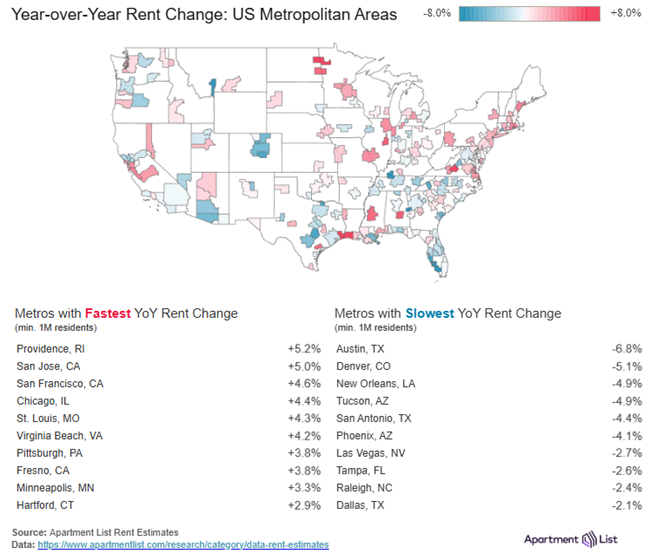
The national median rent dropped by 1.0 percent in November, marking the fourth straight monthly decline, as vacancies hit a record high, Apartment List writes in the December report.

“November is historically the rental market’s slowest month, and it is likely prices will continue to decline modestly in the coming December and January. This is in line with the typical seasonal pattern of rent growth, as fewer renters are looking to move when temperatures dip and the holiday season approaches,” the Apartment List research team writes in the December report.

Highlights of the report

  • The national median rent now stands at $1,367. “It’s likely that we will close out the year with an additional modest rent decline in December,” the research team writes.
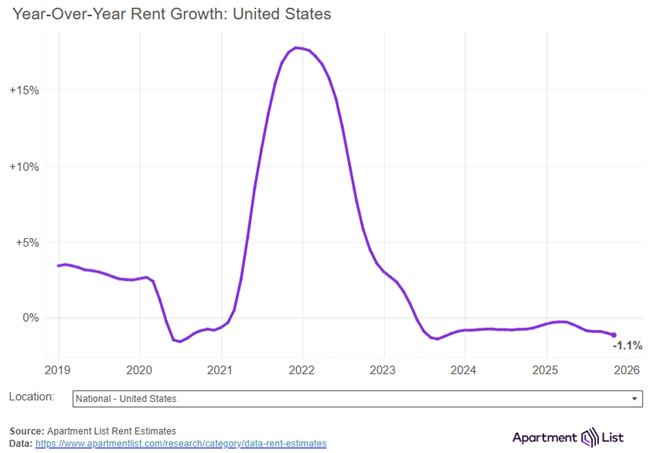
  • Rent prices nationally are down 1.1% compared to one year ago. Year-over-year rent growth has been slightly negative for more than two full years, and the national median rent has now fallen from its 2022 peak by a total of 5.2%.
  • The national multifamily vacancy rate remains at 7.2% this month, “a record high for our index. We’re past the peak of a multifamily construction surge, but a healthy supply of new units is still hitting the market and colliding with sluggish demand, causing vacancies to continue trending up.”
  • Units are taking an average of 36 days to get leased after being listed, two days longer than at this time last year.

Year-Over-Year

“November’s rent decline this year (-1.0 percent) was a bit steeper than last year’s (-0.8 percent), and so we observe a small dip in year-over-year rent growth, down to -1.1 percent nationwide,” the report says.

“Earlier this year, it appeared that annual growth was on track to flip positive for the first time since mid-2023; however, that rebound stalled out and reversed course during a particularly slow summer.”

The national median rent dropped by 1.0 percent in November, marking the fourth straight monthly decline, as vacancies hit a record high

Falling National Median Rent

The national median rent is down $16 per month compared to November 2024.

As prices have trended downward in recent years, the national median rent has now fallen below its August 2022 peak by a total of 5.1 percent, or $75 per month.

The national median rent dropped by 1.0 percent in November, marking the fourth straight monthly decline, as vacancies hit a record high

Multifamily Vacancy Rate Hits 7.2%, a New Peak

The market is still absorbing the swell of new construction units, the report says.

As a result of all this new inventory, more vacant units are sitting on the market, meaning that property owners face more competition for renters and have less pricing leverage.

“Our national vacancy index – which measures the average vacancy rate of stabilized properties in our marketplace – sits at 7.2 in November. This represents an all-time high for this data series, going back to the start of 2017,” the report says.

Vacancy rate hit all-time high

List-to-Lease Ticks Up for Fifth Straight Month

As more vacant units have come onto the market, those units have also been sitting vacant for somewhat longer.

“Our time on market index tells us how long it takes for units to get leased after they are first listed on our platform. This “list-to-lease” time is rising as we approach the new year, and currently sits at 36 days in November, just shy of the peak set last January,” Apartment List writes.

list to lease time on the market

CoStar: Biggest Rent Drop In 15 Years

The fall historically sees the biggest slowdown in multifamily rents, but this year it’s even more pronounced.

The real-estate information group CoStar reported the biggest monthly drops in median rent it had seen in 15 years of tracking. The primary reason is that more young people are struggling to form new households.

“That 18- to 34-year-old group … I think it’s up to 32.5% of those now are living with family, and that’s the highest it’s been in a while,” said Grant Montgomery, CoStar’s national director of multifamily analytics, in an interview with Diana Orlick of CNBC. “I think it reflects high rental costs that have risen over the years, as well as the tougher job market for young folks just coming out of college.”

“That is where a lot of demand traditionally comes from, the core renter demand is from that sort of younger base,” he said.

The weakness is showing up in stocks of the major public apartment REITs. Names like AvalonBay, Equity Residential and Camden Property Trust are all down year to date.

markets with the biggest rent changes and updates

Conclusion

“All of our key indicators are pointing toward ongoing sluggishness in the multifamily rental market – rent prices are down and the vacancy rate is at an all-time high.

“As construction slows further during the tail end of this year and into 2026, rent prices and occupancy should begin to stabilize, and a return to tighter market conditions remains on the horizon.

“That said, the supply boom still has a bit of runway remaining, and the demand outlook has begun to appear weaker amid a shaky labor market. These factors could lengthen the time that it takes for the market to metabolize the recent growth in the rental stock,” Apartment List researchers write.

Sign Up For Our Weekly Newsletter And Get Rental Property And Apartment News And Helpful, Useful Content Each Week.

* indicates required

Wood Burning Manufactured Fireplaces: A Feature Tenants Enjoy

Portland Chimney says wood burning manufactured fireplaces can be a draw for tenants looking for a nice place to live

Wood burning manufactured fireplaces can be a draw for tenants looking for a nice place to live in the Pacific Northwest.

By Portland Chimney

Many multifamily properties choose wood burning manufactured fireplaces to provide their tenants with the wonderful ambiance of a fireplace in the Great Northwest.

This is quite a draw when a tenant is looking for a nice place to live with this fireplace feature.

As with anything the manufactured fireplaces do need to be maintained. Following is a reference on the proper maintenance of these wonderful units.

The service and maintenance to these units as noted by the National Fireplace Protection Association is annually. *

Chapter 13 Maintenance

13.2 Annual Inspection. Chimneys, fireplaces and vents shall be inspected at least once a year in accordance with the requirements of Section 14.2.

Section 14.2.1 Selection of Inspection Type

Level 1 Inspections:

Annual Inspections as required by Section 13.2; during routine cleaning of chimney flue; upon direct replacement of connected appliance with one of similar type, input rating, and efficiency.

The manufactured fireplace has the chimney (flue) that the smoke exits from. This smoke from the particles you burn builds up debris on the walls of the chimney that needs to be removed.

Plus, refractory panels, the walls and floor in the firebox (where you build your fire), need to be inspected for wear and replaced as needed with the exact same refractory panels for wood (not gas) to keep your wood burning manufactured fireplace safe and ready for use.

To do the inspections and cleanings you want a certified chimney inspector/sweep to properly do the service and be able to note any parts that need replacement, due to wear, as needed.

Fireplaces in the Great Northwest create a cozy and comfortable atmosphere in the home.

It’s where the family gathers.

Ensure your property is maintained so your tenants can enjoy the comfort fireplaces provide.

*National Fire Protection Association: NFPA 211 Standard for Chimneys, Fireplaces, Vents, and Solid Fuel Burning Appliances 2010 Edition.

About the author Portland Chimney & Masonry Inc.:

For over 35 years, Portland Chimney has serviced & repaired chimneys all over the Portland Metro area. The Portland Chimney staff offer quality service, customer education, and professional craftsmanship to provide you with a long lasting product.


Smoke Detector Still Bips After Battery Replacement; Who Fixes It?

Smoke detectors and maintenance of them is often a headache for tenants and landlords so if it bips with new battery who is responsible?

Smoke detectors and maintenance of them in rental property is often a headache for tenants and landlords so here is the question this week for Ask Landlord Hank. Remember Hank is not an attorney and is not offering legal advice. If you have a question for him please fill out his form below.

Dear Landlord Hank,

We replaced the batteries in two smoke detectors in our rental because they beeped.

However, when we tried to place them back, one of them didn’t stop the beeps, and the other one “yelled” “Fire! Fire!” and we had to take it back down.

We notified the landlord yesterday when we gave him the keys back after moving out. But he says he will only give us our deposit after we replace the smoke detectors.

Isn’t he responsible for replacing them? I thought tenants were only responsible for batteries. What law could I show him, so he doesn’t keep money from the deposit? The property is in Westchester County, NY.

– Marie

Hi Marie,

Normally it is the landlord’s responsibility to install working smoke detectors when you move into the property, for the safety of both you and the property.

After a tenant moves in, the responsibilities for upkeep are typically shared. Once a tenant moves in, it is their job to test the detectors periodically and replace the batteries as needed. BUT if a  detector stops working or malfunctions, it is the owner’s responsibility to repair or replace the detector.

The tenant must alert the owner of this issue, and it’s best to do so in writing.

Sincerely,

Hank Rossi

www.rentsrq.com

Each week I answer questions from landlords and property managers across the country in my “Dear Landlord Hank” blog in the digital magazine Rental Housing Journal.    https://rentalhousingjournal.com/asklandlordhank/

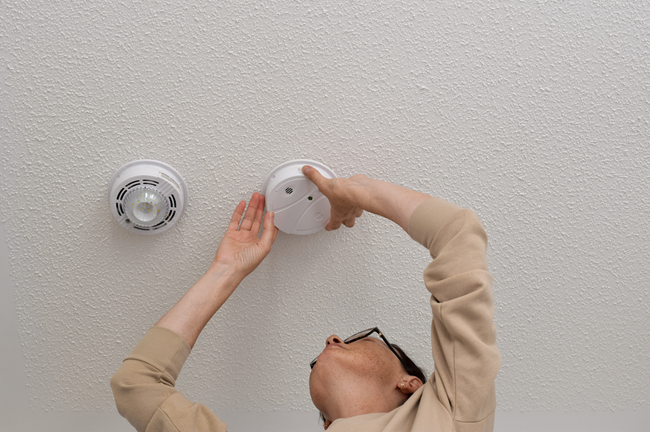
Landlord Hank says, “it is the landlord’s responsibility to install working smoke detectors when you move into the property, for the safety of both you and the property.”

Ask Landlord Hank Your Question

Ask veteran landlord and property manager Hank Rossi your questions from tenant screening to leases to pets and more! He provides answers each week to landlords.

  • This field is for validation purposes and should be left unchanged.

Can a Lease Be Broken By The Landlord?

Tenant Did Not Give 30-Day Notice; Can I Charge for Part of Another Month?

Will 2026 Be A Reckoning Year for the Rental Market?

New Supply Dampens Rent-Growth Projections

Do You Have to Be Lucky to Find a Great Tenant?

Do you have to be lucky to find a great tenant? Not if you take a proactive approach to tenant selection by defining your requirements.

Do you have to be lucky to find a great tenant? Not if you take a proactive approach to tenant selection by defining your requirements.

By Nancy Abrams

Signing a great tenant involves much more than simply crossing your fingers and hoping for the best. A strategic approach that combines effective marketing and thorough screening, along with a touch of luck, is necessary to find the ideal tenant.

Here’s how to ensure you’re attracting and securing high-quality renters:

1. Define your ideal tenant profile

  • Before advertising, clearly define the qualities you’re looking for, such as income level, credit score, rental history and employment stability.
  • Be mindful of Fair Housing Act guidelines, which prohibit discrimination based on protected characteristics, such as race, color, national origin, religion, sex, familial status or disability.
  • In order to prevent Fair Housing Act violations, create a page outlining your criteria and give it to everyone showing an interest in renting your vacancy.

2. Market your property strategically

  • Create an appealing rental listing: Use professional photos and highlight key features and amenities, such as an in-unit laundry, security features, smart-home technology or nearby schools.
  • Advertise in the right places: Leverage online platforms such as Zillow or Facebook Marketplace to reach a broad audience of qualified renters.
  • Price rent competitively: Research similar properties in your area to find a fair market rate that attracts tenants while covering your costs.

3. Implement a comprehensive tenant screening process

  • Request a detailed rental application: This should include personal details, employment and income information, rental history and landlord references. These are factors you want to be aware of before you allow someone to move into your property.
  • Pre-screen: Chat with potential tenants and review their application to get a feel for their suitability before ordering detailed background checks.
  • Verify employment and income: Request pay stubs, bank statements, tax returns or employer letters to confirm their ability to comfortably afford the rent.
  • Conduct thorough background checks: Isn’t it better to know before you sign a lease whether your applicant has been identified as a sex offender or a terrorist?
    • Credit Check: A prospective tenant’s credit report is a good gauge of how conscientious they are about their financial commitments. You’ll learn how much credit they have, if they are approaching their credit limits and if they pay off their debts as agreed.
    • Social Security Number Fraud Check: Is your applicant using another person’s SSN? This verification will uncover whether your candidate is who they say they are.
    • Criminal Background Check: A criminal check will tell you if they have been in trouble with the law during the last seven years. Be sure to include searches for sex offender, terrorist and federal crimes.
    • Eviction History: Indicates past rental problems, usually unpaid rent or extensive damage to the landlord’s property, which can be a predictor of future behavior.
  • Tax Liens and Civil Judgments: A tax lien is a lien imposed by law upon a property to secure the payment of taxes, while a civil judgment is a ruling against a defendant in a court of law. The judgment can arise from small claims, unpaid debts or property damage due to negligence. Any of these is of vital importance to a landlord when considering a possible tenant.
  • Check References: Order landlord and employment verifications to confirm the applicant’s rental and job histories and behavior.

Intuition and luck are just not enough these days when you are deciding who to trust your property with. By taking a proactive approach to tenant selection, you increase your chances of attracting and retaining responsible tenants who will respect your property and pay rent on time.

About the author:

Nancy Abrams currently serves as content editor for AAOA (American Apartment Owners Association). AAOA assists landlords, property managers, real estate owners and brokers across the country with managing their properties, including tenant credit checks and tenant background screening as well as state-specific landlord forms, such as a rental application or rental agreement. The association also offers resources, from educational webinars and landlord tenant law to approved providers for insurance and financing. Contact us today to learn more.

Sign Up For Our Weekly Newsletter And Get Rental Property And Apartment News And Helpful, Useful Content Each Week.

* indicates required

RealPage Agrees to Proposed Justice Department Settlement Over Rent Price-Fixing

The Justice Department has proposed a settlement with RealPage over rent price-fixing in rental housing markets across the country

The U.S. Department of Justice has proposed a settlement with software provider RealPage over rent price-fixing through algorithmic coordination, information sharing, and other anticompetitive practices in rental housing markets across the country, according to a release.

The Justice Department alleged in the suit that RealPage’s revenue-management software has relied on nonpublic, competitively sensitive information shared by landlords to set rental prices.

“Competing companies must make independent pricing decisions, and with the rise of algorithmic and artificial intelligence tools, we will remain at the forefront of vigorous antitrust enforcement,” said Assistant Attorney General Abigail Slater of the Justice Department’s Antitrust Division in the release.

If approved by the U.S.  District Court for the Middle District of North Carolina, the proposed consent judgment would require RealPage to:

  • Cease having its software use competitors’ nonpublic, competitively sensitive information to determine rental prices in runtime operation;
  • Cease using active lease data for purposes of training the models underlying the software, limiting model training to historic or backward-looking nonpublic data that has been aged for at least 12 months;
  • Not use models that determine geographic effects narrower than at a state level, which is broader than the markets alleged in the complaint;
  • Remove or redesign features that limited price decreases or aligned pricing between competing users of the software;
  • Cease conducting market surveys to collect competitively sensitive information;
  • Refrain from discussing market analyses or trends based on nonpublic data, or pricing strategies, in RealPage meetings relating to revenue management software;
  • Accept a court-appointed monitor to ensure compliance with the terms of the consent judgment; and
  • Cooperate in the United States’ lawsuits against property-management companies that have used its software.

RealPage said in a release, “The settlement provides resolution and clarity for RealPage customers and the broader multifamily industry, ensuring the company’s revenue-management solutions remain fully available, legally compliant, and aligned with evolving laws and policies. RealPage has worked collaboratively with the DOJ throughout this process, engaging constructively to reach an outcome that strengthens confidence across the industry.

“This resolution marks an important milestone for RealPage, our customers, and the multifamily industry,” said Dirk Wakeham, RealPage President and chief executive officer, in the release.

“This resolution with the DOJ was necessary to provide certainty and finality for RealPage and its customers to avoid protracted litigation,” said Stephen Weissman, Gibson Dunn Partner and former deputy director for the Federal Trade Commission, in the release.

“While we deny any wrongdoing, we appreciate the constructive engagement by DOJ and its willingness to bless the legality of RealPage’s prior and planned product changes under federal antitrust law through the consent decree,” Weissman said, and added, “There has been a great deal of misinformation about how RealPage’s software works and the value it provides for both housing providers and renters. We believe that RealPage’s historical use of aggregated and anonymized nonpublic data, which include rents that are typically lower than advertised rents, has led to lower rents, less vacancies, and more procompetitive effects.”

There is an upcoming 60-day public comment public period before the U.S. District Court for the Middle District of North Carolina may enter the final judgment upon finding it is in the public interest.

About RealPage, Inc.:

RealPage is a provider of revenue management software and services headquartered in Richardson, Texas.

Sign Up For Our Weekly Newsletter And Get Rental Property And Apartment News And Helpful, Useful Content Each Week.

* indicates required

Greystar To Pay $7 Million In Settlement, End Algorithmic Rent-Setting

Greystar has agreed to pay $7 million to settle lawsuits brought by several states over the use of algorithmic rent-setting software

Greystar has agreed to pay $7 million to settle lawsuits brought by several states, including Oregon, over the use of algorithmic rent-setting software, according to reports.

Oregon Attorney General Dan Rayfield and a bipartisan coalition of nine states filed a proposed $7 million settlement to resolve claims against Greystar Management Services LLC, as part of the coalition’s ongoing enforcement efforts targeting price fixing involving housing rental prices across the country.

“When the largest landlord in America uses an algorithm to price-fix the rent, the result is simple: people pay more,” Rayfield said in a statement. “It squeezes working families when the cost of housing is already at an all-time high. This settlement holds the largest U.S. landlord accountable. It’s a win for Oregonians, our pocketbooks and the rule of law.”

Greystar has agreed to pay $7 million to settle lawsuits brought by Oregon and states over the use of algorithmic rent-setting software
““We’re in the middle of a housing crisis, and families are already stretched to their limits,” Oregon Attorney General Dan Rayfield said.

This summer Greystar reached a non-monetary settlement with the U.S. Department of Justice to end its participation in algorithmic rent-pricing schemes, according to a release.

Greystar, often called the nation’s largest landlord, settled with Oregon and other states that sued the property management company for using rent-setting algorithms that officials have blamed for driving up housing costs.

The proposed settlement, filed in a North Carolina federal court, is the latest to result from antitrust lawsuits targeting RealPage and similar software companies. Prosecutors argue the products help rival property managers illegally align prices and push up rents. A judge must still approve the deal.

In addition to the monetary payment to the states, the agreement, if approved by the court, would require Greystar to:

  • Refrain from using any anticompetitive algorithm that generates pricing recommendations using competitors’ sensitive data or that incorporates certain anticompetitive features.
  • Refrain from sharing competitively sensitive information with competitors.
  • Accept a court-appointed monitor if it uses a third-party pricing algorithm that is not certified under the consent decree.
  • Refrain from attending or participating in RealPage-hosted meetings of competing landlords.
  • Cooperate with the coalition’s claims against RealPage.

As part of the settlement, Greystar will no longer use software that relies on other landlords’ confidential data to set rents. Greystar also agreed separately last month to pay $50 million to settle a class-action lawsuit over its use of RealPage.

“We are pleased this matter is resolved and remain focused on serving our residents and clients,” Greystar said in a statement Wednesday.

The states that are part of the settlement include California, Colorado, Connecticut, Illinois, Massachusetts, Minnesota, North Carolina, Oregon and Tennessee.

The lawsuit involved apartment owners use of RealPage’s rent-setting software.

One legal complaint from the state of California claimed the landlords knew that their nonpublic data would be used to recommend prices, not just for their own units, but also for competitors that use the programs.

In October, Greystar and 25 other property management companies agreed to pay $141 million to settle a class-action lawsuit involving rent-setting algorithmic software coordination and other anticompetitive practices in rental markets across the country.

The complaint said RealPage knew what competing landlords were charging and could increase profits for landlords by using that information to recommend landlords set or raise their prices uniformly, eliminating competition as a result and leaving renters no choice but to pay artificially high prices.

RealPage has denied any wrongdoing and argues that the plaintiffs misunderstand how their product works. RealPage, which is based in Texas, has said its software is used on fewer than 10% of rental units in the United States, and that its price recommendations are used less than half the time.

“While the proposed settlements … do not include RealPage, we are encouraged to see this matter move toward closure,” said Jennifer Bowcock, RealPage’s senior vice president for communications, in a statement. “RealPage continues to believe that this litigation is without merit and that our revenue-management products, and our customers’ use of them, have always been legal.”

Sign Up For Our Weekly Newsletter And Get Rental Property And Apartment News And Helpful, Useful Content Each Week.

* indicates required

Landlord Says ICE Tear Gas Affecting Apartment Residents

Portland landlord says fumes from ICE tear gas used on demonstrators across the street from their Portland apartments is harming residents

A Portland landlord is threating to sue the federal government because ICE tear gas and other munitions used against demonstrators are creating toxic fumes that penetrate the Portland apartment complex and harm residents, according to reports.

“The repeated use of tear gas, smoke bombs, pepper balls and other tactics outside of the ICE facility has had a direct impact on residents’ well-being, and has created significant hardship for Reach Community Development, a nonprofit organization working to create affordable housing our community urgently needs,” said Reach spokesperson Lauren Schmidt in an email.

The Gray’s Landings apartment sits across the street from the ICE detention facility where protests have been taking place. The protests have been mostly non-violent, but are consistently loud and disruptive for nearby residents. On active nights, federal officers have fired tear gas, smoke bombs and pepper balls at crowds protesting the Trump administration’s immigration crackdown, sending toxic fumes into Gray’s Landing living and office spaces.

The  spokesperson for Reach told The Oregonian/OregonLive that the nonprofit has retained an attorney to look into filing a lawsuit. The aim is to force federal officers to halt their use of tear gas and other munitions that affect the more than 200 low-income tenants of Gray’s Landing, which sits across South Bancroft Street from the ICE building.

In interviews with the Oregonian, residents described damaging health effects from the airborne toxins and a heavy emotional toll from dealing with jackhammer-level noise they can’t completely drown out by turning up their televisions.

Gray’s Landing tenants said they’d experienced coughing fits and sleepless nights, and have the feeling of being constantly watched as drones skim past their windows, helicopters circle overhead and federal officers stand watch on the ICE building’s roof.

Reach has previously said it has spent at least $150,000 on measures that include renting industrial air filters to put in hallways and replacing the building’s HVAC filters to make conditions in the building more tolerable. Concerns over tear gas and safety prompted the nearby Cottonwood School of Civics and Science to relocate to Southwest First Avenue before the start of the school year in August.

Sign Up For Our Weekly Newsletter And Get Rental Property And Apartment News And Helpful, Useful Content Each Week.

* indicates required