Home Blog Page 8

Vacancies Will Last Longer Than Expected

An analysis from CoStar says apartment oversupply in some markets will continue to be absorbed, but vacancies will be longer than forecast

The latest analysis from CoStar says the oversupply of apartments in some markets will continue to be absorbed, but that the vacancies will last longer than first forecast.

CoStar, a commercial real estate information company, projects the national apartment vacancy rate will hold at 8.2% through year-end 2025. Then the vacancy rate is expected to gradually improve to about 7.9% by the end of 2026. CoStar describes the decline to 7.9% as reflecting a more modest draw-down of oversupply than previously hoped.

“The updated forecast reflects a more cautious view of the market’s near-term performance. Average rent growth is now expected to turn negative, slipping from 0.6% in the third quarter to a projected -0.1% in the fourth quarter of 2025 — a downward revision of 160 basis points from last quarter’s forecast,” the report says..

The current tariff policy and weakened labor market are creating headwinds for multifamily

GlobeSt reports, “Lower immigration is expected to constrain the labor force and weigh on employment growth through 2030, reducing long-term demand for rentals,” CoStar stated.

What this means for investors is that the future may hold only a modest drop in the vacancy rate over the next five years, along with rent growth averaging just 1.5% a year, below historical levels.

“The balance of risks to the revised forecast remains tilted to the downside,” CoStar cautioned. Four and five-star apartments are likely to be protected, since absorption has already exceeded supply growth and there is strong demand for equivalent high-quality multifamily developments in the lease-up phase.

Their average vacancy rate fell by 90 basis points from 11.9% toward the end of 2024 to 11% in 3Q 2025. And a further 30 basis points of decline by year-end 2025 is projected, as stabilized vacancy is expected to peak.

But the recovery is not helped by the current tariff policy and a weakened labor market. “Lower immigration is expected to constrain the labor force and weigh on employment growth through 2030, reducing long-term demand for rentals,” CoStar stated.

Read the full report on GlobeSt here.

Subscribe to CoStar here.

Sign Up For Our Weekly Newsletter And Get Rental Property And Apartment News And Helpful, Useful Content Each Week.

* indicates required

Declining Rents and Out-of-Market Renters

While rents decline in many markets another trend has emerged, with some metros seeing more out-of-market renters than in-market renters.
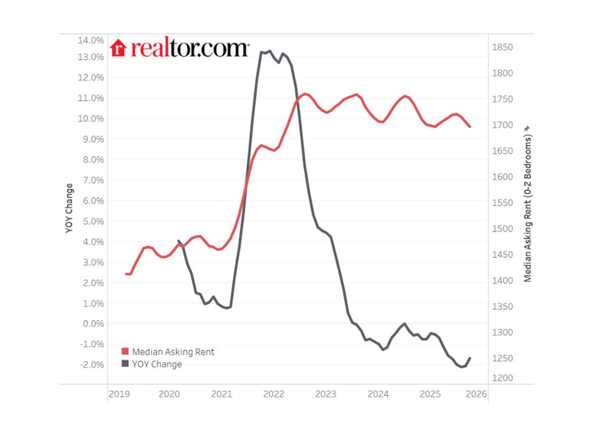
Rents Decline Again, but Nationwide Rent Is 3.6% Below 2022 Peak

While many markets are experiencing the continued national decline in rents, another trend has emerged, with some metros seeing more out-of-market renters than in-market renters.

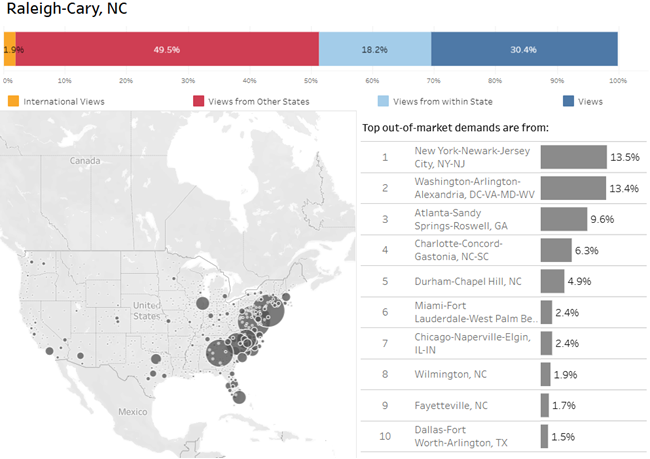
Realtor.com, in its October report, says over the past six years 20 of the 50 largest metros have transitioned from being dominated by local renters to being more driven by out-of-market demand.

As an example, the report compares New York City, which has the largest share of demand from local renters at 74.8%, to Raleigh, N.C., which is  attracting the highest proportion of out-of-market renters at 69%.

While rents decline in many markets another trend has emerged, with some metros seeing more out-of-market renters than in-market renters.
Source: 2025 Q3 Realtor.com search data

Joel Berner, senior economist for Realtor.com, pointed out that some areas are really seeing a lot of out-of-town renters coming in. In an interview with Rental Housing Journal, Berner said, “There are some hot places like Raleigh, North Carolina. People are interested in moving to Raleigh. That I think is genuinely getting a lot of out-of- market activity.

While rents decline in many markets another trend has emerged, with some metros seeing more out-of-market renters than in-market renters.
Joel Berner, senior economist for Realtor.com

“But in some places – a lot of places – people who would be moving in town are staying put. Those people are not shopping on Realtor.com. So, it looks like a larger share of out-of-towners.

“There are a lot of people who would have upgraded their rental within the same metro area where they live, maybe moving a couple of blocks away to a nicer unit. They are not doing that this year. They are staying in place.

“So, the share of activity looks like it is growing in favor of out-of-towners, but that has actually held pretty steady for a lot of places. So, there is actually less local activity going on.”

Of the 20 largest metro areas that shifted from more in-market views to more out-of-market views, the most pronounced are the more affordable metros such as Detroit, Philadelphia and Sacramento, areas where relatively lower rents have attracted out-of-town rent-shoppers.

There is a hidden piece of this, too – the retention piece.

“The share of folks moving city to city is about steady year over year or year over five years. The stories I am hearing are the people concerned for their jobs. People are not interested in moving. In bad times, it’s a risk. I think the prevailing economic sentiment is more conducive to people staying in place,” Berner said. “I am skeptical that anybody in the country can up and move to save $100 a month in rent.”

The report points out that both Raleigh and Nashville are markets dominated by views from out-of-market renters.

“Thee metros generally offer more affordable home prices, which contribute to higher homeownership rates and a smaller pool of local renters. At the same time, they attract newcomers with strong job opportunities and renter-friendly environments,” the report says.

Read the full report here on Realtor.com.

Sign Up For Our Weekly Newsletter And Get Rental Property And Apartment News And Helpful, Useful Content Each Week.

* indicates required

Fair Housing Lessons For A Festive Holiday Season

Fair housing lessons for a festive holiday season, mean creating a community where every resident can comfortably embrace the season.

The inclusive holiday playbook, and fair housing lessons for a festive season, mean creating a community where every resident can comfortably embrace the season.

By The Fair Housing Institute

As the holidays approach, property-management professionals face the annual challenge of balancing festive spirit with compliance.

Communities come alive with lights, decorations, and events, but within this joy lies the responsibility to ensure that everyone feels equally welcome.

The Fair Housing Act doesn’t take a holiday, and neither should inclusion. Understanding where celebration meets regulation is crucial for creating a community where every resident can comfortably embrace the season.

Where Fair Housing Meets Holiday Cheer

Fair housing laws protect individuals from discrimination based on several factors, including religion.

This protection extends to how properties display, advertise, and organize holiday-related activities. The U.S. Department of Housing and Urban Development (HUD) clarified in its 1995 guidance that secular holiday symbols such as Santa Claus, snowmen, or “Merry Christmas” signage do not, by themselves, violate the Fair Housing Act.

However, when decorations or events appear to favor one faith over others, management may unintentionally create the perception of religious preference or exclusion.

The guiding principle is equality—ensuring that every resident, regardless of their beliefs, can enjoy their home and community free from bias.

Setting the Stage with Inclusive Planning

Holiday inclusivity begins long before the first decoration is hung.

Managers should plan celebrations and decor policies that represent all residents. That means thinking beyond one tradition and creating a welcoming environment for everyone. Instead of labeling a gathering as a “Christmas party,” consider a “Holiday Celebration” or “Winter Festivity.” The goal is to celebrate the season, not a specific religion.

When communities hold events, invitations, and advertisements, they should use inclusive language and imagery. This small step reinforces that every resident belongs—no matter what, or how, they celebrate.

Decorating Common Areas with Care

Common areas often become the center of holiday-decorating debates.

While residents appreciate festive spaces, property managers must ensure these areas remain neutral and inclusive. A display featuring just one religious symbol—such as a nativity scene or menorah—can suggest a preference, even unintentionally.

The safest approach is to feature seasonal, non-religious décor such as lights, snowflakes, or greenery. If religious displays are allowed, management should ensure equal representation for multiple faiths. Above all, be consistent. Policies regarding what can or cannot be displayed should be clear, written, and applied uniformly across the community.

Respecting Residents’ Right to Celebrate

Inside their homes, residents generally have the freedom to decorate as they wish, provided they comply with property policies and safety standards.

For instance, decorations that pose hazards—like blocking fire exits or overloading electrical circuits—can be regulated. However, management should avoid restrictions that specifically target religious or cultural displays.

Door and patio decorations are common gray areas. If your policy prohibits decorations year-round, it’s acceptable to maintain that rule during the holidays. But if you permit seasonal displays, restrictions should only apply to items that are unsafe or offensive—not to personal expressions of faith.

Handling Complaints and Fostering Understanding

Even in well-managed communities, disagreements can arise over holiday decorations or events. The key is to respond with professionalism, empathy, and documentation.

Any complaint related to religion or discrimination should be treated seriously, regardless of intent. Property managers should listen carefully, document all relevant details, and adhere to established procedures.

Training your team on how to respond to these concerns helps prevent misunderstandings and reinforces a culture of respect. By addressing issues promptly and fairly, you not only protect your residents’ rights but also safeguard your organization’s reputation.

Building a Year-Round Culture of Inclusion

The holidays provide an opportunity to showcase your community’s values.

Inclusivity shouldn’t appear only when the calendar turns to December—it should be part of your property’s identity year-round. Review policies regularly, communicate expectations clearly, and lead by example. Encourage your team to think beyond compliance and embrace the spirit of equality that the Fair Housing Act was designed to protect.

When every resident feels seen, respected, and valued, the result is more than just compliance—it’s community.

About the author:

In 2005, The Fair Housing Institute was founded as a company with one goal: to provide educational and entertaining fair-housing compliance training at an affordable price at the click of a button.

Sign Up For Our Weekly Newsletter And Get Rental Property And Apartment News And Helpful, Useful Content Each Week.

* indicates required

Should I Change Locks After Tenant Moves Out?

Changing locks and getting tenants to return keys after they are out of the property is a problem often faced by landlords

Changing locks and getting tenants to return keys after they are out of the property is a problem often faced by landlords. So here are a couple of questions this week for Ask Landlord Hank. Remember Hank is not an attorney and is not offering legal advice. If you have a question for him please fill out his form below.

Dear Landlord Hank:

What can I do?

I had to evict my tenants and they took all their stuff out but don’t want to give me my keys to the property?

Can I change the locks, or would it be illegal?

– Lindsay

Dear Landlady Lindsay,

if your tenants have already been evicted and they have removed all their belongings you should change the locks.

I would do this as soon as possible.

Sincerely,

Hank Rossi

Also Hank had a similar question last year.

My tenant is leaving before lease is up and he is refused to give me my house keys what do I do?

-Shari

Dear Landlady Shari,

I’d ask the tenant via email or text so you have something in writing when he is leaving.

Then on that day, I’d go to the property after he has left and do an exit walk through where you assess the condition of the property to see if there is any tenant caused damage or issues.

Then since he is refusing to turn in the keys, I’d change the locks. I suggest you contact an attorney that specializes in landlord tenant law in your area first.

Good luck!

Sincerely, Hank Rossi

www.rentsrq.com

Each week I answer questions from landlords and property managers across the country in my “Dear Landlord Hank” blog in the digital magazine Rental Housing Journal.  https://rentalhousingjournal.com/asklandlordhank/

What should you as a landlord do if a tenant refuses to return keys after leaving your rental property is the question this week.
On dealing with the key issues Landlord Hank says, “I suggest you contact an attorney that specializes in landlord tenant law in your area first.”

Ask Landlord Hank Your Question

Ask veteran landlord and property manager Hank Rossi your questions from tenant screening to leases to pets and more! He provides answers each week to landlords.

  • This field is for validation purposes and should be left unchanged.

Can a Lease Be Broken By The Landlord?

Tenant Did Not Give 30-Day Notice; Can I Charge for Part of Another Month?

Will 2026 Be A Reckoning Year for the Rental Market?

New Supply Dampens Rent-Growth Projections

Multifamily Rents Reflect Uncertain Economy

Multifamily rents reflect an uncertain economy as weakening demand produced another month of negative multifamily rent growth in October

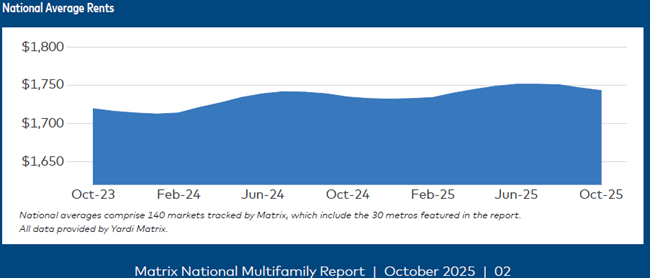
Weakening demand produced another month of negative multifamily rent growth in October which reflects an uncertain economy, according to the Yardi Matrix October report.

“With economic uncertainty shaking consumer confidence, is this the start of a prolonged slump or a short-lived trend?” the report asks.

The report says advertised rents nationally were down by $4 in October, the third consecutive monthly decrease and the third straight October with a similar drop.

October proved to be a challenging month, as only two of Matrix’s Top 30 metros recorded positive advertised rent growth, while rents fell in 25.

This “pullback highlights the effects of deteriorating consumer confidence, persistent inflation and labor market weakness—signs that the sector may be entering a period of softness,” the report says.

Multifamily rents reflect an uncertain economy as weakening demand produced another month of negative multifamily rent growth in October

Highlights of the report:

  • Multifamily rents continued to drop in October showing negative multifamily rent growth with the average national advertised rent at $1,743.
  • Year-over-year growth was unchanged at 0.5%.
  • Although too soon for alarm, apartment demand is showing cracks.
  • Absorption rates dropped sharply in recent months in Midwest metros such as Detroit, the Twin Cities and Indianapolis, and Sun Belt markets including Orlando, Nashville, Miami, Southwest Florida and Dallas.
  • Single-family build-to-rent advertised rates fell for the third straight month, losing gains made since the beginning of the year. The average BTR advertised rent dropped by $6 in October to $2,195, while the year-over-year growth rate remained at 0.0%.

Labor market weakness tells a story

Third-party estimates from the Carlyle Group show just 17,000 jobs added in September—down from 22,000 in August and well below the 54,000 expected—as major employers such as Amazon, Target, UPS and Paramount have announced layoffs.

Federal worker buyouts have also led to roughly 100,000 departures, with more expected by year-end, pressuring markets with large government workforces such as Washington, D.C.

Meanwhile, unemployment among recent college graduates—a key renter demographic—has climbed to a nine-year high, according to the latest available information from Bureau of Labor Statistics.

Not all news is negative

New multifamily starts have fallen by nearly half since 2023, giving high-supply Sun Belt and Western markets time to absorb units in lease-up—an adjustment period likely to last until growth returns.

Read the full Yardi Matrix report here.

About Yardi Matrix

Yardi Matrix researches and reports on multifamily, office and self-storage properties across the United States, serving the needs of a variety of industry professionals. Yardi Matrix Multifamily provides accurate data on 18+ million units, covering more than 90 percent of the U.S. population. Contact the company at (480) 663-1149.

Sign Up For Our Weekly Newsletter And Get Rental Property And Apartment News And Helpful, Useful Content Each Week.

* indicates required

Can a Lease Be Broken By The Landlord?

What if a landlord wants to end the lease early can the lease be broken by the landlord and under what circumstances?

What if a landlord wants to end the lease early can the lease be broken by the landlord and under what circumstances?

By Nancy Abrams

A rental contract is normally viewed as ironclad by both the landlord and the tenant. However, there are times when one of the parties may want to end the lease early. What if that party is the landlord?

In the United States, landlords are obligated to comply with all federal laws in addition to landlord-tenant laws in the states where their properties are located. Technically, a landlord can break a lease early, but not without good reason. Unless the tenant violates the lease, the landlord’s grounds for early termination must be stipulated and agreed upon within the lease agreement.

For instance, landlords cannot end a lease for reasons such as selling the property unless it’s specified in the lease agreement. Some landlords prefer having tenants out of their properties before they put the houses on the market.

Reasons a Landlord Can Terminate a Lease Early

A landlord needs “just cause” to end a lease before its stated expiration date. Common reasons include:

  • Non-payment of rent. If the tenant does not pay the rent over a period of time, the landlord can begin eviction proceedings.
  • Significant lease violations. Repeatedly causing significant damage to the property, making excessive noise, subletting without permission or violating other terms of the lease, such as having unauthorized pets, are legal reasons to break a lease.
  • Creating a safety threat to others or the property. Extensive repairs that make the property uninhabitable can sometimes justify early termination.
  • Unlawful behavior. Engaging in illegal activities or other serious misconduct by the tenant.
  • Specific lease clauses. Some leases may include clauses that allow for early termination by the landlord under specific circumstances.
  • Landlord wants to move into the property. Only if the lease agreement has a clause allowing for this. The landlord must give the tenant adequate notice and may not move in until the current tenant leaves.
  • Agreement to end. The landlord and tenant mutually agree to terminate the lease early.
  • Renovations or repairs. If the landlord requires full access to the property to carry out renovations or repairs, or if the upgrades will violate health and safety standards, then they may terminate the lease early.

Reasons a Landlord Cannot End a Lease Early

  • Retaliation. A landlord cannot end a lease early in retaliation for the tenant exercising their legal rights, like reporting unsafe living conditions.
  • Landlords cannot terminate a lease based on a tenant’s race, religion, gender, national origin, disability, or family status.
  • Other personal preferences. Ending the lease early cannot be done without a contractual or legal basis.
  • Simply wanting to sell the property.
  • No valid reason. There is no legal basis for a landlord to end a lease early if the tenant has not violated the terms of the agreement and there is no other valid reason specified in the lease.

Landlord’s Responsibilities When Terminating a Lease

Even with a valid reason, landlords must follow specific legal procedures and provide proper notice to terminate a lease or begin an eviction process.

To legally end a lease early, a landlord must:

  1. Provide a written notice. This notice specifies the reason for termination and provides the tenant with a specific time frame to address the issue or vacate the property.
  2. Follow proper legal procedures. This may involve formal eviction proceedings if the tenant does not comply with the notice.
  3. State and local Llaws. Tenant and landlord rights vary by state and local jurisdiction, so it’s essential that the landlord is aware of the specific laws in each area.

About the author:

Nancy Abrams serves as content editor for the American Apartment Owners Association (AAOA). AAOA assists landlords, property managers, real estate owners and brokers across the country with managing their properties, including tenant credit checks and tenant background screening as well as state-specific landlord forms, such as a rental application or rental agreement.  The association also offers resources from educational webinars and landlord tenant law to approved providers for insurance and financing. Contact us today to learn more.

Editor’s note: Please be sure to check your local city and state laws on this issue as there are many different rules on this top in different states and cities.

Sign Up For Our Weekly Newsletter And Get Rental Property And Apartment News And Helpful, Useful Content Each Week.

* indicates required

Will 2026 Be A Reckoning Year for the Rental Market?

New Supply Dampens Rent-Growth Projections

Fear Of ICE Creating Headaches for Chicago Landlords

Rental Application Fraud Jumps As High As 50% In Some Cities

Photo credit artisteer via istockimages

Pets Are Family, Not an Apartment Amenity

Pets are family and apartment amenity-based pet fees and restrictions imply that a pet is no different from access to a gym or parking spot.

Pets are family and apartment amenity-based pet fees and restrictions imply that a beloved companion is no different from access to a gym or a parking spot.

By Pet-Inclusive Housing Initiative

Across the country, pets are often treated as lifestyle add-ons — conveniences or “amenities” – that justify extra fees and restrictions.

Yet for roughly two-thirds of U.S. households, pets aren’t luxuries. They’re family. And when housing policies treat them otherwise, the human and financial costs ripple through communities.

A growing body of research confirms what most property managers already know in their hearts: Pets are part of people’s families, and pet-inclusive policies make good business sense. In fact, 93% of owner/operators agree that pets are important members of the family, and 71% of residents — pet owners and non-owners alike — say pets help bring people together within a whole community.

So why does the rental-housing industry still treat them like profit centers?

Pets are family and apartment amenity-based pet fees and restrictions imply that a pet is no different from access to a gym or parking spot.

The Problem with Treating Pets Like Amenities 

When property owners frame pets as “amenities,” they inadvertently put a price on family. Amenity-based pet fees and restrictions imply that a beloved companion is no different from access to a gym or a parking spot — something to be purchased, managed, and monetized.

But pets don’t just use housing — they complete homes. A renter’s relationship with their dog or cat is rooted in love, stability, and security, not luxury. Research shows that pet-inclusive housing leads to residents staying 21% longer and vacancies filling faster and more easily.

These are not signs of a burdensome “amenity.” They are hallmarks of strong, thriving communities.

When restrictive or profit-driven pet policies push families out, the consequences extend beyond the lease. In fact, housing-related issues are one of the leading causes of pet surrender to shelters, accounting for roughly 14% of owner surrenders nationwide.

Every unnecessary restriction or fee risks breaking up a family — a moral and economic loss that can be prevented through simple, humane policy changes.

Pets are family and apartment amenity-based pet fees and restrictions imply that a pet is no different from access to a gym or parking spot.

What the Data Say: Inclusive Equals Accountable

Many housing providers express legitimate concerns about safety, property damage, or resident satisfaction. Fortunately, the data tell a reassuring story:

  • Safety: A dog’s breed is not a predictor of behavior. Diet, training, environment, and socialization matter far more, according to research published in the journal Science.
  • Damage: According to PetScreening’s 2024 report, property managers report an average of $596 in pet damage – an amount covered by most regular security deposits – with just 28% of pet-occupied units showing any damage. Meanwhile, PIHI’s 2021 report shows renters reports just $210 in damage on average, and only 9% of pet-occupied units reporting any damage at all.
  • Community harmony: 73% of dog owners and 49% of cat owners say their pets brought them closer to their neighbors — evidence that pets build social capital, not division.

These statistics dismantle the myths that often justify pet fees, deposits, or restrictions. As Pet-Inclusive Housing Initiative’s research shows, most fears about pets in multifamily living simply don’t match reality.

The Human and Economic Costs of Exclusion

Restrictive pet policies often carry unseen consequences — and they’re not distributed equally. Studies show that nonrefundable pet fees and breed or size restrictions disproportionately affect renters who are Black, Indigenous or People of Color (BIPOC) and low-income renters, perpetuating cycles of inequity.

These barriers compound existing challenges for families who already face limited access to affordable housing.

Meanwhile, renters with pets are often forced into informal or unstable living arrangements, or even homelessness. The National Coalition for the Homeless estimates that up to 10% of people experiencing homelessness have a pet, and many will forgo shelters entirely rather than abandon their companions.

Pet-inclusive housing isn’t just compassionate policy — it’s a lifesaving one.

Concerned About Pets At Your Rental Communities? Pets are family, not an amenity to pull in fees

The Better Way: Pets as Family, Housing as Home

When we reframe pets as family members, we unlock a cascade of benefits — for residents, communities, and housing providers alike:

  • Higher resident retention and satisfaction;
  • Stronger community bonds and reduced isolation;
  • Reduced shelter intake and animal welfare costs;
  • A larger, more motivated rental pool — since two-thirds of U.S. households include pets.

Inclusive policies don’t require landlords to give up agency. Practical tools such as Pet Personality Profiles and Companion Animal Addenda allow providers to evaluate individual animals, set clear expectations, and promote accountability without resorting to outdated breed or weight limits.

A Call to Action for the Rental Housing Industry

If 93% of property owners already agree that pets are family, it’s time for policy and practice to reflect that shared truth.

Let’s retire the notion that companion animals are an amenity to be monetized — and instead embrace them as the living, loving extensions of our residents’ families that they are.

Creating pet-inclusive housing isn’t about bending to a trend; it’s about aligning business operations with the modern realities of life. When we open our doors to pets, we also open them to loyalty, community, and compassion — the real cornerstones of successful multifamily living. Learn more at petsandhousing.org.

About the author:

Dr. Gary Michelson started Found Animals in the aftermath of Hurricane Katrina. With a commitment to continue keeping people and pets together, he turned to the next scalable solution: increasing the availability of truly pet-inclusive housing.  Pet-Inclusive Housing Initiative develops resources, partnerships, and actionable tools to increase the availability of truly pet-inclusive housing. We are working hard to increase pet-inclusive housing because everyone should have access to the joy of pets. After all, pets help communities grow stronger.

pets and housing

Sign Up For Our Weekly Newsletter And Get Rental Property And Apartment News And Helpful, Useful Content Each Week.

* indicates required

Pet Owning Renters Face Barriers Despite “Pet-Friendly” Ads

Pet-Friendly Rental Listings Lease Faster

Will 2026 Be A Reckoning Year for the Rental Market?

Photo credit Massonstock via istockimages and RossHelen

Fear Of ICE Creating Headaches for Chicago Landlords

Fear has become a new expense cost for Chicago landlords as ICE raids across the city have led to missing tenants and contractors

Fear has become a new expense cost for Chicago landlords as Immigration and Customs Enforcement (ICE) raids across the city have led to missing tenants, contractors not showing up for work and headaches for property managers, according to reports.

The Chicago Sun-Times reports that tenants cannot pay rent on time because they are missing work due to fear of agents. Tenants are just staying home in fear of ICE.

Maintenance staff members also are not showing up for work. Contractors working on building repairs for rental units are also missing. Landlords estimate up to 40 percent of their contractors are now absent.

Property owners and property managers worry this is all going to lead to rent increases for the existing tenants to cover losses.

John Warren of Forte Properties, who has been in the real estate business for a decade, talked about the fear among residents and workers – both documented and undocumented – with the Sun-Times.

“Residents are scared to open their doors” for maintenance workers, he said, and it has become harder to schedule repairs with his work force

“All the risk you try to factor into making a business decision to lease and buy property, never had I had to compute ICE or federal authorities,” said Gene Lee, founder of TLG Development, who has been in the real estate industry for 10 years.

Lee said most of his workers are of Hispanic descent, and he has noticed absenteeism and disguises, with workers wearing street clothes and then changing into work gear once inside the building. The absences have caused paint and electrical jobs to be deferred, and Lee’s labor costs to rise. He’s had to spend time finding new vendors, as opposed to relying on workers who he has known for years.

“We didn’t need them here,” said Tracy Scanlon, who manages 70 buildings totaling around 1,000 units on the North Side. “Nobody is benefiting by this. It is making even my American residents and staff, who are Black and brown, scared to go to work.”

Scanlon had contractors tell her two weeks ago that they could not come fix a clogged bathtub and overflowing toilet at one of her buildings because ICE was in the neighborhood.

Sign Up For Our Weekly Newsletter And Get Rental Property And Apartment News And Helpful, Useful Content Each Week.

* indicates required

National Rents Dip for 3rd Consecutive Month

National median rent dipped by 0.8 percent in October, the third straight monthly decline of rent prices in the rental market’s slow season

The rental market slow season is here as the national median rent dipped by 0.8 percent in October, marking the third straight monthly decline, according to the November report from Apartment List.

“We’re now solidly into the rental market’s slow season, and it’s likely that rent prices nationally will continue to decline through the remainder of the year,” the Apartment List Research Team writes in the November report.

“This is in keeping with the typical seasonal pattern of rent growth, as fewer renters are generally looking to move as temperatures turn cooler and the holiday season approaches.”

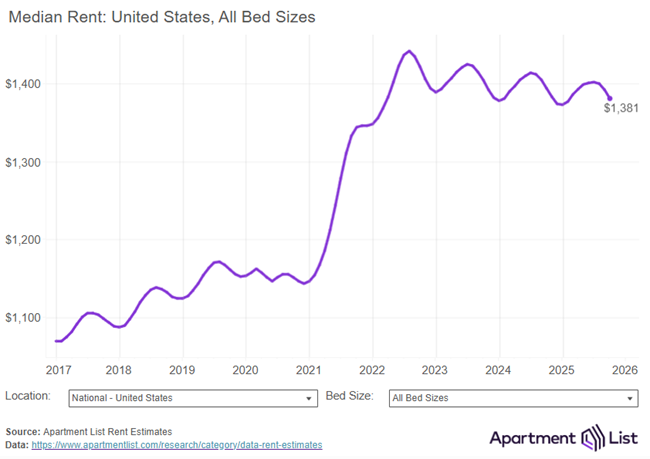
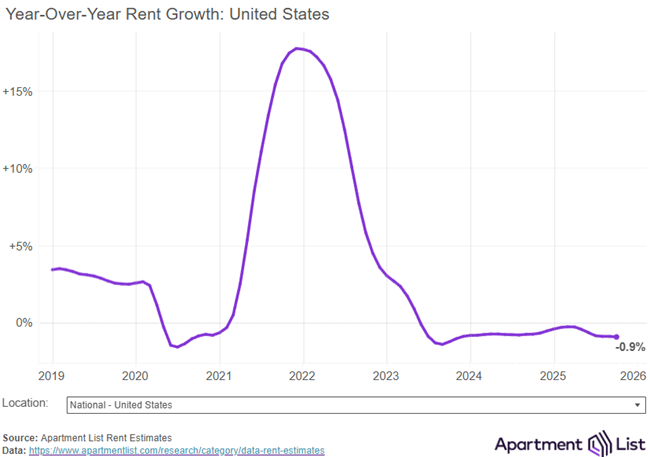
Chart shows trends in all bedroom sizes

Highlights of the national rents dip report

  • The national median rent now stands at $1,381, down $13 per month compared to October 2024.
  • Rent prices nationally are down 0.9% compared to one year ago. Year-over-year rent growth has been slightly negative for more than two full years, and the national median rent has now fallen from its 2022 peak by a total of 4.2%.
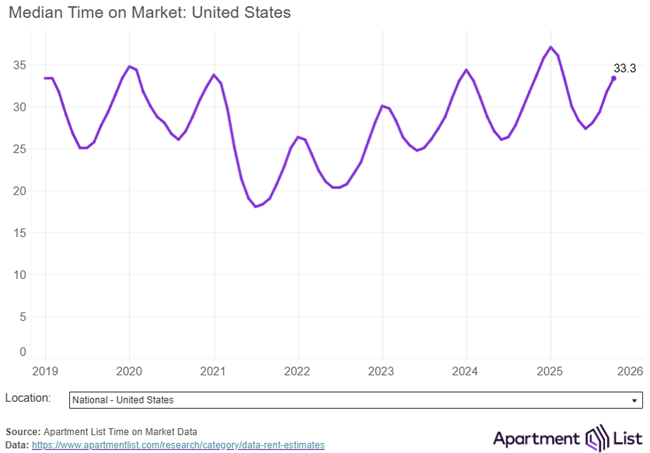
  • Units are taking an average of 33 days to get leased after being listed.
  • Although rents fell more in October than they did in September, this month’s decline was right in line with what we saw in October of last year, and as a result, year-over-year rent growth held steady at the -0.9 percent mentioned above.

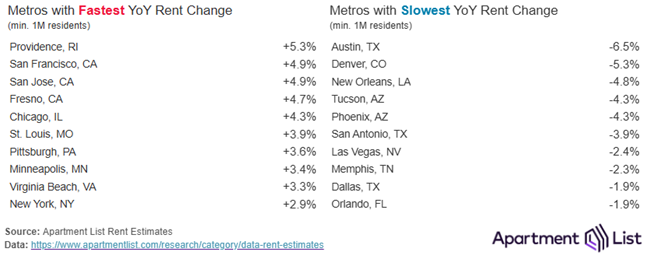
Chart shows cities with the fastest year over year results

National median rent dipped by 0.8 percent in October, the third straight monthly decline of rent prices in the rental market’s slow season

Multifamily vacancy rate hits 7.2%, a new peak

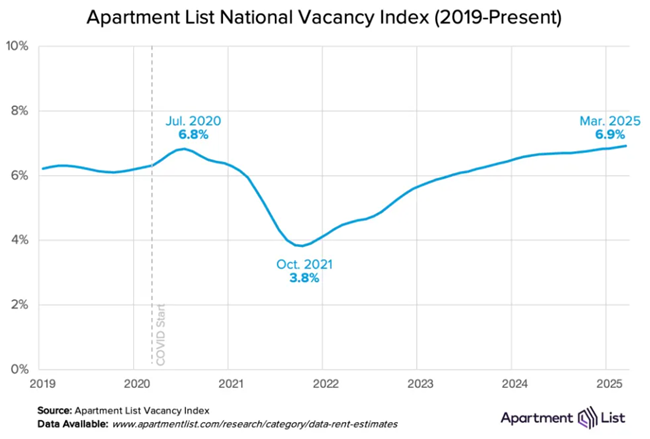
The Apartment List national vacancy index – which measures the average vacancy rate of stabilized properties in the marketplace – ticked up to 7.2 percent in October. This represents an all-time high for this data series, going back to the start of 2017.

As the supply wave continues to recede, these occupancy and pricing trends should begin to gradually shift, but for now the market is still absorbing a swell of new units.

National median rent dipped by 0.8 percent in October, the third straight monthly decline of rent prices in the rental market’s slow season

List-to-Lease time ticks up for fourth straight month

As more vacant units have come onto the market, those units have also been sitting vacant for somewhat longer.

In addition to that seasonal trend, units are also sitting a bit longer than they typically do at this time of year, a signal of market softness that’s also in line with rent growth and vacancy estimates.

National median rent dipped by 0.8 percent in October, the third straight monthly decline of rent prices in the rental market’s slow season

Rent Prices Conclusion

“All of our key indicators are pointing toward ongoing sluggishness in the multifamily rental market – rent prices are down and the vacancy rate is at an all-time high. As construction slows further during the tail end of this year and into 2026, rent prices and occupancy should begin to stabilize, and a return to tighter market conditions remains on the horizon.

“That said, the supply boom still has a bit of runway remaining, and the demand outlook has begun to appear weaker amid a shaky labor market. These factors could lengthen the time that it takes for the market to metabolize the recent growth in the rental stock,” the Apartment List Research Team says in the report.

Read the full report here.

Sign Up For Our Weekly Newsletter And Get Rental Property And Apartment News And Helpful, Useful Content Each Week.

* indicates required

New Supply Dampens Rent-Growth Projections

Rental Application Fraud Jumps As High As 50% In Some Cities

Rental Concessions Rise to New Level


New Apartment Completions Hide Long-Term Housing Shortage

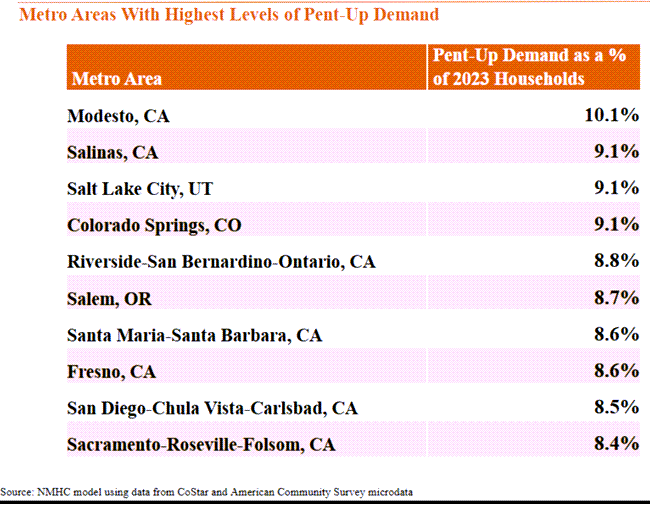
pent up demand and new apartment completions hide long-term housing shortage and household formation, which means not enough homes are being built

Record levels of new apartment completions in many metro markets hide longer-term trends in household formation, which means not enough homes are being built in the long run, according to a report from the Multifamily Housing Council (NMHC).

Chris Bruen writes that housing economists have agreed for many years that the U.S. is short millions of housing units, constraining affordability and limiting options for renters and owners.

“This Research Notes explains why we are observing both of these phenomena simultaneously. While there are short-term supply imbalances in certain markets, examining longer-term trends in household formation reveals longer-term underbuilding,” writes Bruen, senior director of research and chief economist for the NMHC.

Quantifying the Housing Shortage

A range of studies underscore how large our nation’s housing shortage has become:

  • Freddie Mac, for example, estimates a shortfall of 3.7 million housing units as of the third quarter of 2024.
  • Researchers at the Brookings Institution calculated a shortage of 4.9 million housing units in 2023 relative to the mid-2000s.
  • A 2022 study by Hoyt Advisory Services and Eigen10 Advisors estimated that, as of 2021, the U.S. was short 600,000 apartment units (units in structures with five or more units).

The definition of a housing shortage employed by institutions such as Freddie Mac and the Brookings Institution captures more long-term, structural issues within the housing market that account for pent-up demand.

Specifically, Freddie and Brookings estimate how many households would have been formed if housing costs didn’t increase as much as they did since a specific reference year—the year 2000, in the case of Freddie Mac, or 2006 in the case of Brookings.

“Yet this seems difficult to reconcile, particularly in the apartment segment, when the share of vacant apartments is the highest it’s been in decades,” Bruen writes.

“According to data from CoStar, the multifamily vacancy rate rose to 8.3% in fourth-quarter 2024 (the highest rate since recordkeeping began in 2000) before falling slightly to 8.2% during the first half of 2025,” he writes in the report.

Structural Shortage: A Longer-Term Challenge

While many U.S. housing markets are currently recording high levels of vacancy and declining rents—features typically associated with a housing surplus (rather than a shortage)—these markets still have a significant shortage when we consider “latent” or “pent-up” demand (individuals who would form households if housing costs were lower).

“Thus, when we say that the U.S. suffers from a national housing shortage, what we mean is that housing prices have increased significantly over time (more than the rate of inflation), and that this has locked many Americans out of the housing market altogether. This is true even in markets that have seen moderate rent decreases in recent years.

“Unlike the traditional, textbook definition of a housing shortage—which is short-term and corrects on its own as housing providers adjust prices—a shortage that accounts for pent-up housing demand can only be addressed through lowering the cost of housing development or operations, increasing supply in the long run.” Bruen writes in the Research Notes.

Real his full report and detail here.

Sign Up For Our Weekly Newsletter And Get Rental Property And Apartment News And Helpful, Useful Content Each Week.

* indicates required

National Rents Dip for 3rd Consecutive Month

New Supply Dampens Rent-Growth Projections

Rental Application Fraud Jumps As High As 50% In Some Cities

Rental Concessions Rise to New Level