Home Blog Page 9

Strong Retention Offsets Cooling Apartment Demand

multifamily resident retention is approaching an all-time high as the strong retention trend offsets the cooling demand for apartments

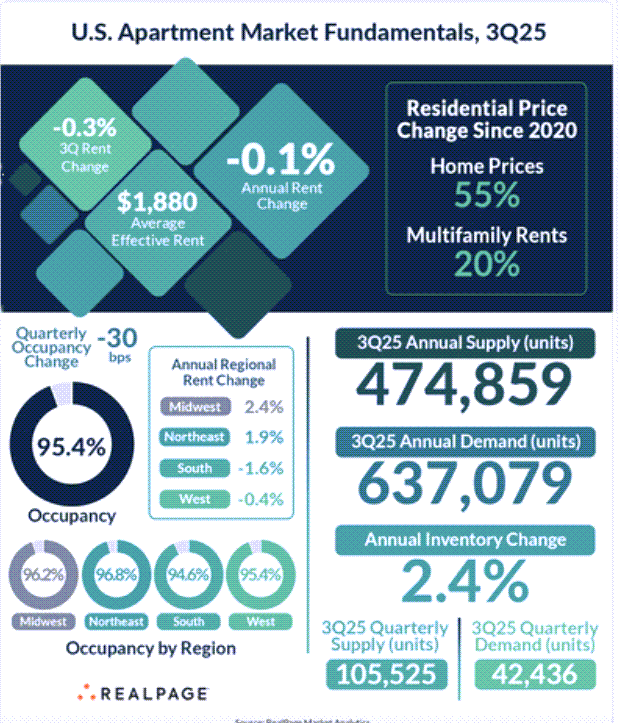
With homeownership exceeding the cost of renting, multifamily resident retention is approaching an all-time high, according to recent data from RealPage, a leading global provider of AI-enabled software platforms to the real estate industry.

In addition to strong resident retention, RealPage also identified specific markets where rent prices are decreasing, such as:

  • Denver and Austin: Rents are down nearly 8%
  • Phoenix: Rents have dropped a little more than 5%
  • Regional trends: The South saw a decline by 1.7% in the past 12 months while the West saw rents fall 0.4%

Looking ahead, RealPage predicts the multifamily industry could see an improved market momentum into 2026

In its third quarter 2025 analysis of the multifamily housing sector, the report noted that the average advertised rent price decreased for only the second time since 2009. Home values have risen at twice the pace of market-rate rental units since 2020, pushing the typical mortgage payment well above the nation’s average rent and keeping many households in the rental market longer.

“Resident retention has increased and is approaching an all-time high as the current cost of renting is significantly less expensive than homeownership,” said Carl Whitaker, chief economist at RealPage. “With residents staying put longer, owners and operators have an opportunity to create an even higher-quality resident experience and build a stronger sense of community at their properties.”

Q3 Industry Takeaways

  • Occupancy backtracked quarter-over-quarter to 95.4%.
  • The South region has added a quarter of a million units in the past 12 months (more than twice the second-fastest growing West region). As such, rents are down 1.7% in the past 12 months in the South while the West saw rents fall 0.4%. Conversely, the Midwest & Northeast regions have seen rents grow 2.3% and 1.9%, respectively.
  • San Francisco’s 7.1% rent growth in the past 12 months is far ahead of second-ranking Chicago (4.5%).

“According to RealPage data, the outlook for the U.S. apartment market in the next 12 months is that supply will cool considerably from its current level,” added Whitaker.

Q4 Industry Outlook

  • Nationwide, supply is starting to cool, with 105,000 units delivered in the third quarter, the fewest since the second quarter of 2023 and a 35% decline versus third quarter 2024.
  • The 324,000 units scheduled to be completed in the next 12 months would be the fewest in a given 12-month window since the second quarter 2020.
  • Construction activity shows supply will remain below normal for some time once this current wave of deliveries subsides.
  • Currently, just 519,000 market-rate apartment units are under construction nationally; the fewest number in more than 10 years.

The continued rise in resident retention with new lease shopping suggests that demand for market-rate apartments remains healthy. Current trends do not mirror past economic downcycles, when both retention and new lease activity contracted significantly. In fact, should strong resident retention persist, the multifamily industry could see an optimistic client base and improved market momentum heading into next year.

For a deeper perspective on these trends and RealPage’s 2026 outlook, watch the Q3 Apartment Market webcast replay. https://www.realpage.com/webcasts/market-intelligence-us-multifamily-update-q4-2025/.
Sign Up For Our Weekly Newsletter And Get Rental Property And Apartment News And Helpful, Useful Content Each Week.

* indicates required

New Supply Dampens Rent-Growth Projections

Rental Application Fraud Jumps As High As 50% In Some Cities

Rental Concessions Rise to New Level


New Supply Dampens Rent-Growth Projections

Anticipated increases in multifamily supply have prompted Yardi Matrix to reevaluate its rent-growth projections for 2027

Anticipated increases in multifamily supply have prompted Yardi Matrix to reevaluate its rent-growth projections for 2027, according to Yardi Matrix Multifamily Rent Forecast Update.

“The main change to our forecast is a more tepid 2027, with a national asking rent growth of 2% vs. 3%” from previous forecasts, said Andrew Semmes, senior research analyst, in the report.

This forecast is the result of more than 400,000 new units expected to come online in 2027, more than previously estimated, leading to tepid rent growth that year.

In addition to new units coming onboard, the projection is for “a more modest trajectory of household formation as the labor market moderates and population growth returns to its pre-COVID decelerating trajectory. Continued decent GDP growth and high federal government financing needs do not warrant reduced long-term interest rates, which we expect will keep mortgage rates high and multifamily turnover at its current lower level,” Semmes said in the report.

Anticipated increases in multifamily supply have prompted Yardi Matrix to reevaluate its rent-growth projections for 2027

Factors driving the projection

The multifamily sector closed the summer leasing season with disparate results by market reflecting complex and uneven economic signals that have come further into focus, such as:

  • Payrolls and employment gains have slowed with data revisions
  • Consumer spending remains but sentiment has weakened
  • Policy to reduce short-term interest rates remains intact but not without some pushback
  • Slower growth on a longer timeline before rising to moderate growth

“Seasonal advertised rent growth continues to flatten and underperform historical norms. On a national basis, the average month-over-month asking rent growth was in the 0.1% range, well below the previously reported 0.4% pace for 2010-19,” the report said.

Key takeaways:

  • Different economic and policy headwinds reveal the United States is in a more vulnerable position than previously reported, though the effects differ in severity by market.
  • The result of all these forces is a slowly recovering apartment market in areas of high supply, but one which is fragile.
  • Year-over-year national rent growth for 2026 is expected in the mid- to low-1.2% range, before a modest ramp-up in 2027 to 2% and then a stronger 2028 and beyond, with forecast increases of 3.4% to 3.8%.

Sign Up For Our Weekly Newsletter And Get Rental Property And Apartment News And Helpful, Useful Content Each Week.

* indicates required

Rental Application Fraud Jumps As High As 50% In Some Cities

Rental Concessions Rise to New Level

Up-Front Fee Transparency Reshapes Multifamily Marketing

Up-front fee transparency for tenants used to the instant price clarity they receive ordering a rideshare builds multifamily marketing trust

Up-front fee transparency for tenants who are used to the instant price clarity they receive when ordering a rideshare or booking travel plans builds trust.

By Andrew Ruhland

Price transparency has become an expectation of consumers spanning nearly every industry, and the multifamily space is finally catching up.

Unlike other industries, such as travel and retail, which might have two or three factors contributing to a total cost, multifamily operators are having to account for countless different factors from multiple sources when calculating a renter’s final monthly payment.

To provide clarity, many operators are now offering fee calculators on their websites, giving prospective renters a complete picture of required, recurring and optional costs.

At first, the idea of showing all-in pricing can feel risky. Listing fees upfront may raise the apparent cost, which seems dangerous in competitive markets. But operators adopting calculators are finding the opposite: they’re spending less on marketing, improving conversion rates and reducing stress for both renters and onsite teams.

“Transparency builds trust and gives prospects confidence before they even step foot onsite,” said Joya Pavesi, president, brand and strategic services, RKW Residential. “Today’s renters are used to the instant price clarity they receive when ordering a rideshare or booking travel plans. Leasing should be just as straightforward.”

When prospects understand total costs from the start, not only do renters tend to be better qualified, tours tend to be more efficient and leasing teams spend less time managing fee-related confusion. And because clarity builds trust and trust drives decisions, renters notice the difference.

Transparency as an Advantage

The cornerstone of fee calculators is transparency. What often begins as a fear of showing too much has become a competitive edge. By setting expectations upfront, operators create trust and reduce friction throughout the leasing process. Renters see exactly what they are committing to and what to expect, which makes move-ins smoother and renewals more likely.

“Providing fee transparency is a prime opportunity to align our digital channels with the expectations of customers,” Pavesi said. “By streamlining the process online, renters navigate pricing more easily while leasing teams benefit from fewer misaligned conversations.”

For operators, clarity means efficiency. For renters, it means confidence. And for all parties involved, transparency is no longer a burden—it’s a differentiator.

Shifting the Marketing Narrative

 The demand for transparency is reshaping multifamily marketing. Historically, only base rent was publicized, forcing prospects to compare communities based largely on amenities and finishes. Today, the focus has shifted—renters want to understand the total cost of living.

In order to make the most informed decisions, renters need a combination of total pricing, interactive floor plans and unit-level maps. Rapidly evolving technology is being implemented to incorporate all of these features into a single interface that can be leveraged across multiple channels.

Complementary tools such as interactive floor plans, virtual tours and maps showing exact unit locations further enhance the digital journey. By pairing transparency with engaging digital experiences, operators ensure consistency between the online search and in-person leasing, which helps renters feel more confident in their choices.

Driving Operational Consistency

 Fee transparency doesn’t just improve marketing, it strengthens operations. For operators with large, diverse portfolios, variations in fees and vendor structures across communities were once unavoidable. These inconsistencies not only created friction for prospects but also complicated efforts to centralize processes.

To address this, some companies have formed cross-department committees to manage fee transparency initiatives. By standardizing fee structures and pricing practices, operators not only simplify internal processes but also deliver clearer, more consistent customer experiences.

Just as internal consistency builds efficiency, external transparency plays a crucial role in building trust and shaping how prospects first encounter a community.

First Impressions are Digital

 A renter’s first impression almost always begins online. Even before connecting with a leasing agent, prospects use websites, reviews, fee calculators, interactive maps and video tours to self-educate and pre-qualify.

“It’s not a stretch to say that a prospect’s shopping experience starts online,” Pavesi said.  “Our paid ads, social media and website, not a leasing agent, is responsible for first impressions.”

That means transparency carries the brand long before an agent steps in. Imagery must be visually compelling, but equally important is providing accurate and complete pricing information. By delivering clarity and consistency across digital channels, communities empower renters and further demonstrate credibility—ultimately leading to more leases signed.

The Road Ahead

 What began as a regulatory requirement has become a defining feature of successful multifamily marketing and operations. Communities that embrace fee transparency are seeing higher conversions, reduced wasted marketing effort and more satisfied residents.

“Digital experiences play an extremely important part of the customer experience,” Pavesi said. “Not only do renters expect unit-level specifics and detailed maps, they also want access to accurate and comprehensive pricing information. It’s our duty to provide them the tools to facilitate that.”

By combining fee calculators, interactive tools and standardized practices, operators are reshaping the entire leasing journey. Transparency is no longer optional—it’s become the foundation of trust, efficiency and long-term renters.

About the author:

Andrew Ruhland is an account executive and content writer for LinnellTaylor Marketing, which focuses exclusively on the rental housing industry, its trends and technology innovations.

Sign Up For Our Weekly Newsletter And Get Rental Property And Apartment News And Helpful, Useful Content Each Week.

* indicates required

New Supply Dampens Rent-Growth Projections

Rental Concessions Rise to New Level

What Should I Ask A Previous Landlord About My Tenant Applicant?

Photo credit Francesco Scatena via istockimages

Rental Application Fraud Jumps As High As 50% In Some Cities

Renters are conning their way into luxury apartments as landlords are seeing a jump in rental application fraud

Renters are conning their way into luxury apartments as landlords are seeing a jump in rental application fraud, according to a story in the Wall Street Journal.

The Journal reports that Atlanta is at the center of the national surge in rental application fraud.

Greystar, one of the country’s largest landlords, says fraudulent applications are a real problem.

Toni Eubanks, Greystar’s managing director of property management, said in an interview recently with Bisnow that in some markets 50% of their applications are fraud.

“What we’re faced with as an industry is fraud. We’re finding it particularly prevalent in certain markets. In some of our markets, 50% of our applicants are fraudulent applicants. It’s our responsibility to catch those, you know, so that we can avoid that kind of disruption at the community level, for the owner and team members. We’re trying to stay very on top of that,” Eubanks told Bisnow.

The National Multifamily Housing Council says a survey it did showed owners reported a 40% increase in rental application and payment fraud.

The Wall Street Journal reported that Atlanta has a large number of high-end apartments for rent and that social media is spreading word about these listings.

“Influencers on Tik Tok say renters can boost their chances of getting approved by fudging financial information on their applications,” the Journal reports. The newspaper also said there are promoted ads that sell fake application packages and more.

“It is becoming a bigger and bigger problem coast to coast,” said Damon McCall, chief executive of ApproveShield, a fraud-detection software company for property managers, to the Wall Street Journal.

Leasing fraud appears to be a fairly widespread issue. According to a 2024 study by RealPage and Dimensional Research that looked at 400 property managers in the country’s largest metros, 75% of them reported experiencing an increase in fraudulent applications.

Read the full story in the Wall Street Journal here.

Sign Up For Our Weekly Newsletter And Get Rental Property And Apartment News And Helpful, Useful Content Each Week.

* indicates required

?️ Are the new tariffs hurting your business?

We’d like to know how the new tariffs are affecting property managers, owners, and suppliers in the rental housing industry.


Your feedback helps Rental Housing Journal track real-world impacts in our industry.

Rental Concessions Rise to New Level

A record number of landlords are giving more and more rental concessions, reaching a high of 37% in September Zillow says

A record number of landlords are giving more and more rental concessions, reaching a high of 37% in September, according to a release.

Subdued rent growth and record-breaking concessions from landlords are turning up now after a deluge of newly built apartments hit the market last year, according to the company’s latest rental market report.

Rental managers have turned to concessions – such as free months of rent or free parking – instead of lowering rents. The 37.3% of rentals on Zillow offering some sort of freebie in September is an increase from 14.4% in 2019.

“Those concessions likely will continue to rise; they typically peak in winter or early spring. As concessions become the norm, property managers may need to consider price cuts, particularly as the year winds down. Competition among prospective renters tends to fall off over the cooler winter months,” the release says.

Rent-concession highlights from the report

  • 37.3% of rentals on Zillow offered concessions in September, up from 36.7% in August and 35.8% in September 2024.
  • The share of rentals with concessions is lower, on a monthly basis, in 13 major metro areas. The largest monthly drops in the share of rentals with concessions are in Birmingham (-3ppts), Los Angeles (-1.9ppts), Minneapolis (-1ppts), Cleveland (-1ppts), and San Francisco (-0.8ppts).
  • The share of rentals with concessions is higher, on a monthly basis, in 37 major metro areas. The largest monthly increases in the share of rentals with concessions are in Pittsburgh (4.5ppts), Seattle (3.7ppts), Richmond (3.3ppts), Raleigh (3.2ppts), and Hartford (3.1ppts).
  • Rent concessions are up from year-ago levels in 33 of the 50 largest metro areas. The annual increase in share of rental listings with concessions is highest in Memphis (10.9ppts), Denver (10.6ppts), Houston (9.4ppts), Orlando (8.1ppts), and Las Vegas (8ppts).

Affordability rises nationwide as rents ease

Cooler growth and even declining rents in some rental markets are contributing to better nationwide affordability than renters have seen in four years.

A typical rental now requires 28.4% of the median household income nationally, down slightly from 28.8% a year ago and below the roughly one-third threshold where housing becomes a financial burden.

Read the full report here.

?️ Are the new tariffs hurting your business?

We’d like to know how the new tariffs are affecting property managers, owners, and suppliers in the rental housing industry.


Your feedback helps Rental Housing Journal track real-world impacts in our industry.

Sign Up For Our Weekly Newsletter And Get Rental Property And Apartment News And Helpful, Useful Content Each Week.

* indicates required

74% Of Renters Lose Trust If AI Not Disclosed During Leasing

Three out of four renters say they lose trust when AI is hidden in the leasing process, and they’re not shy about what they expect instead

Three out of four renters say they lose trust when AI is hidden in the leasing process, and they’re not shy about what they expect instead.

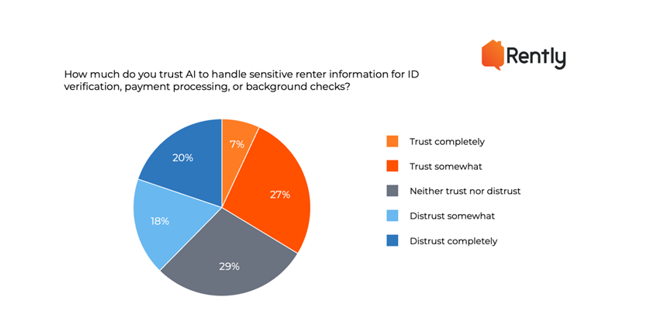
New research from the property-technology company Rently says that renters want AI to handle the hassle, from filtering out stale listings to securing after-hours tours, but demand transparency and human backup when the stakes get high.

The Rently 2025 Report on AI in Leasing polled 800 U.S. adults in September 2025 via the third-party platform Pollfish, examining attitudes across AI-assisted search, self-guided touring, leasing, and support.

Three out of four renters say they lose trust when AI is hidden in the leasing process, and they’re not shy about what they expect instead

The report findings illustrate a balancing act for property managers and operators. Renters are open to AI-powered tools when they make the experience faster and easier–such as delivering real-time pricing or suggesting credible alternatives–but they expect clear disclosure when automation is involved. They’ll pay a little more for peace of mind in areas like security and 24/7 maintenance, yet they draw the line when money, contracts, or disputes are on the table, insisting those moments stay human-led.

Key findings include:

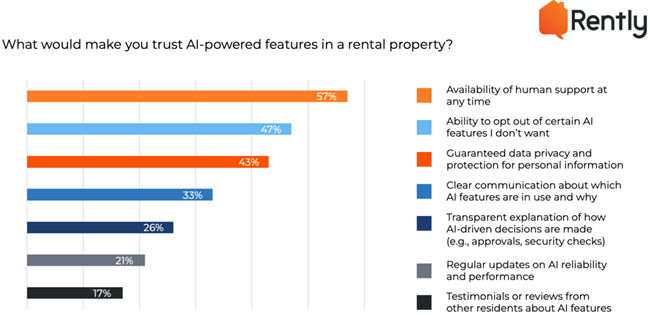
  • Transparency and control set comfort levels. 74% of respondents say they are less comfortable when AI use isn’t disclosed; 57% want human support available anytime; 47% want the ability to opt out of AI features.
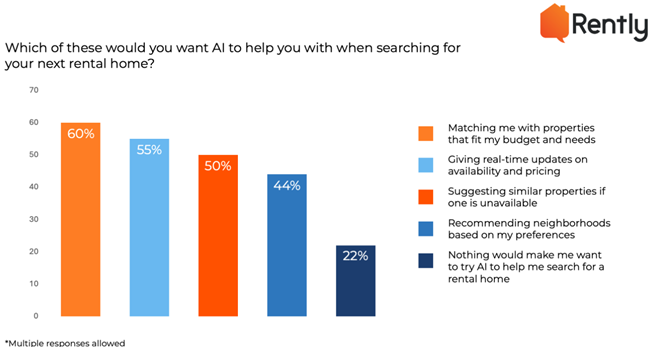
  • Renters want smarter search tools. 60% want home recommendations that match their budget and needs, 55% want availability and pricing updated in real time and 50% want to be suggested comparable units when a listing is no longer available.
  • Self-tours win on access and safety. 50% of renters value the ability to tour after hours, 49% want property details on their phone during the visit and 46% want secure entry with ID verification and one-time codes.
  • Renters will pay small premiums for assurance. 42% would pay more for security monitoring and 37% for 24/7 maintenance support; 64% would cap added tech costs at $20/month or less; 5% would exceed $60.
  • Humans are wanted for high-stakes moments. 71% want to contact a person first when a problem arises, especially for rent negotiations, payment concerns, and disputes.

Three out of four renters say they lose trust when AI is hidden in the leasing process, and they’re not shy about what they expect instead

Taken together, the findings point to a simple expectation for the rental journey: It should be fast, relevant and transparent, with safe access to properties and real people available when judgment is needed. Renters want tools that make decisions easier and teams that stand behind the experience, so the path from search to keys feels predictable and fair.

“The rental process isn’t just about square footage or price. It’s about how the experience feels,” said Merrick Lackner, CEO at Rently. “Renters want listings that are accurate, tours that are flexible and support that’s responsive. AI can make those interactions faster and easier, but only when it’s transparent. Leasing technology that reduces friction while keeping people in control is what will define the next era of rental technology.”

Lackner continued, “AI can deliver faster searches and real-time updates, and safer communities, but its real value is empowering renters to make better decisions. When paired with human support, technology doesn’t just streamline leasing, it elevates the entire renter experience.”

Visit the Rently 2025 Report on AI in Leasing at the company’s website for the complete survey results and additional insights.

Sign Up For Our Weekly Newsletter And Get Rental Property And Apartment News And Helpful, Useful Content Each Week.

* indicates required

Simple Fixes Help Rental Properties Cut Water Costs

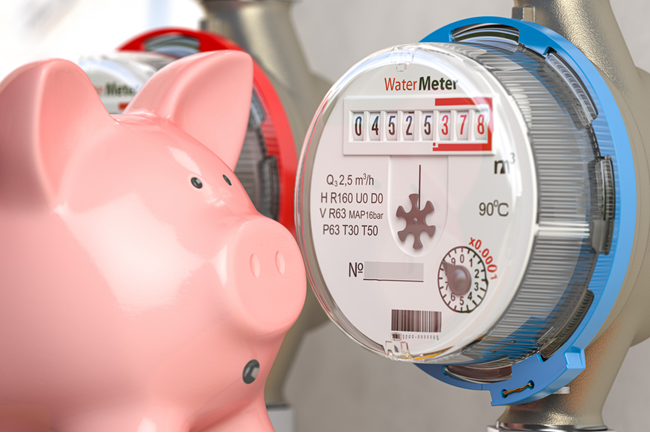
Simple fixes help rental properties cut water costs so here are three practical ways to cut water costs and save water.

Simple fixes help rental properties cut water costs so here are three practical ways to cut water costs and save water.

By Paula Paciorek

Rising utility costs are putting pressure on already-tight rental-property budgets. The good news? Many of the biggest savings can come from simple, low-cost fixes.

Assessments Can Reveal Hidden Waste

 The best starting point is a water-efficiency assessment. Nearly every rental property—regardless of age or size—has opportunities to reduce water waste. A conservation expert can quickly identify inefficiencies, estimate potential savings, and outline exactly what improvements will pay off and when.

A typical property assessment can uncover:

  • Leaks — from dripping faucets to broken or misaligned sprinklers.
  • Faulty or failed metering — which experts can detect by walking the site and reviewing past usage data.
  • Outdated equipment — such as older washing machines, appliances, and fixtures.

Addressing these common issues can significantly reduce operating costs and tenant utility bills, making properties more desirable and competitive. Owners and managers can also incorporate simple retrofits with high return on investment. In some cases, newer or upgraded buildings may also qualify for water-efficiency certifications that unlock additional savings and incentives.

Cities and Utilities Can Help with the Cost

 Many municipalities and utilities offer rebates and free assessments to encourage water conservation. Property owners can often have a city or utility cover part—or even all—of the costs for assessments and upgrades to fixtures, appliances, or equipment.

For example, since 2012, the City of Dallas has partnered with the Water Efficiency and Energy Services (WEES) team at Plummer to conduct more than 1,440 free assessments for local businesses. The program identified potential savings of over 740 million gallons of water per year and earned the Texas Chapter of the American Water Works Association’s Water Conservation and Reuse Award.

Even in areas without existing programs, conservation specialists can work with cities or utilities to create custom rebate or assessment initiatives—creating win-win solutions for both property owners and the community.

Unlocking Hidden Value in Multifamily Affordable Properties

Many affordable housing properties—especially those financed through the Low-Income Housing Tax Credit (LIHTC) program—can benefit from an often-overlooked strategy: Utility Allowance (UA) modeling.

Instead of relying on the standard utility allowance published by the local housing authority, property owners and managers can have their property’s actual water use analyzed. A custom UA model reflects the true consumption patterns of a specific property—and in most cases, that usage is lower than the public allowance. The result? Higher allowable rents, improved cash flow, and greater long-term sustainability.

A UA model not only supports increased rent potential, but it typically covers its own cost very quickly. Industry data shows that the expense of developing a model can often be recovered in just a few months. After that, the ongoing savings and increased revenue can be reinvested into property upgrades such as water-efficient improvements that reduce tenant utility bills and enhance overall property performance.

3 Practical Ways to Cut Rental Property Water Costs

Take advantage of these simple ways to cut costs and save water:

  1. Find hidden inefficiencies.
    Hire a conservation specialist to walk your property, identify “leaks” in water systems, and provide a clear action plan for cost savings.
  2. Leverage local resources.
    Many cities and utility companies offer rebates, free assessments, or incentive programs for water conservation. Don’t leave that money on the table.
  3. Explore UA modeling for LIHTC properties.
    A tailored utility allowance model can reveal how your property truly performs—and potentially open the door to higher rents and reinvestment opportunities.

Across the country, housing providers are using simple conservation assessments, programs and UA modeling as a smart financial and operational strategy to strengthen both their bottom line and their communities. For more information, visit https://www.plummer.com/wees-services

About the author:

 Paula Paciorek is team leader of the Water and Energy Efficiency Practice team at Plummer. Paula leads initiatives that promote water conservation, efficiency, and sustainability for cities, utilities, and businesses, with 14 years of experience in advancing sustainable water management solutions.

Photo credit Bet_Noire via istockimages

Why Treating Maintenance Requests Quickly And Fairly Matters

Why treating maintenance requests quickly and fairly matters for community culture and fair housing - it is more than a leaky faucet issue.

Why treating maintenance requests quickly and fairly matters for community culture and fair housing – it is more than just a leaky faucet issue for property management.

By The Fair Housing Institute

Maintenance requests are often the most frequent interactions residents have with property management. For many residents, the speed and fairness of these responses set the tone for their overall satisfaction.

A quick, consistent, and respectful response can build confidence in the community and reassure residents that their concerns are being addressed.

On the other hand, when delays occur without explanation or when residents perceive favoritism, frustration grows quickly.

This dissatisfaction can spill over into complaints, poor reviews, or even formal fair housing claims. Viewing maintenance not just as a repair function but as a form of customer service helps property managers approach every request as an opportunity to strengthen trust.

Why Fairness Matters Beyond Compliance

Fair housing laws make it clear: all residents must be treated equally.

This applies not only to leasing and advertising but also to day-to-day operations, such as maintenance. If one resident consistently receives faster service than another, especially if there is a pattern tied to protected characteristics, housing providers could face allegations of discrimination.

Yet compliance is only part of the picture.

Fair treatment has a direct impact on how residents feel about their community. When residents see that their requests are taken seriously and handled with fairness, they feel respected. That respect often translates into long-term loyalty, timely lease renewals, and even word-of-mouth recommendations that attract future residents.

Prioritization Done Right

Naturally, some maintenance issues require more immediate attention than others. A burst pipe or malfunctioning air conditioning system in the summer must be prioritized over cosmetic problems, such as a sticking cabinet door. The challenge for property managers is ensuring that the system for prioritization is consistent and clearly communicated.

Establishing objective criteria, such as health and safety concerns, habitability, and urgency, creates a framework that staff can rely on to make informed decisions. When residents understand why certain requests are addressed first, they are less likely to perceive unfairness. Transparency in how priorities are set turns potential frustrations into opportunities for reassurance and confidence.

Communication Builds Confidence

Even with clear priorities, delays are sometimes unavoidable. High demand seasons, staffing shortages, or parts on backorder can all impact response times. The difference between a satisfied resident and an upset one often comes down to communication. Residents who receive proactive updates feel that their concerns are acknowledged, even if the repair is delayed.

Good communication also prevents assumptions of favoritism. If a resident sees a neighbor’s request being completed sooner, they may assume bias unless they have been informed about the reason for the timing. By setting realistic expectations and keeping residents updated, property managers build confidence that all requests are handled fairly and thoughtfully.

Documentation as a Service Tool

Accurate documentation is a cornerstone of both compliance and customer service. By keeping detailed records of when requests are made, how they are prioritized, and when they are completed, property managers can demonstrate consistency in their process. This reduces liability and helps resolve disputes if a resident questions why a delay occurred.

But documentation does more than protect management. It also improves efficiency. Staff can quickly review outstanding requests, provide precise updates to residents, and ensure that no issues fall through the cracks. This level of organization signals professionalism and creates a smoother experience for residents, reinforcing the trust that property managers work hard to build.

Training Staff for Consistency

Frontline staff often handle maintenance requests directly, and their actions can significantly impact resident perceptions. Without clear policies and training, employees may make judgment calls based on convenience or familiarity, unintentionally creating unequal treatment. Training ensures that staff understand fair housing obligations and apply policies consistently.

Beyond compliance, training instills a customer service mindset. Staff learn that every interaction is a chance to either build or damage trust with residents. By equipping employees with both the legal knowledge and customer service skills they need, property managers create a team that represents fairness, professionalism, and respect at every step of the process.

Building Trust One Request at a Time

Balancing maintenance requests fairly is about more than fixing broken items. It is about creating an environment where every resident knows they can rely on management for fair and consistent service. When residents trust the process, they are less likely to feel overlooked, even when delays happen.

By combining consistent prioritization, transparent communication, strong documentation, and well-trained staff, property managers can leverage maintenance as one of the most powerful tools for enhancing resident satisfaction. Each request addressed fairly strengthens the community, reduces risks, and creates long-term value for both residents and housing providers.

Call to Action: Strengthen Your Maintenance Practices Today

Now is the time to review how your team handles maintenance requests.

Are your prioritization standards clear and consistent? Is communication timely and transparent? Do your staff members have the necessary training to handle requests fairly under the Fair Housing Act?

Taking the time to evaluate and improve these areas will pay off in more than just compliance; it will also yield benefits in other areas. It will lead to stronger relationships, greater resident satisfaction, and a healthier community culture. Start with small changes, reinforce them through training, and watch as fairness in maintenance becomes a foundation for trust and long-term success.

About the author:

In 2005, The Fair Housing Institute was founded as a company with one goal: to provide educational and entertaining fair-housing compliance training at an affordable price at the click of a button.

Sign Up For Our Weekly Newsletter And Get Rental Property And Apartment News And Helpful, Useful Content Each Week.

* indicates required

What Should I Ask A Previous Landlord About My Tenant Applicant?

Landlord references from ask landlord hank

This week the question for Ask Landlord Hank comes from a landlord asking about landlord references for his tenant applicant and questions for previous landlord. Remember Hank is not an attorney and he is not offering legal advice so check your local and state laws. If you have a question for him please fill out the form below.

Dear Landlord Hank,

What should I be asking a prospective tenant’s landlord, or previous landlord references, before renting to them?

-Richard

Dear Landlord Richard,

When checking an applicant’s rental history, you must make sure that you are speaking to a real landlord and not the applicant’s brother or friend.

This can be tricky if your applicant is not renting from an apartment complex or rental agency, so be very careful here.

Your rental application should have an information release at the bottom, signed by the applicant so you can legitimately seek landlord references and the information you need to decide if you would like this applicant as a tenant. So send this release to applicant’s prior landlords.

Also, try to get more than one rental history. I ask for the last five years of rental history and will check with all old landlords. I want to make sure the facts line up, such as dates that tenant occupied a certain address, the amount of rent paid, whether rent was paid in timely manner, or were there late payments or NSFs (not-sufficient-funds checks)?

Did this applicant take care of the property? Any damage on move-out? Did the tenant have unauthorized pets or guests, or any criminal activity? Did the tenant get along with neighbors, or was there friction – maybe noise late at night, etc.?

Did the tenant give prior landlord 30-day notice of vacating?

The most important landlord references question

And, the most important question, would the old landlord re-rent to this person?

The information you receive in this section of your application is to me the most vital in determining if I want this person to be my next tenant. Usually, if an applicant has a great and long rental history, that is a good sign that you will have a trouble free tenant.

Sincerely,

Hank Rossi

Ask Landlord Hank - a landlord asks this week about previous landlord references for tenant applicant
Landlord Hank says When checking an applicant’s rental history, and landlord references you must make sure that you are speaking to a real landlord and not the applicant’s brother or friend.

Ask Landlord Hank Your Question

Ask veteran landlord and property manager Hank Rossi your questions from tenant screening to leases to pets and more! He provides answers each week to landlords.

  • This field is for validation purposes and should be left unchanged.

Do I Have to Paint and Replace Flooring for a Long-Term Tenant?

Sign Up For Our Newsletter And Get Apartment News And Helpful, Useful Content Each Week.

* indicates required

Should I Turn On The Utilities and Power For New Tenant Moving In?


Ask Landlord Hank – A Tenant Has Questions About Landlord Obligations

10 Rental Property Maintenance Items To Check This Fall  

The maintenance checkup this week provided  focuses on 10 rental property maintenance items to check this fall in and around your property.

The maintenance checkup this week by Keepe focuses on 10 rental property maintenance items to check this fall in and around your property.

Maintaining your rental property on a seasonal basis allows you to charge the maximum rent from your tenants, maintain a safe property and ensure that your vacancy rates stay low.

Checking for inexpensive maintenance issues also allows you to identify any potential problems and damages before they lead to expensive repairs.

During your fall season maintenance check-in, prioritize these maintenance duties to ensure your property is in tip-top shape.

No. 1 – Inspect heating and ventilation

Avoid expensive repairs by inspecting your HVAC systems at least twice a year. Replace filters in ventilation systems, remove debris from airways and exam heating elements for leaks to ensure safe operation. Additionally, you should cover the exterior HVAC units to prevent snow and cold from coming in.

The maintenance checkup this week focuses on 10 rental property maintenance items to check this fall in and around your property.

No. 2 – Inspect the machines in your building

Ensure that your gym equipment, laundry machines, service elevators and other systems are running safely and efficiently within your building. Maintaining these systems also greatly improves your tenants experience at your property.

No. 3 – Maintain curb appeal

Clean the windows and clean and/or repaint the exteriors of your property. Invest in your landscape to ensure your property is looking its best by incorporating visually pleasing plants and vegetation around your property.

No. 4 – Clean and inspect water-related features

To avoid issues with your downspouts and gutters, clean debris to avoid backups during the fall and winter season. Treating water systems and drainage are always much easier take care of before issues occur.

No. 5 – Upgrade common areas

Every five to seven years, upgrade features such as the flooring, carpets and paint on the walls that are in the common areas and hallways of your building to maintain a clean and modern ambiance.

No. 6 – Chimney sweep

10 Rental Property Maintenance Items To Check This Fall  

If your property has a functional fireplace, now is the best time to conduct a chimney sweep and ensure that any obstructions are cleared. Make sure smoke can get out and cold air can’t flow in.

No. 7 – Landscape maintenance

Maintain the shrubs, trees and fertilization surrounding your property while also removing any plants or vegetation that may interfere with your curb appeal. Removing large objects and unnecessary tree vegetation will also reduce the likelihood of extreme wind related damage to your property.

No. 8 – Inspect for cracks and leaks

10 Rental Property Maintenance Items To Check This Fall  

Replace the stripping on windows, seal any cracks, and prevent drafts and leaks from entering at the bottom of the doors by correcting them with a door piece. This simple inspection can decrease your reoccurring electric bill – or your tenants’ complaints about their high bills.

No. 9 – Fire safety

Replace the batteries in all of the smoke detectors within your property. Home fires are more common during the winter than any other time of the year so ensure that you practice your fire evacuation plan for your tenants during the fall season as well.

No. 10 – Get residents involved

Let your tenants check for property maintenance services that they are responsible for – such as checking their own smoke detectors, windows, etc. If everyone helps out, your fall maintenance will go more efficiently.

Summary

Preserve your property with these preventative maintenance tips and find that your property will be in better shape in the short-term and long-term. Schedule routine proactive inspections and you will save much time and money down the road.

About Keepe:

Keepe is a nationwide network technician maintenance solution for property managers and independent landlords. Learn more about Keepe at https://www.keepe.com

4 Things To Check In A Chimney Inspection In Your Rentals

5 Fire Safety Tips for Property Managers in 2020

Sign Up For Our Newsletter And Get Rental Property And Apartment News And Helpful, Useful Content Each Week.

* indicates required