
Record levels of new apartment completions in many metro markets hide longer-term trends in household formation, which means not enough homes are being built in the long run, according to a report from the Multifamily Housing Council (NMHC).
Chris Bruen writes that housing economists have agreed for many years that the U.S. is short millions of housing units, constraining affordability and limiting options for renters and owners.
“This Research Notes explains why we are observing both of these phenomena simultaneously. While there are short-term supply imbalances in certain markets, examining longer-term trends in household formation reveals longer-term underbuilding,” writes Bruen, senior director of research and chief economist for the NMHC.
Quantifying the Housing Shortage
A range of studies underscore how large our nation’s housing shortage has become:
- Freddie Mac, for example, estimates a shortfall of 3.7 million housing units as of the third quarter of 2024.
- Researchers at the Brookings Institution calculated a shortage of 4.9 million housing units in 2023 relative to the mid-2000s.
- A 2022 study by Hoyt Advisory Services and Eigen10 Advisors estimated that, as of 2021, the U.S. was short 600,000 apartment units (units in structures with five or more units).
The definition of a housing shortage employed by institutions such as Freddie Mac and the Brookings Institution captures more long-term, structural issues within the housing market that account for pent-up demand.
Specifically, Freddie and Brookings estimate how many households would have been formed if housing costs didn’t increase as much as they did since a specific reference year—the year 2000, in the case of Freddie Mac, or 2006 in the case of Brookings.
“Yet this seems difficult to reconcile, particularly in the apartment segment, when the share of vacant apartments is the highest it’s been in decades,” Bruen writes.
“According to data from CoStar, the multifamily vacancy rate rose to 8.3% in fourth-quarter 2024 (the highest rate since recordkeeping began in 2000) before falling slightly to 8.2% during the first half of 2025,” he writes in the report.
Structural Shortage: A Longer-Term Challenge
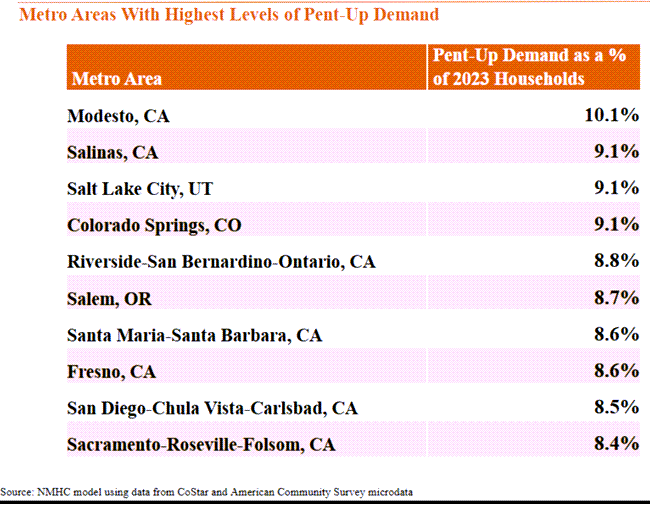
While many U.S. housing markets are currently recording high levels of vacancy and declining rents—features typically associated with a housing surplus (rather than a shortage)—these markets still have a significant shortage when we consider “latent” or “pent-up” demand (individuals who would form households if housing costs were lower).
“Thus, when we say that the U.S. suffers from a national housing shortage, what we mean is that housing prices have increased significantly over time (more than the rate of inflation), and that this has locked many Americans out of the housing market altogether. This is true even in markets that have seen moderate rent decreases in recent years.
“Unlike the traditional, textbook definition of a housing shortage—which is short-term and corrects on its own as housing providers adjust prices—a shortage that accounts for pent-up housing demand can only be addressed through lowering the cost of housing development or operations, increasing supply in the long run.” Bruen writes in the Research Notes.
Real his full report and detail here.