

Weakening demand produced another month of negative multifamily rent growth in October which reflects an uncertain economy, according to the Yardi Matrix October report.
“With economic uncertainty shaking consumer confidence, is this the start of a prolonged slump or a short-lived trend?” the report asks.
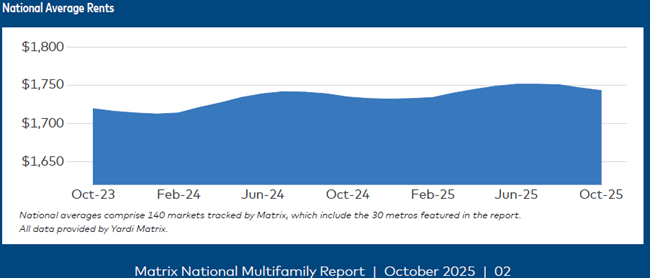
The report says advertised rents nationally were down by $4 in October, the third consecutive monthly decrease and the third straight October with a similar drop.
October proved to be a challenging month, as only two of Matrix’s Top 30 metros recorded positive advertised rent growth, while rents fell in 25.
This “pullback highlights the effects of deteriorating consumer confidence, persistent inflation and labor market weakness—signs that the sector may be entering a period of softness,” the report says.
Highlights of the report:
- Multifamily rents continued to drop in October showing negative multifamily rent growth with the average national advertised rent at $1,743.
- Year-over-year growth was unchanged at 0.5%.
- Although too soon for alarm, apartment demand is showing cracks.
- Absorption rates dropped sharply in recent months in Midwest metros such as Detroit, the Twin Cities and Indianapolis, and Sun Belt markets including Orlando, Nashville, Miami, Southwest Florida and Dallas.
- Single-family build-to-rent advertised rates fell for the third straight month, losing gains made since the beginning of the year. The average BTR advertised rent dropped by $6 in October to $2,195, while the year-over-year growth rate remained at 0.0%.
Labor market weakness tells a story
Third-party estimates from the Carlyle Group show just 17,000 jobs added in September—down from 22,000 in August and well below the 54,000 expected—as major employers such as Amazon, Target, UPS and Paramount have announced layoffs.
Federal worker buyouts have also led to roughly 100,000 departures, with more expected by year-end, pressuring markets with large government workforces such as Washington, D.C.
Meanwhile, unemployment among recent college graduates—a key renter demographic—has climbed to a nine-year high, according to the latest available information from Bureau of Labor Statistics.
Not all news is negative
New multifamily starts have fallen by nearly half since 2023, giving high-supply Sun Belt and Western markets time to absorb units in lease-up—an adjustment period likely to last until growth returns.
Read the full Yardi Matrix report here.
About Yardi Matrix
Yardi Matrix researches and reports on multifamily, office and self-storage properties across the United States, serving the needs of a variety of industry professionals. Yardi Matrix Multifamily provides accurate data on 18+ million units, covering more than 90 percent of the U.S. population. Contact the company at (480) 663-1149.