

The rent dip in November that marked four straight months of rent declines may be a seasonal issue or a larger issue around jobs and consumer confidence, Yardi Matrix says in the most recent Multifamily Report.
Rents are well off the summer peak and 90% of the Yardi Matrix top 30 metros posted negative growth over the last three months.
“The question is whether the performance is seasonal or the result of weakening job growth and consumer confidence,” Yardi Matrix writes in the report.
Highlights of the report
- With job growth and consumer confidence weakening, multifamily rents and demand are struggling. The average U.S. advertised rent fell $8 to $1,740 in November, while year-over-year growth dropped 30 basis points to 0.2%.
- Rent growth has been weak for two years in high-supply markets, but the recent malaise is more widespread. Over the last three months, advertised rents have been negative in 90% of the Matrix top 30, with the Twin Cities the only major metro to produce positive growth.
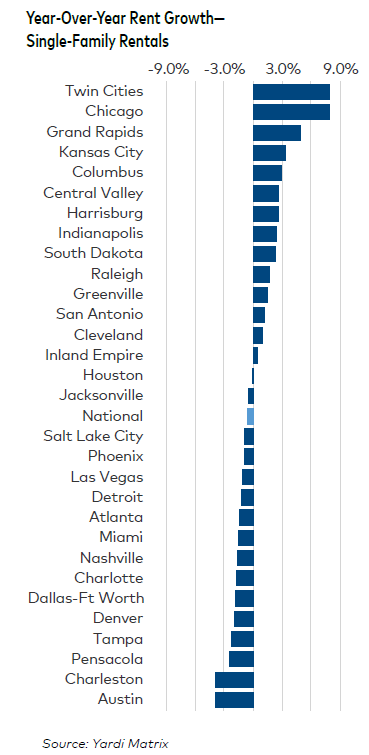
- Single-family build-to-rent advertised rates likewise are exhibiting weakness, dropping for the fourth straight month. The average BTR advertised rent declined by $10 in November to $2,185, while the year-over-year growth rate fell to -0.5%.
“The recent drop is less than ideal, but more worrisome is how widespread the decline is. There are several possibilities why rents are dropping,” Yardi Matrix writes
Seasonality in the winter months could be one issue
The report points out that rents have dropped in each of the past four Novembers but showed modest recovery in the first quarter of the next year.
“Another possibility is that rent growth will be weak for a while due to the supply-demand imbalance. The large delivery pipeline is being absorbed as demand flags. Immigration policy, weak consumer confidence and slowing job growth have caused absorption to decelerate.
“While year-to-date absorption is strong, the number of apartment units absorbed in October was the lowest in several years,” the report says.
The Top Markets Performance
Advertised rents have been negative for a year or more in metros such as Austin, Denver, Phoenix and Dallas that are dealing with a glut of supply that has lowered occupancy rates despite strong absorption.”
But In November “metros such as Columbus, Indianapolis, New Jersey, San Jose and San Francisco saw advertised rents turn from positive to negative. Not only are these metros among the top-performing markets in rent growth over the last couple of years but most sport occupancy rates at or above the national average, so the poor performance cannot be attributed to weak overall conditions,” the report says.
Read the full Yardi Matrix report here.