
Home Blog Page 69

How Text Messages Help With Tenant Communication

Text messages can be an important property manager tool for tenant communication so here are some important things to know.

Text messages can be an important property manager tool for tenant communication so here are some important things to know about communicating with residents by text.

By Tom Sheahan

A big component of a property manager’s job is communicating with residents. There is no one, single way to perform that job. Certainly, it has been done through in-person communication and phone calls for decades, but email, social media communication and text messages have entered the property managers’ toolkit more recently.

There are a few attributes of text messages that make it stand out when compared to other methods of communication.

Here are 4 ways text messages help property managers with tenant communication

  1. Save time: Utilizing texts ensures people will actually read your message. Calls, on the other hand, may or may not be answered, and voicemails (which can be time-consuming) may or may not be listened to.
  2. Record-keeping: Most texting software keeps a log of communication, so it is easy to go back and see what was sent to who and when. This makes record-keeping streamlined and easy.
  3. High read rates: Research from OpenMarket indicates 83 percent of millennials would rather text message a business than call a customer service line. This is important with the millennial age group renting housing at a higher rate than older generations.
  4.  Reliability: Text messages are a reliable form of communication, as the vast majority of texts sent are delivered (different SMS providers tout varying deliverability stats, but many are above 90 percent), even when the internet is down and the power’s out.

While deliverability stats for texts are indeed impressive, the sender has to do their part to make sure messages don’t get blocked due to content.

There are stringent rules and regulations put in place by carriers to make sure spam content is not being sent.

Key Steps For Property Managers In Tenant Communication By Text

In order to ensure messages are reaching the intended people, property managers should take a few key steps, including:

  • Always including an option for people to opt-out: An easy opt-out is essential, and it benefits property managers, too (you don’t want the wrong people receiving information about your properties or its residents). Include opt-out messaging in every text send.
  • Include personalization when possible: Not all text messages that aren’t personalized get blocked, but phone carriers are definitely on the lookout when the same, exact message is sent to many people. To personalize the message, you can include the name of the recipient in the message, or reference the name of the property being addressed.
  • Use full URLs: Generic, public link shortening tools may sound convenient, as they reduce message characters, but they can spur a blocked message. Utilize the full company domain in the URL. If the carriers can’t trace a URL back to the owner or sender, it will likely be blocked.
  • Ensure text content is free of anything that could get flagged as spam: Follow the acronym of “SHAFT,” which indicates the following should be avoided:
  • Sexually inappropriate content
  • Hate speech or profanity
  • Alcohol or references to it
  • Firearms and depictions or endorsements of violence
  • Tobacco or illicit drugs

There are many different types of messages that can be sent to residents.

Property managers can text potential residents to schedule tours, send appointment reminders or share alternate rental options. Property managers can send current residents rent deadline reminders, event information, maintenance updates and more.

Texting software, or application to person (A2P) SMS software can be especially helpful for property managers looking for more opportunities to communicate with their residents and provide additional customer service. With most SMS software, property managers can:

  • Set up two-way texting, empowering residents to either initiate a message to property leaders, or respond back and forth to a message sent originally by the property manager
  • Allow property manager’s personal phone numbers not to be made public (they’ll instead get a consistent, assigned number for texting)
  • Automatically respond to non-emergent texts
  • Send messages in bulk and utilize templates (without relying on the dreaded group text function)
  • Allow property managers to save resident phone numbers within their residential management software
  • Residents can, in turn, save the property manager’s number in their phone contacts, then they can directly report issues within the community, ask questions or share valuable community feedback

No matter how you plan to utilize text messages in 2023, keep in mind that privacy matters.

Do not disclose personal information via text, and ask that residents don’t either. Update text message lists regularly to ensure only current tenants are included.

By taking these steps, property managers are able to utilize an extremely powerful communication tool that provides quick, effective and direct access to residents, strengthening the tenant/property manager relationship.

About the author:

Tom Sheahan is the CEO of CompleteSMS, a leading business SMS solutions provider that works within the rental housing industry and more.

How Property Managers Can Adapt to Changing Resident Expectations

Sign Up For Our Weekly Newsletter And Get Rental Property And Apartment News And Helpful, Useful Content Each Week.

* indicates required

On-Going Battle Over Rent Control Continues

Already in 2023 many states and localities have taken steps to implement rent control policies as the on-going rent control battle continues.

The National Multifamily Housing Council (NMHC) reports that although we’re only weeks into the new year, many states and localities have already taken steps to implement rent control policies as the on-going rent control battle continues.

Jim Lapides, Vice President, Advocacy & Strategic Communications for the NMHC, writes that, “This comes as no surprise to those tuned into these ongoing battles, but it’s no less concerning.

“As highlighted in NMHC’s 2023 Rent Control Outlook resource, we predict 2023 policy activities in this space to potentially surpass what we saw in 2022. Some of the recently introduced bills, like in South Carolina and Virginia, are unlikely to gain much traction, but others may pose a true risk,” he writes.

NMHC Tracking Rent Control Battle

  • Minnesota: A bill introduced in the State Senate would lift rent control preemption, meaning cities would no longer be required to use ballot initiatives to adopt rent control. (SF 130)
  • New Hampshire: A bill in the State House would allow city or town councils to pass emergency bylaws without voter approval to lengthen the notification time and place caps on rent increases. The state currently maintains rent control preemption. (HB 95)
  • New Mexico: Like SF 130 in Minnesota, this Senate bill would lift statewide rent control preemption. (SB 99)
  • South Carolina: A bill in the State House would restrict rent increases to seven percent plus the change on the Consumer Price Index. The state currently maintains rent control preemption. (HR 3264)
  • Virginia: A measure introduced in the General Assembly provides that any locality may by ordinance adopt rent stabilization provisions. (HB 1532)
  • Washington State: A bill in the Washington State House would cap rent increases to no greater than the rate of inflation as measured by the Consumer Price Index or three percent, whichever is greater, up to a maximum of seven percent. (SB 5435 and HB 1389)
  • Montana: On a positive note, the Montana Senate introduced a bill that would enact statewide rent control preemption (SB 105).
  • Massachusetts: Our greatest threat this year may be in Massachusetts. Media reports indicate that Boston Mayor Michelle Wu is preparing to release a rent control proposal that would cap increases at six percent plus the change in the Consumer Price Index. State lawmakers would need to lift rent control preemption for the measure to be enacted.

“At a time of widespread housing affordability, it’s critical lawmakers remain focused on real, actionable solutions. Implementing “quick fix” solutions like rent control only further exacerbate housing shortages, cause existing buildings to deteriorate and disproportionately benefit higher-income households,” Lapides writes.

“NMHC is continuing to work with on-the-ground stakeholders to push back on efforts to implement rent control and to arm its supporters with the materials they need to echo NMHC’s arguments. For those in states with active battles, please contact NMHC so they can assist with your efforts,” he writes.

Stay in the Loop

NMHC will share updates as they occur. To stay updated, subscribe to our rent control alerts mailing list and the biweekly Growing Homes Together newsletter.

In addition, please feel free to reach out to NMHC’s Jim Lapides with any questions.

About the author:

Already in 2023 many states and localities have taken steps to implement rent control policies as the on-going rent control battle continues.

Jim Lapides is the Vice President, Advocacy & Strategic Communications at the National Multifamily Housing Council (NMHC) in Washington, D.C. He can be reached at [email protected].

Multifamily Outlook Generally Positive For 2023

The Multifamily Book Is Closed On 2022–What’s In Store For 2023?

Multifamily Rent Growth Turned Negative In November

9 Key Rental Market Trends From 2022 and Impact on 2023

Sign Up For Our Weekly Newsletter And Get Rental Property And Apartment News And Helpful, Useful Content Each Week.

* indicates required

Rent Growth in 2023 Likely On Low Side of Normal

Asking rent forecast for 2023 has been downgraded from 3.1 percent to 2.6 percent rent growth in the latest Yardi Matrix Special Bulletin.

The asking rent forecast for 2023 has been downgraded from 3.1 percent to 2.6 percent rent growth in the latest Yardi Matrix Special Bulletin.

The report says rent growth continues to moderate and is “largely driven by the downward revision of some large markets that have an outsize effect on the average, including Eastern Los Angeles County, Miami, the South Bay Area, Tampa and Manhattan,” the report says.

Yardi Matrix expects to see changes coming throughout 2023 impacting asking rents and rent growth.

“We do not anticipate significant rent declines, either, but rather a return to growth that is much more in line with what was “normal” before the pandemic, although likely on the lower side of normal,” Andrew Semmes, Senior Research Analyst at Yardi Matrix, writes in the report.

Full Impact Of Federal Reserve Rate Increases Not Yet Felt

Many are predicting the Federal Reserve will continue to increase interest rates in February and again in March.

However, the report says, “Pressure will continue to build on the Fed to stop rate hikes as layoffs mount in the tech sector and begin to spread more broadly into other sectors, and as inflation continues to show real signs of cooling. “

Volatility In Rents In Class A

The report predicts the most volatility in rents will happen in the higher-end Class A properties.

“That volatility will be exacerbated in markets with large amounts of supply being delivered, as new market-rate housing almost always comes in at the top of the market. However, while we expect to see turbulence for Class A properties, we do not expect to see the bottom fall out,” Yardi Matrix says.

“Our overall outlook for multifamily asking rents has not changed much, although we have reduced our expectation for average asking rent growth for 2023 to 2.6 percent from 3.1 percent. The magnitude of that change is largely driven by the lowering of our forecasts in some large markets,” Semmes writes in the report.

About Yardi Matrix

Yardi Matrix researches and reports on multifamily, office and self-storage properties across the United States, serving the needs of a variety of industry professionals. Yardi Matrix Multifamily provides accurate data on 18+ million units, covering more than 90 percent of the U.S. population. Contact the company at (480) 663-1149.

The Multifamily Book Is Closed On 2022–What’s In Store For 2023?

Multifamily Rent Growth Turned Negative In November

9 Key Rental Market Trends From 2022 and Impact on 2023

Sign Up For Our Weekly Newsletter And Get Rental Property And Apartment News And Helpful, Useful Content Each Week.

* indicates required

Revamping Multifamily Pet Waste Management Efforts

Multifarmily's pet waste management is challenged by unscooped pet waste which increases the health risks that both individuals and pets face

Multifamily’s pet waste management is challenged by unscooped pet waste which increases the health risks that both individuals and pets face, it’s also a potent cause of environmental impact.

By Andrew Ruhland

In order to protect the well-being of residents and onsite associates alike, apartment communities have a myriad of health procedures and best practices in place.

From doing routine smoke alarm testing and changing air filters to cleaning up trash around properties and ensuring well-kept curb appeal, operators aim to protect the health and safety of their residents and onsite team members.

Beyond the obvious issues like excessive trash or insufficient smoke alarms, one of the more sinister health threats at apartment communities is pet waste.

Per internal data from PooPrints, a staggering 40 percent of pet owners fail to pick up after their pet. The unscooped pet waste issue is a serious challenge at millions of communities across the globe and due to the extreme illnesses it can cause – Salmonella, E. Coli, Ringworm and Cat Scratch Disease – it’s time operators revamp the protocols they currently have in place to address it.

Unscooped Pet Waste

Unscooped pet waste not only harms the health of humans and pets, but it wreaks havoc on the environment in a day and age when the entire world is trying to be more eco-conscious and enact greener initiatives. With wellness and sustainability at the forefront of many residents’ minds, it’s worth reexamining some of the best practices being implemented at apartment communities when it comes to keeping residents, associates and pets safe and healthy.

“The fact is, we are responsible for the well-being of our residents and team members and we don’t take that duty lightly,” said Susan Passmore, executive vice president of Blue Ridge Companies. “It’s definitely a nuisance when people don’t pick up after their pets, but it’s also a threat to everybody’s health and the entire environment around us. If residents are not going to pick up after their pets, there are countless reasons we’ve got to establish effective and proactive ways to take care of it.”

While unscooped pet waste significantly increases the health risks that both individuals and pets face, it’s also a potent cause of environmental impact. In fact, pet waste has been classified as a considerable source of nonpoint environmental contamination by The U.S. Environmental Protection Agency. After a period of time, unscooped pet waste washes into neighboring bodies of water through storm sewers, and subsequently, it ends up in local lakes, rivers and streams.

“Any health risk to our residents and surrounding community is something we proactively mitigate,” said Jamin Harkness, President of The Life Properties. “We have a responsibility to our residents and the surrounding neighborhoods in which we operate to make a positive impact and contribute to the overall ecosystem – not harm it.”

Multifamily Efforts

In the past, pet waste management and mitigation involved supplying bag and disposal stations throughout a community and perhaps having associates keep an eye out for irresponsible pet owners.

If unscooped pet waste was found onsite, then maintenance teams would be tasked with the chore of picking it up. But those practices have proven to be slightly effective at best. In reality, they most likely only encouraged the behavior of a resident not picking up after their pet because they knew that eventually somebody else would do it and there would be no penalty.

To truly have an effect on reducing the amount of pet waste left behind at a property and promote responsible behavior by pet owning residents, operators need to adopt a more sophisticated method of identifying who the culpable party is. In an effort to eliminate unscooped pet waste on a micro level at individual communities and have a positive impact on a macro level for the environment, operators are opting to enlist biotechnology solutions consisting of DNA testing services.

“At Blue Ridge, we utilize biotechnology services to address any pet waste management issues we experience at our communities,” Passmore said. “We incorporate it into the residents’ leases, and per the agreement we collect a DNA sample via a mouth swab of the pet. The service stores the DNA information for us and if pet waste is located onsite and a match comes back, there is no question exactly who it belongs to.”

Welcoming More Pets Can Lead To Better Retention, More Revenue but you need pet waste management in place for unscooped pet waste


Biotechnology Solutions For Pet Waste Management

Unlike previous methods of diminishing unscooped pet waste in a community, biotechnology services are not a short-term solution – they offer long-term benefits for people, pets and the environment and pet waste management.

“Residents are far less likely to leave their pet’s waste behind when there is real accountability involved,” Harkness said. “When there is real accountability, it fosters responsible pet ownership, which creates a better overall community culture.”

Operators that use biotech services at their communities have reported an average reduction of 95 percent in the amount of unscooped pet waste being left onsite.

“I know that not every pet owner is leaving their pet’s waste behind out of spite or laziness,” Passmore said. “While some certainly do, the majority of them simply lack the knowledge surrounding the negative impact it can have on residents and other pets’ health, as well as the lasting damage it can do to the environment. Biotechnology solutions provide a layer of protection to the health of those individuals who live in our communities, while keeping residents honest when it comes to picking up after their pet.”

At the end of the day, operators want to have happy residents who want to stay at their communities. And to keep them satisfied, it is in the best interest of everybody to have the most current and effective health protocols available.

“We want to be at the forefront of improving the health and well-being of residents and the environment around us,” Harkness said. “There is a lot at stake and we want to make sure we’re doing our part. Many changes are happening within the industry and we like to stay ahead of the curve and continue making a positive impact on people, neighborhoods and the environment.”

About the author:
Andrew Ruhland is an account executive and content writer for LinnellTaylor Marketing, which focuses exclusively on the rental housing industry, its trends and technology innovations.

How Pet Poop DNA Testing Fixes Your Apartment Poop Problem

Welcoming More Pets Can Lead To Better Retention, More Revenue

7 Questions Landlords Have About Pets and Pet-Friendly Apartments

Sign Up For Our Weekly Newsletter And Get Rental Property And Apartment News And Helpful, Useful Content Each Week.

* indicates required

Welcoming Pets Is a Smart Financial Move In Rental Housing

Emotional Support Animals and the Fair Housing Act

Everything Landlords Should Know About Emotional Support Animals

Striking the Balance of Automation In Multifamily

Automation in multifamily that saves time is a good fit but there is a balance to strike on execution and onboarding training for teams.

Automation in multifamily that saves time is probably a good fit but there is a balance to strike on execution with your teams and training.

By Chase Harrington

Automation is no longer an abstract concept to multifamily operators. Previously deployed by only the most tech-savvy of properties, automation has firmly woven its way into the daily routine of the apartment landscape.

Operators are leaning on automation solutions more than ever to create efficiencies and save invaluable time, including the use of chatbots, automated lead follow-ups, self-guided tours, automated screening software and data management. But as automation possibilities continue to evolve, overload becomes a plausible reality. Yes, there is such thing as too much automation.

A firm gauge of the effectiveness of automation solutions can be measured in time. When it saves time, it’s probably a solid fit. If the setup and execution processes take longer than manual efforts to tackle the same task, maybe it’s something to avoid. While that idea can serve as a general guidepost, striking the balance of which solutions to implement can be a bit more complicated—but doing so is key to the overall efficiency of an operation.

Four Key Questions In Assessing Tech Additions To Your Organization

When assessing any tech-related additions to an organization, four key questions can help shape the roadmap: What happened under the existing way of doing things? Why did it happen? What could happen with the new solution? And how do I make it happen? The same holds true for automation solutions, as operators can analyze small snippets of data pertaining to the challenge they are aiming to solve, learn how to adjust the application of the solution and slowly expand its usage. In fact, automation solutions can be used by operators to analyze and aggregate the data stemming from all kinds of solutions, automated or not.

For instance, an operator aiming to streamline the lead management process might start by blasting out automated follow-ups to a small sample size of prospective residents. They then can finetune the process based upon the follow-up schedules that are most effective and slowly roll it out across the portfolio. Essentially, the operator shifts from an analytic perspective to prescriptive as they learn how automation can best assist day-to-day processes.

Perhaps the most critical component to effectively onboarding an automation solution is training, which enables teams to know what tools to apply for certain situations. For instance, you wouldn’t use a hammer to knock down tree branches when a hacksaw is available, and a fluency level must be reached with automation tools, as well. Associates must be comfortable enough with the technology to drive a desirable result based upon what they’re hearing and seeing.

For example, while chatbots might be effective for answering upfront questions from prospects, the chat will sometimes reach a point where human interaction is genuinely needed. An organization’s chatbot should be configured to transfer the prospect to a live agent once it reaches this threshold, as prospects will often move along if they get stuck in a loop and cannot have their questions answered effectively. As always, the implementation of these solutions and the fine-tuning of them should be done on a realistic, non-stressful timeline.

Most automation solutions are fueled by artificial intelligence and machine learning, and as these concepts continue to evolve, the possibilities will increase for multifamily. A gradual adoption works well for operators, as those too hasty to implement every new solution might find themselves overburdened rather than on the forefront of the innovation curve.

That said, AI and machine learning promise to bring unparalleled efficiency to tasks like marketing, building maintenance and even answering phone calls from prospects and residents. They will also have the ability to take scores of unstructured data and ultimately convert it into organized, actionable information.

The possibilities for maintenance teams alone could constitute a separate story, as technicians are already achieving automation efficiencies through quicker communication to residents; automated notices of malfunctioning appliances, boilers and LED lighting; and assignment notices through apps that tell them where to go next. The days of returning to the office and realizing the next assignment was only a few doors away are dwindling.

The common denominator with all current and upcoming automation solutions is that community teams—whether leasing associates or maintenance techs—still have a vital role to play. The human touch remains crucial in serving residents, and that won’t change. In fact, automation enables teams to offer higher service levels because time is freed when many day-to-day tasks can be automated.

Striking the balance between automation in multifamily and the human touch is paramount. Too little automation leaves too much manual work. Too much automation can create challenges and, even if effective, lend something of a cold feel. Operators who best blend automation with tried-and-true soft skills are a step ahead of the game.

About the author:

As president of Entrata, Chase Harrington commands the product strategies of the company’s suite of more than 30 products. Because of his leadership, Entrata now serves more than 3 million apartment units across the U.S. He also is a regular speaker at conferences hosted by the National Apartment Association and National Multifamily Housing Council as well as the annual Entrata Summit. He was named a 2022 Multifamily Influencer by GlobeSt. Real Estate Forum.

9 Key Rental Market Trends From 2022 and Impact on 2023

Multifamily Outlook Generally Positive For 2023

Sign Up For Our Weekly Newsletter And Get Rental Property And Apartment News And Helpful, Useful Content Each Week.

* indicates required

18 Months of Outstanding Rent Growth Coming to An End

Multifamily Outlook Generally Positive For 2023

Multifamily outlook faces challenges in 2023, but indications are apartment demand will remain strong and the outlook generally is positive

Multifamily faces a number of challenges heading into 2023, but all indications are that apartment demand will remain strong and the outlook generally is positive, according to Yardi Matrix Winter 2023 Outlook.

Multifamily rent growth has been slowing since the fall and faces the following issues.

  • A softening economy
  • Slowing migration
  • Issues with affordability
  • Pricing uncertainty
  • Higher mortgage rates

“Nonetheless, Yardi Matrix expects that apartment demand will remain strong and the outlook is generally positive,” the report says.

Exceptional rent growth the previous two years, including 6.4 percent in 2022, is ending and will return to more normal patterns.

“This year we foresee rent growth dropping in half to 3.1 percent as demand lessens and deliveries remain high. Factors that drive demand include less migration, fewer new households and declining affordability,” Yardi Matrix writes in the report.

“The bottom line is we expect rents will be propped up by the lack of housing options while single-family development declines and first-time homebuyers are frozen out. Meanwhile, property owners will continue to bring renewal rents closer to the rates on new leases.”

Multifamily outlook faces challenges in 2023, but indications are apartment demand will remain strong and the outlook generally is positive
Chart courtesy of Yardi Matrix

Multifamily outlook faces challenges in 2023, but indications are apartment demand will remain strong and the outlook generally is positive

More new apartments coming

More new apartments continue to be built, which will impact rental rates as more units become available to renters.

“The robust pipeline of projects under construction will ensure a sizeable number of deliveries. Our forecast calls for 440,000 new deliveries this year, an increase in stock of 2.9 percent,” the report says.

“ The 1 million units under construction in January under normal circumstances would produce close to 500,000 units coming online. But the time between start and completion of projects has lengthened considerably due to shortages of materials and labor,” Yardi Matrix reports.

Slowing migration between metros

“The post-COVID-19 surge in migration from high-cost coastal markets to Sun Belt metros is cooling. Although that migration to the Sun Belt predates the pandemic and will continue, it has decelerated in some locales.

Some Sun Belt markets such as Austin and Miami continue to see strong migration and job growth, but others such as Phoenix, Las Vegas and Sacramento are seeing demand wane,” Yardi Matrix writes.

Read the full report here.

About Yardi Matrix

Yardi Matrix researches and reports on multifamily, office and self-storage properties across the United States, serving the needs of a variety of industry professionals. Yardi Matrix Multifamily provides accurate data on 18+ million units, covering more than 90 percent of the U.S. population. Contact the company at (480) 663-1149.

The Multifamily Book Is Closed On 2022–What’s In Store For 2023?

Multifamily Rent Growth Turned Negative In November

9 Key Rental Market Trends From 2022 and Impact on 2023

Sign Up For Our Weekly Newsletter And Get Rental Property And Apartment News And Helpful, Useful Content Each Week.

* indicates required

Do I Have To Pay Agent Again If Tenant Renews Lease?

If a tenant renews lease does landlord have to pay the original real estate agent again who brought the tenant is the question this week

If a tenant renews lease does landlord have to pay the original real estate agent again who brought the tenant is the question this week for Ask Landlord Hank. Remember Hank is not an attorney and is not offering legal advice. If you have a question for him please fill out his form below.

Dear Hank:

Does the agent who initially found you a tenant and got commission on one month’s rent get a commission again if the same tenant renews the lease agreement for a second year?

And if they do how much is the total amount or  percentage?

Thank you.

-Helen

Hello Landlady Helen,

I would check your agreement with the agent that found your tenant.

In Florida, we use the standard MLS agreement and that agreement says that if the owner enters into any new lease or renewal of the original lease with a tenant placed in the property by or through broker, owner agrees to pay broker as compensation in connection with the new lease or renewals the amount specified in another section.

When I hear that a tenant is leaving a property at the end of the lease, I usually ask why.

Sometimes I hear that the tenant found a less expensive property, or one closer to work, or a larger property or is being transferred to another city, you get the idea, but other times I hear that the property manager was a poor communicator or made the tenant feel insignificant or didn’t take care of maintenance issues promptly.

So, I can see some rationale for charging renewal fees if tenant renews lease, stays and the owner is not managing. My company doesn’t charge renewal fees. We feel that when you pay for a good quality tenant and they stay for one year or ten years that the owner has already paid for the tenant.

Sincerely,

Hank Rossi

www.rentsrq.com

Each week I answer questions from landlords and property managers across the country in my “Dear Landlord Hank” blog in the digital magazine Rental Housing Journal.    https://rentalhousingjournal.com/asklandlordhank/

If a tenant renews lease does landlord have to pay the original real estate agent again who brought the tenant is the question this week
Landlord Hank says, “My company doesn’t charge renewal fees. We feel that when you pay for a good quality tenant and they stay for one year or ten years that the owner has already paid for the tenant.”

Ask Landlord Hank Your Question

Ask veteran landlord and property manager Hank Rossi your questions from tenant screening to leases to pets and more! He provides answers each week to landlords.

  • This field is for validation purposes and should be left unchanged.

Do I Have to Paint and Replace Flooring for a Long-Term Tenant?

A Tenant Poured Grease Down Drain Who Is Responsible?

Sign Up For Our Newsletter And Get Rental Housing And Apartment News And Helpful, Useful Content Each Week.

* indicates required

The Future of Residential Rental Renovation – What’s Next

Residential property managers and landlords need to always stay current on the latest residential rental renovation technologies.

However busy residential property managers and landlords may be, it’s important to always stay current on the latest residential rental renovation technologies see the four technologies below.

By Ron Fanish

Residential property managers and landlords have notoriously full schedules. From attracting new tenants and serving existing ones, to keeping up with repairs, the days are often long and hectic.

Still, it’s crucial that property managers and landlords find time to stay up-to-date on changes to the residential renovation landscape, especially when it comes to emerging technologies.

Indeed, a suite of new tools and techniques have recently developed — and continue to evolve — that make renovation more efficient than ever before. As renters’ tastes and needs change, property managers and landlords can deploy these new technologies to remain relevant and competitive. Below, learn about four technologies that are transforming the industry.

Laser cleaning technology. Renovation projects sometimes center around returning a building to its former glory — restoring original millwork, or rejuvenating antique doors and windows. Other times, renovation projects are about erasing the damage done by fire, smoke, water, or mold. In both cases, property managers and landlords can now rely on laser cleaning technology. How does it work? Precise laser beams are shot at a damaged surface. The contaminants on the surface then absorb the laser, and either fall free or transform into gas. This process is able remove blemishes, patinas, and other imperfections from materials, leaving them looking brand new. A laser approach is much safer and cleaner than previous technologies, like sand blasting or dry ice pellets, which can be loud, hazardous, and incredibly messy.

Administration software. Restoration projects don’t just entail building materials. Equally important are the processes, like keeping track of job timelines, deliveries, equipment, and correspondences with tenants and contractors. This is where cutting-edge admin software comes in. These new tools can streamline and automate many administrative duties, freeing up precious time. They can also make communication between all the different parties lightning fast and efficient, since multiple people can log in to a program and access information. Further, many of these tools now incorporate AI, which can send reminders and alerts if tasks are falling behind or not being completed correctly.

3D scanning software. In the past, residential renovation professionals had to spend a great deal of time on site while drafting their plans, and also craft detailed sketches by hand. But the advent of 3D scanning software means much of the renovation planning can be done anywhere with computer access. 3D scanning software allows every nook and cranny of a space to be captured in vivid detail. With this in hand, plotting the changes becomes far easier. This software also allows clients to peer into the future, envisioning what the final product will look like before work even begins. Floor plans can be created in careful detail, testing out everything from colors to furniture arrangements.

Risk management and preventative solution tech. Sometimes, a renovation project is a necessity — it’s done not to update a property, but to restore it after a fire, flood, or other catastrophe. The latest risk management software can help property managers and landlords avoid this situation entirely. These tools allow you to collect, store, and share essential building information, like electrical and plumbing layout, utility locations, construction materials used, and more. If a disaster occurs, this information can easily be shared with insurance carriers, first responders, contractors, and other parties. As a result, the damage inflicted by the disaster can be greatly reduced, saving significant time and money. These tools can do even more, too — like track worksite safety, and ensure that all proper permits are filed.

However busy residential property managers and landlords may be, it’s important to always stay current on the latest renovation technologies. Take the time to learn about these new developments and how they may be of use for your projects in 2023 and beyond. These tools and techniques are transforming the industry, and can make your next renovation project safer, more efficient, and more effective.

About the author:

Ron Fanish is co-owner of Rainbow International Restoration of Westchester, a full-service, one-stop-shop for restoration, cleaning, and reconstruction based in Westchester County, NY. For more information, visit www.RBWWestchester.com.

9 Key Rental Market Trends From 2022 and Impact on 2023

Multifamily Outlook Generally Positive For 2023

Sign Up For Our Weekly Newsletter And Get Rental Property And Apartment News And Helpful, Useful Content Each Week.

* indicates required

18 Months of Outstanding Rent Growth Coming to An End

The Multifamily Book Is Closed On 2022–What’s In Store For 2023?

Multifamily rent growth had its second best year this century in 2022, though it finished the year on the downside due to weakening demand

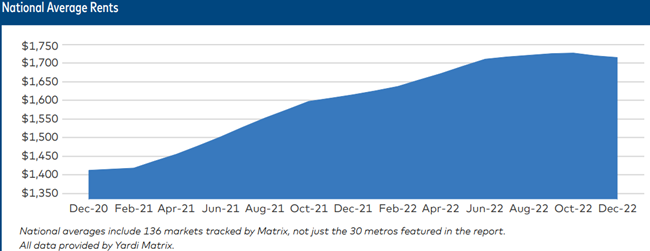
Multifamily asking rent growth recorded its second best year this century in 2022, though it finished the year on the downside due to weakening demand and robust supply growth that has occupancy rates sinking, Yardi Matrix writes in a year-end report.

“What do we expect in 2023? Despite headwinds, the market has positive drivers,” Yardi Matrix writes.

Highlights of the report:

  • Multifamily rents fell again in December under the strain of weakening demand. U.S. asking rents dropped $4 during the month to $1,715, while year-over-year growth declined by 80 basis points to 6.2 percent, the lowest level since May 2021
  • For the full year in 2022, rents increased by 6.2 percent, the second-highest annual growth this century, only behind 2021’s growth of nearly 15 percent. With the market entering 2023 with a variety of concerns about the economy and affordability, we expect rent growth in 2023 will be closer to historical levels.
  • Deceleration is also hitting the single-family rental market. The average U.S. asking rent dropped $8 in December to $2,083, while the year-over-year increase fell by 100 basis points to 4.8 percent.
Chart courtesy of Yardi Matrix

The 2023 National Market To Behave More Traditionally

“Asking rents should remain flat or fall slightly through the spring, when growth typically is strongest,” Yardi Matrix writes. “Then rents will rise moderately, though nowhere near the outsize levels of the last two years.”

The 2023 outlook however is influenced by demand and supply issues in many markets as demand for apartments is declining for several reasons:

  • The economy is cooling
  • Excess household savings are depleted
  • Affordability is stretched
  • The post-pandemic migration is played out

“Despite headwinds, there are positive forces that will keep the industry healthy in 2023,” the report says.

The story on lease renewals

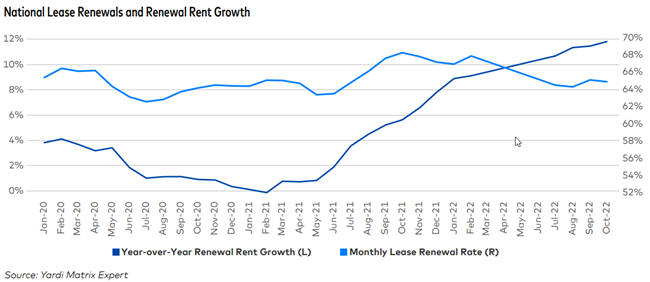
Nationally, renewal rents were still surging in the fall, rising 11.8 percent year-over-year through October, up 30 basis points from September. The growth reflects property owners continuing the process of bringing rents of existing tenants closer to asking rates.

“October’s renewal rate growth is likely at or near its apex, since asking rents have been negative since November,” the report says.

National lease renewals were 64.9 percent in October, down slightly from the prior month. Renewal rates have settled into a range near 65 percent after peaking in the fourth quarter of 2021. Lease renewal rates varied much by metro, led by Philadelphia (77.8 percent) and Baltimore (70.2 percent), while they were less than half in San Francisco (48.5 percent) and Los Angeles (49.3 percent).

Chart courtesy of Yardi Matrix

Reaction to Changing Conditions

Yardi Matrix writes that the biggest issue is how multifamily fundamentals will react to higher short-term interest rates in the post-pandemic world.

  • The multifamily market is starting the new year with rapidly evolving conditions that in some ways are unprecedented.
  • The multifamily industry reaction to the rapid increase in interest rates and resulting weakening of the job market will be closely watched.
  • 2023 could see weaker household formation and demand. Meanwhile, transaction activity will be affected by uncertainty about values.

“Multifamily performance in 2023 will be studied for many years because it is at the intersection of multiple trends involving the economy, rents, demand and the capital markets,” the report says.

Read the full report from Yardi Matrix here

About Yardi Matrix

Yardi Matrix researches and reports on multifamily, office and self-storage properties across the United States, serving the needs of a variety of industry professionals. Yardi Matrix Multifamily provides accurate data on 18+ million units, covering more than 90 percent of the U.S. population. Contact the company at (480) 663-1149.

Multifamily Rent Growth Turned Negative In November

Sign Up For Our Weekly Newsletter And Get Rental Property And Apartment News And Helpful, Useful Content Each Week.

* indicates required

Multifamily Rents ‘Hit the Brakes’ in September

Rental Price Drops Around The Country

Can I Monitor Tenant Smoking In My No-Smoking Rental?

How to keep tenant smoking out of no-smoking rentals is a constant issue for many landlords but how to monitor tenant smoking is the question

How to keep tenant smoking out of no-smoking rentals is a constant issue for many landlords. So how to monitor tenant smoking in non-smoking rentals is the question this week for Ask Landlord Hank. Remember Hank is not an attorney and is not offering legal advice. If you have a question for him please fill out his form below.

Hello Landlord Hank,

I put no smoking clauses in leases also we don’t allow burning of incense for that would qualify as smoking in our book.

Are there any devices that can be installed to detect cigarette, smoke and the like remotely.

And can they alert you if they have been tampered with?

-Trevor

Dear Landlord Trevor,

Yes, Aretas Sensor Networks has a smoke monitoring device that you can monitor wirelessly.

I don’t believe it is tamper proof though.

This could be a good option for your rentals and you could tell tenants it is a safety device, smoke detector that works remotely to help keep your property and the tenants safe.

Sincerely,

Hank Rossi
Each week I answer questions from landlords and property managers across the country in my “Dear Landlord Hank” blog in the digital magazine Rental Housing Journal.  https://rentalhousingjournal.com/asklandlordhank/

How to keep tenant smoking out of no-smoking rental units is a constant issue for many landlords. So how to monitor tenant smoking is the question
On dealing with tenant smoking Landlord Hank says, “Yes, Aretas Sensor Networks has a smoke monitoring device that you can monitor wirelessly.”

Ask Landlord Hank Your Question

Ask veteran landlord and property manager Hank Rossi your questions from tenant screening to leases to pets and more! He provides answers each week to landlords.

  • This field is for validation purposes and should be left unchanged.

Here is a recent Landlord Hank answer concerning tenant smoking in no-smoking rentals and how to prove it.

Dear Landlord Hank,

My lease specifies no smoking in the unit and even goes so far as to state that tenants may be responsible for all costs to repaint/clean if they do smoke in the unit, but I am struggling with how to enforce this clause because it’s difficult to prove.

When my latest tenants moved out I found the entire inside of the unit had a grey haze on everything (walls, ceiling, doors, and cabinets). They insist they didn’t smoke in the unit and suggested that it may have been caused by candles.

I’ve had tenants who used candles regularly before and have never seen this kind of thick haze. I’m certain they were smoking in the unit, but don’t have any evidence other than photos of how bad the haze was and my receipts for painting the walls/ceiling.

Is this sufficient if they challenge my deductions from their security deposit or is there a better way to prove this in the future?

-Gordon

Dear Landlord Gordon,

Usually, tenant smoking is easy to detect by the distinctive smell on walls, in carpeting and furniture, signs of ash or cigarette butts, and yellow or brown discoloration on walls, counters, cabinets, doors and trim.

Even with camouflage, you can usually find enough signs to prove indoor smoking.

If you want to know for sure if the haze you are finding is related to smoking, there are air-quality detection companies and devices that can confirm the presence of smoke residue from cigarettes.

You may also try a home air-quality test, but the accuracy is not as high as with a professional assessment. The Bosch Macurco D381 Air Quality Detector can detect cigarette smoke.

There are also smoke detectors available to alert you to someone smoking in your property, and a new “smoke sensor” should be coming to market this year.

Detection may be tougher to do now though since you’ve tried to erase all signs of this issue, including painting your property. Have you checked your vents and ducting for signs of smoking?

We deal with companies that have “ozone” machines that will be attached to your ducting and clean ducting and air handler as well as your unit to get rid of the smoke smell, and this is a great and cost-effective way to take care of the issue.

-Hank Rossi

Do I Have to Paint and Replace Flooring for a Long-Term Tenant?

A Tenant Poured Grease Down Drain Who Is Responsible?

Sign Up For Our Newsletter And Get Rental Housing And Apartment News And Helpful, Useful Content Each Week.

* indicates required