
Home Blog Page 165

5 Rental Housing Siding Materials And The Pros And Cons Of Each

rental housing siding

Rental housing siding is not very sexy but it is important to your tenants and your budget long-term so here are 5 siding materials and the pros and cons of each as the maintenance checkup from Keepe.

When it comes to the siding on your rental properties, many things come into play such as the look and appeal to tenants, energy efficiency and of course your budget which is most important.

Knowing about the needs of different materials can allow you to plan how to best take care of your property’s siding and make an informed decision about which kind really is best for your property, needs, expectations, tenants and budget.

Let’s look at the pros and cons of 5 common rental housing siding materials.

No. 1 – Wood shingles and clapboard rental housing siding materials

Wood shingles and clapboard are a timeless favorite because they create a naturally warm and rustic look that many people like.

What are the pros?

    • Wood siding comes in numerous varieties, which can be customized further by utilizing unique paint and/or stain colors.
    • Fairly easy and thus affordable to install – on average, it’s about $8 per square foot
    • When it is well maintained, it ages beautifully and can last for decades.
    • The Forest Stewardship Council certifies sustainable varieties to offer environmentally-friendly and repurposed options.

What are the cons?

    • Wood requires regular treatments to last. Stains, sealants and paints must be re-applied as directed by the manufacturer to avoid the extensive and costly damage that occurs when untreated wood is exposed to moisture, harsh weather, sun rays and pests. Regular maintenance itself can also be costly, and should be anticipated.
    • Wood is a uniquely attractive material for pests, which makes it fundamental to regularly check for signs of rodent or termite activity.
    • Higher grade types of wood are more durable and do not present as many imperfections, but are more expensive than low-grade wood.

No. 2 – Vinyl siding

Vinyl siding has become one of the most popular siding materials, with thousands of satisfied rental property owners and contractors raving about it.

What are the pros?

    • Budget-friendly vinyl is one of the cheapest materials to purchase and install.
    • Low-maintenance vinyl does not require special treatments and is easy to clean. Pressure washing every few years generally restores vinyl siding back to a like-new condition.
    • Long-lasting vinyl is waterproof, fade resistant and does not retain or absorb moisture.
    • Customizable vinyl is available in many different colors, textures and finishes. Some kinds are manufactured to specifically resemble wood grains.

What are the cons?

– Vinyl is water resistant, but not completely waterproof. It is of utmost importance for it to be installed correctly to avoid water permeating and reaching the property’s core structure, which can lead to internal rotting, mold growth and more serious water damage.

– Vinyl can be easily damaged, dented and scratched,  by branches. It’s important to keep this in mind and ideally trim back any vegetation.

rental housing siding vinyl options

Created by Schantalao – Freepik.com

No. 3 – Brick siding 

Like wood siding, brick siding creates a one-of-a-kind look that is preferred by lovers of Colonial and Tudor architecture. Bricks are typically made from fired clay that can be engineered to present special colors and textures.

What are the pros?

    • When correctly installed, brick siding can last a lifetime or longer.
    • Countless colors and varieties exist to realize custom looks.
    • Brick is a great insulator, and unlink wood, is fire and pest-proof.
    • It requires minimal to no maintenance; as time passes, bricks can be restored by simply scheduling a pressure-washing treatment.

What are the cons?

– Brick installation requires skill and is labor-intensive, which makes it quite expensive to install. Brick siding is one of the most expensive siding options.

– Additional work is typically required prior to installation to prep a property’s walls before brick is installed. This includes extending foundations and insulating exterior walls.

– The main issue with brick siding is that it is known to be vulnerable to water finding its way between the layer of bricks and the actual wall, which can lead to mold growths and water damage.

No. 4 – Stone and stone veneer rental housing siding materials

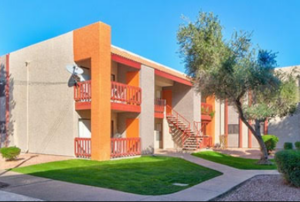
Similarly to brick siding, stone and stone veneer add a beautiful rustic finish to a property’s exterior. The naturally occurring variegations in the coloration and texture of natural stone make it a popular siding option featured as an accent. Stone veeners are made with “faux stone” and are often referred as Cast or Manufactured Stone Veneer (MSV). MSV’s are created from synthetic blends and resins.

What are the pros?

    • Stone is incredibly durable: it is not easily damaged by water, weather exposure or fire.
    • Stone is one of the most naturally abundant materials on the planet, which makes it easy to repurpose and source it sustainably.
    • Natural stone offers unique variations of color and texture that are prized by lovers of natural, beautifully rugged aesthetics.
    • Synthetic stone can resemble the look of natural stone but is considerably less pricey since it is more lightweight and easily manufactured.

What are the cons?

    • Stone is another labor-intensive material to install. It is heavy and required to comply with a state building codes. This all contributes to making stone and stone veneer installation particularly expensive.
    • While it does not require regular maintenance, stone can crack. Cracks must be repaired as soon as possible to avoid water infiltrations.
    • Rental housing siding brick options

No. 5 – Stucco rental housing siding materials

Stucco results from mixing Portland cement, limestone, sand, water and other chemical additives. Once applied, stucco creates a concrete-like layer on top of a property’s core structure.

What the pros?

    • Since stucco acts as an exterior “shell”, it has amazing insulating properties, which can help with making it so less energy is required to keep a property’s interiors hot in the winter and cool in the summer. It can also help with making a property more insulated from exterior noise.
    • Stucco can be mixed with numerous available dyes to create a variety of color options for a property’s exteriors.
    • In an emergency, stucco can act as a fire-retardant.
    • When it’s properly maintained, stucco can last a lifetime.

What are the cons?

    • Stucco is installed in layers, which is a labor-intensive process. This contributes to stucco installation being a quite expensive project.
    • It does not perform well in wet climates. Continued exposure to regular downpours and moist weather damages stucco finishes, which are water-resistant only up to a certain point. When water permeates, serious issues result from moisture infiltration into the property’s interior – from mold growth to cracking and rotting. Stucco is most popular in the Southwest – which indeed presents the ideal weather for stucco to last in.
    • Stucco is not intended to be painted over, which makes choosing a color quite a permanent decision that will be not so practical to change post-application.
    •  Stucco is prone to cracking: earthquakes and the more common shifting of the property’s structure will easily create cracks over the years. Cracks must be tended to and repaired immediately to avoid their expansion and resulting damage.

Other recent rental property maintenance Keepe posts you may have missed:

4 Outdoor Flooring Options For Your Rentals

20 Easy, Affordable Maintenance Projects To Update Your Rentals


Keepe is an on-demand maintenance solution for property managers and independent landlords. The company makes hundreds of independent contractors and handymen available for maintenance projects at rental properties. Keepe is available in the Greater Seattle area, Portland, Phoenix, San Francisco Bay and San Diego areas.

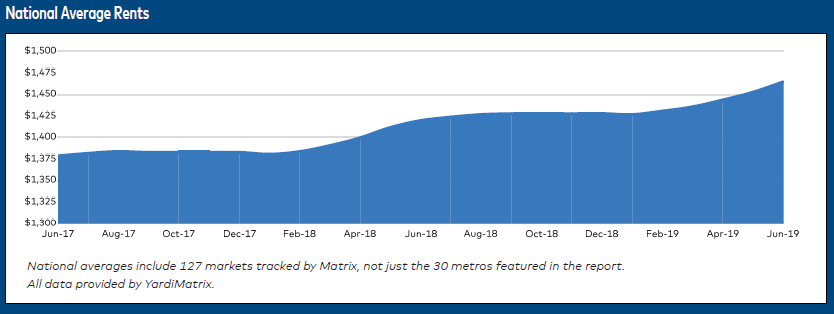
 

Multifamily Rents Stay Robust; Average Rent Rose $12 in June

Multifamily Rents Stay Robust; Average Rent Rose $12 in June

Multifamily rents rose robustly in the second quarter, and the market’s consistent growth once again shows no signs of waning, according to the June report from Yardi Matrix.

“After a $12 jump in June, average rents increased by 2.0% in the second quarter of 2019, and they are up 2.6% so far this year. Those are not the biggest percentage increases achieved in recent years, but both come close to the best performance,” the Yardi Matrix report says.

Highlights of first half of the year ending with a flourish for multifamily

  • A year of moderate multifamily rent growth turned serious in June, as the average U.S. multifamily rent increased by $12 to $1,465. Year-over-year growth increased to 3.3%, up by 40 basis points from May.
  • Average U.S. rents grew by 2.6% in the first half of 2019, and 2.0% in the second quarter. Although growth tends to slow down in the second half of most years, the multifamily market’s extended run of strong performance does not appear to be winding down soon.
  • Las Vegas (8.4% year-over-year growth) and Phoenix (8.1%) remain blazing hot, but the strong gains are not limited to any particular region. Rents in every metro on our Top 30 list increased by at least 1.3% on a trailing 12-month basis in the second quarter.

Multifamily Rents Stay Robust; Average Rent Rose $12 in June

Multifamily rents solid fundamentals continue to be favorable

“As has been the case for years, favorable funda­mentals are behind the shift. The economy has added 172,000 jobs per month this year, a slow­down from the 200,000-per-month average since the recovery began in 2010, but solid growth con­sidering the below-4.0% unemployment rate and the lateness of the economic cycle,” the report says.

“Absent an unforeseen exogenous event, demand for multifamily shows no signs of abating.

“That doesn’t address whether rent growth can remain elevated, but rents have stayed at above-trend levels during several years of robust supply in­creases and ongoing issues with affordability, so it seems foolish to discount the market’s potential to maintain its performance over the near term,” the report says.

Lifestyle rents rose faster than renter-by-necessity rents for first time in recent years

Lifestyle rents outpaced renter-by-necessity (RBN) rents in 17 of the top 30 markets, indicating healthy demand for the new luxury product being delivered in many cities, the report says.

Housing affordability has recently come into the spotlight, not just for the real estate industry but for the 2020 presidential candidates, as well. Rent-control legislation has passed in New York and Or­egon, with a number of other states also intro­ducing bills.

Many of these bills focus on rent con­trol for older stock, most of it RBN. As rent control expands, the ability to raise rents may put a ceil­ing on RBN rent growth and continue to narrow the gap between Lifestyle and RBN rent growth.

Related stories:

Portland Multifamily Rent Growth Cools
Multifamily Rent Growth Remains Consistent


Seattle Sees Six Straight Months Of Rent Increases

Seattle Sees Six Straight Months Of Rent Increases

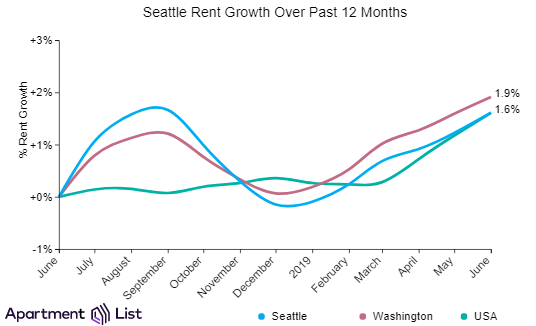
Seattle rents have increased 0.4% during June, and are up slightly by 1.6% in comparison to the same time last year, according to the most recent monthly report from Apartment List.

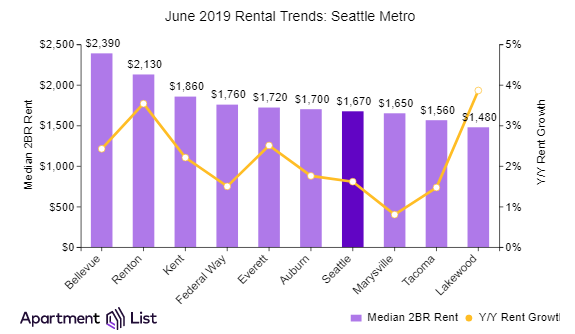
Currently, median rents in Seattle stand at $1,340 for a one-bedroom apartment and $1,670 for a two-bedroom.

This is the sixth straight month that the city has seen rent increases after a decline in December of last year.

Seattle’s year-over-year rent growth lags the state average of 1.9%, but is in line with the national average of 1.6%.

Seattle Sees Six Straight Months Of Rent Increases

Rents rising across the Seattle Metro

Throughout the past year, rent increases have been occurring not just in the city of Seattle, but across the entire metro. Of the largest 10 cities that we have data for in the Seattle metro, all of them have seen prices rise. Here’s a look at how rents compare across some of the largest cities in the metro.

  • Lakewood has the least expensive rents in the Seattle metro, with a two-bedroom median of $1,480; the city has also experienced the fastest rent growth in the metro, with a year-over-year increase of 3.9%.
  • Bellevue has the most expensive rents of the largest cities in the Seattle metro, with a two-bedroom median of $2,390; rents were up 0.6% over the past month and 2.4% over the past year.

Similar cities nationwide show more affordable rents compared to Seattle

As rents have increased slightly in Seattle, a few other large cities nationwide have also seen rents grow modestly. Compared to most similar cities across the country, Seattle is less affordable for renters.

  • Rents increased slightly in other cities across the state, with Washington as a whole logging rent growth of 1.9% over the past year. For example, rents have grown by 2.0% in Vancouver and 1.4% in Spokane.
  • Seattle’s median two-bedroom rent of $1,670 is above the national average of $1,190. Nationwide, rents have grown by 1.6% over the past year, which matches the rise in Seattle.
  • While Seattle’s rents rose slightly over the past year, many cities nationwide also saw increases, including Phoenix (+3.8%), Austin (+3.5%), and Boston (+2.5%).
  • Renters will generally find more expensive prices in Seattle than most other large cities. For example, Spokane has a median 2BR rent of $890, where Seattle is nearly twice that price.


Apartment Industry Jobs Continue Strong Growth in Second Quarter, NAA Report Says

Apartment Industry Jobs Continue Strong Growth in Second Quarter, NAA Report Says

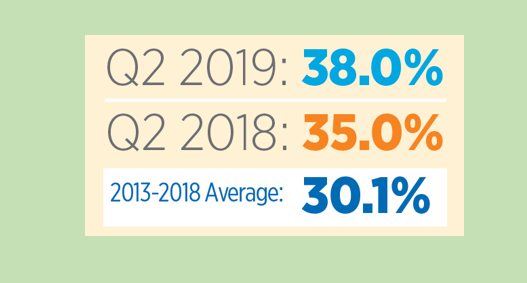
Apartment industry jobs continued strong growth in the second quarter, amounting to 38 percent of available real estate jobs in the United States, well above recent averages and an increase from 2018, according to the most recent jobs report from the National Apartment Association.

Job demand was partly due to the surge in demand for apartments during the second quarter of 2019, reaching a five-year high.

According to RealPage, net move-ins totaled 155,515 units, which outpaced the second quarter of 2018 by 11 percent, according to the NAAEI’s Apartment Jobs Snapshot.

Openings in the apartment sector comprised 38 percent of positions available in the real estate sector, well above the average of 30.1 percent.

Los Angeles, Dallas and Washington, D.C. had the highest concentration of apartment jobs during the second quarter of 2019, unchanged from last year.

Dallas performed well, leading the United States in apartment-leasing activity during the second quarter by renting more than 10,400 units, RealPage reported.

Apartment Industry Jobs Continue Strong Growth in Second Quarter, NAA Report Says

Apartment industry jobs in maintenance show strong demand

Apartment Industry Jobs Continue Strong Growth in Second Quarter, NAA Report Says

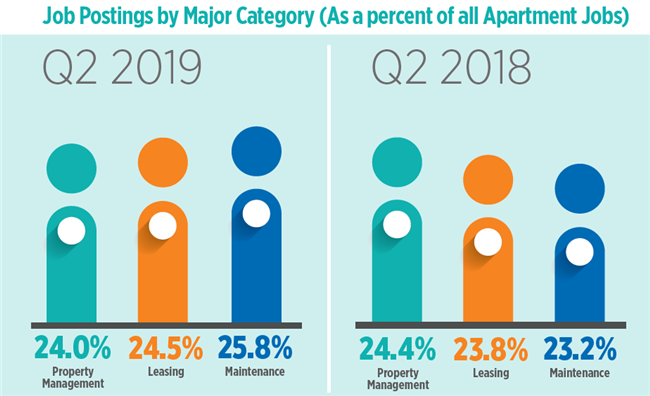
Available maintenance positions had a significant year-over-year increase, up by 2.6 percent.

Positions in maintenance were in greatest demand during the second quarter.

Maintenance technicians and maintenance supervisors landed within the top 5 job titles, comprising more than 7,500 postings combined.

Maintenance-technician and maintenance-supervisor positions experienced the highest growth in demand since 2014, increasing their share of apartment jobs by 3.5 and 1.2 percentage points, respectively.

Software skills needed

Apartment Industry Jobs Continue Strong Growth in Second Quarter, NAA Report Says

Since 2014, positions requiring skills in Yardi Software, team collaboration, and time management have notably increased.

Yardi software skills were up 7.2 percentage points. Positions requiring strong team collaboration and time management increased significantly since 2014.

National apartment association jobs report background

 The NAA jobs report focuses on jobs that are being advertised in the apartment industry as being available, according to Paula Munger, Director, Industry Research and Analysis, for the National Apartment Association’s Education Institute.

“Our education institute is a credentialing body for the apartment industry. They hear often that one of the biggest problems keeping our industry leaders up at night is the difficulty in finding talent, attracting talent and retaining talent,” Munger said.  “Labor-market issues are happening in a lot of industries, certainly with the tight labor market we have.”

NAA partnered with Burning Glass Technologies. “They have a labor-job posting database that is proprietary,” she said, and they can “layer on data from the Bureau of Labor Statistics (BLS). We looked at that and thought we could do something that is really going to help the industry and help benchmark job titles and trends as we go forward,” Munger said.

Last month’s report:

Portland has Highest Number of Apartment Job Openings in the Country

5 Tips for Fixing Tenant Drain Clogs

5 Tips for Fixing Tenant Drain Clogs

Fixing tenant drain clogs was one of the most popular maintenance jobs this week performed by Keepe, so here are some tips to help.

 Recently, Keepe has been getting many jobs for clogged drains; these situations are never ideal for anyone.

Your tenants are trying to take a shower and the water keeps coming up on their feet (or even higher). If you are dealing with a lot of standing water, the drain is probably clogged and fixing tenant drain clogs is something you should address as soon as possible.

Standing water for long periods of time can lead to more problems for you. Depending on the severity of your drain’s clog, you might be dealing with standing water sitting in your tub for hours or even days.

Insects tend to breed in standing water; mainly mosquitoes, flies, and dragonflies, and they’ll be a nuisance if allowed to reach adult form and continue to breed. These insects can also carry diseases that can harm your family or your pets. Standing water also causes mold and mildew to form; this is a breathing hazard for anyone in the home.

To get rid of nasty clogs, try using baking soda and vinegar. Mix 1/3 of a cup of baking soda with 1/3 of a cup of vinegar in a measuring cup. It will fizz immediately; pour it down the clogged drain right away. The fizzing action will help to remove the gunk, hair, and grime that has built up in the pipe. Let it sit for an hour, or even overnight if you can. Flush with hot water to melt whatever is clogging your drain away.

 5 drain tips to help with fixing tenant drain clogs

  • Use a drain claw to help grab hair or anything else that may be blocking the drain.
  • Pour dishwashing liquid and hot water down to clean drains.
  • Invest in a drain wig to help prevent hair clogs.
  • Use granular drain and trap cleaner to help prevent food or grease-based clogs.
  • To help prevent future clogs, regularly fill the tub or sink with hot water and let it drain. This helps flush away small levels of debris before they can become a bigger problem.

 Odd Job of the Week

This week, Keepe got a job request in the greater Seattle area for a kitchen sink in which the water would only come out scalding hot. When the issue was reported, the property manager stated that, “When you turn all the way to cold you only get a trickle of cold water. You can’t even get warm water, it’s always super hot.” The issue had been going on for a few months.

5 Tips for Fixing Tenant Drain Clogs
The faucet valve was malfunctioning and killing the pressure on cold side, stopping the flow of cold water and only letting the hot water in.

When our worker came in, they were able to assess the situation and find that the faucet valve was malfunctioning and killing the pressure on cold side, stopping the flow of cold water and only letting the hot water through. After the source of the issue was found, the faucet was replaced and is now working great!

Here are other recent rental property maintenance Keepe posts you may have missed:

 How To Pick The Perfect Exterior Paint Color For Your Rental Property

4 Outdoor Flooring Options For Your Rentals

20 Easy, Affordable Maintenance Projects To Update Your Rentals

7 Tech Gadgets For A Safer And More Efficient Rental Property

5 Maintenance Tips For Long-Lasting Rental Carpet Flooring

Is The Water Heater At Your Rental Property Ready For The Big One?

7 Types Of Kitchen Countertops For Your Apartments

Which Cooktop Is Best For Your Rental Property?

A Guide To 4 Types Of Flat Roof Systems

6 Ways To Trash Your Apartment Waste Management Issues

Top 5 Apartment Maintenance Emergencies vs. Maintenance Requests

5 Tips for Preparing Your Apartments for the Summer Season

4 Air Conditioning Maintenance Best Practices For Summer

About Keepe:

Keepe is an on-demand maintenance solution for property managers and independent landlords. We make hundreds of independent contractors and handymen available for maintenance projects at rental properties. Keepe is available in the Greater Seattle area, Greater Phoenix area, San Francisco Bay area, and Portland area, and we are continuing to expand. Learn more at http://www.keepe.com

561-Unit Phoenix Apartment Complexes Sell For $56.7 Million

561-Unit Phoenix Apartment Complexes Sell For $56.7 Million

Phoenix apartment complexes Solano Ridge I and Solano Ridge II Apartments, a 561-unit multifamily housing community located near 35th Avenue and Northern, have sold for a combined price of $56.7 million, according to a release.

The complex was purchased in December 2016 by 3rd Ave Investments of Phoenix for $35.95 million. Over the last 30 months, 3rd Ave Investments invested $2.5 million into the property to upgrade the apartments, clubhouse and common areas.

The NorthMarq Phoenix team of Trevor Koskovich, Bill Hahn, and Jesse Hudson represented both the seller and the buyer, Intercapital Partners of Chicago, in this transaction.

Phoenix apartment complexes unique multifamily investment

“Solano Ridge was a unique investment for the buyers to acquire two properties and significant economies of scale,” Koskovich said in a release. “The seller deployed capital into the common areas and amenities, but left upside for new investors via interior renovations and in-unit washer/dryer installation.”

Built in 1982, the apartment communities feature studio, one- and two-bedroom apartments, along with three swimming pools, a dog park and upgraded outdoor living spaces. Solano Ridge is in close proximity to major employment hubs, retail centers, and universities.

561-Unit Phoenix Apartment Complexes Sell For $56.7 Million
The apartment communities feature studio, one- and two-bedroom apartments, along with three swimming pools, a dog park and upgraded outdoor living spaces.

About NorthMarg

As a capital markets leader, NorthMarq offers commercial real estate investors access to experts in debt, equity, investment sales, and loan servicing to protect and add value to their assets. For capital sources, we offer partnership and financial acumen that support long- and short-term investment goals. Our culture of integrity and innovation is evident in our 60-year history, annual transaction volume of $13 billion, loan servicing portfolio of more than $57 billion and the multi-year tenure of our more than 500 people.

 About 3rd Ave Investments
3rd Ave Investments is a real estate investment and management firm specializing in the acquisition and re-positioning of Arizona multifamily assets through a value-add private equity fund structure. Founded in 2015 by Zev Hendeles, 3rd Ave Investments has acquired more than 3,050 apartments with an aggregate market value of more than $320 million.

3rd Ave Investments targets poorly managed, undervalued and off-market investments, where opportunities exist to create value with an active management approach. 3rd Ave Investments is directly involved in all aspects of the acquisition, re-positioning and/or redevelopment process.


Portland Rents Declined in June for Third Straight Month

Portland Rents Declined in June for Third Straight Month

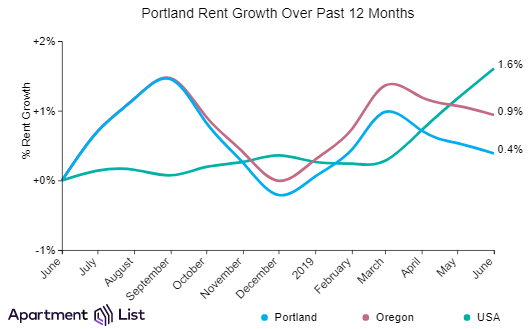
Portland rents have declined 0.1% during June, but have remained steady at 0.4% in comparison to the same time last year, according to the latest report from Apartment List.

Currently, median rents in Portland stand at $1,120 for a one-bedroom apartment and $1,330 for a two-bedroom.

This is the third straight month that the city has seen rent decreases after an increase in March.

Portland’s year-over-year rent growth lags the state average of 0.9%, as well as the national average of 1.6%.

Portland Rents Declined in June for Third Straight Month

Rents rising across cities in Oregon

Throughout the past year, rents have remained steady in the city of Portland, but other cities across the state have seen rents increase.

Of the largest 10 cities that Apartment List has data for in Oregon, 9 of them have seen prices rise. The state as a whole logged rent growth of 0.9% over the past year.

Here’s a look at how rents compare across some of the largest cities in the state.

  • Hillsboro is the most expensive of all Oregon’s major cities, with a median two-bedroom rent of $2,090; Medford, where a two-bedroom goes for $990, is the only major city to see rents fall year-over-year (-0.3%).
  • Hillsboro, Beaverton, and Vancouver all have experienced year-over-year growth above the state average (4.2%, 3.3%, and 2.0%, respectively).

Portland Rents Declined in June for Third Straight Month

Portland Rents Declined in June for Third Straight Month

Portland rents in June more affordable than many comparable cities nationwide

Rent growth in Portland has been relatively stable over the past year; there are other large cities that have seen more substantial increases. Portland is still more affordable than most other large cities across the country.

Portland’s median two-bedroom rent of $1,330 is above the national average of $1,190. Nationwide, rents have grown by 1.6% over the past year compared to the stagnant growth in Portland.

While rents in Portland remained moderately stable this year, similar cities saw increases, including Las Vegas (+3.9%), Phoenix (+3.8%), and Austin (+3.5%); note that median 2BR rents in these cities go for $1,180, $1,080, and $1,450 respectively.

Portland Rents Declined in June for Third Straight Month

Last month: Portland Rents Declined Moderately Over the Past Month

Rental Housing Requests For Assistance Animal Accommodation Shows About 40% Approval

Rental Housing Requests For Assistance Animal Accommodation Shows About 40% Approval

A new study of 8,600 assistance animal accommodation requests for rental housing shows that 39 percent of requests were recommended for approval, 43 percent did not continue with the review and 18 percent did not provide sufficient documentation, were unresponsive or were possible fraud.

The study, done by PetScreening.com, of 8,600 reasonable accommodation requests submitted to the company by prospective residents, also known as requesters, found that the pit bull variety is the dog breed most commonly submitted for reasonable accommodation requests.

The results of the study highlight the importance of properly confirming the reliability and credibility of third-party verifier documentation for reasonable accommodation requests, according to John R. Bradford, III, CEO and founder of PetScreening.com, which is based in Charlotte, N.C., and operates in all 50 states and Canada.

Reasonable assistance animal accommodation

“For individuals who do not have a readily apparent disability, requiring and reviewing third-party verifier documentation to support the requester’s reasonable accommodation request is critical. This maintains the integrity of necessary and legitimate assistance animals for individuals with a disability and disability-related need for the animals,” Bradford said in a release.

“Unfortunately, there are bad actors that are abusing this process to possibly avoid pet rent or circumvent pet policies, such as breed restrictions. There are many individuals with legitimate disabilities and disability-related needs for assistance animals, who shouldn’t be put at risk or receive a negative reputation just because of these bad actors.”

The pet-screening platform empowers property managers to outsource their pet-risk assessment and assistance animal-validation processes at no charge.

According to the release, property managers are often hesitant to ask for third-party verifier documentation for fear of violating Fair Housing laws and HUD guidelines, making it difficult to uphold the integrity of the accommodation-request review process. But new technology and databases, like PetScreening.com, help address these concerns by using electronic accommodation-request review processes and an in-house legal-review team. They review each reasonable accommodation request, adhere to the FHAct guidelines, and validate the third-party verifier documentation as being reliable, credible and meeting the test of reasonableness.

This standardizes the property manager’s reasonable-accommodation-request review process, saves time and helps mitigate liability for a possible discrimination complaint. Submitting a reasonable accommodation request for an assistance animal through the PetScreening platform is free to both the requester and the property manager, according to the release.

There is a cost for screening regular household pets who are not assistance animals. Applicants with a regular pet pay a $20 fee at the time they apply for a rental home and enter information about their specific pet, including their general care and understanding of pet policies, into the only centralized pet-screening database to analyze rental-housing-related risk. The platform reviews various pet-related factors, including community-specific restrictions, such as breed, weight and age, and then creates a “FIDO Score.” This proprietary scoring system can be used to generate new pet-related revenue opportunities such as additional pet rents, non-refundable fees, and deposits – with the primary purpose being to help cover any additional risk the housing provider is taking with the pet and its owner.

Property managers can also require non-pet owners, at no charge, to formally acknowledge pet-related policies that apply to them at the time of application. Through Petscreening.com, non-pet owners agree to policies that, among other examples, prohibit them from using their homes for pet-sitting services and require them to properly report any pet or animal they acquire during their lease term. PetScreening also provides property managers with the ability to record and report noteworthy pet and animal incidents. Examples include bites, property damage, unauthorized pets, pet-waste offenders and more. These incident reports are shown in the digital profiles and follow the pet and pet owner to future rentals – ensuring that future property managers and owners are aware of previous concerning behavior.

About PetScreening.com
PetScreening.com helps property managers and housing providers manage their housing-related pet risk and validate assistance animals for free while generating more opportunities for pet-related revenue. The proprietary screening platform adds an additional layer of liability protection by having a standardized process when dealing with household pets and assistance animals. It also helps with assistance-animal accommodation-request validation through a comprehensive legal and FHAct/HUD guideline review process. The end result is a Pet Profile with FIDO Score based on pet specific information such as breed, pictures, weight, vaccination records, and behavior.

The Pros And Cons Of Having A Pet Friendly Apartment Or Rental Property

Rental Housing Requests For Assistance Animal Accommodation Shows About 40% Approval
Photo credit Cylonphoto via istockphoto.com

How Does Rent Control Affect the Value of Multifamily Property?

How Does Rent Control Affect the Value of Multifamily Property?

By Gabe Johansen
SMI Commercial Real Estate

Over the last few months, you have undoubtedly read numerous articles about rent control.

With the passage of SB 608, Oregon has become the first state in the nation to introduce a form of statewide rent control, passed under the guise of rent “stabilization.”  While the new changes for landlords are many, there is one question on a lot of minds that has not been answered:

 How does rent control affect the value of multifamily property?

The answer to this question is multifaceted.

There are many factors that weigh on the value of real estate, especially when considering the income-generating nature of multifamily real estate.  With rent control now in place for 2019, rent increases can no longer exceed 7% plus the West Region Consumer Pricing Index (currently 3.1%).  For the average property owner, this is not an onerous restriction.

In most cases, managers do not increase rents by more than 10% in any given year because landlords prefer to keep their current tenancy in place and avoid costly turnover expense and vacancy loss.  But what happens if one decides to sell or refinance their property?

Let’s take a look at 3 factors that affect the value of rental property

1. Income Approach

Prior to the passage of SB 608 in February 2019, the common practice of listing brokers was to price properties based on pro forma rents.

In a seller’s market when rents are on the rise, buyers are lined up and willing to pay top dollar for an income stream that does not yet fully exist.  It is then the job of the buyer to increase rents as quickly as possible in order to make their investment cash flow.  If a property’s rent roll is already near market levels, the value of the property can be based on current income.

However, if there are tenants currently paying below-market rents, the new rent-control laws are going to make repositioning the asset a much longer process.  This is already having a negative effect on the values of underperforming properties.  Sophisticated buyers are not willing to underwrite the value of a property based on rents that will not be achieved within the first year or two of ownership.

Since the passage of statewide rent control in Oregon, multifamily brokers have begun to take a new approach to pricing.

Brokers are now arriving at listing prices based on the income that a property will produce after its initial round of rent increases, within the guidelines of SB 608.  This means that if a property’s rent roll is trailing the market by more than 10%, it will be difficult to maximize its appraised value in the event of a sale or refinance, thus bringing the market value of the property down.

How Does Rent Control Affect the Value of Multifamily Property?

2. Supply and Demand

While the legislature is currently working on ways to increase the supply of housing, historical data shows that rent control slows development, creating a greater shortage.

If this holds true for Oregon, we will see a decline in the number of multifamily units being developed and a further increase in demand.  For investors, this is good news in regards to the value of their multifamily holdings because it limits competition from new properties that are coming online.

An artificially low inventory will drive rents higher and thus continue to push the value of multifamily properties to greater heights.  As long as the demand from renters remains, multifamily property will appreciate as a result of higher yields – albeit at the cost of Oregon families, many of whom are already struggling to make ends meet.

3. The Market

Supply and demand will drive the market to value property based on scarcity.

In the second quarter of 2019, Oregon saw a 38% decline in multifamily transactions and out-of-state investment dropped to nearly zero.  Much of this could be due to the pipeline shadow of 2019’s first quarter, which had many investors scared to make a move, not knowing what the new rent-control laws might look like.  This may be a boon for local buyers because it will reduce acquisition competition, but the value of multifamily property could decline due to a decrease in overall buyer demand.

Now that the dust has settled on Oregon rent control, investors are coming back to the market.

So how does rent control affect the value of multifamily property?

Some owners have decided to sell because they no longer wish to deal with the tightening landlord-tenant laws; other owners have decided it is a good time to reposition their portfolios and are now more aggressively pursuing 1031 tax-deferred exchanges.  Listings are going live at a pace we have not seen for some time, which creates a different form of competition and can place downward pressure on prices.  With more sellers and less buyers, we are beginning to see equilibrium in the marketplace, and while property values will continue to improve over time due to supply and demand, the days of explosive growth are probably over for now.

About the author:

Gabe Johansen is the Willamette Valley’s #1 apartment broker and the principal broker and owner of SMI Commercial Real Estate, LLC.

How Does Rent Control Affect the Value of Multifamily Property?


Assistance Animals Are Not Pets, Repeat, Assistance Animals Are Not Pets

“I didn’t know” is not an acceptable defense if you face a discrimination charge, so the Grace Hill training tip of the week focuses on repeating advice that assistance animals are not pets when it comes to leasing your rentals.

By Ellen Clark

The typical story goes like this, where a prospective renter provides documentation from her doctor showing she needs an assistance animal because of her disability and she is told by a leasing agent that the owner does not allow pets.

One of the most common accommodation requests is to have an animal that would otherwise be restricted by a community’s rules.

In these cases, it is important to understand that service and assistance animals are not pets. Rather, they provide an important service to people with disabilities. You must know how to handle these accommodation requests in compliance with the law.

So in the example above, HUD recently announced a conciliation agreement between two Nevada real estate companies and a prospective resident to resolve a claim that the companies denied the prospective resident’s request to have an assistance animal live with her in her apartment home. Read the agreement here.

After the prospective tenant was told the owner did not allow pets because hardwood floors had recently been installed, at that point, the prospective resident did not continue trying to lease the apartment.

Apartments must pay $6,000 under the agreement involving assistance animal

Under the agreement, the two companies must pay the prospective resident $6,000, take fair housing training and adopt policies that handle reasonable accommodation requests on a timely way and maintain records related to the accommodation requests.

Remember, to remove barriers that people with disabilities often face when searching for and living in rental homes, it may be necessary to make changes to community rules, policies, procedures, or services.

These kinds of changes are called reasonable accommodations. If the requests are reasonable and would not cause undue hardship to your community’s business operations, fair housing laws require you to make accommodations for people with disabilities.

Here are some important points to remember about assistance animals

    • Stay up to date on the guidelines for reviewing assistance animal accommodation requests.Under the FHA and Section 504, individuals with a disability may be entitled to an assistance animal as a reasonable accommodation in housing that otherwise restricts or prohibits animals. Assistance animals include service, companion, and emotional support animals. Assistance animals may be any type of animal, and no training is required.
    • There are strict guidelines for what you may ask a person requesting a reasonable accommodation. Not following them puts you at risk of committing disability discrimination.
    • Never ask for specifics about a person’s disability. All that’s required is reliable documentation of a disability and that the animal provides disability-related assistance or emotional support.
    • If you doubt the credibility of documentation related to an accommodation request, you can ask for more information. Be sure to proceed carefully and consult your legal counsel.

If you have doubts about how to proceed with any request related to assistance animals, reach out to your supervisor or legal counsel for help.  Not doing so may cost you and your company dearly.

Resources:

Recent Grace Hill training tips you may have missed:

7 Ways To Stay Out Of Trouble When Checking Criminal History

5 Ways To Protect Applicants, Residents And Employees From Sexual Harassment

Do You Have A Smoke-Free Policy That Adequately Protects Residents?

How To Handle Suspicious Documentation For Assistance Animals

How A No Pet Policy Can Be Discriminatory

Property Management Cyberattack Risks Overlooked, Underestimated

Do You Know How To Respond To a Sexual Harassment Complaint?

Have You Reviewed Your Criminal Background Checks Policy Lately?

Multifamily Managers And Marijuana: Caught In A Pot Crossfire

Fair Housing Discrimination Against Someone You’ve Never Talked To?

4 Ways To Avoid Screening Pitfalls With Applicants

About the author:

Ellen Clark is the Director of Assessment at Grace Hill.  Her work has spanned the entire learner lifecycle, from elementary school through professional education. She spent over 10 years working with K12 Inc.’s network of online charter schools – measuring learning, developing learning improvement plans using evidence-based strategies, and conducting learning studies. Later, at Kaplan Inc., she worked in the vocational education and job training divisions, improving online, blended and face-to-face training programs, and working directly with business leadership and trainers to improve learner outcomes and job performance. Ellen lives and works in Maryland, where she was born and raised.

About Grace Hill

For nearly two decades, Grace Hill has been developing best-in-class online training courseware and administration solely for the Property Management Industry, designed to help people, teams and companies improve performance and reduce risk.


Assistance animals are not pets

An assistance dog is shown during a performance before given to an individual with a disability. The animal is trained by an assistance dog organization with the help of a professional trainer. Photo credit Cylonphoto via istockphoto.com


Sign Up For Our Newsletter And Get Apartment News And Helpful, Useful Content Each Week.

* indicates required