
Home Blog Page 166

Blind Replacement and Repair For Your Rental Property

Blind Replacement and Repair For Your Rental Property

Maintenance folks have seen a lot of window-blinds replacement and repair calls lately, so here are 6 tips to help with blind replacement and repair for your rental property from Keepe.

Blind replacement and repair for your rental property

Blinds are popular. And whether your blinds are new or old, broken blinds seem to be an ongoing issue for many rental property owners.

If you were ever wondering why mini-blinds break so frequently, here’s your answer: Basically, the holes in the top of each vane – which are also called slats – are squarely “hole-punched” and, unfortunately, aren’t as reinforced as they should be.

Sometimes kids rip them out or pets pull them down, but one of the primary reasons blinds break is because people are lazy.

Blind Replacement and Repair For Your Rental Property
Using blinds correctly can save maintenance time and expense.

Using blinds correctly can seem like a hassle. You have to take the time to turn the wand, open the slats, and then pull the string slowly. Not using the wand and rushing the process causes a bunch of tension on each vane, causing it eventually to crack and snap off. Happily, there are some easy fixes to minimize this from happening…

 Blind replacement and repair for your rental property tips!

  • Invest in some “vane savers” as reinforcements or as a way to fix broken vanes;
  • You may also use paperclips instead of “vane savers,” by taping one over the end of each vane where a piece has broken off;
  • Let the cords hang freely, this can help the cords last longer;
  • Clean blinds by vacuuming them regularly with a brush attachment on low suction, brushing across the slats for venetian and pleated blinds and down the fabric or slats for vertical and roller blinds;
  • Spot-clean any stubborn stains by blotting with a mild detergent solution or alcohol-free wipe (but never spray cleaner directly onto fabric);
  • To prevent vanes from getting out of sync, always tilt the vanes open fully before drawing the blinds open or closed.

 The maintenance odd job of the week

Blind Replacement and Repair For Your Rental Property and the odd maintenance job of the week.
The sink faucet began spraying water in all directions!

This week, we got a job request in the greater Seattle area to repair a sink faucet that “began spraying in different directions.” We checked it out and realized it was the aerator, which was fixed in no time. Aerators are often found at the end of the faucet. Essentially, the aerator pushes a mixture of air and water through the end of the faucet. They are used to prevent splashing, conserve energy and increase water pressure.

Here are other recent rental property maintenance Keepe posts you may have missed:

 How To Pick The Perfect Exterior Paint Color For Your Rental Property

4 Outdoor Flooring Options For Your Rentals

20 Easy, Affordable Maintenance Projects To Update Your Rentals

7 Tech Gadgets For A Safer And More Efficient Rental Property

5 Maintenance Tips For Long-Lasting Rental Carpet Flooring

Is The Water Heater At Your Rental Property Ready For The Big One?

7 Types Of Kitchen Countertops For Your Apartments

Which Cooktop Is Best For Your Rental Property?

A Guide To 4 Types Of Flat Roof Systems

6 Ways To Trash Your Apartment Waste Management Issues

Top 5 Apartment Maintenance Emergencies vs. Maintenance Requests

5 Tips for Preparing Your Apartments for the Summer Season

4 Air Conditioning Maintenance Best Practices For Summer


About Keepe:

Keepe is an on-demand maintenance solution for property managers and independent landlords, making hundreds of independent contractors and handymen/women available for maintenance projects at rental properties. Keepe is available in the Greater Seattle area, Greater Phoenix area, San Francisco Bay area, and Portland area, and is still expanding. Learn more at http://www.keepe.com

Surging Demand for Apartments in Second Quarter of 2019

Surging Demand for Apartments in Second Quarter of 2019

The surging demand for apartments in the second quarter of 2019 saw occupancy climbing to 95.8 percent and new lease rents up three percent annually, according to a release from RealPage, Inc.

Net move-ins totaling 155,515 units in the April-through-June time frame topped second quarter 2018 product absorption by 11 percent, climbing to a five-year high, the report said.

“Apartment leasing activity accelerates during the warmer weather months, and demand is proving especially strong in this year’s primary leasing season,” said RealPage chief economist Greg Willett said in the release.

“Solid economic growth is encouraging new household formation, and rentals are capturing a sizable share of the resulting housing demand,” he said. “At the same time, loss of existing renters to home purchase remains limited relative to historical levels.”

Surging Demand for Apartments in Second Quarter of 2019

Surging Demand for Apartments in Second Quarter of 2019
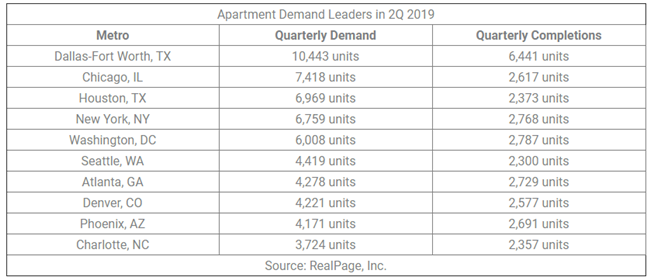
The fast-growing Dallas-Fort Worth area led the nation in apartment-leasing activity during the second quarter, as renters snapped up 10,443 units. Net move-ins also reached robust levels of more than 6,000 units in Chicago, Houston, New York and Washington, D.C.

With demand proving so strong in the second quarter, occupancy tightened despite the delivery of quite a bit of new product. Occupancy climbed to 95.8 percent in second quarter, up from 95.4 percent a year earlier.

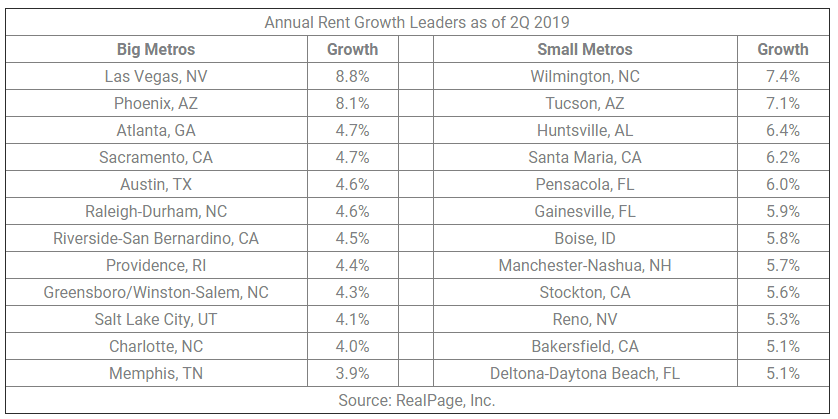
Rents Rise with Phoenix and Las Vegas leading

Rents for new leases increased 1.8 percent during the second quarter, which normally is when pricing moves most rapidly during the course of the year. Rents are up 3 percent from year-ago levels, reaching an average of $1,390 per month.

Among the country’s large metros, local rent-growth leaders are Las Vegas and Phoenix, with each area posting annual price jumps of more than 8 percent. At the next tier of performance, rent growth comes in at roughly 4 percent to 5 percent in a long list of markets: Atlanta, Sacramento, Austin, Raleigh-Durham, Riverside-San Bernardino, Providence, Greensboro/Winston-Salem, Salt Lake City, Charlotte and Memphis.

Surging Demand for Apartments in Second Quarter of 2019
Houston’s performance is the weakest among big metros, with rents in the second quarter up just 0.1 percent from the pricing seen a year earlier. Slight rent cuts are occurring in a few small markets: Des Moines, Iowa; Fargo, N.D.; College Station, Texas; Baton Rouge, La.; and Santa Rosa, Calif.

Building in the U.S. apartment sector remains at three-decade highs. Market-rate apartment properties under construction contain more than 418,000 units that will be finished during roughly the next 18 months.

Dallas-Fort Worth remains the country’s leader in apartment construction activity. More than 34,000 apartments are on the way in North Texas, compared to about 20,000 units in Washington, D.C., the second-busiest metro for building. Near-term deliveries will run around 18,000 units in Los Angeles and Houston.

“While the apartment sector’s performance has been terrific of late, the amount of product under construction does point to some near-term risk,” Willett said in the release.

“Most economists are anticipating a slowdown in economic growth, cooling support for housing demand. It would be tough to maintain price growth with so many new properties moving through initial lease-up at a time when demand has weakened.”

About RealPage

RealPage is a leading global provider of software and data analytics to the real estate industry. Clients use its platform to improve operating performance and increase capital returns. Founded in 1998 and headquartered in Richardson, Texas, RealPage serves more than 12,100 clients worldwide from offices in North America, Europe and Asia. For more information, visit http://www.realpage.com.

https://www.businesswire.com/news/home/20190701005020/en

6 Ways to Make Your Rental Property Kitchens Feel Bigger

6 Ways to Make Your Rental Property Kitchens Feel Bigger

Keeping tenants happy with a nice kitchen is important to rental property owners, so the maintenance tip from Keepe is about 6 ways to make your rental property kitchens feel bigger.

Rental-property kitchens can be small, and tend to feel cramped.

Luckily, there are ways to make your kitchen feel bigger without physically expanding the space!

Small fixes like a paint change or adding additional lighting can make a huge difference in the way your kitchen looks and feels.

Here are 6 ways to make your rental property kitchens feel bigger:

No. 1 – White paint

White paint reflects light, which makes a room feel bigger and brighter. Try matching the countertops (and table, if appropriate) with a similar light color. It also helps to repaint bulky items to match the walls, which will camouflage them. If the room stays within a relatively similar color scheme, it creates an illusion of infinite space because the eye doesn’t have to jump from light to dark so often.

6 Ways to Make Your Rental Property Kitchens Feel Bigger
White paint it creates an illusion of infinite space in the kitchen because the eye doesn’t have to jump from light to dark so often.

No. 2 – Patterned floors

Horizontal lines make your eyes move from one side to the other, creating the illusion of a wider and more open space. Hardwood floors are an option for this. Try aligning the panels horizontally when looking from the entrance of the room. Any other floor style with a similar pattern could have the same widening effect.

No. 3 – Lighting

A dimly lit kitchen can make it feel small and gloomy, while a brightly lit one feels open and welcoming. Try to encourage sunlight to enter the room if you can. Think about replacing any curtains with sheer curtains, or maybe removing them altogether. Pendant lights can be used as a source of lighting and a beautiful focal point for the room. Lights above, below and even inside the cupboards can help create the illusion of a bigger room by highlighting a once-dim area.

No. 4 – Shiny appliances

By switching appliances for newer, shiny ones, the light reflects off of the appliances, furthering the illusion of an “infinite” space. The brighter appliances also highlight the feeling of having a fully upgraded kitchen. Maybe this is one reason why stainless steel has never gone out of style!

No. 5 – Lightweight furnishing

Furnishings are always a focal point when it comes to kitchens. When looking to create the illusion of a bigger space, slim and lightweight furnishings are the way to go. Lightweight furnishings give the room a more airy feeling and also helps with the actual physical space of the room. Some options for this include kitchen stools, narrow chairs or slim tables/counter tops.

it creates an illusion of infinite space because the eye doesn’t have to jump from light to dark so often.
Lightweight furnishings like stools give the kitchen a more airy feeling and also helps with the actual physical space of the room.

No. 6 – Organization

As with any room, organization is key. In a smaller kitchen, storage and floor space can be scarce. Taking advantage of vertical wall space can help with removing clutter from countertops. Hanging shelves help with storage and add a sophisticated look to any kitchen. Think about adding magnetic holders for kitchen utensils, like knives, or pegboards for hanging pots and pans.

Here are other recent rental property maintenance Keepe posts you may have missed:

 How To Pick The Perfect Exterior Paint Color For Your Rental Property

4 Outdoor Flooring Options For Your Rentals

20 Easy, Affordable Maintenance Projects To Update Your Rentals

7 Tech Gadgets For A Safer And More Efficient Rental Property

5 Maintenance Tips For Long-Lasting Rental Carpet Flooring

Is The Water Heater At Your Rental Property Ready For The Big One?

7 Types Of Kitchen Countertops For Your Apartments

Which Cooktop Is Best For Your Rental Property?

A Guide To 4 Types Of Flat Roof Systems

6 Ways To Trash Your Apartment Waste Management Issues

Top 5 Apartment Maintenance Emergencies vs. Maintenance Requests

5 Tips for Preparing Your Apartments for the Summer Season

4 Air Conditioning Maintenance Best Practices For Summer

About Keepe:

Keepe is an on-demand maintenance solution for property managers and independent landlords. The company makes a network of hundreds of independent contractors and handymen available for maintenance projects at rental properties. Keepe is available in the Greater Seattle area, Greater Phoenix area, San Francisco Bay area, Portland, San Diego and is coming soon to an area near you. Learn more about Keepe at https://www.keepe.com


A Client’s First Experience with DSTs

Kay Properties and 1031 and 1033 exchanges and eminent domain options details

Sponsored Blog

Case Study: A Client’s First Experience with DSTs
By Betty Friant, Senior Vice President, Kay Properties & Investments, LLC

The client has invested in real estate since 1987. After experiencing difficulties in renting an industrial property she owned for the past 13 years, it was time to sell. Having sold many properties in the past, the concept of doing a 1031 exchange was all too familiar to her. She questioned whether or not to do it this time.

In consulting her financial advisor and CPA, she was informed of the tax consequences in selling this property. In hearing this information, she inquired into the best course of action for her tax situation. The advice was based on a simple question, “Do you want another rental property”? Emotionally, the client was tired of the responsibilities associated in being a landlord, in addition to everything involved in purchasing another rental. Logically, however, it was concluded that the best course of action was to purchase a replacement property and defer the taxes.

The search began for a replacement property, with the industrial unit settlement coming in 60 days. Within a few days, she was tired of looking through 100’s of listings provided by residential realtors and commercial properties, that did not meet the financial criteria. Despite these challenges, the search continued until she reached a point of frustration and considered paying the tax, rather than deal with this long process. Why invest in another property, doing the same things she has already been doing such as rent collections, paying bills, and solving all sorts of problems? She called her commercial broker to discuss the situation, who said the DST’s sound like the perfect solution for her situation.

The client was then introduced by the commercial broker to Kay Properties and Investments, LLC. She was hesitant at first, not knowing how DST’s (Delaware Statutory Trust) work. Taking it upon herself to read all of the educational material and asking many questions, the client studied DST’s prior to the settlement for her warehouse.

Client spent six weeks prior to her warehouse settlement, immersed in numerous PPM’s and in study mode with Kay Properties. In the end, the client was grateful to Kay Properties for helping her to avoid a huge tax consequence and educating her through various channels.

The client was able to successfully complete her 1031 exchange into a diversified portfolio of DSTs consisting of Class A apartments, Class B apartments, and also single tenant net lease industrial. The process from the close of the warehouse to the selected DST’s took place within a week! She was delighted to start receiving income from her DST investment because for the two and a half years prior, her relinquished property had been vacant and not producing income. She now enjoys sharing her new acquired knowledge with other investors, who are tired of property management, but still love the passive income real estate offers.

This is an example of the experience of one of our clients and may not be representative of the experience of other clients. Past performance does not guarantee or indicate the likelihood of future results. Diversification does not guarantee profits or protect against losses.

A Client’s First Experience with DSTs

About Kay Properties and Investments, LLC:

Kay Properties and Investments, LLC is a national Delaware Statutory Trust (DST) investment firm with offices in Los Angeles, San Diego, San Francisco, Seattle, New York City and Washington DC. Kay Properties team members collectively have over 114 years of real estate experience, are licensed in all 50 states, and have participated in over $7 Billion of DST real estate. Our clients have the ability to participate in private, exclusively available, DST properties as well as those presented to the wider DST marketplace; with the exception of those that fail our due-diligence process. To learn more about Kay Properties please visit: www.kpi1031.com

This material does not constitute an offer to sell nor a solicitation of an offer to buy any security. Such offers can be made only by the confidential Private Placement Memorandum (the “Memorandum”). Please read the entire Memorandum paying special attention to the risk section prior investing. This email contains information that has been obtained from sources believed to be reliable. However, Kay Properties and Investments, LLC, WealthForge Securities, LLC and their representatives do not guarantee the accuracy and validity of the information herein. Investors should perform their own investigations before considering any investment. IRC Section 1031, IRC Section 1033 and IRC Section 721 are complex tax codes therefore you should consult your tax or legal professional for details regarding your situation. This material is not intended as tax or legal advice.

There are material risks associated with investing in real estate, Delaware Statutory Trust (DST) properties and real estate securities including illiquidity, tenant vacancies, general market conditions and competition, lack of operating history, interest rate risks, the risk of new supply coming to market and softening rental rates, general risks of owning/operating commercial and multifamily properties, short term leases associated with multi-family properties, financing risks, potential adverse tax consequences, general economic risks, development risks and long hold periods. There is a risk of loss of the entire investment principal. Past performance is not a guarantee of future results. Potential cash flow, potential returns and potential appreciation are not guaranteed. For an investor to qualify for any type of investment, there are both financial requirements and suitability requirements that must match specific objectives, goals and risk tolerances.

Securities offered through WealthForge Securities, LLC. Member FINRA/SIPC. Kay Properties and Investments, LLC and WealthForge Securities, LLC are separate entities. This email, including attachments, may include non-public, proprietary, confidential or legally privileged information. If you are not an intended recipient or an authorized agent of an intended recipient, you are hereby notified that any dissemination, distribution or copying of the information contained in or transmitted with this e-mail is unauthorized and strictly prohibited. If you have received this email in error, please notify the sender by replying to this message and permanently delete this e-mail, its attachments, and any copies of it immediately. You should not retain, copy or use this e-mail or any attachment for any purpose, nor disclose all or any part of the contents to any other person. For your protection, please do not transmit orders or instructions by email or include account numbers, social security numbers, credit card numbers, passwords, or other personal information.

1031 Exchange Investors Are Choosing DST Properties for Passive Real Estate Ownership

Cities and States Lose Revenue To Airbnb On Short-Term Rental Tax Deals

Cities and States Lose Revenue To Airbnb On Short-Term Rental Tax Deals

Short-term rental tax deals are causing cities and states to lose millions of dollars in tax revenue from “voluntary collection agreements” with short-term rental platforms such as Airbnb, according to a release.

Most short-term rental revenue is simply a diversion of lodging stays from traditional lodging sources, which generally collect and pay lodging taxes through a more transparent and documented tax collection process, according to a report, authored by Dan Bucks, former director of the Montana Revenue Department and previous executive director of the Multistate Tax Commission.

“Airbnb is frequently depicted as a boon for travelers looking for lower-cost or nontraditional accommodations, and for homeowners looking to expand their income stream. But in many local markets, the arrival and expansion of Airbnb is raising questions about its potential negative impacts on local housing costs, quality of life in residential neighborhoods, employment quality in the hospitality industry, and local governments’ ability to enforce municipal codes and collect appropriate taxes,” Josh Bivens writes in a Economic Policy Institute article.

Short-term rental tax deals cause tax losses at all levels of government

“Companies such as Airbnb regularly take credit for producing certain amounts of revenue for states and localities, with numbers that often run into millions of dollars,” Bucks said, in a release from the American Hotel and Lodging Association (AHLA).

“The problem is that they are taking credit for a revenue stream that is, at best, uncertain, illusory and unreliable. Short-term rental platforms are actually responsible for significant, unacceptable losses of revenue at all levels of government,” Bucks said.

Cities and States Lose Revenue To Airbnb On Short-Term Rental Tax Deals
“Airbnb and other short-term rental companies have been pressuring state and local governments into these sweetheart tax deals for years, under the guise of innovation and disruption,” said Chip Rogers, president and CEO of AHLA.

Short-term rentals taxed as residential rather than commercial like hotels

The report says that the growth in short-term rentals costs states and cities in property tax revenues. That’s because short-term rentals are primarily residential homes, which are typically taxed at a lower rate than commercial properties such as hotels.

“The amount of property tax revenue foregone or lost in these circumstances will vary, but could be substantial depending on the number of lodging rentals and the degree of differential taxation for commercial and residential properties,” Bucks said.  “Given that property taxes are the largest source of revenue for state and local governments, the fiscal impact could, in some jurisdictions, rival or exceed the related lodging tax revenues.”

The report on short-term rental tax deals is the latest evidence that state and local governments should cease current voluntary tax agreements with companies such as Airbnb, according to the release. Earlier this year, Bucks called on government leaders to reject short-term rental platforms’ future pursuit of voluntary collection agreements (VCAs) and look to the U.S. Supreme Court’s South Dakota v. Wayfair, Inc. decision as a pathway to cancel current VCA agreements and bring Airbnb up to code with current industry tax standards and regulations.

Short-term rental companies should not be exempt from regulations

“Airbnb and other short-term rental companies have been pressuring state and local governments into these sweetheart tax deals for years, under the guise of innovation and disruption,” said Chip Rogers, president and CEO of AHLA, in the release.

“The fact is, these companies are engaging in shady business practices while asking for special treatment. They shouldn’t be exempt from existing tax laws and regulations that govern all other accommodations businesses.”

“AHLA urges state and local government leaders to terminate Airbnb’s voluntary tax deals and instead institute a tax policy that will collect taxes from Airbnb and its operators and ensure an even playing field and transparency. In San Francisco, home of Airbnb’s corporate headquarters, the company agreed to pay back taxes and collect city taxes from its hosts. AHLA urges other states and localities to follow suit,” Rogers said.

“These so-called ‘voluntary’ tax agreements are hurting our communities by skirting the tax regulations that fund our education systems, public safety needs and infrastructure improvements.

“Our government leaders across the country must hold companies like Airbnb to the same standards as all other law-abiding, tax-paying businesses in the industry,” Rogers said in the release.

Resources:

REPORT: STATES AND LOCALITIES ARE LOSING MONEY ON AIRBNB’S TAX DEALS

The economic costs and benefits of Airbnb

States and localities lose money on sweetheart short-term rental tax deals

Short-Term Rentals Costing States Millions

Big Apartment Landlord Settles Lawsuit With Airbnb

3 Criteria That Must Be Met In Regards To Assistance Animals

People with disabilities are involved in the majority of housing discrimination complaints, so the Grace Hill training tip of the week goes back to some basics on assistance animals.

By Ellen Clark

As a landlord or property manager, it is important to handle assistance animal accommodation requests properly

According to The Case for Fair Housing: 2017 Fair Housing Trends Report by the National Fair Housing Alliance, nearly 55% of all reported housing discrimination complaints in 2016 involved discrimination against people with disabilities.

This statistic is a reminder of how important it is to handle accommodation requests properly. Let’s review some of the basics.

Under the FHA and Section 504, individuals with a disability may be entitled to an assistance animal as a reasonable accommodation in housing that places restrictions on or prohibits animals.

Remember, assistance animals include service animals, companion animals, and emotional support animals. They can be dogs, cats, birds, rabbits, or other types of animals.

 Examples of reasonable accommodation requests related to assistance animals

    • Requesting to have an assistance animal in a community or building that doesn’t allow pets
    • Requesting to have a 70 -pound dog in a community doesn’t allow dogs over 50 pounds
    • Requesting to have a pit bull in a community where pit bulls are a restricted breed

  3 Criteria That Must Be Met In Regards To Assistance Animals

Always review and verify the three criteria that must be met for a person to be protected by the FHA and Section 504 in regard to assistance animals:

    1. The person must have a disability
    2. The animal must serve a function directly relates to the person’s disability
    3. The request to have the animal must be reasonable.

3 Criteria That Must Be Met In Regards To Assistance Animals

Keep in mind that the FHA and Section 504 do not protect individuals who do not have disabilities, and they do not protect situations in which individuals train animals for use by other people.

This means, for example, that you would not be required to grant an exception to a no pet policy for a resident who does not have a disability but has a dog that keeps people company at a nearby nursing home on weekends.

Understanding these basic principles of reasonable accommodations for assistance animals under the FHA and Section 504 will help you comply with the law, and will also ensure that everyone feels welcome in your community.

If you’d like additional information about how to handle conversations around assistance animals, download our guide. If you’d like to preview our new mini-course, Assistance Animals in Multifamily Housing, please request a demo.

Resources:

Recent Grace Hill training tips you may have missed:

7 Ways To Stay Out Of Trouble When Checking Criminal History

5 Ways To Protect Applicants, Residents And Employees From Sexual Harassment

How To Handle Suspicious Documentation For Assistance Animals

How A No Pet Policy Can Be Discriminatory

About the author:

Ellen Clark is the Director of Assessment at Grace Hill.  Her work has spanned the entire learner lifecycle, from elementary school through professional education. She spent over 10 years working with K12 Inc.’s network of online charter schools – measuring learning, developing learning improvement plans using evidence-based strategies, and conducting learning studies. Later, at Kaplan Inc., she worked in the vocational education and job training divisions, improving online, blended and face-to-face training programs, and working directly with business leadership and trainers to improve learner outcomes and job performance. Ellen lives and works in Maryland, where she was born and raised.

About Grace Hill

For nearly two decades, Grace Hill has been developing best-in-class online training courseware and administration solely for the Property Management Industry, designed to help people, teams and companies improve performance and reduce risk.

Photo credit YakobchukOlena via istockphoto.com


HUD Charges Landlords with Discrimination for Not Allowing Assistance Cat

HUD Charges Landlords with Discrimination for Not Allowing Assistance Cat

Landlords who refused to allow a single mother with a daughter who needs an assistance cat to rent a townhome has been charged with housing discrimination, according to a release.

The woman had already signed a lease and explained to the landlords that her oldest daughter, who has mental disabilities, needed the assistance cat – which was recommended by her daughter’s therapist – to live in the townhome in Minnesota.

“For individuals with mental disabilities, assistance animals provide the support they need to perform life’s daily tasks,” said Anna María Farías, HUD’s Assistant Secretary for Fair Housing and Equal Opportunity, in the release. She said the action “demonstrates HUD’s ongoing commitment to taking appropriate action when housing providers fail to meet their obligations to comply with the Fair Housing Act.”

The U.S. Department of Housing and Urban Development (HUD) said the case came to their attention when the mother of three minor children filed a complaint alleging that the owners of the townhouse refused to rent her the home for which she had signed a lease agreement because she asked them to permit her oldest daughter’s assistance animal to live in the home.

HUD’s charge states her “daughter’s disabilities substantially limit her daughter’s major life activities, including, but not limited to, sleeping, taking care of herself and her surroundings, focusing, and engaging in social interactions. Due to those limitations, complainant’s daughter is disabled, as defined under the Fair Housing Act.”

No pets, no exceptions

The landlords’ lease stated, “Residents are not allowed to have pets of any kind on the premises. There are no exceptions to this rule.” Elsewhere in the lease it had a provision that warned, “NO PETS ALLOWED.”

HUD’s charge alleges that the owners refused to allow the assistance animal in the home, even though the woman provided documentation from her daughter’s therapist attesting to the need for the assistance cat and how it addressed the girl’s condition.

The woman then wrote a letter to the landlords and requested a reasonable accommodation to this no-pet policy. The reasonable accommodation requested was for permission to permit her daughter to reside with her assistance animal at the property.

The letter from the therapist stated that the daughter suffered from major depressive disorder for several years and “is on http://www.papsociety.org/prednisone/ medication for this disorder. She has also regularly attended therapy and a therapy skills training group. In the group, participants are encouraged to find coping strategies that are not self-destructive and one of the coping strategies is petting and being with her cat. The cat is a companion animal that has assisted in dealing with her depression. I would be in favor of (the daughter) being allowed to have this animal in her new living environment if at all possible.”

The landlords provided a letter back saying, “We are so very sorry and sympathetic to hear of your family situation. And we understand how difficult these situations can be. We have, and have had, some very similar situations. Unfortunately, we have a strict NO-pet policy. This is clearly stated on the application. So, if we let you have a pet, then everyone else will want one. Do you see how this will go?”

The landlords denied the reasonable accommodation request.

HUD Charges Landlords with Discrimination for Not Allowing Assistance Cat

Assistance animals are not pets

HUD has said in the past that service and assistance animals are not pets.

Concurrently with the denial of the reasonable-accommodation request, the owners terminated the lease agreement before the family could move in. HUD’s charge further alleges that the woman informed the owners of their responsibilities under the Fair Housing Act and its protections for individuals with disabilities and asked that they reconsider her request. The owners refused to do so, and the family was forced to find other housing.

The Fair Housing Act prohibits housing providers from denying or limiting housing to people with disabilities, or from refusing to make reasonable accommodations in policies or practices for people with disabilities.

This includes not allowing people with disabilities (impairments that substantially limit major life activities) to have assistance animals that perform work or tasks, or that provide disability-related emotional support. In addition, the act prohibits housing providers from retaliating against people who exercise their fair housing rights, such as filing a complaint with HUD.

Related stories:

The Fair Housing Act and Assistance Animals

Assistance Animals Are Not Pets–Repeat–Assistance Animals Are Not Pets

Are You Confused By Requests For Service, Emotional Support And Assistance Animals?


5 Rental Maintenance Tasks That Prevent Long-Term Problems

5 Rental Maintenance Tasks That Prevent Long-Term Problems

Here are 5 rental maintenance tasks for you rental properties that can save you money and prevent long-term problems and more costly repairs.

By Holly Welles

As a landlord or property manager, you already have a lot on your plate. Dealing with tenants’ issues when they arise takes up a lot of time. The thought of adding more to your to-do list could certainly be daunting.

However, you should consider making rental maintenance a priority if you want to relieve yourself of some of your unpredictable house-related duties, as well as the financial strain that such incidences can cause. Here are 5 rental maintenance tasks to steer your property clear of long-term issues that will waste your time and money.

No. 1 – Rental Maintenance Task: Pest control

No tenant wants to live in a home that has become infested by cockroaches, ants, rodents or any other pest. It may sound overzealous, but you should have an exterminator come to your rental property monthly or quarterly to keep such intruders at bay. This rule applies regardless of whether there’s already a pest problem. Preventive maintenance is likely to prevent an infestation in the future.

To that end, you should make sure your pest-control plan is thorough enough to cover all the properties in your portfolio. For instance, if you own more than one unit, then you should have every property inspected and treated on a regular basis. All the effort to do this will be worth it, too — monthly maintenance checks will be less expensive than having your apartment sit empty because no one wants to live in a pest-infested space.

5 Rental Maintenance Tasks That Prevent Long-Term Problems
Pest control s one of the 5 maintenance tasks most important for your rental properties.

No. 2 – Clean the gutters

Another must-do rental maintenance task for property owners has to do with the building’s exterior. Over time, leaves and other debris can pile up in the rain gutters. These build-ups and blockages can cause rainwater to overflow and leak into the home through the roof.

Your property-maintenance checklist needs to include gutter cleanings. In most cases this is a once-a-year job, but houses that sit beneath trees with lots of debris might need more frequent emptying. To that end, you can easily get rid of gutter clutter yourself. Don a pair of gloves and manually remove any debris that’s clogging the drain. Once you’re finished, flush the gutters to make sure they’re in working order.

Of course, you don’t have to do this job yourself if you don’t have the time or energy. Plenty of companies offer this service at an affordable price. Whichever option you choose, though, make sure the gutters are cleaned at a regular clip.

No. 3 – Service the air-conditioner

On a scorching hot day, there’s nothing better than cranking up the air-conditioning. However, if something goes wrong, this important appliance could stop working. Replacing it will cost a pretty penny, too.

That’s why air-conditioning maintenance should be on your list of rental property must-dos. A regular tune-up will uncover any condensation, which can potentially cause the unit to flood and risk filling your property with water.

Dirt and debris can weaken the system and its output, and without regular cleanings and checks, an air-conditioning unit might lose some of its energy efficiency. This might cause you to spend more on utilities for your rental. Make sure you hire someone to come out for a checkup each year just before it’s time to turn the A/C on.

No. 4 Check the plumbing

Your rental property’s plumbing may not have visible problems, but clogging and leaking can have long-term, expensive consequences. A simple dripping faucet can rack up your bills over time. Meanwhile, a serious pipe blockage may require a larger-scale repair job than you’d like.

Between tenants, a thorough plumbing check and cleaning will do wonders for longevity. But many plumbing issues pop up and worsen while a unit is occupied. Keep an open line of communication with your tenant and let them know that you’re happy to fix any minor plumbing problems they come across. Otherwise, tenants may decide not to bother you with leaks or drips they perceive as hiccups.

You can also consider adding specific lease clauses to address simple maintenance tasks your tenants should carry out. For example, request that tenants flush the kitchen drain with hot water and detergent each month and clean hair from the shower drain. Putting these tasks in writing helps you and your tenant maintain a livable space.

5 Rental Maintenance Tasks That Prevent Long-Term Problems
Many plumbing issues pop up and worsen while a unit is occupied. Keep an open line of communication with your tenant and let them know that you’re happy to fix any minor plumbing problems they come across.

No. 5 – Monitor the furnace

Heating is crucial, especially for properties in cool climates. The last thing you want to deal with in the winter is a sudden, expensive breakdown. Not only will your tenants be miserable, but you’ll have to manage the costs and scheduling for an emergency repair.

While it’s pricier than ignoring the problem, getting your furnace serviced or your oil tank lines cleaned each year can prevent such emergencies from taking place. Plus, these checkups will extend the life of your furnace by years, letting you put off a costly replacement for much longer.

5 rental maintenance tasks for long-term success

Landlords and property managers have lots to do already, but routine maintenance should go on the list, too. These five tasks will keep your place in great shape for longer.

In turn, this will save you money and time, since you won’t have to worry about repairs and replacements as often — and you can thank regular maintenance for that.


Salt Lake City Rents Increase Sharply Over The Past Month

Salt Lake City Rents Increase Sharply Over The Past Month

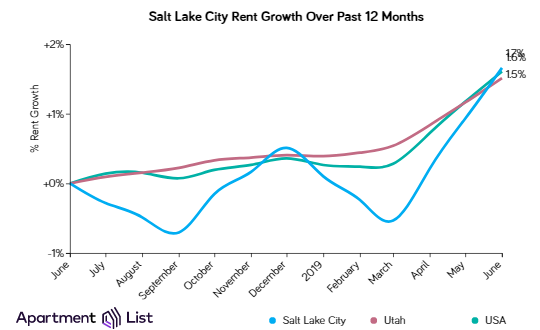
Salt Lake City rents have increased for the third straight month and have increased 0.7% over the past month, and have increased slightly by 1.7% in comparison to the same time last year, according to a report from Apartment List for June.

Currently, median rents in Salt Lake City stand at $880 for a one-bedroom apartment and $1,090 for a two-bedroom.

This is the third straight month that the city has seen rent increases after a decline in March. Salt Lake City’s year-over-year rent growth leads the state average of 1.5%, as well as the national average of 1.6%.

Salt Lake City rents more affordable than many large cities nationwide

As rents have increased slightly in Salt Lake, a few large cities nationwide have also seen rents grow modestly. Salt Lake City is still more affordable than most large cities across the country.

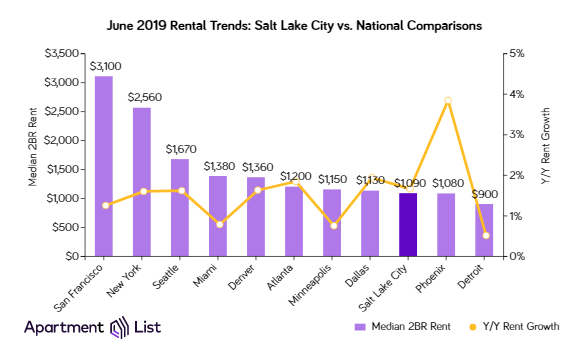
  • Salt Lake City’s median two-bedroom rent of $1,090 is below the national average of $1,190. Nationwide, rents have grown by 1.6% over the past year compared to the 1.7% increase in Salt Lake.
  • While Salt Lake rents rose slightly over the past year, many cities nationwide also saw increases, including Phoenix (+3.8%), Dallas (+1.9%), and Atlanta (+1.8%).
  • Renters will find more reasonable prices in Salt Lake than most large cities. For example, San Francisco has a median 2BR rent of $3,100, which is more than two-and-a-half times the price in Salt Lake City.rent in Salt Lake City compared to national rents


Net Lease Property The Way To Go For Your 1031 Exchange?

Kay Properties and 1031 and 1033 exchanges and eminent domain options details

Sponsored Article

By Chay Lapin

Senior Vice President Kay Properties and Investments

Please find below a case study when considering purchasing NNN properties versus alternative options such as DSTs.*

Is a NNN Property the way to go for my 1031 exchange?

Are you considering to purchase and manage a (NNN) Net Lease Property on your own? 

  1. Are you prepared for the potential active management?NNN properties are only passive if everything goes well. What happens if they do not?
  • If a NNN Property goes dark (tenant moves out) or bankrupt, are you ready to search for a new tenant, negotiate a new lease, negotiate with tenants and lenders, pay lawyers, manage leasing agents, higher contractors to renovate, etc. We have had clients 1031 exchanging out of their NNN properties because their NNN broker communicated half truths about NNN being a turn key option. NNN’s are great, until they’re not. Investors are exchanging out of NNN nightmare situations that a NNN broker didn’t walk them through the potential downfalls of NNN properties all too often…
  1. Are you willing to take a multi-million dollar company to court?
  • We have seen large companies bully their way out of a lease agreement because the landlords/building owners are too small to afford a costly litigation. Therefore the owner has been left with tens of thousands of dollars in maintenance costs or unpaid/reduced rent. Not only does this negatively impact your potential cash flow, it also impacts the overall value of the building and your family’s financial security. Many NNN investor clients that we worked with that were told by their NNN broker they were buying a “safe” property have found themselves with properties valued at significantly lower values and lesser returns. Although corporate tenants can do this to anyone… This is more difficult for these companies to do when the landlord is represented by a real estate equity firm with hundreds of millions or billions of dollars of real estate under management which is why the DST may be a fit for investors afraid of these scenarios.
  1. Are you prepared to do your own comprehensive due diligence required to purchase a NNN property that is such a large component of your wealth?
  • On all our DST properties, we conduct/review lease audits, environmental reports, insurance audits, building inspections, economic/demographic surveys, and we send someone to conduct onsite inspections. This can be a very costly and a time consuming process that many NNN buyers don’t have the time or experience to do themselves. Has your broker done that for you or are you prepared to do this on your own?
  1. Do you feel comfortable with all your eggs in a single NNN basket
  • Putting a large component of one’s wealth into a single NNN asset is simply not wise. Why would one invest in a single NNN property, when you can get access to the similar type of NNN properties but in a diversified strategy whereby you don’t have all of your eggs in one basket? **
  1. One of the greatest questions 1031 clients ask themselves, “what kind of legacy will I leave my family when I am gone?”
  • Are your wife or heirs able to take on any of the above situations if you are not around to manage these issues?Selling a property years into the lease can result in pennies on the dollar, especially if there are issues and they will be left to negotiate lease terms with a large fortune 500 company.  Many NNN investor clients that we worked with choose DST investments since the sponsor company will be handling these items and not their wife/heirs who may not have the real estate experience to properly asset manage a NNN property.

 *These examples are the experiences of a few of our clients and may not represent the experiences of others. Past performance does not guarantee or indicate the likelihood of future results.

**Diversification does not guarantee profits or protect against losses.

Using (DST) properties as opposed to NNN properties for your exchange:

  • Diversification – Don’t put all your eggs into one basket!
  • You can often close on a DST in 2-3 days – helps to potentially reduce 1031 exchange
    closing risk.
  • Non-recourse financing with DSTs as opposed to partial and full recourse with NNN
    properties.
  • Back up – Use a DST as a backup ID in case your NNN deal falls apart.
  • DST as a home for leftover funds to cover your exchange and avoid boot.
  • Professional asset and property management in place.

Access to Quality Real Estate

Often times, 1031 investors are selling a property that comprises a substantial amount of their net worth. DST 1031 properties provide access to real estate that is often otherwise outside of an individual investor’s price point. With the typical minimum investment of $100,000, investors are still able to purchase an ownership interest in large $20 million-plus apartment communities, $5 million-plus pharmacies or $15 million grocery stores, for example. This allows investors access to a level of real estate that they just would not have been able to exchange into before.

That being said, we also have had many clients with very large 1031 exchanges opt to invest in multiple DST 1031 properties/offerings because they did not want to place “all their eggs into one basket” by purchasing one single, large NNN investment property.

For a list of current DST offerings available at Kay Properties please visit www.kpi1031.com or call 1.855.466.5927.

About Kay Properties and Investments, LLC:

 Kay Properties and Investments, LLC is a national Delaware Statutory Trust (DST) investment firm with offices in Los Angeles, San Diego, San Francisco, Seattle, New York City and Washington DC.  Kay Properties team members collectively have over 114 years of real estate experience, are licensed in all 50 states, and have participated in over $9 Billion of DST real estate.  Our clients have the ability to participate in private, exclusively available, DST properties as well as those presented to the wider DST marketplace; with the exception of those that fail our due-diligence process. To learn more about Kay Properties please visit: www.kpi1031.com

This material does not constitute an offer to sell nor a solicitation of an offer to buy any security. Such offers can be made only by the confidential Private Placement Memorandum (the “Memorandum”). Please read the entire Memorandum paying special attention to the risk section prior investing. This email contains information that has been obtained from sources believed to be reliable. However, Kay Properties and Investments, LLC, WealthForge Securities, LLC and their representatives do not guarantee the accuracy and validity of the information herein. Investors should perform their own investigations before considering any investment.  IRC Section 1031, IRC Section 1033 and IRC Section 721 are complex tax codes therefore you should consult your tax or legal professional for details regarding your situation. This material is not intended as tax or legal advice.

There are material risks associated with investing in real estate, Delaware Statutory Trust (DST) properties and real estate securities including illiquidity, tenant vacancies, general market conditions and competition, lack of operating history, interest rate risks, the risk of new supply coming to market and softening rental rates, general risks of owning/operating commercial and multifamily properties, short term leases associated with multi-family properties, financing risks, potential adverse tax consequences, general economic risks, development risks and long hold periods. There is a risk of loss of the entire investment principal. Past performance is not a guarantee of future results. Potential cash flow, potential returns and potential appreciation are not guaranteed. For an investor to qualify for any type of investment, there are both financial requirements and suitability requirements that must match specific objectives, goals and risk tolerances.

Securities offered through WealthForge Securities, LLC. Member FINRA/SIPC. Kay Properties and Investments, LLC and WealthForge Securities, LLC are separate entities. This email, including attachments, may include non-public, proprietary, confidential or legally privileged information. If you are not an intended recipient or an authorized agent of an intended recipient, you are hereby notified that any dissemination, distribution or copying of the information contained in or transmitted with this e-mail is unauthorized and strictly prohibited. If you have received this email in error, please notify the sender by replying to this message and permanently delete this e-mail, its attachments, and any copies of it immediately. You should not retain, copy or use this e-mail or any attachment for any purpose, nor disclose all or any part of the contents to any other person.  For your protection, please do not transmit orders or instructions by email or include account numbers, social security numbers, credit card numbers, passwords, or other personal information.