Home Blog Page 167

Portland City Council Approves Controversial Tenant Screening Ordinance 3-1

Portland City Council Approves Controversial Tenant Screening Ordinance 3-1

The Portland City Council has approved a controversial tenant screening ordinance by a vote of 3-1, with one council member and former landlord dissenting from the group saying the ordinance will drive up housing costs for both renters and landlords.

The approval of the controversial ordinance led by Commissioner Chloe Eudaly and supported by tenants’ rights groups, would restrict the way landlords may screen tenants before they sign a lease, with the aim of addressing discrimination and requiring more consideration for people who have criminal records. It also places “first-in-time” rules for landlords to accept applications. It is scheduled to take effect next year.

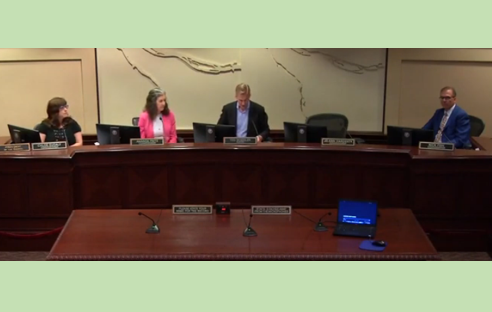
Each council member spoke about why they supported or did not support the tenant screening ordinance except Commissioner Jo Ann Hardesty, who did not attend the session.

While Eudaly thanked those who had worked on the ordinance, Commissioner Amanda Fritz, a former landlord herself, said the ordinance would only make it more difficult for all concerned and voted no.

“When I moved to the United States, I lived in a Salvation Army, single-room occupancy residence for two months before subletting an attic room in an apartment close to the hospital where I trained. I lived below the poverty level for seven years, moving apartments four times. I’ve also been a landlord who rented out our first house in Portland,” she said, after her family grew too large, but “now my parents-in-law are retiring to it.

“So I have lived and have experience on both sides of this issue.”

Controversial waiting period provision

“There are elements in the fair housing policy that are great, such as improving the process for people experiencing disabilities and making sure that application fees are returned,” Fritz said. “ I can’t support the screening criteria as a whole. One of the fundamental flaws of the ordinance is the 72-hour waiting period followed by first-come- first-served,” she said. The 72-hour element could actually increase bias instead of helping, she said, because those with means would be able to take advantage of it.

Tenant screening ordinance may lead to more problems in rental housing

“Many people can no longer afford rent in Portland. This policy not only doesn’t solve for this problem, it may exacerbate it,” Fritz said.

Portland City Council Approves Controversial Tenant Screening Ordinance 3-1
Amanda Fritz said, “ I can’t support the screening criteria as a whole. “

“One way is through loss of rental housing stock. Landlords are not just threatening to sell their rental properties because of this policy; they already have. I’ve heard from them. They’ve told me – they told us all – in emails. I’ve heard this directly from landlords as well as from Realtors who cited the fair housing policy as a reason that an increasing number of landlords are coming to them to put their rentals on the market.

“Many of the single-family homes and duplexes will be purchased by new owner occupants losing units from the rental market. I’ve heard testimony from a developer who has put affordable housing projects on hold here in Portland and is planning instead to develop in Clackamas county.

“Here’s what another one said: ‘We have delayed starting three projects, one for 39 micro units, all inclusionary, and another one for 48 low-income situations and a third one on northeast 102nd  … potentially bigger than the first two. We have asked for no subsidies, but Portland’s deciders are making it too difficult for developers, owners, and managers. The word in investor meetings is that other cities are more attractive for investing. I think that’s really sad because I think what we need as well as a fair housing and rental policies is more supply.’ “

Small landlords will leave and corporate landlords will take over

“Another way the new rules will drive up housing costs is by more of the small owners who currently own 60 percent of Portland’s rental units changing from managing their own units to hiring property management companies and lawyers,” Fritz said.

“Already over the past four years, over $6 billion in multifamily housing in Portland has been purchased by large corporations. Owners with a small number of units know their tenants by name and develop relationships with them. Multistate corporations maximize profits for their investors,” she said of the impact of the tenant screening ordinance.

Criminal background checks are an issue

“Perhaps the most troubling in this policy is the lack of an exception for people convicted of violent crimes, even rape and murder. In the low-barrier screening process, on the day of release from prison from a seven- or more year sentence, every landlord in Portland would be required to accept that application,” Fritz said.

Rents will go up, pricing out many people

“I expect that those landlords who do choose to keep their rental properties will increase rents significantly on vacant units, pricing out those very people we are trying to help with our actions. What this means is … communities of color and low-income renters will not be better off,” Fritz said.

She said unlike testimony given to the council by some, landlords are not “bad actors sitting on bags of money.”

She said the council is passing an ordinance that is “burdensome and costly to catch a few problematic owners. I believe there are proven methods that we should have focused on, such as increased education and training for both landlord and tenants and increased enforcement of existing fair housing laws.

“I know that the Portland Housing Bureau is up to the task to lead the implementation and I want to acknowledge the amount of work that still lies ahead in developing the administrative rules, education and ongoing monitoring of policy impacts. The Housing Bureau will need more staff to implement this policy,” Fritz said.

Commissioner Nick Fish, who voted in favor of the ordinance, offered an amendment setting up periodic assessment of the results of this program, to monitor access, to monitor administrative burdens and costs and the impact on the housing market, if any. Also to make any adjustments to the policy as necessary.

Eudaly read a statement from Hardesty saying, “I appreciate the concerns many small and midsize landlords have. Having to change how you’ve conducted business for years can be a challenge. I also recognize that many landlords do not discriminate in their business practices, but the fact remains that many do and many Portlanders are impacted by these practices on a regular basis.

“These ordinances will provide protection from these discriminatory practices. I’m happy that the city will be working to educate landlords on the new requirements and I’m thankful for all the input I have received from residents, landlords, and community groups on this important subject,” Hardesty said in the statement read by Eudaly.

Working on the ordinance for two years

Eudaly spoke at length at the council meeting about her ordinance.

“Considering it took us two years to get to this point, I think I deserve a little extra air time,” Eudaly said.

 Portland city council passes controversial tenant screening ordinance
Chloe Eudaly said the new Portland fair-access policy is a significant effort toward helping the housing crisis.

“We are experiencing a national housing crisis driven by our federal government’s divestment in affordable housing, by state and local governments who have failed to meet the growing need for affordable housing or to adequately regulate their rental markets to protect tenants, (and) by Wall Street, who is not only responsible for a housing crash, but has been snapping up thousands upon thousands of multifamily and single-family residences in our region while showing rampant disregard for the health, wellbeing, and very lives of the people who reside in them,” Eudaly said.

Landlord lobby wants to extract every penny from renters

“And finally by multiple industries, not the least of which is the landlord lobby, with a vested financial interest in extracting every penny from renters with no regard for the impact on their renters, our communities, or our local economy,” Eudaly said.

She said the new Portland fair-access policy is a significant effort toward helping the housing crisis.

“It’s no secret that Portland has a long history of overtly racist housing laws, the effects of which still shape our city today. What we fail to acknowledge more readily is that many of our current laws continue to uphold discriminatory practices,” Eudaly said.

“While the language may be less explicit now, the effect is just as clear. We continue to see communities of color and especially black residents pushed to the margins of our city and beyond at an alarming rate. The heart of the fair-access and renting policies is about addressing the criteria that continued to be used as a proxy for race, which includes criminal records, income requirements, and credit scores, which leads to discrimination and disparate outcomes.

“We would have never come to these policy solutions if we did not consider the unique experiences, needs and barriers faced by black renters in Portland. The policies before us today would not have been as strong if they were not developed in partnership with our community allies.

“I’m proud of the policy our office helped create with the community and I’m excited to see how it changes the way tenants access housing over time. We know it will take time for tenants to understand and for the industry to adjust. We know some fine-tuning will be necessary, but we also know that research and data have laid a solid foundation for the decisions we made,” Eudaly said.

Mayor says the tenant screening ordinance policy is rooted in important values

“I want to be very clear that there’s no question in my mind that these policies are rooted in important values and they’re based on real issues that exist in this community,” said Mayor Ted Wheeler.

“In particular, there is still far too much discrimination in access to rental units for people of color, for people of lower income and for people who experience disability in our community. That is not to say that all landlords are bad actors.

“I personally believe the vast majority of landlords are playing by the rules. They’re already playing by many of the rules that are established in these policies. We heard what I thought was very valuable testimony from them. We also heard heart-rending testimony from people about the very real need for change in this community,” Wheeler said.

Much work still ahead on the policy

“The work is most certainly not done with the passage of these ordinances. We can’t ignore that. The reality is that we have much work to do in the months ahead. We have to align our values with sound policy and measurable deliverables that are associated with these policies,” Wheeler said.

“As housing commissioner, it’s of particular importance to me that we’d be able to measure who is being helped by these policies and to what degree. Much of the actual implementation of this policy is going to be left to rule-making by the Portland Housing Bureau and the housing commissioner,” Wheeler said.

Resources:

City Council Delays Action on Controversial Portland Proposed Tenant Screening Ordinance

Housing Authority Settles For $1 Million With Tenants Over Emotional Support Animals

Ultimate guide to assistance animals in rental property

A Colorado housing authority accused of violating the federal rights of tenants with disabilities by charging a fee for emotional support animals has settled a lawsuit for nearly $1 million.

The lawsuit was recently settled between the Meeker Housing Authority and 22-year-old A.J. White for $1 million, according to reports.

The suit was originally filed in U.S. District Court on behalf of White over allegations he was discriminated against for owning emotional support animals.

According to the suit, White suffers from depression, anxiety, and ADHD, and his two cats were his emotional support animals meant to help him through his mental illnesses https://neurofitnessfoundation.org/xanax-alprazolam/.

The lawsuit was settled for $1 million after the judge ruled the housing authority “had discriminated against tenants who own” emotional support animals.

White filed his suit a few years back after the Meeker Housing Authority announced it would “require a $300 fee per emotional support animal,” according to legalreader.com.

Colorado District Court Judge William J. Martinez ruled in February that the creation of a $300 fee and the denial of requests for an exception by the tenants with disabilities violated federal law preventing discrimination against people with disabilities. Other claims were set to be decided by a jury in early May until the parties began settlement talks, according to the Denver Post.

Under the agreement, the plaintiffs will receive $950,000 from the Meeker Housing Authority. They previously settled with the town of Meeker for $50,000, attorneys said.

Housing Authority Settles For $1 Million With Tenants Over Emotional Support Animals


Are You Confused By Requests For Service, Emotional Support And Assistance Animals?

Grace Hill has provided some excellent training for landlords and property managers in this area.

Housing that receives federal financial assistance from HUD must also comply with Section 504. Like the FHA, Section 504 prohibits discrimination based on disability and requires housing providers to make reasonable accommodations for people with disabilities.

Whereas the FHA and Section 504 prohibit discrimination in housing, the ADA prohibits discrimination based on disability in all areas of public life, including schools, transportation, and all public and private places that are open to the public. The ADA requires you to let service dogs accompany their owners in any area of the community that is open to the public, such as the leasing office.

Know the assistance animal terminology and definitions

An assistance animal may be any type of animal and is not required to have specific training.

The FHA and Section 504 use “assistance animal” as a broad term to describe any animal that works, provides assistance, or performs tasks for the benefit of a person with a disability or provides emotional support that alleviates one or more symptoms or effects of a person’s disability.

Under the FHA and Section 504, service animals, emotional support animals, and companion animals are all considered assistance animals. An assistance animal may be any type of animal and is not required to have specific training.

The ADA uses the term “service animal” and defines it specifically as a dog that has been individually trained to do work or perform tasks for people with disabilities. Emotional support animals, companion animals and animals other than dogs (and sometimes miniature horses) are not considered service animals under the ADA.

You cannot deny a reasonable accommodation request because an animal does not meet the ADA definition of a service animal. Under the FHA and Section 504, reasonable accommodations must be granted for assistance animals, which include service animals, emotional support animals, and companion animals.

Residents making accommodation requests are not required to use specific terminology

If an animal works, assists, or performs tasks for the benefit of a person with a disability or provides emotional support that alleviates one or more symptoms or effects of a person’s disability, it doesn’t matter what term someone uses, it is an assistance animal under the FHA and Section 504.

Think of assistance animals as working animals, not pets

Thinking of assistance animals as working animals, not pets, can prevent confusion. Under the FHA and Section 504, assistance animals may be cats, dogs, birds, turtles, rabbits, hamsters, fish, or nearly any other type of animal. It is not the type of animal that matters, but rather the function the animal serves.

“This stuff is complicated – and serious. You’ll find that The Multifamily Property Manager’s Guide to Handling Assistance Animals answers a lot of your questions about assistance animals, including how to tackle conversations with other residents. But when in doubt, ask your supervisor or legal counsel,” Grace Hill writes in the blog post.

Are You Confused By Requests For Service, Emotional Support And Assistance Animals?

Resources:

Colorado lawsuit over companion animals settles for $1M

Three disabled residents sue Meeker housing authority claiming right to have companion animal

Meeker Housing Authority Settles Lawsuit Over Emotional Support Animals For $1 Million

Meeker Housing Authority Pays $1M to Settle Emotional Support Animal Lawsuit

Colorado Governor Signs New Bed Bug Law For Landlords And Tenants

Colorado Governor Signs New Bed Bug Law For Landlords And Tenants

Colorado Gov. Jared Polis has signed HB19-1328, a new bed bug law which requires a tenant to promptly notify the landlord via written or electronic notice when the tenant knows or reasonably suspects that the tenant’s dwelling unit contains bed bugs.

Not more than 96 hours after receiving notice, a landlord in most circumstances must hire a pest management professional to inspect and treat the dwelling unit and any contiguous dwelling units for bed bugs. Except as otherwise provided, a landlord is responsible for all costs associated with mitigating bed bugs.

The provisions in the measure are:

  • A tenant who gives a landlord electronic notice of a condition must now send such notice only to the email address, telephone number, or electronic portal specified by the landlord in the rental agreement for communications. In the absence of such a provision in the rental agreement, the tenant shall communicate with the landlord in a manner that the landlord has previously used to communicate with the tenant. The tenant shall retain sufficient proof of the delivery of the electronic notice.
  • Not more than 96 hours after receiving notice of the presence or possible presence of bed bugs, a landlord (a) must inspect or obtain an inspection by a qualified inspector of the dwelling unit, and (b) may enter the unit or any contiguous unit for the purpose of conducting the inspection.
  • If the inspection of a dwelling unit confirms the presence of bed bugs, the landlord is also then under obligation to perform an inspection of all contiguous dwelling units as promptly as is reasonably practical.
  • Except as otherwise provided, a landlord is responsible for all costs associated with inspection for, and treatment of, the presence of bed bugs.
  • If a landlord, qualified inspector, or pest control agent must enter a dwelling unit for the purpose of conducting an inspection for, or treating the presence of, bed bugs, the landlord shall provide the tenant reasonable written or electronic notice of such fact before the landlord, qualified inspector, or pest control agent attempts to enter the dwelling unit. A tenant who receives the notice shall not unreasonably deny the landlord, qualified inspector, or pest control agent access to the dwelling unit.
  • A tenant shall comply with reasonable measures to permit the inspection for, and treatment of, the presence of bed bugs, and the tenant is responsible for all costs associated with preparing the tenant’s dwelling unit for inspection and treatment. A tenant who knowingly and unreasonably fails to comply with inspection and treatment requirements is liable for the cost of subsequent bed-bug treatments of the dwelling unit and contiguous units if the need for the treatments arises from the tenant’s noncompliance.
  • If any furniture, clothing, equipment, or personal property belonging to a tenant is found to contain bed bugs, the qualified inspector shall advise the tenant that the furniture, clothing, equipment, or personal property should not be removed from the dwelling unit until a pest-control agent determines that a bed-bug treatment has been completed. The tenant shall not dispose of personal property that was determined to contain bed bugs in any common area where such disposal may risk the infestation of other dwelling units.

Related:

Top 25 Most Bed-Bug Infested Cities
Apartment Owner Ordered To Pay $1.6 Million In Bed Bug Lawsuit

Resources:

CPCA Bed Bug Legislation Signed Into Law


Justice Department Sues California Landlord for Trading Sex for Rent Discounts

Man Who Threatened to Kill His Landlords Sentenced to 40 Years

The U.S. Department of Justice has filed suit against the owner and manager of rental properties in the San Diego area who is alleged to have been sexually harassing female tenants and trading sex for rent discounts, according to a release.

The Justice Department lawsuit alleges that Larry Nelson, owner and manager of residential housing in Spring Valley, California, violated the Fair Housing Act by subjecting female tenants of his properties to sexual harassment and retaliation.

Trading sex for rent discounts

The seven-page complaint, filed in U.S. District Court in San Diego, accuses property owner Larry Nelson of entering the homes of his female tenants without reason and in several cases offering to reduce or forgive rent in exchange for sex, according to the Los Angeles Times.

The lawsuit alleges that Nelson engaged in sexual harassment of and retaliation against female tenants from at least 2005 to the present, by, among other things, engaging in unwelcome sexual touching, offering to reduce monthly rental payments in exchange for sex, making unwelcome sexual comments and advances, making intrusive and unannounced visits to female tenants’ homes to further his sexual advances, and evicting or threatening to evict female tenants who objected or refused his sexual advances.

“The Fair Housing Act prohibits sexual harassment and retaliation in housing,” said Assistant Attorney General Eric Dreiband in the release.

“Any landlord who sexually harasses his tenants or retaliates against them for refusing sexual advances, destroys their housing security and risks families’ ability to keep a roof over their heads.  Anyone who engages in this kind of disgusting and illegal conduct should be on notice:  The Department of Justice will be coming for you.”

Prosecutors said Nelson controlled every aspect of the rental process, from accepting applications and determining who could rent the units to setting the rental amount and collecting monthly payments.

“Let this be a wake-up call for abusive landlords,” U.S. Attorney Robert Brewer said in the release. “Holding a key to someone’s property is not a license to exploit them for sex. The Department of Justice is going to make sure a tenant’s home is a place of safety, not suffering,” Brewer said.

In October 2017, the Department of Justice launched an initiative to combat sexual harassment in housing. In April 2018, the department announced the nationwide rollout of the initiative, including three major components: an outreach toolkit to leverage the department’s nationwide network of U.S. attorney’s offices, a public awareness campaign, including the release of a national public service announcement, and a new joint task force with HUD to combat sexual harassment in housing. Since launching the initiative, the Department of Justice has filed 10 lawsuits alleging a pattern or practice of sexual harassment in housing.

The California lawsuit seeks monetary damages to compensate the victims, a civil penalty to vindicate the public interest, and a court order barring future discrimination and harassment. The complaint contains allegations of unlawful conduct; the allegations must be proven in federal court.

The federal Fair Housing Act prohibits discrimination in housing based on race, color, religion, national origin, sex, disability and familial status. More information about the Civil Rights Division and the laws it enforces is available at http://www.justice.gov/crt. Individuals who believe that they may have been victims of sexual harassment or other types of housing discrimination at rental dwellings owned or managed by Larry Nelson, or who have other information that may be relevant to this case, can contact the Housing Discrimination Tip Line, at 1-800-896-7743, and select mailbox 9991 to leave a message.

Related story:
Sexual Harassment In Housing And Unwelcome Comments And Requests
Resources:

Spring Valley Landlord Accused of Trading Sex for Discounts on Rent

Spring Valley landlord accused of sexually harassing tenants

Federal prosecutors accuse Spring Valley landlord of sexually harassing female tenants


Washington Landlords Win Pothole Contest And Get Apartment Parking Lot Makeover

Washington Landlords Win Pothole Contest And Get Apartment Parking Lot Makeover Contest

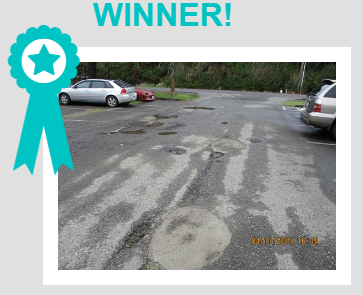
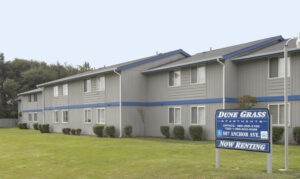
Gwyn Desimone and Jim Miller have won the pothole contest for their apartment complex and get a parking lot makeover for their Dune Grass Apartment complex courtesy of NYS Enterprises Paving.

Their complex is located at 807 Anchor Ave NW in Ocean Shores, Washington.

Washington Landlords Win Pothole Contest And Get Apartment Parking Lot Makeover
The Dune Grass apartments won the pohole contest and will get a parking lot makeover courtesy of NYS Enterprises paving.

“I would like to congratulate the winners. I have visited site and looking forward to repairing their very needed pot holes!” said Steve Nys of NYS Enterprises.

Gwyn and Jim combined on the winning entry with Jim taking the photo and Gwyn entering it into the pothole contest.

She is the Area Manager for the property and recently moved into compliance at the corporate office.

Washington Landlords Win Pothole Contest And Get Apartment Parking Lot Makeover
Gwyn Desimone Area Manager for the property entered the pothole contest.
Washington Landlords Win Pothole Contest And Get Apartment Parking Lot Makeover
Jim Miller the landlord and property manager took the winning pothole contest photo.

“I have been with Quantum Management Services for approximately 10 years, we work with mostly low income programs. This property is a USDA/RD property we have managed since 2012. The manager Jim Miller is an asset to the property and does everything he can to maintain the property in great condition under a budget.

“He has been with the property over 20 years. I started out as a leasing agent and moved my way up through the company. I enjoy helping others and providing safe /clean affordable housing to those whom are in need for housing,” Gwyn said.

Pothole contest focuses attention on parking lot maintenance

Nys said, “Potholes start by not sealing your cracks. Filling cracks is inexpensive maintenance that should be looked once a year. Water is the number one cause of asphalt damage. Be proactive and seal your cracks. Pot holes are telling you that asphalt is in need of overdue repairs. And seal coat your lots!

“So avoid future potholes by having annual sealing and maintenance of the cracks in your parking lot,” Nys said. “If you already have potholes in need of repair give us a call.  We do the highest quality work at very reasonable prices.”

Ugliest pothole photo contest

5 Perfect Bathroom Upgrades for Your Rental Property

5 Perfect Bathroom Upgrades for Your Rental Property

This week, Keepe offers a look at 5 perfect bathroom upgrades for your rental property.

No. 1 – Install a shower door

Instead of a shower curtain, a shower door can immediately upgrade any bathroom. Shower doors can make your bathroom seem more modern and up-to-date. When it comes to durability, shower doors are a must. They last longer because of stain resistance, ease of cleaning, and prevention of bacteria growth.

5 Perfect Bathroom Upgrades for Your Rental Property
Shower doors work much better in rental properties than shower curtains so consider installing a shower door.

No. 2 – Install tile around the tub

Tiling around the walls of a tub can help with water- and stain-resistance. It can also add a pop of color to any bathroom to make the room seem more cohesive and fresh. There are many different types of tile to choose from, the most popular being porcelain due to its water resistance.

5 Perfect Bathroom Upgrades for Your Rental Property
Bathroom upgrades can make your rental property really attractive to tenants.

No. 3 – Install a bathroom vent fan

Steam from your showers can cause stuffy bathrooms and, eventually, unwanted mold on the walls. To eliminate this, try adding a vent fan to the ceiling of the bathroom. The vent will help with the excess moisture in the room and give it a more upgraded look.

No. 4 – Add extra storage

Any bathroom can use extra storage space. Cabinets, drawers and shelves are handy for all kinds of storage and can add value to your bathroom. Depending on what materials you choose, you can add highlights of color to keep the look cohesive and current. These days, medicine cabinets with mirrored sliding doors are a good-to-go storage solution for any bathroom.

No. 5 – Improve the lighting

The quality of lighting in a bathroom can turn a good bathroom into a great one. Vanity lighting around the mirror is a great option; it helps illuminate faces for grooming. A common mistake is to put lights on the ceiling above the mirror, which can cause unwanted shadows on the face. In addition to vanity lighting, a central fixed ceiling light can be used as a substitute for natural light. When it comes to choosing bulbs, a daylight bulb is best for making the room seem more open and natural.

In addition to the 5 perfect bathroom upgrades for your rental property here are other recent rental property maintenance Keepe posts you may have missed:

 How To Pick The Perfect Exterior Paint Color For Your Rental Property

4 Outdoor Flooring Options For Your Rentals

20 Easy, Affordable Maintenance Projects To Update Your Rentals

7 Tech Gadgets For A Safer And More Efficient Rental Property

5 Maintenance Tips For Long-Lasting Rental Carpet Flooring

Is The Water Heater At Your Rental Property Ready For The Big One?

7 Types Of Kitchen Countertops For Your Apartments

Which Cooktop Is Best For Your Rental Property?

A Guide To 4 Types Of Flat Roof Systems

6 Ways To Trash Your Apartment Waste Management Issues

Top 5 Apartment Maintenance Emergencies vs. Maintenance Requests

5 Tips for Preparing Your Apartments for the Summer Season

4 Air Conditioning Maintenance Best Practices For Summer

About Keepe:

Keepe is an on-demand maintenance solution for property managers and independent landlords. The company makes a network of hundreds of independent contractors and handymen available for maintenance projects at rental properties. Keepe is available in the Greater Seattle area, Greater Phoenix area, San Francisco Bay area, Portland, San Diego and is coming soon to an area near you. Learn more about Keepe at https://www.keepe.com


How A No Pet Policy Can Be Discriminatory

The Grace Hill training tip of  focuses on the issue of how a no pet policy can be discriminatory when it involves potential tenants with disabilities.

By Ellen Clark

Landlord and property managers must make reasonable accommodations to meet the needs of people with disabilities.

An accommodation is a change in any rule, policy, procedure, or service if the changes are needed for a person with a disability to have equal opportunity to occupy and enjoy full use of their housing.

One of the most common accommodation requests people with disabilities make is to have an animal that would otherwise be restricted by a community’s rules.

No pet policy should specific an exception

Unless a no-pet policy specifies an exception for assistance animals, it may be considered discriminatory to residents with disabilities who might require an animal for assistance.

Consider this case: The owner of several apartment complexes and rental homes in San Jose sent a letter to residents stating that he did “not like to deal with pets of any kind” and that residents could not “introduce any new pet or replacement pet.”

In a civil complaint, The California Department of Fair Employment and Housing (DFEH) accused the property owner of discriminating against residents with disabilities. The property owner settled with DFEH for $100,000. As part of the settlement, the owner will undergo in-person training annually for three years and must develop a new reasonable accommodation policy. Interestingly, the owner must also provide semi-annual reports to DFEH about the number of requests for accommodation and the nature and outcome of those requests. Read more about the case here.

What can you do to avoid finding yourself in a similar situation?

    • Ensure that any no pet policy or prohibition against pets, whether verbal or in writing, makes a specific exception for assistance animals as reasonable accommodations for residents with disabilities.
    • Remember that assistance animals are not pets. Rather, they provide an important service to people with disabilities, and you must handle these accommodation requests in compliance with the law.

Summary:

According to The Case for Fair Housing: 2017 Fair Housing Trends Report by the National Fair Housing Alliance, of all reported complaints of housing discrimination in 2016, nearly 55% involved discrimination against people with disabilities. That’s a staggering statistic. Make sure your no pet policy is not an issue.

Recent training tips you may have missed:

Assistance Animals Are Not Pets, Repeat, Assistance Animals Are Not Pets

Read Ellen’s full blog post here.

About the author:

Ellen Clark is the Director of Assessment at Grace Hill.  Her work has spanned the entire learner lifecycle, from elementary school through professional education. She spent over 10 years working with K12 Inc.’s network of online charter schools – measuring learning, developing learning improvement plans using evidence-based strategies, and conducting learning studies. Later, at Kaplan Inc., she worked in the vocational education and job training divisions, improving online, blended and face-to-face training programs, and working directly with business leadership and trainers to improve learner outcomes and job performance. Ellen lives and works in Maryland, where she was born and raised.


Portland has Highest Number of Apartment Job Openings in the Country

Portland has Highest Number of Apartment Job Openings in the Country

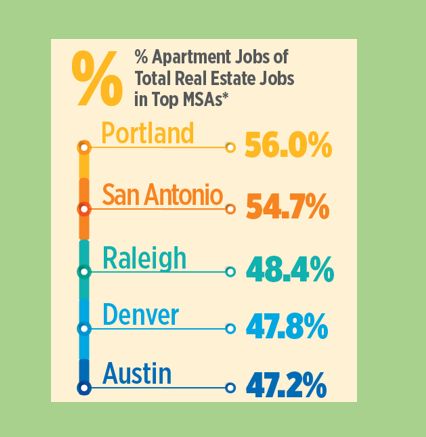
Portland apartment job openings represent 56 percent of all the real estate jobs in the metro, according to the latest jobs report from the National Apartment Association.

The city leads all United States metros with the highest number of apartment job openings at 56 percent, followed by San Antonio at 54 percent and Denver at 47 percent.

Leasing season has officially begun, and property management companies are preparing for an increase in traffic, new leases, and apartment turnovers, the report says.

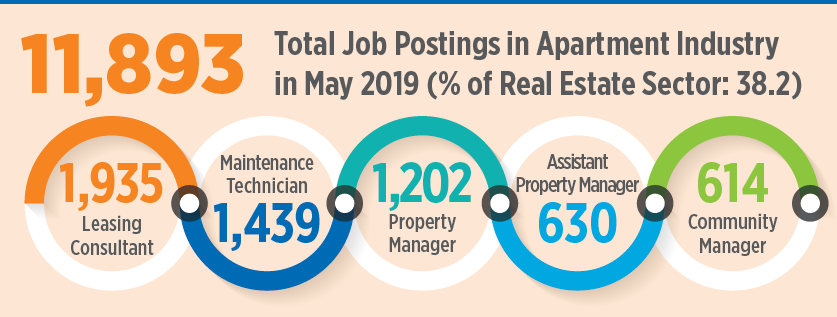
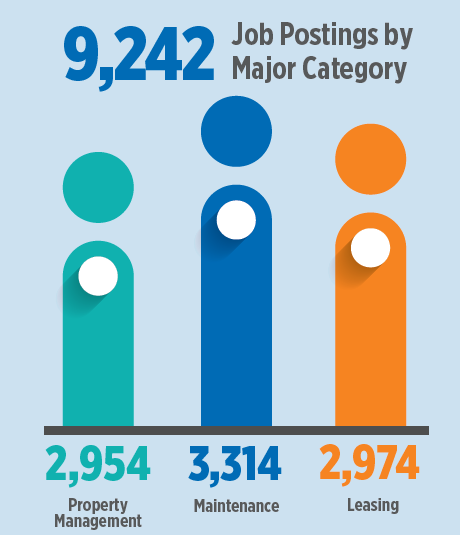
In May’s edition of NAAEI’s Apartment Jobs Snapshot, the number of available positions in the apartment industry amounted to more than 11,000 job openings, with the highest concentration of job postings in Portland, San Antonio, Raleigh, Denver, and Austin.

Portland has Highest Number of Apartment Job Openings in the Country

Portland has Highest Number of Apartment Job Openings in the Country

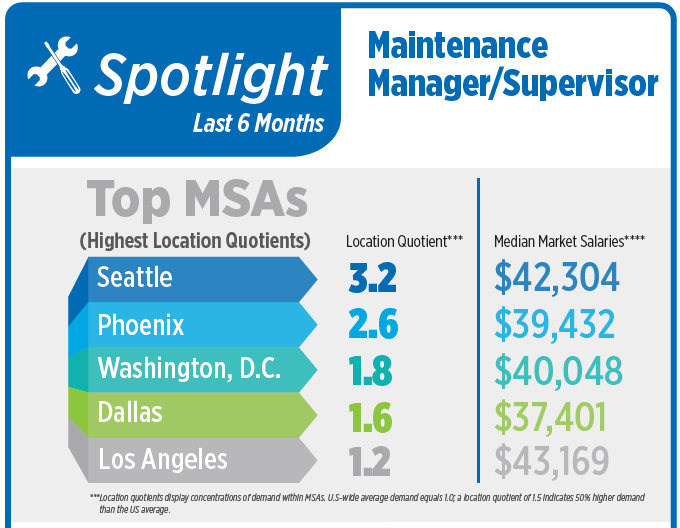
This month’s spotlight highlights maintenance managers and supervisors.

Maintenance apartment job openings in high demand in Seattle

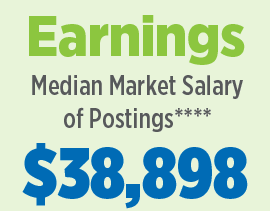
The demand for maintenance positions was more than three times the U.S average in Seattle, where the median market salary for maintenance manager or supervisor is $42,304.

The top specialized skills employers are looking for included plumbing, repair, HVAC, and property management skills. They also are seeking candidates with strong budgeting skills, staff management skills, and experience with property management software.

Portland has Highest Number of Apartment Job Openings in the Country

Portland has Highest Number of Apartment Job Openings in the Country

Portland has Highest Number of Apartment Job Openings in the Country

Portland has Highest Number of Apartment Job Openings in the Country
Market salary is calculated using a machine learning model built off of millions of job postings every year, and accounting for adjustments based on locations, industry, skills, experience, education requirements, among other variables.

National Apartment Association jobs report background

The NAA jobs report focuses on jobs that are being advertised in the apartment industry as being available, according to Paula Munger, Director, Industry Research and Analysis, for the National Apartment Association’s Education Institute.

“Our education institute is a credentialing body for the apartment industry. They hear often that one of the biggest problems keeping our industry leaders up at night is the difficulty in finding talent, attracting talent and retaining talent,” Munger said.  “Labor-market issues are happening in a lot of industries, certainly with the tight labor market we have.”

NAA partnered with Burning Glass Technologies.

“They have a labor-job posting database that is proprietary,” she said, and they can “layer on data from the Bureau of Labor Statistics (BLS). We looked at that and thought we could do something that is really going to help the industry and help benchmark job titles and trends as we go forward,” Munger said.

Last month:

Portland Apartment Job Openings Half Of All Real Estate Sector Jobs

Dwelo Investing $20 Million To Bring Smart Technology To Apartments

Dwelo Investing $20 Million To Bring Smart Technology To Apartments

A leading smart-technology company in the multifamily space is investing $20 million to bring more smart technology to apartments such as thermostats, locks, light switches, and more to apartment communities, according to a release.

Dwelo technology is now helping customers in more than 200 apartment communities and about 50,000 apartment units.

“Smart technology is generating tremendous returns for our customers as both a resident amenity and an operational tool,” said Mike Rovito, CEO of Dwelo, in a release.

Smart technology to apartments

“We’re adding thousands of units to the platform each month, and this investment will help us deliver the same quality of service to every one of those residents and managers. At the same time, we are pouring significant resources into R&D, which we expect will create more value for all those working and living at Dwelo’s apartment communities.”

Dwelo is focused on the multifamily industry. They provide their customers – owners, managers, and residents – with web and mobile applications that allow them to control smart devices across their communities, according to the release.

The platform saves time and money, reduces risk, provides users convenience, and improves security for the entire asset while offering end-to-end support. With this technology and service, residents live in the future, managers streamline their operations, and owners improve their NOI.

The company has completed an extension to its Series A round led by existing investors Wasatch Venture Holdings, with participation from Perot Jain, and several customers. Dwelo’s total investment in developing smart technology for apartments now exceeds $20 million.

“We were drawn to Dwelo because of the innovation and disruption they are driving within the multifamily industry,” said Joe Beard, Partner at Perot Jain, in the release. “Dwelo is solving real problems for owners, managers, and residents, and we believe they are the future of apartment living.”

Founded in 2014, Dwelo has experienced enormous growth and operates out of offices based in San Francisco, CA, Draper, UT, and Dallas, TX. The company works with more than 60 of the country’s leading multifamily developers, owners, and managers, including Alliance Residential, Wasatch Premier Communities, Howard Hughes, Pinnacle, and BH Management.

Dwelo’s customers have developed, own, or manage about half a million apartment units. The company is outfitting each of those units with smart devices like smart thermostats, locks, light switches, meters, voice controllers and more, while also supplying commercial smart technology solutions for common areas and perimeter access points.

This new round of funding will allow Dwelo to expand its operational footprint in order to bring industry-best implementation and support to more multifamily communities nationwide. That includes expanding its engineering and product team, driving its vision of a complete smart community platform. Investing in product and engineering will provide the tools and infrastructure necessary to ensure that the next 1,000 communities receive the same hallmark level of quality and reliability that the company’s  first 200 communities have received, according to the release.

“We are thrilled to continue our partnership with Dwelo,” said Scott Stettler, CFO at Wasatch Venture Holdings, in the release. “Dwelo has proven time and again they are the right partner to bring smart technology applications to the multifamily industry. We see a growing demand from residents for smart apartments, and we are confident that Dwelo will continue to push and shape the limits of what is possible within the apartment space”.

Company Rolls Out Smart Apartment Technology Package To 25,000 Units

About Dwelo

Dwelo Investing $20 Million To Bring Smart Technology To Apartments

Dwelo provides simple, seamless smart apartments to the owners and managers of multifamily communities. The company connects popular smart devices from Z-Wave, Nest, Kwikset, Yale, and others to proprietary mobile and web applications as well as voice platforms like Amazon Echo and Google Home. Dwelo’s platform enables residents to enjoy the benefits of a smart home in a rental setting while helping managers run their communities more efficiently.

About Wasatch Venture Holdings

Wasatch Venture Holdings invests in promising companies that provide technology solutions and services to the commercial real estate industry. Wasatch Venture Holdings has had great success with multifamily-specific technology investments in particular, funding several companies in the compliance, lead management software, property management software and smart technology space. Collectively, Wasatch-backed companies have grown to service more than 4M multifamily units nationwide. Wasatch Venture Holdings’ sector focus gives its portfolio companies a competitive edge with the insight they can provide from over a decade of funding multifamily-focused technology businesses.


Renter Migration Patterns Show Tech Workers See Portland As Affordable Alternative

Renter Migration Patterns Show Portland As Affordable Alternative to San Francisco, Seattle

A new report on renter migration patterns shows Portland is seen as an affordable alternative to San Francisco and Seattle according to the report from Apartment List.

The study looked at which parts of the country are retaining their renter populations and which parts renters are fleeing, as well as which metros are doing the best and worst jobs of attracting renters from other parts of the country, according to Chris Salviati, housing economist at Apartment List.

“In some cases, the patterns we observe in this data are intuitive, while in others we unearth surprising insights,” Salviati writes in the report. A new interactive mapping tool  from Apartment List uses unique, proprietary data from our user searches to examine where people are looking to make their next home. This data sheds valuable new light on migration patterns that will reshape cities around the country.

West Coast tech workers look to Portland as a more affordable alternative to San Francisco and Seattle

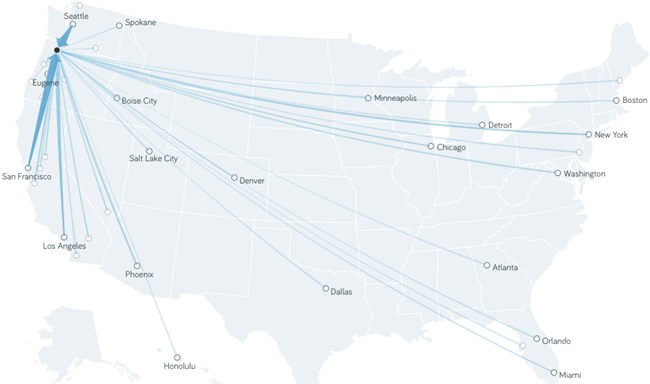
Portland is the most popular out-of-state destination for those looking to leave the San Francisco metro.

Among all renters looking to move to Portland from elsewhere, 9.0 percent are currently living in San Francisco, making it the most popular inbound search location for Portland.

Seattle is the 2nd most common source of inbound searches to Portland, followed by Los Angeles, San Jose, and New York.

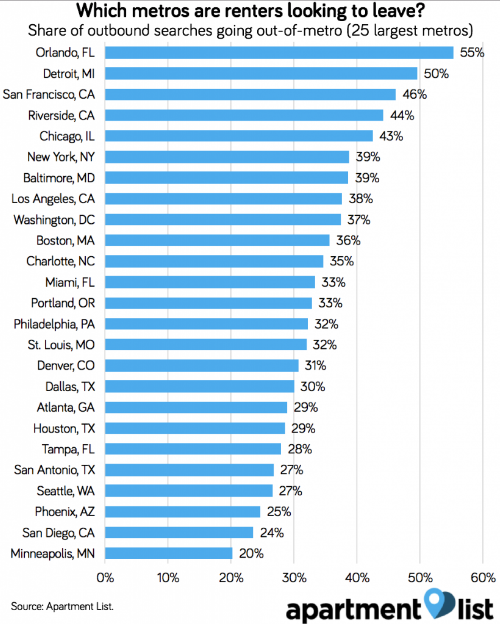
33% of Portland renters are looking to move elsewhere

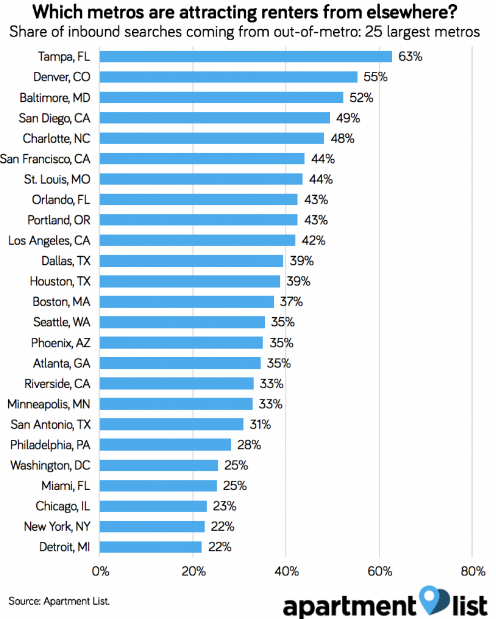
According to the new report published by Apartment List, 42.5% of those looking for a place to live in Portland are searching from outside the metro. Renters looking to move to the Portland metro from elsewhere are most likely to be searching from San Francisco, CA (9.0%), Seattle, WA (8.9%), or Los Angeles, CA (4.8%) – areas that boast some of the nation’s fastest growing tech hubs. The City of Roses has a robust tech scene and growing population, as workers in San Francisco and Seattle are constantly seeking out more affordable housing.

In fact, Portland is the most popular out-of-state destination for those looking to leave the San Francisco metro. Among all renters looking to move to Portland from elsewhere, 9% are currently living in San Francisco. West Coast tech workers find Portland to be a more affordable alternative to other neighboring metropolitan areas.

Additionally, Portland is the most popular destination for Seattle renters looking to move elsewhere, with 7.9% of outbound searches being dedicated to it. Some of those looking to move to Portland may be prepared to work remotely for their current employers, as the city has the nation’s fourth-largest share of remote employees.

On the other hand, 32.9% of Portland renters looking to move elsewhere, with some of the most popular destinations being Seattle, WA (24.4%), Eugene, OR (5.1%), or Phoenix, AZ (4.9%).

Renter migration from San Francisco, but not from the Bay Area

San Francisco has the third highest share of users looking to move outside the metro.

At first this may appear to confirm a popular narrative that San Francisco is losing residents to more affordable emerging tech hubs such Denver and Austin, however, a closer look at the data contradicts this interpretation.

Renter Migration Patterns Show Portland As Affordable Alternative to San Francisco, Seattle

As New Yorkers move in, Denver residents turn to more affordable Colorado metros

While the flow of renters from San Francisco to Denver may have been lower than we expected, the tech boom in Denver is definitely a real phenomenon.

“We see the Denver metro attracting renters from other major metro areas with highly educated workforces. The New York City, Chicago, and Washington D.C. metros are the first, second, and fourth most common locations for inbound searches to Denver, respectively making up 4.7 percent, 4.6 percent, and 3.0 percent of inbound searches coming from outside the metro,” Salviati writes.

Renter Migration Patterns Show Portland As Affordable Alternative to San Francisco, Seattle

Inbound searches to Phoenix dominated by Los Angeles

Phoenix is another example of a rapidly growing metro that has thus far retained its affordability, making it an attractive destination for those looking to leave more expensive areas on the West Coast.

But while Portland is attracting renters from throughout the West Coast and beyond, inbound searches to Phoenix are dominated by one metro: Los Angeles.

Users currently living in the L.A. metro comprise 18.9 percent of inbound searches coming to Phoenix from outside the metro.

Phoenix is the most popular outbound search location for those looking to leave the L.A. metro, ranking even higher than the Riverside metro which borders L.A. In contrast to the Bay Area residents who are moving further and further from the core metro and enduring increased commute times, it seems that L.A. residents feeling the price crunch would rather relocate to Phoenix than super-commute from Riverside.

Renter migration summary

“Knowing where Americans are moving to and from is key to understanding the evolution of our nation’s cities. Publicly available migration data from Census tracks these trends, but that data source captures moves that have already occurred and is released with a fairly lengthy time lag,” Salviati writes.

“Search data from platforms such as Apartment List can help supplement our understanding of migration patterns by serving as a leading indicator that shows where renters are looking to move before those moves have actually occurred.

“It is important to note that Apartment List users are not fully representative of the American population as a whole, and that rental listing searches do not always result in completed moves. That said, the trends we observe are nonetheless informative, and we hope that this data tool will serve as a valuable resource for those looking to understand the mobility patterns of America’s renters,” Salviati writes in the report.

Methodology:

Results are based on searches of Apartment List users occurring between January 1, 2018 and May 1, 2019. The company includes data from both registered and unregistered users. While registered users are uniquely identified, unregistered users who perform multiple searches may be counted multiple times. For users who search in multiple locations, the company considers the initial search location to be the primary one. Each user’s current place of residence is defined by the IP address from which the user is searching. All results are aggregated at the metro level, using Census definitions of metropolitan statistical areas.