Home Blog Page 156

Don’t Drop The Baton: Finishing The Race With Bad Tenants

Common landlord mistakes and don't drop the baton when it comes to bad tenants

Common landlord mistakes that can trip up landlords is the topic this month as attorney Brad Kraus urges landlords to win the race with bad tenants.

By Brad Kraus
Attorney, Warren Allen LLP

Imagine you entered a relay race, competing with one other team for a prize you desire. You’ve ran hard, persevered, but rather than cross the finish line and prevail, you decide to throw your baton backwards. Sounds crazy, doesn’t it?

Some Landlord/Tenant disputes can feel like grueling marathon races, with eviction actions denoting the finish line. Successful landlords cross the finish line first by avoiding mistakes in the lead up period. Many Landlords stumble during the race or right before they are set to cross the finish line, often due to inexperience or a lack of knowledge of the procedures involved.

Two common landlord mistakes

Two common mistakes often befall landlords: (a) service of notices at improper times, and (b) actions taken which undermine the Landlord’s position of strength in an eviction case. For example, I’ve seen many landlords serve termination notices after they’ve already terminated tenancies or when termination dates are rapidly approaching. The latter termination notices can unnecessarily extend the finish line by shifting termination dates out into the future.

Assuming the Landlord does the right thing and files an eviction action on the uncured 72-Hour Notice, a court-enforceable Stipulated Agreement within this process provides the Landlord with the strongest rights. The Landlord can dictate the terms of the Agreement from both a fiscal prospective, but also with provisions related to conduct. If the Tenant fails to comply with the terms, a Declaration of Noncompliance can be filed, and the tenancy can be terminated through the courts.

Another common Landlord misstep involves actions that undermine rock solid Stipulated Agreements in FED actions. For example, some Landlords—with a court-enforceable agreement in hand—unknowingly serve Notices for tenant defaults of that very court-enforceable Stipulated Agreement. If the Notice of Termination extends or waives the Agreement’s deadlines, the landlord again shifts the finish line and makes the race unnecessarily harder. These Landlords ran the race . . . but failed to cross the finish line.

Being a Landlord can feel like a rat-race in and of itself. It’s rarely easy, and troublesome tenants make it harder.

The best landlords are constantly “training.” They update their legal knowledge, keep their forms current, and optimize their termination and eviction strategies, whenever the occasion calls.

At the same time, they don’t trip themselves up. Successful landlords understand the marathon nature of some landlord/tenant disputes and adhere to strategies that ensure their position at the finish line. With troublesome tenants, your goal should always be to position yourself favorably within the confines of the eviction statutes. Within that setting, if the Tenant fails to perform as required, finishing the race is easy. However, it’s important to cross the finish line with your baton . . . rather than throw said baton (i.e. your rights/remedies) into the river.

Brad’s recent posts:

Money For Nothing: Getting The Most From Your Tenant Settlement Strategies

Think Like A Tenant: Qualifying Repair and Renovation Landlord Exemption Under SB 608


Common landlord mistakes that can trip up landlords is the topic this month as attorney Brad Kraus urges landlords to win the race with bad tenants.

3 Safeguards For The Growing Tide of Roommate Renters

Living With A Roommate Can Save Renters $515 A Month

Renters who are strangers and yet will be roommates can present a challenge for leasing apartments. Here are 3 safeguards to consider when renting to these types of occupants.

By Ellen Calmas

While individual renter households represent the highest volume growth since 2007, non-family roommate renter households have grown at almost twice the pace, or 2.9 percent over the same period, according to recent Axiometrics data.

That’s an increase of 20.7 million “non-family” households consisting of either one person or two or more roommates, representing growth of 330,000 people per year sharing apartment homes – and potentially a lot of hassle for communities that don’t have clear policies in place.

Renting to Non-family Roommate Renters

Typically all parties applying for a lease have to meet screening criteria. But what happens when one roommate’s screening is up to snuff and the other’s isn’t?

That’s where corporate policy comes in. Most companies consider each party jointly and severely responsible for the lease. The question still is, “Do you use the lowest screening score or the highest in determining whether applicants are accepted outright or with conditions?”

Think of college friends who decide to move in together while they experience their first taste of independence and new jobs. One person not taking rent seriously is enough to ruin a relationship and leave the community spending unwanted time going to occur.

The situation can be worse in situations where two strangers decided to cohabitate after matching profiles on a roommate listing site. They may feel little if any obligation to act responsibly toward each other or the community, and only consider themselves obligated to pay their fair share.

Putting aside the potentially messy interpersonal issues that come when people share an obligation, there are safeguards communities can put in place:

3 Safeguards for Apartments And Roommate Renters

1. The conservative approach is to use the lowest screening score in developing lease offers for renters and to treat both residents as conditionally approved while collecting some extra deposit or other protection for    the company. Requiring each roommate to pay a security deposit is the usual course of business since it creates ‘skin in the game’ for each person and provides protection to each roommate in the event of    unit damage at move out.

2. Alternately, some communities require each roommate to provide a guarantor for a portion of the lease or requiring one guarantor for the entire lease. In the college graduate scenario this is usually the parent who has the best credit so both roommates and qualify. In roommate match-up scenarios it can get trickier.

3. Providing payment options that protect on time rent delivery has also become a strategic amenity as many communities are finding that simply requiring automated payments with roommates isn’t enough    to assure performance. These companies are turning to options like rent from payroll which involves direct deposit from employer payroll of a portion of rent every time each roommate is paid to a bank account neither person can withdraw from. These programs also allow flexibility if one roommate will be responsible for a larger portion of rent.

4. It’s also important to be clear about late fee policies for rent in arrears and the potential legal consequences to all involved if one roommate fails to perform. All parties need to realize the    implications of financial commitments.

Finally, cross your fingers. Staying together is tough enough when residents are related or in a relationship. Things can get really tricky if not handled well.

About the Author:

Ellen Calmas is Co-Founder and Executive Vice President at Neighborhood Pay Services, the company that pioneered the only payroll direct deposit platform for multifamily, NPS Rent Assurance. Life is good when we achieve our mission of making payment assurance the catalyst for improved economic occupancy among hard working individuals who need help securing a place to live.

Roommates photo credit By Tulane Public Relations (Roommates  Uploaded by AlbertHerring) [CC BY 2.0 (https://creativecommons.org/licenses/by/2.0)], via Wikimedia Commons

Why Property Managers Are Skeptical When Tenants Decline Lease Offers


Portland Rents Declined After Three Months of Increases

Portland Rents Decline After Three Months of Increases

After three straight months of increases,  Portland rents declined slightly in October, declining 0.8 percent over the past month, according to Apartment List.

Currently, median rents in Portland are $1,133 for a one-bedroom apartment and $1,337 for a two-bedroom.

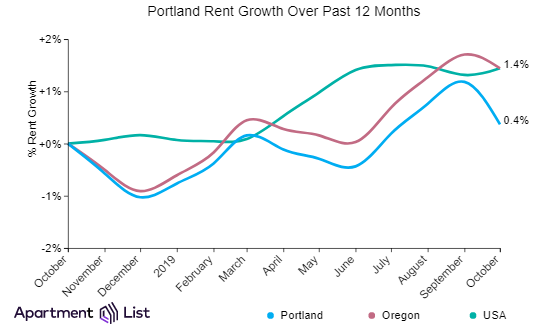
Portland proper has the least expensive rents in the metro area and Portland’s year-over-year rent growth is essentially flat and lags the state and national averages, which both stand at 1.4 percent.

Rents rising across the Portland metro

While rents have remained flat in the city of Portland proper, cities across the metro have seen a different trend.

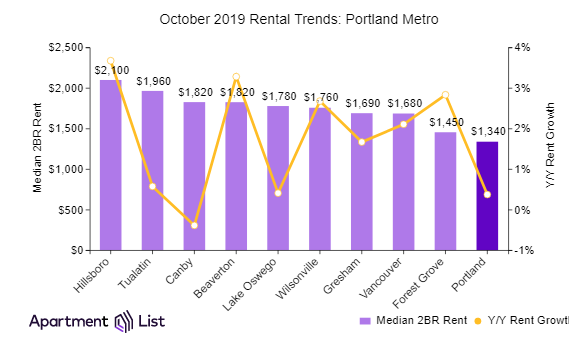
Rents have risen in nine of the largest 10 cities in the Portland metro for which Apartment List has data. Here’s a look at how rents compare across some of the largest cities in the metro.

  • Hillsboro has the most expensive rents in the Portland metro, with a two-bedroom median of $2,098; the city has also seen rent growth of 3.7 percent over the past year, the fastest in the metro.
  • Over the past month, Canby has seen the biggest rent drop in the metro, with a decline of 4.5 percent. Median two-bedrooms there cost $1,824, while one-bedrooms go for $1,546.

Vancouver rents have increased for eight straight months

Vancouver rents in October 2019

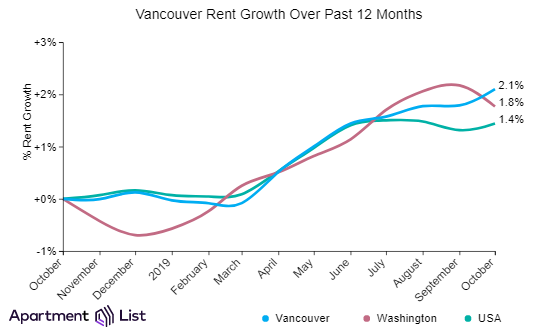
Vancouver rents, meanwhile, have increased 0.3 percent over the past month, and are up moderately by 2.1 percent in comparison to the same time last year.

Currently, median rents in Vancouver stand at $1,427 for a one-bedroom apartment and $1,684 for a two-bedroom. This is the eighth straight month that the city has seen rent increases after a decline in February.

Vancouver’s year-over-year rent growth leads the state average of 1.8 percent, as well as the national average of 1.4 percent.

Rent growth in Oregon

While the report shows Portland rents declined recently, rent growth in Portland has been relatively stable over the past year – some other large cities have seen more substantial increases.

Portland Rents Declined After Three Months of Increases

Portland is still more affordable than most comparable cities across the country.

  • Oregon as a whole has logged 1.4 percent year-over-year growth, while rent trends across other cities throughout the state have seen both increases and decreases.
  • For example, rents have grown by 1.0 percent in Eugene, while in Salem rents have fallen 0.6 percent.
  • Portland’s median two-bedroom rent of $1,337 is above the national average of $1,191. Nationwide, rents have grown by 1.4 percent over the past year compared to the stagnant growth in Portland.
  • While rents in Portland remained moderately stable this year, similar cities saw increases, including Phoenix (+4.0 percent), Las Vegas (+3.4 percent), and Austin (+3.2 percent); note that median 2BR rents in these cities go for $1,097, $1,188, and $1,471 respectively.

Eugene Rents Drop in October

Eugene rents have declined 1.0 percent over the past month, but are up slightly by 1.0 percent in comparison to the same time last year, according to the latest report from Apartment List.

Median rents in Eugene stand at $829 for a one-bedroom apartment and $1,102 for a two-bedroom.

Eugene’s year-over-year rent growth lags the state and national averages, which both stand at 1.4 percent.

Corvallis rents held steady over the past month

Unlike Eugene, while rents in Corvallis have remained flat over the past month they are up slightly year-over-year, by 1.3 percent

Median rents in Corvallis stand at $829 for a one-bedroom apartment and $1,040 for a two-bedroom.

Salem rents plunge in October

Salem rents dropped 3.0 percent over the past month, and are down moderately by 0.6 percent in comparison to the same time last year.

Median rents in Salem stand at $820 for a one-bedroom apartment and $1,078 for a two-bedroom.

Last month’s report:

Portland Rents Continue Upward Trend for Third Straight Month

The Fundamentals of 1031 Exchanges

Kay Properties and 1031 and 1033 exchanges and eminent domain options details

Sponsored Article

By Dwight Kay and the Kay Properties Team

Welcome to 1031 101! If you’ve come to our metaphorical class here, you likely have a few questions. Chief among them: What is a 1031 exchange? What Qualifies for a 1031 exchange?  Why should I do a 1031 exchange?  What should I 1031 exchange into?  Is there an option if I have a failed 1031 exchange?

So let’s take a look at the 1031 exchange fundamentals.

WHAT IS A 1031 EXCHANGE?

A 1031 exchange is a procedure that allows the owner of investment property to sell and acquire another “like-kind” property while deferring capital gains tax. The name comes from IRS Section 1031 and has morphed into a verb in the investment real estate world — as in, “Let’s 1031 this property for that one.”

WHAT QUALIFIES FOR A 1031 EXCHANGE?

While the idea is a simple one, the execution is a bit more complex. There are very specific definitions and timeframes to which users must adhere to qualify for a 1031 exchange. Just one of the key 1031 exchange fundamentals.

The most important thing to keep in mind in 1031 exchange fundamentals just might be how to define a “like-kind” property.

That doesn’t mean you must exchange one apartment complex for another; there’s actual considerable flexibility there.  For instance, you can sell an apartment complex and purchase a retail building, you can sell a retail building and purchase and industrial building, you can sell an industrial building and purchase raw land, etc.  However, you can’t exchange a property for a business, for example. It’s also worth noting that a 1031 exchange can only involve property held for investment, not personal use and, to maximize the benefits of a 1031 exchange, the replacement property should be of equal or greater value than the original.

What’s often forgotten in the lead-up to an investment property’s sale is how quickly the 1031 clock starts. After that sale, you have 45 days to choose aka identify a property with your qualified intermediary (the escrow like company that holds your exchange proceeds after you sell your relinquished property). From there you must close on that property within 180 days of the sale to qualify for the 1031 benefits. Just one of the 1031 exchange fundamentals.

WHY SHOULD I DO A 1031 EXCHANGE?

You know the saying about death and taxes? Well, at least you can defer one of those with a 1031 exchange. Typically, when you sell an investment property, you’re subject to several different taxes. But by trading one like-kind property for another via a 1031 exchange, the IRS lets you defer a considerable amount of taxes.

Without a 1031 exchange, you can be taxed at a rate of 25 percent on all depreciation recapture. Depending on your taxable income, you would owe federal capital gains tax of at least 15 percent and as high as 20%.  On top of that is the state capital gains tax which is anywhere from 0-13.3%.  Lastly, there is a 3.8 percent Medicare surtax as well.

WHAT SHOULD I 1031 EXCHANGE INTO?

We’ve already established that you must exchange your investment property for a like-kind property. However, there are many different options for you to execute a 1031 exchange. These options are key 1031 exchange fundamentals.

The most obvious is trading one property you manage for another. An example: you sell a duplex and purchase a commercial building. In that instance, you’re maintaining your role as landlord, which comes with responsibilities such as repairing issues, dealing with individual tenants, property management, asset and property level accounting and processing rent. The role of the investor is very involved.

A slightly more passive approach is to exchange into a triple-net property.

In this case, you’re leasing your property to a tenant who often agrees to pay the majority of expenses associated with the property. Which can include taxes, insurance and maintenance. But it does not mean the investor just gets to kick back. You are still often responsible for those many needs of a property — including coordinating and paying for repairs, paying property tax bills, processing invoices. The difference from a standard lease is that you are then billing the tenant for those expenses and now tasked with the fun job of tracking down the tenant and getting them to actually reimburse you for them.  Our firm has owned many triple net properties over the years and we have to have full time asset management, accounting and legal teams to look after the triple net properties and run them efficiently.  For an investor to think that the triple net property option is a passive endeavor is wishful thinking!

If, as an investor, you are looking for a fully passive exchange option, Delaware Statutory Trusts (DSTs) are potentially a good option. A DST is an entity that holds title to a piece of real estate and investors are able to buy in for typically 100k minimum investments.  DSTs are used by investors to build a diversified portfolio for their 1031 exchanges whereby they can, for example, on an exchange with $1,000,000 of equity purchase 5 different DSTs in 200k increments.  The investor may purchase 200k in a DST that owns a long-term net leased FedEx building, 200k in a DST that owns a long-term net leased Amazon building, 200k in a debt free multifamily DST apartment building in the Nashville metro area, 200k in a DST that owns 1,000 multifamily units among 3 properties in 3 different states and lastly 200k in a DST that owns a long-term net lease industrial building.

Additionally, the trust’s sponsor is the asset manager of the property, which involves handling reimbursements from tenants and daily needs, repairing issues, processing rent and invoices, etc.  This provides investors with a truly passive approach to their 1031 exchange and a change in lifestyle from the active duties of property management.  DSTs are also a great backup plan to keep in mind due to the 1031 exchange’s tight timeframe. Because the trust already owns the properties, transactions can often be completed within just a few days.

IS THERE AN OPTION IF I HAVE A FAILED 1031 EXCHANGE?

If a 1031 isn’t on the table for you (for whatever reason that might be), the Tax Cuts and Jobs Act of 2017 created a new way to defer, reduce and, in some cases, eliminate long-term capital gains taxes: Opportunity zones. There are more than 8,700 qualified tracts scattered around the country. By investing your capital gains in one of those via a Qualified Opportunity Zone Fund, you will be able to defer any taxable gain until the fund is sold or Dec. 31, 2026, whichever comes first. Five years in, you receive a 10 percent step-up in tax basis with an additional 5 percent step-up after seven years. Hold the fund for at least 10 years and the new capital gains taxes generated from the opportunity fund investment are slashed to zero.

Summary 1031 exchange fundamentals

The 1031 exchange is a valuable tool in the real estate investor’s toolbox and with proper planning and understanding the investor can utilize the features of this piece of the tax code which has been around since 1921.  To learn more about 1031 exchanges and your 1031 exchange options utilizing DST, NNN and Opportunity Zones please visit www.kpi1031.com.  You will also, upon registering, be sent a free book on 1031 exchanges.

Other recent Kay Properties posts:

Why You Should Consider Deferring Your Capital Gains Taxes

Triple Net Properties and Delaware Statutory Trusts

About Kay Properties and Investments, LLC:

Kay Properties and Investments, LLC is a national Delaware Statutory Trust (DST) investment firm with offices in Los Angeles, San Diego, San Francisco, Seattle, New York City and Washington DC. Kay Properties team members collectively have over 114 years of real estate experience, are licensed in all 50 states, and have participated in over $9 Billion of DST real estate. Our clients have the ability to participate in private, exclusively available, DST properties as well as those presented to the wider DST marketplace; with the exception of those that fail our due-diligence process.

To learn more about Kay Properties please visit: www.kpi1031.com.

This material does not constitute an offer to sell nor a solicitation of an offer to buy any security. Such offers can be made only by the confidential Private Placement Memorandum (the “Memorandum”). Please read the entire Memorandum paying special attention to the risk section prior investing. This email contains information that has been obtained from sources believed to be reliable. However, Kay Properties and Investments, LLC, WealthForge Securities, LLC and their representatives do not guarantee the accuracy and validity of the information herein. Investors should perform their own investigations before considering any investment. IRC Section 1031, IRC Section 1033 and IRC Section 721 are complex tax codes therefore you should consult your tax or legal professional for details regarding your situation. This material is not intended as tax or legal advice.

There are material risks associated with investing in real estate, Delaware Statutory Trust (DST) properties and real estate securities including illiquidity, tenant vacancies, general market conditions and competition, lack of operating history, interest rate risks, the risk of new supply coming to market and softening rental rates, general risks of owning/operating commercial and multifamily properties, short term leases associated with multifamily properties, financing risks, potential adverse tax consequences, general economic risks, development risks and long hold periods. There is a risk of loss of the entire investment principal. Past performance is not a guarantee of future results. Potential cash flow, potential returns and potential appreciation are not guaranteed. For an investor to qualify for any type of investment, there are both financial requirements and suitability requirements that must match specific objectives, goals and risk tolerances.

Securities offered through WealthForge Securities, LLC, Member FINRA/SIPC. Kay Properties and Investments, LLC and WealthForge Securities, LLC are separate entities. There are material risks associated with investing in DST properties and real estate securities including illiquidity, tenant vacancies, general market conditions and competition, lack of operating history, interest rate risks, the risk of new supply coming to market and softening rental rates, general risks of owning/operating commercial and multifamily properties, short term leases associated with multi-family properties, financing risks, potential adverse tax consequences, general economic risks, development risks, long hold periods, and potential loss of the entire investment principal. Past performance is not a guarantee of future results. Potential cash flow, returns and appreciation are not guaranteed. IRC Section 1031 is a complex tax concept; consult your legal or tax professional regarding the specifics of your particular situation. This is not a solicitation or an offer to see any securities. Please read the Private Placement Memorandum (PPM) in its entirety, paying careful attention to the risk section prior to investing.

Rising Rent Control Is Slowing Development And Investment

Rising Rent Control Is Slowing Development And Investment

States and municipalities threatening to or imposing rent control are losing interest from multifamily firms, causing them to reconsider their investment decisions, according to the latest survey from the National Multifamily Housing Council (NMHC).

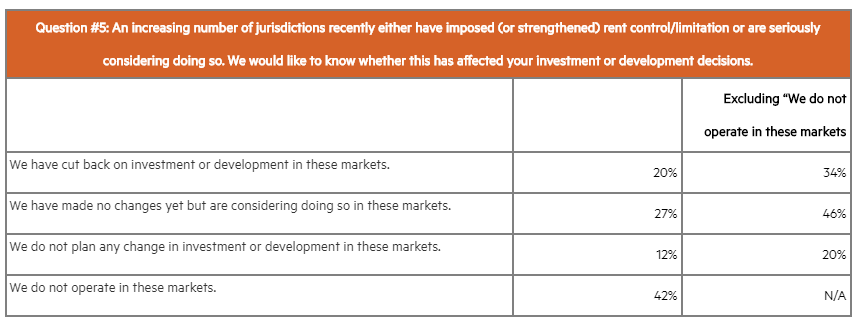
The NMHC’s Quarterly Survey of Apartment Market Conditions, conducted in October 2019, says with the continuing expansion of rent-control legislation 58 percent of survey respondents say they now operate in jurisdictions that have either recently imposed rent control or are seriously considering doing so.

Of respondents who operate in these markets:

  • 34 percent have already cut back on investment or development, up from 20 percent last quarter.
  • 49 percent are considering cutting back on investment or development going forward.

Rising Rent Control Is Slowing Development And Investment

Despite rent control, the market remains strong

While rent control has led to increased concerns, the survey found that national market conditions remain strong as the Market Tightness (54), Equity Financing (55), and Debt Financing (75) indexes all came in above the break-even level (50). The Sales Volume Index (46) indicated a continued softness in property sales.

“While there has been much speculation recently about a coming recession, these latest survey figures suggest that apartment demand continues to drive rent growth and occupancy,”  said NMHC Chief Economist Mark Obrinsky in a release.

“Twenty percent of respondents reported improving market conditions, compared to just 12 percent who observed a looser market. Lower interest rates continue to create a more favorable environment for debt financing, as 58 percent of respondents reported improving conditions.”

  • The Market Tightness Index decreased from 60 to 54, indicating improving conditions for the third consecutive quarter.  Twenty percent of respondents reported tighter market conditions than three months prior, compared to 12 percent who reported looser conditions. Over two-thirds (69 percent) of respondents felt that conditions were no different from last quarter.
  • The Sales Volume Index decreased from 48 to 46, with 31 percent of respondents reporting lower sales volume than three months prior. A slightly smaller group – 23 percent of respondents – reported higher sales volume, while 41 percent regarded volume as unchanged. Although the share of respondents indicating increased sales volume was the highest in 5 quarters, the share indicating lower sales volume grew slightly as well, causing the index to remain below 50.
  • The Equity Financing Index inched down from 56 to 55, marking the eighth straight quarter of relatively unchanged conditions. Eighteen percent of respondents reported that equity financing was more available than in the three months prior, compared to only nine percent who believed equity financing was less available. Meanwhile, the majority of respondents (60 percent) thought that conditions were unchanged in the equity market.
  • The Debt Financing Index decreased from 80 to 75. For the third straight quarter, the majority of respondents (58 percent) reported better conditions for debt financing compared to three months prior, while eight percent felt that financing conditions were less favorable. More than a quarter (27 percent) of respondents reported unchanged conditions.

Rising Rent Control Is Slowing Development And Investment

About the Survey:
The October 2019 Quarterly Survey of Apartment Market Conditions was conducted October 7-14, 2019; 102 CEOs and other senior executives of apartment-related firms nationwide responded.


4 Easy Steps to Furnishing Your Short-Term Rental Or Your Airbnb

4 Easy Steps to Furnishing Your Short-Term Rental Or Your Airbnb

Here are four easy steps to furnishing your short-term rental or Airbnb short-term rental to create a home-like appeal, in contrast to feeling like a traditional hotel room.

Guests who like traveling on their own or who are there just for a few days need a pleasant place to sleep with excellent wi-fi and a bit of advice on public transport or places to visit if they have time to do so. One suggestion: equip your rentals with anything one might need on their stay, from cutlery to city maps.

However, as any landlord would know, that kind of look that seems welcoming and effortless actually takes effort to create. Good online rankings and comments don’t come from you just having a place with a bed available for rent.

4 easy steps to furnishing your short-term rental or your Airbnb

So to help out landlords with their short-term rentals, here are four pieces of advice to easily make your rental more desirable.

No. 1: Consider the lighting

A large percentage of Airbnb guests are couples on a romantic getaway wanting to explore the city and spend some quality time together.

It would be thoughtful to consider the lighting sources in the place so they won’t be greeted by harsh,   unpleasant light. Also, from the perspective of a homeowner, you should definitely opt for LED lighting since it provides more lighting for less energy and will influence your electricity bill significantly.

As for the lighting arrangement, in the living room, you might want to go with soft white tones so that guests can watch TV or make plans about which parts of the city to visit. For the bedroom, you should invest in ambient lights to set a relaxing mood, so no harsh overhead lights or any over-the-top light displays because the lights need to be subdued and gentle.

4 Easy Steps to Furnishing Your Short-Term Rental Or Your Airbnb

No. 2: Combine cozy and practical

Forget about minimalistic sinuous furniture, which may look great but is uncomfortable. And honestly, people are not even certain how to sit without sliding off of it.

4 Easy Steps to Furnishing Your Short-Term Rental Or Your Airbnb

In the living room, go with a solution that doesn’t take up too much space and that has a storage option so that the room is always neat. To achieve that balance, use modular couches that come with shelves and are luxurious-looking but incredibly flexible in the sense that pieces can be moved. Your guests will like the fact that they can rearrange the couch based on their needs as well as being able to use its accessories to charge their smartphone wirelessly.

In the bedroom, your main focus should be on providing a quality bed – nothing is more appreciated by guests than a great night’s sleep. Then you can focus on making the room cozy and aesthetically pleasing.

No. 3: Add some artsy details

It’s true that you can’t please everyone, but your short-term rental will be more popular if it has a unique atmosphere about it as opposed to looking like a big hotel room

4 Easy Steps to Furnishing Your Short-Term Rental Or Your Airbnb

You can achieve that homey vibe, for example, by creating a travel corner so that you can place trinkets from different countries you visited; your guests might be coming from all around the world, so they might find it interesting. Otherwise, you can have different posters and interesting photographs framed and placed on the walls. Kitchen utensils and mugs don’t have to come from the same set – mix-and-match has a rustic appeal. Your guests will value those little things because they would make them feel more comfortable, and more inclined to give you a high rating.

One caution: Don’t use fragile figurines and vases; they’re just accident waiting to happen, especially if the place is pet-friendly. If you must, make sure they’re on a high shelf.

No. 4 – Place plants around the place

4 Easy Steps to Furnishing Your Short-Term Rental Or Your Airbnb

No. 4: Place plants around the place

You can achieve that homey vibe, for example, by creating a travel corner so that you can place trinkets from different countries you visited; your guests might be coming from all around the world, so they might find it interesting. Otherwise, you can have different posters and interesting photographs framed and placed on the walls. Kitchen utensils and mugs don’t have to come from the same set – mix-and-match has a rustic appeal. Your guests will value those little things because they would make them feel more comfortable, and more inclined to give you a high rating


Seattle Rents Continue Upward for 9th Straight Month

Seattle Rents Continue Upward for 9th Straight Month

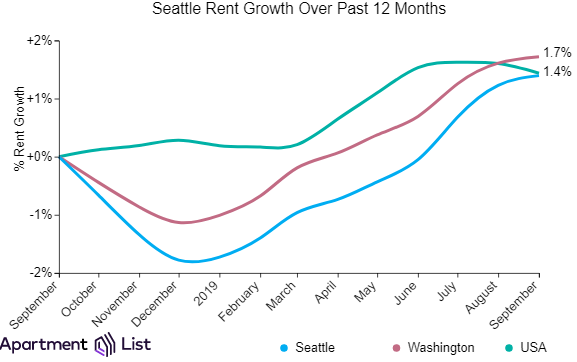
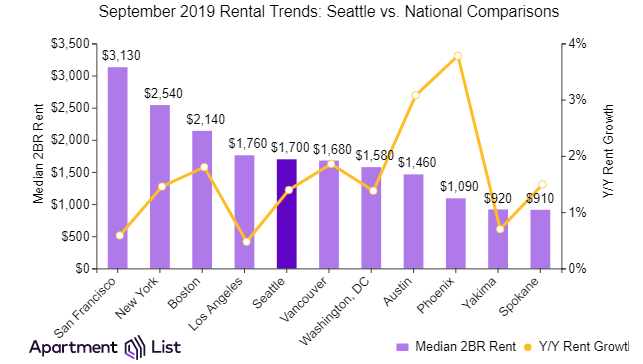
Seattle rents increased again in September, marking the ninth straight month that the city has seen rent increases after a decline in December of last year, according to the September report from Apartment List.

Over the past month, Seattle rents have increased 0.2 percent, and have increased slightly by 1.4 percent in comparison to the same time last year.

Currently, median rents in Seattle stand at $1,364 for a one-bedroom apartment and $1,698 for a two-bedroom. Seattle’s year-over-year rent growth lags the state average of 1.7 percent, but is in line with the national average of 1.4 percent.

Rents rising across the metro

Throughout the past year, rent increases have been occurring across the entire Seattle metro.

Seattle Rents Continue Upward for 9th Straight Month

Of the largest 10 cities that Apartment List has data for in the Seattle metro, all have seen prices rise.

Here’s a look at how rents compare across some of the largest cities in the metro.

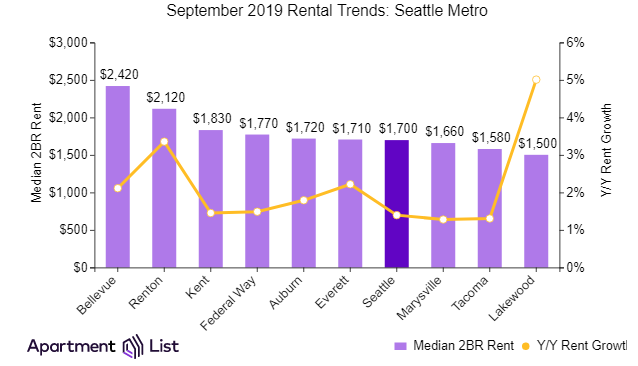
  • Lakewood has the least expensive rents in the Seattle metro, with a two-bedroom median of $1,502; the city has also experienced the fastest rent growth in the metro, with a year-over-year increase of 5 percent.
  • Over the past month, Renton has seen the biggest rent drop in the metro, with a decline of 0.7 percent. Median two-bedrooms there cost $2,116, while one-bedrooms go for $1,699.
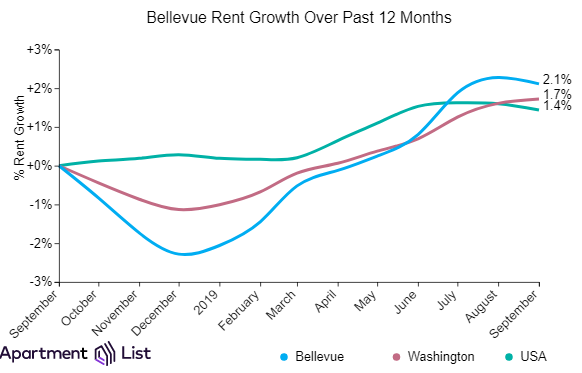
  • Bellevue has the most expensive rents of the largest cities in the Seattle metro, with a two-bedroom median of $2,420; rents decreased 0.2 percent over the past month but were up 2.1 percent over the past year.

Seattle Rents Continue Upward for 9th Straight Month

As rents have increased slightly in Seattle, a few similar cities nationwide have also seen rents grow modestly. Compared to most other large cities across the country, Seattle is less affordable for renters.

  • Rents increased slightly in other cities across the state, with Washington as a whole logging rent growth of 1.7 percent over the past year. For example, rents have grown by 1.9 percent in Vancouver and 1.5 percent in Spokane.
  • Seattle’s median two-bedroom rent of $1,698 is above the national average of $1,189. Nationwide, rents have grown by 1.4 percent over the past year, which matches the increase in Seattle.
  • While Seattle’s rents rose slightly over the past year, many cities nationwide also saw increases, including Phoenix (+3.8 percent), Austin (+3.1 percent), and Boston (+1.8 percent).

Metro trends

Last month’s report:

Seattle Rents Increase Again For Eighth Straight Month

Salt Lake City Rents Decline For Third Straight Month

Salt Lake City Rents Decline For Third Straight Month

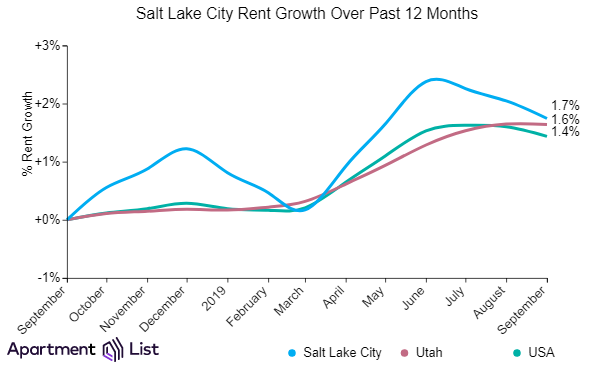
Salt Lake City rents have declined 0.3% over the past month, but have increased slightly by 1.7% in comparison to the same time last year, according to the latest report from Apartment List.

Median rents stand at $870 for a one-bedroom apartment and $1,080 for a two-bedroom.

This is the third straight month that the city has seen rent decreases after an increase in June. Salt Lake City’s year-over-year rent growth leads the state average of 1.6%, as well as the national average of 1.4%.

Ogden rents increased slightly over the past month

Ogden rents

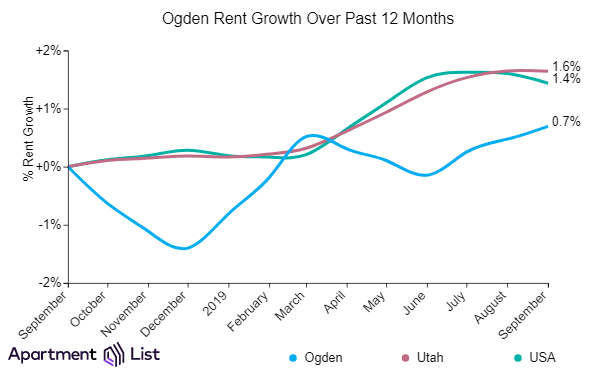
Meanwhile, Ogden rents have increased 0.2% over the past month, and are up marginally by 0.7% in comparison to the same time last year.

Currently, median rents in Ogden stand at $698 for a one-bedroom apartment and $895 for a two-bedroom. This is the third straight month that the city has seen rent increases after a decline in June.

Ogden’s year-over-year rent growth lags the state average of 1.6%, as well as the national average of 1.4%.

Rents more affordable than many large cities nationwide

Rents more affordable than many cities

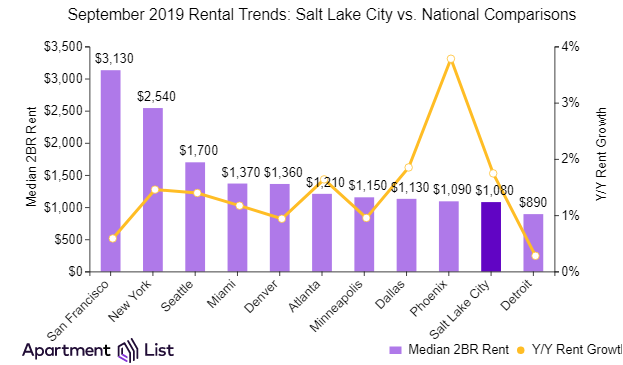
As rents have increased slightly in Salt Lake City, a few large cities nationwide have also seen rents grow modestly. Salt Lake City is still more affordable than most large cities across the country.

  • Salt Lake City’s median two-bedroom rent of $1,080 is below the national average of $1,189. Nationwide, rents have grown by 1.4% over the past year compared to the 1.7% increase in Salt Lake City.
  • While rents rose slightly over the past year, many cities nationwide also saw increases, including Phoenix (+3.8%), Dallas (+1.8%), and Atlanta (+1.6%).

Renters will find more reasonable prices in Salt Lake City than most large cities.

Report from last month:

Salt Lake City Rents Declined Slightly Over The Past Month

5 Top Technologies That Renters Want

5 Top Technologies That Renters Want

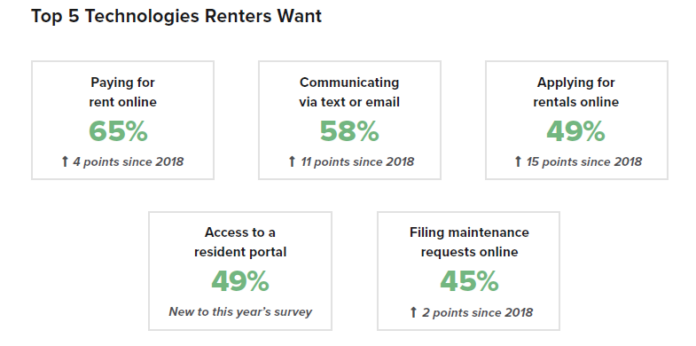
A new survey shows the 5 top technologies that renters want and that, over the last year, residents’ interest in rental technologies has grown by an average of 7 points.

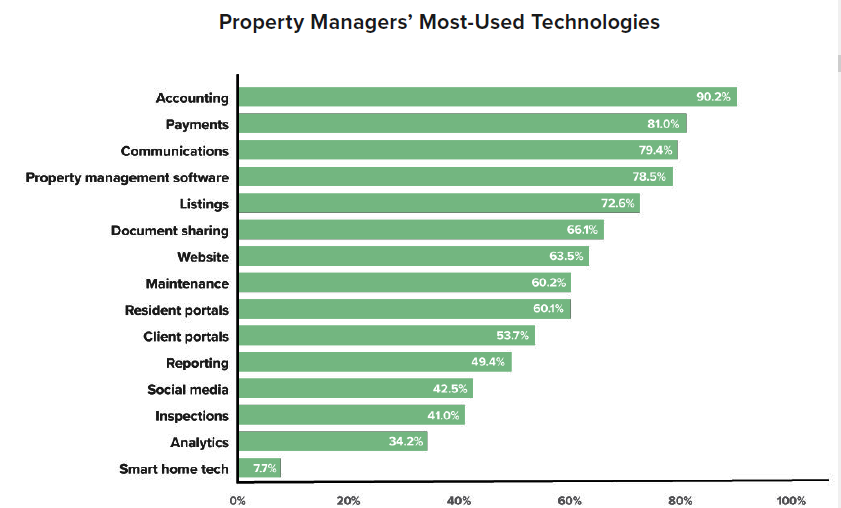
The 2020 State of the Property Management Industry Report by Buildium and the National Association of Residential Property Managers (NARPM), surveyed both property managers and renters.

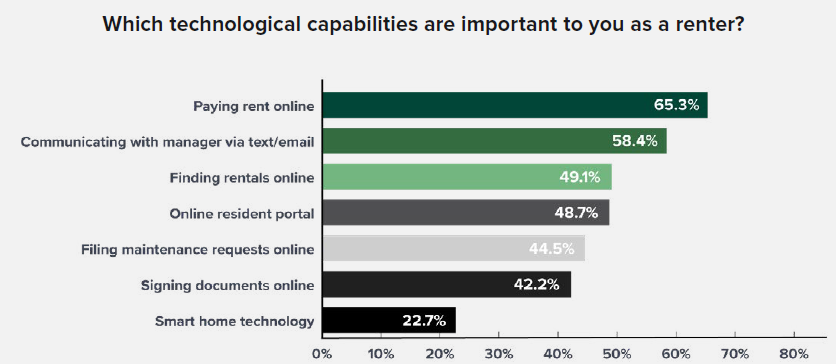
In the annual survey of 1,188 renters across the county, Buildium and NARPM found the biggest gains in interest among renters were in applying for rentals online (+15 points), communicating with their property manager via text or email (+11 points), and signing leases and other documents electronically (+8 points).

Though interest has stayed roughly constant among Gen Z and Millennial renters over time, Gen X residents and Baby Boomers are far more interested in technology than they were just a year ago: On average, interest in rental technologies has grown by 8 points among Gen Xers and 10 points among Baby Boomers, according to Buildium’s 5th Annual State of The Property Management Industry Report.

Though Millennials are the most enthusiastic about technology overall, more than half of Gen Z, Millennial, Gen X, and Baby Boomer renters want the ability to pay rent online and communicate with their property manager via text or email.

How residents want to pay

technologies renters want and capabilities


Gen Z, Millennial, and Gen X renters all agree that they prefer to pay their rent via electronic payment, electronic bank transfer, or credit/debit card over writing a check.

Though most Baby Boomers still feel more comfortable paying by check, nearly 1 in 3 would rather pay online. Residents of all ages appreciate having the option to pay their rent online, and their expectation to be able to handle this and other tasks digitally increases with every year.

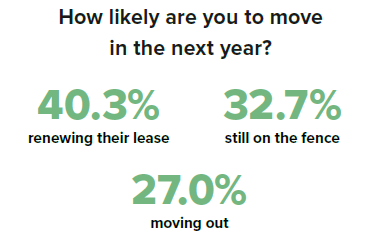
The survey also showed two in five renters definitely plan on renewing their lease for another year—a number that stayed constant from 2018 to 2019.

technologies property managers use

How the “typical renter” definition is evolving and what renting means to residents

“In the past, we’ve thought of renting as a temporary rite of passage for those who haven’t yet set down roots or saved enough for a down payment on a home of their own. But for many Americans today, renting is a lifestyle choice, as well as a necessary alternative to homeownership for those whose finances were irreparably altered by the Great Recession,” the report says.

As a result, property managers’ strategies for attracting and retaining renters will need to evolve to fit a broader demographic than they’ve seen in the past.

how likely are residents to move in the next year

Renters’ desire to own a home of their own varies logically by age: Gen Z residents are happy renting for now, but assume that they’ll want to become homeowners down the road.

Millennials and Gen X renters are highly interested in homeownership, but are waiting for the right time to buy. Baby Boomer residents are largely former homeowners who either prefer to rent or have financial reasons for doing so at this time in their lives.

The report was produced by Buildium in partnership with the National Association of Property Managers (NARPM).

Strong Demand For Apartments Shows In Strong Demand For Apartment Jobs

Strong Demand For Apartments Shows In Strong Demand For Apartment Jobs

The strong demand for apartments across the country also shows up in the strong demand for apartment jobs, according to the latest report from the National Apartment Association.

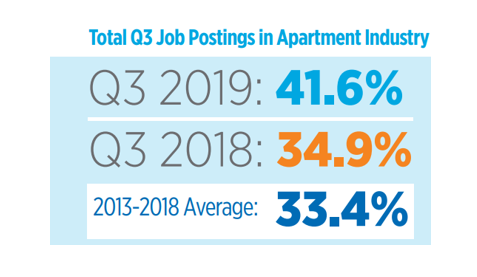
More than 41 percent of available real estate jobs in the U.S. were in the apartment sector, increasing from 34.9 percent in from the third quarter in 2018, according to the NAAEI’s Apartment Jobs Snapshot.

Strong Demand For Apartments Shows In Strong Demand For Apartment Jobs

Occupancy up to 96.3 percent

A hectic leasing season yielded 118,000 move-ins during the third quarter.

Also, occupancy soared to 96.3 percent, as reported by RealPage.

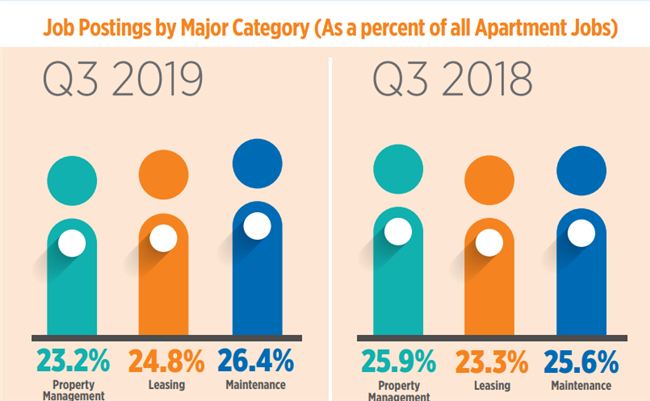
Maintenance positions remained in greatest demand during the third quarter, increasing by 0.8 percentage points since the second quarter of 2018.

Leasing consultant apartment jobs in high demand

Strong Demand For Apartments Shows In Strong Demand For Apartment Jobs

Leasing consultant job postings had the largest growth in demand year-over-year with an increase of 1.5 percentage points.

In fact, leasing consultants had the highest growth in demand over the past five years, increasing by 1.7 percentage points.

Compared to five years ago, there has been an increase in employers seeking candidates who are skilled in Yardi Software, Microsoft Office and teamwork/collaboration.

Phoenix led nation in rent growth

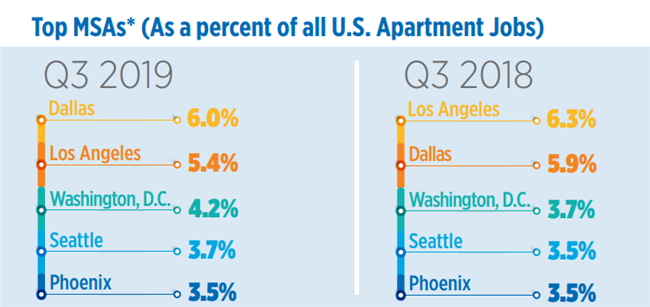
Consistent with third quarter of 2018, Dallas, Los Angeles, and Washington D.C. had the greatest demand for apartment jobs in 2019. However, Phoenix continues to rank as one of the top preforming apartment markets. According to RealPage, Phoenix led the nation in annual rent growth with an increase of 8.2 percent.

Strong Demand For Apartments Shows In Strong Demand For Apartment Jobs

National apartment association jobs report background

 The NAA jobs report focuses on jobs that are being advertised in the apartment industry as being available, according to Paula Munger, Director, Industry Research and Analysis, for the National Apartment Association’s Education Institute.

“Our education institute is a credentialing body for the apartment industry. They hear often that one of the biggest problems keeping our industry leaders up at night is the difficulty in finding talent, attracting talent and retaining talent,” Munger said.  “Labor-market issues are happening in a lot of industries, certainly with the tight labor market we have.”

NAA partnered with Burning Glass Technologies. “They have a labor-job posting database that is proprietary,” she said, and they can “layer on data from the Bureau of Labor Statistics (BLS). We looked at that and thought we could do something that is really going to help the industry and help benchmark job titles and trends as we go forward,” Munger said.

August report from the NAA:

Portland Apartment Jobs Almost 60 Percent Of All Real Estate Jobs