Home Blog Page 155

Rents Rise, As Do Political Pressure and Rent Control

Rents Rise, As Do Political Pressure and Rent Control

Multifamily rents in the United States reached a new high in October, signaling strength and resilience across the industry but also provoking a backlash among advocates for renters and their allies in state governments as political pressure and rent control rise as well, according to the latest report from Yardi Matrix.

The multifamily market continued its strong performance into the fourth quarter, as demand remains almost insatiable, the report says. However, it adds, “We think rent-control measures are counterproductive.”

Some highlights of the latest report

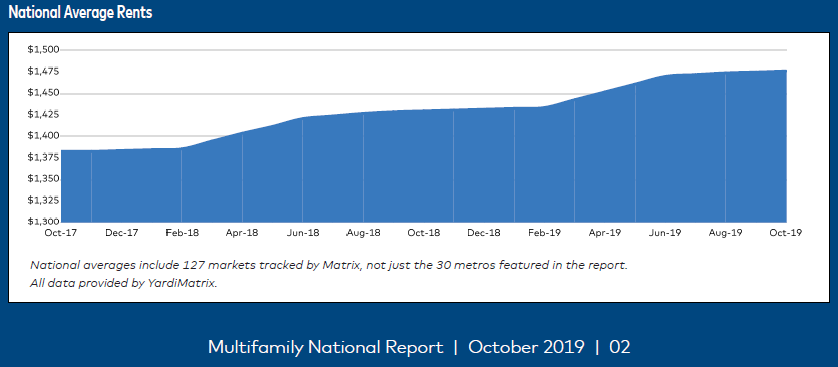
  • Multifamily rent growth inched upward in October, as the average U.S. multifamily rent increased by $1 to $1,476. Year-over-year rent growth remained at 3.2 percent.
  • Although subject to some seasonality by metro, the multifamily market continues to consistently produce strong rent growth.
  • Of the 30 major markets covered by the report, 17 saw year-over-year rent growth of at least 3.3 percent and only two (San Jose and Houston) were much below the 2.5 percent long-term average.
  • The extended period of good performance has produced one bad side effect: legislation enacted in three states to limit rent growth and pressure to act in more states.
  • After a period of below-par growth in housing stock, the country needs more units built, but rent control moves the needle in the opposite direction.

Year-Over-Year Rent-Growth Leaders

The fourth quarter is often a slower time for rent growth, but continuous demand and a slowly growing economy will likely keep rent growth above its long-term average, the report says.

Phoenix, at 7.9 percent, and Las Vegas, at 6.4 percent, remain at the top of our rankings.

However, three Southeastern markets that have absorbed significant amounts of new supply have recently re-entered the top 10. Raleigh, at 5.1 percent; Charlotte, at 4.8 percent; and Nashville, at 4.6 percent have some of the strongest demographic demand for multifamily housing in the nation, but high deliveries had weighed on rent growth for many of the past few years.

However, absorption remains very strong, and rents are growing accordingly.
Rents Rise, As Do Political Pressure and Rent Control

Political pressure and rent control

Multifamily sector performance has been stellar for years, with the average U.S. apartment rent up by 32 percent since January 2012, according to Yardi Matrix. That success has created pressure for legislation to put a lid on rent growth.

Rent growth means the number of rent-burdened households is rising. More than 20 million renter

households spend over 30 percent of income on housing, and 80 percent of renters and 63 percent of owners making less than $30,000 are cost-burdened, according to the Joint Center for Housing Studies at Harvard University.

  • So far this year, Oregon, New York, and California have passed measures to limit rent increases, and more than a dozen other states are considering laws.
  • Rent control has proven to be a counterproductive solution in that it reduces investment and limits badly needed new supply.

Owners also used to be able to increase rents in conjunction with capital improvements to prop­erties.

Now, however, landlords can only get rent increases on $15,000 of improvements over a 15-year period. If landlords can’t recoup capital spent on improvements, they won’t make the improve­ments or will do it with lesser-quality materials. This can all lead to deterioration of units.

Legislatures need to address the affordable-hous­ing crisis, but the best solution involves making it easier to build units that low- and middle-class households can afford. That means reducing ex­clusionary zoning, allowing more density, alleviat­ing red tape and fees for developers, and subsidiz­ing developments.

Demographics Continue To Drive Multifamily Demand

Multifamily Growth on Track to Continue at 3 Percent Annually

Yardi Matrix is a business development and asset management tool for investment professionals, equity investors, lenders, and property managers who underwrite and manage investments in commercial real estate. Yardi Matrix covers multifamily, industrial, office and self storage property types. Email matrix@yardi.com, call 480-663-1149 or visit yardimatrix.com to learn more.

About Yardi

Yardi develops and supports industry-leading investment and property management software for all types and sizes of real estate companies. Established in 1984, Yardi is based in Santa Barbara, Calif., and serves clients worldwide. For more information on how Yardi is Energized for Tomorrow, visit yardi.com.
Sign Up For Our Newsletter And Get Apartment News And Helpful, Useful Content Each Week.

* indicates required


Seattle’s Linden Square Apartments Sold For $52 Million

Seattle’s Linden Square Apartments Sold For $52 Million

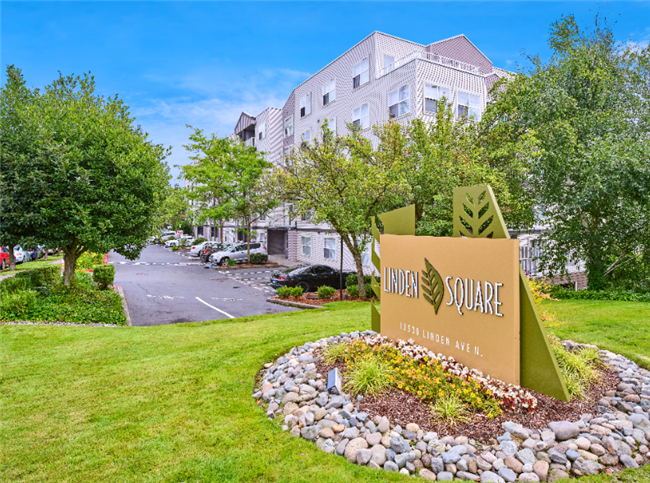
Two companies have purchased the 186-unit Linden Square Apartments in North Seattle for $52,750,000, according to a release.

RISE Properties Trust (“RISE”) a Canadian real estate trust based in Seattle, and Aegon Real Assets US (“Aegon RA”), an indirect wholly owned subsidiary of Aegon N.V., a multinational life insurance, pensions and asset management company headquartered in the Netherlands, announced the sale.

Located a short distance northwest of Northgate Mall, the multifamily community was built in 1993 and features a mix of one-, two- and three-bedroom units, a fitness center and pool, as well as ample garage parking, storage, and amenity space.

The property is a short walk to Bitter Lake and its adjoining playfield amenities, as well as a rapid ride transit stop, which features service every four minutes during peak hours. In addition, the location has strong accessibility to major Seattle employment nodes by way of short drives to both Highway 99 and Interstate 5.

“Linden Square is a rare, transit-oriented asset that will benefit from our expertise in acquiring, renovating and operating multifamily properties. Having recently completed a number of successful renovation projects in the area, we are excited for the opportunity to unlock the potential at Linden Square by reimagining the asset’s branding and leasing experience, as well as its amenity and apartment offerings,” said Beau Madsen, Investment Manager at RISE, in the release.

Also in the release, Cameron Jones, Head of Real Estate Equity Acquisitions for Aegon RA, said, “The acquisition of Linden Square Apartments is another illustration of Aegon RA’s investment strategy, which focuses on acquiring, improving and preserving workforce housing in select metros across the U.S.  The venture with RISE showcases alignment with regional experts and leverages our experience and depth of relationships in the multi-family sector.”

Including Linden Square Apartments, RISE owns approximately 3,200 units across 20 multifamily properties in the Pacific Northwest.

The property will be managed by Thrive Communities, a Seattle-based property management firm with approximately 12,000 apartments under management.

 The transaction, brokered by CBRE, represents the third joint venture between the companies this year.

About RISE Properties Trust

RISE Properties Trust is a publicly-offered non-traded Canadian REIT focused on the U.S. multifamily sector in the Pacific Northwest. The Trust works to acquire underperforming apartment properties and improve their operations, cash flow, and value.

About Thrive Communities

Thrive Communities is an award-winning property-management firm with approximately 12,000 apartments under management.  Their in-house renovation platform has improved more than 5,000 apartments on both an occupied and vacant turn process.

About Aegon Real Assets US

Aegon Real Assets US is an indirect wholly owned subsidiary of Aegon N.V., a multinational life insurance, pensions and asset management company headquartered in the Netherlands. Aegon RA provides yield-oriented private debt and equity strategies and specialty solutions.  The company manages manages and advises $21 billion in real assets.


Resident Preferences Show In-Person Tours Of Apartments Before Renting Still Important

Resident Preferences Show In-Person Tours Of Apartments Before Renting Still Important

Resident preferences show most renters still prefer an in-person tours of apartments with a representative, according to a new resident-preferences report from the National Multifamily Housing Council (NMHC).

“While emerging technologies have allowed communities to offer virtual tours and other opportunities for online engagement, we found that the majority of renters still prefer an in-person tour with a community representative,” said Rick Haughey, Vice President, Industry Technology Initiatives, NMHC, in a release,

“That said, 14 percent of renters noted they would rent an apartment sight-unseen,” he said in the resident preferences report.

The NMHC and Kingsley Associates report provides a look at what apartment residents want and need in their next homes. The NMHC says the report is the largest-ever collection of apartment-resident insights, featuring input from nearly 373,000 renters living in 5,336 communities across the United States.

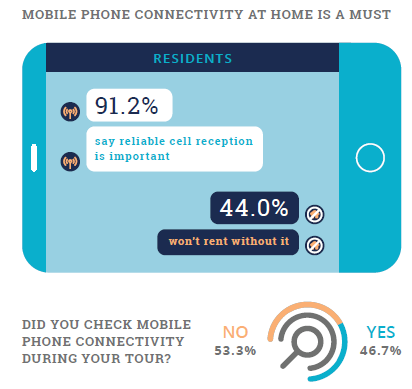
Resident Preferences Show reliable mobile phone connectivity is a must

The report details the apartment features and community amenities that renters can’t live without, how much they expect to pay for them, and what matters during their apartment search.

Resident Preferences Show renters want internet everywhere

Topics and trends covered in the resident preferences report

  • Short-term rentals.The view on whether short-term rentals are allowed on site is strongly reflective of resident age, with younger renters expressing more interest. Nationally, nearly 60 percent of respondents said having short-term rentals would either positively impact their perception of a community or have no effect at all; conversely, 16 percent said they wouldn’t rent at a community that allowed short-term rentals.
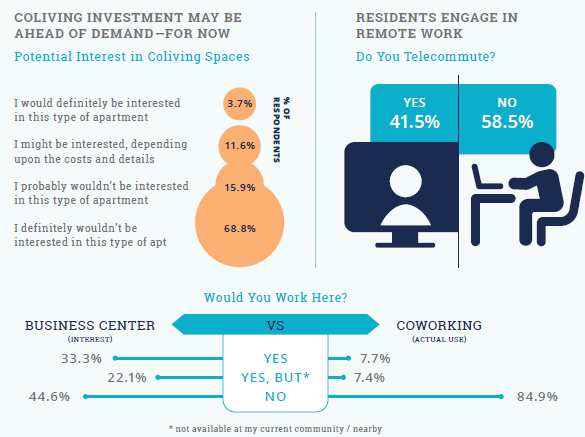
  • Co-working.While 42 percent of survey respondents said they telecommute at least part of the time, just 15 percent said they either had used or would use a coworking space, while 55 percent said they were interested in an on-site business center.
  • Co-living.Despite a lot of investment in co=living start-ups, nationally, apartment residents remain skeptical about the trend—at least for now—with 69 percent saying they definitely would not be interested in this type of living arrangement.
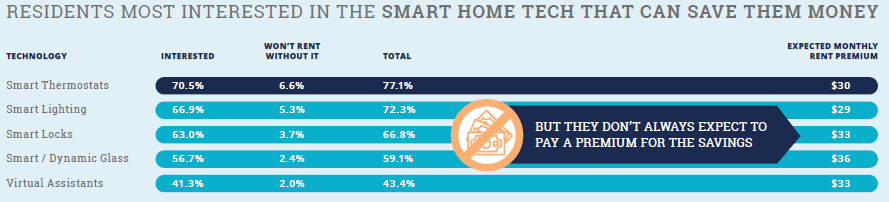
  • Voice-activated technology.Forty-three percent of respondents said they were interested in or would not rent without voice-activated virtual assistants like Amazon’s Alexa or Google Home. More than a third said they already owned such devices.
  • Pet amenities.More than one-third of respondents were pet owners, with the majority having dogs. Dog owners, in turn, said they expected to pay between $28 and $34 more per feature per month for perks like a community dog park, pet-washing station or on-site pet services.

Resident Preferences Show coliving not popular, yet

“The 2020 Apartment Resident Preferences Report offers an in-depth look at what renters expect when choosing where to live,” said John Falco, Principal, Kingsley Associates, in the release.

“This data is invaluable for not only developers, architects and designers looking to build a new community or renovate an existing community, but also for property managers and leasing agents trying to improve the renter experience for current and future residents.”

Resident Preferences Show renters want smart home technology that saves them money.

Purchase the 2020 NMHC/Kingsley Apartment Resident Preferences Report

Resident Preferences Show In-Person Tours Of Apartments Before Renting Still Important

About the Survey

Since its inception in 2013, the NMHC/ Kingsley Associates Apartment Resident Preferences Report has been the authoritative data source for apartment owners, managers, developers, industry suppliers, as well as architects, financial institutions and others seeking insights into the mind of apartment residents. This biennial survey provides users with reliable data to make a variety of investment, development and operational decisions. For the 2020 report, 372,944 apartment residents from 5,336 professionally managed apartment communities responded to the survey.

Demographics Continue To Drive Multifamily Demand

Sign Up For Our Newsletter And Get Apartment News And Helpful, Useful Content Each Week.

* indicates required


Demographics Continue To Drive Multifamily Demand

Lack of New Construction Underlying Cause of Oregon Housing Affordability Crisis

Demographics continue to drive multifamily demand,  and along with lifestyle changes, will continue to fuel strong demand and the need for 425,000 multifamily rental units per year, Yardi Matrix experts said in a recent webinar.

An aging population, increasing divorce rates, and more young people who haven’t yet moved out of their family homes all contribute to the strong multifamily demand.

Jeff Adler, vice president of Matrix, and Jack Kern, director of research and publications, presented the Yardi Matrix 2019 Multifamily Market Update during the webinar.

“Overall, the multifamily industry is performing well, with strong demand, level new supply, and strong rent growth,” they said during the webinar.

Demographics drive multifamily demands

  • Total housing production is unlikely to catch up to household formation, putting upward pressure on rents and occupancy rates and pressures for rent control, the report says.
  • Economic growth and population continue to move south and west to “intellectual capital nodes within tech hub markets,” they said in the report.
  • For new investments, “it’s a sharpshooter’s game to find the right deal at the right price, and on the operational side, it’s about finding revenue and cost-trimming opportunities to grow your net operating income from your existing assets.”
  • Total renter demand will be two-thirds multifamily and one-third single family.

Predictions are that single-family rent growth will continue to exceed that of multifamily, they added in the report. However, as home values continue to rise, the cost of home ownership is growing faster than multifamily rents.

Growth of apartment supply

In looking at the supply of new multifamily units coming, Adler and Kern said national supply growth is expected to remain level with 2018 deliveries for the next few years.

  • At the market level, gateway and tech hub markets have had the most deliveries in 2019.
  • “Our analysis of construction durations showed recent improvement in duration in most markets after several years of increasing construction timelines.”
  • “Despite a large number of deliveries, Dallas, Seattle and Austin had strong absorption of new units, while most other markets struggled.”
  • “Our new supply forecast shows Dallas, Seattle and Denver topping the list for the most deliveries expected between 2019 and 2022; however the new supply will be focused in different submarkets, making the future supply-demand picture for these markets look less grim,” they said in the report.

Takeaways from new rent-control legislation

The webinar report also covered the political side of the affordability crisis in housing.

The summary and takeaways for California and Oregon markets were:

  • They are livable for now, if you are already in the market;
  • On the investment side, the question is: What is your exit strategy?
  • The value-add trade will become less feasible;
  • There’s a slow grind of capital out of California; and
  • Less capital is likely to enter Oregon.

Get the full Yardi Matrix report here.

Multifamily Growth on Track to Continue at 3 Percent Annually

Yardi Matrix is a business development and asset management tool for investment professionals, equity investors, lenders, and property managers who underwrite and manage investments in commercial real estate. Yardi Matrix covers multifamily, industrial, office and self storage property types. Email matrix@yardi.com, call 480-663-1149 or visit yardimatrix.com to learn more.

About Yardi

Yardi develops and supports industry-leading investment and property management software for all types and sizes of real estate companies. Established in 1984, Yardi is based in Santa Barbara, Calif., and serves clients worldwide. For more information on how Yardi is Energized for Tomorrow, visit yardi.com.
Demographics Continue To Drive Multifamily Demand

Sign Up For Our Newsletter And Get Apartment News And Helpful, Useful Content Each Week.

* indicates required


Man Who Threatened to Kill His Landlords Sentenced to 40 Years

Man Who Threatened to Kill His Landlords Sentenced to 40 Years

A Beaverton, Oregon man who threatened to kill his landlords and used mercury to deter people from entering his apartment has been sentenced to 40 years in prison, a sentence “commensurate to the danger he posed to his neighbors in the community,” according to the U.S. Attorney for Oregon.

Jason Paul Schaefer, 28, of Beaverton, Oregon, was sentenced to 40 years in federal prison and 5 years’ supervised release for detonating an improvised explosive device on October 11, 2017, and assaulting two members of the Portland Joint Terrorism Task Force (JTTF), according to a release.

In May 2019, Schaefer was convicted after a six-day trial of two counts of assaulting a federal officer and one count each of carrying and using a destructive device during and in relation to a crime of violence, carrying and using an explosive during the commission of a federal felony, unlawful transport of explosive materials, possession of an unregistered destructive device and being a felon in possession of explosives.

“The government may never fully know why Mr. Schaefer amassed a large quantity of dangerous precursor chemicals and the components needed to make a large, remote-detonating bomb. What we do know is that on October 11, 2017, he tried to kill two federal task force officers attempting to make a lawful arrest,” said Billy J. Williams, U.S. Attorney for the District of Oregon, in a release.

“We owe a debt of gratitude to the JTTF agents and partners and our prosecutors for protecting our community by taking this violent criminal off the streets. This prosecution affirms the critical public safety mission of the JTTF and the need for continued and active participation of all federal, state and local partners,” Williams said in the release.

Man who threatened to kill his landlords

According to court documents and evidence presented at trial, FBI Portland determined that Schaefer had purchased several items that could be used to make a bomb. The threat to kill his landlords and the use of mercury led to Schaefer being arrested and prosecuted for illegally possessing body armor.

Federal agents and task force officers executed a search warrant on Schaefer’s Beaverton apartment in October 2017, according to the release. Schaefer arrived that morning at a meeting with his probation officer to find two federal agents there to meet him. They notified Schaefer of the warrant and asked if his property was booby trapped. Schaeffer told the agents that it was not and the search commenced.

After a brief conversation with the agents, Schaefer departed in a white sport utility vehicle. The agents followed Schaefer, but lost him. Meanwhile, agents searching Schaefer’s apartment found several explosive precursors and electronic matches. While the search was ongoing, Schaefer returned to the apartment and threatened a task force officer before fleeing, according to the release.

Two task force officers pursued Schaefer, who soon got stuck in traffic.

The officers approached Schaefer on foot and ordered him out of the vehicle. Schaefer did not comply, threatened to kill the officers and ignited an explosive device concealed in a cigarette pack. The blast caused significant injury to Schaefer’s hand and sent debris flying into one of the officers, who suffered bodily injury. Following the explosion, Schaefer was arrested and officers found a second cigarette pack containing explosives in his vehicle.

The Portland JTTF includes FBI special agents and more than a dozen state and local law enforcement officers.

Related story from 2016:

Two Property Managers Shot During Eviction At Portland Apartments

Man Who Shot Portland Property Managers Sentenced to 13 Years

Sign Up For Our Newsletter And Get Apartment News And Helpful, Useful Content Each Week.

* indicates required


Apartment Mystery Maintenance Call Spilled Bleach

Apartment Mystery Maintenance Call Spilled Bleach

The latest apartment mystery maintenance call from Keepe comes from Seattle, where a property manager called in distress with an emergency after a tenant had spilled a jug of bleach on the garage floor.

Due to its highly corrosive nature, the bleach dug through the garage floor and corroded it.

The incident started out when the tenant decided to call her property manager and explain what happened.

It turns out the tenant was simply cleaning out her garage and knocked over the jug of bleach by accident.  She was not doing work on the garage on her own, just a routine cleaning.

After the manager called, a worker was assigned and got to the garage in about an hour to assess the extent of the corrosion.

After inspecting the damage to the garage floor, they did the following:

  • Patched the corroded floor.
  • Cemented the entire garage floor to restore it to its original condition.

The repair project took about four to five hours and cost $399, which included $89 for materials.

This was an expensive job for an accidental spill of a jug of bleach, and led to a lengthy dispute between the property manager and the tenant over who would pay the cost.

In the end, the tenant agreed to be the one to cover the cost.

Apartment Mystery Maintenance Call Of The Week: Hornets In My Rental

Apartment Mystery Maintenance Call Of The Week: Why Is Only Hot Water Coming Out of the Kitchen Faucet?

Apartment Mystery Maintenance Call Of The Week

About Keepe:

Keepe is an on-demand maintenance solution for property managers and independent landlords. The company makes a network of hundreds of independent contractors and handymen available for maintenance projects at rental properties. Keepe is available in the Greater Seattle area, Greater Phoenix area, San Francisco Bay area, Portland, San Diego and is coming soon to an area near you. Learn more about Keepe at https://www.keepe.com

Sign Up For Our Newsletter And Get Apartment News And Helpful, Useful Content Each Week.

* indicates required


California Set To Try Again On Proposition 13 Repeal

California Set To Try Again On Proposition 13 Repeal

A vote that could undo Proposition 13 property tax protection in California could lead to future initiatives to tax multifamily properties.

By Carole Ellis

When Californians head to the polls next November, they will be presented with a ballot measure titled, “The California Schools and Local Communities Funding Act” that purports to “restore over $12 billion per year to California’s schools, community colleges, health clinics, and other vital local services,” as  local advocacy group SchoolsAndCommunitiesFirst.org describes it.

If voters opt to pass this bill, they will officially undo Proposition 13 property tax protection for Californians on all commercial and nonresidential properties, which may feel irrelevant to many apartment owners and landlords in the state.

However, warned Tracey Hernandez, founding CEO of the Los Angeles-based nonprofit Business Federation (BizFed), this legislation could create a landslide of future initiatives that will not only affect multifamily property owners immediately but place single-family rental owners and their tenants squarely in the crosshairs as well.

“This measure will take all commercial property taxes to a new appraised value to the tune of $11 billion a year,” she explained in a session at Standard Management Company’s annual “The Magic of Real Estate” conference on October 29, 2019.

“The money will go for a variety of things: 40 percent for education, 60 percent to do a variety of other work. The problem we have is that it is a ‘split role,’ which means splitting the types of properties and saying, ‘Of course, commercial properties and businesses will foot the bill. There is a fault in that argument,” she said.

Hernandez warned that many California voters will likely believe single-family rental owners and renters are protected because the bill only raises taxes on commercial properties. However, multifamily properties will, in at least some cases, be included in that tax hike. Those costs will be passed, at least in part, on to tenants as property owners struggle to meet rising tax bills.

“People may say that single-family rentals are protected, but…landlords and renters will be right around the corner for the next tax increase,” Hernandez added.

History of Proposition 13

The California legislature passed Proposition 13 in 1978, and the measure has held despite multiple attempts to repeal it over the years. It has often been called the “third rail” of California politics because repealing it has historically been extremely unpopular. However, targeting commercial properties instead of residential ones could be the first step in successfully rolling it back.

The act, officially titled The People’s Initiative to Limit Property Taxation, limits the tax rates for real estate by assessing values at 1976 value and restricting annual increases of assessed value to an inflation factor that cannot exceed 2 percent per year. When Prop 13 passed, it received enormous publicity across the country and likely contributed to the 1980 presidential election of Ronald Reagan.

If California lawmakers succeed in repealing the act, this will likely also reverberate across the country, as other states and cities with high property values attempt to adjust their own tax codes to access previously protected property tax revenues.

Rent Control Measures Go into Effect on a Local Level in California

Danielle Peretz, director of government affairs and external relations for the Apartment Association of Greater Los Angeles, also commented on legislation aimed at California landlords during the conference. California governor Gavin Newsom recently signed a statewide rent-control bill into law that will cap annual rent increases and extend other “rent-control protections” starting in 2020, but the ramifications of the legislation already are in full effect.

“The issue of rent control is not just a state issue, it is a local issue as well,” Peretz said. “Los Angeles County, Inglewood, and Culver City are among the local areas working toward permanent ordinances.

“For example, Inglewood will be considering moving toward an ordinance that would cap rent increases at 8 percent and include relocation assistance,” Peretz said.

She also noted that local areas are moving immediately to counter potential landlord strategies to raise rents before the statewide bill goes into effect on January 1, 2020. These countermoves include an LA City Council decision to prohibit 60-day notices that took effect on October 24, 2019 and applied to any 60-day notice already in effect, thereby voiding everything back to August.

The state and local legislation governing rent-rate increases have created a windfall of positive publicity for the governor and other legislators promoting their efforts to combat housing affordability issues in the notoriously unaffordable state. It is likely lawmakers in other markets dealing with similar issues may mimic the regulatory moves if the positive press continues.

BizFed.org often works with the Apartment Association of Greater Los Angeles to share information among business associations and real estate-related groups in the Los Angeles area. “We share fast-moving intelligence, know when things are moving, promote brand-new ideas, and strengthen the voice of business,” Hernandez said.

About the author:

Carole Ellis is the editor-in-chief of Self-Directed Investor magazine, a national print and digital publication for investors using their retirement accounts to invest in alternative assets, including real estate and private mortgage notes. Learn more at SDImagazine.com or email Carole at Carole@selfdirected.org. Learn more about Standard Management Company’s real estate conferences at StandardManagement.com.

California Set To Try Again On Proposition 13 Repeal
San Jose, California skyline photo credit Andrei Stanescu via istockphoto.com

Sign Up For Our Newsletter And Get Apartment News And Helpful, Useful Content Each Week.

* indicates required


The Job of Property Management Is Changing, Survey Shows

The Job of Property Management Is Changing, Survey Shows

How the job of property management is changing “came through loud and clear” in this year’s annual survey of property managers, said Chris Litster, CEO of Buildium, in a recent webinar.

Litster presented the 2020 State of the Property Management Industry Report along with National Association of Residential Property Managers (NARPM) CEO Gail Phillips.

The survey was actually three surveys in one, including 1,738 property managers, 217 community managers, 1,118 tenants and 603 owners and investors in more than 50 cities.

“What we heard loud and clear is that property management has changed,” Litster said. “Property management is complex, yes, but what has changed is the environment around it.”

He cited five substantial elements, macro trends, that show how property management is changing.

  • Cost of housing
  • Legislation and regulation
  • Industry consolidation and owner mix
  • Changing tenant demographics and generations
  • How technology is changing everything

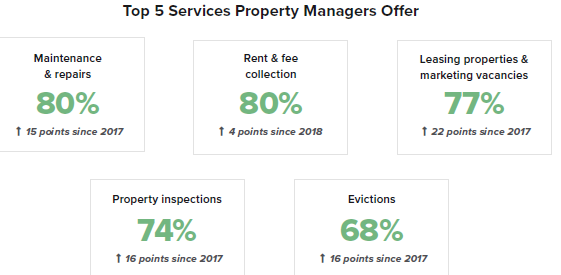
Property management is changing and offering more services

The Job of Property Management Is Changing, Survey Shows

Across the board, property managers are offering more services than ever before.

This is a way for property managers to diversify their revenue streams and find new ways to demonstrate their value to clients in a shifting market. Of particular note are services like property sales and brokering, financial reporting, building renovation, and investment advice, which have experienced average gains of 14 points over the last three years.

These are the types of services that are taking on new importance as landlords sell rentals, investors acquire rentals, and owners of all types keep a close eye on their properties’ profitability.

The Job of Property Management Is Changing, Survey Shows

Business growth opportunities for property managers

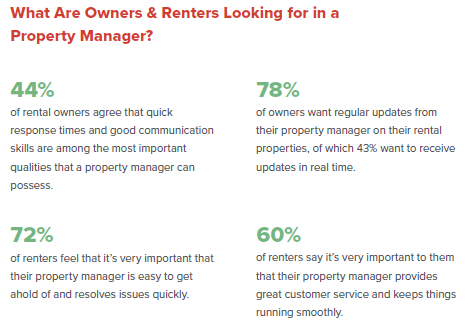
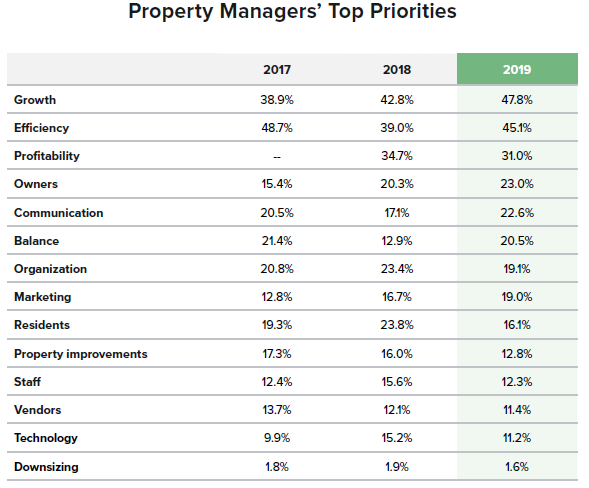
The survey shows that 48 percent of property managers named growth a top priority this year—an increase of 9 points since 2017.

“Growth is the top priority,” Phillips said, and “the importance of efficiency has rebounded this year.” Profitability expectation was lower.

Though fewer property managers reported portfolio growth in 2019 than in years past, 70 percent did add new properties to their portfolios in the last 2 years.

Portfolio loss has prevented many property managers from achieving significant growth recently, with a strong seller’s market motivating some rental owners to sell their properties. In response, property managers have found innovative ways to generate more revenue without adding new doors, from expanding their services to retooling their fee structures and more.

“However, another piece to the profitability question that has really exploded is legislation and regulation,” Phillips said. “There are a lot of changes that are going on here and I just want to note we are looking through the lens of how it impacts our industry. This is not about politics. This is how these policy changes impact our economy. “

Phillips read a response from a participant in the survey that said, “So as laws become more restrictive we are forced to take additional precautions in our leasing processes and resident-retention policies. This is not always perceived well by owners and residents.”

Phillips said in an effort to combat housing-related issues NARPM is seeing “a lot of new regulations pop up, and we are trying to work with our localities. This is just the beginning.”

The Job of Property Management Is Changing, Survey Shows

Top priorities for property managers

Property managers are laser-focused on growth and efficiency above all else—as they have been for four years straight, according to the survey

In our recent seller’s market, growth hasn’t come naturally, the survey says.

Property managers have had to fight to maintain their profitability and client base—their third and fourth most-selected priorities for the coming year. In addition, many have renewed their focus on effective communication with their residents, owners, and employees, needed in this fast-moving era where technology both facilitates and hinders relationships.

The Job of Property Management Is Changing, Survey Shows

The future of property management

“Property management increasingly resembles the hospitality industry,” Phillips said in the webinar. “The role is becoming more of a consultant, especially as regulations complicate things for the landlords. Relationships are still the most important thing despite all prop-tech hype,” she said during the webinar.

“Customers are drawn to high-touch, personalized experiences,” she said. “It should all be in service to a strategy that creates great tenant experience and customer experience,” she said.

In addition, a few takeaways:

“First and foremost, make sure you ground every decision you make in the experience and relationships you are seeking to create with your owners and managers.

“Remember, focus on your local expertise. Property management cannot be handled on a national level. Awareness of local market trends matter.

“Diversify your revenue stream, and most of all keep learning and stay connected and take advantage of the learning opportunities out there for you,” Phillips said.

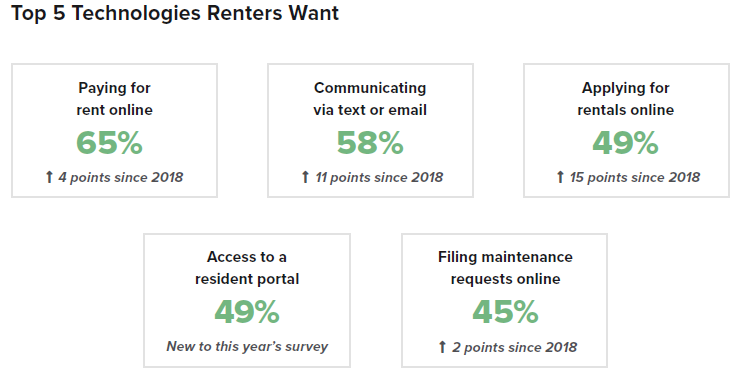
5 Top Technologies That Renters Want

5 Top Technologies That Renters Want

Resources:

Download Buildium’s 2020 State of the Property Management Industry Report

Buildium property management software

National Association of Residential Property Managers

The Changing Role of the Property Manager from Handyman to Almost An Attorney

Sign Up For Our Newsletter And Get Apartment News And Helpful, Useful Content Each Week.

* indicates required


How To Find A Contractor You Can Trust

How To Find A Contractor You Can Trust

Advice on how to find a contractor you can trust, and how to find trustworthy vendors for your rental property, by veteran property manager Corey Brewer.

By Corey Brewer

Vendor relationships are a critical component of a successful property management operation, whether you manage one home or thousands.

Timely, effective, cost-efficient repairs are good for you, good for the owner’s bottom line, good for your tenants, and good for the sanity of everyone involved.

So how do you find a contractor you can trust, and trustworthy vendors

  • Establish some qualification criteria – set the bar and only work with vendors who meet your standards.
  • Work only with contractors who are properly licensed and insured.  If someone is unwilling to show you their current documentation, move on to the next immediately.
  • Use your state association for research, such as the Washington State Department of Labor & Industries. This is where you would see if the contractor has had a history of complaints or violations, so look for red flags here.

Assuming you have done your homework and found a contractor who looks good on paper, the next step would be to look up online reviews (BBB, HomeAdvisor, etc.) and obtain some references from former and/or current clients, or from a property manager who already uses them regularly.

At our firm we perform an annual audit of our vendors (more than 400 of them) and remove any who get consistently negative feedback, whether it be regarding customer service, quality of work, or pricing.

For larger jobs, you might consider a site visit to personally see any work that the contractor has performed (or has currently under way).

And finally, a strong understanding about expectations should be in place, and it should be in writing.

Contractors should discuss issues with the property manager, not the tenant

A good contractor will understand that while a home may be occupied by a tenant, he or she is working on behalf of the owner.

This means that if unforeseen problems occur on a job, or the cost/scope becomes more than the original estimate, the vendor should be discussing what to do next with YOU and YOU ALONE (not the tenant).

Payment timelines are also important, as landlords may or may not have enough funds in their operating account readily available until next month’s rent checks arrive.

So be clear on payment due dates to ensure you’ll be able to pay on time when the invoice arrives.

As with so many other things in our industry, it’s best to agree to these terms in writing prior to working being performed.

With any luck you’ll compile a list of vendors in multiple industries who you can trust to do good work at fair prices and are quick to act when you call on them.

How To Find A Contractor You Can Trust
How to find a contractor you can trust photo credit vittaya25 via istockphoto.com

Related story:

7 Common Maintenance Emergencies And What To Do

Seattle Improving Some Housing Policies, But More Need To Change

Seattle Improving Some Housing Policies, But More Need To Change

Seattle housing policies are the topic of this opinion blog from an attorney on how bad policy can be the originator of housing issues.

By Ethan Blevins
Pacific Legal Foundation

For decades, cities have slogged through a depressing trend: Limited housing options have forced rents higher than ever. A New Yorker even founded a political party to argue that “Rent Is Too Damn High.”

While some advocates have pushed policies that actually make the affordable housing issue worse (like rent control, and affordable housing “fees” on new construction), solutions like upzoning or stripping away onerous permitting requirements can help tamp down housing costs.

Seattle housing policies

In Seattle, the city with perhaps the worst housing issues in the country, the city has finally begun to recognize, and change, some causes of the affordable housing crisis. For years, the majority of Seattle was zoned for single-family houses. This severely limited housing options in the city by making it impossible for developers to build apartment buildings, or for families to build multi-family homes and rent to outside tenants. Fewer housing options meant housing became more expensive.

Fortunately, Seattle is changing its zoning laws to allow more apartments and multi-family properties. But just because Seattle is begrudgingly combatting one bad policy doesn’t mean it understands the cause of its crisis. Seattle still bans housing innovations that can help reduce rental costs—like “rental-bidding” websites.

Starting in 2017, a few startups unfurled a new kind of housing website that’s basically a mashup of eBay and Zillow. Rentberry is one example. On Rentberry, landlords post an initial asking price on rent and security deposit, and potential tenants can post a bid above or below that price. The website also seeks to be a one-stop shop for housing; eventually you’ll be able to shop for housing, pay for rent, make maintenance requests, and so on—all on the same site.

But after Rentberry started operating in Seattle, it didn’t take long for passionate people with little understanding of economics to fear-monger. Sites like Rentberry were accused of being run by predatory capitalists taking advantage of an already-inflated housing market. That’s why Seattle, with no meaningful evidence of harm, slapped a ban on the use of those sites before even a handful of people had ever used them. Pacific Legal Foundation represents Rentberry and a local landlord in challenging this website ban.

Seattle frets that bidding will inflate housing costs. But that isn’t how the bidding process works. Bidding helps buyers and sellers more easily settle on the prevailing market rate for that particular unit. If that happens to be high, that isn’t the website’s fault. Bidding may result in a higher or lower price, depending on many factors, like location, unit quality, and a host of other factors. Blaming bidders for a high price is basically just killing the messenger.

A bid is just a price signal, and there are good reasons why we need efficient price signals. For one, without a bidding process, landlords are left to simply make educated guesses about what their unit will rent for. This can increase the time that a rental sits vacant while the landlord blindly adjusts the rental offer until he gets a hit. And without a bidding process, a house hunter desperate to grab a unit in a hot market may end up entering into a more expensive lease than he or she could’ve gotten with a lower offer. If, on the other hand, the unit ends up renting for an amount below the market rate, a renter may have an unpleasant surprise when the landlord ratchets up the price as lease-renewal time rolls around.

Yes, the rent is too damn high in many cities across the country. Yet cities like Seattle all too often fail to recognize how bad policy creates the problem in the first place. Now, despite the city realizing how zoning laws have hurt renters, rental-bidding platforms are still being used as an easy scapegoat. High rent is not an inevitability. But until we begin pointing the finger of blame in the right direction, it will be.

About the author:

Seattle housing policy
Ethan Blevins

Ethan Blevins joined Pacific Legal Foundation in August 2014. He litigates cases involving the First Amendment, property rights, and the separation of powers.

Related story:

Seattle City Council Member Wants City Rent Control

Seattle Improving Some Housing Policies, But More Need To Change
Seattle apartment photo credit irina88w via istockphoto.