Home Blog Page 154

Justice Department Sues California City, County Over Rental-Housing Ordinance

Justice Department Sues Owner, Manager of Rental Properties for Sexual Harassment of Female Tenant

A rental housing ordinance designed to target criminal activity has led to a lawsuit by the U.S. Department of Justice charging a violation of the Fair Housing Act, according to a release.

The Justice Department suit alleges the city of Hesperia, California, and the San Bernardino County, California Sheriff’s Department discriminated against African-American and Latino renters in violation of the Fair Housing Act.

The lawsuit alleges that the city, with substantial support from the sheriff’s department, enacted a rental housing ordinance with the intent of addressing what one city councilmember called a “demographical problem” – the city’s increasing African-American and Latino populations – resulting in the evictions of numerous African-American and Latino renters.

The ordinance, which was in effect between Jan. 1, 2016 and its amendment on July 18, 2017, required all rental property owners to evict tenants upon notice by the sheriff’s department that the tenants had engaged in any alleged criminal activity on or near the property. The complaint further alleges that the sheriff’s department exercised its substantial discretion in enforcement to target African-American and Latino renters and areas of Hesperia where ethnic minorities made up the majority of the population.

Evictions more likely for minority renters

The Justice Department’s lawsuit is based on an investigation and charge of discrimination by the U.S. Department of Housing and Urban development (HUD), which found that African-American and Latino renters were significantly more likely to be evicted under the ordinance than white renters, and that evictions disproportionately occurred in majority-minority parts of Hesperia.

According to the complaint, HUD determined that African-American renters were almost four times as likely as non-Hispanic white renters to be evicted because of the ordinance, and Latino renters were 29 percent more likely than non-Hispanic white renters to be evicted. Sheriff’s department data showed that 96 percent of the people the sheriff’s department targeted for eviction under the ordinance in 2016 had lived in majority-minority census blocks.

HUD determined that reasonable cause existed to believe the city and county engaged in illegal discriminatory housing practices.

Rental-property registration ordinance required property owners to give names of tenants to sheriff

The complaint alleges that, in addition to the eviction mandate, the ordinance required all rental property owners to register their properties and pay an annual fee; submit the names of all adult tenancy applicants to the sheriff’s department for a background screening; use a commercially available service to conduct at their own expense a criminal background check of their tenants; and subject their rental properties to annual inspections by police. Failure to comply subjected owners to fines.

The lawsuit alleges that the Sheriff’s Department used the ordinance to target African American and Latino renters and tenants living in majority-minority areas of Hesperia. The United States’ complaint alleges that, in enforcing the ordinance, the sheriff’s department notified landlords to begin evictions of entire households for the conduct of a single individual, including in cases where tenants were victims of domestic violence. Those evicted included young children who were not accused of any wrongdoing.

“The Fair Housing Act prohibits local governments from enacting ordinances intended to push out African-American and Latino renters because of their race and national origin, or from enforcing their ordinances in a discriminatory manner,” said Assistant Attorney General Eric Dreiband in the release.

“The United States Department of Justice will continue zealously to enforce the Fair Housing Act against anyone and any organization or institution that violates the law’s protections against race, national origin, and other forms of unlawful discrimination.”

Did You Know Fair Housing Laws Apply To Vendors Working At Your Property?

Sign Up For Our Newsletter And Get Apartment News And Helpful, Useful Content Each Week.

* indicates required


Large Apartment Owner Drops Facebook Marketing For Its 260 Properties

Large Apartment Owner Drops Facebook Marketing For Its 260 Properties

A Kirkland, Washington-based owner of apartment homes has decided to drop Facebook marketing its properties to better protect privacy and data for its residents and business operations, according to a release.

Weidner Apartment Homes, the nation’s 15th largest owner of apartment homes, which owns and operates more than 260 buildings, and 56,000 units across North America, has dropped Facebook.

The action is not in response to any previous data breach, but is a preventive measure to ensure better privacy for its business operations and residents, the company said in a release.

“Some of Facebook’s business practices have come into question, and we reevaluated whether to continue using Facebook to market our properties,” said Jack O’Connor, chief executive officer, in the release.

Decision to drop Facebook marketing for apartments

“We have withdrawn from Facebook based on factors such as the unpredictability in how it applies its policies, privacy protection for users, and tactics used in selecting data to share with others,” O’Connor said. “This action demonstrates how Weidner refines and improves our efforts to create meaningful engagement, while elevating our ability to conduct business in a thoughtful and trustworthy manner.”

Weidner made the decision based on issues associated with Facebook including user privacy, data breaches, frequently shifting advertising practices, and a lack of transparency.  As a result, the privately held company will stop using Facebook by January 1, 2020.

The decision to drop Facebook marketing affects Weidner’s business use of the social media platform for marketing and advertising.  The policy will obviously not restrict Facebook to residents for their personal use.  Weidner’s marketing vendors will not be allowed to use Facebook for Weidner property marketing.

Weidner will utilize Yardi, a property management software system, to create resident communication groups, similar to Facebook Groups.

Weidner’s goal is to continue to build community by using safe, secure, and easy-to-use methods and tools rather than trying to keep up with an ever-changing space potentially compromising the privacy of the company’s customers and the business, according to the release.

O’Connor said Facebook is still experiencing growing pains and may explore opportunities to correct these issues with time.  Weidner will monitor Facebook and its partners to see if it will become a more reliable and viable platform to use in the future.

About Weidner Apartment Homes
Founded in 1977, Weidner Apartment Homes is consistently ranked among the top apartment owners throughout the United States and Canada.

Large apartment company drops Facebook marketing

HUD Charges Facebook With Fair Housing Discrimination Over Targeted Advertising Practices

Large Apartment Owner Drops Facebook Marketing For Its 260 Properties
Stock photo credit NicoENino via istockphoto.com

Sign Up For Our Newsletter And Get Apartment News And Helpful, Useful Content Each Week.

* indicates required


Why Property Managers Are Skeptical When Tenants Decline Lease Offers

Property managers want tenants who will be excited about their lease offers. When you decide to extend a lease with a conditional offer, and the tenant declines, then what? What do you think that means? Blogger Ellen Calmas has some ideas to share.

By Ellen Calmas

It’s pretty obvious that occupancy drives revenue, and leasing (among other things) drives occupancy.

What’s less obvious is that there are times it makes more sense to let a prospective lease walk away.

Property owners and managers spend millions of dollars annually screening prospective residents to gain better insights into their ability to afford, retain and adhere to the specifications of a lease.

Screening results in a rejection, an acceptance without conditions, a conditional lease offer, or a lease offer with mandatory requirements.

The conditional and mandatory categories typically include safeguards for timely rent delivery and/or protection against future inability or unwillingness to pay rent on time.

Why property managers put safeguards in the lease

Herein lies the rub in that the prospective resident who agrees to extra conditions upfront – no matter how relatively easy or onerous – is typically the resident who wants to perform reliably. Yet sometimes things work out and other times they don’t. That’s why safeguards are tied to lease offers in the first place – to protect the property company.

So what’s the implication for property managers when a prospective resident declines a conditional or mandatory lease offer? A few options come to mind:

    • The prospect can’t afford what’s being asked
    • The prospect doesn’t want to move in with the lease offer terms
    • The prospect doesn’t want pay rent on time

Pick any one of the above property managers and you’re better off letting that prospect walk away.

Yet with upwards of 35 percent to 45 percent of all lease acceptances falling into a conditional or mandatory category, it makes sense to have alternatives built into your lease offers to help protect a community’s bottom line that also contribute to increased leasing velocity.

NPS Rent Assurance does just that as an alternative to a higher security deposit that enables prospective residents to better afford move in costs while demonstrating their commitment to deliver rent reliably throughout the life of a lease.

Residents who enroll in our rent budgeting program linking rent to payroll tend to stay in their apartment homes over 550 days, or twice the industry average, so things work by design.

On the flip side, the prospect who walks away from a lease offer that includes rent budgeting flunks a secondary, less obvious layer of screening that illustrates either their financial insecurity or their future intention to fall down on their lease.

In other words, prospects typically enroll in our program unless they really don’t want to put structure in  place to assure their rent will be paid on time – and that’s not a resident you want to move in.

Period. Full stop.

For more information on NPS Rent Assurance, download our recent whitepaper <https://www.npsrentassurance.com/resources>.

About the Author:

Ellen Calmas is co-founder and executive vice president of Neighborhood Pay Services, LLC / NPS Rent Assurance and brings 25+ years marketing communications experience with Fortune 500 and entrepreneurial companies to her role in strategic planning and marketing and sales support. She is also responsible for brand positioning, outbound marketing and digital networking as well as coordination of partner programs. Ellen has held senior management positions for marketing communications firms serving such clients as GlaxoWellcome, Bausch & Lomb, Avon Products, Heinz USA, AT&T, The House of Seagram, among others. She actively supports numerous health, civic and arts organizations throughout the Boston area and currently holds board positions for Silent Spring Institute, a leading research and advocacy group dedicated to identifying links between women’s health and the environment. She received her B.S. from the Roy H. Park School of Communications at Ithaca College. She can be reached at 617.209.3048 ext 104.

Rent-Deferral Payback Plan Guidelines & What You Need to Know During COVID-19

Portland Rents Decline for Second Month

Portland Rents Decline for Second Month

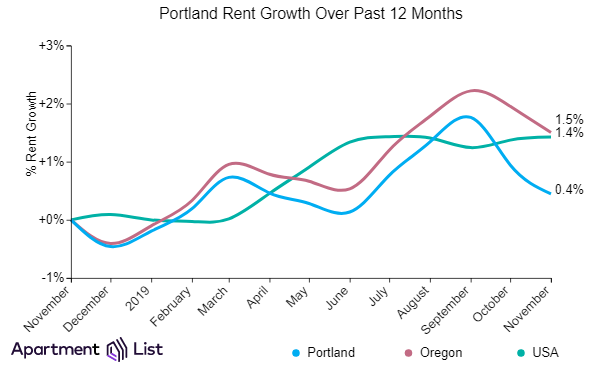
Portland rents have declined 0.5 percent over the past month, the second month in a row the city has seen declines, according to the latest report from Apartment List.

Portland’s year-over-year rent growth lags the state average of 1.5 percent, as well as the national average of 1.4 percent.

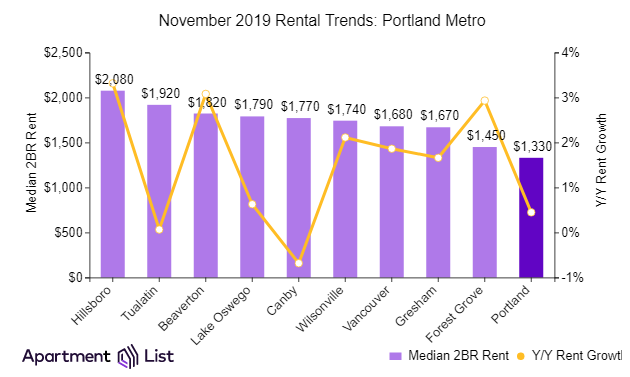
While rents in Portland stand at $1,127 for a one-bedroom apartment and $1,330 for a two-bedroom, the same trend does not hold across the metro. Rents have steadily risen across the Portland metro area.

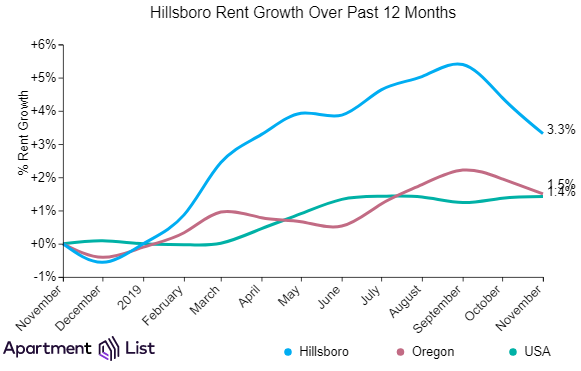
Hillsboro has the most expensive rents in the metro, but recently those rents have declined as well, down 0.1 percent over the past month but up 3.3 percent year-over-year. This is the second straight month that the city has seen rent decreases after an increase in September.

Hillsboro rents are highest in the Portland metro but declined recently

Rents in Hillsboro are $1,759 for a one-bedroom apartment and $2,076 for a two-bedroom.

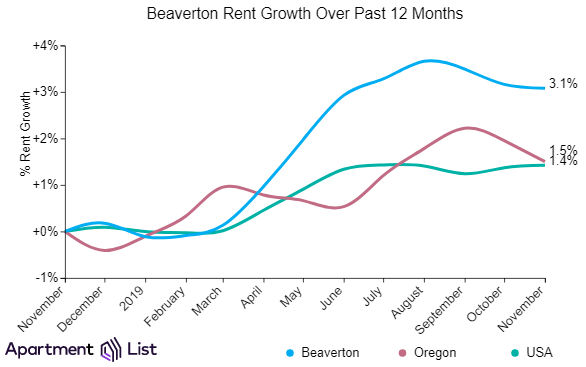
Unlike Hillsboro, Beaverton rents held steady over the past month and are up 3.1 percent year-over-year. Median rents in Beaverton are $1,545 for a one-bedroom apartment and $1,822 for a two-bedroom.

Beaverton rent growth has been steady

Portland rents still more affordable than comparable cities

Rent growth in Portland has been relatively stable over the past year; some other large cities have seen more substantial increases. Portland is still more affordable than most comparable cities across the country.

Portland metro rent growth

  • Oregon as a whole has logged 1.5 percent year-over-year growth, while rent trends across other cities throughout the state have seen both increases and decreases. For example, rents have grown by 1.1 percent in Eugene, whereas rents have fallen 0.6 percent in Salem.
  • Portland’s median two-bedroom rent of $1,330 is above the national average of $1,191. Nationwide, rents have grown by 1.4 percent over the past year compared to the stagnant growth in Portland.
  • While rents in Portland remained moderately stable this year, similar cities saw increases, including Phoenix (+3.9 percent), Las Vegas (+3.2 percent), and Austin (+3.1 percent).
  • Renters will find more reasonable prices in Portland than most other large cities

Last month’s report: Portland Rents Declined After Three Months of Increases

Sign Up For Our Newsletter And Get Apartment News And Helpful, Useful Content Each Week.

* indicates required


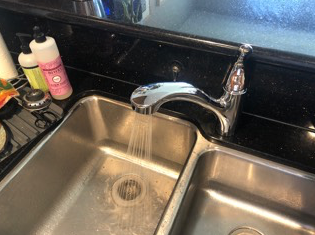
Leaking Sinks No. 1 Most Popular Maintenance Fix in November

Leaking sinks were the No. 1 maintenance item in November

Leaking sinks have been the most popular maintenance call for Keepe during the month of November.

The calls from tenants to property managers have mostly related to leaking kitchen sinks. These are the kinds of calls that require immediate attention.

  • “My sink has been leaking since this morning.”
  • “My kitchen is flooded with water.”
  • “My faucet must be broken because it is dripping water no matter how hard I try to turn it off!”

Leaking sinks in kitchen can cause serious water damage

An example of this problem came from a woman in Seattle with a distress call regarding her kitchen being flooded.

When technicians got to her residence, they found a serious water-damage problem.

The problem with her sink was a little complicated because first, her faucet was leaking. The second part of the problem seemed to be connected to either the water lines or the P-Trap because the water was dripping from under the sink basin and onto the floor.

Technicians also noticed that her sink drainage was not in good shape and needed replacement.

They felt that the drain needed to be checked for possible leaks and repaired or replaced, depending on the level of damage it had suffered.

The first part of the repair was the P-trap.

Normally, the shape of the P-trap makes it hard to maintain, but doing so is necessary because it keeps bad smells out of the house. Technicians were able to detect the first problem – food debris had accumulated in this part of the sink. The food had started rotting, hence creating a leak.

The first repair job took three hours.

Technicians had to replace the P-trap with a new one. After installation, they tightened all the connectors, and water stopped dripping onto the floor.

The second issue was the faucet.

Technicians discovered that the faucet’s gaskets were too worn out and that the washers were failing. It took about 45 minutes to make simple replacements to these two parts.

The entire repair job took about four hours. By the end of the job, there was proper kitchen drainage, a well-functioning sink, and a satisfied customer.

Leaking sinks and 6 Sink and Garbage Disposal Maintenance Tips for Your Rentals

Here are other recent rental property maintenance Keepe posts you may have missed:

 How To Pick The Perfect Exterior Paint Color For Your Rental Property

4 Outdoor Flooring Options For Your Rentals

20 Easy, Affordable Maintenance Projects To Update Your Rentals

7 Tech Gadgets For A Safer And More Efficient Rental Property

5 Maintenance Tips For Long-Lasting Rental Carpet Flooring

About Keepe:

Keepe is an on-demand maintenance solution for property managers and independent landlords. The company makes a network of hundreds of independent contractors and handymen available for maintenance projects at rental properties. Keepe is available in the Greater Seattle area, Greater Phoenix area, San Francisco Bay area, Portland, San Diego and is coming soon to an area near you. Learn more about Keepe at https://www.keepe.com

Sign Up For Our Newsletter And Get Apartment News And Helpful, Useful Content Each Week.

* indicates required


New Pet-Damage Insurance Policies Give Property Managers More Potential Tenants

New Pet-Damage Insurance Policies Give Property Managers More Potential Tenants

Pet damage insurance and pet-deposit protection is now being offered by a company to help property managers cover any pet-related damages and allow tenants to lease a property without an extreme up-front pet deposit.

Jetty Pet is a new offering from Jetty, a financial services company. Jetty Pet is Jetty’s pet protection for property managers, which can be used alone or combined with Jetty Deposit to replace a traditional up-front pet-deposit charge.

This can give properties increased coverage against pet-related damages and a more streamlined leasing process–while keeping move-in costs lower for the renter.

“We always have an ear to the ground on the fundamental problems our partners face, and how we can solve even more of them,” said Mike Rudoy, CEO and co-founder of Jetty, in a release. “Jetty Pet is just another way we give partners the protection they need, while keeping costs low for the many pet-loving renters nationwide.”

According to Jetty’s nationwide survey of U.S. renters, more than 70 percent of pet owners have decided against applying for a rental home or apartment because the costs to have a pet were too high.

This can have a negative impact on the number of qualified applicants at pet-friendly buildings. But without the added protection of a pet deposit, properties risk exposure to pet-related damages and unforeseen expenses, which can cost much more than what a pet fee might cover.

Jetty Pet provides the pet damage insurance protection to a rental home, while alleviating the burden of high up-front costs for the renter.

Pet damage protection for property managers and tenants

How it works is that renters pay a one-time fee to Jetty, which replaces a traditional pet deposit. A fee of $200, for instance, covers a potential $1,000 in damage. A traditional $200 pet deposit covers only $200 of potential damage (which is why most pet deposits are higher).

Property managers benefit from marketing a lower move-in cost, filling more units while having the added protection of an admitted, non-pooled product, and generating meaningful ancillary revenue for the portfolio.

Pet damage insurance can better protect Your Pet-Friendly Rental Properties

How  pet deposit protection works:

  • More protection against pet-deposit damages: Pets are capable of causing a lot more damage than what a typical pet deposit might cover. Properties can get more coverage without raising move-in costs.
  • Lower move-in costs (competitive edge): In addition to eliminating security deposits through Jetty Deposit, Jetty renters can save on costly pet deposits, reducing move-in costs for qualified renters and giving Jetty properties a competitive edge.
  • Simplified overhead: Jetty properties benefit from a streamlined operation process. With the addition of Jetty Pet to Jetty Deposit, both deposits are replaced by one fee. Properties don’t have to worry about managing checks, and there is less confusion for residents.

Jetty works with property managers across the country to increase lease-conversion rate, reduce bad debt, and streamline operations, hereby increasing net operating income.

Partners include LivCor, Related, Pinnacle, MG Properties, Trammell Crow, Griffis Residential, Cortland, and many more. Jetty’s products are written on A-rated paper, and are admitted in 49 U.S. states and D.C, which means they have been approved by those states’ insurance departments, providing additional consumer protections.

About Jetty
Jetty is a financial services company that helps property managers increase lease conversion, reduce bad debt, and streamline operations. For the renter, Jetty lowers the barrier to entry, potentially saving residents thousands of dollars on move-in costs.

Sign Up For Our Newsletter And Get Apartment News And Helpful, Useful Content Each Week.

* indicates required


Canadian Real Estate Trust Buys 2 Seattle-Area Apartment Complexes for $162 Million

Apartment purchase: Canadian Real Estate Trust Buys 2 Seattle-Area Apartment Complexes for $162 Million

A Canadian real estate trust has purchased the 366-unit Mosaic Hills Apartments in Kent for $81 million and the 336-unit Colby Creek Apartments in Everett for $81.3 million, according to a release.

RISE Properties Trust, a Canadian real estate trust based in Seattle, and Aegon Real Assets US, an indirect wholly owned subsidiary of Aegon N.V., a multinational life insurance, pensions and asset management company headquartered in the Netherlands, announced the apartment purchase.

Including Mosaic Hills Apartments and Colby Creek Apartments, RISE owns approximately 4,000 units across 22 multifamily properties in the Pacific Northwest.

This concludes over $300,000,000 of Seattle-area apartment purchase acquisitions for the joint venture in 2019, according the release.

“In unique ways, both properties are very well positioned for our company to execute on strategic capital investments and operational improvements,” said Beau Madsen, Investment Manager at RISE, in the release. “Through the execution of our business plans, we are eager to add value to the surrounding communities, the resident experience, and our investors.”

Apartment purchase in Seattle by Canadian real estate trust
Mosaic Hills property.

Cameron Jones, Head of Real Estate Equity Acquisitions for Aegon RA, said in the release, “Aegon RA has significantly expanded its workforce housing portfolio in 2019 across the U.S., and Seattle is a substantial part of that growth. The acquisition of Mosaic Hills and Colby Creek aligns with Aegon RA’s investment strategy to preserve and enhance the housing stock in select metros across the U.S.  The venture with RISE reinforces Aegon RA’s alignment with regional experts and leverages our experience and depth of relationships in the multi-family sector.”

Barrett Sigmund, President of RISE, said in the release, “Aegon and RISE have worked closely throughout the year to acquire five properties together in the Seattle region. Our success showcases our commitment to the Pacific Northwest and is the result of a shared vision of maintaining and improving apartment communities in our region. We are excited to welcome these properties to our real estate portfolio.”

The property will be managed by Thrive Communities, a Seattle-based property management firm with approximately 12,500 apartments under management.

About RISE Properties Trust

RISE Properties Trust is a publicly-offered non-traded Canadian REIT focused on the U.S. multifamily sector in the Pacific Northwest. Through fully integrated operations, the trust works to acquire underperforming apartment properties and improve their operations, cash flow, and value.

About Thrive Communities

Thrive Communities is an award-winning property management firm with approximately 12,500 apartments under management.  Their in-house renovation platform has improved over 5,000 apartments on both an occupied and vacant-turn process

About Aegon Real Assets US

Aegon Real Assets US is an indirect wholly owned subsidiary of Aegon N.V., a multinational life insurance, pensions and asset management company headquartered in the Netherlands. Aegon RA provides yield-oriented private debt and equity strategies and specialty solutions backed by a full range of in-house support services. Aegon RA’s, multi-disciplined, integrated team of professionals manages and advises $21 billion in real assets.

Apartment purchase: Canadian Real Estate Trust Buys 2 Seattle-Area Apartment Complexes for $162 Million
Colby Creek Apartments.

Sign Up For Our Newsletter And Get Apartment News And Helpful, Useful Content Each Week.

* indicates required


Salt Lake City Rents Up For Second Month In A Row

Salt Lake City Rents Up For Second Month In A Row

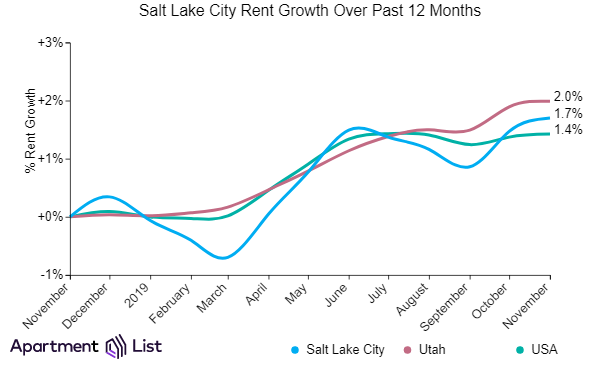
Salt Lake City rents have increased 0.2 percent over the past month, the second straight month that the city has seen rent increases after a decline in September, according to the latest report from Apartment List.

Rents are up 1.7 percent year-over-year in the city. Median rents are $878 for a one-bedroom apartment and $1,089 for a two-bedroom.

Ogden rents declined slightly over the past month

Ogden rents declined over the past month

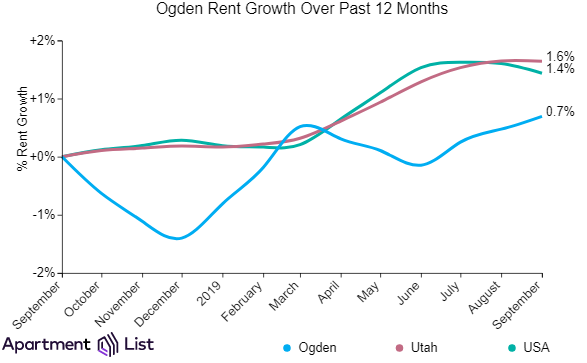
Ogden rents have declined 0.2 percent over the past month, but have increased slightly by 1.4 percent in comparison to the same time last year.

Currently, median rents in Ogden are $696 for a one-bedroom apartment and $892 for a two-bedroom. This is the second straight month that the city has seen rent decreases after an increase in September.

Salt Lake City rents more affordable than many large cities nationwide

Salt Lake City more affordable than many other cities

As rental prices have increased slightly in Salt Lake City, a few large cities nationwide have also seen moderate growth.

Salt Lake City is still more affordable than most large cities across the country.

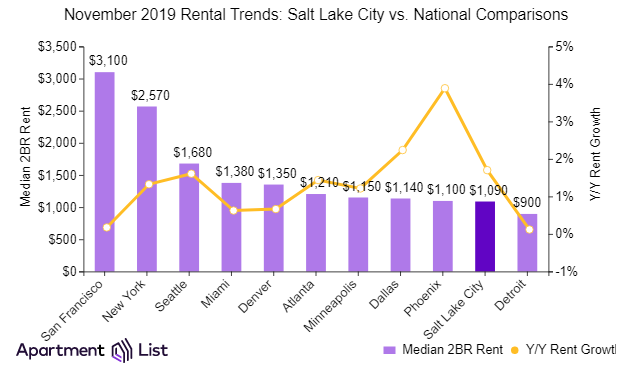
  • Salt Lake City’s median two-bedroom rent of $1,089 is below the national average of $1,191. Nationwide, cost of rentals have grown by 1.4 percent over the past year compared to the 1.7 percent increase in the city.
  • While Salt Lake City’s rents rose slightly over the past year, many cities nationwide also saw increases, including Phoenix (+3.9 percent), Dallas (+2.2 percent), and Seattle (+1.6 percent).

Previous report: Salt Lake City Rents Decline For Third Straight Month

Property Manager Jobs In High Demand In Latest Jobs Report

Property Manager Jobs In High Demand In Latest Jobs Report

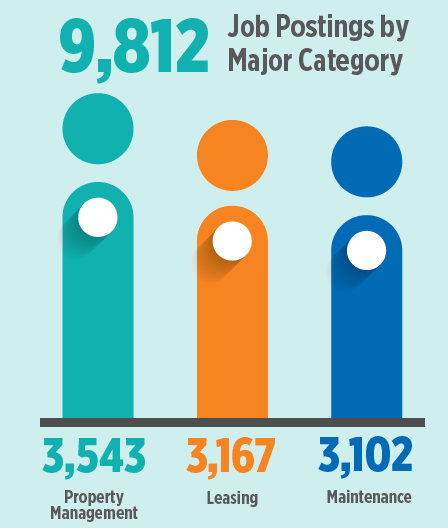
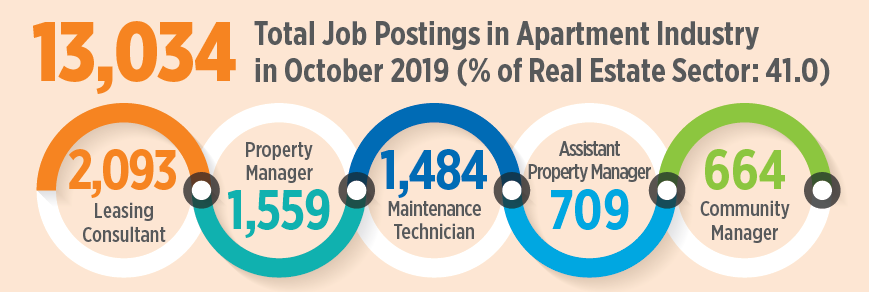
Property manager jobs and community manager jobs are in high demand, according to the latest jobs report from the National Apartment Association.

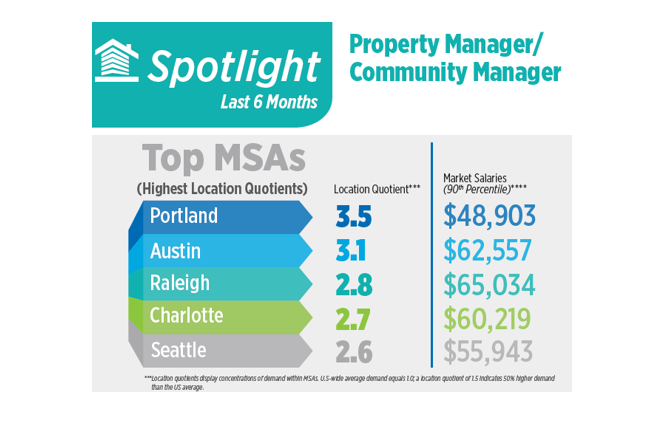
Demand was three times greater than the U.S. average for property managers and community managers in Portland, Seattle and Austin, according to the report from National Apartment Association’s Education Institute.

Property Manager Jobs In High Demand In Latest Jobs Report

Salaries for property managers in the 90th percentile was $61,481 and were displayed in the report due to the tightness of the job market.  Market salary is calculated using a machine-learning model built o­ff of millions of job postings every year, and accounting for adjustments based on location, industry, skills, experience, and education requirements, among other variables.

Property manager jobs skills

Property Manager Jobs In High Demand In Latest Jobs Report

Across the county, more than 13,000 rental housing jobs were available during October, representing 41 percent of the real estate sector.

Overall, Indianapolis, San Antonio, Columbus, Austin, and Raleigh ranked as the top five metro areas for apartment job demand.

Property Manager Jobs In High Demand In Latest Jobs Report

National apartment association jobs report background

The NAA jobs report focuses on jobs that are being advertised in the apartment industry as being available, according to Paula Munger, Director, Industry Research and Analysis, for the National Apartment Association’s Education Institute.

“Our education institute is a credentialing body for the apartment industry. They hear often that one of the biggest problems keeping our industry leaders up at night is the difficulty in finding talent, attracting talent and retaining talent,” Munger said.  “Labor-market issues are happening in a lot of industries, certainly with the tight labor market we have.”

NAA has partnered with Burning Glass Technologies. “They have a labor-job posting database that is proprietary,” she said, and they can “layer on data from the Bureau of Labor Statistics (BLS),” Munger said.

National Apartment Association Jobs Report

August report from the NAA:

Portland Apartment Jobs Almost 60 Percent Of All Real Estate Jobs

Sign Up For Our Newsletter And Get Apartment News And Helpful, Useful Content Each Week.

* indicates required


How To Avoid My Top 7 Landlord Mistakes

How To Avoid My Top 7 Landlord Mistakes

Veteran landlord and investor Larry Arth shares “how to avoid my top 7 landlord mistakes” because if you have not made any mistakes as a landlord, you probably have not been in the business that long. One of the best ways to learn is from other people’s mistakes.

By Larry Arth

Learning from your mistakes so you can master your business is the key to your success.

You can learn from other people’s mistakes, so I would like to share mistakes that I have either personally made or have watched investor-clients make. So here is how to avoid my top 7 landlord mistakes.

No. 1 – How to avoid my top 7 landlord mistakes? Being too quick to fill a vacancy

I often see new landlords and investors fall prey to this one.

I, too, many years ago made these bad judgment calls (never again). It is easy to drop your standards when a unit is about to become vacant.

Emotions take over and a prospect comes to you waving cash at you.

Sure, they do not represent the perfect tenants. Or their income is lower than you as a landlord might require. But they are nice people and they have the cash for the deposit and first month’s rent.

Besides, I  think, “I will start negative cash flow next week if I do not rent to them.”

Three months later, I struggle to collect rent and month after month is a fight to get paid. I tell myself, “I wish I held out for better tenants.”

Like so many others, I have learned it is far better to have a few weeks of vacancy while finding the best tenant than to hurry and rent to a bad apple.

No. 2 – Treating tenants as an income source instead of valued customers

How To Avoid My Top 7 Landlord Mistakes

Having an investment property business and managing tenants as a landlord is no different than any other business.

We need to work hard to obtain customers and treat them well so they will return.

I was a landlord at the age of 18 and to me then, tenants were my income source.

I have since learned this valuable lesson that indeed they are an integral part of the business and need to be treated as valued customers. I do continue to see investors and landlords treat tenants as an income source instead of a valued customer.

Tenants needs to be nurtured so they feel like valued customers and are willing to return at time of lease renewal. Failing to clearly define rules and boundaries I have learned that the first week or two of being a landlord and having tenants is that boundaries automatically are set. The big question is, “Who is setting the boundaries?”

My experience tells me that when you give them a chance, many tenants will immediately push the boundaries to see what they can get away with. So either you are setting precedents to the rules, or they are.

I create a list of expectations that is given to them at move-in when you do the walk through inspection. This list should outline the parts from the lease on policy and procedures which includes what they do as a tenant and what you do as a landlord.

No. 3 – Landlords or property managers trying to become friends with their tenants

I do see a lot of landlords try to be friends with their tenants.

You want to like and trust each other but you are in a business relationship and it should stay that way.

Developing a close relationship makes it difficult to manage from a logical business person’s perspective.

Emotional-based decisions have very little place in running an effective business.

No. 4 – Failing to keep property maintained

I look at hundreds of properties each year, and I continue to see a large number in disrepair.

When talking with sellers the common theme is they want to increase cash flow and do so by ignoring repairs or simply doing inexpensive “bandages” on a property. In reality it creates unhappy tenants who move frequently, which actually results in lower cash flow.

The repairs themselves that get ignored devalue the property.

My experience as an investor and landlord tells me that to maintain maximum cash flow you want to maintain a property in great condition.

No. 5 – Missing opportunities on multiple-year leases


How To Avoid My Top 7 Landlord Mistakes

As landlords and investors, you all know that tenant turnover is the single largest expense we encounter.

You do not have to continue to carry that burden. This is an expense you want to address and fix not just accept it.

I have found great success in offering two- and three-year leases. It immediately goes to identify tenants who want to stay long-term.

I have even used escalators to increase rental rates each year. Both ways your cash flow will be more consistent and your tenants who desire to stay will know what the future has in store for them as opposed to wondering what is going to happen on their move-in anniversary.

You also want to treat these tenants well so they continue to renew leases.

No. 6 – Being too quick to hire a property manager

That was my No. 1 mistake.  That’s it, doesn’t sound so bad does it. Well it had some serious ramifications. Being a “hands on” man in my earlier years of investing I managed my own properties.

This is, for many, a mistake. Being a seasoned investor I will never manage my own properties again.

No. 7 – Being a landlord instead of being an investor

This one may be subjective but it comes from my experiences working with hundreds of investors.

I find a common denominator separates the most successful investors from the ones who struggle to advance.

The most successful investors spend their time investing instead of being landlords.

As a licensed real estate broker, I am always asked if I will manage my client’s property. I always state that managing property is a full-time position.

To be effective at it, you need to devote full-time attention to it. Perhaps one of the biggest mistakes is trying to be effective as a part-time landlord.

“To achieve your dreams you must embrace adversity and make failure a regular part of your life. If you’re not failing, you’re probably not really moving forward.” This is my favorite quote from the book, “Failing Forward: Turning Mistakes into Stepping Stones for Success” by John Maxwell.

I invite you to share some mistakes you have made or have seen others make. Together we can all do as the book states: we can “Fail Forward” and hopefully avoid my top 7 landlord mistakes.

Summary of how to avoid my top 7 landlord mistakes

  1. Being too quick to fill a vacancy
  2. Treating tenants as an income source instead of valued customers
  3. Trying to become friends with tenants
  4. Failing to keep property maintained
  5. Missing opportunities on multiple-year leases
  6. Being too quick to hire a property manager
  7. Being a landlord instead of being an investor

Resources:

Failing Forward the video.

Failing Forward Turning Mistakes into Stepping Stones

Legal Mistakes To Avoid

About the Author:

Larry Arth is the founder and CEO of Equity Builders Group, a Florida based Real Estate investment Group. As a 36 year veteran to real estate investing, Larry understands that we are now in a global economy and as times have changed, investment strategies must change as well. Larry is an international recognized consultant and speaker and assists hundreds of investors per year, both foreign and domestic to realize their investment potential. He analyzes locations across the country for economic strength and the locations that yield the largest most sustainable return on investment. Within these locations he seeks out and gathers the best teams to deliver sound, high performing and most importantly sustainable turnkey investment. He works with investors to ride the wave of each area-specific market surge. Larry’s primary focus is offering (Non Listed) safe and sustainable turnkey investments to the passive investor.

3 Of The Most Common Traps Rental Property Owners Encounter