The California Apartment Association has called on members to freeze rents, halt evictions, offer payment plans and waive late fees as a result of COVID-19, according to a release.
“The COVID-19 pandemic has brought frightening and uncertain times, leaving many Californians with health challenges and economic difficulties. The California Apartment Association urges rental housing providers to act with compassion and work with residents who face COVID-19-related hardships,” the association said in the statement.
“The last thing Californians need when they are struggling to maintain stability is to lose the safe place they call home. In this time of crisis, CAA members offer stability as they provide safe homes to millions of Californians sheltering in place.
“To ensure this stability, CAA calls upon every California rental housing provider to support CAA’sSafe at Home Guidelines by committing to the following through May 31, 2020:
Freeze rents on all residents & pledge to not issue any rent increases.
Halt evictions on renters affected by COVID-19, absent extraordinary circumstances.
Waive late fees for residents who pay rent after the rent due date because they have been affected by the COVID-19 pandemic and related government actions.
Offer flexible payment plans for residents who cannot pay rent by the due date.
Direct renters to available resources to assist with food, health, and financial assistance.
Communicate with residents proactively that you are available to assist them and want to work with them to ensure they remain housed.
Freeze Rents, Offer Payment Plans
“The challenge before us is one like we have never endured. But as a community of responsible housing providers, it’s our opportunity to help our communities heal.
“CAA believes rental-housing providers have an obligation to stay informed, to look out for each other and our residents, and work together to weather this storm. If we meet this moment, we can come out of this crisis stronger,” the association said.
The National Multifamily Housing Council has called for the industry to halt rent hikes and evictions for 90 days.
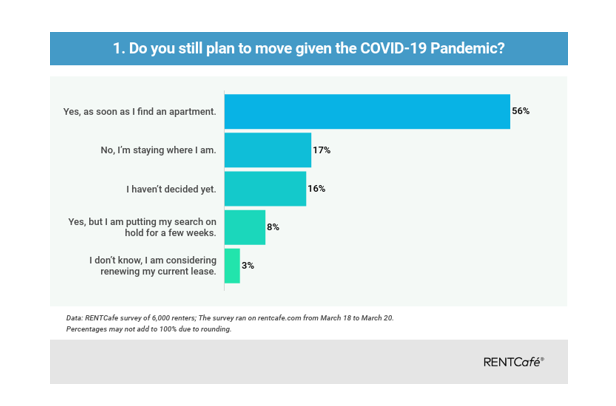
Renters are still optimistic about moving, and finding new apartments remains a priority even during these times, as 56 percent saying they would move as soon as they find one, compared to 17 percent who decided not to move, according to Rent Café.
The survey was conducted of 6,000 people between March 18 and March 20 and asked renters whether they’re still planning to move now, what their main concern is, if and for how long they intend to postpone moving, and how their renting preferences and selection process have changed, if at all.
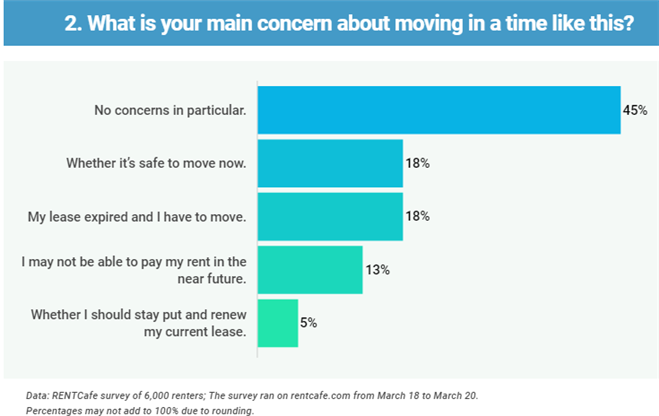
According to the survey results, so far renters seem optimistic about moving now; 45 percent of respondents said they have no particular worries during this time.
On the other hand, 18 percent reported pondering whether it’s safe to move now, and another 18 percent are concerned about their lease expiring and having to move regardless.
And, more than 13 percent are worried about finances and paying rent, while 5 percent are concerned with whether they should renew their current lease.
Almost half of the respondents reported no changes in their renting preferences. But 28 percent are now considering something cheaper than what they looked for initially, and 15 percent say they are now paying more attention to how clean a potential new apartment is.
Events and opinions tend to develop fast in times of crisis; we’ll be interested to see how renter perception changes as things move ahead. RENTCafé plans to re-run its survey later this week to capture renter sentiment after stay-at-home orders were put in place in a number of states. We will update this story when those results come in.
A transparent relationship between a real estate investor and property manager is critical to a successful rental property. Especially as it relates to insurance. Both parties should agree on what coverage the other should hold, how they are protected within that arrangement, and understand their individual exposures.
I’m a property manager, how should the property owner be insuring the property correctly?
Most landlords know they need property insurance for direct physical damage (fire, lightning, theft, etc). This can be purchased for named perils (known as basic form coverage) or all-risk (special form coverage), where any cause of loss is covered unless specifically excluded in the policy. Some of these exclusions can be “bought back” with additional endorsements, such as terrorism and earthquake.
But often, even more important is premises-liability coverage with a minimum of $1 million of coverage per occurrence. Premises liability covers the investor in case of bodily injury at the property. You, the property manager, can and should be listed as an additional insured on the owner’s liability policy. This does two things – could provide cover for you in the event a tenant sues both parties, and notifies you if the owner is in jeopardy of letting their coverage lapse for non-payment, or any other underwriting reason. And can be done for no additional cost.
Imagine a tenant notifies you of some broken stairs at their rental. You consult with the landlord, who does not authorize the repairs. The tenant falls on the broken step a few days later, injuring themselves, and files suit against both you and the landlord. If you are not listed as an additional insured on the premises-liability policy, you could be left with no legal protection for injuries on the property, regardless if you are determined to be at fault or not.
A couple other things to note about the investor’s liability insurance – be sure the owner’s liability policy provides defense costs outside of the limit of liability. Legal fees can add up. And if you are managing more than one location for the same owner, be sure they carry a liability limit per location versus per occurrence, so that limits are not shared with multiple properties. Depending on the size of the portfolio by a single owner, an umbrella policy may be considered to provide additional cover above those limits in their underlying liability policy.
I’m a real estate investor, what insurance should I expect my property manager to carry?
First and foremost, the property manager should carry adequate professional liability including both general liability (for day-to-day business practices) and errors & omissions (E&O) coverage. Like your liability policy, you should be listed as an additional insured on the PM’s policy and it should include a minimum limit of liability of $1 million per occurrence. The PM should be sure the policy includes crime coverage, and wrongful eviction coverage. E&O coverage protects the PM (and you, if listed) from claims related to a mistake made by the property manager.
If the property manager has employees, they should also consider employment practices liability insurance (EPLI) to cover for claims by their employees for wrongful termination, failure to promote, sexual harassment or discrimination. This is especially important to you if you share employees (such as maintenance workers). They might also consider workers compensation coverage in case an employee is injured on the job.
Where can we get this coverage?
National Real Estate Insurance Group operates the largest and longest running insurance program in the country, built specifically to meet the needs of rental property owners and their property managers. The program allows investors or their property managers to manage property and liability insurance for portfolios of any size, on one or multiple accounts, on the same schedule, with monthly reporting and payment options. For property owners who assign responsibility to their PM to secure and keep insurance coverage active, we can engage directly with the manager with ease and flexibility. And our full-service commercial agency has access to 300+ insurance markets and carriers for all of the professional coverages needed to keep both parties protected.
With the real-estate industry and property-management businesses already reporting losses since the outbreak of the coronavirus (COVID-19), it is easy to get caught up in worry, not just about the health risks, but about your properties, tenants and property maintenance.
At Keepe, we understand that health is wealth. Since the outbreak of the coronavirus, we have taken several action steps to protect our business, our workers, and our clients. Being in the service industry requires us to be proactive in our actions toward fighting the spread of this virus.
Below are some of the recent action steps we have taken/are taking to fight against the spread of the coronavirus.
Encouraging Rental Property Cleaning Habits
Cleanliness is essential for rental properties. Not only does it help in the fight against the spread of the coronavirus, but it helps in the promotion of a healthy living environment for tenants. We encourage our clients (property managers) to introduce a regular rental-property cleanliness plan. Our recent emails and blog posts focus on how property managers can get their tenants to clean their respective rental properties, with actionable steps.
Screening Our Workers Ahead of Work Orders
Every rental property needs a reliable handyperson or contractor at some point in time. While this is one of the motivations behind our business model, we understand the need to put our clients first. Buildings and property managers will always need the service of a reputable vendor to handle minor to major maintenance requests.
But even in the face of a pandemic such as the coronavirus, buildings or tenants with repair issues cannot be left without a vendor. That is why we are taking all precautionary measures to screen all our workers before they are sent out to handle a work order in a tenant’s home.
Our screening practice involves hopping on a call with the workers to discuss their present health condition, and making sure they adhere to the practices of good hygiene. We also encourage our contractors to keep a minimum six feet distance from any of the tenants present while getting work orders completed.
Approval from Clients
At Keepe, we understand that individuals around the world are in panic mode. People are wary of what they touch, the food they buy, and the people allowed into their homes. In the face of a virus, we understand the need to be careful, and we encourage it as a business.
That is why before our workers proceed to your home for maintenance repairs, we will need to request your approval for their entry into your unit. And all of our workers are aware that clients may require additional hygiene measures, such as the washing of hands, wearing of a face mask, and refusal to shake hands with them.
In conclusion
At Keepe, we are doing our best in creating safety measures targeted at not only fighting the spread of the virus but also in serving you better. We encourage you to plan on how to safeguard you and your tenants from the spread of the coronavirus. Above all, we would love to hear from you on strategies you may have adopted to fight against its spread in your property.
Keepe is an on-demand maintenance solution for property managers and independent landlords. The company makes a network of hundreds of independent contractors and handymen available for maintenance projects at rental properties. Keepe is available in the Greater Seattle area, Greater Phoenix area, San Francisco Bay area, Portland, San Diego and is coming soon to an area near you. Learn more about Keepe at https://www.keepe.com
Oregon Governor Kate Brown has ordered a stop to residential evictions in Oregon by placing a temporary moratorium effective for 90 days due to the public health emergency caused by the spread of coronavirus in Oregon, according to a release.
“Through no fault of their own, many Oregonians have lost jobs, closed businesses, and found themselves without a source of income to pay rent and other housing costs during this coronavirus outbreak,” Brown said in the release.
“The last thing we need to do during this crisis is turn out more Oregonians struggling to make ends meet from their homes and onto the streets.
“This is both a moral and a public health imperative. Keeping people in their homes is the right thing for Oregon families, and for preventing the further spread of COVID-19,” she said.
Under the governor’s emergency powers, the order places a temporary hold throughout Oregon on law-enforcement actions relating to residential evictions for not paying rent.
Recognizing that landlords and property owners face their own costs if tenants are not able to pay rent, the governor and her Coronavirus Economic Advisory Council are engaging lenders to find potential solutions and are exploring various state and federal policy options that might be available to provide assistance to borrowers or other options for relief.
Oregon Housing and Community Services and the Department of Consumer and Business Services are also pursuing relief options at the direction of the governor.
Portland and Multnomah County Residential Evictions
Portland Mayor Ted Wheeler and Multnomah County Chair Deborah Kafoury have signed emergency orders suspending evictions for tenants who cannot pay rent due to coronavirus-related challenges.
Residential tenants cannot be evicted for not paying rent during the entire time the county and city are under a state of emergency, the two officials announced in a press conference.
Both moratoriums on suspending evictions say that rent owed to a landlord will continue to accrue during the state of emergency. There will be a six-month repayment grace period, which will begin as soon as the state of emergency ends.
In this week’s Ask Landlord Hank question he deals with a COVID-19 question and a tenant who cannot pay rent. Hank is a veteran property manager and landlord and strives to help other landlords and property managers. He does not offer legal advice.
Dear Landlord Hank:
With schools closed, my tenant has advised she has to stay home with her children and cannot go to work and thus will have no income to pay rent. She wants to know if she can delay paying rent.
-Sam
Dear Landlord Sam,
With this pandemic, most are living in fear and uncertainty right now. I’m all about business first, but this is different.
Government bailout money is in the works, supposedly mortgage companies may be offering delays on payments (I’d call your mortgage company to see what their stance is), businesses are shutting down, etc.
We all have to work together in this disaster. Even if you didn’t want to help out your tenant right now, courts are suspending evictions in many districts.
I’d try to work with this tenant if you can. Hopefully, with all the measures that are being taken, this can be contained and eliminated and we can get back to the good life.
Sincerely,
Hank Rossi
Ask Landlord Hank Your Question
Ask veteran landlord and property manager Hank Rossi your questions from tenant screening to leases to pets and more! He provides answers each week to landlords.
“I started in real estate as a child watching my father take care of our family rentals- maintenance, tenant relations, etc , in small town Ohio. As I grew, I was occasionally Dad’s assistant. In the mid-90s I decided to get into the rental business on my own, as a sideline. In 2001, I retired from my profession and only managed my own investments, for the next 10 years. Six years ago, my sister, working as a rental agent/property manager in Sarasota, Florida convinced me to try the Florida lifestyle. I gave it a try and never looked back. A few years ago we started our own real estate brokerage. We focus on property management and leasing. I continue to manage my real estate portfolio here in Florida and Atlanta. “ Visit Hank’s website here.
Property managers and renters may view a swimming pool for your rental property as an appealing feature that can de help attract new tenants and keep current tenants happy. But pools also come with a maintenance price tag and that is the maintenance checkup from Keepe this week.
Building a swimming pool on-site may not always be a good option so there are some issues to consider.
Here are 10 things to consider before building a pool for your rental property.
1. A pool for your rental can be dangerous
Pools can represent a serious and potentially deadly danger for those who do not know how to swim, especially children. Making a pool available to residents will require implementing effective safety measures to eliminate the danger of accidental falls or easy access for unsupervised children.
2. Safety is necessary but expensive
A property owner and/or manager can be held liable for injuries caused by negligence. Implementing safety measures will be necessary, and those measures will come with a price tag. From building fencing and a locked-gate system to hiring a seasonal lifeguard, expenses should be expected.
3. Return on investment is not ideal
In most cases, building a pool for your rental property is an expensive project. While it can raise an estimated five percent to a property’s value, you are not likely to get that back when the property is sold. The market demands in a certain area will dictate the value of a property and of the addition of the pool, not the exact amount that was invested into building it.
4. Expect higher utilities
Operating the pool and additional elements – such as lighting around the pool or the filtering system – will require higher usages of water and electricity, which translates into a more expensive utilities bill. If you plan to heat the pool which is needed in some parts of the country, it costs even more.
5. Routine maintenance is a must
Regularly scheduled pool maintenance is a must to guarantee it is clean and safe. Outdoor pools are exposed to dirt, debris and even insects, which can all easily contaminate the water. A professional pool maintenance service should be contacted and hired to actively maintain the pool, especially during the warmer seasons.
Consider come of the downsides to having a swimming pool as part of your rental property even though it may be appealing to tenants.
6. Careful with chemicals
Pool maintenance includes the use of chemicals to condition the water, keep Ph levels safe, and bacteria and algae out. Improper maintenance of chemicals can cause tenants to get sick and/or experience reactions to the chemicals. Managing and adding chemicals to the pool should only be left to a qualified, trained professional.
7. Mosquitoes love pools too!
Some areas vulnerable to mosquito infestations can be even more vulnerable with a pool. Building a pool in those areas will require extensive and regular maintenance and treatments by a pest control specialist.
8. Trespassing and unwanted guests
Tenants won’t be the only ones wanting to enjoy their new pool. Sometimes, unwanted guests might begin accessing the property’s pool, which is not only a nuisance but also a safety concern. For this reason, building secure fencing or some kind of monitoring system might be needed.
9. Plan on routine updates
Over time, pools will need updating. Every five years or so, it is appropriate to check and update the pool with new materials, such as tiles, panels, lighting or draining systems. This kind of preventative maintenance will help avoiding unexpected, substantial damages and will keep the pool looking appealing.
10. Construction can annoy neighbors and residents
From a construction standpoint, building a pool requires extensive work. Tenants and neighbors will experience construction site noise and traffic. Generally, it’s always best to notify tenants and neighbors about the project ahead of time and offer support throughout the process.
Summary on building a pool for your rental property:
For most of us, outdoor pools are the synonym of fun, relaxation and good times in the sun. It can be easy to get excited about having access to a pool as part of one’s own amenities: both property managers and renters alike tend to view it as a unique asset to the property. Especially in warmer geographies, pools are generally quite an appealing feature that can definitely help with attracting new tenants and keeping current tenants happy.
About Keepe:
Keepe is an on-demand maintenance solution for property managers and independent landlords. The company makes hundreds of independent contractors and handymen available for maintenance projects at rental properties.
Portland Mayor Ted Wheeler and Multnomah County Chair Deborah Kafoury have signed emergency orders suspending evictions for tenants who cannot pay rent due to coronavirus-related challenges.
Residential tenants cannot be evicted for not paying rent during the entire time the county and city are under a state of emergency, the two officials announced in a press conference.
Both moratoriums on suspending evictions say that rent owed to a landlord will continue to accrue during the state of emergency. There will be a six-month repayment grace period, which will begin as soon as the state of emergency ends.
Kafoury said in a press conference she was ordering the eviction moratorium because, while many can self-quarantine, “When someone loses their home, self-quarantine and other measures become impossible” and that puts “them and our community at greater risk.”
“Yes, everyone should pay their rent on time. But for people who are losing their wages due to COVID-19 and find themselves unable to pay rent, we want you to be able to stay in your home.”
She said the county is partnering with the sheriff’s office and state courts to keep people housed during the emergency. “When this emergency ends, people will have six months to pay back what they owe,” Kafoury said.
Suspending evictions in Portland
Portland Mayor Ted Wheeler said he was appearing at the press conference representing the entire city council.
“Effective immediately, we, in alignment with the county, are implementing a moratorium on evictions in the city of Portland. Keep in mind rent to any landlord will continue to accrue. This is not a forgiveness of rent.”
Mayor Ted Wheeler, “We are implementing a moratorium on evictions in the city of Portland.”
Wheeler said there will be a repayment grace period of six months following the end of the emergency declaration.
Wheeler said he is also asking the state legislature to increase rent assistance “for all Oregonians.”
The crisis is having an impact on employers as well. He also said he has created a task force to work with large and small employers and their employees struggling with the impact of the COVID-19 virus.
He said the task force and Prosper Portland will work with commercial partners and ask for help from the private sector to deal with commercial eviction-prevention strategy.
Wheeler said community leaders as well as many landlords have already voluntarily stepped forward to help and let tenants know they can forgive or forgo payments.
Under the terms of the agreement, the owners will pay the women who filed the complaint $10,000 in six installments and attend mandatory fair-housing training. The owners will also pay $4,500 to two other aggrieved female residents.
In addition, Mario Prudencio, who was the property manager, will be permanently prohibited from directly or indirectly engaging in or conducting any property management responsibilities. Prudencio is no longer employed and does not serve as property manager of the subject property.
Two women filed the initial complaint and the agreement states that the owners and property manager subjected the women to differential treatment based on sex and subjected them to sexual harassment.
“Throughout the course of the investigation two additional female tenants… also alleged that Respondent Mario Prudencio subjected them to unwelcome sexual comments and unwelcome sexual advances,” the settlement states.
The Fair Housing Act makes it unlawful for housing providers to sexually harass tenants. This includes creating a severe or pervasive hostile housing environment, or conditioning housing or housing-related services on the tenant’s acquiescence to sexual demands, HUD said in the release.
“A home should be a place of peace and security, https://holisticdental.org/klonopin-for-anxiety/ not fear and anxiety because of sexual harassment,” said Anna María Farías, HUD’s Assistant Secretary for Fair Housing and Equal Opportunity, in the release.
The “settlement agreement sends a clear message to all property owners and landlords that HUD is committed to taking appropriate action when offenders engage in behavior that violates the Fair Housing Act,” she said.
In April 2018, HUD and the Justice Department launched a nationwide joint initiative aimed at combating sexual harassment in housing, enhancing public education about the issue, and encouraging those faced with sexual harassment to report their cases.
The multifamily industry may feel the impact of the domestic spread of COVID-19, however the majority of the industry remains well-capitalized and strong enough to weather a modest slowdown, says Yardi Matrix in its latest report.
“Owners and operators may face short-term rent-collection issues if there is a tightening in the employment market, and value-add projects will likely slow,” the report says. Landlords and property managers “may face rent-collection issues from tenants who have either fallen ill or lost their jobs, and some flexibility with (affected) tenants may be required.
“However, most real-estate investors are poised to sustain their operations, and may see an investment opportunity as the market shocks continue,” the report says.
Seattle and Western markets led the way in February
Rents increased 3.2 percent in February on a year-over-year basis, matching January’s growth rate, as demand for multifamily has yet to feel any major impact from the coronavirus outbreak.
Phoenix (7.6 percent) led all major markets, followed by Seattle (5.5 percent) and the Inland Empire (5.0 percent).
Seattle has maintained incredible demand for housing, as its tech economy continues to thrive. Despite adding nearly 35,000 units in the past three years, Seattle has once again emerged as one of the fastest-growing rental markets in the country.
All primary markets, with the exception of Washington, D.C. (3.4 percent), fell below the national average for rent growth in February. While secondary markets in the West continue to grow strongly, San Francisco (1.7 percent) and Los Angeles (2.4 percent) are among the slowest-growing markets, as affordability issues and the emergence of rent control continue to curb growth.
Coronavirus likely to cause technical recession
The Yardi Matrix report says it “seems inevitable that the U.S. economy will experience a technical recession.”
The latest data available is still from February, where rents held strong, “but the coming weeks and months are likely to show employment cuts and a slowdown in trade,” the report says.
Multifamily coronavirus outlook
“We expect the impacts of coronavirus to last roughly three to six months. However, certain industries will be impacted more than others, and hard-hit sectors like leisure and hospitality and trade may take much longer to recover.
“Most economic data has yet to reflect the impacts from the coronavirus, but given the fundamental strength of the economy prior to the outbreak, most industries should be able to recover from the oncoming technical recession.
“Overall, however, the multifamily market and the real estate industry as a whole, are positioned favorably compared to other industries during this time of rising uncertainty,” Yardi Matrix said.