
Home Blog Page 148

Seattle Mayor Signs Emergency Order Placing Moratorium on Evictions

Seattle Mayor Signs Emergency Order Placing Moratorium on Evictions

Seattle Mayor Jenny Durkin has signed an emergency order putting in place immediately a temporary moratorium for any residential eviction action related to the non-payment of rent, according to a release.

Tenants are required to continue paying their rent if they are able and should work with their landlords on payment plans if they are experiencing financial hardship.

“We have entered an unprecedented era for our city,” Durkin said in a release. “Too many families are already struggling, and COVID-19 virus has disproportionately affected the communities who can least afford it.

“As we take steps to slow the spread of the virus across Seattle’s communities, a part of that response is to ensure that families are not displaced and forced into homelessness. While the city will need significant state and federal resources to handle the long-term impacts of the crisis, we are charting the course for the rest of the country, and Seattle must set the example by reducing the financial hardship for workers impacted by this pandemic.”

Other cities and states are also exploring placing a moratorium on evictions.

Durkin also announced that the City of Seattle will provide $5 million in grocery vouchers to help families impacted by the COVID-19 pandemic. The new grocery voucher program will provide 6,250 families $800 in vouchers to purchase food, cleaning supplies, and other household goods at any Safeway store in Washington state.

Earlier, two major landlord groups in Washington proposed a 30-day halt to the enforcement of evictions because of the COVID-19 virus.

The Rental Housing Association of Washington (RHAWA) and the Washington Multi-Family Association (WMFHA) had called for the pause.

“We are actively working with the city of Seattle, King County, and the legislature to implement emergency rental-housing measures that will open the door for services and rent relief, with minimal administrative delay. In addition, we anticipate over one million dollars of state budget money will be appropriated by the end of the week to fund rental-support services at the Department of Commerce,” the RHAWA said in its statement.

“King County is experiencing the highest rate of COVID-19 illness in the country and the disease is impacting many elements of daily life. Decisions to cancel or postpone public events or institute building closures are done in the interest of public health, but can lead to tangible impacts on people’s income and employment – particularly those who cannot go to work as a result. Housing providers are committed to supporting residents who are impacted by COVID-19 and need assistance with their housing costs.

“The rental-housing industry is recommending a 30-day hold on writs of restitution for King County residents. This hold would prevent physical evictions during the emergency period. Importantly, it would still allow unlawful detainer proceedings to continue but prevent the physical eviction and keep people in their homes. New laws in Washington state make rental-assistance funds available to residents only after a court proceeding is initiated. The industry supported these funds and welcomes their use.

“A hold on physical evictions that allows court proceedings to continue has the dual benefit of keeping residents in their homes while opening paths to emergency rental-assistance funds at the state and local level,” the RHAWA said in the release.
moratorium on evictions

 Further recommendations and reminders for housing providers

The association also said in the release, “In addition to working with local leaders, we are encouraging our members and all housing providers to engage in early and regular outreach to their residents. Communication is key to addressing financial, health, and other hardships that can make it difficult to cover expenses like housing costs. As such, we are sharing the following reminders and recommendations for housing providers:

  • Work with your residents on payment plans and agreements, and be sure to put them in writing.
  • Waive late fees and other administrative costs over the next 30-day period.
  • Share the latest COVID-19 recommendations and updates provided by King County Public Health.
  • Contact your mortgage lender about temporary mortgage relief and federal mortgage assistance to protect your credit, prevent foreclosure, and ensure your rental property remains available and on the market.
  • Contact the Washington State Department of Commerce Landlord Fund Programs to access reimbursements for unpaid rent.

“We are committed to solutions that provide immediate relief to residents impacted by COVID-19 that ensure the ongoing availability of rental housing to everyone who needs a home,” the association said in the statement.

Mayor Durkan Signs Emergency Order To Halt Residential Evictions

Resources Available

The association said there are multiple financial resources available in the industry. For a non-exclusive list of resources, follow this link.  The association said it will continue to work with policymakers to identify additional financial resources dedicated to preventing physical evictions during this critical time.

Rental assistance programs in King County

As coronavirus slows Seattle’s economy, tenants, advocates and landlords raise concerns about evictions

Supporting Renters Impacted by COVID-19
Sign Up For Our Newsletter And Get Apartment News And Helpful, Useful Content Each Week.

* indicates required


Portland Rents Remain Steady Over The Past Month While Suburbs Climb

Portland Rents Remain Steady Over The Past Month While Suburbs Climb

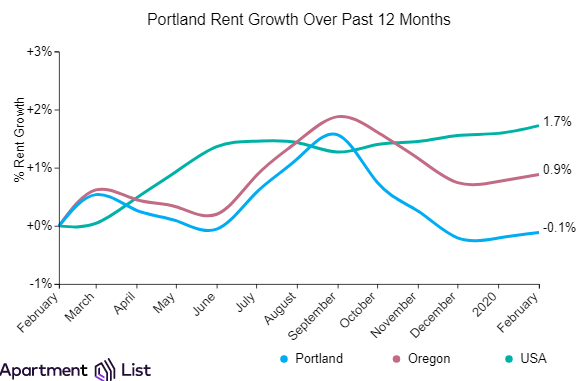
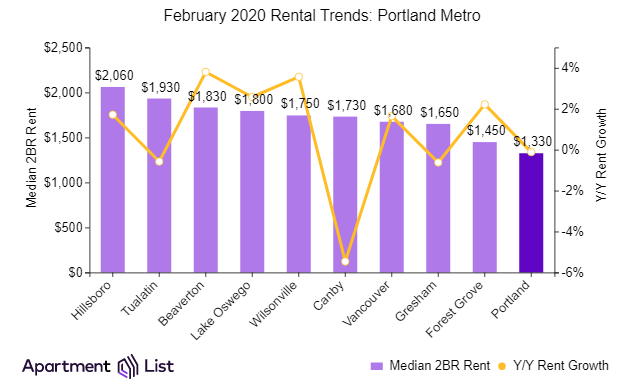
Portland rents have remained steady over the past month, but are down slightly by 0.1 percent year-over-year, according to the latest report from Apartment List.

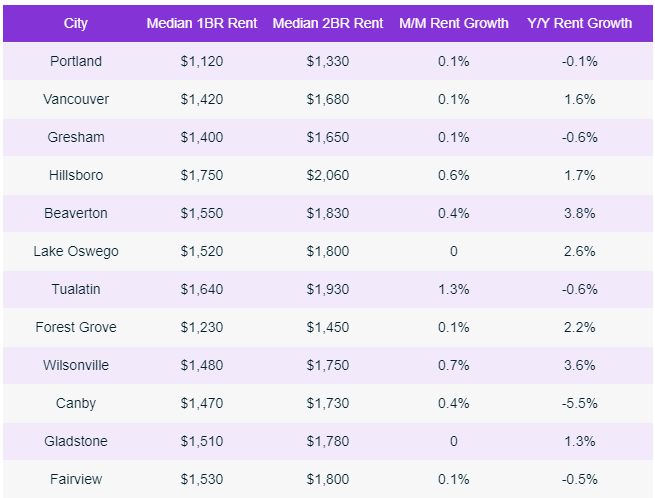
Median rents in Portland are $1,123 for a one-bedroom apartment and $1,325 for a two-bedroom.

Portland’s year-over-year rent growth lags the state average of 0.9 percent, as well as the national average of 1.7 percent. This was the second month in a row Portland’s rental rates have held steady after a three-month decline late last year.

Portland Rents Remain Steady Over The Past Month While Suburbs Climb

Surrounding cities in Portland metro see rent gains

While rent prices have decreased in Portland over the past year, the rest of the metro is seeing the opposite trend.

Rents have risen in six of the largest 10 cities in the Portland metro for which Apartment List has data.

Here’s a look at how rents compare across some of the largest cities in the metro.

  • Beaverton has seen the fastest rent growth in the metro, with a year-over-year increase of 3.8 percent. The median two-bedroom there costs $1,833, while one-bedrooms go for $1,554.
  • Hillsboro has the most expensive rents of the largest cities in the Portland metro, with a two-bedroom median of $2,061. Rents there grew 0.6 percent over the past month and 1.7 percent over the past year.
  • Canby has seen the biggest rent drop in the metro, with a decline of 5.5 percent. Median two-bedrooms there cost $1,732, while one-bedrooms go for $1,468.

Portland Rents Remain Steady Over The Past Month While Suburbs Climb

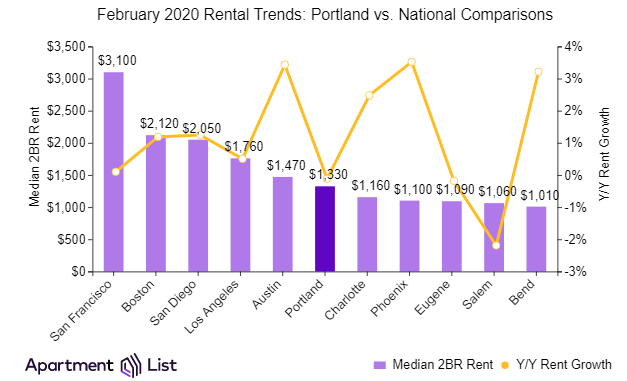
Portland rents more affordable than many large cities nationwide

While rents have fallen slightly in Portland, many similar cities nationwide have seen prices increase, in some cases substantially.

Portland is also more affordable than most comparable cities across the country, according to the Apartment List report.

While Oregon as a whole logged rent growth of 0.9 percent over the past year, other cities across the state have seen rents decline moderately. For example, rents have fallen by 0.2 percent in Eugene and 2.2 percent in Salem.

Portland v national rents

Portland Rents Hold Steady In January Stopping Slide Over Last 3 Months

How to Rent a Pest-Free Home to Your Tenants

How To Deal With The Most Common Pests In Rental Housing

By Raymond Web

All landlords are expected to provide habitable and sound homes to their tenants, including providing a pest-free home.

You should do a pest and termite inspection before renting out any property you own.

Let’s look at some things you should know about pest control.

  • Hire Professional Pest Control Experts: First and foremost, hire a pest-control company to make certain there are no pests on the property. The pest-control company will inspect the property and take the necessary measures to exterminate any pests. Doing this will guarantee that you are renting out a pest-free house to the tenants.
  • Seal Entry Points: Cracks and crevices are favorite entry spots for pests. Therefore, seal all visible cracks and entry points around the exterior and interior of the property. This includes checking the building’s foundation and looking for gaps in the doors, windows, vents, and pipes. Seal up entry points in common areas, crawl spaces, and attics. Do a termite home inspection to ensure there are no termites.

It might take time to seal up everything, but it will save you a lot of money and trouble in the future and have a pest-free home for your tenants.

How to Rent a Pest-Free Home to Your Tenants

  • Keep Common Areas Clean: Pests usually stick around where food waste is present. They are also attracted to trash and debris as their hiding places. Make sure your tenants know this, and require that common areas be kept clean and free from trash. Sweeping and vacuuming regularly is a must inside all residences.
  • Keep Trash Bins: Trash bins help residents dispose of trash safely and properly. Make sure your bins are sturdy and have the lids on. There shouldn’t be any holes through which pests can enter. You need enough bins for all the tenants you serve; and they should be placed away from actual residences, because the small of garbage can attract pests.
  • Contact Tenants if You Notice a Problem: Visit your property regularly to inspect it for pest infestation. If you find any signs that could potentially lead to a pest infestation, contact your tenants immediately. For instance, if you see garbage accumulating, get in touch with the tenants. Inform them of proper disposal techniques and remind them that keeping the property clean will keep the pests away.

3 Ways to Educate Your Tenants About Pest Infestations 

1. Communicate. If you know which pests commonly attack the property, educate the tenants about the same. For example, if bed bugs and rodents frequently attack the property, inform residents as to how they can handle such infestations, and when to call the pest-control company.

2. Give Property Maintenance Tips. Inform the tenants of the following maintenance tips:

  • Sweep hardwood floors once a week. Termites may attack the wood flooring if it is not maintained properly.
  • Clean air-conditioning filters and window units to keep them free of dust.
  • Keep the plumbing throughout the house in good order.
  • Remove the trash and debris from the premises regularly.
  • Ask residents to pay extra attention during the winter. Pests might enter the house to stay warm and end up damaging your property. The tenants must take winter pest control

3. Encourage Residents to Inform You Quickly About a Pest Infestation

If you receive a complaint of pests, address it as quickly as possible. It won’t just keep the tenants happy, it also will keep the property protected from damage or further infestations. Quick action will prove cheaper in the long run.

Make sure that you give a pest-free home to the tenants and help them maintain the property. Call a residential pest control whenever required to exterminate pests.

About the author:

Raymond Web educates people on pest prevention and control strategies, helping them keep their surroundings healthy, safe and pest-free. As the digital marketing manager for Take Care Termite and Pest Control, in Tracy, CA, he has an in-depth understanding of the issues.

7 Pest Preventative Maintenance Steps For Rental Housing

Sign Up For Our Newsletter And Get Apartment News And Helpful, Useful Content Each Week.

* indicates required


Demand for Apartment Jobs Reached Record Levels In 2019

Demand for Apartment Jobs Reached Record Levels In 2019

Demand for apartment jobs reached record levels in 2019 and the apartment labor market delivered a strong performance by the end of the year, according to the annual report from the National Apartment Association.

Demand for apartments reached record levels during the year, in turn creating a competitive labor market as owners sought talent to manage, lease, and maintain their communities, the report from the National Apartment Association’s Education Institute says.

Monthly job postings, not all of which actually get filled, averaged 10,979.

In August, total job postings in the apartment industry as a percent of the real-estate sector soared to 43.3 percent. A hectic leasing season yielded record-level occupancy rates. According to Real Page, U.S. occupancy rates averaged 96.3 percent in August, the highest rate since 2000.

Top cities showing demand for apartment jobs

Secondary markets Denver, Austin, San Antonio, and Raleigh took the lead for markets with the highest demand for apartment industry professionals.

Apartment-job demand for these areas coincided with their strong apartment-market fundamentals during the year, most notably with new deliveries.

Denver supplied 4,315 apartment job openings. Bell Partners accounted for 11.1 percent of all apartment job postings in Denver.

Availabilities in Austin totaled 2,954, and 9.8 percent of all apartment job openings in Austin were provided by Alliance Residential Company. Another large Texas market, San Antonio, posted 1,769 job openings. Lincoln Property Company was the top employer in San Antonio, responsible for 6.5 percent of all apartment job openings.

Raleigh listed 1,413 job openings. Identical to Denver, Bell Partners represented 11.1 percent of all apartment job postings.

Apartment jobs salaries

Demand for Apartment Jobs Reached Record Levels In 2019

In a tight labor market, industry employers are faced with the challenge to attract and retain talent, while still managing the bottom-line.

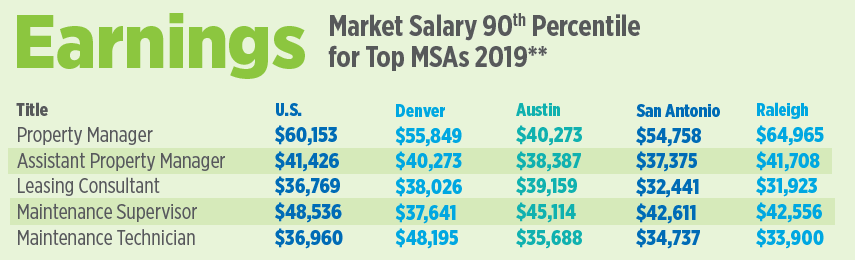
Salary ranges can be wide depending on location, education, certifications, skills, and years of experience. In Raleigh, salaries for property managers and assistant property managers were above the U.S. average. Leasing-consultant salaries were particularly competitive in Austin and Denver.

Maintenance technicians were also in high demand in Denver during 2019, which produced salaries well above the national average.

Seattle has high concentration of apartment jobs

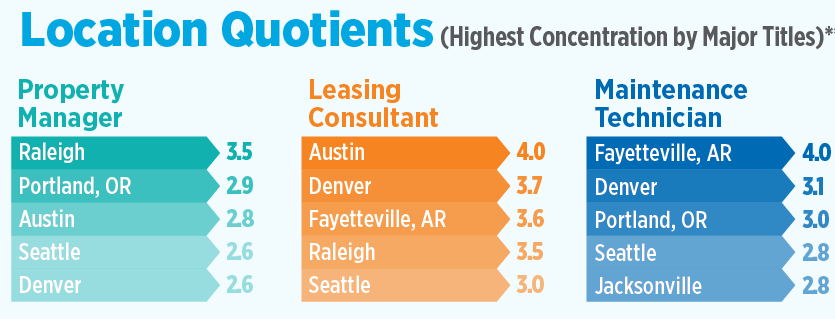
Denver and Seattle had the highest concentration of major apartment-job titles, with demand for talent averaging 3.1 and 2.8 times the national average, respectively.

Apartment construction has boomed in Denver as large companies such as Amazon have expanded their offices. The tech titan created 400 jobs, generating demand for more housing.

Competition for talent in Seattle was also highly competitive, most notably for leasing consultants and maintenance technicians, location quotients for these positions were about three times the U.S. average.

Competition for rental-housing labor fared particularly high in both Raleigh and Fayetteville, Ark., which experienced job growth well above the U.S. average in 2019.

Skills that are required

Employers are constantly competing for talent in a shrinking pool of qualified candidates.

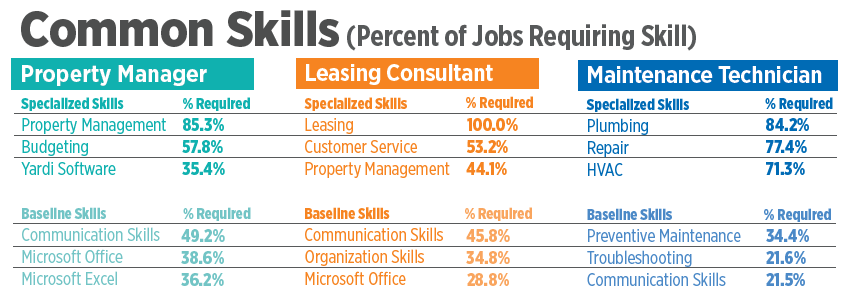
Strong communication skills are critical across property managers, leasing consultants, and maintenance technicians. Employers agree that effective communication with residents, contractors, and other members of the property-management team plays an important role in the property’s performance.

Microsoft Word and multi-tasking skills had the greatest rise in demand among the many baseline skills required in the apartment industry, increasing by 1.6 and 1.4 percentage points annually.

Experience with sales, customer service, and Yardi Software also saw a significant increase in the percentage of jobs requiring these skills since 2018.

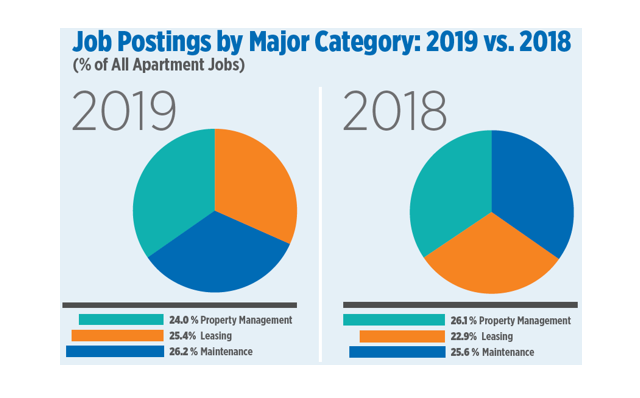
Maintenance positions were the most sought-after jobs in 2019

Maintenance positions were the most sought-after and in demand for apartment jobs  during 2019.

As reported by the Bureau of Labor Statistics, general maintenance and repair occupations are projected to experience an average growth rate of six percent through 2028, which is above the average of five  percent for all jobs.

A high school diploma or vocational training represented 98.8 percent of all minimum education required for maintenance technicians and supervisors. Outside of standard requirements like drivers licenses, certifications in greatest demand for these positions included EPA certification, pool-operator certification, and boiler-operator license.

Demand for Apartment Jobs Reached Record Levels In 2019

Employee turnover rate falling

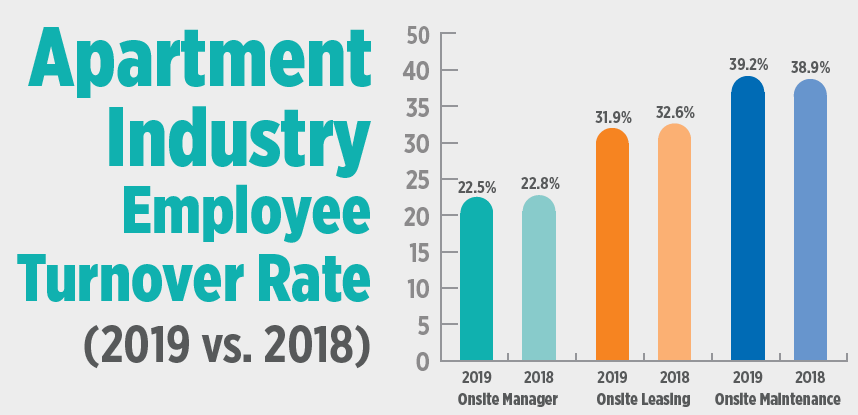
The overall turnover rate fell for the first time since 2016, driven mainly by the 0.7 percentage point decline in leasing positions.

Maintenance technicians continued to be the most challenging to retain, with a decade-high turnover rate of 39.2 percent. According to Grace Hill, on-boarding, employee recognition, and career paths are the most effective methods for decreasing turnover.

Turnover and Demand for Apartment Jobs

Sources: NAA Research; Burning Glass Technologies; CEL & Associates; Real Page, Grace Hill; Bureau of Labor Statistics Data as of December 31, 2019; Not Seasonally Adjusted.

Apartment Jobs Almost 40 Percent Of Real Estate Jobs In January, NAA Says

Sign Up For Our Newsletter And Get Apartment News And Helpful, Useful Content Each Week.

* indicates required


3 Ways to Effectively Handle Tenants’ Property Maintenance Requests

3 Ways to Effectively Handle Tenants’ Property Maintenance Requests

How to effectively handle tenant’s property maintenance requests and keep them happy is this week’s maintenance tip from Keepe.

As a property manager, the job comes with its fair share of maintenance troubles.

From sudden gas leaks to bad locks to a leaking roof, the maintenance issues faced in a rental property can be overwhelming.

One thing every seasoned property manager understands is that tenants’ satisfaction is the key to excellent tenant-retention rates. A unique way to improve your tenant satisfaction is by proactively handling tenant requests when they come in.

Below are three ways to manage your tenant’s property maintenance requests as a property manager.

No. 1 – Act Fast On Property Maintenance Requests

Aside from the fact that tenants’ satisfaction is dependent on your response to their increased maintenance requests, responding on time helps you save money and your property from further depreciation.

Have a list of reliable vendors (maintenance people and contractors) whom you can contact in the quickest time possible. Companies such as Keepe can connect you with a reliable worker for your rental-property maintenance issues if you need help.

Also, keep in mind that many tenants these days like to text you their maintenance requests and expect immediate response to their texts.

No. 2 – Communicate

As soon as you receive a maintenance request, communicate not just with the vendor but with the tenant about the work progress.

You can find out more details about the history of the problem and the progress made by the vendor.

Reach out to the tenants via phone, email, or text to inform them about the moves you are making and what is required of them, or even to address their complaints in an orderly manner if there is a delay from the worker’s end. You can ask questions such as:

  • When did the issue start?
  • Has it happened before?
  • How is the maintenance issue affecting your day-to-day activities within your apartment?

You can go as far as sending the tenant the vendor information to help the two speak directly, or share relevant information to help solve the issue promptly.

In today’s world, property managers are digitalizing how they handle tenants’ property-maintenance requests. This helps to keep all parties involved in the loop about the progress made and any changes to the request.

No. 3 – Follow-Up

As a property manager, handling maintenance requests goes beyond finding a reputable vendor or communicating during the repair period.

It involves reaching out to the tenant after the repairs have been completed. Find out from your tenants about their post-maintenance repair experience and how you can be of help next time.

You can send out a brief online feedback experience form or schedule a quick phone call if you like to keep a personal touch with your tenants.

A great set of follow-up questions to ask after a maintenance episode with tenants:

  • What is the present state of the issue?
  • Are you satisfied with the completed changes or repairs?
  • Are there any extra costs you may want to relay back to us that you may have spent?

By doing the above, you’re not only improving your relationships with your tenants but also gathering further information for future occurrences.

Property maintenance requests conclusion

Managing a rental property requires you to be proactive, predictive, and an excellent communicator. Tenants are impatient and want quality services that match the rent they pay. If you are looking to increase tenant retention and satisfaction rates, you will need to improve on how you handle tenants’ maintenance requests.

5 Fire Safety Tips for Property Managers in 2020

The Best Appliances In Rental Property

About Keepe:

Keepe is an on-demand maintenance solution for property managers and independent landlords. The company makes a network of hundreds of independent contractors and handymen available for maintenance projects at rental properties. Keepe is available in the Greater Seattle area, Greater Phoenix area, San Francisco Bay area, Portland, San Diego and is coming soon to an area near you. Learn more about Keepe at https://www.keepe.com.

Sign Up For Our Newsletter And Get Apartment News And Helpful, Useful Content Each Week.

* indicates required


Seattle Mayor Won’t Sign Winter Evictions Ban Passed by City Council

3 Areas Where Congressional Legislation Falls Short, Could Be Detrimental to Rental Housing Market

Seattle Mayor Jenny Durkan will not sign a ban on winter evictions passed by the Seattle City Council,  and announced a new partnership and legislation that will provide assistance for individuals who are facing winter eviction, according to a release.

“Being progressive means more than slogans. If city council wants to accomplish our shared goals to prevent winter evictions, then they should pass a bill to actually help people facing winter evictions,” Durkan said in the statement.

“As council knows, their bill will not prevent evictions – it places the full burden on the tenant and opens up the city to significant legal costs. As a city, we should be spending taxpayer dollars to help people – not hundreds of thousands of dollars on lawyers to defend this bill. A real solution is to help households avoid the eviction process altogether,” she said.

The bill will now go back to the council for consideration, and council members could still make it law with a two-thirds vote, according to reports.

The Seattle City Council voted in February to ban winter evictions during the months of December through February, shortening the original proposal from five months to three.

Council Bill 119727, which council members unanimously passed Feb. 10, bans evictions between December and February with exceptions for landlords who own four units or fewer and evictions caused by behavior that has an impact on the health and safety of others.

Durkan’s statement continued: “After conversations with United Way of King County, an investment to build off the Seattle Human Services Department’s current prevention programs could allow the city to provide resources to individuals potentially facing evictions this upcoming winter.”

The release said as currently written, Council Bill 119727 “does not protect most vulnerable households at risk of evictions, and the city could incur potential litigation. In addition to spurring more evictions in the spring, council’s legislation did not ban winter evictions. Instead, it created a legal defense during eviction proceedings. It would require tenants to appear in court to use winter eviction as a defense. A recent study concluded nearly half of households failed to contest an eviction or appear in court.

“As a young lawyer, I saw firsthand how devastating evictions can be in one’s life. I first met Lola at a women’s shelter after she had been forced out of her home and onto the street. After months in court, I was able to prove she was wrongfully evicted and connect her with a new home, but she had spent months without a home because of lengthy legal proceedings. Providing the resources to help prevent eviction in the first place is the right thing to do,” Durkan said in the release.

To successfully help people at risk of eviction stay in their homes, Durkan will transmit a bill to the city  council to increase funding assistance to tenants facing homelessness due to eviction between December 1 and March 1, building off of the Seattle Human Services Department’s existing program, which served 974 unique households at risk of homelessness last year. In addition, her bill would require the development of a disclosure provision that will require landlords to make sure tenants are aware of the availability of winter-eviction support and prevention resources, according to the release.

Seattle City Council Bans Winter Evictions

Sign Up For Our Newsletter And Get Apartment News And Helpful, Useful Content Each Week.

* indicates required


Are Fraudulent Rental Applications a Risk to Your Business?

Are Fraudulent Rental Applications a Risk to Your Business?

Sponsored

By Daniel Berlind

Bad residents top the list of things that property managers lose sleep over, and for a good reason. Evictions are expensive—as much as $7,000 or more.  Further, evictions keep units off the market.  Here’s the bad news—there are a host of ominous trends that point to a dramatic rise in evictions in 2020.  Let’s examine these trends one-by-one.

Let’s start with economics.  A study from the National Association of Realtors shows that rents are rising faster than incomes. This obviously puts more pressure on residents.  Fair enough, but as long as the applicant’s financials qualify, there’s no problem, right?  Yes, but this added pressure is causing more and more applicants to lie about their financials so they can qualify.

Fraudulent rental applications

In fact, according to a UBS study, one in five consumers admit to lying on credit applications.  The most common transgression?  Inflating their income. This is certainly the case in the rental-housing market, where a study from Forrester Consulting shows that 97 percent of property managers have been victims of resident fraud.

“About 30 to 40 percent of the applications we receive contain financial documentation that has been fraudulently altered,” says Chad Vasquez, property manager at Circa LA, a luxury property in downtown Los Angeles managed by Greystar.

Clearly, income verification is more important than ever.

Which is why our next trend, the “Gig Economy,” is so important. Here’s a great report on what the Gig Economy is all about, but the short version is the rise of workers who work by the “gig” as opposed to working for a salary. Think Uber driver versus Starbucks barista.

“It is difficult to manage fraud,” says Vasquez.  “There are a lot of self-employed people making tremendous amounts of money.  It’s a situation that invites fraud.”

The reason the Gig Economy is important to property managers is that it makes it so much more difficult to verify income.  With gig workers there are no employers to check with and no pay stubs to verify.  That’s important because analysts predict self-employed workers will total 42 million in the United States in 2020 (27 percent of the workforce).  The rise of the Gig Economy will make it more difficult for property managers to vet applicants.

If that wasn’t enough, we’re also seeing an explosion in online tools that make it simple to create fraudulent financial documentation. Legitimate companies set up to help business owners calculate pay stubs for their employees can be manipulated to produce fraudulent pay stubs. Other sites can be used to crease bank account statements with false balances. Even innocuous software like Adobe Acrobat can be manipulated to alter IRS documents for fraudulent purposes.

So, with all these trends pointing to a rise in fraudulent rental applications, will we see a rise in evictions?  We already have.  Research shows that annual evictions filings have skyrocketed over the past few decades.  In fact, there were twice as many evictions filed in 2016 as in 2000 (nearly 2.4 million in 2016).

So, what can property managers do?  You can always check documentation manually, but that’s a lot of effort for your team.  Also, altered documents are often impossible to spot by humans.  And, as we mentioned above, more than a fourth of your applicants are now self-employed, making manual verification nearly impossible.  This leads to verifying statements with the government and the IRS—a time-consuming and expensive proposition.

There are a host of commercial services available that take way less time and are far easier.  The problem is none of these will tell you if the applicant’s financial documents have been altered.  For example, you can verify the applicant’s ID, but that won’t verify that the documentation they supplied is valid.  You can check their credit or eviction history, but that shows their past.  There’s no guarantee you won’t be their first eviction.

Most of these measures are helpful and you should consider using them.  But in today’s world, you need to add a way to spot fraudulently altered financial documentation.  “We catch most of the obvious cases ourselves, but about 20 fraudulent tenants slip through each year,” says Vasquez.  “That’s why we invest in a service like Snappt to spot altered financial documents.”

Solutions such as Snappt, which offer a quick, inexpensive screening process that spots altered documentation, can help solve that challenge of fraudulent rental applications.

I’ll leave you with one final statistic.  More than 33 percent of the financial packages we review have been altered.  Let that soak in for a minute.  Accepting applicants without checking the accuracy and fidelity of their financial documentation is a serious risk to your business. Are you ready for that kind of risk?

About the author:

Are Fraudulent Rental Applications a Risk to Your Business?
Daniel Berlind is the Chief Executive Officer and Founder of SNAPPT, a cutting-edge technology company that is disrupting the rental property application process. Prior to founding SNAPPT, Daniel served as the President of Berlind Properties and oversaw the management of their properties from 2011 to 2017. Prior to Berlind Properties, Daniel was a professional baseball player for the Chicago Cubs and Minnesota Twins.

Sign Up For Our Newsletter And Get Apartment News And Helpful, Useful Content Each Week.

* indicates required


5 Fire Safety Tips for Property Managers in 2020

5 Fire Safety Tips for Property Managers in 2020

Fire safety is always top of mind for rental housing managers, so here are 5 fire safety tips for property managers for the weekly maintenance checklist from Keepe.

According to the Insurance Information Institute, fires in property structures not related to wildfires caused $11.1 billion in property damage in 2018.

The average loss per resident for these property structure fires was $22,244, up 3.7 percent from a year ago.

As a property manager, your want to ensure that your rental property is safe from fire hazards. The process of managing fire risk in a rental property can be challenging. This may be due to the size of the property, the number of tenants, and tenant profiles.

5 Fire Safety Tips for Property Managers in 2020

Property managers must acquaint themselves with the necessary fire safety tips to protect their properties and tenants.

1. Carryout A Fire Risk Assessment of the Property 

As a property manager, the first step to preventing fire hazards in your property is by identifying the likely cause of potential fire in your property.

Carry out a comprehensive fire risk assessment of the property. Identifying the probable cause of potential fire risk in your property will help you in drafting a solid fire prevention strategy.

According to a National Fire Protection Association report, smoking, electrical, open space heating, cooking equipment, and candles are some of the significant causes of a rental property fire.

2. Install A Smoke Detector and Smoke Alarm

The US Fire Administration reports that 40 percent of fire deaths happen in residences with no smoke alarm. Smoke detectors can easily detect smoke in the event of a fire faster than you or your tenants can, so if you do not already have them everywhere double check to be sure.

One of the easiest ways to make sure that it is in pristine condition is to test it at least once a month. Also, install a smoke alarm in and around the property. A quick piece of advice, interconnect the smoke alarms & detectors so that they all ring at the same time.

3. Initiate A No-Smoking Policy

“Smoking is the leading cause of civilian home fire deaths,” according to the NFPA. Property managers in the US are fast adopting a no-smoking policy in their lease agreement with tenants.

If you are not already doing it, as a manager, you can restrict smoking within the apartments, common areas, hallway, and enclosed spaces. Find out from your attorney about including this clause within your lease agreement with potential tenants.

4. Create an Evacuation Plan and Educate Tenants About It

It is essential that you identify possible evacuation exits during your property fire risk assessment.

As a property manager, draw up a concise evacuation map that highlights the relevant escape route.

By creating a comprehensive evacuation plan, you will be able to educate your existing and new tenants about it. If you have a multistory building, be sure you have dedicated evacuation routes and proper emergency lighting available on each of the floors.

5. Engage in Regular Preventive Maintenance

One of the significant causes of fire hazards in rental properties is irregular maintenance of the electrical/heating system.

As a property manager seeking to protect their property from fire hazard, carrying out monthly checks on the electrical and mechanical systems of the property is essential. Do not wait till they are faulty or cause a fire outbreak before maintaining them.

5 Steps To Get Your Property’s HVAC System Ready For Spring

The Best Appliances In Rental Property

5 Maintenance Tips For Long-Lasting Carpet In Your Rentals

About Keepe:

Keepe is an on-demand maintenance solution for property managers and independent landlords. The company makes a network of hundreds of independent contractors and handymen available for maintenance projects at rental properties. Keepe is available in the Greater Seattle area, Greater Phoenix area, San Francisco Bay area, Portland, San Diego and is coming soon to an area near you. Learn more about Keepe at https://www.keepe.com.

Sign Up For Our Newsletter And Get Apartment News And Helpful, Useful Content Each Week.

* indicates required


Allowable Fees Under The Landlord Tenant Act

Allowable Fees Under The Landlord Tenant Act

Bradley S. Kraus
Attorney at Law, Warren Allen, LLP

As a Landlord’s attorney, I’ve had the opportunity to review thousands of rental agreements. I can often tell which rental agreements came from different states or the internet, as I’ll see odd charges in them, such as “Notice Service Fee – $25.”

While this may be allowed in other states, Oregon does not have such an allowable fee. Many landlords believe that simply because a particular fee is in the rental agreement, that provides them the authority they need to charge for the same. Unfortunately, that’s only part of the discussion.

Allowable fees and Oregon statute

Oregon’s fee statute, ORS 90.302, requires that any fee charged by a landlord be described in a written rental agreement. The statute is also clear in its prohibition against charging fees not described in, or as allowed by, that statute. A review of that statute shows that there is no such fee as a “Notice Service Fee,” much to the disappointment of some Landlords accustomed to different states. So what can be charged as a fee?

The allowable fees can be broken down into two categories; those that trigger upon a given event, and non-compliance fees. The fees which trigger upon a given event are standard in the industry. They include things like late rent fees, dishonored check fees (NSF charges), and early termination fees. As long as these are described in the rental agreement, it’s not often that a Landlord can run afoul of the statute on these particular fees.

The second type of fees allowed under the statute are non-compliance fees. These fees are allowed for things such as late utilities, failure to clean up pet waste, and smoking. These types of fees are often where I see Landlords slip up. For example, many Tenants often fail to pay their utilities on time. Seeing this, the Landlord will apply a “Utility Late Fee” to the Tenant’s ledger without first complying with the statutory prerequisites for doing so. The statute requires that, prior to charging a non-compliance fee, the Landlord must give the tenant a written warning notice that describes:

(i) A specific noncompliance before charging a fee for a second or subsequent noncompliance for the same or similar conduct; and

(ii) The amount of the fee for a second noncompliance, and for any subsequent noncompliance, that occurs within one year after the warning notice.

The failure to provide the written warning notice renders the charged fee invalid, thus requiring the Landlord to (a) reverse the fee, or face a potential claim for an improper fee, and (b) start over with a warning notice, thus delaying any real remedial conduct sought by the Landlord. It can also complicate evaluation of the ledger down the road if it is not immediately discovered, thus potentially leading to further delays in other settings (i.e., evictions).

While some Landlords prefer the non-compliance fee path towards the particular violations described in statute, many landlords will opt to pursue their For Cause Termination remedies under ORS 90.392 in lieu of charging a non-compliance fee. This is simply an easier approach and provides a quicker approach to the change in conduct sought.

The statute is clear that you must pick one or the other for a particular violation; a Landlord cannot charge a non-compliance fee and serve a For Cause Notice for the same violation. However, if the Tenant fails to pay the non-compliance fee, a Landlord’s remedy for that is . . . a For Cause Notice. Due to the shear amount of time that will have elapsed to get to that point, it is imperative that you ensure compliance with the statutory prerequisites for a non-compliance fee, in the event that you elect to charge one.

allowable fees under the landlord tenant act
Bradley Kraus, Portland attorney

[email protected]
503-255-8795

The Utility of Reviewing Your Tenant Utility Billing Practices

Sign Up For Our Newsletter And Get Apartment News And Helpful, Useful Content Each Week.

* indicates required


Investing In Net Lease Properties Via Delaware Statutory Trusts

Kay Properties and 1031 and 1033 exchanges and eminent domain options details

By Steve Haskell
Vice President, Kay Properties and Investments, LLC

A CPA in San Diego contacted Kay Properties & Investments on behalf of his client, Peggy.

Peggy owned an apartment building in East San Diego that she and her husband purchased together 50 years ago. Unfortunately, Peggy’s husband passed away five years ago and the maintenance, tenants, and looming threat of rent control had become overwhelming.

She had an agent list her building and was pleased to receive the full asking price of $1.4 million the very next day. However, her excitement quickly vanished after her CPA informed her the capital gains tax and depreciation recapture will result in over 35% of her property value and prevent her from maintaining her current lifestyle. They concluded that a 1031 exchange into a passive property was critical.

Peggy’s CPA told the Kay Properties team that his first thought was to introduce her to a commercial broker that could help her find a NNN leased property. However after he did more research, Peggy’s CPA decided that a NNN leased property was highly inappropriate for her for the following reasons:

Foreclosure Risk. A NNN leased property with a reputable tenant in a populated location would be four to five times the price Peggy could afford. Peggy would then have to take on debt, which the CPA wanted to avoid at her age. Lender foreclosure would be catastrophic for Peggy at her stage in life, and the CPA believed that she should stay as debt free as possible. Kay Properties & Investments make these properties available to their clients…debt free! So Peggy invested in multiple debt free DSTs which gave her access to credit tenants in highly sought after areas with no risk of lender foreclosure!

Lack of diversification. Peggy relied almost exclusively on the income of her apartments. Exchanging into a single-tenant NNN property is risky. The CPA did not like the idea of Peggy putting all her eggs in one basket, leaving her entire livelihood vulnerable to a single tenant.

The due diligence required to responsibly make a decision was overwhelming. Peggy did not have the experience, time, or resources to conduct her own lease audits, environmental surveys, market analyses, insurance policies and building inspections. This was not the passive investment that the broker advertised.

After further research, the CPA determined that a 1031 exchange into  a diversified portfolio of Delaware Statutory Trust (DST) investments was much more appropriate for Peggy. Due diligence had already been completed, including property visits, lease reviews, market comparable sales analysis, DST offering structure, underwriting analysis, and etc.

This enabled Kay Properties Team to develop a tailored solution that spread her 1031 exchange equity among five DST investments, with Fortune 500 tenants and three multifamily DST investments. There are no guarantees in DSTs or any other real estate. However, the due diligence, diversification, and access to passive DST real estate provided by Kay Properties & Investments has allowed Peggy to enjoy the lifestyle she has looked forward to for the past 50 years, while allowing her CPA to feel comfortable in his recommendation to his client. This is an example of the experience of one of our clients and may not be representative of the experience of other clients. Past performance does not guarantee or indicate the likelihood of future results.

Please visit www.kpi1031.com for more details as well as to register for a list of currently available 1031 Delaware Statutory Trust investments, call us at 1.855.466.5927 or email [email protected].

Delaware Statutory Trust information

There are material risks associated with investing in real estate, Delaware Statutory Trust (DST) properties and real estate securities including illiquidity, tenant vacancies, general market conditions and competition, lack of operating history, interest rate risks, the risk of new supply coming to market and softening rental rates, general risks of owning/operating commercial and multifamily properties, short term leases associated with multi-family properties, financing risks, potential adverse tax consequences, general economic risks, development risks and long hold periods. There is a risk of loss of the entire investment principal. Past performance is not a guarantee of future results. Potential cash flow, potential returns and potential appreciation are not guaranteed. For an investor to qualify for any type of investment, there are both financial requirements and suitability requirements that must match specific objectives, goals and risk tolerances.

Diversification does not guarantee returns and does not protect against loss. This material does not constitute an offer to sell nor a solicitation of an offer to buy any security. Such offers can be made only by the confidential Private Placement Memorandum (the “Memorandum”). Please be aware that this material cannot and does not replace the Memorandum and is qualified in its entirety by the Memorandum.

This material is not intended as tax or legal advice so please do speak with your attorney and CPA prior to considering an investment. This material contains information that has been obtained from sources believed to be reliable. However, Kay Properties and Investments, LLC, WealthForge Securities, LLC and their representatives do not guarantee the accuracy and validity of the information herein. Investors should perform their own investigations before considering any investment. There are material risks associated with investing in real estate, Delaware Statutory Trust (DST) and 1031 Exchange properties. These include, but are not limited to, tenant vacancies, declining market values, potential loss of entire investment principal.

Past performance is not a guarantee of future results: potential cash flow, potential returns, and potential appreciation are not guaranteed in any way and adverse tax consequences can take effect. Real estate is typically an illiquid investment. Please read carefully the Memorandum and/or investment prospectus in its entirety before making an investment decision. Please pay careful attention to the “Risk” section of the PPM/Prospectus. All photos are representative of the types of properties that Kay Properties has worked with in the past. Investors will not be purchasing an interest in any of the properties depicted unless otherwise noted.

IRC Section 1031, IRC Section 1033, and IRC Section 721 are complex tax codes; therefore, you should consult your tax and legal professional for details regarding your situation. Securities offered through registered representatives of WealthForge Securities, LLC, Member FINRA/ SIPC. Kay Properties and Investments, LLC and WealthForge Securities, LLC are separate entities.

DST 1031 properties are only available to accredited investors (generally described as having a net worth of over one million dollars exclusive of primary residence) and accredited entities only (generally described as an entity owned entirely by accredited individuals and/or an entity with gross assets of greater than five million dollars). If you are unsure if you are an accredited investor and/or an accredited entity, please verify with your CPA and Attorney prior to considering an investment. You may be required to verify your status as an accredited investor.

Five Things To Remember When Deciding To Do A 1031 Exchange