Renters are changing, and the properties and property managers of the future are going to have to be increasingly flexible to adapt to evolving renter needs, says Buildium in its 2020 Renters’ Report.
Property managers are already starting to see the trends: They must adapt to more roommates, different household types, pets, and other changes that focus on renter needs.
Also, higher-income renters who are professionals have become more common, along with seniors.
Less about granite countertops, more about customer service
“Renters also have higher expectations than ever—though not in the areas you might expect,” Buildium writes in the report.
“Property managers have been feeling pressured to offer the latest amenities as luxury developments pop up in neighborhoods across the country. But attracting renters in 2020 is less about the flashy appeal of pools and granite countertops—particularly in the current economy.
“Instead, it’s more about delivering a level of customer service that makes renters feel as though their needs have been taken into consideration in the place they call home,” the report says.
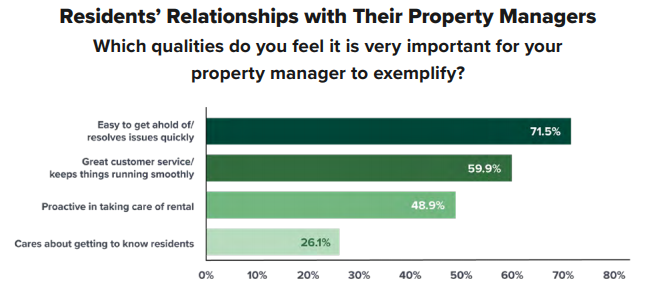
Chart courtesy of Buildium
Some highlights of the renter needs report
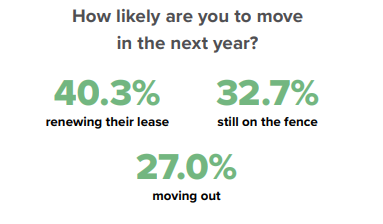
Among the 1,188 renters who took the Buildium survey, two in five definitely plan on renewing their lease for another year—a number that stayed constant from 2018 to 2019. Only 27 percent say they are definitely moving.
Reasons for renting vary by generation. Some simply cannot afford to buy where they are and have to rent because it is more affordable. Others, such as seniors, want the convenience of not having to maintain a home.
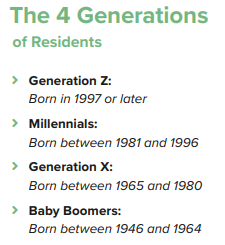
Charts courtesy of Buildium
“Renters’ desire to own a home of their own varies logically by age,” the report says. “Gen Z residents are happy renting for now, but assume that they’ll want to become homeowners down the road. Millennials and Gen X renters are highly interested in homeownership, but are waiting for the right time to buy. Baby boomer residents are largely former homeowners who either prefer to rent or have financial reasons for doing so at this time in their lives.”
Technology renters need is not fancy thermostats
The report says that while technology interest has grown by 7 points over the past year, renter needs are not about fancy gadgets like thermostats or door locks.
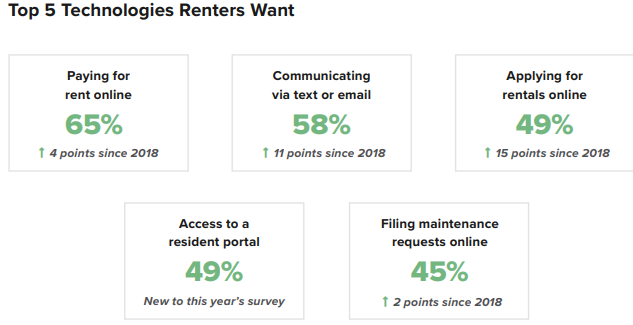
“The biggest gains in interest among renters were in applying for rentals online (+15 points), communicating with their property manager via text or email (+11 points), and signing leases and other documents electronically (+8 points),” Buildium says. “Baby boomers are far more interested in technology than they were just a year ago. On average, interest in rental technologies has grown by eight points among Gen Xers and 10 points among baby boomers.”
Chart courtesy of Buildium
Also, most renters want to pay their rent with a credit card, debit card, or electronic payment of some type, instead of paying with a check.
“Residents of all ages appreciate having the option to pay their rent online, and their expectation to be able to handle this and other tasks digitally increases with every year,” the report says.
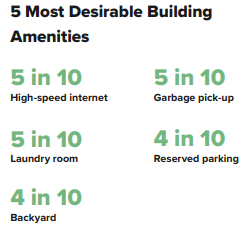
The most popular building amenity is high-speed internet
When it comes to technology, nothing is more important than high-speed internet, especially now that more people are working from home.
“High-speed internet has remained the most popular building amenity for the last three years,” the report says.
Chart courtesy of buildium
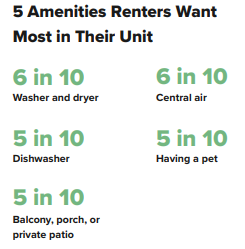
The most popular in-unit amenity
In-unit laundry and central air conditioning have topped the list of residents’ most-wanted amenities for three years in a row.
Tenant screening services for landlords are not all the same writes veteran investigator and rental property owner David Pickron who offers several cautions to landlords.
When you’re shopping for a shirt, it’s easy to compare the quality of two options by looking at them side by side. You ask yourself questions like: Do I like the style? How is the stitching? Is the material going to last after one wash? How does it fit my build? This physical, tactile data gives you the necessary information to purchase the right shirt for your particular need.
Unfortunately, when it comes to backgrounds and screening your prospective tenants, you don’t have the same luxury.
As a landlord, the tenant-background research process and results are invisible, seeming like smoke and mirrors. You’ve probably asked yourself, “How do I quickly get a reliable background on an applicant that allows me to make an intelligent and informed decision, and protects my investment?” This is THE essential question for you, because the wrong background will cost you time, money, headache, and heartache.
Deterioration of tenant screening services for landlords
As a licensed private investigator, I’ve had a front-row seat to the deterioration of reliable information generated through tenant screening/background check processes, and the resulting misguided decisions by landlords over the years.
In the past, investigators went to the courts in the jurisdictions where rental applicants lived and worked to obtain current and accurate data, at the source. Contrast that with today’s “high-speed” approach to everything, where quickly delivered results are king, regardless of whether they are backed by inferior and useless data.
A New York Times article titled, “How Automated Background Checks Freeze Out Renters” does a fantastic job explaining how the growth in data-mining in relation to tenant screening has become such a lucrative market over the last 10 years; all to the detriment of the tenant. Most of the biggest players in the industry are sourcing their tenant applications through these well-known, large data providers. As noted in the article, these large companies often employ rogue screening techniques that saddle landlords with maintaining their investment while also trying to sort through a list of applicants with limited, often inaccurate data as their source material.
To add to all of this, the government requires landlords and screening companies to have systems in place to report accurate Fair Credit Reporting Act (FCRA)-compliant records. In other words, false or misleading records can result in a FCRA violation, which can lead to lawsuits. Denny Dobbins, attorney for Rent Perfect, reminds us that the top three pitfalls to look out for with screening-company instant results are:
No. 1 – Records are those of my applicant
Do the records on the report represent the right applicant, and how does the screening company know?
Being correct about the data you are using to determine an applicant’s status is critical. Recent case law shows evidence that many background companies simply do not have good or adequate processes in place to ensure that a criminal history really belongs to the applicant. Consider all the information that is needed to make sure your screening company is reporting accurate results for your applicant: date of birth, Social Security number (if it can be found), full address history of the applicant since age 18, maiden names, alias names, etc. Most screening companies that provide instant products do not obtain all this vital information, or lack the experienced personnel to analyze it properly for clues and anomalies.
No. 2 – Records match exactly with the court
Are the records reported to the landlord identical to what is in court records?
Landlords are expected to make informed, professional decisions and, without court-verified and matched records, you may be subjected to making unskilled interpretations and conclusions. Every time data is transferred from one source to another, it loses its original integrity, similar to a copy machine. The more copies of copies you make, the less quality you have versus the original. So, a case in an instant database might show as dismissed – as if they never created the crime – but the actual court file will show a guilty plea that was dismissed two years later because of good behavior. One says the person was guilty, the other infers he or she was not.
No. 3 – Records are complete and updated
Are all the records complete and up to date? As a landlord, you deserve to see the case in its entirety. Things to look for are (a) do the records show the actual final disposition of the case, i.e. did the record start as a felony but was later reduced to a misdemeanor; (b) was the case dismissed after the applicant successfully completed probation, or did the matter go through some kind of a diversion process as opposed to ending in a conviction? Keep in mind that criminal records are constantly being updated at the court, and it is critical to the have most recently updated records in your report. Also, of note, states deal with these issues differently and there is no standard by which they all report or update records. Please note, information typically found in instant-database searches is not always complete and/or updated.
Instant searches often provide faulty data, which, when used by a landlord, can result in getting sued by applicants.
“Are all the records complete and up to date? As a landlord, you deserve to see the case in its entirety,” writes David Pickron. Photo credit AndreyPopov via istockimage.com
Use a licensed private investigator for tenant screening services for landlords
There is both greater safety and protection for you and your investments using a licensed private investigator to perform your tenant screening.
Although this sounds expensive and possibly time-consuming, the exact opposite is true.
Over the years, court data has become more accessible, and trained private investigators have paid-subscription access that allows them to quickly gather court data at a minimal cost to you. When an investigator accesses court records at their original source, whether it is for evictions or criminal history, they get current, accurate, and complete results, which protects all parties involved in the transaction.
“There is both greater safety and protection for you and your investments using a licensed private investigator to perform your tenant screening,” said David Pickron.
Customer service is key for tenant screening services for landlords
Having the correct data is the first step in finding the right person, but you should also look to lean on your screening company for additional policies, procedures, and simple answers to questions you might have.
Large companies who want to get into the screening business might offer an online application or background check, but when you pick up the phone to call them, the line keeps ringing. Technology can only get us so far, but it cannot replace a human being on the other end of the line.
You should be able to call and lean on your screening company for additional policies, procedures, and simple answers to questions you might have says David Pickron. Photo credit Ridofranz via istockphoto.com
An application and background check are nice and convenient, but there is so much more to providing you the service and protection you deserve from tenant screening services for landlords.
“Landlords get in trouble when they do not follow the Fair Credit Reporting Act,” Denny Dobbins continues. “One of the biggest, and most easily corrected, mistakes landlords seem to make is the complying with sending the required Adverse Action letter to the applicant. This letter is required if the applicant does not qualify for or meet the landlord’s rental criteria. It is very easy to do, but landlords must make it a habit. A good screening company should have a procedure/process in place to help you meet your obligations for this requirement and consult you through this process, but the landlord has to send the actual letter.”
Another area many landlords do not realize they have to comply with is to perform a HUD-type of “individualized assessment” for any report that comes back with negative information resulting in the landlord deciding not to rent to the applicant, based in part or in whole on information found in the background report.
Dobbins indicates that the way to perform this individualized assessment is to ask yourself these questions:
Looking at the nature and gravity of the criminal history, does the particular criminal history in the report constitute a risk that I am not willing to take based on my substantial, legitimate, and non-discriminatory interests to protect my property, my staff and other residents? In other words, what kind of criminal history is it and how bad was it? Is it an unacceptable risk to take?
How long has it been since the applicant was involved with the criminal activity?
How long has it been since the applicant has been released from prison or parole for that criminal activity?
Have I analyzed all information that the applicant has provided me about mitigating factors regarding the criminal activity and rehabilitation for the criminal activity?
Does the particular criminal history in the report constitute a risk that I am not willing to take based on my substantial, legitimate, and non-discriminatory interests to protect my property, my staff and other residents? Dobbins asks.
To help guide the analysis above, Fair Housing suggests investigating back o more than seven years, and determining if any prior crimes cause a threat to your property or other people. However, some felonies may create enough risk that you may want to include a longer research period, such as sex crimes, crimes against children, and violent crimes. These should be discussed with your attorney.
Landlords have a duty to properly screen tenants as outlined above, and may be held liable for the criminal acts of a bad tenant upon others. What might seem like a “no-win” situation can easily be remedied by having a legally sound rental criteria that is strictly enforced, fair and respectful treatment of tenant applicants, employing a quality background-check company that ensures they are delivering accurate and complete results, and giving you the proper tools and resources to manage applicants that do not meet your criteria.
Summary
So, compare your current tenant applicant background process with the actions that are prescribed above. If you find them lacking in one or more areas, you owe it to yourself and your investments to find a screening company that understands your needs for quick (less than 6 hours), accurate, and up-to-date information on your applicants while supporting you every step of the way. With the right questions and diligent comparisons, you will soon find out that not all screening services for landlords and companies are the same.
About the author:
David Pickron is a private investigator licensed in Arizona. He owns and manages residential and commercial properties and is the founder and president of Rent Perfect, an investigative screening company. He wants landlords to find the right renter the first time.
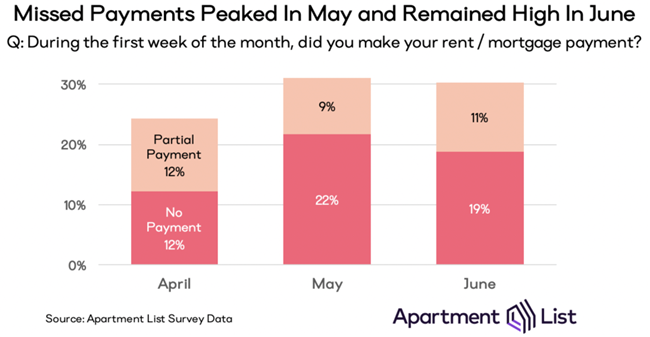
At the beginning of June, 30 percent of Americans missed housing payments, down slightly from 31 percent in May but still up from 24 percent in April, according to the latest report from Apartment List.
The missed-payment rate—the percentage of renters and mortgaged homeowners failing to make a full payment at the beginning of the month—jumped to 24 percent in April, rose again to 31 percent in May, and then dipped slightly to 30 percent in June.
Of those who have yet to make their June housing payment, one-third made a partial payment and two-thirds made no payment at all.
Some highlights of the missed housing payments report
Missed payments continue to concentrate among renters, younger and poorer Americans, and those who cannot work remotely.
A majority of payments missed at the beginning of the month are paid by the end of the month. But those who do not pay on-time in one month are much more likely to miss a payment in the following month.
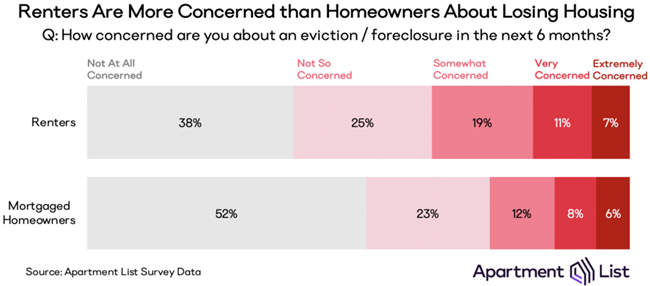
Some eviction and foreclosure protections are beginning to expire, creating concern that many Americans will soon lose their housing as a result of missed payments. As many as 37 percent of renters (and 26 percent of homeowners) are at least somewhat concerned that in the next six months they will face an eviction or foreclosure.
Housing payments often catch up by end of the month
“Despite many households missing payments at the beginning of each month, the majority have managed to close the gap with late payments over the following weeks,” Apartment List said in the report.
“In April, nearly one quarter did not make a full on-time payment, but fewer than 10 percent remained delinquent by the end of the month. May showed a similar trend: the missed-payment rate dropped from 31 percent at the beginning of the month to 11 percent at the end.”
Some sources, such as the National Multifamily Housing Council, have reported a higher percentage of rent being paid than what Apartment List is reporting.
Rob Warnock, research associate at Apartment List said, “We’ve consistently reported higher missed payment rates than NMHC, and I think it has to do with two things.
“The first is the composition of our samples. By surveying professionally managed multi-family apartment buildings, the NMHC data naturally favors newer market-rate units and a wealthier demographic of residents who can afford them. Our survey, on the other hand, doesn’t have this exclusion. So, I think we’re capturing more inventory on the lower-end of the market, where missed/late payments may be more common.
“This is a minor point, but we ran our survey between June 3-4, while NMHC’s data runs through June 6. That gives their sample an extra two days to make payments, potentially bumping up their rate. Although I can’t say for sure how much of a difference two days make for people struggling to afford their payments in the first place,” Warnock said.
JRK, a Nevada corporation headquartered in Los Angeles, will pay almost $300,000 directly to tenants in the form of refunds, payments and rent forgiveness.
Ferguson filed suit in April, charging JRK violated Gov. Jay Inslee’s Emergency “Evictions” Proclamation. Inslee’s proclamation establishes a temporary moratorium on evictions for the inability to pay rent. The proclamation specifically prohibits landlords from issuing notices to pay or vacate during the effective period.
Ferguson said in the complaint that JRK Residential violated the proclamation by issuing Notices to Pay or Vacate in April to at least 14 tenants of The Boulders at Puget Sound, a multi-building Tacoma apartment complex containing more than 700 units. The lawsuit also asserted that JRK sent unfair, deceptive and harassing communications to approximately 1,400 Washington state tenants.
The Boulders at Puget Sound tenants discovered the notices to pay or vacate at their front doors. The notice instructed tenants to pay all rent due within 14 days or be “subject to eviction as provided by law.” The notice stated that it was “unconditional,” and threated tenants that if they failed to “surrender the premises,” they would “be guilty of unlawful detainer and subject to eviction.”
In addition, beginning on April 1, JRK sent multiple emails to tenants reminding them that rent was due, and stating that they would “not waive any late fees.” This notice and later notices pressuring tenants to pay April 2020 rent did not mention the governor’s proclamation prohibiting evictions for non-payment of rent.
JRK Residential is a Nevada-based for-profit real-estate investment firm and property-management company that operates at least four apartment complexes in Pierce, Snohomish, and Kitsap counties. JRK Residential manages property in 20 states with an investment portfolio of $6 billion.
JRK said in a statement it had taken steps after the pandemic began to “ease the resulting burdens” on its tenants but recognized that more could have been done.
“To that end, we have worked with the state to further improve our policies and procedures and to offer our residents financial compensation to ease their burden during this time,” the statement said.
JRK Residential unfairly and deceptively pressured residents to pay outstanding rent by sending numerous threatening emails and notices, sometimes multiple times per day, and making harassing phone calls to tenants or tenants’ workplaces, according to the release.
Ferguson’s lawsuit was the first state lawsuit filed to enforce Inslee’s emergency proclamations.
“JRK Residential is a large, sophisticated corporation that knew about the governor’s emergency evictions proclamation and ignored it anyway,” Ferguson said in the release. “Their conduct is cruel and unlawful – and we will hold them accountable.”
Washington Attorney General Bob Ferguson
As part of the consent decree, filed in Pierce County Superior Court, JRK will be required to:
Forgive April 2020 rent, or offer refunds to those who paid, for 14 tenants at The Boulders at Puget Sound complex who received 14-day Notices to Pay or Vacate in violation of the governor’s proclamation;
Once the consent decree is approved by the court, JRK will also be required to pay $246,900 to 1,441 tenants who received unfair, deceptive or harassing communications from JRK;
Waive or refund fees for tenants who need or choose to move out before their lease is up while the governor’s proclamation is in effect.
JRK Residential will pay approximately $344,646 to resolve the lawsuit, with almost $300,000 going directly to tenants in the form of refunds, rent forgiveness, or direct payments, including:
Full rent forgiveness or refunds of April 2020 rent for the 14 tenants of Boulders at Puget Sound who received 14-day Notices to Pay or Vacate — a total of $26,877.69;
$500 payments to 257 JRK tenants who were behind on April rent at the time that JRK sent letters that attempted to shame or harass tenants who had been unable to pay full April rent — a total of $128,500; and
$100 payments to 1,184 JRK tenants who received the unfair and deceptive letters but were not behind on April rent — a total of $118,400.
“During this time of hardship and uncertainty, the moratorium on evictions is intended to help families and individuals keep a roof over their heads,” Inslee said in the release. “Any property owners who attempt to remove people from their homes and skirt this order are breaking the law. I thank AG Ferguson and his team for enforcing the eviction moratorium.”
The attorney general’s active enforcement of the eviction moratorium
Ferguson’s civil-rights division began receiving complaints from tenants shortly after Inslee issued his evictions proclamation. The attorney general’s office launched an eviction-complaint form on April 1. Since then, more than 650 Washingtonians have filed complaints. The attorney general’s office has contacted 469 tenants and 284 landlords in response to complaints.
More than a dozen assistant attorneys general from other divisions in the office are volunteering their time to assist the Civil Rights Division in responding to these eviction moratorium complaints.
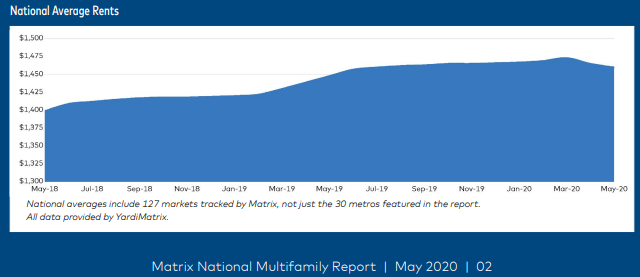
National rents continued their downward trend in May, reaching their lowest year-over-year level since February 2011, according to the latest report from Yardi Matrix.
During what would typically be prime leasing season, rents decreased by 0.3 percent on a month-over-month basis.
Nationwide, rents have declined by $13 over the past two months, the company reported.
Fall could become the rental season
“This rapid decline will likely continue through the summer as the nation continues to practice social distancing. As some unemployed (people) slowly return to work in the coming months, the fall could become this year’s rental season,” Yardi Matrix said in the report.
Rent collections nationally in May were still reasonably strong with 93 percent of households “paying some rent,” according to the National Multifamily Housing Council.
“With the extra $600 per week in unemployment benefits set to run out at the end of July, it remains to be seen how renters will fare if the extra assistance is not extended. A decline in collections seems imminent, but as of right now, renters are prioritizing their rent payments.”
“If rents continue this rapid downward trend, we could be looking at alarming numbers by the end of the summer,” the report said.
“The reason numbers could get worse is that the CARES Act currently provides an additional $600 a week in unemployment benefits on top of the standard state payment, but this is set to expire at the end of July unless another stimulus bill is passed.
“The HEROES Act was passed by the House of Representatives on May 15 and proposes to extend the extra unemployment benefits through January 2021, among other provisions. The $3 trillion HEROES Act will likely face significant opposition in the Senate. The extra $600 a week is a necessity for many Americans to pay their bills, most notably rent, and if it does run out, we could see rent collections decline rapidly,” the report says.
Month-over-month, the markets with the most severe declines include:
Houston -0.9 percent
San Jose -0.9 percent
Seattle -0.8 percent
Nashville -0.8 percent
Seattle, San Jose and Orange County were among the first markets to impose stringent lockdowns. Seattle only planned to enter Phase 1 of reopening on June 5.
I want to give you an update on the status of Covid-19 housing policies. However, I want to be candid and tell you that I wish I had more to say than I do, or at least something better to say than I do. But here goes…
Currently we are into the third month of the 90-day Non-Eviction Order as mandated by Oregon Governor Kate Brown.
The statistics have been that about 15-to-17 percent of tenants have not paid rent in either April or in May, statewide, and our company has seen the same. It is predicted that the number of non-payments will increase in June, as many tenants who have paid at first, have used up their resources.
At our company, we have tenants from all income brackets who cannot pay rent, from housing voucher contributions of $400 per month up to leases more than $2,500 per month. Business owners that rent housing and are unable to work are just as affected (sometimes even more affected) than tenants who work at minimum wage jobs.
Tenant debt is mounting
As the tenants’ debt mounts and the economy continues to tank, it does not take a lot of imagination to see that many people will not be in a position to repay the delinquencies even in the six-month period that they were granted by the state.
Additionally, it should be understood by everyone here that the governor and State Legislature are aware of this dynamic and they are no doubt crafting some plan that they will announce at some point.
My guess is that they will toss a small bone to owners, while new restrictions may be imposed on them that provide even more protection for vulnerable tenants.
So what are we doing about all of this?
The truth is that we don’t have many tools at our disposal here.
We have reached out to all of our non-paying residents and asked them to fill out and sign our Covid-19 Deferral Plan – which simply spells out the terms they would agree to repay the back-rent owed.
About 50 percent of the tenants have signed this and 50 percent have not.
Our working plan (after the 90-day ban is lifted) is to contact those tenants who did not sign the agreement and did not pay part or all of the rent, and let them know we need to make those arrangements or they would face the prospect of an eviction for non-payment. Then if they didn’t sign it we would send the FED (Forced Entry Detainer).
Where this could get complicated
But here’s where it is going to get complicated, because I suspect that either:
The state will forbid evicting anyone for non-payment of rent during the quarantine period, (so that messaging will be moot) and/or
Even for those that legitimately could be evicted – the courts will be 90 days backlogged as they have been closed for the last two months to all but extreme cases, essentially not hearing any rental related issues. So the entire process will be prolonged and the losses from continued non-payment of rent would mount.
It will be at this point in time that rental property owners will be at ground zero of the pandemic (much as restaurants and retail stores were at the beginning).
It will be at this time that we begin the bartering and negotiating and risk management with all of our tenants and clients. It will be at this time that we will need to create new policies and procedures to address unforeseen issues. (Remember, we are still dealing with state and local rent restrictions and housing regulations limiting everything we do more and making the process ever more complicated.)
DISCLAIMER: I may be wrong and it may all work out okay. I feel a little like an oceanfront homeowner boarding up for an approaching hurricane, while my neighbors are having a barbeque.
Difficult for staff at our property management company
The strain on our property management company from the pandemic has taken a toll.
We hired new staff in February for staff that left in January, but they were gone by March for their inability to work and our inability to properly train them.
However – we hired a key manager, who has brought incredible resources to bear.
This month, we have just formed a new portfolio team as we are actually anticipating a growth surge due to the complexities of managing residential properties at this time.
I am personally going to manage this group of properties as well to make sure we get it right. We will continue to outsource most of our maintenance to companies that are geared and prepped to operate in an on-going health crisis. My political days are on hold for now and if you want to see that messaging go to my website at gogarcia.org.
We are a relationship business
Our business is built on relationships with owners, with tenants and vendors.
Our product is problem solving and communication. Whenever a crisis occurs, those that are able to, go to work. Often those people are called on to work harder. It is time for us in the residential property industry to go to work and help all of those who are affected (tenants and landlords) with the best advice and perspectives and resources we can locate and offer.
In closing, it is still too early to know who will or will not pay rent this month. Please know we are carefully watching it and getting ready to do what is needed.
Property management is one of the most demanding careers in the real-estate industry so how does a property manager stand out from the competition? That is this week’s tip from Keepe the maintenance company.
Meeting the high expectations of tenants, landlords, colleagues, and contractors is no small task.
A rental property manager may need to handle the tasks of finding and screening new tenants, maintenance issues, handling renters’ complaints, and leases. This means that for a property manager to be successful, they need to possess excellent management skills.
With the property-management industry being a lucrative career in recent years, there is a massive influx of individuals seeking to take up property management as a career. According to a report by Statista, there are approximately 80,000 property managers in the United States.
Considering that level of competition, it’s important that property managers learn strategies to stand out from the crowd.
No. 1 – Be Available and Responsive
Successful property management entails being available and responsive.
You have to be available to respond to your tenants, landlord, and even contractor messages or requests. Today, tenants want a property manager to whom they can easily communicate their fears and desires about their apartments. Responding to your tenant’s request or complaint in a timely manner will help you build trust with your tenants and clients. On the other hand, being unavailable will only earn you negative reviews or ratings, and will hurt your chances of scoring new clients.
No. 2 – Have an Excellent Understanding of your Rental Properties
To be ahead of your competition, you need to have a complete understanding of the properties and neighborhood(s) you manage.
Start by learning all their unique features and selling points. Learn more about the neighborhood, entertainment areas, relaxation spots, education facilities, social amenities, and business areas. Such information will make it easier for potential renters to decide whether this is a place they would want to live. The more knowledge you have about your rental properties and neighborhood, the higher your chances of attracting and retaining tenants.
No. 3 – Set Realistic Prices for Your Rental and Service
When it comes to finding a rental, price is one of the most important considerations for most renters.
If the rent is set too high, potential tenants are likely to overlook it and go to the competition. Therefore, do your due diligence before setting the price. A property manager could consult an experienced real estate agent to find out what others in the neighborhood are charging for similar properties. Finding the right price will help lower your vacancy rate and boost your occupancy rate.
In addition to setting the best rental rate to make both tenants and clients happy and to keep your property management business running, you need to think about how much you should charge your clients. In addition, try to offer unique services that allow you to charge more and help to attract property management clients as well.
The bottom line for a property manager
If you want to stand out from the crowd as a property manager, you’re going to have to do things a little differently. Just be sure to keep an eye on the growing competition!
About Keepe:
Keepe is an on-demand maintenance solution for property managers and independent landlords. The company makes a network of hundreds of independent contractors and handymen available for maintenance projects at rental properties. Keepe is available in the Greater Seattle area, Greater Phoenix area, San Francisco Bay area, Portland, San Diego and is coming soon to an area near you. Learn more about Keepe at https://www.keepe.com.
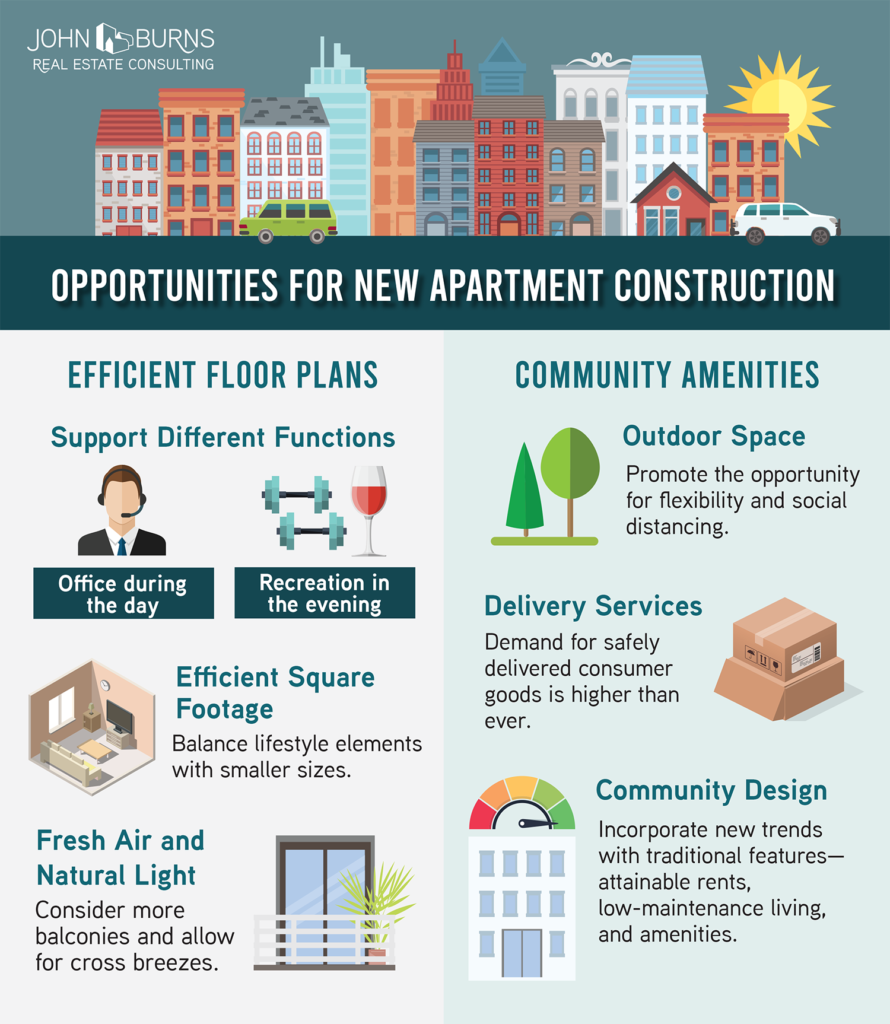
Space in home and community design is more important than ever with the pandemic and with so many people working from home, John Burns Consulting took a look at the future of apartments and tried to determine what it will take, going forward, to get people to rent.
“People need space for health reasons, and people need space and privacy to work from home. Working from home will be a significant shift that stays with us for years,” wrote Ken Perlman and Lesley Deutch in the John Burns Consulting newsletter. “To succeed during lease-up, the more than 400,000 apartment units currently in some stage of construction also need to capitalize on tenants’ need for space.”
They point out some opportunities for new apartment construction that were already trending before the pandemic.
Floor plans that provide both natural light and privacy
Apartments that can provide roommates or couples several places to work – and provide privacy plus separation – will get people to rent and may be the future of apartments.
“Rooms that can flex to support different functions, such as office during the day and fitness in the evening, will be part of the new apartment landscape,” Perlman and Deutch wrote.
“While planning for roommates is important, we also anticipate some renters will be less amenable to sharing their homes. For them, apartment floor plans will need to balance the lifestyle elements they want with smaller sizes that can keep rents attainable. That will mean apartments that are large enough to support both living and working with very efficient square footage and design elements that promote physical and emotional separation.”
What future of apartments looks like
The smaller the apartment, the more important light, balconies and fresh-air spaces become.
“We advise more ‘under roof’ spaces without walls that provide shade and fresh air. Apartment communities will need more places for outdoor yoga and parks for free play or alfresco dining. Today’s consumers love their pets more than ever, and community amenities that include dog parks or pet-washing stations will resonate more than ever before.
“Apartment communities that can adjust to shifting consumer demands will have a competitive advantage in what we believe could be a very competitive leasing environment,” Perlman and Deutch write.
Article courtesy of John Burns Real Estate Consulting. Contact Ken Perlman, Lesley Deutch, or other team members for more insight into changing rental preferences and trends in new construction.
As our country experiences one of the worst economic downturns in its history, consumers and companies alike are facing unprecedented financial hardships. If you extend credit, chances are you’ve heard from your customers and clients asking what you can do to help them through these difficult times.
Creditors are answering these requests in a variety of ways. Some are extending due dates, waiving late fees, reducing or forgiving payments, or delaying foreclosure, repossession, or ceasing service. In addition, a new March 2020 law offers consumers and businesses various forms of financial relief — even when it comes to their credit reports.
Impact of the CARES Act on credit
The Coronavirus Aid, Relief, and Economic Security (CARES) Act was introduced in March 2020 to help Americans impacted by the COVID-19 pandemic. You may have heard about the generous small business loans, enhanced unemployment benefits, and stimulus payments the Act offers. What you may not have heard about, though, are the Act’s rules about credit reporting during the covered pandemic period.
Section 4021 of [the CARES Act] requires furnishers during the COVID-19 pandemic covered period to report to the credit bureaus that consumers are current on their credit obligations if they enter into an agreement to defer, forbear, modify, make partial payments or get any other assistance on their loan payments from a financial institution and fulfil those requirements, provided they were current before this period.
In other words, the document explains, under the CARES Act, lenders now have to report obligations to the credit bureaus as “paid on time” if the debtor has asked for and has been granted any allowance regarding their payment. So, for example, if your customer asks you to place their account in forbearance and you agree to do so, the CARES Act requires you to report this debt as “paid on time.” (To learn more about forbearance, read our March 2020 blog post “How to Report COVID-19 Debt Information to the Credit Bureaus”.)
“Together, we believe this solution ensures consumers get the help they need while preserving the integrity of the consumer reporting system, which is critical to our economic recovery,” the statement reads.
“The Act requires lenders to report to credit bureaus that consumers are current on their loans if consumers have sought relief from their lenders due to the pandemic,” reads the CFPB release. “The Bureau’s statement informs lenders they must comply with the CARES Act. The Bureau’s statement also encourages lenders to continue to voluntarily provide payment relief to consumers and to report accurate information to credit bureaus relating to this relief. The continuation of reporting such accurate payment information produces substantial benefits for consumers, users of consumer reports, and the economy as a whole.”
The CFPB also encourages lenders to make a “good faith” effort to continue investigating disputes as quickly as possible. For those who do, the CFPB says it doesn’t “intend to cite in an examination or bring an enforcement action against firms who exceed the deadlines to investigate.”
The bottom line on credit reporting and the Cares Act
All of this guidance on credit reporting and the Cares Act boils down to one fact. No matter what you’re offering in these unprecedented circumstances, don’t stop reporting credit data to the bureaus. In response to the CARES Act, the Consumer Data Industry Association (CDIA) has issued specific Metro 2® reporting guidelines for data furnishers. We’re sharing these instructions here, but you can also find them here on the CDIA’s website.
Furnisher – CARES Act Reporting
Report the following Base Segment fields as specified if the account was current prior to the Accommodation period:
Highest Credit or Original Loan Amount = the total amount borrowed
Credit Limit = assigned Credit Limit for the account
Scheduled Monthly Payment Amount = zero
Account Status Code = 11 (Current account)
Payment History Profile (report All prior history)
Report value 0 for the months during the Accommodation period
As an option, increment the Payment History Profile with value D during the Accommodation period
Current Balance = outstanding balance amount
Amount Past Due = zero
For all other Metro 2® fields, the standard guidelines described within the Field Definitions module of the CRRG should be followed.
Report the following Base Segment fields as specified if the account was delinquent prior to the Accommodation period:
Highest Credit or Original Loan Amount = the total amount borrowed
Credit Limit = assigned Credit Limit for the account
Scheduled Monthly Payment Amount = zero
Account Status Code = Delinquency Status 71 – 84 as reported prior to the Accommodation period (example 30-day delinquency prior to the period remains a 30-day delinquency throughout the Accommodation period)
Payment History Profile (report ALL prior history)
Report appropriate code that specifies the previous month’s Account Status for each month the account is in the Accommodation period
As an option, increment the Payment History Profile with value D during the Accommodation period
Current Balance = outstanding balance amount
Amount Past Due = APD as reported prior to the accommodation period
For all other Metro 2® fields, the standard guidelines described within the Field Definitions module of the CRRG should be followed
Report the following Base Segment fields as specified if the account is brought current during the Accommodation period:
Highest Credit or Original Loan Amount = the total amount borrowed
Credit Limit = assigned Credit Limit for the account
Scheduled Monthly Payment Amount = zero
Account Status Code = 11 (Current account) or 13 (Paid account)
Payment History Profile (report All prior history)
Report appropriate code that specifies the previous month’s Account Status for each month the account is in the Accommodation period
As an option, increment the Payment History Profile with value D during the Accommodation period
Current Balance = outstanding balance amount OR zero if Paid
Amount Past Due = zero
For all other Metro 2® fields, the standard guidelines described within the Field Definitions module of the CRRG should be followed
If furnishers elect to utilize the Metro 2® FAQ 44 (Deferred), FAQ 45 (Forbearance) or FAQ 58 (Natural Disaster), they should do so in accordance with the CARES Act amendment to the FCRA as outlined above.
Please visit our website at www.datalinxllc.com, or contact us at [email protected] or (425) 780-4530 if you have any questions or need our assistance.
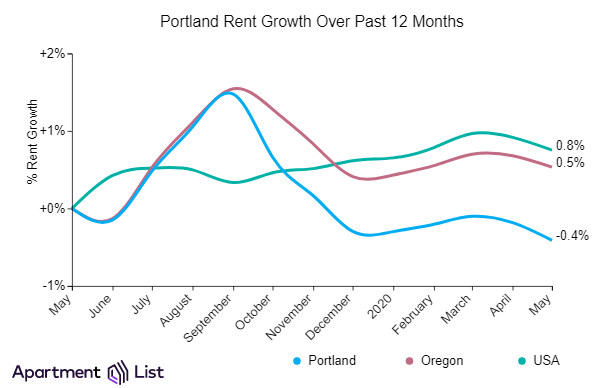
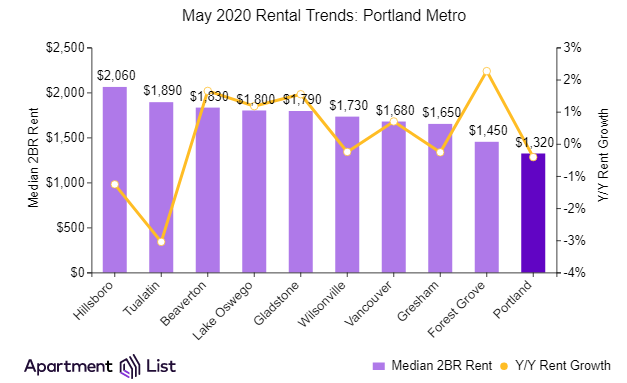
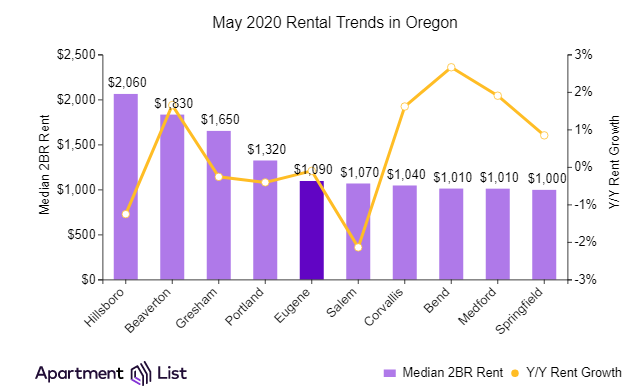
Portland has seen a rent decline of 0.3 percent in the past month as rents in many places have started to dip during the pandemic, according to the latest report from Apartment List.
Other cities nationwide are also feeling the rent decline, such as Seattle by 0.1 percent and Phoenix by 0.2 percent.
“It’s important to note that the magnitudes of these rent decreases are all quite modest, but on the other hand, this may just be the beginning of a prolonged trend,” said Chris Salviati, Housing Economist at Apartment List.
“I would note that the areas where we’re seeing the most significant rent dips are in local economies that are heavily dependent on tourism, such as Las Vegas, Orlando, and Miami. Compared to those cities, Portland, Seattle, and Phoenix all have notably higher shares of workers employed in knowledge occupations that can be done from home, so they’re a bit more protected from the harshest economic impacts,” he said.
Rent trends vary across the Portland Metro
While rent prices have decreased in Portland, the rest of the metro is seeing varying rent trends.
Of the largest 10 cities that Apartment List has data for in the Portland metro, half have seen increases, while the other half have been decreasing.
Impact on rent will depend on economic recovery
Salviati said as far as longer-term impact, the pandemic’s effect on rent prices will depend heavily on how quickly the economy is able to recover.
“Even in the best-case scenario, it’s highly possible that we could see a protracted uptick in downgrade moves as many households facing financial hardship begin looking for more affordable housing,” Salviati said.
“We may also see a significant slowdown in new-household formation, as more Americans move in with family or friends to save on housing costs. These trends could lead to tighter competition for rental units at the middle and lower ends of the market, while luxury vacancies get harder to fill.
“As I mentioned above, Phoenix, Seattle, and Portland are not among the areas that I would consider to have the most at-risk local economies, but there’s still a lot of uncertainty in how this will all play out,” Salviati said.