Home Blog Page 134

Do You Answer These 4 Vital Questions Before Your Tenant Asks?

Answer tenant questions before they come up and be sure to get it in your leases

Here are four important questions to answer before your tenant asks, and before you both enter into a rental or lease agreement, from Keepe the on-demand repair company.

Obviously the lease is designed to hold you and your tenant to all the conditions of tenancy, which may protect either party during a dispute.  As a property manager, it is your duty to make sure all the conditions regarding living or renting an apartment or single-family home you manage are expressly stated in the agreement to prevent future dispute.

One great way to prevent future disputes with your tenants is to answer all the questions they may have in the actual agreement even before they ask you.

Below is a list of four questions your prospective tenants are most likely to ask before signing a lease agreement with you.

No. 1 – How is Rent Paid?

It’s likely that nearly every property management company or landlord in charge of a rental home employs a different strategy for dealing with rent-related issues, especially in this time of COVID-19.

It is important that you clearly state in the lease agreement your position on how rent should be collected and any other related matter.  Below are ideas for clarifying the rent-collection process in your rental agreements:

  • State whether you allow for a grace period, and the terms for it;
  • Specify penalties for late payments or late-rent policies
  • Specify the acceptable method(s) of rent payment:
  • Spell out the consequences of not paying rent.

No. 2 – What Utilities are Tenants Accountable for?

 In most rental homes, this is one of the major causes of disputes between renters and property managers.

In many cases, landlords cover some utility bills as a form of incentive or bonus to tenants. Other times, the utilities are in the landlord’s name and will require a change to the tenant’s billing. Be sure to state when and how this is supposed to happen so you as the manager do not get stuck with tenants’ bills.

When drafting your rental agreements, it is advisable that you clearly itemize the utility bills that renters are expected to handle on their own and answer this tenant question up front.

Below is a list of utilities that property managers are likely responsible for:

  • Water/sewer/trash
  • Garbage collection
  • Parking permits
  • Cable and/or internet connections

No. 3 – What If I Need to Break My Lease Before Its Expiration?

 Sometimes your tenants may need to break their lease before the agreed termination date.

You cannot force a tenant to continue to live in your property against their wishes. It is a hassle every property manager must deal with.

It is important that you include the early-lease-termination procedure in your lease agreement. This alerts your tenants of what to expect if such a situation arises in the future.

Here are some key things to include in this clause of the contract:

  • The notice required to vacate the property (including time-frame and form the notice must be given in).
  • Charges associated with early termination.
  • The cancellation process, should you choose to allow certain instances of early lease termination.

No. 4 – What is Your Pet Policy?

answer tenant questions on pets before the lease is signed and before issues come up.
Remember before renting your home to a tenant, you should include the type/number of pets allowed and the deposits tenants are required to pay

Pets are great friends to live with, but what happens when your garden or rental-home carpets are destroyed by these same friends?

Before renting your home to a tenant, you should include the type/number of pets allowed and the deposits tenants are required to pay.

Also, clearly state the penalty for destruction caused by a tenant’s pet(s) or the presence of an unapproved pet on the property.

Also remember that therapy dogs, assistance animals, and companion animals approved by a medical professional are not pets and thus not subject to a no-pet policy.

Answer tenant questions final thoughts

 Renting your property to a tenant can be a lot to handle if your rental agreement doesn’t explicitly state your position on these important issues.

It’s also a good idea, before drafting your agreement, to talk with a local property lawyer. It’s important to be on the right side of your state and city laws. It’s critical that you stay on the right side of your state laws.

About Keepe:

Keepe is an on-demand maintenance solution for property managers and independent landlords. The company makes a network of hundreds of independent contractors and handymen available for maintenance projects at rental properties.

Keepe is available in the Greater Seattle area, Greater Phoenix area, San Francisco Bay area, Portland, San Diego and is coming soon to an area near you. Learn more about Keepe at https://www.keepe.com.

5 Maintenance Tips For Long-Lasting Carpet In Your Rentals

Kitchen Range Hood Options for Your Rentals

Sign Up For Our Newsletter And Get Apartment News And Helpful, Useful Content Each Week.

* indicates required

I Am Afraid Tenants Will Abuse Gated Driveway; What Can I Do?

I Am Afraid Tenants Will Abuse Gated Driveway; What Can I Do? Ask Landlord Hank

A gated driveway can provide extra security for tenants, but also added costs which is the question for Ask Landlord Hank this week.

Dear Landlord Hank:

I have a gated driveway to a triplex. I’m concerned about tenants possibly abusing the gate. I would welcome your thoughts.

-Tom

Dear Landlord Tom:

Is there a way for you to install a discrete camera to observe?

If there is some abuse and you have no proof of which person caused the damage to the gate, you won’t be able to bill the proper party for repairs.

I’d hook the camera up to a monitoring system so you can check footage if something happens at the gated driveway.

It would be nice if the camera would work at night as well.

Sincerely,

Hank Rossi

Can you evict a tenant for discharging a pistol or guns in your apartment is the question for Ask Landlord Hank
Landlord Hank Rossi I am afraid tenants will damage by gated driveway to my rentals

Ask Landlord Hank Your Question

Ask veteran landlord and property manager Hank Rossi your questions from tenant screening to leases to pets and more! He provides answers each week to landlords.

  • This field is for validation purposes and should be left unchanged.


Do I Have to Paint and Replace Flooring for a Long-Term Tenant?

No Guns In My Apartments: Can A Landlord Say That And Put It In A Lease?

Sign Up For Our Newsletter And Get Apartment News And Helpful, Useful Content Each Week.

* indicates required

What the Downsizing Trend Means for Apartment Living

downsizing to apartments What the Downsizing Trend Means for Apartment Living

Downsizing is becoming more popular and driving rental demand in both younger and older generations.

By Holly Welles

More people than ever are moving out of their homes and transitioning or downsizing to apartment living.

Apartments offer many advantages over owning a home. For one, renting can be cheaper than paying off a mortgage. Repairs and maintenance are essential to consider, too; in an apartment, tenants don’t have to pay out of pocket if there’s a leaky roof or burst pipe. This lack of responsibility can be a big stress reliever for anyone who doesn’t want to tap into their rainy-day fund.

Apartments offer benefits beyond savings, too. Many complexes offer excellent amenities, such as pools, gyms, laundry facilities, dog parks and convenience stores. If residents like to be social, they can also mingle with the building community and make new friends. Some buildings even host resident events, such as trivia night, bingo and potluck dinners.

With all this in mind, it’s no surprise that the share of the population who rent is only expected to grow in the United States. However, diving into the demographics can highlight less-obvious trends that help landlords prepare for the future of rentals. In this case, what does downsizing have to do with apartment living?

Downsizing to apartments and the older generations

Many young people choose to rent because they’re still building their savings and getting started in their careers. However, more people in older generations have decided to sell their homes, downsize their lives and move into apartments. The number of renters over the age of 60 grew by 43 percent in the last 10 years.

More than 22 percent of the U.S. population is aged 60 and over. These people are tired of the work and headaches that come with owning and maintaining a home. They want to enjoy their golden years and relax, which means putting up for-sale signs and searching for rentals in the classifieds. According to one study, 37 percent of baby boomers plan to move later in life, and, of those, 42 percent say they will choose a smaller home.

Renting comes with less responsibility and also tends to offer better accessibility for older people. Many apartments are on a single floor, meaning renters don’t have to traverse up and down the stairs to get their bedrooms, bathrooms or laundry rooms. Multi-story complexes also offer elevators, allowing convenient access for those who use walkers and wheelchairs.

What Landlords Can Expect Going Forward

With this trend of downsizing on the rise, what can property managers and landlords expect in the years to come?

More Age Variance

Millennials were responsible for 37 percent of home sales in 2018, with many moving out of apartments and into newly owned properties. Meanwhile, a growing proportion of people over age 60 are selling their homes and looking to downsize.

As such, landlords should prepare for a shift in the average renter’s age. They may need to change their strategy for how to market their available apartments based on how they appeal to each demographic. For instance, a significant community of older renters in the area, good amenities for low-maintenance living and other property touches can match what downsizers are looking for in their new space.

New amenity requests

When catering to younger people, multifamily developers may think amenities like high-speed Internet connections and dog parks are the way to go. However, they’ll soon have to consider what older generations may prefer.

For instance, those who can’t or don’t want to drive may appreciate a complimentary shuttle service that can get them to the grocery store and doctor’s appointments. Others may look for community-building programming that allows renters to socially connect in their new surroundings.

Property floor plans and additions

Older generations may have some different expectations compared to younger people regarding floor plans and safety features in downsizing to apartments. Small accessibility finishes like grab bars in the shower can help rentals offer long-term value for tenants. Many will look for simple, open floor plans that help them adjust to a downsized lifestyle and age in place for years to come.

Some renters will also seek out two- or three-bedroom apartments to accommodate family visits, particularly if they have children and grandchildren. Landlords with larger units or single-family rentals may benefit from marketing to older renters.

Helpful technology

Millennials and Gen Zers aren’t the only ones who appreciate tech-laden apartments. The older generations also love gadgets that make their lives easier. According to one poll of nearly 6,000 older adults, 80 percent are interested in smart thermostats and apps that control appliances. Almost 70 percent want tech to improve their health at home, such as air purifiers, and 58 percent want cleaning robots.

Downsizing to apartments conclusion

The younger generation once monopolized the renting scene.

Today, however, older individuals are selling their homes and moving into apartments in droves. They’ve realized the benefits of downsizing and want to enjoy the convenience that comes with no responsibility.

How Property Managers Are Managing COVID-19 Cautions in Apartment Communal Spaces

How to Manage Tenant Communication During COVID-19

How to Avoid Crossing the Line with Tenants’ Privacy 

Sign Up For Our Newsletter And Get Apartment News And Helpful, Useful Content Each Week.

* indicates required

2020 Apartment Construction Down 12%, a 5-Year National Low

2020 Apartment Construction Down 12%, a 5-Year National Low

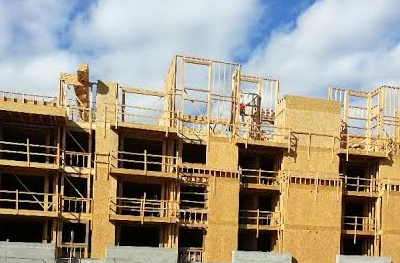
New apartment construction across the country is starting to mirror the downward trend following the 2008 crisis, down 12 percent and hitting a five-year low for buildings of 50 units or more, according to a report from Rent Café.

The covid-19 pandemic is further complicating an already-visible slowdown in apartment construction since its 2018 peak.

The report says:

  • Apartment construction is down, with around 283,000 new units expected to hit the market this year, considerably fewer than the 2018 peak.
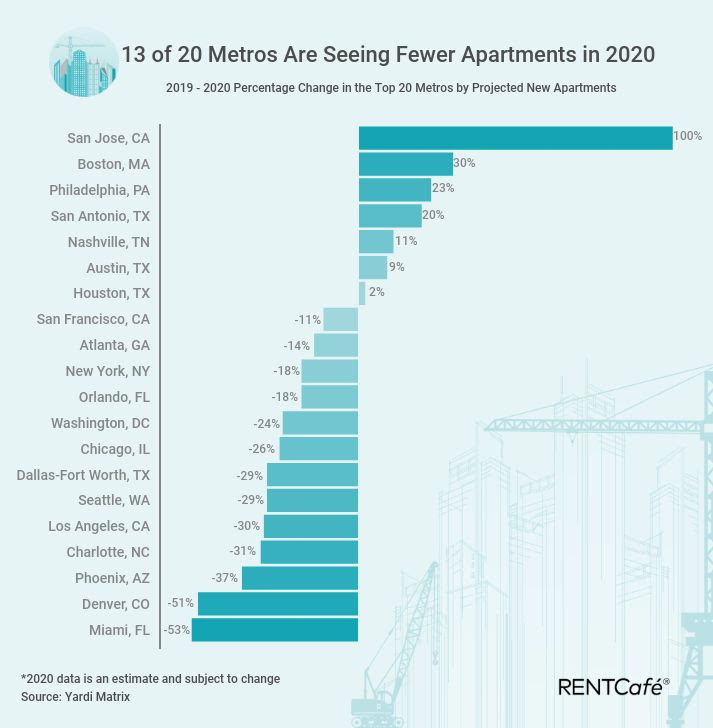
  • The San Jose metro is expected to double the number of projected units added last year, while Miami sees the biggest drop in new apartments year-over-year. Despite doubling its apartment construction, Silicon Valley is adding a relatively low number for a giant tech hub, 5,800 units.
  • Overshadowing New York metro for the third consecutive year, the Dallas-Fort Worth area is first in the nation in terms of apartment construction, set to complete 19,300 new units by the end of 2020.
  • 13 of the 20 most active large metros are expected to complete fewer units compared to last year. Miami metro is experiencing the biggest drop, 53 percent, down from a whopping 12,500 deliveries in 2019.
  • At the city level, Austin is leading nationwide with the most apartment completions at 3,800 apartments, followed by San Antonio, Denver, and Charlotte. Brooklyn rounds up the top 5, having delivered around 2,100 units, on par with Chicago.

“The downtrend is mainly due to the slower pace of construction, as a result of a shortage of available construction crews, funding and permits, along with some temporary bans on construction projects in certain states,” the Rent Café report says. “With projects dragging and some new projects hitting pause, many U.S. metros are likely to see fewer new apartments in the coming years.”

2020 Apartment Construction Down 12%, a 5-Year National Low

Apartment construction uncertainty

“As the United States begins to recover from its steepest economic downturn in history, the construction industry is faced with unprecedented levels of uncertainty,” said Doug Ressler, manager of business intelligence at Yardi Matrix.

“How that uncertainty and broader macroeconomic conditions will affect the industry to date, and the shape of the recovery to come, depends on multiple factors.

“Around the U.S., we have seen a variety of states, counties, and cities choose to close nonessential businesses, or stay-at-home or shelter-in-place orders. For the most part, construction activity has been included as an essential activity that can continue with business as usual during these orders.

“Construction starts have begun to increase from their April lows and there is cautious optimism that as the year progresses, construction markets around the country will begin a modest recovery,” Ressler said.

Lack of New Construction Underlying Cause of Oregon Housing Affordability Crisis

Sign Up For Our Newsletter And Get Apartment News And Helpful, Useful Content Each Week.

* indicates required

Why the Cares Act Seems So Uncaring Towards Landlords

Why the Cares Act Seems So Uncaring Towards Landlords

Veteran landlord and private investigator David Pickron shares his thoughts on why the cares act seems so uncaring toward landlords.

By David Pickron

Landlords, it’s time we all pay very close attention.

A second devastating wave of trouble is thundering towards us, and it is imperative that you know how to protect yourselves and your investments.

On July 26, 2020, the 120 days of eviction relief provided by the Cares Act expired.  With that, landlords across the United States were given the green light to start the eviction process for non-payment of rent, with the caveat of having to use a special 30-day notice as required by the act.

We are seeing that landlords are generating notices with $4,000-$8,000 demands for the last several months of unpaid rent, begging the question that if these renters couldn’t afford $1,000-a-month rent, what makes us think they can come up with $4,000 to make the landlord whole?  It appears that tenants interpreted the eviction moratorium as “we do not have to pay rent,” which could not be further from the truth.

So, what happens now?

Over the next 30 days, if the Cares Act is not extended, thousands of people in your area face being evicted and receiving a judgment against them for thousands of dollars.

These costly judgments had to come from somewhere, to help the landlords who have carried their loans and their unpaying tenants for months.  For many landlords, the burden was too great, and they did not survive carrying these unexpected costs.

The Cares Act gave businesses large PPP loans to cover employee pay, and some individuals who were unemployed collected more than they would have if they worked, all to help people cover their expenses.  What did the struggling landlord get from the Cares Act?  Nothing but their properties “seized” by the federal government if they had a loan backed by Fannie Mae or other government-backed loan (something the landlord did not ask for) and told they could not make decisions for properties they own.  This has resulted in landlords who are financially stretched and a pool of potential tenants that are not all that dependable.

COVID has had a significant impact on our society but it is by no means the first time that people have endured challenging situations.

People deal every day with illness, cancer, and other diseases and disabilities that are terribly unfortunate.  In the past, tenants who have struggled with these types of issues have leaned on family, savings, or churches to help them make ends meet.  With the Cares Act, the landlord was the one forced to carry the bill.  We have been beat up enough and the struggle is not over.  The current pool of potential applicants in the next 30 days will have evictions and judgments against them that can hurt you.

Here is how to protect yourselves

  1. Call your screening company and make sure they search for eviction records in your local jurisdiction and in the jurisdictions your applicant has lived. Credit bureaus removed eviction and judgment data from their reports last year, so the only way you can find a civil eviction record is for your screening company to go right to the court.  Keep in mind, since these are off the credit bureaus, these evictions will not affect credit scores.
  2. Ask for proof of payment of rent for the last four months, through bank statements or canceled checks. Do not fall for “they were living with family and did not have to pay rent.”
  3. Give good landlord verifications. What that means is when you are asked about a current or former tenant, stick to fact-based answers, and stay away from sharing your personal, biased opinion of the people.  A factual question you can answer and provide backup for is “Has your current tenant paid his or her last few months of rent?”  It’s a simple question with a simple answer of yes or no.  We need to protect each other so no one gets hurt again, and that can happen when we ask for and provide good landlord verifications.
Tenant screening services for landlords should include good telephone customer service support.Why the Cares Act Seems So Uncaring Towards Landlords
David Pickron says to protect yourself “Call your screening company and make sure they search for eviction records in your local jurisdiction and in the jurisdictions your applicant has lived.”

Right now, the collection companies are salivating over these new, large judgments to collect on.

If you rent to a person who has a judgment, chances are they will be garnished at every job to which they apply, leaving them with less money to pay you rent.  With the “free-money” mentality and the ability to obtain a residence after their first eviction, they might consider making their smaller car payment over their larger rent payment and take a chance that a second eviction won’t hurt them either.

As a landlord, you don’t want to experience the pain all over again.

I do not want to see any fellow landlord be victimized again.  We are good people who have been responsible enough to be able to provide housing across this country to millions of people.  For the most part we are all not rich, but rather are living simple responsible lives, trying to get ahead a little and raise our families.  More than ever we must band together to survive in an environment that has been stacked against us by our legislatures and tenants.  Together we can weather the storm and come out of this a stronger and more unified group.

The secret to being successful in this business is finding the right tenant, or what I call “business partner,” and proper screening is one way to beat the challenges ahead.

About the author:

David Pickron is President of Rent Perfect and a fellow landlord who manages several short- and long-term rentals.  He is a private investigator and teaches organizations across the country the importance of proper screening.  His platform, Rent Perfect, was built to help the small landlord find success.

Successful Landlords Know All Tenant Screening Companies Are Not The Same

Manage in the Past and Forget the Present

Sign Up For Our Newsletter And Get Apartment News And Helpful, Useful Content Each Week.

* indicates required

Seattle Rents Continue Decline For Third Month

Seattle rents decline for third month

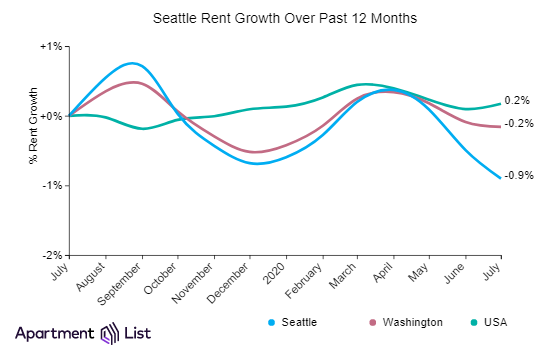
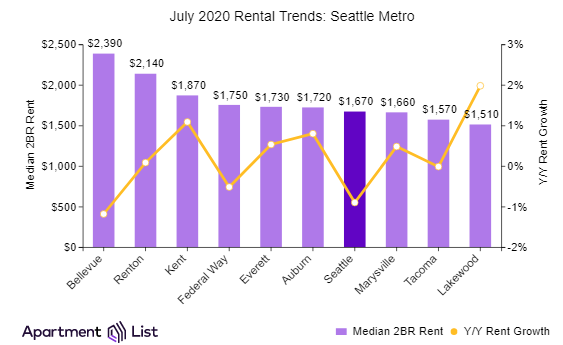
Seattle rents continued to decline for the third month, falling 0.4 percent in July, according to the latest report from Apartment List.

Rents are down 0.9 percent year-over-year in Seattle, where rents lag both the state and national averages for rents. April was the last time Seattle saw a rent increase.

Median rents in Seattle are $1,342 for a one-bedroom apartment and $1,671 for a two-bedroom.

Rents rising across the Seattle Metro

While Seattle rents declined, over the past year the rest of the metro is seeing the opposite trend.

Rents are up in 6 of the largest 10 cities in the Seattle metro for which Apartment List has  data.

Here’s a look at how some rents compare across some of the largest cities in the metro.

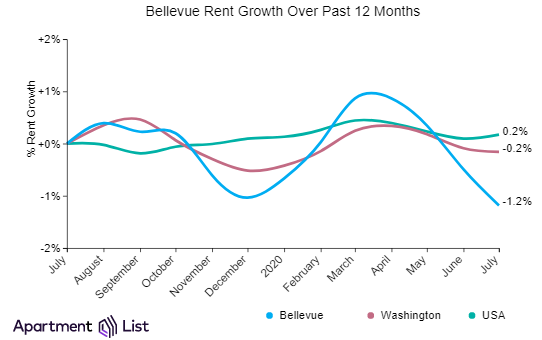
  • Bellevue has the most expensive rents in the Seattle metro, with a two-bedroom median of $2,386; however, the city has also seen rents fall by 1.2 percent over the past year, the biggest drop in the metro.

Bellevue has most expensive rents in Seattle metro

  • Lakewood has the least expensive rents in the Seattle metro, with a two-bedroom median of $1,512; the city has also experienced the fastest rent growth in the metro, with a year-over-year increase of 2.0 percent.
  • Although rents across cities in Washington have been marginally on the rise, the state’s growth as a whole has held steady over the past year. For example, rents have grown by 1.3 percent in Spokane and 0.5 percent in Vancouver.

Seattle rents decline while metro rents rise

Tacoma rents increased moderately over the past month

Tacoma rents have increased 0.3 percent over the past month, but have remained steady in comparison to the same time last year.

Currently, median rents in Tacoma are $1,262 for a one-bedroom apartment and $1,571 for a two-bedroom.

Greater Seattle Area Mid-Year Residential Rental Housing Update

Landlord Regulations – Should I Just Give Up?

Sign Up For Our Newsletter And Get Apartment News And Helpful, Useful Content Each Week.

* indicates required

Three Solutions for Safeguarding the Affordable Housing Supply

Three Solutions for Safeguarding the Affordable Housing Supply

Here are three solutions for safeguarding the affordable housing supply as the CARES act ends, according to a Stockton, California-based affordable housing advocate.

By Matthew Davies

In the coming weeks, the affordable-housing industry will be hit with the perfect storm.

President Trump’s recent memorandum extended federal unemployment benefits through December 27. Yet, those out of work will still receive a lesser benefit per week compared with the federal employment benefits provided under the CARES Act. Some are questioning the legality of the memorandum, leaving an industry in flux and 24 percent of Americans uncertain as to whether they will be able to make their next rent payment.

At the same time, federal eviction moratoriums that went into place following the COVID-19 pandemic have been lifted. Trump’s recent executive order doesn’t clearly extend the moratorium, but instead directs Health and Human Services and the Centers for Disease Control to evaluate whether stopping evictions is necessary, leaving low-income families subject to eviction proceedings after August 24.

Across the country, many states have, or are considering, extending the eviction moratoriums, which offers a welcome reprieve to renters in those states.

But rent forgiveness only passes the burden to the landlords who manage these properties, who have mortgages and property taxes of their own. With little to no rental income and no moratorium for paying mortgages and property taxes, owners and operators of affordable housing face a difficult choice: fight these eviction moratoriums in court or – unable to sustain their businesses – cut their losses and walk away altogether. The result is a devastating impact on an affordable housing stock that is already in short supply, at a time when increasing numbers of people need affordable housing.

 Why are owners and operators of affordable housing more deeply impacted than other property owners?

Affordable housing presents an array of challenges for property owners.

First, owners and operators of affordable housing operate on thinner margins than market-rate apartments, especially upper-end apartments. Second, a much higher proportion of affordable housing residents work in the “informal” economy, making them ineligible for unemployment benefits, much less the expanded benefits that were offered under the CARES Act. For these residents, help has come instead in the form of local jurisdiction ordinances that delay payment of rent and forestall evictions.

On the West Coast, these ordinances have been overly broad, allowing people to stop paying rent for any reason, regardless of whether their jobs were affected by COVID-19. At the same time, local governments are making delayed property tax payments hard for property owners to obtain. Local utility companies are offering no deferrals and GSO debt forbearance creates its own sets of undue hardship. The housing providers are bearing the brunt from all sides.

 A Complex Problem Requires a Multi-Faceted Solution

 The U.S. has a shortage of more than 7 million affordable homes and apartments for extremely low-income families, according to the National Low Income Housing Coalition (NLIHC). As housing production costs rise faster than incomes – particularly in light of the COVID-19 pandemic and its impact on jobs, this disparity is only poised to widen.

While a second coronavirus stimulus bill, if passed, will help citizens in the short term, bailouts like these are economically unsustainable for our country and they don’t solve the underlying issue: the shortage of affordable homes in the nation.

Increasing the number of affordable homes available to renters requires a three-pronged approach that includes short-term rental assistance for those in need, longer-term financial assistance to the developers, owners, and operators of affordable housing communities, and fewer burdens and zoning restrictions to encourage – rather than stifle – development.

 Landlords: Negotiate payment plans with tenants

Landlords should be willing to negotiate rent payments with their tenants when necessary.

Discuss what tenants can afford and then offer an alternative such as rental assistance, temporary rent subsidies, or a rent payback plan that is acceptable to both parties.

Banks, Lenders, Municipalities, and Utilities: Provide Assistance for Owners and Operators of Affordable Housing

Private and government lenders can help lessen the burden on the affordable housing industry by granting zero-interest bridge loans for property owners with a timeline that coincides with the government-mandated rental freezes. This type of assistance could help ensure the properties could remain operational until such time that renters are back to work and able to pay their rent.

For landlords who have a mortgage, the CARES act assisted by waiving late fees on mortgage payments or suspending foreclosures, and some lenders extended those moratoriums. To qualify, landlords must show proof of rental income losses to their lender. Finally, the Economic Injury Disaster Loan (EIDL) offers emergency grants up to $10K to small businesses impacted by the coronavirus.

State and Local Government Leaders: Adopt Policies that Encourage the Development of Affordable Housing

As previously mentioned, our nation has a shortage of affordable homes, which can be alleviated – at least in part – by increasing the supply. This means building affordable housing closer to population centers and closer to jobs, and doing so requires more permissive zoning and less red tape.

Further, we need to get creative with how we use the available land to accommodate more families. Tiny home communities are one option for providing homes for more families in less space, often accommodating 25-30 residencies per acre. High-rise apartment buildings also provide greater density, giving housing to about 300 people per acre, on average.

To protect the businesses that provide and maintain affordable housing requires safeguarding rental income, deferring at least some management costs, and cutting down barriers that preclude housing development in the areas where they are needed most. This is vital if we are to ensure the continuation of affordable housing that society relies on.

About the Author:

Matthew Davies is the founder of Stockton, CA-based Harmony Communities, which currently owns and operates thirty-three manufactured housing communities in the western United States. An investor and community development professional working for affordable hThree Solutions for Safeguarding the Affordable Housing Supplyousing solutions, Davies’ goal is to help bring the opportunity for homeownership to people in his home state who otherwise could not afford to buy a home.


Why Is It So Hard To Build Affordable Housing In Portland?

NAA Study: Barriers To Affordable Apartment Housing In Many Cities

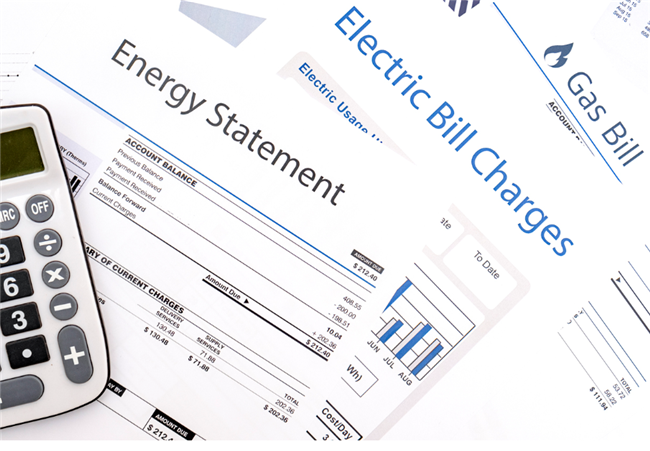
Automating Utility Verification Can Save Landlords Time and Money

Automating Utility Verification Can Save Landlords Time and Money

How automating utility verification for new tenants can save landlords time and money and be sure tenants have signed up for utilities.

 By Naman Trivedi

Apartment managers have a long checklist of responsibilities when preparing to welcome a new tenant.

This typically can include everything from cleaning the unit after the previous occupant moves out to making any necessary repairs to changing the locks and ensuring that all plumbing, heating and electrical systems are functioning properly. In most cases, the process also includes verifying that a new tenant has signed up for utilities; Chandan Economics has found that almost three-quarters of residents in large multifamily apartments and 90 percent of in small multifamily apartments pay for their own electricity usage.

However, this seemingly small step can result in real costs for property owners if not managed properly.

In most instances, property managers either do not do utility verification and utility billing properly, or they must ask each new resident to manually provide a utility account number. Even this check is generally passive, as property managers rarely verify that a new account number was established in the tenant’s name. While it’s a tedious and time-consuming process, if not carried out, the property can be liable for the cost of the utilities if accounts aren’t properly established and transferred.

At an apartment building with a few hundred units, this impact on operating expenses is significant if a landlord is on the hook for even a month or two of service. While these costs can potentially be recovered from the tenant after the fact, the process can take weeks – if not months – and create unnecessary headaches.

Revert-to-owner agreements

One approach that landlords use to manage this process is to set up “revert-to-owner agreements” with the local utility, which are sometimes also known as landlord-rollover agreements. These agreements ensure that service remains active during the period between one tenant moving out and a new one moving in.

This requires completing paperwork in advance with the utility to place all billing information – and responsibility – in the landlord’s, property manager’s, or owner’s name. Once the tenant signs up for service, the billing then switches over to their name and they become responsible for monthly bills. Avoiding a gap in electricity service is certainly a convenience for landlords; however, if a tenant stops paying the utility, then landlords could find themselves on the hook for any missed or overdue bills.

Vacant-unit cost recovery

In the event that an existing tenant stops paying their utility bill, landlords often turn to vacant-unit cost recovery (VUCR) to try and recoup those costs. Similarly, VUCR allows landlords to recoup costs incurred by new tenants who failed to sign up for utility service in their name upon moving in. As one might imagine, it’s a cumbersome process to recover these costs and it can take several weeks or even months to do so.

There are a number of service providers that specialize in VUCR on behalf of the landlord. Some are offered as a collections-style service that help recoup these costs after they are incurred by tenants. Other services monitor proactively for overlap between a landlord’s occupancy data and vacant-unit utility-service invoices. In other instances, VUCR is included as part of a suite of property-management software tools to help landlords reduce the amount of time they spend on utility management. In all of these scenarios, however, landlords pay a fee for someone else to administer the service on their behalf.

Automation technology

Lastly, there is a new method to manage and verify the proper establishment of utilities that relies on automation technology to handle the process. This new method streamlines utility verification by notifying landlords when a new tenant sets up an account with an electricity provider. This is typically accompanied by an administrative dashboard that allows the landlord to quickly confirm whether each of their tenants has established utility service in their respective name.

One benefit of automation is that it often includes a complementary service that allows residents to compare and select electricity plans from various providers in deregulated markets. Typically offered at no cost to landlords, an automated solution may also be accompanied by a revenue share that landlords receive from the electricity provider each time a resident establishes service. Generally, however, automated services are only available in the 13 states that currently have deregulated electricity markets.

Regardless of the method selected, the research from Chandan Economics points to an increasing number of residents in recent years paying for utilities separate from their rent. As such, the issues and challenges associated with utility verification to confirm that tenants properly establish and maintain utility service are likely only to continue to grow.

About the author:

Naman Trivedi is co-founder and CEO of energy intelligence service WattBuy and a 2020 Forbes “30 Under 30” honoree in the energy category. In addition to roles at Google and Box, Trivedi previously served in the White House Office of Science and Technology Policy, where he focused on federal renewable energy policy.


3 Unexpected Costs Landlords Have When Tenants Move Out

More Than 15,000 Apartment Industry Jobs Open in July

More Than 15,000 Apartment Industry Jobs Open in July

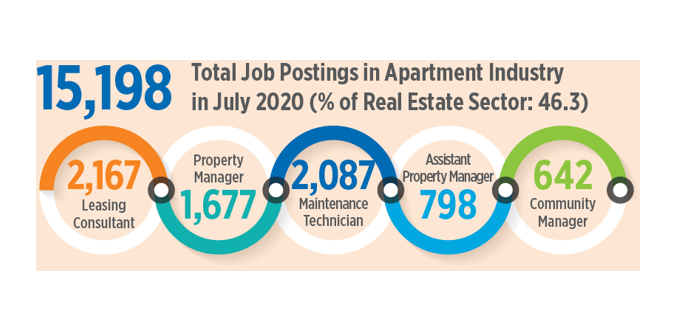
Apartment industry jobs continued to show strength despite the pandemic, with more than 15,000 jobs available in apartments during July, according to the National Apartment Association.

The National Apartment Association Education Institute’s Apartment Jobs Snapshot for July showed that multifamily job opportunities comprised over 46 percent of the real-estate sector jobs during July, exceeding the 2019 monthly average of 39 percent.

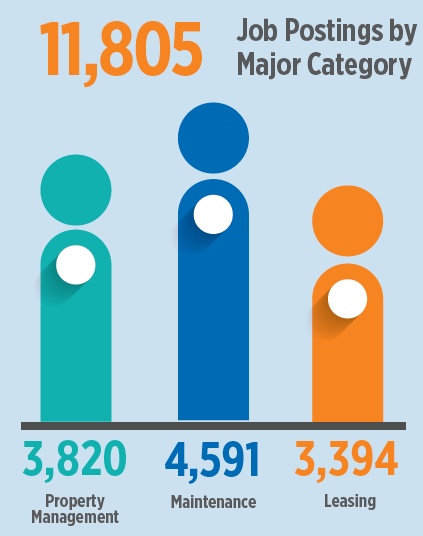
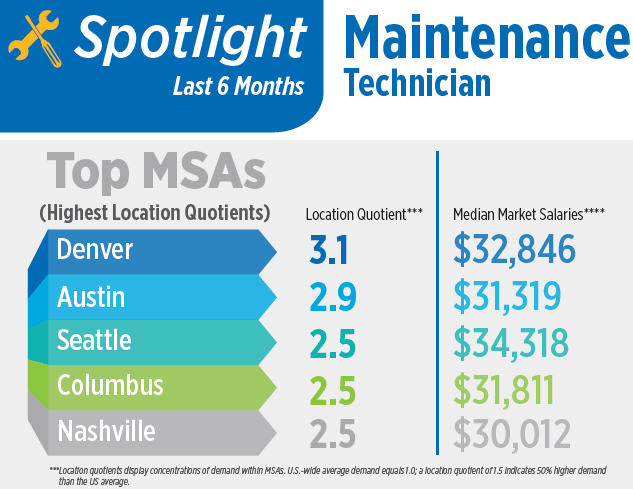
Maintenance jobs were in high demand, accounting for about 30 percent of the openings in  apartment industry jobs.

Major Texas markets such as Houston, Dallas, San Antonio, and Austin led the nation with the highest concentration of job postings.

More Than 15,000 Apartment Industry Jobs Open in July

In Denver, the demand for maintenance technicians was more than three times the U.S average, and median market salaries also exceeded the national median. Seattle also had a high demand for maintenance technicians at 2.5 times the U.S. average.

The top specialized skills employers are seeking included plumbing, repair, HVAC, carpentry skills, and painting.

top maintenance skills needed for apartment jobs

More Than 15,000 Apartment Industry Jobs Open in July

National apartment association jobs report background

“Our education institute is a credentialing body for the apartment industry. They hear often that one of the biggest problems keeping our industry leaders up at night is the difficulty in finding talent, attracting talent and retaining talent,” NAAEI’s Paula Munger said.

Assistant Property Manager Jobs In Demand

So NAA partnered with Burning Glass Technologies. “They have a labor-job posting database that is proprietary,” she said, and they can “layer on data from the Bureau of Labor Statistics (BLS). We looked at that and thought we could do something that is really going to help the industry and help benchmark job titles and trends as we go forward.”

Apartment Jobs Hiring Resilient in 2nd Quarter

Sign Up For Our Newsletter And Get Apartment News And Helpful, Useful Content Each Week.

* indicates required


5 Ways to Spot Fake Landlord References

5 Ways to Spot Fake Landlord References

One of the most crucial aspects in tenant screening is that of checking your prospective tenant’s landlord references, so here are 5 ways to spot fake landlord references from Keepe the maintenance company.

Unfortunately, some tenants have been known to make up references or list friends or family members as previous landlords. There are even companies that hire themselves out to pose as landlords.

As a property manager, you are bound to receive landlord references day in and day out. Some are beautifully written testaments to the incredible nature of these individuals looking to rent, while others are simply fake, with bogus testimonials about the tenant.

5 ways to spot fake landlord references

Below, we’ve shared some ways in which you can spot fake references.

No. 1 – Call the references yourself

 For starters, on most landlord references, they will provide a phone number.

One of the first things you can do to tell if the reference is a fake is to call the number inquiring about a rental. If it is fake, the number either won’t work or will lead to a completely different person or place.

In rare instances, a fake number does lead to an individual, but they may seem to be either untruthful or not detailed in their answers.

No. 2 – Check up on the reference’s name

 Go online and Google the reference’s name and look them up on social-media platforms.

Check to see if this person is tied to the potential tenant through tagged pictures and/or posts. If there is a lot of overlap in the people’s profiles, these individuals may have a personal relationship and not a tenant/landlord relationship.

No. 3- Look at tax records

The tax records for all property owners are in the public domain. All you have to do is look up the records for the address where the applicant claims to have lived.

The name on the tax record should match the name you’ve been given. Double-check that the property hasn’t been sold, but otherwise this is a great way to spot a fake.

No. 4 – Analyze a reference’s answers

It’s best to always fall back on your knowledge as a landlord and analyze the answers that the potentially fake landlord reference has given you.

If their answers are vague and don’t have details then it’s likely that they aren’t a real landlord and are instead a friend or family member of the person who is trying to rent from you.

No. 5 – Ask for advice from the reference

 Landlords tend to have the same frustrations, interests, and problems.

It wouldn’t be at all unusual for you as a property manager to ask for some advice from another landlord while calling for a reference. Ask for their procedure for getting rid of a tenant who doesn’t pay, for instance.

A real landlord will have an actual answer, even if they’re not interested in spending much time on the phone with you. A fake, on the other hand, will likely have nothing specific to say. This can help you further determine whether the person on the other line is a real landlord, or someone just posing as such.

In conclusion

 As a property manager, a significant part of your job involves filling properties with quality, long-term tenants. Including thorough reference verification as part of your tenant screening process, such as the strategies above, can help you avoid costly mistakes and keep you a few steps ahead of the game.

The Best Appliances In Rental Property

Successful Landlords Know All Tenant Screening Companies Are Not The Same


About Keepe:

Keepe is an on-demand maintenance solution for property managers and independent landlords. The company makes a network of hundreds of independent contractors and handymen available for maintenance projects at rental properties. Keepe is available in the Greater Seattle area, Greater Phoenix area, San Francisco Bay area, Portland, San Diego and is coming soon to an area near you. Learn more about Keepe at https://www.keepe.com

Sign Up For Our Newsletter And Get Apartment News And Helpful, Useful Content Each Week.

* indicates required