Home Blog Page 101

How To Enforce A Lease for Non-Lease Occupants

Ask Attorney Brad: How to Enforce Lease for Non-Lease Occupants

Ask attorney Brad is a feature with attorney Bradley S. Kraus and the question this week is about how to enforce a lease for non-lease occupants and it is the question he get asks about the most.

Ask Attorney Brad:

How can an owner effectively enforce the lease limitations on extended guests and non-lease occupants contained in the standard Oregon rental agreement?

-John

Hello John,

Thanks for reaching out on this one. Unauthorized-occupant situations are maddening to deal with.

It’s the most frequent question I deal with as a landlord’s attorney.

Prior to Senate Bill 282, it was difficult to prove a tenant had an unauthorized occupant in the premises for longer than the timeframe set forth therein. If you could prove that a tenant had a guest in the premises longer than the timeframe set forth in the lease, a Notice of Termination for Cause under ORS 90.392 was our remedy.

Since Senate Bill 282, the rules of the game have changed a bit, and the strategy has changed. I covered this topic in a previous article for Rental Housing Journal. Senate Bill 282 requires a landlord to prove that the unauthorized occupant has been in the premises for longer than 15 days in the preceding 12-month period. The proof could be such things as witness statements, admissions from the tenant themselves, or other documentary proof to support the same. Once the landlord can prove the 15-day issue, the remainder of a landlord’s rights kick in.

With the above proof, a landlord can require the unauthorized occupant to (a) pass a criminal screening, and (b) sign a temporary-occupancy agreement with the landlord and named tenant. If the occupant or tenant fails/refuses to do either of those items, the landlord can serve a notice of termination for cause to enforce those rights. If the tenant and occupant fail to cure those issues, an eviction can be filed based upon that notice.

Thanks,

Brad

Bradley S. Kraus is an attorney at Warren Allen LLP. His primary practice area is landlord/tenant law, but he also assists clients with various litigation matters, probate matters, real estate disputes, and family law matters. You can reach him at kraus@warrenallen.com or at 503-255-8795.

Ask Attorney Brad: How to Enforce Lease for Non-Lease Occupants
Bradley Kraus, Portland attorney

Ask Attorney Brad

Please enter your rental housing management question below for Ask Attorney Brad Kraus. Unfortunately he cannot answer questions from tenants.

  • This field is for validation purposes and should be left unchanged.

Sign Up For Our Newsletter And Get Rental Housing and Apartment News And Helpful, Useful Content Each Week.

* indicates required


Ask Attorney Brad: How Do I Prove a Tenant Smoking Inside My Rental?

Can We Charge The Tenant for a Big Stain in New Granite Top?

Tenant Occupancy Issues During COVID-19: Occupants, Sublessees, and Squatters

Financial Amenities: The New Front in the Amenity Wars

Financial Amenities: The New Front in the Amenity Wars

Financial amenities have added to the amenity wars in the battle for the latest and greatest.

By Morgan Dzak

Just when it seemed like the apartment “amenity wars” were coming to an end, the pandemic revived a new front: financial amenities. The battle for the latest and greatest amenities continues. But emerging financial amenities make a much larger impact on residents and operators than any rooftop pool, fitness center or dog park.

Apartment operators and residents have faced 20 percent+ monthly delinquencies, as highlighted by NMHC and its monthly Rent Tracker. Properties are increasingly turning to financial solutions and technologies to solve their challenge of collecting rent.  Solutions include credit-building tools that add incentive for on-time payments, digital payments and flexible rental payments, among others.

“The financial amenities and resources are just as important as any type of physical amenity for a meaningful number of residents,” said Les Menkes, founder and managing partner at Asia Capital Real Estate (ACRE), which owns and operates across the country. “It’s really a win-win between resident and operator, and that should be our ultimate goal. It leads to longer-term, deeper and higher quality relationships with residents, and that is a huge benefit to both parties.”

Here are some of the ways apartment operators can participate in the financial-amenities trend and sweeten the deal for residents while improving net operating income (NOI):

Flexible Budgeting and Rent Payments

 Apartment operators who have historically required a resident to pay all their rent on the first of the month have found that providing residents flexibility can increase on-time rent by 70 percent.

“Providing flexibility to residents in a space where there is generally a lack of flexibility makes a significant impact,” Menkes said. “Operators can be progressive in their approach to rent payments and better embrace the reality of many residents, and how their lives, cash flow and income works. Paying rent once per month doesn’t match how many residents manage their lives, so we have room to embrace these realities and implement a solution to better support that.”

Today’s renter has a different income profile than yesterday’s, with a significant portion of renters working in the gig economy, leveraging government stimulus or even working multiple jobs to make ends meet. According to research from Statista, there were 59 million people doing freelance work in the United States in 2020, and the number of freelancers has been steadily increasing since 2014.

Earning levels for these workers are different and pay schedules vary greatly from resident to resident. Work hours can fluctuate week to week, and freelance workers generally aren’t paid biweekly. It can be difficult for operators to adapt to income- and earning-schedule discrepancies, but it’s not impossible.

“Paychecks will often have 20 percent variability to them and that can get really tricky for the resident when they are trying to pay 40 or 50 percent of their income for rent on the first of the month,” said David Sullivan, founder and CEO of Till. “The rental-housing industry underwrites residents to an annual gross-income-to-rent ratio. But that’s not always reflective of the resident’s cash flow. The key to resident-payment success is to adapt to how the resident is getting paid in a way that empowers renters to pay in full and on time, and operators to get what’s owed to them on the first of the month. Better budgeting really supports that.”

This year, ACRE partnered with Till to offer flexible rent-payment options to residents in approximately 6,700 units across 33 properties located in Florida, Georgia, Kentucky, North Carolina and Ohio. Till’s analytics-driven platform positions renters for success by creating a customized payment schedule that aligns with their individual cash flow. In this way, residents participating in the program are empowered to become consistent, on-time rent payers, deferring late fees and eviction proceedings for as long as they comply with the agreed-upon schedule.

Menkes noted that a one-size-fits-all rent approach doesn’t necessarily work for all residents. Even though the industry is fixed, there are still ways to provide flexibility for residents and resources for better cash-flow management and financial savviness.

Credit Reporting

Credit reporting for rental payments is really starting to take off.  Historically, credit reporting has had slow adoption. It has been expensive for renters or operators and can sometimes put data burdens on the property.  With a new wave of credit-reporting tech that is free for renters, more and more operators are starting to offer this financial amenity. When residents make on-time, in-full rent payments, data furnishers in partnership with properties can report payments to credit bureaus, which can help residents build their credit scores with their largest expense of the month.

According to a TransUnion Consumer Pulse report for Q3 2021, 62 percent of consumers believe it’s extremely or very important to have access to credit to achieve their financial goals. Sixty-five percent of consumers believe monitoring credit is very to extremely important, and just 5 percent noted they don’t believe credit monitoring is important at all.

“ACRE offers credit reporting to all residents, but it especially makes a difference for the workforce residents,” Menkes said. “This financial amenity is a huge benefit and bona fide way to help residents build credit when many are trying to either build their score or maintain their score.”

Offering a credit-reporting amenity can be critical for many modern residents. Credit scores are wired into the economy, and without a decent credit score, many residents can be excluded from several key facets of life, like getting a car loan or a mortgage.

“Many residents in the workforce housing space are really at the inflection point of having and/or building a credit score,” Menkes said. “If you think about it, a renter’s single largest expense outlay is going to be housing, and it’s not traditionally reported to credit bureaus. If we can provide a solution to recognize and share these on-time payments to the credit-rating providers it will make a big impact for residents.”

Resident Empowerment, Operator Success 

 Operators can set up residents for success by extending different financial resources. Financial amenities not only help residents build financial stability, but they help residents better understand and develop budgeting skills and cash flow management. These amenities enable residents to take a large payment and turn it into a more manageable expense in the long run.

“There are some really critical, foundational financial amenities that we can offer to residents that make a tremendous impact, not only for the resident, but for the operator as well,” Menkes said.

Financial amenities are first designed to help residents, but the long-term benefits extend to the operators as well. When residents are successful, operators are successful and can boost NOI and asset value. Operators can eliminate delinquencies and bad debt by setting residents up for financial success and providing the means to pay rent while building a financial foundation.

“ACRE really tries to create a high-caliber resident experience,” Menkes said. “We all know it’s good for business, and why aim for satisfied residents when you can have delighted residents? We might as well aspire to please our main constituents.”

The “amenity wars” will probably never end, and if anything, amenities will continue to shift with industry and resident needs. Financial amenities can be a real differentiator for modern communities. They set residents up for success, help them develop better budgeting skills, support them for making on-time, in-full rent payments while building financial stability, and significantly improve NOI and collections for operators. Financial amenities are a win-win for residents and operators alike – a distinction few other apartment amenities can claim.

 About the author:

Morgan Dzak is an account manager for LinnellTaylor Marketing. She previously spent time as a digital content specialist for Cornerstone Apartment Services and a sports reporter and producer for The Denver Post and 9NEWS in Denver.

Sign Up For Our Newsletter And Get Apartment News And Helpful, Useful Content Each Week.

* indicates required

3 Best Practices for Communicating with Residents

3 Best Practices for Communicating with Residents

Here are 3 best practices for communicating with residents to make them feel safe and secure in your rental properties.

By Dustin Lacey

In every relationship, effective communication is critical to a positive experience. This remains true when it comes to a property manager’s relationship with their residents.

We provide exceptional places that feel like home where people can feel safe and secure to enjoy time with their loved ones at Mark-Taylor. Thoughtful communication with our residents has proven to make an incredible impact in creating that feeling of home.

Here are three of our best practices for communicating with residents:

The simpler, the better

Strive to save  residents’ valuable time by making living simple. To respect their busy schedules, the simpler we can make communications for them, the better. Therefore, before we press “send” on a communication to our residents, we thoroughly consider our residents’ perspective, keeping in mind that simplicity is always key.

It helps to put ourselves in a new resident’s shoes. Without context, would a new resident understand what is being communicated? If it is an action-oriented communication, could a new resident read it and walk away knowing exactly what they need to do?

This exercise is guaranteed to generate enhancements, every time. After considering the new-resident perspective, we revisit the communication to ensure the information included has the simplicity and clarity it needs to answer any potential questions.

Transparency creates trust

From our residents and guests to our team members and business partners, we are committed to creating trusting relationships. An essential part of inspiring and building trust is through transparent communication over time.

That is why we approach resident communications with as much transparency as possible. At times, there may be an occurrence, such as a building repair, that is inconvenient for your residents. It is far better to acknowledge the inconvenience and communicate openly about why it is happening, rather than to brush over it. Not only does this show that you are proactively fixing the situation, it also shows that you respect our residents, building upon that trusting relationship.

 People first, business second

 Everything we do, we do with a people-first mindset. It is who we are as a company and brand, and it is important to us to show that in every communication.

In resident communications, our people-first approach is of utmost importance. People choose to live at our communities because of many factors: our modern luxury designs, high-quality standards, but most importantly, because we put them first. Our home-like atmosphere can only be created when we stay true to that approach in the way we communicate.

As an example, when navigating the change management of a community project, lead and focus communication on how it benefits the resident. Because our business decisions keep people first, it is a genuine and important reminder, especially in times of change.

Seemingly simple day-to-day exchanges of communications between property teams and residents may seem small but they add up to shape a resident’s living experience. Approaching communication in an intentional way for every email, phone and in-person conversation combines to create the exceptional living experience that residents deserve.

About the author:

Dustin Lacey is the vice president of brand and marketing for Mark-Taylor Companies. He provides strategic direction for Mark-Taylor’s marketing, communications and technology, which reaches more than 20,000 units of residents across Arizona and Nevada. Lacey utilizes his expertise to embrace innovation and take a data-driven approach to advancing the Mark-Taylor brand while overseeing a talented team.

Sign Up For Our Newsletter And Get Apartment News And Helpful, Useful Content Each Week.

* indicates required

Top 20 Oldest Apartment Buildings Still Occupied By Renters

The rental market has turned renter-friendly as the vacancy rate has climbed to 7.6% across the 50 largest metros

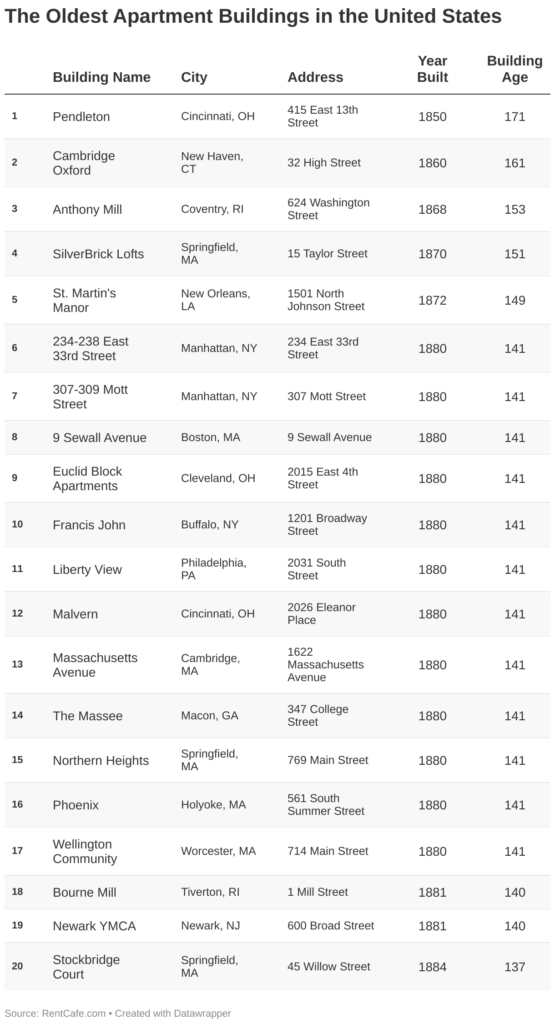
Some of America’s oldest rental apartment buildings pre-date the Civil War and are still occupied by renters today. Here are the top 20 oldest apartment buildings, according to research by RentCafe.

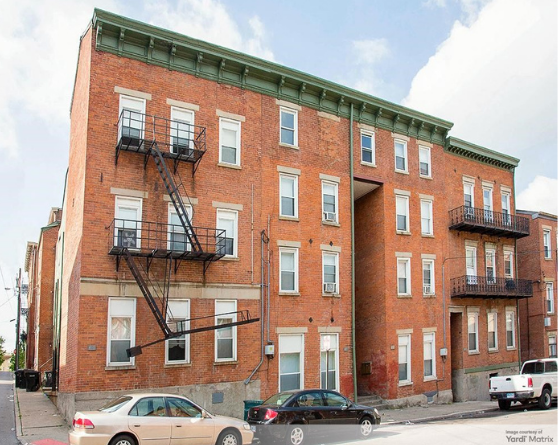
The oldest apartment building on the list is the quaint Pendleton in Cincinnati, Ohio. Dating back to before the Civil War, the red brick structure is alive with residents inhabiting its 78 rental units.

The top 20 oldest buildings renting today are more than 135 years old and are characteristic of the North and Northeast region.

  • Cambridge Oxford is the second oldest, located near Yale University in the heart of New Haven, Conn. With 84 boutique apartments, it’s been a desirable place for renters since 1860.
  • History-rich places, as well as some northern cities, have the oldest apartment buildings in the country. Buildings in Boston, Mass., top our chart with an average age of 105. It’s followed by Minneapolis, Minn., (104) and Springfield, Mass. (101).
  •  Meanwhile, 26 percent of the country’s old inventory is in Manhattan, a whopping 923 buildings that still rent.

“A building’s endurance and durability can be attributed to the materials used back in the day,” said Kurt Walker, a real estate investor and real estate agent for Cream City Home Buyers. “Raw materials used to cost a fraction of what they do today. Materials can make a building last more, but they can also cause a structure to wither.”

Real estate experts agree that the charm of older buildings is a big factor when renters choose them over newer ones. But there are other, more practical reasons, too — good old insulation in particular, the RentCafe report said.

“One of the biggest draws to buildings constructed before 1950 is charm,” said Marina Vaamonde, founder and commercial real estate investor at PropertyCashin. “Many folks are attracted to the look and feel of these older buildings, and there is often a certain status that living in a well-maintained, pre-1950s apartment block brings. There are more practical benefits, however. One of the biggest is the soundproofing and insulation in a lot of older apartment blocks in cities like New York or Chicago. These buildings are often reported to be a lot quieter and warmer than modern ones.”

Barry Saywitz, president of The Saywitz Company, added: “Renovated and/or upgraded older buildings tend to have a charm that you cannot find with a newer product. In many metropolitan areas, these are attractive and well-located. In many instances, the walls are solid and provide better insulation from weather and noise.”

Here are the top 20 oldest apartments:

Top 20 Oldest Apartment Buildings Still Occupied By Renters

Sign Up For Our Newsletter And Get Apartment News And Helpful, Useful Content Each Week.

* indicates required

4 Steps to Make Rental Home Carpet Last Longer

Is Your Tenant a Tool? (It’s Not What You Think)

Tenant personalities and how they fit with your management style as a property manager and landlord

Tenant personalities and some of the types of people you may encounter as a property manager when you work to rent your property and how they fit with your management style.

By Scot Aubrey

A few years ago my wife decided to surprise me by organizing our garage.  I was reluctant at first because my garage has always been the one safe place for me to put my stuff; no questions asked.

I knew once the organizing process started, there would be a lot of questions from her and a lot of push back from me.  We started by emptying the contents of my tool bag, some of which were embarrassingly still in their original wrapper.

After pulling out 5 or 6 screwdrivers, my wife asked, “Do we really need this many screwdrivers, after all you only have two hands.”  What I knew that she did not is that each screwdriver (flathead, phillips, ratchet, magnetic) had unique characteristics that made it especially useful.  This process continued as we worked our way through cutters, pliers, and other odds-and-ends, with a brief explanation of why I needed each, and its usefulness.

Reviewing rental applicants remind me a lot of this initial organizing experience.

When we open up the pool of possible tenants for our properties, we are almost always looking at a mixed bag of individuals and tenant personalities.  Each is valuable, each has purpose, and each has merit for us to consider as we look to fill our property with a potential, qualified “business” partner.

Let’s take a look at some of the types of people you might encounter as you get ready to rent your property.

Tenant Personalities – THE HAMMER

Often you can hear the hammer applicant coming from a mile away.

A hammer tenant isn’t necessarily bad and when managed the right way, can be the perfect tenant to get things done.  As a hard but effective personality, the hammer tenant can either beat up or fix up your property.

As a property owner your management style will directly affect which way the hammer hits.  Hit too hard and the hammer will hit even harder back; but sometimes direct conversation can be your best bet.

Instead, handle the hammer properly, focus their energy, and provide clear directions and expectations.  Use your expertise to anticipate where these types of tenant personalities will have issues with you, your property, or the lease.  Use their strong personality type to build a great relationship and you’ll be amazed at how often they “hit the nail on the head” and become a great tenant.

THE SAW

You may recognize the saw applicant by their ability to cut to the heart of the matter.

This applicant has no time or energy to waste becoming friends with you, they just want to get down to business and get the job done.

How does that work with your management style?  If you like to become best friend with your tenants, the saw type may challenge you… or they may become your best tenant yet.  After all, when looking for a business partner, who better to have than someone who is all business.

When working with this type of applicant, it is important to remember to not take things personally, rather understand that business is business.  The saw type values paying rent on time, respecting the property, and keeping your relationship transactional.  These are all great things when protecting your investment is critical to you.

THE WRENCH

Having a wrench type applicant means one of two things; either they will literally throw a wrench into all your plans, or they will tighten things up and make them stronger than ever before.

There are a few things you can do to help facilitate this tenant personality type into becoming a great fixer for your investment.

First, realize they will always be questioning how things are done.  Why does your lease include this, why can’t we do that on the property, etc.  Being prepared with well thought out answers in advance puts you in a position to react professionally.

Second, consider their questions, ideas, and suggestions, not just out of courtesy, but out of curiosity.  Why are they asking these questions?  Have they had past experiences as a tenant that can make me a better owner?

Lastly, assume the best when dealing with the wrench type.  Interpret their interest as a positive thing and see them as a beneficial partner rather than a nuisance.

THE MULTI-TOOL

Sometimes you get those applicants that are a mishmash of all the possible tenant personalities and types.

Reluctant to be typecast as any one thing, they truly represent the multi-tool with many facets, functions, and features.  Although they may be difficult to categorize, and even more difficult to manage, I actually love working with this type of applicant.

Think of the countless ways you can connect with someone like this.  Every good baseball team needs a utility player who can cover many positions, and that is exactly what the multi-tool applicant brings to your rental business relationship.  Need someone to challenge you?  Someone to quickly get down to business?  Someone to make you think more deeply about your business?  Check, check and check!  The multi-tool tenant personality has the potential to challenge your management style and help develop you into the best owner you can be.

THE WRECKING BALL

Although I doubt any of us have a wrecking ball in our garage, this type of applicant is the one to avoid.  They are wired to destroy anything in their path.

Often playing the toxic victim, they will bad mouth past landlords, challenge you on every front, hesitate or refuse to provide you information and give you every reason not to trust them.  Run!!!

Other critical landlord tools

With all this talk of tools, it’s equally important that you also implement the other critical landlord-specific tools of background screening, consistent criteria, and online rental collections into your daily business practices.

Regardless of the “tool type” your tenant turns out to be, if you examine your business and make a goal to get organized, you will be ready for anyone that walks through the door.  By viewing each applicant as a tool with the potential to make you a better landlord and investor, you can see them positively for the good they bring to your life, and not just as another tool you can shelve, use, or throw away.

About the author:

Scot Aubrey is Vice-President of Rent Perfect, a private investigator, and fellow landlord who manages short-term rentals.  Subscribe to the weekly Rent Perfect Podcast (available on YouTube, Spotify, and Apple Podcasts) to stay up to date on the latest industry news and for expert tips on how to manage your properties.

What Drives Your Management Style?

Sign Up For Our Newsletter And Get Apartment News And Helpful, Useful Content Each Week.

* indicates required

Don’t Let Rental Criteria Be Your Kryptonite

Successful Landlords Know All Tenant Screening Companies Are Not The Same

7 Top Challenges Facing Rental Housing Property Managers

7 Top Challenges Facing Rental Housing Property Managers

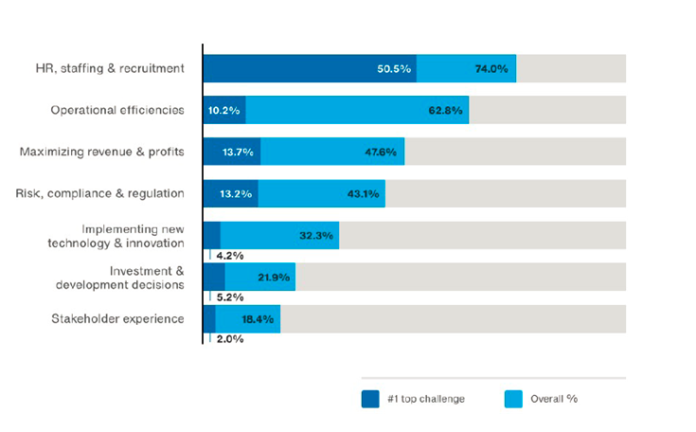
A new survey by the National Apartment Association (NAA) shows the top seven challenges facing rental housing property managers today, with the No. 1 challenge – not unlike many other businesses – being recruitment, staffing, and human resources issues.

Property management professionals were asked to select the topics that are most challenging right now, and 74 percent answered with issues surrounding hiring and staff.

That’s not surprising, said Paula Munger, assistant vice president of industry research and analysis for the NAA.

“If you were on another planet and dropped in right now and missed the pandemic, you would look at this report and say, ‘Wow, something weird must have happened last year,’ because you can really see the effects of the pandemic in a lot of the responses and in a lot of their issues. Every industry right now, every single one, is having issues with the labor market. So, you know about the great resignation. There’s near-record amount of jobs available. People are quitting, they’re feeling empowered to do other things,” she said.

Munger said the data shows that in big companies with more than 20,000 units, more than 80 percent cited human resources as their top challenge. She said it’s a mind-boggling number “that really blew me away.”

Operational efficiencies came in second, with 63 percent listing it as a top challenge.

The survey of property managers, sponsored by AppFolio, received a total of 1,048 online responses in July and August of 2021 and was conducted by the NAA and ndp | analytics.

“The past year and a half have brought unprecedented change to the real estate industry,” the report says. “From transitioning to remote work, to the adoption of technology, property managers have had to pivot to stay successful, make the most of demand, and continue to serve residents, owners, investors and teams,” the report says.

Most pressing issues facing property owners and executives

The biggest concerns weighing on the minds of property owners and executives, including hiring and training new employees but also government regulations, eviction moratoriums, rent collections and COVID-19-related issues.

Most pressing issues facing property managers

The greatest challenges facing property managers also was hiring and retaining employees, but included  finding qualified maintenance talent, delinquency rates, and eviction moratoriums. Maintenance positions are notorious for having high turnover rates and property management companies are struggling to fill essential maintenance positions.

No. 1:  The most urgent challenge in the property-management business

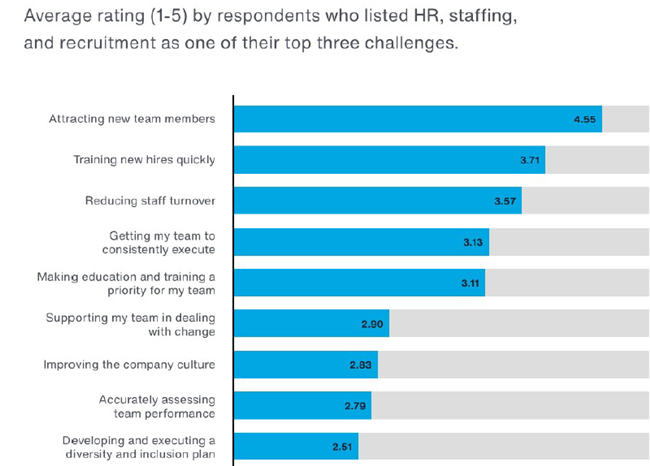
Human resources issues, staffing and recruitment were the top challenge, and while those issues have always played a large role in property management, the pandemic exacerbated them. The inability to backfill positions plus the influx of inexperienced new hires created a training backlog, a “doing more with less” situation creating inefficient property management operations. Staffing issues are forcing an increase in wage and benefit packages to attract and retain talent. These increases are not being offset by increased revenue.

“The report talks about what they’re doing, and what they need to do right now, which is offering signing bonuses and higher pay, using recruiters and I think one of the quotes that was really telling was, ‘We need to focus on retention as well as recruitment’,” Munger said.

“There’s so many jobs available. There’s so much demand right now in multifamily. The labor market is so competitive. So, if you don’t offer your employees (a) good benefit package, training, professional development and really have them involved in the operation, I think you’re going to lose out to a competitor,” Munger said.
7 Top Challenges Facing Rental Housing Property Managers

No. 2: Operational efficiencies

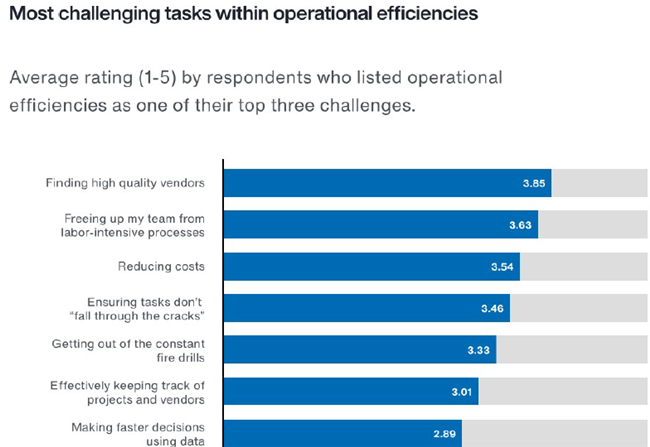
Rental housing challenges in finding high-quality vendors, reducing labor-intensive processes and reducing costs were cited in the report as the most challenging tasks for rental property owners and property managers. Getting out of the “constant fire drill” mentality was also cited as a big issue in operational efficiency.
7 Top Challenges Facing Rental Housing Property Managers

No. 3: Maximizing revenue and profits

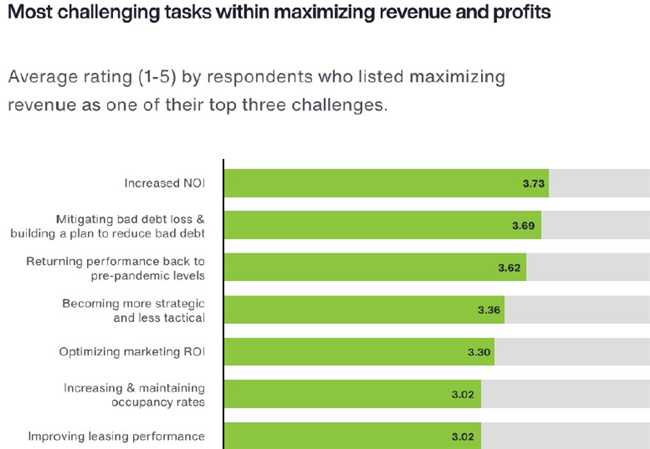
Increasing net operating income (NOI) to maximize revenue was a top-rated challenge and major pain point by many in the survey. On top of that, mitigating bad debt loss and trying to return performance to pre-pandemic levels were extra stressful and big issues.

“The specific analysis looked at the entire pool of under 1,500 units, where maximizing revenue and profits was their second greatest challenge,” Munger said. “We know a lot of those owners and operators lost revenue during the pandemic, and as an aside, we just released our income and expenses survey that we do every year and it covers 2020 financials … for the first time, since a great recession, we saw revenue, losses and expense increases.”
7 Top Challenges Facing Rental Housing Property Managers

No. 4: Risk, compliance and regulation

Keeping up with constant new regulations, a particularly difficult issue in the Pacific Northwest, along with staying compliant was cited in the report as major rental housing challenges for rental housing property managers. Fraudulent applications and cyber threats also fell in this category.
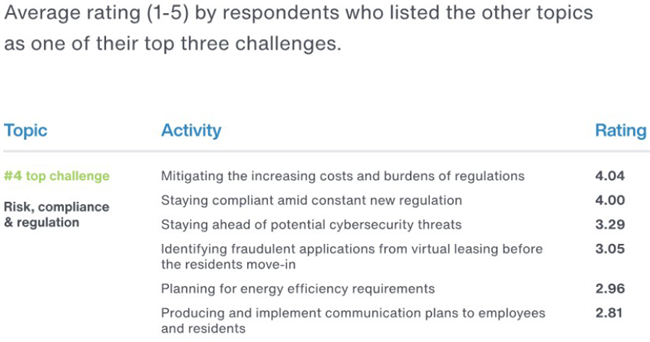
risk and compliance issues

No. 5: Implementing new technology and innovation

Training teams on new technology and working that it into the daily routine are both ongoing rental housing challenges for many. Vetting new technology also is an issue. Too, there is resistance by some to learning new technology.
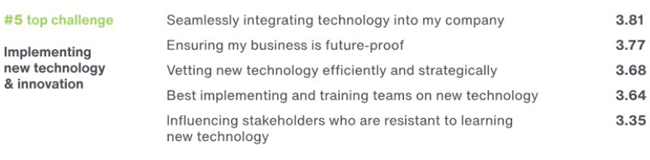
7 Top Challenges Facing Rental Housing Property Managers

No. 6: Investment and development decisions

The need to grow rental housing portfolios in a sellers’ market was cited as a top concern. Also, forecasting the impact of renovations on a rental unit and its value.
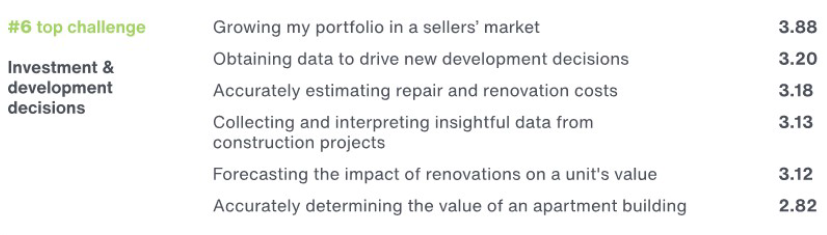
investment decisions in rental housing

No. 7: Stakeholder experience

Improving customer and resident satisfaction was tops in this area of concern, along with keeping staff and residents safe during the pandemic.
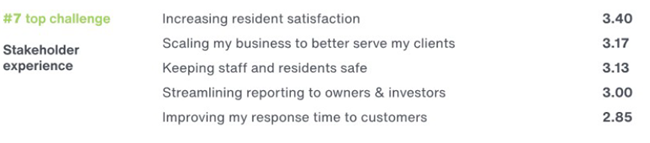
stakeholder experience facing property managers

Labor market challenges will remain

Munger added, “I think there’s still some difficulties to get through. Especially with the labor market.”

However, she said the report also showed some optimism.

“We did get a good mix of respondents here, and when you look at those rental numbers, they’re typically larger buildings, professionally managed and maintained buildings, and they tell a different story than with some of our smaller, mom-and-pop owners,” Munger said.

“The survey was done in late July, early August and rents were definitely starting to head up then, but certainly not as much as we’ve seen over the last quarter or so.”

Munger said her advice to property owners and managers out there is: “Hang on, as we want to get back to pre-pandemic levels.” She said with what they are seeing in revenue increases and enhanced demand this year that, that will happen.

Get the full report here

Sign Up For Our Newsletter And Get Rental Property And Apartment News And Helpful, Useful Content Each Week.

* indicates required

5 Ways to Increase Rental Housing Revenue or Rents in 2021

Can Tenants Dictate When I Need To Enter My Rental?

Can Tenants Dictate When I Need To Enter My Rental?

When a landlord needs to “enter my rental” to fix or prevent a maintenance problem how much notice is required for tenants is this week’s question. On his page,  Ask Landlord Hank answers questions from other landlords and property managers around the country about their rentals so fill out the form below if you have a question for him. Remember Hank is not an attorney and is not offering legal advice.

Ask Landlord Hank:

My tenants won’t put Bio Rooter in his sinks monthly to keep them flowing. So I volunteered to do it once a month on the same day. I’ve given them a week’s notice.

They want to be there. I’m making it convenient for myself and for them with the one-week notice and a time easy for me to drive (2 p.m.). They want to change the day and time. If not the day, then the time.

Can they do this? I am always respectful of their apartment and have been there many times before without them. Can they dictate the day? Time when I enter my rental?

-Jennifer

Dear Landlady Jennifer,

This situation all boils down to your lease.

In most leases, there is a “right-of-entry” clause that basically states that with reasonable notice you have the right of entry for any reason. The tenants don’t dictate the timing – you are the boss, so you decide when you are coming.

You have an immediate right of entry in cases of emergency to protect the premises (fire, flood, etc.). If the tenants agreed in writing to use Bio Rooter on a monthly basis, and they don’t do it and a clog develops, then the repair costs would be the tenant’s responsibility.

These tenants are adults and they should be expected to be responsible and do what they’ve agreed to in the lease or bear the consequences.

Sincerely,

Hank Rossi

Can Tenants Dictate When I Need To Enter My Rental?
Landlord Hank says, “The tenants don’t dictate the timing – you are the boss, so you decide when you are coming.”

Ask Landlord Hank Your Question

Ask veteran landlord and property manager Hank Rossi your questions from tenant screening to leases to pets and more! He provides answers each week to landlords.

  • This field is for validation purposes and should be left unchanged.

About the author Landlord Hank:

“I started in real estate as a child watching my father take care of our family rentals- maintenance, tenant relations, etc , in small town Ohio. As I grew, I was occasionally Dad’s assistant. In the mid-90s I decided to get into the rental business on my own, as a sideline. In 2001, I retired from my profession and only managed my own investments, for the next 10 years. Six years ago, my sister, working as a rental agent/property manager in Sarasota, Florida convinced me to try the Florida lifestyle. I gave it a try and never looked back. A few years ago we started our own real estate brokerage. We focus on property management and leasing. I continue to manage my real estate portfolio here in Florida and Atlanta. “ Visit Hank’s website here.

Dear Landlord Hank: I Have A Tenant Couple Who Fight On A Regular Basis – What Do I Do?

Sign Up For Our Newsletter And Get Apartment News And Helpful, Useful Content Each Week.

* indicates required


6 Ways To Trash Your Apartment Waste Management Issues

6 Ways To Trash Your Apartment Waste Management Issues

The maintenance checkup this week provided by Keepe focuses on the challenges of apartment waste management and trash.

Whether you manage a single apartment complex or multiple high-rise apartment buildings, your waste and recycling systems should be designed to be reliable and easy to use.

If you are running into issues with your current apartment waste management disposal system, here are six ideas that may help.

 No. 1 – Expand your waste disposal area


Watch and see how much space your residents need for trash disposal and update your system by increasing the number of bins or pickups.

Also try to implement several accessible disposal stations throughout your property to ensure your tenants can easily access a trash bin. Furthermore, include trash and recycle bins as close to each other as possible.

This way, residents don’t have to take a separate trip to an alternate location to throw away certain trash.

6 Ways To Trash Your Apartment Waste Management Issues
If trash containers are regularly overflowing, that is a clear sign. You need to expand your waste disposal area and/or bin size.

 No. 2 Adopt a recycling system as part of your apartment waste management

A recycling option at your apartment complex can significantly cut down on the amount of garbage that is collected at your property. With regular move-ins and outs, cardboard and can quickly pile up and take up a majority of the trash bin space – especially if your tenants are not flattening cardboard prior to disposal.

Communities that recycle effectively, generate lower volumes of trash.

No. 3 – Streamline your disposal system

Streamline your garbage and recycling systems by informing and communicating with tenants on how to dispose of trash.

  • Implement rules such as requiring all cardboard to be flattened before recycling.
  • Require tied-off bags for trash.
  • Label and map your trash and recycle locations to avoid residents putting the wrong items in the recycle bin and vice versa.
  • Make sure pickup frequency is consistent and meets the needs of your tenants.
6 Ways To Trash Your Apartment Waste Management Issues
Streamline your garbage and recycling systems by informing and communicating with tenants on how to dispose of trash.

No. 4 – Address large trash items

Often, large items such as old furniture and mattresses pile up near trash bin areas.

Adopt a system that allows for on-call pick up for larger items.

Work with tenants to maximize on the safety and cleanliness of your exterior space. For bulkier items, consider a regular pick up system from a hauler, onsite team member, or a third party.

No. 5 – Manage unauthorized dumping by vendors

If you hire a contractor for landscaping, don’t allow disposal of green waste such as grass waste and tree trimmings on your property.

The same goes for other contractor related waste such as construction and remodeling waste. Consider implementing a surveillance system or adopt a secure, locked, private space for residents to dispose of trash.

No. 6 – Prepare for seasonal issues

During the holiday season, residents tend to have more waste due to shopping and festivities. Make sure to schedule additional pickups during peak times to avoid issues with overflow.

Weather variations during the extreme winter season can also present challenges for waste collection. Prepare for delays in pickups and ensure your waste storage containers and tanks are sturdy enough to handle freezing temperatures and extreme rain, wind and snow.

About Keepe:

Keepe is an on-demand maintenance solution for property managers and independent landlords. The company makes a network of hundreds of independent contractors and handymen available for maintenance projects at rental properties. Keepe is available in the Greater Seattle area, Greater Phoenix area, San Francisco Bay area, Portland, San Diego and is coming soon to an area near you. Learn more about Keepe at https://www.keepe.com

3 Reasons Why You Should Consider Trash Valet Service

Camera Technology Helps Apartments Document Waste Diversion

Successful Landlords Know All Tenant Screening Companies Are Not The Same

Manage in the Past and Forget the Present

Sign Up For Our Newsletter And Get Apartment News And Helpful, Useful Content Each Week.

* indicates required

Solving Junk Removal Problems From Your Rental Property

I Hate to Say I Told You So, but ‘Renter-Protection’ Policies Aren’t Working

I Hate to Say I Told You So, but ‘Renter-Protection’ Policies Aren’t Working

A vice president of residential rental operations and veteran property manager writes about why renter protection policies are not working.

By Cory Brewer

I have spent a lot of my time this year trying to get an important message across: Legal regulation is killing rental-housing supply in Seattle.

Whether it is via written article, calls and emails to elected officials and meetings with their staffs, or TV and radio interviews with news media, the message has been consistent.  I’ve laid out facts and offered carefully reasoned predictions.  I’ve partnered with my colleagues from around Washington State to compare data and share stories.

One thing is abundantly clear:  Lawmakers have put a target on the backs of corporate landlords, and their crusade against this existential bogeyman has resulted in nothing but collateral damage.

Over the course of countless state legislature, city, and county council meetings I have heard testimony from local mom-and-pop housing providers about concerns over “renter-protection” policies aimed at “profiteering” corporate landlords … but you know who never calls in to voice opposition?  Corporate landlords.

Why?  I propose to you that in the end, the only group that stands to gain from “renter-protection” policies are, ironically, the corporate landlords that they are intended to harm.  These corporations are often not local, and in many cases may not even oppose the legislation because – even while anti-landlord by definition – the policies do little more than to drive out the mom-and-pop competition.  Large corporations built on the economy of scale can absorb short-term losses and come out the other end way ahead when renters have fewer choices.

Some will say that the loss of single-family rental homes is no problem because so many new housing units are being added to the Seattle market.  The problem is that three+ bedroom houses are being “replaced” by one-bedroom apartment units, which are not suitable replacements at all.  The city of Seattle runs the RRIO program (Rental Registration & Inspection Ordinance) as a way to, among other things, attempt to establish a database of the rental-housing stock in the city.  Their 2020 report indicates a loss of 4,858 property registrations compared to the previous year (a drop-off of 14.4 percent).  During the same time period the UNIT count only decreased by 0.65 percent.  So what is going on here?  Clearly single-family houses are going away, and apartment units are “replacing” them.  Apartment units don’t work for everyone, especially in this new age of working and schooling from home.

This is becoming, as I predicted, increasingly difficult for those that the “renter-protection” policies are supposedly meant to help: low-income renters.  I recently spoke with Chris Klaeysen, an adviser with the Seattle Housing Authority, which administers Section 8 housing assistance vouchers to low-income renters.  Here is what he had to say: “Generally we do find that Seattle has a shortage of larger (3+ bedroom) units.  This obviously creates a difficult situation for the families we serve.  Many of the new buildings coming online have primarily studios and one-bedroom units.”

Let’s look at some year-to-date numbers through the third quarter of 2021 to prove this theory:

The availability of a three+ bedroom rental home in Seattle is down 5 percent this year compared to the previous five-year average.  Pricing of such a home is concurrently up 3.5 percent, the largest year-over-year increase going back five years (according to NWMLS data).  It’s getting increasingly more difficult and increasingly more expensive to find a suitable family rental home in the city of Seattle.

At my brokerage we saw a 48 percent spike in the number of our Seattle clients selling off their rental homes in 2020, compared to 2019.  Here at the end of Q3 2021 we have officially surpassed the 2020 total.  That’s right, more clients have sold this year with three months left to go than all of last year.  At this pace we’ll be looking at another 35 percent increase ON TOP OF last year’s 48 percent increase.  These numbers are tracking very similarly to data I collected at the end of June from a dozen other property managers around the state, at which time we projected a 38 percent increase by year’s end.

And I do want to be very clear about something, which I pointed out in my first Seattle Times article back in June of this year:  As a property management firm, while we have clients selling off their properties, our client roster continues to grow each year.  I can very easily make the argument that increased legislation makes the market more difficult for mom-and-pop housing providers to self-navigate and so they make the decision to hire a property management firm like ours.  This increases their operating-cost basis and ultimately increases rents.  I could argue that these “renter-protection” policies are actually good for business!  Even then, I oppose them because they are just flat-out bad policies.

What can we do about this?

We can vote.  While it may be accelerated here in Seattle due to radical city council ideologies, this problem is not unique to Seattle.  We need to take a good, hard look at the candidates running for office – wherever any given reader may be from – and understand their approach to housing policy.

We can offer up legal challenges to these policies as well, and that is the approach we should take when opportunities present themselves in the short-term.  There is a strong argument that some of these policies amount to a government “taking” of private property without due compensation.  But in the long run, we need to stop these things before they happen, and that begins with our elected officials.

We can press our elected officials to re-focus on things that will actually help, such as getting COVID-19 relief money distributed properly, preserving the existing housing supply, and fostering the development of more new housing to complement what already exists.  We can press our elected officials to take the target off the back of the “evil landlord” and take a hard look at the other reasons the homelessness problem continues to escalate.  The data is clear, as presented in my Seattle Times article in July, that homelessness has grown in recent years despite a waning number of evictions (and this was pre-moratorium).  We can press elected officials to work on their own solutions to provide low-income housing rather than trying to force it upon the private sector (while operating costs such as maintenance and property tax are ever on the rise).

For anyone who thinks they are helping the rental housing market by trying to make it tough on corporate landlords, well, what you’re really doing is putting small local business owners (your constituents!) out of business and removing critical housing supply from the community.  I hate to say I told you so: What you’re trying to do is not working.

About the author:

I Hate to Say I Told You So, but ‘Renter-Protection’ Policies Aren’t Working
Cory Brewer

Cory Brewer is vice president of residential operations for Lori Gill & Associates and Windermere Property Management in Bellevue, WA. He oversees a team of property managers in the greater Seattle area who manage approximately 1,500 rental properties. Brewer can be reached via www.wpmnorthwest.com or coryb@windermere.com and 425-623-1330

Seattle Area Market Rebounds, Marches On

Sign Up For Our Newsletter And Get Rental Property And Apartment News And Helpful, Useful Content Each Week.

* indicates required

6 Lessons For Landlords from the COVID-19 Pandemic

Emotional Support Animals and the Fair Housing Act

Fair Housing and Sexual Harassment – Staff and Resident Relationships

What Are Tenant Preferences In Single-Family Build-For-Rent?

What Are Tenant Preferences In Single-Family Build-For-Rent?

Tenant preferences in the single-family build-for-rent space are now backed up by some solid research from John Burns Real Estate Consulting.

Burns says that “we now have concrete data to back some of the multi-million dollar decisions that single-family rental developers make.”

“Our New Home Trends Institute group (you really should join if you haven’t yet!) surveyed nearly 1,200 single-family renters with rent budgets of $1,000+ to figure out what matters most in a single-family rental home. We paired the results with our homeowner survey findings and DesignLens™ database” to come up with the following conclusions about tenant preferences.

Those preferences fall into four major categories:

  • Pet decisions
  • Finish and materials decisions by room
  • Home office decisions
  • Amenity decisions

Spend the money on some pet-friendly home designs

Burns says in the report that being pet friendly is key.

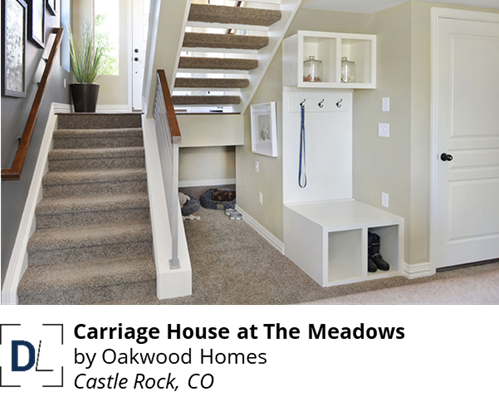
“Pet friendliness is the third highest ranking reason that single-family renters choose to rent a home over an apartment, falling below a private yard (also important for pets) and having no one living above or below. Thoughtful niches dedicated to pets (like the one below) are very appreciated by pet owners without alienating those who don’t have pets, since they can use the space for storage.”

What Are Tenant Preferences In Single-Family Build-For-Rent?
Thoughtful niches dedicated to pets like the one back under the stairs here are very appreciated by pet owners.

 Don’t spend on pet services

Don’t bother offering services like dog walking for an additional fee. Only 15% of renters would even consider opting into them. Single-family renters would much prefer paying extra for lawn or interior maintenance services.

Also owners and landlords don’t spend on pet services like dog walking for an additional fee. “Only 15 percent of renters would even consider opting into them. Single-family renters would much prefer paying extra for lawn or interior maintenance services.”

 Spend extra for a fabulous kitchen

Higher quality finishes mean more to tenants and a great kitchen can make a huge difference when tenants are choosing a build-to-rent property.

“Premium kitchen finishes and energy efficient appliances are huge draws for single-family renters, with 42 percent considering them a top influence for choosing a home above others. Don’t forget about ease of cleaning, which is a top pain point among owners and renters alike.”

Spend less on premium flooring, healthy home certifications, and smart tech

This falls into the nice-to-have but not needed to get quality renters category that landlords are very familiar with. These features ranked at the bottom of the list of draws for single-family renters in the Burns research and they do not sway rental decisions. “That said, we also advise developers to spend extra money on materials that will reduce damage and reduce the work needed to get the home ready for a new tenant.”

Devote more land to relaxation amenities – not social activities

Preferences for nature, security, and leisure amenities highlight the fact that build-to-rent single-family renters want a community they can relax in. That will influence renters’ decisions on choosing a community. Social events (e.g., concerts or movie nights), community gatherings (e.g., farmers markets), and event spaces (e.g., party rooms) were the three lowest-ranking amenity options among single-family renters.

The home office requirement

“Our recent work-from-home survey finds that 51 percent of full-time employed households plan to work from home next year (38 percent hybrid, 13 percent exclusively from home),” the report says.

The desire for a home office varies by life stage.

Singles or couples can use an extra bedroom for an office so a dedicated space for them is not an absolute requirement. However a full office or den matters more for single-family renters with children.

About John Burns Real Estate Consulting

“Our consulting experts will tell you that each location and development density have nuances to these conclusions, and our DesignLens™ team can share great design ideas for each density configuration and target life stage you are considering.“ If you are interested in learning more from our consultants, our DesignLens™ Director, or our monthly consumer surveys and prestigious design councils, please fill out this form or email Mikaela and one of our team members will get back to you soon.”

Suburbs Where Renters Became the Majority Over Owners

Sign Up For Our Newsletter And Get Rental Property And Apartment News And Helpful, Useful Content Each Week.

* indicates required


Average National Monthly Rent Tops $1,500 For 1st Time

Everything Landlords Should Know About Emotional Support Animals