Home Blog Page 101

Property Management Jobs In High Demand In Third Quarter

Property Management Jobs In High Demand In Third Quarter

Property management jobs were in high demand in the third quarter, according to the latest jobs report from the National Apartment Association (NAA).

Nearly 38 percent of available real estate jobs in the U.S. were in the apartment sector during the third quarter of 2021, exceeding the five-year average of 35.6 percent, the NAA Education Institute said in its third quarter Apartment Jobs Snapshot.

However, apartment job availabilities have muted year-over-year. The annual decline in apartment job postings reflects that other property sectors are recovering from the pandemic.

Robust apartment demand and rent growth generated the revenue property management companies needed to grow their onsite teams. According to RealPage, annual absorption reached 610,715 units in the third quarter. Average effective rent increased 11 percent since the same time last year.

Robust leasing activity during the third quarter of 2021 yielded strong demand for skilled professionals.

Property Management Jobs In High Demand In Third Quarter

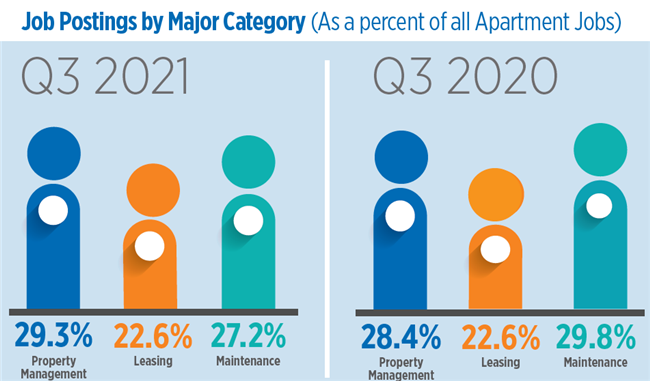
Property management professionals were the most sought-after during the quarter however job postings declined slightly year-over-year in the third quarter.

Demand for maintenance positions also fell by 2.5 percentage points year-over year. The decline in hard-to-fill maintenance job postings suggests that companies may be deciding to hire vendors to handle maintenance and repairs as salary expectations have increased.

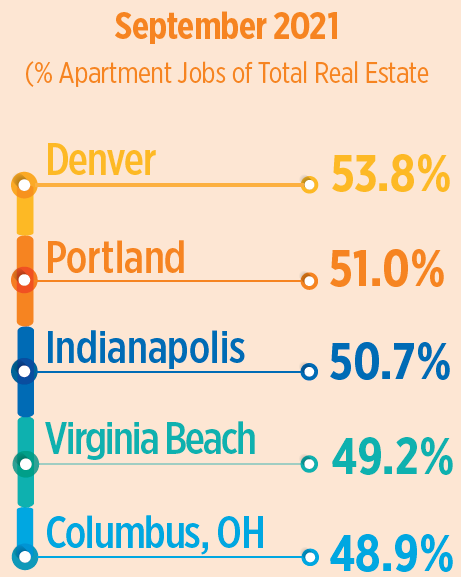
Dallas, Los Angeles, Seattle, Washington, D.C and Phoenix were the leading markets for the highest concentration of apartment job openings. Demand for student housing talent was strongest in Austin, Columbus, Gainesville, Houston and Tallahassee.

Sign Up For Our Newsletter And Get Rental Property And Apartment News And Helpful, Useful Content Each Week.

* indicates required

Divided Oregon Supreme Court Upholds Portland Relocation Payment Ordinance

Divided Oregon Supreme Court Upholds Portland Relocation Payment Ordinance

Oregon landlords “lost a good fight” after a divided Oregon Supreme Court upheld the Portland Relocation Ordinance, according to attorney John DiLorenzo Jr. with Davis Wright Tremaine LLP.

DiLorenzo, who represented the interests of landlords who sued the City of Portland, said the ruling was contained in a 31-page majority opinion and a nine-page dissent.

“We did not get the result we hoped for. The bottom line is that we did not prevail.  According to the dissent, we should have,” he said. “The long and the short of all this is that we lost despite a good fight.”

The majority opinion concludes that ORS 91.225 does not prevent municipalities from enacting measures that might have some influence over a landlord’s decision to raise rent unless it actually controls the amount.  The opinion also concludes that the ordinance did not impermissibly create a private cause of action. Also, “it goes on to say the statute does not define rent control or control.”

On the other hand, the dissent says, “The text of the ordinance and the circumstances surrounding its adoption permit only one conclusion:  The city, as a means of ‘stabilizing’ rising rents, intended to deter landlords from setting rents at fair market levels and selected a coercive tool to accomplish that objective.”

The dissent concludes that the relocation ordinance “controls the rent” and should therefore be preempted.

DiLorenzo added his opinion, saying, “The City of Portland has over the past several years created an extreme regulatory environment for housing providers. “Yet it decries the lack of sufficient rental housing.  It is unrealistic to, on the one hand, adopt policies that discourage ownership of rental housing and, on the other hand, complain that there is too little supply and that rents are too high.”

The landlords, who lost in lower court rulings, argued the Portland relocation ordinance is in conflict with state laws that ban rent control. On March 7, 2018, the Portland City Council made the ordinance permanent and extended its application to landlords who own as few as one rental unit. The ordinance requires landlords to pay tenant moving costs if they want to increase rent by 10 percent or do no-cause evictions to move tenants out to rehab old apartment buildings to upgrade them.

Download the majority opinion here.

Download the dissenting opinion here.

Sign Up For Our Newsletter And Get Rental Property And Apartment News And Helpful, Useful Content Each Week.

* indicates required

What to Look for in Property Management Software

What to Look for in Property Management Software

Are you still chasing down tenants every month or falling behind on the books?

There’s plenty to do when it comes to managing properties and it can be stressful.  The best way to get organized and stay on top of the day-to-today tasks is to keep everything in one centralized place.  The solution is property management software.  It can keep track of tenant, owner, vendor information, communication, and balances. It can also eliminate manual methods, multiple online tools, and increase productivity.  Most importantly, it can save time and money.  Below are key features to look for.

1. Accounting

Popular features include tracking income and expenses, online payments for tenants/owners/vendors, bank reconciliation and tax reports. Income is automatically recorded when tenants pay online and receipts and invoices can be uploaded with expenses. Tax season can get busy, but it’s easier with 1099s and Schedule Es that are already completed in the software.  Reporting is another important feature.  Some reports include rent roll, tenant late rent report, owner statements, and income and expenses.  With a lot of reporting options, you’ll always know how the properties are doing and property management software helps eliminate human error and keeps you on top of your books.

2. Leasing

Leasing includes rental listings, online applications and leases and tenant screening.  Property management software can post to multiple rental sites in minutes with one click.  Gone are the days of posting to rental sites one by one or using multiple online tools. Online applications and leases can be e-signed and the application fee and security deposit can be collected online too.  No more paper forms or paper checks.  Integrated tenant screening can provide background checks, credit checks, social security validation, and eviction search reports. These reports can be pulled within minutes allowing property managers to choose the right tenant quickly.  With property management software, your business would be more streamlined and have vacancies filled faster.

3. Communication

Portals help build strong relationships with tenants, owners and vendors.  Portals give everyone full transparency for online payments, important notices and work orders.  Tenants can submit maintenance requests and upload photos.  Vendors get notified for every new work order assigned to them and all communication is electronically saved for future reference.  Sending notices is also faster because it can be done in bulk to all tenants, owners, and vendors via email and text message.

One popular property management software that has all of these features plus more is SimplifyEm. They have been helping property managers and real estate investors for over 15 years and have over 150,000+ happy customers.  SimplifyEm is an all-in-one, easy to use software.  With simple and intuitive design, customers have a seamless experience.  The automation and sophisticated reporting saves you countless hours, giving you your time back.  As an online based software, you can access SimplifyEm anywhere at any time. With free onboarding and free live phone and email support, SimplifyEm Property Management Software will help take your business to the next level.  Get 50% off today and be up and running for the new year.


Stringent Rent Control Measure Passes in Minnesota

Stringent Rent Control Measure Passes in Minnesota

A stringent 3 percent rent control measure has passed in St. Paul, Minn., and Minneapolis voters also approved rent control in concept, according to reports.

Voters approved St. Paul’s measure that will cap rent hikes at 3 percent in a 12-month period regardless of a change in occupancy, and Minneapolis voters approved a measure to allow city leaders to begin crafting a rent-control policy, according to the Minneapolis Star-Tribune.

Supporters said the initiatives — which would enact rent control in St. Paul in 2022 and allow Minneapolis to enact a yet-to-be-developed policy in the future — would create stability for tenants in a tight housing market where most residents are renters.

NMHC: Rent control well-meaning but ineffective

The National Multifamily Housing Council (NMHC) released a statement saying, “”Although well-meaning, rent-control measures do nothing to provide real relief for those they intend to help. The passage of rent-control measures in Minneapolis and St. Paul are a true setback for those committed to finding effective solutions to address the cost of housing.

“Rather than improving the availability of affordable housing, rent-control laws exacerbate shortages, cause existing buildings to deteriorate and disproportionately benefit higher-income households. These measures could result in even further instability for Minnesota’s renters and the rental-housing market at large,” the NMHC said in the release.

St. Paul’s stringent rent control

St. Paul’s policy would not make exemptions for new construction or inflation.

Critics said that without those exemptions, the stringent rent control policy could be one of the strictest in the world. On Tuesday, some St. Paul voters said rent control was the biggest issue on this year’s ballot, which also included mayoral and school board races, according to reports.

The vote comes in response to a nation-leading housing shortage in the Twin Cities, which has led to skyrocketing home prices and steep rent hikes.

Voters in Minneapolis were asked a similar question about rent stabilization, although that proposal does not cap rent increases at a certain percentage like the St. Paul policy does, and leaves open options yet to be approved.

Sign Up For Our Newsletter And Get Rental Property And Apartment News And Helpful, Useful Content Each Week.

* indicates required

Rent Growth Continues to Slow Down After Record Year

Rent Growth Continues to Slow Down After Record Year

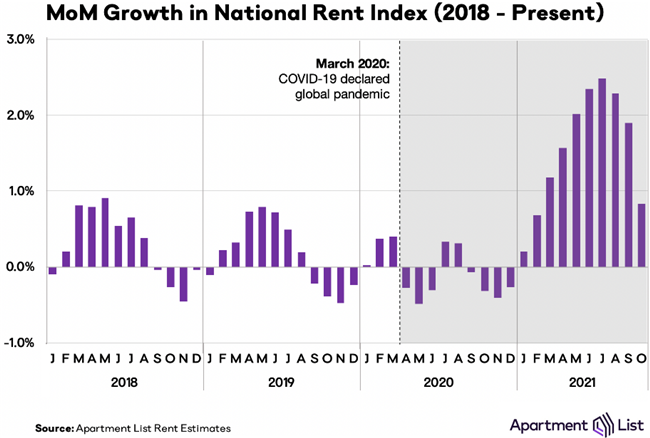
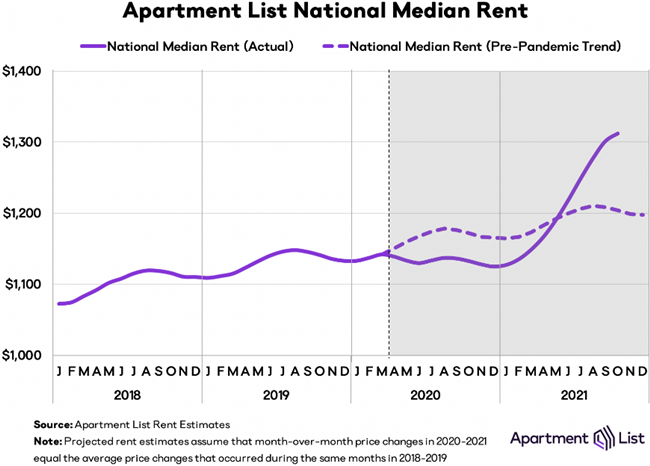
National rent growth continued to slow down in October as the national index increased by 0.8 percent from September to October, the lowest month-over-month growth rate since February, according to the November Apartment List report.

While October still showed a slight rent growth increase, “Twenty-two of the nation’s 100 largest cities saw rents fall this month, ending a six-month stretch in which virtually all of these cities were experiencing uninterrupted rent growth,” Apartment List said in the report.

“Although the pace of rent growth has slowed down significantly from its July peak, growth is still outpacing pre-pandemic trends, with rents continuing to rise during a time of year when seasonality normally causes prices to dip.

“Since January of this year, the national median rent has increased by a staggering 16.4 percent. To put that in context, rent growth from January to October averaged just 3.2 percent in the pre-pandemic years from 2017-2019,” the report says.

Rent Growth Continues to Slow Down After Record Year

Vacancy Rate Continues Upward Trend

Apartment List says much of the year’s rent-price increases have been tied to the tight rental market, with more people competing for fewer rentals. Now the vacancy rate, after hitting bottom at 3.8 percent in August, has trended up the last two months to 4.1 percent.

“Although this is a fairly modest increase, it represents an important inflection point, signaling that tightness in the rental market is finally beginning to ease. If our vacancy rate continues to increase in the coming months, it’s likely that rent growth will also continue to cool,” Apartment List said in the report by Chris SalviatiIgor PopovRob Warnock, and Lilla Szini.

Conclusion

“While the market remains extremely tight, we’re now seeing the first signals of that pressure beginning to ease. That said, it’s important to bear in mind that 35 of the nation’s 100 largest cities have seen rents jump by more than 20 percent since the start of the pandemic. Even if rent growth is finally cooling, this year’s rent boom has already added significant housing affordability pressure for America’s renters.”

Read the full national report here.

Sign Up For Our Newsletter And Get Rental Property And Apartment News And Helpful, Useful Content Each Week.

* indicates required

Rent Payments Slowing In Early September

Technology Adoption Doesn’t Have To Leave Disengaged Employees

Technology Adoption Doesn't Have To Leave Disengaged Employees

Technology adoption in the multifamily industry does not have to leave disengaged employees in its wake after multifamily operators had to move quickly with technology adoption due to the pandemic.

By Elizabeth Francisco
President, ResMan

The days of referring to the multifamily industry as a lagger in technology adoption have come to an end.

When the pandemic started, management companies of all sizes found themselves behind the eight ball with technology adoption, as they had to quickly figure out how to allow frontline and back-office employees to work remotely.

There’s little time for change management or training when you expedite technology adoption out of immediate need. As a result, you end up with a disconnect between process and people.  Unfortunately, this is where many in the industry are finding themselves now. As employees see technology driving efficiency, it’s easy to feel insecure about their long-term value to the organization.

Rather than embracing the tools the company has invested in, they disengage or resist in ways that slow or derail adoption. Before we get any further down the path of digital transformation, it’s important for management companies to step back and take a more “human-centric” approach to technology adoption.

What is a ‘Human-centric’ Approach to Technology?

Humanizing a technology means explaining the technology and its usefulness to the users. It also means helping the users embrace the technology in their daily routines.

A user who does not get the point of or see the value in innovative technology will not use it. Therefore, technology should stay focused on humans, not the other way around.

Explaining the why behind the technology your organization is adopting is critical to successful adoption and employee retention. Simon Sinek has a great Ted Talk on the importance of starting with “why.”  He explains that the most inspiring leaders communicate from the inside out; they inspire people around them because they start with defining the purpose, why it matters. The “why” inspires people, whether you are a consumer buying a product or service or a part of an inspiring organization. People choose to follow or buy the product because they want to, not because they were told to.

At ResMan, we advocate for our customer partners to identify someone in their organization as the change champion. The change champion needs to work with leadership to set expectations for the rollout and get buy-in from leadership to support their communications. They need to educate the team on the why, clearly communicate how the technology will be rolled out, and help with realistic expectations during the rollout.  They must be realistic with their teams about bumps along the way and the additional time and energy often required; if you have effectively communicated why it is beneficial to your team, they will understand and embrace all that comes with the change.

Lastly, efficiency gains do not have to equate to reductions in staff, and communicating this to employees is important. Employees often fear technology will result in their job being eliminated, so it’s important to address this perception and help them understand how the technology will increase capacity and allow them to refocus their energy on other aspects of the business.

I cannot think of any organization I have worked in or that we have worked with that does not have aspects of the business under-resourced. Our customers often find that they have increased capacity after a rollout of our platform.  The increase in capacity allows for focus on important under-resourced activities like attracting and retaining renters or conducting a higher degree of analysis of the business.

Human-centric Approach with a Remote Work Model

Prior to the pandemic, many leaders in the multifamily industry were still holding back from a more flexible work model, fearing loss of productivity, or believing that they needed to physically see their employees working.

However, the pandemic forced us all to re-evaluate our thinking as the whole country went remote at some point for some amount of time. With the right technology in place, multifamily operators are now positioned to consider a remote work model for at least some aspects of their business.

This type of model offers benefits to both operators and employees:

  • The ability to draw from a nationwide talent pool
  • Quality-of-life improvements that come with eliminating commutes
  • Increased loyalty and commitment to the organization

When the pandemic drove ResMan to a remote work model, we saw a significant increase in productivity levels, and we have made permanent changes to our policies as a result. Working remotely gave our employees more time with their loved ones, significantly improving morale. The flexibility also resulted in employees taking fewer days away from the office, leading us to add more company holidays to make sure everyone can unplug and take a well-deserved break!

But working remotely brought challenges that again required a focus on humanization.

We needed to make sure employees were equipped with the right technology and office setup to be productive and comfortable. We also had to be mindful that employees who work remotely can feel isolated and disconnected from their teams and companies, so we do weekly company standups on top of department standups, including a cameras-on requirement, as do many of our meetings. As leaders, we absorb a lot of information from body language when we meet with employees in person. Making sure we continue to get non-verbal cues is critical to being good managers in a virtual work environment.

Work-Life Balance in the Age of “Always On”

Regardless of whether you offer a remote work model, technology has freed employees from their desks, cubicles, and regional corporate office buildings but, in turn, has shackled them to their smartphones, tablets, and laptops. Even before the pandemic there was a growing concern about the “always-on” impact on an employee’s physical and mental health.

As a result of the notification options included in our smart devices, employees may be experiencing Pavlovian conditioning from notifications of a new email, a new chat, and a new comment. An important part of taking a human-centric approach to technology is putting up digital guardrails to facilitate a healthy work-life balance. Our team members need time to disconnect like they need to sleep. It allows them to recharge, which will positively affect productivity and creativity, and it ensures they can be present when having quality time with friends and loved ones. In the multifamily industry, policies and leadership modeling of good “disconnection” practices is key to ensuring a healthy work-life balance for your employees.

About the author:

Elizabeth Francisco has spent the last two decades building a successful career as an operator and technology provider in the multifamily industry. She started her career as an onsite leasing agent and worked her way up to a vice president of operations while simultaneously helping to launch ResMan, a property-management technology platform.

Sign Up For Our Newsletter And Get Rental Property And Apartment News And Helpful, Useful Content Each Week.

* indicates required

How to Combat the Apartment Industry’s Uptick in Fraud

How to Combat the Apartment Industry’s Uptick in Fraud

An increasingly digital world invites more fraud and how to combat the apartment industry’s uptick in fraud has become a primary concern.

By Paul Willis

It’s become one of the most striking—and most unwelcome—trends in multifamily rentals.

Over the past couple of years, and especially since the start of the pandemic, apartment operators say fake pay stubs, “synthetic” IDs and other falsified documents have become all too common in the leasing process. While fraud has always existed in the apartment world, industry professionals agree that it has never before elevated to its current levels.

“It’s insane,” said Nikki Chambers, director of systems and training for Hanover Company. “I’ll have five fraudulent applications at one property in just one week. It’s crazy just how much more fraud there is in the market. It used to be isolated to particular submarkets and now, just like how crime has no zip code, it’s the same thing with fraud. It’s not isolated to any area, submarket, region or even a product type.”

A recent Entrata survey found that 55 percent of respondents have been experiencing fraudulent attempts every few months with 15 percent experiencing multiple fraudulent attempts every month. The pandemic has exacerbated the fraud trend, as Entrata data shows that identity-theft reports are up over 2,000 percent since the onset of the pandemic. Perhaps more telling is that 5 percent of applicants among the company’s clients could not be approved due to a lack of verifiable identification, which indicates that one of every 20 potential lessees is aiming to circumvent the system.

“With the average fraud loss at about $3,500 per case, it can be extremely costly, particularly with multiple instances,” said Kelly Canepa, senior vice president of product for Entrata. “That’s why operators are seeking advanced-screening measures that diagnose potential fraud early in the process and ensure that preventative best practices are in place.”

While fraud prevention used to be a background priority in the industry, it has risen to the forefront as a primary concern. Industry experts recently discussed the rising fraud problem, including innovative tactics by deceitful applicants and ways to combat the escalating trend.

Types Of Apartment Industry Fraud

Fake pay stubs, designed to inflate one’s actual earnings, are so prominent that websites are dedicated to them. But that fraud tactic seems a bit old-school compared to some of the new-age types being introduced. Identity theft is becoming more sophisticated, as individuals are using the identities of children, missing persons and deceased individuals—a tactic known as synthetic ID fraud.

This occurs when parts of real identities—such as Social Security numbers, address and driver’s license information—are combined with false information. This means a background check can still pass on some occasions.

“There has been an enormous uptick in all types of applicant fraud,” said Shawaun Alexander, vice president of operations software and systems for Bozzuto. “It’s actually become one of our primary focus areas, particularly since the effects of the pandemic still loom over occupancy and retention rates.”

Fraudsters are becoming more sophisticated. They often use these forms of fake information and false identities to get into an apartment community, then skip out after a few months when it’s apparent that they cannot pay. Oftentimes they escape with no repercussions, because their identity was false to begin with. And the tactics they deploy continue to evolve. They’ll even use outlets that sell identities on the black market.

“False pay stubs used to be all that we’d see,” Chambers said. “Now they are the least of our worries. We’re more worried about the actual identity of someone else being stolen.”

How To Combat The Apartment Industry Fraud Trend

An increasingly digital world invites more fraud, whether through ID theft, innovative phishing scams or other cyber-related activity. Operators tend to agree that fraud has become too complicated and complex to combat on their own. They need help in the form of technology, including intuitive tools to authenticate identity, verify bank account information and substantiate the overall suitability of a potential renter.

“When these solutions are in place, they enable apartment communities to make accurate risk assessments of all their lease applicants,” said Chris Ryan, Experian’s fraud and identity go-to-market lead for North America.

Alexander noted that in addition to utilizing its standard screening provider, Bozzuto utilizes a combination of ID verification and document verification software. But even with all the screening tools in place, she says the manual review process should not be abandoned. For instance, a Bozzuto internal team recently short-circuited approximately 200 potential fraudulent applicants at one community.

“The big goal is to find a full-house solution that doesn’t disrupt the application process or create hurdles for valid renters or your site teams,” Alexander said. “One that hits the key checkpoints of screening, ID and document verification. Many tech platforms hit one of those but aren’t built into the process, so fraudulent applicants can often bypass some of the checkpoints.”

Bozzuto’s primary objective after uncovering a fraudulent applicant, Alexander said, is to ensure the information surrounding fraudulent applicants is transparent across the portfolio.

Hanover Company also uses a variety of tools, including a product to scan driver’s licenses and several third-party verification services. Chambers noted that an ID verification platform utilized by Hanover has been the most successful in flagging potentially fraudulent items at various checkpoints in the process.

“Don’t think that just because you’re in a submarket that historically has not had a problem—or because you have a superior product type or a stellar onsite team with tried-and-true industry professionals—that something cannot sneak past you,” Chambers said. “Technology might not be the only answer, but it’s certainly part of the equation. At this point in the industry life cycle, you have to have some sort of technology checkpoint.”

Industry recommendations

While fraud prevention is key, industry experts agree that any prevention methods should not intrude on the experience of good renters. On the flipside of fraud prevention, Bozzuto uses a credit-reporting agency for positive rent recording. Reputable residents making payments each month receive the benefit of possibly increasing their credit score and strengthening their rental-history profile.

“We have to make sure our teams have the tools—systems, technologies and procedures—that enable them to weed out the fraudulent applicants and create the best possible experience for the qualified applicants,” Alexander said.

Operators agree that augmenting tech with manual practices is a solid tactic, because instances exist when tech won’t catch everything. Chambers said to remain diligent and not fall into the trap of thinking that you have “an amazing manager and she’ll catch everything.”

“Criminals are getting smarter by the day,” Chambers said. “If people used their insight into criminal activity for good instead of evil, the world would truly be a better place.”

In a hypercompetitive industry, it’s not natural to share information. But many believe exceptions can be made when it comes to preventing apartment industry fraud.

“I think it’s important as leaders that we work together to really dig into how prominently our industry is being affected by fraud and how drastically it has increased over the last few years,” Alexander said.

About the author:

Paul Willis is a content manager for LinnellTaylor Marketing.

Sign Up For Our Newsletter And Get Rental Property And Apartment News And Helpful, Useful Content Each Week.

* indicates required

97 Percent Of Property Management Companies Have Experienced Fraud

Residential Rental Companies Lose $4.6 Million Annually to Fraudulent Rental Applications

Parent Died and Left a Rental to Sell; How Do I Get the Tenant Out?

Landlord Hank Parent Died and Left a Rental to Sell; How Do I Get the Tenant Out?

The question this week for Landlord Hank is about inheriting a rental to sell and how to get the tenant out to put rental on the market. On his page,  Ask Landlord Hank answers questions from other landlords and property managers around the country about their rentals so fill out the form below if you have a question for him. Remember Hank is not an attorney and is not offering legal advice.

Dear Landlord Hank,

One of my parents died and left me a single-family home rental in Dublin, Calif., in Alameda County.

We’d like to take the home off the rental market and sell it. Is there a legal way to notify the tenant?

-Dave

Hi Dave,

You just inherited a rental property, and now you want to sell it.

You can easily do this. I would send the tenant a certified letter letting the tenant know your intention. But I would talk to the tenant first and let them know what you plan; this will help you determine whether they’re going to cooperate.

You selling the property and gaining entry is usually addressed in the lease, so look at it closely. Most leases have a right-of-entry clause stating that you can access the property with reasonable notice to the tenant for showings and that you can post for-sale signs.

This doesn’t mean that the tenant’s lease doesn’t have to be honored – it does. A lease is a contract for a set time, and if you sell it during this time, the new owner must honor the lease too.

The lease may have clauses for early termination, so check for that. I’d have a real discussion with the tenant to try to get them on your side and make sure they know you intend to honor the lease.

You don’t want to show a property when the tenant is against your plan, as the condition may not be optimal if the tenant is trying to discourage the sale (dirty dishes in the sink, unmade beds, etc.).

Good luck!

Sincerely,

Hank Rossi

The question this week for Landlord Hank is about inheriting a rental to sell and how to get the tenant out to put rental on the market.
Landlord Hank says, “I’d have a real discussion with the tenant to try to get them on your side and make sure they know you intend to honor the lease.”

Ask Landlord Hank Your Question

Ask veteran landlord and property manager Hank Rossi your questions from tenant screening to leases to pets and more! He provides answers each week to landlords.

  • This field is for validation purposes and should be left unchanged.

About the author Landlord Hank:

“I started in real estate as a child watching my father take care of our family rentals- maintenance, tenant relations, etc , in small town Ohio. As I grew, I was occasionally Dad’s assistant. In the mid-90s I decided to get into the rental business on my own, as a sideline. In 2001, I retired from my profession and only managed my own investments, for the next 10 years. Six years ago, my sister, working as a rental agent/property manager in Sarasota, Florida convinced me to try the Florida lifestyle. I gave it a try and never looked back. A few years ago we started our own real estate brokerage. We focus on property management and leasing. I continue to manage my real estate portfolio here in Florida and Atlanta. “ Visit Hank’s website here.

Dear Landlord Hank: I Have A Tenant Couple Who Fight On A Regular Basis – What Do I Do?

Sign Up For Our Newsletter And Get Apartment News And Helpful, Useful Content Each Week.

* indicates required


Can Tenants Dictate When I Need To Enter My Rental?

Are You 10 Out Of 10 In Collecting Rent?

collecting rent and online rent payment technology david pickron rent perfect

Collecting rent using online rent payment technology is a game changer for landlords so here are 3 reasons to use online payment technology from veteran real estate investor and property manager David Pickron.

By David Pickron

History is littered with what at the time were considered “game changers.”  Those game changers have become commonplace in our current world; when was the last time you marveled at the technological breakthrough we know as the wheel?  Or the lightbulb?  Or even the fact that we fly in airplanes all around the world?  The likelihood is we dismiss or overlook these incredible technologies and innovations because we have become so familiar with them.  We don’t see just how amazing these everyday conveniences are and how our lives are better for them.

In the world of landlords and property management, game-changing circumstances might be even harder to identify, as many operate by the “If it’s not broke, don’t fix it” rule.  Having nearly 30 years of experience in this field, I have seen a lot of ideas come and go, but nothing has struck me as a game changer more directly than the introduction of online rent payments.  After all, if I’m not collecting rent, then I have no business being in this business.  The following are the three main reasons I view online rental payment programs as a true game changer.

The System Collects Rent for You

For far too many years, I had a renter who consistently paid rent on the fifth of each month (or later) and was never charged a late fee, even though they should have incurred one every month.

Why did this happen?

First, I allowed it to.

Second, I was always busy with other things and was genuinely happy when the check finally did appear.  With the advent of rental payment programs, I was able to take back control of who is in my property and get paid on time, every time.  Imagine your tenant receives an email from the rental collection system prior to the due date indicating that rent is due in 5 days, then 4, then 3, etc.  If they don’t pay, the system automatically reminds them that rent is due.  If rent becomes past due, the system automatically begins calculating and assessing late fees starting on the date indicated by your lease.

If a tenant calls, seeking permission to make a partial payment or waive fees, you simply tell them there is no way to do that because the system won’t allow it; the system will only let them pay the full amount including late fees.  It’s an easy way to play “good landlord, bad landlord” without getting your hands too dirty.

Rent Collection Consistency

As with all things in our industry, consistency is the name of the game when it comes to anything that can be regulated or overseen.

This is especially true in regard to all interactions with your tenant, including collecting rent. In my early years I had multiple properties and each tenant paid differently.  One would bring a check to my home, another would mail theirs, and I even had one that would go directly to my bank and deposit directly into my account (with my bank account numbers, which I provided).  I was scoring a 0/10 when it came to rent-collection efficiency and consistency.

With my current rental-payments system I now have the ability to look at an online ledger and easily see the payment status of every property at a glance.  Knowing who has paid, who is outstanding and who owes late fees puts me squarely in control of my business.  Having the ability to effectively “set it and forget it” when it comes to collecting rent will allow you to be consistent in your practices and get paid consistently.

Benefit to the Tenant

Unlike the heartless, greedy persona that many use to describe their landlords, the overwhelming majority of us truly do want to provide some benefit to our tenants.

Online rental-payment programs allow our tenants to 1) stop writing checks, which no one wants to do anymore, 2) set up automatic payments so you get your money at the same time every month, and 3) reports successful payments to the credit bureaus, helping to boost their credit.

Strangely enough, the things that benefit your tenant also benefit you.  I challenge you to show me a landlord who doesn’t benefit from getting paid on time on a more consistent basis; it’s a win-win for both parties.

Recently Rent Perfect had our own game-changing moment with the launch of our own online rental-payment system.  Regardless of whether you use Rent Perfect for tenant background checks or to create your own custom leases, rent pay is available to all landlords and tenants.

All landlords now have the ability to use the exact same process I use to manage the oft-challenging tenant life cycle.  Designed with input from seasoned landlords across the country, this program was built to help you collect rent in a consistent manner to the benefit of every tenant… and yourself.  When you are ready for a game changer for your business, we invite you make your life easier with rent pay.

About the author

David Pickron is president of Rent Perfect, a private investigator, and a fellow landlord who manages several short- and long-term rentals.  Subscribe to his weekly Rent Perfect Podcast (available on YouTube, Spotify, and Apple Podcasts) to stay up to date on the latest industry news and for expert tips on how to manage your properties.

Are you 10 out of 10 in collecting rent and online rent payment technology?
David Pickron

3 Tips to Keep You Out of Landlord Rehab

Sign Up For Our Newsletter And Get Rental Property And Apartment News And Helpful, Useful Content Each Week.

* indicates required

Why I Like My Rental Properties’ Nosy Neighbors

6 Trigger Words And Questions Every Landlord Should Listen For

Small Amount of Rental Relief Money Getting to Landlords, Tenants

Small Amount of Rental Relief Money and rental assistance Getting to Landlords, Tenants

Less than 25 percent of the rental relief money approved by Congress has moved through the states’ distribution processes to residents and property owners in need, the U.S. Department of Treasury reported.

State, local and tribal officials had disbursed about $10.7 billion in rental relief money as of the end of September, representing less than a quarter of the $46.5 billion Congress authorized in two tranches since last December. The Biden administration has pressured state and local governments to ramp up delivery of the rental relief money to avert evictions during the pandemic, so far without much success.

While the Treasury reported that funds going to landlords and tenants went up by 9 percent in September over August, the agency also said they will soon start taking back funds where distributions have been lagging, regardless of the reason.

Some 8.4 million people are behind on rent, according to the most recent Census Bureau survey, with 3.6 million reporting they are likely to face eviction within two months, Politico reported.

“Even with the stronger performance we know that if we don’t do better nationwide, hundreds of thousands of families will still unnecessarily face that painful eviction or risk of eviction,” said Gene Sperling, a senior adviser to the president and the White House’s point person on coordinating rent relief efforts, to Politico.

The National Multifamily Housing Council (NMHC) and the National Apartment Association (NAA) said in a  release that, “In order to facilitate the distribution of rental assistance aid to residents and housing providers alike, NMHC and NAA, on behalf of the nation’s 40.1 million individuals who call an apartment home, ask policymakers to make the following improvements to expedite rental assistance distribution:

  • Reject the addition of counter-productive eviction-moratorium provisions.
  • Direct grantees to allow housing providers to apply on behalf of residents under a notification safe-harbor, prioritize arrearages and remove the 18-month limit on assistance.
  • Allow ERAP to reimburse rental property owners, without qualification, on properties where a renter has moved out.

Additional proposed reforms to the emergency rental assistance program can be found here.

“Without action to improve disbursement of ERAP and increased participation in the program, renters are faced with further uncertainty and a mounting debt cliff, while rental property owners move closer to foreclosure, bankruptcy, or a forced sale of the property—putting the overall stability of the rental housing sector and broader real estate market in peril,” the NMHC and NAA said in the release.

In Oregon, the  Department of Housing and Community Services and 18 community action agencies paid out a total of $133 million by a Sept. 30 deadline set by the U.S. Treasury for states to commit at least 65% of their initial shares of rental assistance. Oregon’s initial share was $204 million, and the state is in line for more money that will be reallocated from other states failing to spend their full amounts, KOIN reported.

Sign Up For Our Newsletter And Get Apartment News And Helpful, Useful Content Each Week.

* indicates required

Don’t Let Rental Criteria Be Your Kryptonite