Home Blog Page 99

Portland Rents Up, Seattle Sees Slight Decline In October

Portland Rents Up, Seattle Sees Slight Decline while Oregon rents growth

Portland rents increased only slightly by 0.2 percent last month while Seattle saw a slight decline of 0.2 percent, according to the November report from Apartment List.

However for the year Portland rents are up 7.6 percent and Seattle is up 15.4 percent in comparison to the same time last year.

Currently, median rents in Portland are $1,244 for a one-bedroom apartment and $1,451 for a two-bedroom. This is the ninth straight month that the city has seen rent increases.
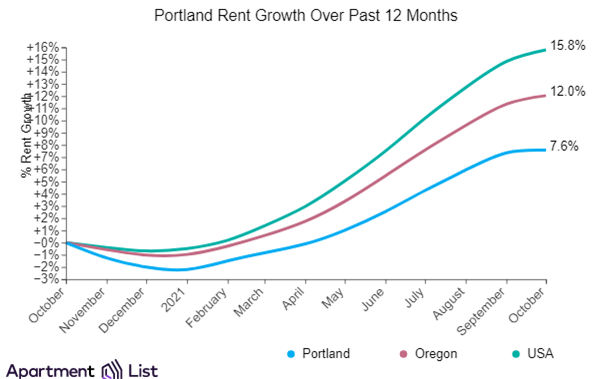
Portland rents increased only slightly by 0.2 percent last month

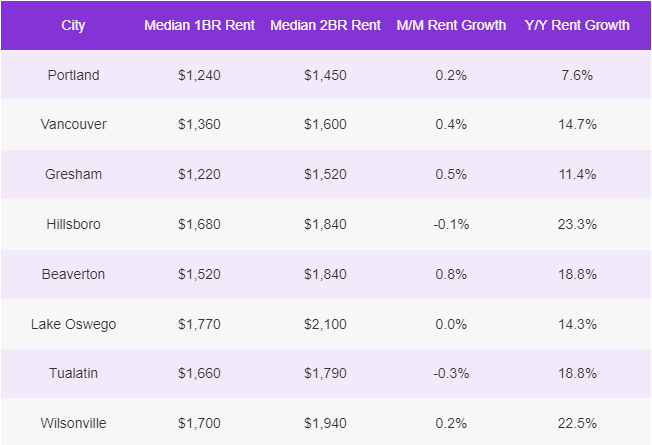
Throughout the past year, rent increases have been occurring not just in the city of Portland, but across the entire metro. Of the largest 10 cities that Apartment List has data for in the Portland metro, all of them have seen prices rise.

Oregon as a whole logged rent growth of 12.0 percent over the past year.
Portland rents increased only slightly by 0.2 percent last month

Here’s a look at how rents compare across some of the largest cities in the Portland metro and in Oregon:

  • Looking throughout the metro, Hillsboro is the most expensive of all Portland metro’s major cities, with a median two-bedroom rent of $1,845.
  • Of the 10 Portland metro cities with rent increases year-over-year, Hillsboro is experiencing the fastest yearly growth up 23.3 percent.
  • Beaverton was up 19.9 percent year-over-year.
  • Vancouver  up 14.7 percent in comparison to the same time last year
  • Bend up 19.9 percent for the year.
  • Salem grew 15 percent.

Seattle Rents

Currently, median rents in Seattle stand at $1,726 for a one-bedroom apartment and $2,153 for a two-bedroom.
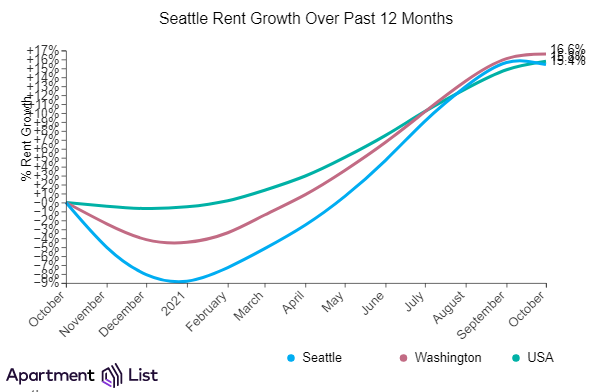
Rent growth over the past month

While up 15.4 percent, Seattle’s year-over-year rent growth still lags the state average of 16.6 percent, as well as the national average of 15.8 percent.

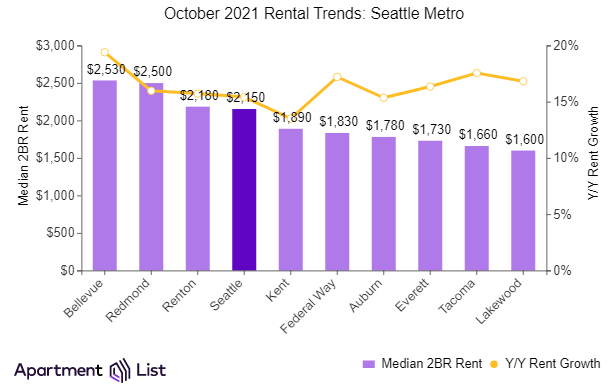
Here’s a look at how rents compare across some of the largest cities in the Seattle metro.

  • Bellevue has the most expensive rents in the Seattle metro, with a two-bedroom median of $2,534; the city has also seen rent growth of 19.4 percent over the past year, the fastest in the metro.
  • Over the past month, Redmond has seen the biggest rent drop in the metro, with a decline of 0.7 percent. Median two-bedrooms there cost $2,499, while one-bedrooms go for $2,226.
  • Lakewood has the least expensive rents in the Seattle metro, with a two-bedroom median of $1,600; rents grew 0.1 percent over the past month and 16.8 percent over the past year.
Seattle saw a slight decline of 0.2 percent

Sign Up For Our Newsletter And Get Rental Housing and Apartment News And Helpful, Useful Content Each Week.

* indicates required

Demand Keeps Pushing Up Rental Rates For Another Month

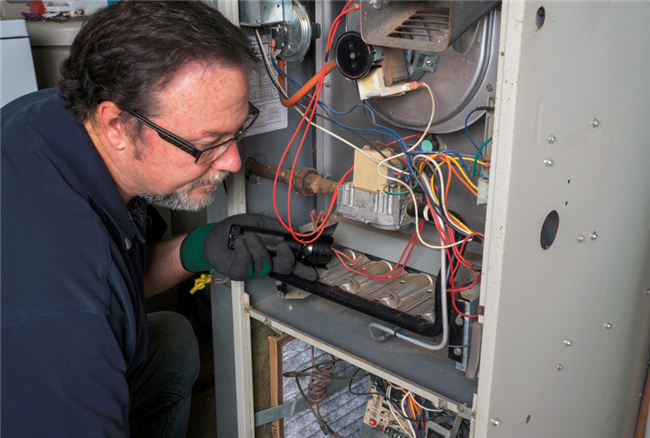
5 Steps To Take Care Of Your Rental Property Heating System In Winter

5 Steps To Take Care Of Your Rental Property Heating System In Winter

Here are 5 steps to take care of your rental property heating system in winter and protect your investment and your tenants, the  maintenance check up provided by Keepe.

You get a sudden phone call from your tenant in the middle of a deep cold snap and the tenant is panicking because the heating system suddenly stopped working.

Their home is getting colder and colder.

In less than an hour, you get two more calls from two more tenants reporting malfunctioning heating systems.

    • What if your trusted maintenance professional is on vacation?
    • What if other contractor companies you can think of happen to be unavailable?

This might sound like an unlikely situation, but it actually happened to a property manager in a big city.

That property manager had always relied on the same contractor before and assumed that living in a big city would guarantee access to several others in an emergency.

It can make it easy to underestimate how the maintenance solution you are used to might actually not be the most effective solution for you.

5 steps to take care of your heating system in winter

Here is where preventative maintenance comes in too – instead of waiting for the worst, prepare for the cold.

Our heating, ventilation and air conditioning experts explain how the following 5 steps can help you take the best care of your rental property heating systems to avoid the headaches of unexpected emergencies:

    1. It is essential to schedule a thorough inspection of the heating system once a year, ideally in the fall but early winter works too. By doing so, any potential issues can be identified before the cold season and the tenant calls with an emergency.
    2. Tenants should be reminded that air filters need to be regularly checked and replaced every 90 days. This will optimize a property’s air flow and avoid furnaces and central systems to become overworked, which is also more expensive.
    3.  Vents should be inspected often to prevent clogging caused by debris and dirt. Especially after leaves falling in the fall, hiring a professional for an inspection of vents and ducts is the best way to ensure that your tenants can enjoy an efficient and safe space with adequate air flow.
    4. As different heating systems have different maintenance needs, it is best to consult a trusted technician and promptly schedule the recommended maintenance services for your particular system. The money you might save by skipping the occasional service is not worth the future expenses and headaches brought by a heating crisis in the middle of the winter season.
    5. Now is the time to compile a readily-available list of reliable local technicians you can trust in an emergency. When finding yourself dealing with sudden emergencies, wasting precious time searching for a new contractor can become a stressful process. Not to mention that the pressure from tenants to get something fixed quickly can lead to rushing the selection process, and hiring someone who turns out to be unqualified for the job can result in even more problematic and pricier damages.

About Keepe:

Keepe is an on-demand maintenance solution for property managers and independent landlords. Keepe makes hundreds of independent contractors and handymen available for maintenance projects at rental properties. Learn more about Keepe at https://www.keepe.com.

Sign Up For Our Newsletter And Get Rental Housing and Apartment News And Helpful, Useful Content Each Week.

* indicates required


Preparing Your Furnace For Winter

Developers Pausing, Pulling St. Paul Projects After Rent Control Vote

Developers Pausing, Pulling St. Paul Projects After Rent Control Vote in St. Paul Minnesota

The recent rent control vote in St. Paul, Minn. that capped annual rent increases at 3 percent has caused developers to pull permits, pause projects, or reconsider sites for future housing, according to reports.

The St. Paul rent control vote does not exempt new construction, unlike rent control in some other cities, so developers who had projects underway moved quickly to stop construction and plans tied to new housing, which also affects planned affordable-housing units.

St. Paul Mayor Melvin Carter is reportedly asking the city council to amend the strict cap on rent increases, but legal questions put any changes in doubt.

The Minneapolis Star-Tribune reported that Ryan Companies was scheduled to submit three building plans to the city this week, but Tony Barranco, Ryan’s north region president, said those reviews have been postponed indefinitely in light of the rent-control referendum’s outcome.

Ryan Companies warned before election day that the rent control ordinance in St. Paul could prevent the company from finding investors for the 760 affordable-housing units the city pledged to bring to the former Ford site.

The company, which is developing a total of 3,800 housing units at the old Ford site under the “Highland Bridge” project, told KARE 11 that it pulled applications for three buildings there.

“If our banking partners won’t loan us dollars to build the buildings that are planned as market-rate because they can more safely lend their dollars elsewhere, we will not be able to build the market-rate projects” that help subsidize affordable housing, Barranco told the Star-Tribune.

“We’re aware that Mayor Carter has asked the St. Paul City Council to pass a clarifying ordinance that allows exemption for new housing construction. We support that position and hope to learn more about those clarifications as soon as possible,” Barranco said.

Other developers are waiting to see what will happen amid the confusion over the rent-control ordinance.

“We, like everybody else, are re-evaluating what—if any—future business activity we’ll be doing in St. Paul,” said Jim Stolpestad, founder of development company Exeter, in an interview with the Star-Tribune.

Stefanie Sokup, the vice president of marketing and head of new construction at Real Estate Equities, told KARE 11 the lack of an exemption for new projects also troubled her. Real Estate Equities owns five apartments in St. Paul.

“I do worry about other developers in St. Paul and what this means. I think it will halt development, or at least stall it for a while,” Sokup said. “Ultimately, we feel this wasn’t thought through… Is this the best solution to help the people that need affordable housing in five years, or is this just a quick fix?”

Sign Up For Our Newsletter And Get Rental Housing and Apartment News And Helpful, Useful Content Each Week.

* indicates required

Stringent Rent Control Measure Passes in Minnesota

Salt Lake City Rents Increase Sharply Over The Past Month

Salt Lake City Rents Increase Sharply Over The Past Month

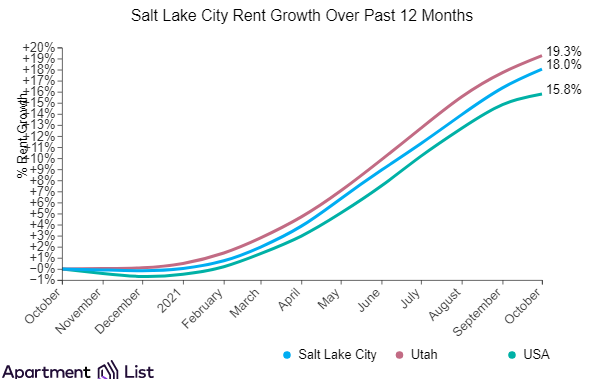
Salt Lake City rents increased 1.5 percent over the past month, and have increased sharply by 18.0 percent in comparison to the same time last year, according to the most recent report from Apartment List.

Currently, median rents in Salt Lake City stand at $1,082 for a one-bedroom apartment and $1,383 for a two-bedroom.

This is the tenth straight month that Salt Lake City rents increased after a decline in December of last year.

Salt Lake City’s year-over-year rent growth lags the state average of 19.3 percent, but exceeds the national average of 15.8 percent.

 West Valley City rents also up sharply over the past month

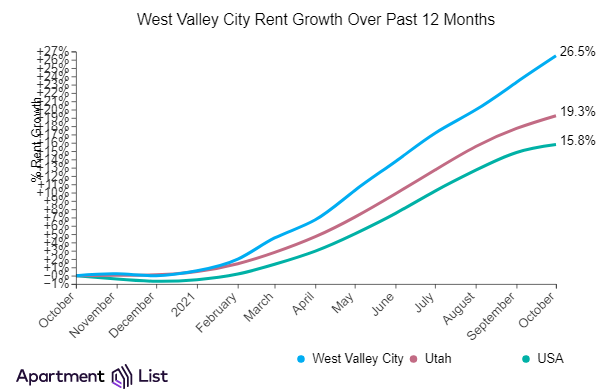
West Valley City rents have increased 2.6 percent over the past month, and have increased sharply by 26.5 percent in comparison to the same time last year.

Currently, median rents in West Valley City stand at $1,315 for a one-bedroom apartment and $1,550 for a two-bedroom.

West Valley City Utah rents increase

West Jordan rents also increase

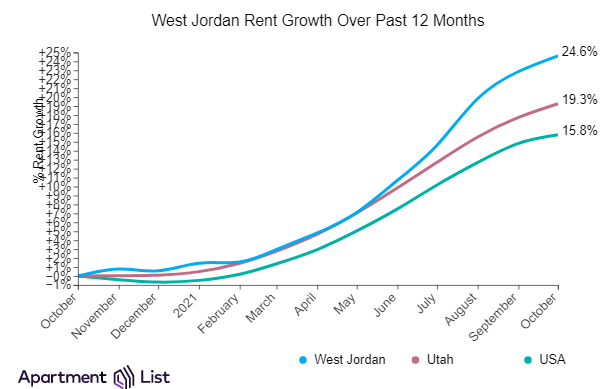
West Jordan rents have increased 1.4 percent over the past month, and are up sharply by 24.6 percent in comparison to the same time last year.

Currently, median rents in West Jordan stand at $1,403 for a one-bedroom apartment and $1,709 for a two-bedroom.

West Jordan Utah rent increases

Salt Lake City rents increase sharply over the past month

How Do You Keep Tenants From Going Overboard With Holiday Lights?

How Do You Keep Tenants From Going Overboard With Holiday Lights?

Can tenants go overboard with holiday lights especially in a multifamily property is the question for Ask Landlord Hank this week. Remember Landlord Hank is not an attorney and is not giving legal advice.

Dear Landlord Hank:

Do you have any rules for Christmas lights or yard art tenants can put up outside your rentals?

We just saw a tenant nailing up lights to the frame around the front door and are concerned about how far this could go in terms of potential damage.

We don’t want to be the Grinch, but what is reasonable?

-Sarah

Dear Landlady Sarah,

I understand your concerns and sometimes residents don’t use the best judgement in holiday decorating.

I make sure tenants know that they are not permitted to get on the roof, nor attach anything to the structure of the property by any intrusive means-no nails, no staples, etc. but there are many other options that don’t damage anything.

I’ve had folks use zip ties, string, wire, putty, hooks with adhesive, tape, winding lights around columns, you get the idea.

Holiday yard art could be an issue

Yard art could be problematic depending upon the situation.

If this is a single-family home you are talking about, then the more the merry, in my opinion. The lawn won’t be damaged as the grass isn’t growing, in cold climates.

Multifamily properties are different

If this is a multifamily property, I like tenants to keep the decorations confined to their own units or balconies or porch.

Holiday celebration in this manner is a very good sign to me. It means that your tenant is thinking of your place as home.

Most folks take care of their home, they want to stay and make more family memories and they may be putting down roots.

Long-term tenants are stable assets that I like to groom.

But do what feels right for you and your situation.

If you haven’t set some boundaries, maybe you could talk to your tenants? See what they have in mind, as far as decorating? Then,  you can give them some pointers.

Happy Holidays!

Sincerely,

Hank Rossi

Ask Landlord Hank: can tenant holiday lights go overboard in multifamily properties? to a rental property.
Can tenant holiday lights go overboard in multifamily properties? Landlord Hank says, “I like tenants to keep the decorations confined to their own units or balconies or porch. “

Ask Landlord Hank Your Question

Ask veteran landlord and property manager Hank Rossi your questions from tenant screening to leases to pets and more! He provides answers each week to landlords.

  • This field is for validation purposes and should be left unchanged.

Sign Up For Our Newsletter And Get Apartment News And Helpful, Useful Content Each Week.

* indicates required

Can I Evict Tenants for Drilling Holes in Exterior Walls?

Can I Evict Tenants for Drilling Holes in Exterior Walls? Ask Landlord Hank

The question this week for Landlord Hank is whether a landlord can evict tenants for drilling holes in an exterior wall. On his page,  Ask Landlord Hank answers questions from other landlords and property managers around the country about their rentals so fill out the form below if you have a question for him. Remember Hank is not an attorney and is not offering legal advice.

Dear Landlord Hank:

Can I evict tenants because they altered the house by attaching Internet cables to the house and drilling a couple of holes through the exterior walls?

The lease agreement states that they may not alter any part of the premises, and I sent a follow-up email as well, reminding them that they were not allowed to attach anything to the house.

These tenants, who have lived there for a week, and who called the police on me when I refused to strike a line from the pet agreement, have behaved horrendously, intimidating me at every turn.

I don’t want a cure. I just want to evict them. You should know that they’re on a two- year lease. I know. I feel pretty stupid.

-Maureen

Hi Landlady Maureen,  

Don’t feel stupid.

This business is simple in theory but complicated in reality, sometimes.

Can you evict tenants for attaching Internet cables to the house, even though you warned them they couldn’t alter the house in any way?

The most likely test the judge would use when hearing your case would be if your demand was reasonable to not allow the running of two wires for Internet connection. I would think that it is not reasonable for you to refuse to allow this Internet connection – unless you already had a great connection for the Internet and some real damage would occur by drilling two holes.

Maybe if they drilled through a support beam or damaged Venetian plaster on the wall, etc.

I can’t believe the tenants called the police because you wouldn’t alter the lease. They sound unrealistic.

You may have to put up with them until they don’t pay rent or have a serious breach of the lease.

I suggest you speak to an attorney who specializes in landlord/tenant law. I’d hate to see you go to court and lose.

I know many folks like the idea of having a tenant locked-in to a two-year lease, but you don’t really know who you are dealing with until the tenants take occupancy. I don’t recommend multi-year leases for that reason.

And, if the market goes crazy, like now, you could be missing out on rent appreciation. The increases in my area have been staggering.

Sincerely,

Hank Rossi

Ask Landlord Hank: Can I Evict Tenants for Drilling Holes in Exterior Walls?
Landlord Hank says, “I know many folks like the idea of having a tenant locked-in to a two-year lease, but you don’t really know who you are dealing with until the tenants take occupancy.”

Ask Landlord Hank Your Question

Ask veteran landlord and property manager Hank Rossi your questions from tenant screening to leases to pets and more! He provides answers each week to landlords.

  • This field is for validation purposes and should be left unchanged.

About the author Landlord Hank:

“I started in real estate as a child watching my father take care of our family rentals- maintenance, tenant relations, etc. , in small town Ohio. As I grew, I was occasionally Dad’s assistant. In the mid-90s I decided to get into the rental business on my own, as a sideline. In 2001, I retired from my profession and only managed my own investments, for the next 10 years. Six years ago, my sister, working as a rental agent/property manager in Sarasota, Florida convinced me to try the Florida lifestyle. I gave it a try and never looked back. A few years ago we started our own real estate brokerage. We focus on property management and leasing. I continue to manage my real estate portfolio here in Florida and Atlanta. “ Visit Hank’s website here.

Sign Up For Our Newsletter And Get Rental Property And Apartment News And Helpful, Useful Content Each Week.

* indicates required

Fair Housing and the Supreme Court Ruling for the LGBTQ+ Community

Fair Housing and the Supreme Court Ruling for the LGBTQ+ Community

Fair housing and the U.S. Supreme Court ruling for the LGBTQ+ community means it is time to review your policies and make any needed changes according to the expanded understanding of the category of sex. Here is some help with the issues and remember this is not legal advice so check with your attorney on specifics.

By The Fair Housing Institute

In line with the Supreme Court’s decision regarding discrimination based on sexual orientation or gender identity, President Biden signed an executive order earlier this year mandating that all federal agencies review the ruling and make needed adjustments.

So, what can property-management companies expect?

Should we wait on updated guidelines from HUD (Department of Housing and Urban Development) or should we make changes now to avoid any appearance of housing discrimination against LGBTQ+ prospects?

A Quick Legal Recap

President Biden signed an Executive Order on January 25, 2021, requiring protections of LGBTQ+ community people in housing, health care, and education. The Executive Order cites the recent Supreme Court decision, Bostock v. Clayton County, that held that the prohibition against sex discrimination in the Equal Employment Act prohibits discrimination on the basis of sexual orientation and gender identity. The Executive Order requires the applicable federal agencies, including HUD, to promulgate actions consistent with Bostock and the various civil rights laws. This Executive Order will result in new HUD regulations explaining the protections of LGBTQ+ persons under the Fair Housing Act.

A New Protected Category?

There is always confusion with any change. With this new ruling, questions have been raised as to whether this ruling meant a new protected category. To clarify, we do not have a new protected category, rather we now have an expanded protected category of sex. Under this expansion, it is illegal to discriminate against anyone based on their sexual orientation or the gender they are presenting.

The Time to Act Is Now

The next question raised is whether or not housing providers should start making changes now or wait for guidance from HUD. We believe there will be a notable increase in testing and enforcement of the new fair-housing protections of LGBTQ+ people. Whenever changes in regulations occur, housing providers can expect an increase in testing by housing-advocacy agencies. To avoid unnecessary liability, all housing providers should be educated about these changes, and ensure that all employees are properly trained and prepared for testers now.

Fair Housing Compliance and LGBTQ+ Prospects

Consider a few situations that may arise. A same-sex couple is interested in renting an apartment. Can you ask them for a marriage certificate? How would you handle an individual who is dressed as a woman and the name they give doesn’t match their government-issued ID?

Fair housing best practices in both of these situations are to ensure your policies are up to date according to the new laws and that they are applied across the board. If your policy does not require a heterosexual couple to produce a marriage certificate, then you cannot request one from any other type of couple. As far as a person who uses a name other than what is on their ID, your policy needs to be the same for everyone regardless of how they are dressed.

Now is the time to review your policies and make any needed changes according to the expanded understanding of the category of sex. Expect that testers will be focusing their attention on compliance with the new law. Up-to-date training is also absolutely necessary to make sure that every staff member is prepared to handle any situations that will arise. Remember, the best way to avoid a fair-housing complaint is to be fair-housing compliant!

About the author:

In 2005, The Fair Housing Institute was founded as a company with one goal: to provide educational and entertaining fair housing compliance training at an affordable price, all at the click of a button.


Sign Up For Our Newsletter And Get Rental Housing and Apartment News And Helpful, Useful Content Each Week.

* indicates required

Emotional Support Animals and the Fair Housing Act

Ask Attorney Brad: How Do I Prove a Tenant Smoking Inside My Rental?

Ask Attorney Brad: How Do I Prove a Tenant Smoking Inside My Rental?

Ask attorney Brad is a feature with attorney Bradley S. Kraus and this week the question is about tenant smoking and how to prove it if you go to court. If you have a question for Brad, please feel out the form below.

Ask Attorney Brad:

I trust this message finds you well. I’m wondering this: How can I prove in court that my tenants are smoking inside the home rented to them? Can you please advise?

-Arun

Hello Arun,

Thank you for your question. Proof of smoking can be a challenge.

Obviously, the best proof is when you catch a tenant in the act. However, that’s not always easy, and short of putting cameras in your tenants’ unit—please don’t do that—you may need to do your homework.

It’s important to verify the smoking with neighboring tenants (i.e., those above, below, and on the sides of the smoker) if possible. That way, you may be able to “box-in” the smoking, and rely on that circumstantial evidence to buttress your case.

If you have properly inspected the unit, and found ashtrays in the unit, disposed/used cigarettes therein, and/or lingering odors in the unit, those are all items you may be able to rely on as well.

Finally, if smoking has been pervasive inside the unit, the walls can collect smells and stains which, if combined with the proper testing and testimony, could rebut any tenant contention that they weren’t smoking inside the unit.

Ultimately, your tenant will deny they are smoking in the unit.

Some judges may require you to have more than just circumstantial evidence, so there’s risk of attempting a termination strategy without stronger proof.

However, enforcing other tenants’ rights to live in a smoke-free area can be a worthy fight at times, even without rock-solid proof. Showing them you’re fighting for them may keep their focus and frustration on the smoking tenant . . . as opposed to you.

-Brad

Bradley S. Kraus is an attorney at Warren Allen LLP. His primary practice area is landlord/tenant law, but he also assists clients with various litigation matters, probate matters, real estate disputes, and family law matters. You can reach him at kraus@warrenallen.com or at 503-255-8795.

Ask Attorney Brad About Tenant Notification in Oregon
Bradley Kraus, Portland attorney

Ask Attorney Brad

Please enter your rental housing management question below for Ask Attorney Brad Kraus. Unfortunately he cannot answer questions from tenants.

  • This field is for validation purposes and should be left unchanged.

Sign Up For Our Newsletter And Get Rental Housing and Apartment News And Helpful, Useful Content Each Week.

* indicates required

Ask Attorney Brad: Why Can’t A Landlord Give a 30-Day Notice to Vacate?

CFPB Warns Tenant Screening Companies Over Name-Only Matching

Consumer Financial Protection Bureau Warns Tenant Screening Companies Over Name-Only Matching and False identity matching

The Consumer Financial Protection Bureau (CFPB) is warning tenant screening companies and employment-screening companies that they are violating the law if they engage in shoddy name-matching procedures, saying that regulators will crack down on false identity matching.

In an advisory, the CFPB says regulators are concerned about the significant harms caused by false identity matching, where an applicant is disqualified from rental housing or a job based on having the same name as another individual who has negative information in their credit history. Specifically, the CFPB affirmed that the practice of matching consumer records solely through the matching of names is illegal under the Fair Credit Reporting Act (FCRA).

“This advisory opinion focuses on one method of matching being used in the industry, known as ‘name-only matching.’ This method is especially likely to lead to inaccuracies in consumer reports. Name-only matching occurs when a consumer-reporting agency uses only first and last name to determine whether a particular item of information relates to a particular individual, without using other personally identifying information such as address, date of birth, or Social Security number,” the CFPB statement said.

False identity matching hurts landlords and tenants

“These sloppy practices hurt all of us,” CFPB Director Rohit Chopra said in a statement. “They hurt prospective renters in search of affordable housing. Even when they are able to locate a safe and affordable unit, many prospective renters are unlawfully blocked from an opportunity to live in the home of their choice due to careless data practices by tenant screeners.

“These inaccuracies also hurt the small landlords who rely on tenant-screening companies to help them make smart decisions about their business, and who themselves often confront an opaque and uncompetitive market in information about tenants.”

Also, disclaimers from the companies are not good enough, according to the CFPB.

Chopra added, “I would warn consumer-reporting companies against trying to evade their responsibilities under the Fair Credit Reporting Act simply by issuing a disclaimer that their report might not be matched to the right person.”

He said false identity-matching “is especially harmful for communities of color who are disproportionately impacted by these sloppy practices. The risk of mismatching from name-only matching is likely to be greater among Hispanic, Black, and Asian individuals because there is less surname diversity in those populations than among the non-Hispanic white population.”

Following the issuance of the opinion, the Consumer Financial Protection Bureau intends to take a number of additional steps:

  • First, closer collaboration with the Federal Trade Commission (FTC). In the background-screening context, the FTC may be able to prosecute unfair or deceptive conduct not covered by the Consumer Financial Protection Act.
  • Second, when prosecuting violations under the Fair Credit Reporting Act, in addition to civil penalties, the CFPB will seek to redress the full range of harms to victims. The law authorizes the CFPB to seek restitution and damages for violations of the FCRA.
  • Third, the bureau will make referrals to the Department of Justice’s Civil Rights Division when the conduct might implicate violations of anti-discrimination laws.
  • Finally, the CFPB will be supporting the FTC in its work to monitor business models that rely on harvesting and monetizing personal data. Big Tech giants and less well-known data brokers may be trafficking data and consumer reports that trigger obligations under the FCRA, including restrictions on permissible purposes. The CFPB will be using its tools to ensure that individuals are protected in accordance with the law.

Read the full report here.

Sign Up For Our Newsletter And Get Rental Property And Apartment News And Helpful, Useful Content Each Week.

* indicates required

Demand Keeps Pushing Up Rental Rates For Another Month

Multifamily rental rates surge again in October

With no sign of slowing, multifamily rents continued upward in October, reaching new highs as the surge in demand continues to push up rental rates, according to the Yardi Matrix Multifamily Report.

Since March, the average U.S. asking rent has increased by $179, or roughly the amount of increase over the previous five years combined for rental rates, Yardi Matrix reports, driven by demand.

Highlights from the report

  • Recent signs that multifamily rent growth might slow down proved to be premature, as the average U.S. asking rent increased by $23 in October to a record high $1,572.
  • Asking rents were up 13.7 percent year-over-year, also a record high recorded by Matrix.
  • The growth is driven by an ongoing surge in demand that started in the spring and has yet to subside. The average U.S. occupancy rate of stabilized properties reached a record-high 96.1 percent in September, up 1.4 percent year-over-year.
  • Single-family home rents also continued their upswing and were up 14.7 percent nationally year-over-year. Demand is especially strong in fast-growing regions in Florida and the Southwest that are seeing a wave of in-migration.

Average U.S. occupancy also broke records, reaching a high of 96.1 percent in September.

Seasonal rental rates tend to flatten in a normal year between September and March, but this has not been a normal year. How long before things slow down to what would be normal in a rental year is an unknown at this point.

Renter households looking for detached living space

The build-to-rent community continues to grow as asking rents in the single-family market are up 14.7 percent year-over-year.

“One difference is that there is a larger divergence in growth in the single-family market. Growth on the metro level is led by Miami (41.9 percent), Tampa (41.0 percent), and Phoenix (24.8 percent), with a large gap between those metros and those at the bottom of the rankings, San Antonio (6.9 percent), Kansas City (6.4 percent), and Pittsburgh (6.2 percent).

Summary

“If there is a surprise with the 2021 demand numbers, it comes from the turnaround of the gateway markets. Gateway markets—which we define as New York, Boston, Washington, D.C., Miami, Chicago, San Francisco and Los Angeles—saw negative absorption in 2020. With offices and recreation venues closed, some renters left for the suburbs and less expensive markets.

“It’s not a given that gateways can maintain this year’s success. All of them have challenges that include expensive rents, high taxes, concerns about crime and schools, and movement of corporate headquarters to tech hubs in the South and Southwest. Plus, growth in work-from-home policies means fewer knowledge workers will be compelled to live near urban office towers. That said, multifamily performance in 2021 demonstrates that gateway markets continue to have an allure for many, including young workers looking for life experience and retirees seeking amenities, which should provide a consistent base of demand,” Yardi Matrix said in the report.

About Yardi Matrix:

Yardi Matrix researches and reports on multifamily, office and self-storage properties across the United States, serving the needs of a variety of industry professionals. Yardi Matrix Multifamily provides accurate data on 18+ million units, covering more than 90 percent of the U.S. population. Contact the company at (480) 663-1149

Multifamily Rent Growth Surges Again in September, but Less Than Previous Months

Sign Up For Our Newsletter And Get Rental Property And Apartment News And Helpful, Useful Content Each Week.

* indicates required


Rents Surge Again in September, but Less Than Previous Months