Renters are increasingly unhappy with sky-high rents according to a new survey and analysis of renters’ reviews, ratings and conversations on social media sites.
The survey shows that sky-high rents have created unhappy renters and increasingly negative sentiment among renters and raises the specter of rent controls in major cities, according to Reputation, an online reputation-management company, which did the survey.
In addition, rising interest rates are eating into property owners’ profits and could pressure them to raise rents, which “would most certainly worsen an already contentious relationship with renters,” the report says.
The company analyzed nearly 600,000 reviews of more than 80,000 multifamily residential properties.
“In it, we’ve seen review volume is up 7 percent compared to 2021, but sentiment is down 0.2 stars. In addition, reviews about rent specifically have increased by 3.5 percent year over year, with sentiment dropping by 0.12 stars. Renters are as motivated as ever to talk about their experiences, and they’re growing less happy,” according to a release about the report.
The research found that:
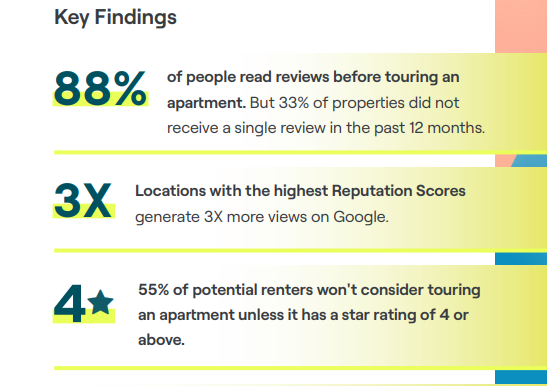
Reviews are gold but must be current. 88 percent of people read reviews before touring an apartment, but 33 percent of properties did not receive a single review in the past 12 months. Property managers need to protect their reputations by asking for reviews, so public feedback remains up to date.
Review volume is up, but sentiment is down. Quality and speed of customer service drive positive sentiment, while the responsiveness of the rental office, quality of the residence, and surcharges drive negative sentiment.
Renters demand four stars or more. Property managers must use sentiment feedback to make improvements, as 55 percent of potential renters will not consider touring an apartment unless it has a rating of 4 stars or higher. The average star rating is between 3.8 and 4.1 stars, so there is some room for improvement in the industry.
A strong reputation pays off. Locations with the highest Reputation Scores generate three times more views on Google. Additionally, a 100-point increase in Reputation Score adds $150,000 (for 500 units managed) to $3 million (for 10,000 units managed) to your top line annually.
“Data from our property management report shows that now is the time for leaders in the multi-family housing business to solidify their customer experience and carefully communicate major changes to renters. Property managers must invest in closing the customer loop with reviews – this means proactively eliciting feedback, learning from it, and implementing changes that will improve renters’ experiences over time,” said Joe Fuca, CEO of Reputation, in a release.
The multifamily outlook is still hopeful as rent increases are starting to slow as rent growth is getting moderated by soaring inflation, Yardi Matrix says in a summer report.
So the outlook is still hopeful for the rest of the year, but shows multifamily may have reached a point where potential change is coming in what has been robust growth, the report says.
The report says the economy “features some strong fundamental metrics that are being overshadowed by inflationary pressures that stem from soaring energy and housing prices, global supply-chain issues, and the hangover from post-COVID-19 monetary expansion.”
However, the report points out that the economic picture “is not bleak for multifamily” as job growth and consumer spending are still strong, and debt service low by historical standards.
“All these economic measures contribute to strong growth in household formation and demand for multifamily,” the report says.
Multifamily outlook still hopeful some highlights of the report:
Growth will decelerate in the second half, but the question is by how much, as persistently high inflation threatens to roil the economy.
The Federal Reserve’s bid to reduce demand through rising rates and quantitative easing will cut growth, with the odds of a recession in 2023 or 2024 increasing rapidly in recent weeks.
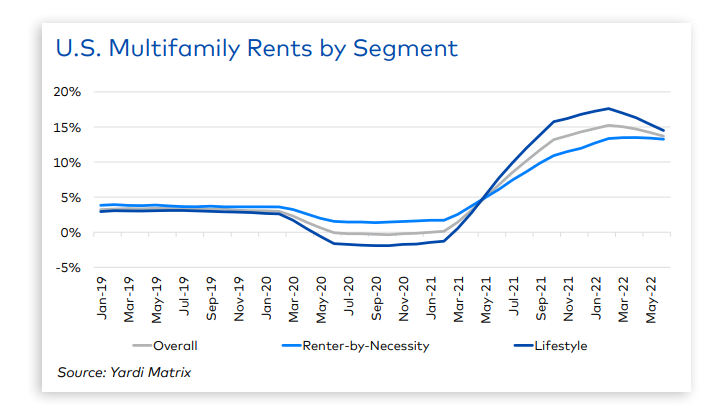
Multifamily rents are decelerating from 2021’s record highs but remained at double-digit percentage growth levels through mid-year. “We expect average asking rents to increase by 7.9 percent by year-end.”
Lenders are becoming more conservative, focusing on cash flow rather than income growth. Many investors and lenders are taking a step back to digest where the market is headed before they resume activity.
Chart courtesy of Yardi Matrix
Rent Growth Will Moderate Later In 2022
“Coming off record-high rent growth of 14.7 percent in 2021, deceleration in multifamily rents in 2022 was inevitable, but the question was how much?
“Rent growth has started to come down, but slowly as the conditions that produced strong gains have persisted. Average national asking rents increased 5.7 percent in the first six months of the year. Year-over-year rent growth at the year’s midpoint was 13.7 percent, down 100 basis points from the end of 2021 and 150 basis points from the February peak of 15.2 percent.
“While growth is moderating, we expect gains will continue to remain well above trend, with average asking rents increasing by 7.9 percent nationally by the end of 2022,” the Yardi Matrix report says.
Yardi Matrix researches and reports on multifamily, office and self-storage properties across the United States, serving the needs of a variety of industry professionals. Yardi Matrix Multifamily provides accurate data on 18+ million units, covering more than 90 percent of the U.S. population. Contact the company at (480) 663-1149.
A homeowners association that decided to impose restrictions and assistance animal rules on dogs belonging to two homeowners and then retaliating against them after they filed a Fair Housing complaint, has been charged with discrimination by the U.S. Department of Housing and Urban Development (HUD).
The homeowners association published rules saying they preferred residents without support animals and “and impermissibly sought to limit the owners of support animals from enjoying shared community resources,” HUD said in the discrimination charge.
The Spring Creek Homeowners Association, the governing body of approximately 131 residential housing units in Jackson, Wyoming, was charged with putting in place discriminatory rules “permitting assistance dogs to be walked only outside the Spring Creek property and to relieve themselves on property only in the early morning or late evening.”
HUD said it was a Fair Housing Act violation by denying the dog owners “a reasonable accommodation to keep their support animals when they conditioned approval on requirements that are beyond what is allowable under the Act including imposing conditions on where, when, and how (the dog owners) could take their support animals in the community.”
The letter stated the dog regulations and rules that residents must submit a veterinarian statement that the dog has been vaccinated and that the owner assumes liability for the dogs. It then added, “If you declare that your dog is an emotional support animal you also need to submit a letter or certificate from a licensed health care professional who has a legitimate ongoing relationship with you stating that you require an emotional support animal. See airline documentation requirements from American, Delta and United airlines for the substance required in this documentation, which can be provided in any reasonable format.”
The letter also stated, “Please also remember that many Spring Creek Ranch homeowners do not like to see dogs within Spring Creek Ranch. Please do your part by complying with the aforementioned dog regulations and also by walking your dog off the butte at the many wonderful dog-friendly locations around Teton County. … Letting your dog out briefly to relieve itself in the immediate vicinity of your residence during the early morning and late evening are reasonable exceptions to this, but otherwise please minimize the presence of your dog within Spring Creek Ranch.”
After the home owners with assistance animals challenged the rules, the HOA “sent a letter to all residents in the community admonishing the homeowners for attempting to circumvent the HOA’s arbitration provisions and publicly questioning the homeowners’ need for their assistance dogs.”
“The letter also described the dog owners’ support animals as ‘two large dogs which they contend are emotional support animals’ even though HOA had approved the support animal accommodation request many months before the letter was sent and the dogs’ support animal status was no longer in question.”
The HUD action “should remind housing providers, including HOAs, that they must make exceptions to restrictive pet rules for individuals with disabilities in need of assistance animals,” HUD General Counsel Damon Smith said in a release.
“HUD will continue to enforce the Fair Housing Act to ensure that individuals with disabilities have equal access to housing and are not subjected to retaliation for exercising their fair housing rights.”
7 ways to deal with uncooperative tenants so you can act quickly, stay within legal limits and document your interactions with problem tenants.
By Justin Becker
When you’re a landlord or property manager, there are a lot of problems to deal with on a daily basis. There are regular things like maintenance issues, of course. But the most challenging problems of all are related to difficult or uncooperative tenants.
What kind of problems can uncooperative tenants give to property managers or landlords?
Dealing with people is a notoriously difficult business in itself. In other sectors, people working as cashiers or wait staff frequently complain about having to deal with uncooperative customers. They get blamed for the smallest things, even when a solution isn’t in their hands. Other folks might swear that they will never work retail again, just to avoid the constant mental struggle of handling dissatisfied, troublesome people.
Ask the other landlords in your social circle, and you may realize that property management is somewhat similar. However, the upside here is that you might actually be on the side with more power! Tenants are in a rental property, which you either own or manage. While it’s important to stick to the rental agreement when possible, also remember that no tenant really wants an eviction notice.
When to take action against a bad tenant?
If you’re fairly new to the landlord or property management game, you may not recognize the signs of an uncooperative tenant right away. While it’s fine to give some leeway if a trusted tenant is having cash flow problems, you have to draw the line somewhere.
For starters, be on the lookout for the following red flags (especially if they’re consistent and frequent):
Unnecessary maintenance requests that are not mentioned in the lease agreement
Lease violations such as keeping pets, smoking indoors, etc
Late payments
Late fees (for services or pets)
Signs of illegal activities
Unpaid rent or only partial payments
Property damage outside normal wear and tear
Disrespect or damage to another tenant’s belongings
Refusal to move out in case of a foreclosure
Granted, not all of the above issues mean that you have to send a vacate notice to the uncooperative tenants. An uncooperative tenant might only be having a rough time or not know enough about sticking to a strict payment plan. As a landlord or manager, you need to decide between going to small claims court, retaining the security deposit, or starting the eviction process.
If the trouble is more related to a complaint from one occupant toward another, there’s one more decision to make. You may let the tenants resolve disputes on their own if they’re not too serious, or get involved in the tenants’ problems yourself.
7 Ways to Deal with Uncooperative Tenants
Whether you’ve taken over the property from previous landlords or are interviewing prospective tenants at present, it’s essential to do your homework beforehand. Without further ado, let’s have a look at the most common problems and the best possible solutions to problem tenants:
What to Do Beforehand
The best way to handle bad tenants is to stay prepared at all times. Once a problem arises, you need to have a clear plan of action already in place. A late or missed rent payment is among the most common issues; you don’t want to lose out on your income while the tenant remains in a rental property they haven’t paid for. Even if you have a brand new tenant for that 950 sq. ft. two-bedroom apartment, your research on dealing with problem tenants starts now (if not sooner).
1. Do your research
Bad tenants can come in all shapes and forms. Perhaps they missed out on the rent for a few months. They might have shady visitors coming in at all hours of the day and night. Other tenants may frequently complain of their neighbors playing loud music or letting things rot and stink in their apartment.
Act quickly and effectively
When you are informed about the situation, try to manage the issues as effectively and quickly as possible. It’s not enough to simply clear away the trash that a tenant has left out for a day; you have to go in and confront them about it. Start off with being polite; offer flexible payment plans if viable, and see if that will do the trick. Take legal counsel if you have to and see what the safest plan should be before sending a rent notice or jump-starting the eviction process.
Understand your rights
Every state and country may have different rights and roles for the landlord. Make sure you understand these, along with the rights of your tenants, steps for legal eviction, etc.
2. Stay within the legal limits
Signing a lease agreement means that the tenant legally has to abide by the rules, policies, and regulations of the rental unit. Ensure that all of these are stated within the documents. Get a copy (electronic or physical, whatever suits them) for the tenants as well.
3. Double-check the lease agreement before signing
Ensure that the agreement’s details include what you allow and don’t allow tenants to do on the property. The amount of rent, when you will collect rent, security deposit, pets, maintenance, guests, additional occupants, and other items should also get a mention. The landlord and tenant responsibilities should be clear-cut and easy to understand.
4. Keep records
As a property owner or manager, you need to protect yourself at all costs. Documenting and keeping a record of the important things can really help you out in a tight spot:
Document interactions
Even if the rent payments are regular and there’s nothing to hold against a tenant yet, you should have documentation of all your interactions with them. Unless you’re good friends with your tenant, your text conversations will probably be short. Don’t delete these; or at least have a backup if you do. Make sure your tenant legally can’t touch you by claiming or denying certain elements of your interactions.
Document the policies, procedures and agreements
When there’s a tenant complaint or some other issue, always document the procedures that take place afterward. Include the communication forms, response times, warnings, rental history, notices served, and so on. If applicable, make incident reports and escalate the issue when necessary. There’s now software for customer-relations management that can help you with proper documentation for late rent payments, all sorts of emails, notices, warnings, and even text messages.
5. Train yourself and your staff
Many times, all you need is careful, respectful communication. Whether you’re in charge of only two tenants or a whole apartment complex, know the difference between a legal and a non-legal problem. If it’s the latter, you or your staff should first engage the tenant in a direct discussion and let them know the consequences of non-compliance.
For instance, phrase the discussion as saying “rent is due on X day/week; if you don’t pay rent by then, you’ll get an eviction notice/penalty.”
Give some leeway
If the credit and rental history of a particular tenant is good, a bit of conflict resolution might be all you need. It could be that the tenant simply doesn’t have enough to pay rent this month. If you trust them enough (limit emotional or personal feelings, though), talk about a partial payment instead. However, they shouldn’t withhold rent for more than three or four months.
6. Have a screening process in place
All sorts of people might apply for a rental space, so an extensive screening process is a must. This will help you weed out the people who might create problems and disputes down the road. However, even the best tenant might encounter problematic situations, changes in finances, or unexpected emotional states that were not present during the interview.
7. Know about termination notices
Before issuing a notice or warning, see if you know what it entails. Take a look at the local laws, especially if you’re thinking about eviction. You need to serve the right kind of notice that deals with the issues instead of exacerbating them. Start with these three most common notices:
Nonpayment of rent: Issue this when the tenant doesn’t pay rent at the required time; it notifies them to either pay up or vacate the place.
Cure or quit: Use this when your tenant is in violation of the lease; it gives them some time to either pack up or rectify the problem.
Unconditional quit or vacate: Issue this when the tenant is causing dangerous or severe problems, or constantly repeating a lesser problem; this notice will categorically state that the tenant has to leave.
Every notice needs to have certain elements to stay valid. The rules might differ according to where you are, so consult the local laws and legal professionals before issuing anything.
Responding to Common Uncooperative Tenant Problems
After covering how to prepare yourself for problematic uncooperative tenants, it’s now time to check out the most common issues that you may face. No amount of screening can give you an absolutely perfect tenant. So, it’s best to know what to do when the following issues come up:
1. Late payments and non-payments
The most basic responsibility of any tenant is to pay rent when it’s due. Failing to do this will adversely affect your income or that of your direct employers.
What to do?
First of all, the rental policy should outline the guidelines surrounding rent: the amount, when it’s due, late payments, fines, and so on. In case of any payment issues, act quickly and make sure the tenant knows of the repercussions. For complete failure of payment, a nonpayment-of-rent notice is the most common choice.
2. Noise, disruption and uncooperative tenants
Are your tenants regularly fighting each other, playing music too loudly, or just generally being disruptive? They might think it’s not an issue. But they’re actually taking away from the quiet, more muted enjoyment of their neighbors. Everyone has the right to be at peace where they live, and too much noise is simply not acceptable.
Look into soundproofing the units. This could eliminate a lot of the complaints and also increase the value of your property.
Your tenant’s lease should have a clause that states such a right, though the wording might be a little different. Quiet enjoyment also includes no sexual harassment, intimidation, disturbing people, or racial slurs.
What to do?
If you get noise or disruption complaints from your other tenants, document these for future evidence. Give fair warning to the offending person, and document that as well. If they don’t stop, remind them of the lease terms. After that, it’s time for a cure-or-quit notice through email or regular mail.
Another way around
If you’re considering renovated one-bedroom apartments, do look into soundproofing the units. This could eliminate a lot of the complaints and also increase the value of your property. It will also make the current tenants happier, which might make them less disruptive!
3. Destruction of Property
Many tenants might not care about damaging rental property. In their mind, it isn’t theirs and hence not their responsibility. However, you have the right to demand the repair of damages if they’re beyond what is considered normal wear and tear. Again, keep a record of the first request and preferably have it in writing.
What if the tenant can’t repair the damages?
If the tenant has caused damages that are too expensive or difficult for them to correct themselves, you’ll have to take action. After all, damage to the property adversely affects the property owners most of all.
In the case of a huge hole in the structure or some plumbing issue, it’s wise to call in a professional. You can then send the bill to the tenant, let them pay it off in installments, or suggest deducting the cost from the security deposit.
If the tenant isn’t open to any of this, issue a cure-or-quit notice. The next notice will be to vacate the place. To be on the safe side regarding such disputes, make sure the lease explains all responsibilities in case of damage to the property.
Finally, if the tenant has a record of causing damage, make sure you conduct routine inspections of their unit. This will hopefully keep them on their toes and they’ll be wary of damaging anything in the future.
4. Illegal or questionable activities
Sometimes, tenants might be really shady people who want to use the property for illegal activities. If you strongly suspect anything like drug abuse, selling of illegal drugs, money laundering, or some other serious problem, call the police first. A call to the local narcotics division will let you find out about any reports that are connected with the rental property.
What to do?
If the neighbors call with suspicion of illegal dealings, request them to deliver a letter or send an email detailing their observations. Also, ask them to send a copy of the same letter to the local narcotics department. This will help to document evidence. Finally, assure any witness that their details will not be disclosed to anyone, and people dealing in drugs can be quite dangerous.
Consider a cash-for-keys offer for uncooperative tenant
Evicting tenants for illegal activities might serve further problems. So, you may have to play it safe here. If you fear that the tenants might threaten someone or cause damage to the property before leaving, think about a cash-for-keys offer. This means that you offer them money in exchange for vacating the apartment before their lease is up. While you’ll have to part with some cash, it’s a small price to pay for everyone’s security and safety.
5. Consistent complaints and disputes
At times, problem tenants may not be up to anything sinister or damaging. However, they can be the most annoying of all by always coming up with maintenance disputes, complaints, and other hindrances to your routine. It would be fine if these complaints had some grounds, but they’re usually too many in number to take seriously.
For instance, a certain tenant may complain that they don’t like the color of a certain room and demand repainting even if the paint is still new. They might also demand repairs for minor things that lie outside your liability coverage. The complaints and requests could flood your inbox and voicemail. If they accost you in person, these uncooperative tenants can make your daily life a burden.
What to do?
The first step is to treat everyone with respect, regardless of how pesky they are. Document each request; if there’s just too much communication, sit those tenants down and have a serious conversation. If they’re making unreasonable demands, remind them about the lease terms.
In case things are just getting out of control, wait until the lease is up. You may then refuse to renew the lease or make the conditions so strict that they might prefer to leave.
The Takeaway On Uncooperative Tenants
The current landlord and property owners in the market certainly have their work cut out. While they do get monetary compensation for their pains, the mental and emotional burden can take a physical toll.
Keep in mind that every landlord and property manager will come across bad tenants and problem uncooperative tenants at some point in their lives. The tips above might help you prevent future squabbles between many tenants, property management, and even family members. Stay professional, communicate clearly, and be ready to take firm action if a tenant fails to comply after repeated warnings. When in doubt, a legal professional team can come to your rescue.
About the author:
Justin Becker is a property owner in the state of Michigan and has a passion for managing communities. He owns apartment complexes and mobile home communities, and has been writing his own blogs for his properties for several years.
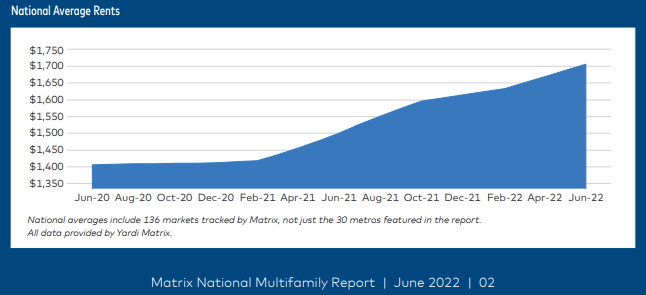
Multifamily performance continued strong as U.S. asking rents rose $19 for the month of June to an all-time high of $1,706, according to the Yardi Matrix June Multifamily Report.
“Robust household formation is driving demand, as people who lived with family or friends during the pandemic have formed independent households.
“However, absorption is slowing, presaging a second-half deceleration,” the Yardi Matrix report says.
Some highlights of the report:
Multifamily performance remained strong in June despite economic deceleration in some other markets. Year-over-year growth decelerated by 50 basis points to 13.7 percent. That’s 130 basis points off the February peak of 15.2 percent, but still exceptional performance.
Demand and rent growth remained strong throughout the country. Rent growth increased at least 10 percent year-over-year in 25 of Yardi’s top 30 metros. National occupancy rates were 96 percent.
The single-family sector continues to grow on par with multifamily as homeownership becomes out of reach for more households. The average single-family asking rent increased by $23 in June to an all-time high of $2,071, as year-over-year growth dropped by 90 basis points to 11.8 percent.
Chart courtesy of Yardi Matrix
A strong labor market will continue to allow rents to rise, but at a slower rate as the economy begins to cool down, the report says.
“Inflation and increasing interest rates have started to cool down the for-sale market, keeping more households in multifamily and single-family rental markets. However, inflation rates will take a while to ebb, causing consumers to cut into savings as their ability to afford increasing rental rates lessens,” Yardi Matrix says.
Occupancy Rates Point to Shift in Migration Patterns
Demand is continuing to cool in Sun Belt and Western metros, which could presage a deceleration in rent growth in coming months.
Occupancy rates year-over-year decreased in 11 metros in May, led by Las Vegas (-1.6 percentage points), Phoenix (-1.1) and Sacramento (-1.0), a likely sign that in-migration is weakening.
U.S. households have grown increasingly less mobile in recent decades, a trend that continued post-pandemic, per the Census Bureau.
Yardi Matrix says, “Freddie Mac noted in a recent paper that after years of outsize population growth, metros such as Denver, Nashville and Austin have begun to lose residents as housing costs soar. Notes Freddie: ‘The pandemic amplified existing urban de-concentration by threefold from large, expensive metro areas to smaller, more affordable destinations. Data also shows that in fast-growing metro areas, the continued shortage of housing and high house-price-to-income ratios eventually lead to increased out-migration as homebuyers seek more affordable destinations.’ ”
Yardi Matrix researches and reports on multifamily, office and self-storage properties across the United States, serving the needs of a variety of industry professionals. Yardi Matrix Multifamily provides accurate data on 18+ million units, covering more than 90 percent of the U.S. population. Contact the company at (480) 663-1149.
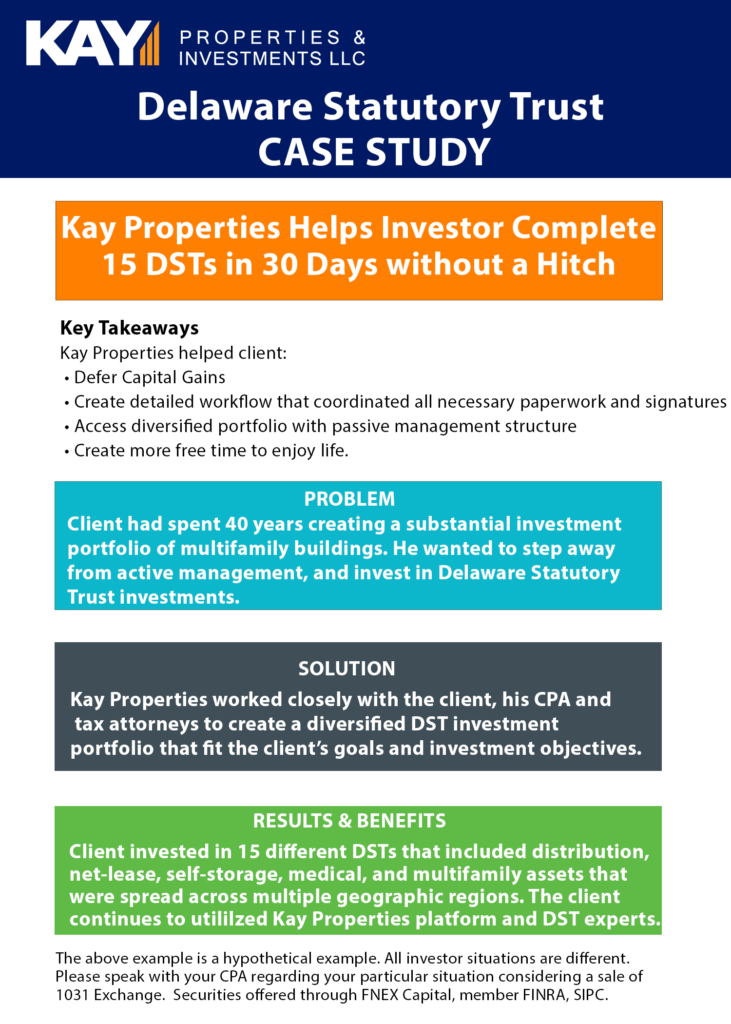
High net-worth investor decides to relinquish a portion of his rental property portfolio in a succession of sales before entering into multiple DST 1031 exchanges to help achieve diversification, non-active management, and potential monthly income.
Key Takeaways:
Kay Properties registered representatives spent more than one year educating the client on DST investments.
Kay Properties worked closely with client’s CPA and real estate attorneys to create a custom investment strategy that fit perfectly with the client’s specific goals.
Kay Properties created a workflow plan that achieved the closing of 15 DST investments in 30 days without a hitch.
Background:
A high-net worth accredited investor spent more than 40 years building a substantial rental property portfolio of nearly 20 different multifamily buildings. In addition, he managed all the property management challenges himself.
When he decided it was time to start selling some of his real estate holdings, he approached Kay Properties because he wanted to learn more about how he could deploy the Delaware Statutory Trusts for future 1031 Exchanges. For more than a year, Kay Properties worked closely with the investor, utilized the firm’s robust educational platform to help the client fully understand the potential benefits and risks of DSTs. He eventually sold one of his properties and reinvested the proceeds into a DST.
Because he was so pleased with the results of the initial DST investment, he decided to liquidate multiple assets within his portfolio in successive sales and reinvest in multiple DSTs.He once again came to Kay Properties to help coordinate the 1031 exchanges and DST investment strategies.
To learn more about the Kay Properties DST offering, please visit kayrhj.com or call 855-875-2781.
Challenge:
The initial challenge was creating an extensive, multi-year, customized educational program that included lots of reading material, one-on-one consultations, and a custom menu of diversified DST investment options that fit his goals and investment objectives. However, the next challenge was how to coordinate 15 different sales and DST investments within a short period of time.
Solution:
Together with his CPA and real estate attorneys, Kay Properties representatives to create a very detailed plan that included anticipated closing times on the relinquished properties, timelines for finding and vetting replacement properties that fit within the investors very specific parameters and creating a custom workflow that coordinated all the necessary paperwork and signatures so that everything was organized, and every closing went smoothly.
Results:
The client ultimately invested in 15 different DST investments that included distribution facilities, net-lease properties, self-storage, medical, and multi-family assets that were spread across multiple geographic regions. The client continues to utilize Kay Properties best-in-class kayrhj.com and customized advice by DST experts with more than 150 years of combined experience.
Ask Bill Exeter
Ask Bill Exeter and his team your questions about 1031 exchanges and he and his team will get back to you.
About Kay Properties
Kay Properties is a national Delaware Statutory Trust (DST) investment firm. The Kay Properties platform provides access to the marketplace of DSTs from over 25 different sponsor companies, custom DSTs only available to Kay clients, independent advice on DST sponsor companies, full due diligence and vetting on each DST (typically 20-40 DSTs) and a DST secondary market. Kay Properties team members collectively have over 150 years of real estate experience, are licensed in all 50 states, and have participated in over $30 Billion of DST 1031 investments.
This material does not constitute an offer to sell nor a solicitation of an offer to buy any security. Such offers can be made only by the confidential Private Placement Memorandum (the “Memorandum”). Please read the entire Memorandum paying special attention to the risk section prior investing. IRC Section 1031, IRC Section 1033 and IRC Section 721 are complex tax codes therefore you should consult your tax or legal professional for details regarding your situation. There are material risks associated with investing in real estate securities including illiquidity, vacancies, general market conditions and competition, lack of operating history, interest rate risks, general risks of owning/operating commercial and multifamily properties, financing risks, potential adverse tax consequences, general economic risks, development risks and long hold periods. There is a risk of loss of the entire investment principal. Past performance is not a guarantee of future results. Potential cash flow, potential returns and potential appreciation are not guaranteed.
Nothing contained on this website constitutes tax, legal, insurance or investment advice, nor does it constitute a solicitation or an offer to buy or sell any security or other financial instrument. Securities offered through FNEX Capital, member FINRA, SIPC.
Can you ever have too much fair housing training as state and local laws are constantly changing and you need to know the rules based on where your rental property is located.
Fair Housing is complicated and ever-changing. Combined with state and municipal laws that can vary greatly, proper training becomes even more critical. But what does that training look like? Should it encompass more than federal laws, and how often should training occur?
Fair Housing – Know Your Local Laws
More is needed than a basic knowledge of the protected classes. This is because state and municipal laws can change how fair housing compliance is interpreted. Not knowing the laws specific to your area can leave you open to a fair housing complaint.
For example, in Austin, Texas, students are considered a protected category. Meanwhile, in New York City, reasonable modifications are covered at the expense of the property regardless if they are private-market or not. Another example would be when it comes to source of income. Some states view this as a protected category, while others do not.
As a result, fair housing training needs to include an understanding of all laws specific to where your property is located. These are just a few examples. The list goes on.
How Often Should Fair Housing Training Happen?
As highlighted above, fair housing can be challenging and can cover a considerable range of topics and sub-topics. It stands to reason that a one-and-done approach to training will never be adequate. In addition, laws are continually changing, as is their application.
Currently, the industry average for training is every two years. That being said, more and more companies are gravitating to annual training as better practice. Annual training provides staff the opportunity to brush up on skills as well as become familiar with any changes that they need to be aware of.
By having access to regular training, companies are giving their staff the best possible chance to remain fair housing compliant and therefore reduce the risk of a complaint or violation.
Choosing the Right Fair Housing Training for Your Company
Training can and should take many different shapes and sizes. People learn differently, so employing various learning methods will ensure that everyone has access to the information they need.
Thanks to Covid, we have seen an increase in online training offerings. A few things to keep in mind if you choose the online route are: when the course was last updated, what it covers, and whether it provides a way to gauge how your staff is doing. Try to find industry-accredited training programs that include both tests and certifications. Online learning is an excellent way for staff to learn at their own pace and when it’s convenient for them, and it can be easily added to your training suite.
Another great way to help your staff is training via role play. Have you had a recent situation come up that staff was unsure of how to handle? Why not turn it into a teaching/learning experience? Recreate the problem with the team and discuss possible solutions and outcomes. This type of diverse training will reach every style of learner.
And happily, we can also now return to in-person training! Look again for industry-accredited instructors and enjoy the one-on-one training and the opportunity to network.
Fair housing training doesn’t need to be complicated, but it does need to be thorough and regular. You can avoid time-consuming and costly mistakes and create a positive work environment by ensuring that all your staff has access to up-to-date, reliable training in multiple formats.
About the author:
In 2005, The Fair Housing Institute was founded as a company with one goal: to provide educational and entertaining fair-housing compliance training at an affordable price at the click of a button.
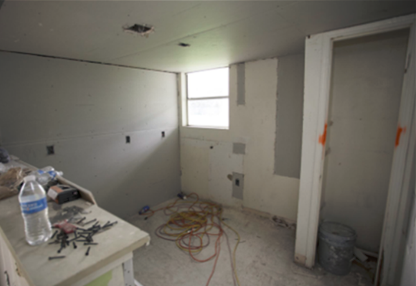
Does a landlord have to provide housing during rental renovation is the question this week for Ask Landlord Hank. Remember Hank is not an attorney and is not offering legal advice. If you have a question for him please fill out his form below.
Dear Landlord Hank:
When a landlord is installing a shower where a bathtub has been for 50 years, and says it will take two weeks to replace, does the landlord have to provide housing/motel/etc. during the renovation time?
Is the tenant still responsible for rent for that full month?
-Roger
Dear Landlord Roger,
I don’t have all the information here but if the rental unit only has one bathroom and that bathroom is not usable during repairs or rental renovation, then you as the landlord would be responsible for your tenants’ housing since your project is making the property uninhabitable.
If the tub removal can wait until the tenants’ lease is over, then that would be the best option.
If there is more than one bathroom, you may want to give the tenants a rent concession since a part of the property is not available.
Also, if you are using your tenants’ electricity for your renovation, you may want to work out something with them in advance for this, too.
Sincerely,
Hank Rossi
Each week I answer questions from landlords and property managers across the country in my “Dear Landlord Hank” blog in the digital magazine Rental Housing Journal. https://rentalhousingjournal.com/asklandlordhank/
Landlord Hank working on one of his rentals. Hank says instead of having to provide housing during rental renovation if the tub removal can wait until the tenants’ lease is over, then that would be the best option.
Ask Landlord Hank Your Question
Ask veteran landlord and property manager Hank Rossi your questions from tenant screening to leases to pets and more! He provides answers each week to landlords.
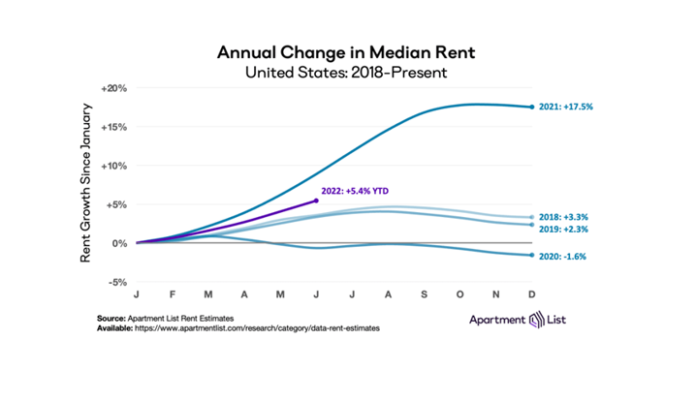
Apartment List says their national index rose by 1.3 percent over the course of June, “consistent with last month’s increase” but so far in 2022 “rents are growing more slowly than they did in 2021, but rents continue climbing faster than they did in the years immediately preceding the pandemic.”
In the June report, Apartment List says over the course of 2021 the median rent increase of 17.5 percent “is a key contributor to overall inflation, which is currently rising at its fastest pace in 40 years.1
“With inflation top-of-mind for policymakers and everyday Americans alike, our rent index is particularly relevant, since movements in market rents lead movements in average rents paid. As a result, these rent dynamics signal what is likely ahead for the housing component of the official inflation estimates produced by the Bureau of Labor Statistics. Thankfully for the country’s renters, our index shows that rent growth in 2022 has cooled from last summer’s peaks. At the same time, however, rents are continuing to rise faster than they did in pre-pandemic years.”
Apartment List reports in the first six months of 2022, their national rent index has increased by 5.4 percent, well below last year’s 8.8 percent increase over the same months.
“However, this year’s pace is also still notably faster than that of the years prior to 2021. For comparison, rent growth from January to June totaled 3.1 percent in 2017, 3.6 percent in 2018, 3.4 percent in 2019, and -0.7 percent in 2020. The trend of rent growth is pacing well behind last summer’s scorching pace, but ahead of the pre-pandemic norm.”
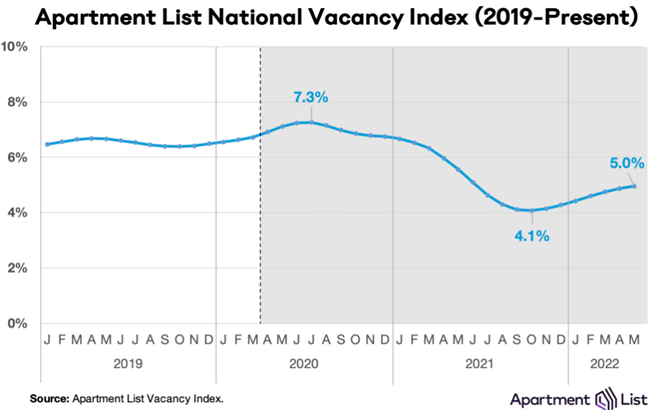
Vacancy rate easing appears to be leveling off
The vacancy index spiked above 7 percent in the early months of the pandemic in 2020, as many Americans moved in with family or friends amid the uncertainty and economic disruption of the pandemic’s onset. After that, however, vacancies began a steady decline, eventually falling to a low of 4.1 percent.
Since October of last year, however, “our vacancy index has been on a trend of gradual easing. This month however, our index remained flat at 5 percent, after seven consecutive months of increases.
“It’s likely that spiking mortgage rates are beginning to sideline potential first-time homebuyers from the for-sale market, keeping these households in rental units for longer. And although we’re now in the midst of the busy season for the rental market, when the bulk of moving activity normally takes place, rapidly rising rents may be incentivizing many renters to stay put and renew existing leases rather than looking for new ones.
“These factors could be contributing to the flattening of our vacancy index at a level that is still far below the pre-pandemic norm,” the report says.
Conclusion
“With a 1.3 percent increase in May, rent growth is continuing to pace ahead of pre-pandemic trends, even as it cools substantially from last summer’s peak. While the apartment market has shown some signs of easing, our 5 percent vacancy index remains well below the pre-pandemic norm, and increased pressure in the for-sale market could translate to the rental market as well.
“The summer months are likely to bring continued rent growth through the rental market’s busy season. Despite a recent cool-down, many American renters are likely to remain burdened throughout 2022 by historically high housing costs,” Apartment List says in the report.
Here are 5 keys to attracting and retaining qualified team members during high-turnover season in the rental property business.
By Kurtis Strauel
Mark-Taylor Residential
The multifamily housing community is growing at an incredible rate, creating new opportunities for career-seekers. Due to nationwide staffing challenges, it is vital for organizations to strategically attract and retain highly qualified individuals who share a passion for people. Not only is this a valuable practice year-round but it proves to be especially necessary during high-turnover seasons such as summer.
Mark-Taylor uses the following main approaches, driven by our people-first human resources team, to build, cultivate, and grow teams that thrive:
No. 1 – Build a strong workforce from the inside out
When you have a new position to fill, make sure you consider your internal talent. Tenured experience is incredibly useful as existing team members climb the ladder within the organization, mutually benefiting both the individual and the company. Motivation and positive sentiment are contagious; career development creates a sense of belonging for the individual, encourages others who are seeking similar opportunities, and contributes to a thriving culture.
No. 2 – Diversify attraction through special programming
When you seek new team members externally, attracting a diverse pool of talent requires forethought and creativity. Professionals in the multifamily industry come from all walks of life, backgrounds and experiences. Extending a hand to diverse candidates through special programming, such as internship programs and partnerships with local schools and organizations, can add exceptional personalities and skill sets to your teams.
No. 3 – Stay competitive
Attraction and retention are directly connected to what you can offer team members; honorable offerings communicate the value of their roles and responsibilities within your organization. Competitive pay, comprehensive benefits, exclusive perks, and promotional opportunities are necessary to ensure team members are getting out what they put in.
No. 4 – Spark pride and foster connection
What causes turnover? The answer is often simple: The individual does not feel tied to the organization. Therefore, when challenges arise, they may seek seemingly greener pastures. Providing team members, existing or future, with a connection to the organization’s mission and its community, as well as a true understanding of their impact, is imperative.
When team members feel that there is value and purpose in their work with residents, clients, partners, and leadership, work becomes a home away from home for them.
No. 5 – There is no such thing as too much communication
Team members want to join and stay at a company where their personal and professional needs will be regularly heard and supported. Establishing an open communication system throughout the entirety of the employment journey is important, from application and onboarding to consistent checkpoints in their career, and even to departure.
Two-way communication with team members ensures that they acquire the support they need and are aware of the resources available to them. The more you listen and prove you care, the more they care.
There are limitless ways to attract and retain highly qualified team members in the rental property business – not all approaches are one size fits all. The overarching theme in our recommendations is to stay people-focused. If you want to attract and retain talented people, you must prioritize their wellbeing, wants and needs.
About the Author:
Kurtis Strauel
Kurtis Strauel is the director of human resources at Mark-Taylor Residential. His passion is people – he has nearly three decades of financial and HR leadership experience spanning various industries. Since joining Mark-Taylor, he has been instrumental in providing strategic direction to elevate accessible support, as well as opportunities that have an impact, for valued corporate and onsite team members.