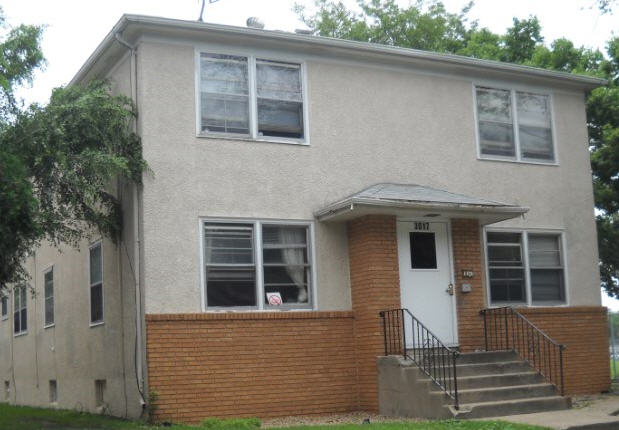
How do you handle potential tenants who lie about jobs and income is the question this week for Ask Landlord Hank. Remember Hank is not an attorney and is not offering legal advice. If you have a question for him please fill out his form below.
Dear Landlord Hank,
I’m having a tremendous time getting qualified tenants at the moment. Many applications from people with bad criminal backgrounds.
I have had multiple people lie about names/jobs/income. I recently called someone on the fact they had just been evicted, they had given me false information on last address and landlord. I found the truth and called them on it, they did admit that I was correct but the next day someone tagged the property with graffiti! I’m sure it was them.
Should I not be honest with applicants? It’s a scary world. How do you handle people/tenants who are bad news? Thanks.
-Paul
Hi Paul,
Sorry you are having such a hard time finding a qualified tenant for your place.
I’ve been where you are many times in the past, having to reject multiple candidates who know they wouldn’t pass normal rental screening. On properties like this I ask tenants up front the info I want to know.
You could say you are managing the property for the owner and that the owner requires a credit score of 650 or better, good rental history, clean background and must gross at least three times the rent, plus anything else that is important to you.
That way the candidates won’t waste an application fee only to be denied. I’d also consider putting up a temporary security camera at your place with video recording so you can protect your place.
Good luck!
Sincerely, Hank Rossi
Each week I answer questions from landlords and property managers across the country in my “Dear Landlord Hank” blog in the digital magazine Rental Housing Journal.https://rentalhousingjournal.com/asklandlordhank/
Landlord Hank working himself in one of his rentals. “I’ve been where you are many times in the past, having to reject multiple candidates who know they wouldn’t pass normal rental screening.”
Ask Landlord Hank Your Question
Ask veteran landlord and property manager Hank Rossi your questions from tenant screening to leases to pets and more! He provides answers each week to landlords.
Here are 6 winter maintenance best practices to be pro active and keep your rental property residents informed of actions they should take before they call.
Strategic planning makes all the difference when successfully managing a multifamily community throughout the seasons. Waiting until changes in weather hit could leave you in a bind. As winter approaches, implement a plan to help your team continue to provide an exceptional living experience.
Is your multifamily community ready for winter? Here are some best practices to better prepare for the change in seasons.
1. Be Proactive and Prepared
Year after year, we know changes in seasons will present the same challenges at multifamily communities. Set your teams up for success by reviewing protocol and pre-ordering supplies you may need for anticipated maintenance requests, such as heating-system repairs.
When in doubt this winter, be proactive and err on the side of caution. Prepare your teams and help residents enjoy a warm and cozy winter in their homes.
2. Check your Systems Year-Round
During the warmer months, all systems should not only be checked but turned on during routine inspections. If equipment is not in use during a specific time of year, it is still crucial to check that everything is properly functioning. For communities in climates with mild winters, this is even more important because heaters and fireplaces are not used frequently.
When you get comfortable and stop thoroughly performing routine maintenance checks, things can quickly turn into a maintenance emergency. Regular maintenance tune-ups help eliminate unexpected breakdowns and stop problems before they occur. Control the controllable to stay ahead of the game.
3. Keep Residents Informed
Encourage residents to test their HVAC prior to changing seasons, ensuring that it is functioning properly. For a seamless transition from season to season, transparent communication regarding winter preparation is imperative.
Residents need to be informed of any actions they should take to keep themselves safe this winter and receive a list of proper contacts in case of emergency. Over-communicate with them and make sure none of their questions are left unanswered.
4. What should you do when a winter-maintenance emergency occurs?
Unfortunately, unforeseen issues may arise despite a service team’s best efforts. In such instances, make sure the resident is comfortable and work with them to determine a desirable solution if an immediate one is not available. Remain calm but confident – this creates trust and shows that you have the resident’s best interest in mind.
5. Build Relationships with Vendors
Develop relationships with reliable vendors who offer consistent quality and support. The assistance of trusted vendors helps speed up repair processes and ensures issues are fixed the right way, the first time.
Work together to plan ahead with your vendors. Replacement parts are still quite difficult to obtain, especially when needed in a pinch. Stock up on inventory, and secure contracts before you need them.
6. The Importance of Trust
Encourage your residents to report any maintenance issues promptly. Reiterate to them the importance of bringing anything that is seen as being “off” to your team’s attention – the sooner, the better. It may end up being nothing, but chances are, if a resident notices something of concern in their home, it is a problem and needs your attention.
About the author:
Derek Studebaker
Derek Studebaker is a manager of facilities and services at Mark-Taylor. With tenured experience and well-deserved recognition as MFS of the Year and AMA Team of the Year, Derek diligently heads a portfolio of Mark-Taylor communities’ service teams.
2022 brought a lot of changes in the rental property industry and property owners have a chance to use these changes to their advantage in 2023.
By Nino Chicoga
As a landlord, you should be well aware of the pandemic’s changes to the rental real estate industry in 2020. The industry has only grown ever since and the investors have been making a big profit due to rising rent prices.
Although the daily rental properties have not been as successful as they were in the past lately, more and more people are looking to rent real estate for long periods. Therefore, many of the property owners switched their focus from renting daily to renting monthly.
Each year tends to affect the next in both negative and positive ways. 2022 has set the grounds to make your investment successful for the next year. We can explain some of the positive effects that 2022 has on your assets and rentals for 2023.
The Short-Term Rental Industry is Making a Comeback
As mentioned, in recent years because of the great fear that the pandemic brought us, many people were too afraid to book rentals for a night or two. Daily rentals turned out to be a failure for many investors in 2020 and 2021. However, in 2022 we saw a bit of change as the Covid 19 panic slowly died down. Although we are far from completely defeating the virus, people have found hope and we can see some positive results in the medicine.
Traveling just came back in style and people are eager to visit the places they couldn’t for years due to lockdown. It’s the property investors’ time to take the spotlight and make a big profit.
Since traveling is not as big of an issue in 2022 as it was in 2021, we can see more and more people visiting a variety of places. As expected, by 2023 short-term rental properties will have renewed their spot on the market. If you own a rental property that you rent out daily, 2023 might be highly beneficial for you.
In 2022, 80 percent of travelers made plans to visit different regions, and 86% of the travelers said they would stay in rental properties. Such surveys bring hope to investors for next year. We suggest you get your property management company to prepare your commercial real estate for daily and weekly visits.
How to Handle the Positive Change
Furnishing properties and changing policies to make them suitable short-term rentals is going to be costly.
If you can’t decide to switch your rental from a long-term one to a short-term rental you are going to need to consider these factors that impact the renters’ choices.
Location: Is your rental property located in the part of the region that gives the guests the liberty of visiting multiple attractions in a day?
Tenants: Do you have tenants that plan to move out in a short term or do you have the grounds to evict them?
Government regulations: Many states have changed certain laws and regulations in the past few years. Are you up to date with the property law in your area?
Vacancy: How are the vacancy and the profit going to change by switching to short-term rental?
Policies: What are your policies for long-term rental and how are they going to change?
You must also remember that by changing the type of your rental property, you are going to have to publish new advertisements on different platforms. You will need to post your listings on booking websites and change the style of how you present your property online.
By switching to short-term rentals, you will need to consider giving additional services to the guests. When the visitors stay at properties for a short period of time they expect clean towels and help with navigating through the area. If your property is located at a distance from your residence of living you should start thinking about hiring a property manager.
Moreover, you will need to attend to the needs of the guests and oversee their actions daily. Since you will have to host new people every few days, it will be difficult to trust them completely. Therefore, you will need to spend a lot of your time checking up on the visitors.
In conclusion, 2022 has promised us the comeback of the short-term rental industry. As a property investor, you can start receiving guests to your commercial real estate daily again. If it’s your first time renting out properties short-term, you can check some of the pointers we gave you so you can easily navigate this new style of business.
Usually, property owners make much more profit by renting out properties daily, especially if they are located in a tourist zone. Therefore, if you decide to use the advantages that 2022 has given us for 2023, you will not regret switching back to short-term rentals.
About the author:
Nino Chicoga is a content/blog writer at Goodjuju. Before joining the team she had various jobs. She worked as a content writer, a business manager, an HR intern and a logistics assistant. Nino loves to do research on different topics. She enjoys learning about philosophy, psychology, and reading classic literature.
By Dwight Kay, Founder and CEO of Kay Properties & Investments
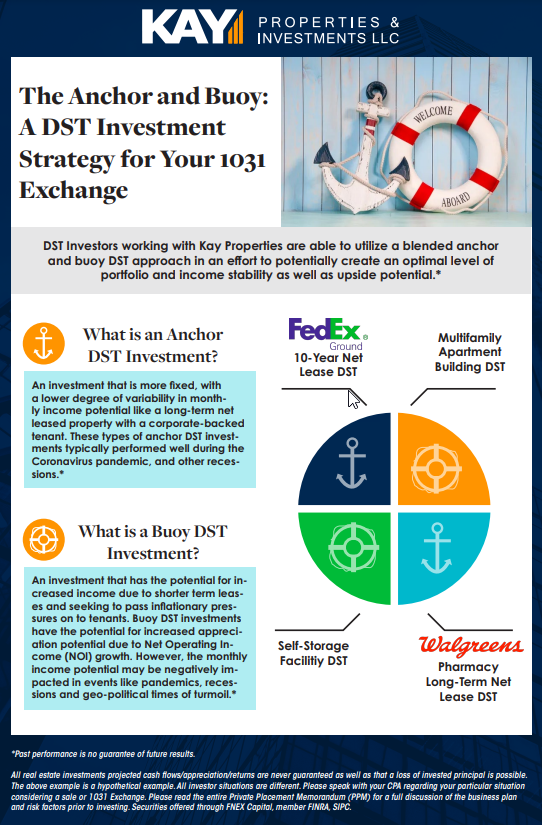
Real estate investors currently considering a Delaware Statutory Trust (DST) investment for a 1031 exchange or even a direct-cash investment, one of the first things to consider is what specific investment strategy should you pursue? For example, is the goal to achieve greater appreciation even if it means investing in an asset that carries greater risk? Or is your long-term strategy to have steady monthly income even if it means lower overall appreciation potential? I like to call this the “Anchor and Buoy” investment theory. One of the beautiful things of Delaware Statutory Trust investments is that they can potentially provide investors both the benefits of the anchor and buoy investment strategies.
How “Buoy” Investments Work for Your Delaware Statutory Trust
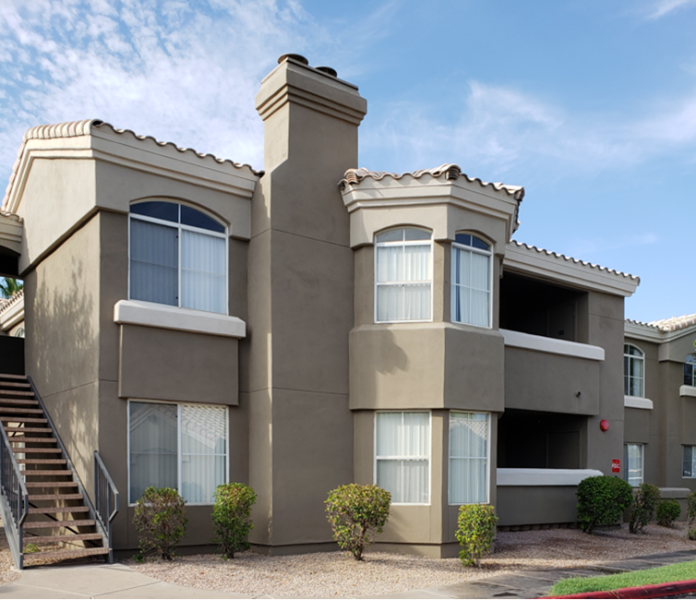
To better understand how to use the anchor and buoy theory to evaluate potential DST investments, consider a multifamily building that has 500 tenants. First, while residential properties use comparable sales or “comps” to approximate valuation, multifamily properties are also valued based on the amount of Net Operating Income (NOI) they produce. NOI is calculated by subtracting a property’s operating expenses from its gross income. Gross income is derived from the sum of all sources of income for the multifamily property. While the vast majority of income comes from rent payments, there could also be ancillary sources of income like covered parking fees, laundry/vending income, pet rent income and even rent for storage unit access. On the flip side, operating expenses are the costs required to run the multifamily property on a day-to-day basis. Although these amounts will vary depending on the type of building, the line items will be typically very similar. These can include things like utilities, taxes, insurance, maintenance, property management, and even legal fees.
In this example, the multifamily building has a diversified tenant base of 500 tenants that are paying rent each month. Additionally, because most multifamily assets use an annual lease, landlords have the opportunity to potentially increase those leases every year. In addition, any vacancies can provide owners the opportunity to potentially raise rents when filling the vacancy. In this way, multifamily properties act like a buoy, moving and adjusting with the conditions.
While all real estate investments have some form of material risks associated with them like interest rate risks, vacancies, general market conditions, and financing risks, many investors like assets like multifamily and self-storage because they have the potential to gain more appreciation over time as they hopefully are able to increase their income generated through rental increases over the years. In addition, multifamily and self-storage are considered good “buoys” to potentially hedge against inflation because owners can hopefully raise the rents each year to help offset rising costs.
Why Multi-Family and Self-Storage are Considered Good Buoy DST Investments
Many investment professionals and accredited investors view self-storage and multifamily markets through the same investment lens. First, both asset classes follow a similar set of metrics to help determine market favorability, including demographic trends and income statistics. Second, both multi-family and self-storage use rent growth and vacancy rates as a way to project future performance. Finally, as mentioned earlier both asset classes are considered to be somewhat recession-defensive, and because operators are able to quickly respond to changing market conditions with rent changes, both property types are also considered to be an inflation hedge option in commercial real estate.
Example of Buoy Multifamily Delaware Statutory Trust Investment
A good example of a buoy DST investment would be Dallas Multifamily 59 DST, a debt-free, unleveraged DST investment currently being offered to accredited investors by Kay Properties.
You can learn more about this Buoy investment by watching this video:
What is an Example of an Anchor Delaware Statutory Trust Investment?
So, if a multifamily building is considered a “Buoy” DST investment, then what is an “Anchor” DST investment? Many investors consider a commercial net lease type of asset as more of an anchor investment for their DST 1031 Exchange investments. First of all, instead of using NOI and market capitalization rates (cap rates) solely as a valuation measurement, most commercial net lease assets are going to additionally tie the valuation of the property with the creditworthiness of the tenant. For example, Joe’s Pizza Shop is not as creditworthy of a tenant as FedEx or Walgreens, both of which are considered investment grade tenants. First of all, Joe’s Pizza Shop can shut down and investors are left with an empty building and the potential for expensive maintenance costs and unpaid rent. While it is possible that FedEx or Walgreens can also shut down a location, the odds are that these multi-billion dollar public companies will continue to pay rent as they have investment grade credit ratings by Standard and Poor’s (S and P).
Why are Long-Term Net Lease Commercial DST Buildings Considered Anchor Investments?
In addition to the creditworthiness of the tenant, anchor investments also use the length of the lease as another important factor to take into account. For example, a FedEx distribution center with a 10-year lease is an inherently valuable asset because there are 10-full years of potential income that has a corporate guarantee on the lease to pay the landlord the predetermined amount each month. However, while this type of asset can act as an anchor over the course of many years, there is typically not an opportunity to raise rents as can be found in multifamily or self-storage facility DST investments.
Example of an Anchor Long-Term Net Lease Delaware Statutory Trust Investment
A good example of a buoy DST investment would be Pharmacy Net Lease 46 DST, a debt-free, unleveraged DST investment currently being offered to accredited investors by Kay Properties.
You can learn more about this Anchor DST investment by watching this video:
How Delaware Statutory Trust Investments Blend Both Anchor/Buoy Philosophies
DST investments provide investors several ways to incorporate both anchor and buoy investment strategies by incorporating diversification into a real estate portfolio. For example, DSTs can create diversification through geography, property type, and investment structure.
● Geography
The beautiful thing about Delaware Statutory Trust investments is they can hold real estate assets in any state across America, helping investors target properties in specific markets where they believe will deliver a desirable combination of ongoing income and potential appreciation. For example, investors might decide to invest in tax-friendly, high-growth states like Texas, Florida, or North Carolina among others.
● Property Type
Delaware Statutory Trusts also allow investors to achieve the potential for greater diversification through property types as well. For example, DSTs can include a wide range of asset types including apartments, distribution centers, medical buildings, and self storage facilities. Essentially any asset that can qualify as a “like kind” 1031 exchange property can potentially be structured as a DST.
● Investment Structure
Another way DSTs help investors incorporate both anchor and buoy investment strategies is through investment structure. A good way to explain this is to recognize that while many DSTs consist of a single property, other DST investments consist of a larger portfolio of similar assets e.g., multiple apartment complexes, self-storage facilities, office buildings, or retail properties. In this way, a DST portfolio can create a “built-in” diversification component that many investors find attractive.
In conclusion, an investor could place their entire exchange proceeds into a multifamily or self-storage DST if they were seeking greater upside potential that the buoy strategy is seeking. The downside is that if the economy were to suffer, if another pandemic or any other myriad of black swan events were to happen that investor could easily see cash flow cut in half or suspended entirely. So in an effort to enhance appreciation potential the investor sacrifices the stability of income that many investors are seeking in today’s volatile environment.
However, many investors these days are achieving the goal of potential appreciation by utilizing the buoy investment strategy of multifamily and self storage DSTs and at the same time blending in the anchor strategy in an effort to gain potential stability of income by utilizing long-term net leased DSTs with tenants such as FedEx and Walgreens. This blended anchor and buoy combination strategy is gaining popularity as investors consider where we are in today’s economic and geopolitical environment.
To see a complete list of anchor and buoy DST properties and other real estate investment options, please visit www.kpi1031.com. About Kay Properties and www.kpi1031.com
Kay Properties is a national Delaware Statutory Trust (DST) investment firm. The www.kpi1031.com platform provides access to the marketplace of DSTs from over 25 different sponsor companies, custom DSTs only available to Kay clients, independent advice on DST sponsor companies, full due diligence and vetting on each DST (typically 20-40 DSTs) and a DST secondary market. Kay Properties team members collectively have over 150 years of real estate experience, are licensed in all 50 states, and have participated in over $30 Billion of DST 1031 investments.
This material does not constitute an offer to sell nor a solicitation of an offer to buy any security. Such offers can be made only by the confidential Private Placement Memorandum (the “Memorandum”). Please read the entire Memorandum paying special attention to the risk section prior investing. IRC Section 1031, IRC Section 1033 and IRC Section 721 are complex tax codes therefore you should consult your tax or legal professional for details regarding your situation. There are material risks associated with investing in real estate securities including illiquidity, vacancies, general market conditions and competition, lack of operating history, interest rate risks, general risks of owning/operating commercial and multifamily properties, financing risks, potential adverse tax consequences, general economic risks, development risks and long hold periods. There is a risk of loss of the entire investment principal. Past performance is not a guarantee of future results. Potential cash flow, potential returns and potential appreciation are not guaranteed.
Nothing contained on this website constitutes tax, legal, insurance or investment advice, nor does it constitute a solicitation or an offer to buy or sell any security or other financial instrument. Securities offered through FNEX Capital, member FINRA.
What can properties learn from e-commerce giants like Amazon? Owners and operators can deliver an exceptional experience for the renter by following principles that have transformed the online shopping landscape. Apartment hunting has three factors of success that are also critical in other types of online shopping: customer service, availability & ease of access, and community engagement.
“Everyone wants the Amazon experience online,” said Max Morales, Director of Marketing at Cornerstone group. In a webinar on how to optimize marketing for a variety of properties, Max shared a fundamental truth about modern living and leasing. “People like simple.” Renters want to easily find and live in their ideal apartment. Much like successful e-commerce businesses, exceptional experiences in leasing require rental property managers to make it easy for renters to find what they’re looking for.
While this is simple in principle, it can be challenging to implement without clear guidelines. We’ll get into each of these and how property technology comes into play.
Reduce friction in the leasing process
“Customer obsession rather than competitor focus,” is one of the four principles guiding Amazon’s mission. And this reveals why many of the company’s most sophisticated tech innovations deliver convenience , personalization, and speed. Properties that champion the renter experience find out where there is friction in the renter journey. They then can use technology to remove the roadblocks and make leasing more effortless.
For rental property managers and teams, the challenge is getting all of the tools they manage to seamlessly work together. Single-point solutions have flooded the market to guide leasing teams through specific steps. But the next phase of multifamily is in operational efficiency. Seek automated communications, integrated solutions and FHA-compliant resources that are renter-centric.
Automate when possible, and with intention
Digital shopping allows us to take action, uninterrupted. Automated tour scheduling and email confirmations show renters that your property can swiftly lead them into the leasing process.
Ensure that your automated communications provide clear next steps for the renter and options to continue exploring in the meantime. For example, your follow-up email may include appointment date and time. But also providing a virtual video of the apartment they will be touring or a link to the website for further details – ties back to the whole experience and keeps them engaged.
Renters are also often under time constraints. Make responding easy with two-way email or text communications, simple rescheduling options and clear directions for onsite tours.
Anticipate common renter questions and needs
Exceptional digital experiences answer common questions that shoppers are trying to solve for. Your property can answer frequently asked questions from your renters in a variety of engaging ways – from property photos and maps to reviews. Here are a few ways to develop digital experiences with common questions in mind:
“What’s the neighborhood like?”
Renters can quickly get a feel for your community if you have “Places nearby” enabled on your listings. Photos and videos of events, partnerships with local vendors and welcome kits with local recommendations also showcase your property location in a fun and experiential way.
“Can I trust that it will be this good once I start living there?”
Ratings, reviews and social media are powerful word-of-mouth indicators of what it’s like for residents at the community. Ensuring that they are available, recent, and responded to will help you build trust early and get ahead of renters’ remorse down the line.
“Is this property pet friendly?”
Clear pet policies in listings and the website, fun photos of community pets, and other examples of your community (dog park photos, pet washing stations, etc.) are all ways to effortlessly address this.
Pets can be an important part of the renter experience.
“What shape is the apartment in?”
The key question most properties answer can inspire a variety of digital content. Think about how your 3D tours, videos, photos, floor plans and other visual guides reflect the onsite experience.
Work with new browsing behaviors without working against your busy schedule
Touring schedules have changed post-pandemic. The rise in remote work has prompted many renters to research apartments on their own time – during what used to be off-hours.
In a panel at the 2022 Apartmentize conference, “What do Post-Pandemic Renters Need? Data & Industry Expert Perspectives,” speakers shared how this has impacted leasing schedules. In the past, days surrounding the weekend, Fridays, Saturdays and Mondays, used to be the most popular times to tour. But Tuesdays have recently become a popular tour day as workers make time to quickly explore a new apartment.
The digital evolution of leasing has also made late-night browsing easier. Instead of overextending leasing teams, properties use automated communication channels and support to fill in outside of office hours.
To provide a high-quality renter experience, also ensure outside support teams understand your team’s priorities and can interact with renters as an extension of your team. Virtual leasing solutions, text and email communication, web chat, and other digital messaging services can fulfill this need. Important to look for here are services that integrate with your PMS (property management system) or other platforms and FHA-compliant vendors.
Can your leasing process pass the ultimate test?
The best way to fully understand the renter journey is by taking it. Test out the leasing process for yourself and with your team. Fill out a lead form on your listings and property website to see firsthand what automated communications you receive. Test out booking, rescheduling, and canceling a tour to see how simple or difficult moving through each process is. Write down any questions that came up (where could I call the leasing team from this page?), natural responses you had (I want to see more but am not sure where to find the website) and wish list items for where you want to see improvement. Then, use your findings to make tweaks to the current process.
The renter experience is constantly evolving. With simplicity in mind, rental property managers and owners can make adjustments or shift strategies according to a time that works for your team, your budget and your current processes.
About the author:
Rachel Richardson is a Content Manager for Rent. a leading rental marketplace.
The apartment market slowdown continues but apartment executives remain bullish on 2023 according to this analysis from John Burns Real Estate Consulting.
The gravitational forces of rising supply, economic uncertainty, and the return of seasonality have all pulled the apartment market back down to earth.
While apartment owners would normally not celebrate a softening in demand, this is exactly what the Fed needs to see in order to tame inflation, which will be great for the economy overall, as well as apartment-owner borrowing costs and cap rates.
The major publicly traded apartment (real-estate investment trusts (REITs) just finished reporting their 3Q22 and preliminary October results, and confirmed what we noted last month: Rent growth is quickly decelerating. The Fed has to be pleased with the latest round of results from America’s largest residential operators.
While rent growth has slowed, the apartment executives remain bullish on 2023 because they see both the financial strength of their renters and the numerous headwinds facing their competition: the for-sale housing market. While many analysts expect job losses next year, including the Fed which is forecasting unemployment to rise to 4.4 percent, most believe the losses will be mild due to today’s labor shortage.
Here are the performance highlights that apartment REIT executives shared over the last few weeks.
New lease rent growth decelerated sharply in October
By October, all REITs reported low- to mid-single-digit new lease rent growth (the best proxy for current demand), a deceleration from recent double-digit growth. While a slowdown is expected this time of the year due to seasonality, that sharp of a decline indicates the apartment market is slowing more than normal. Annual new lease rent growth slowed to 5 percent in October, from 13 percent in 3Q22.
Essex Property Trust: 3 percent in October, down from 10 percent in 3Q22.
Equity Residential: 5 percent in October, down from 13 percent in 3Q22.
UDR, Inc.: 5 percent in October, down from 13 percent in 3Q22.
Camden Property Trust: 5 percent in October, down from 12 percent in 3Q22.
Mid-America Apartment Communities: 6 percent in October, down from 14 percent in 3Q22.
Renewal rate growth eased but remains high
REITs focused on pushing renewal rents to minimize the difference between in-place rents and market-rate rents (known as loss-to-lease). As a result, renewal rents increased at a similar pace to new leases in the third quarter and outpaced new lease rent growth in October.
Occupancy fell slightly
Weighted-average total occupancy fell to 96.2 percent in 3Q22, from a record high of 96.6 percent one year prior. Mid-America Apartment Communities, with a portfolio located in Sunbelt markets, was the only REIT that reported an increase in occupancy from 2Q22.
Transaction market at a standstill
Apartment sales have almost come to a full stop as buyers wait on the sidelines, expecting either prices or borrowing rates to drop further. Per the REIT CEOs, asset values have already declined 10 percent to 20 percent this year, pushing cap rates up 75 to 100 basis points.
Equity Residential: “There’s so little going on in any market. Just sharing anecdotally, a large national broker told us that [in] a large southeastern apartment market, they didn’t have a single listing at this time, so that’s unprecedented.”
Camden Property Trust: “We will not be selling or buying properties for the balance of the year. Apartment transactions remain quiet as participants’ cost of capital continues to rise and price discovery continues.”
Alex Thomas and Jesse McConnico are senior analysts at John Burns Real Estate Consulting. The six apartment REITs we track in our report include AvalonBay Communities (AVB), Camden Property Trust (CPT), Essex Property Trust (ESS), Equity Residential (EQR), Mid-America Apartment Communities, (MAA), and UDR, Inc. (UDR).
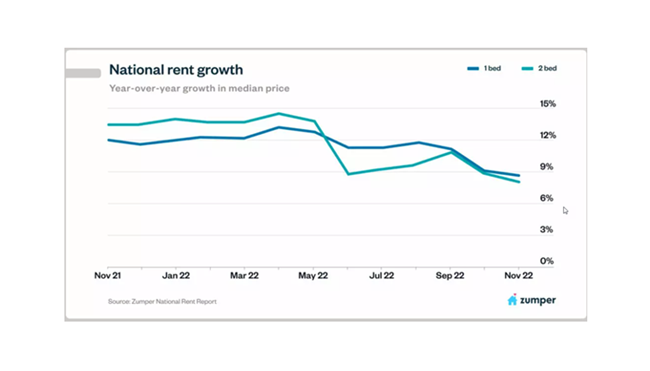
Rent prices continue to decline gradually across much of the United States, according to the November rent report from Zumper.
Nationally, the median price for a one-bedroom is flat over last month; the two-bedroom median fell 0.4 percent. Nearly half the cities on Zumper’s list posted decreased or flat one-bedroom prices compared to last month; the two-bedroom median is down or flat in 60 percent of Zumper top 100 cities.
“We’re seeing pandemic trends begin to unwind, and unwind quickly, as renters hunker down in anticipation of a recession,” Zumper CEO Anthemos Georgiades said in a release.
“Over the last two years we saw unprecedented rises in rent prices driven by a booming economy, low interest rates, a one-off spike in demand post vaccines, and supply chain issues that delayed new units coming to market. Now—with inflation and interest rates high and the labor market beginning to tighten—Americans are holding off on major economic decisions. Household formation has paused and even inverted, driving demand down and cooling off rent prices.”
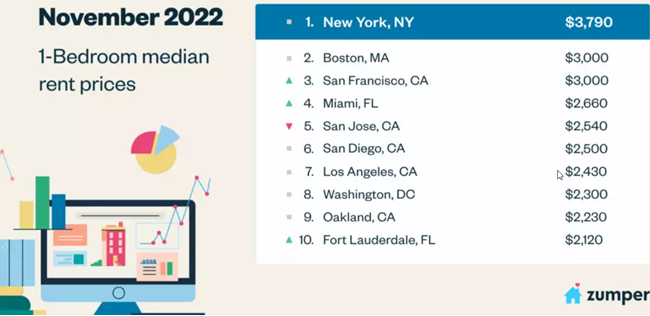
Charts courtesy of Zumper
Metros beginning to see rent prices leveling off
Several metros accustomed to substantial, sustained price increases are beginning to level off: Median one-bedroom rent is down 2.9 percent in Nashville, 2 percent in Boston and 1.8 percent in New York City.
One-bedroom rent in Tulsa, OK—which previously saw big price hikes thanks to an incentive program to lure remote workers—is down a whopping 6.3 percent over last month. Fresno, CA, dropped 16 spots this month and is now in the bottom half of our list with a median one-bedroom rent of $1,330.
What is this happening?
Recession fears and diminishing occupancy are helping nudge rental prices down across much of the country.
Pandemic-era trends are beginning to unwind, especially in areas that previously welcomed large numbers of new residents thanks to work-from-home policies. This reversal is especially evident across Arizona.
Boston and San Francisco are now tied for second most expensive city in the country, with New York showing no signs of relinquishing its No. 1 spot.
How to buy your first multifamily investment property as multifamily buildings tend to be more capital intensive yet offer benefits for real estate investors.
Real-estate investing is one of the most reliable methods for wealth creation. While many novice investors start by purchasing a single-family home, once you gain experience, you may consider expanding into multifamily properties. Multifamily buildings tend to be more capital-intensive, yet offer intriguing benefits for investors.
Here’s a step-by-step look at how to buy your first multifamily investment property.
What Is A Multifamily Investment Property?
A multifamily investment property is a residence with more than one housing unit that you intend to rent to tenants. A building with one residence is known as a single-family home – the typical detached home you see in most suburban neighborhoods. Anything larger is known as a multifamily property, which can range from a duplex or triplex to a large apartment building with 100+ units.
Due to the higher earning potential, multifamily investment properties tend to be more expensive. But they can also offer various benefits to investors, including more stability and tax incentives. So, if you want to expand your portfolio, you may consider investing in a multifamily investment property.
Multifamily properties include duplexes, triplexes, townhouses, high-rises, low-rises, condominiums, bungalows, mixed-use buildings, and more.
How To Buy Your First Multi-Family Investment Property
Follow along as we uncover a step-by-step guide on how to buy your first multi-family investment property:
Decide On Your Financials: Before you scout potential investments, take stock of your financial situation and decide how much you can realistically afford. Multifamily properties are often more complex investments because you’ll have multiple tenants and units to maintain. So, if you need to finance the purchase, you’ll need a clear business plan and a proof-of-funds letter to be approved for a loan. You may also join a group of investors and pool your funds to purchase a property to take some of the burdens off yourself. But before doing so, you must analyze your finances and set a realistic budget, so you don’t get in over your head.
Do Your Research: Next, you should start researching different markets and types of multifamily properties to find a wise investment. Multifamily properties include duplexes, triplexes, townhouses, high-rises, low-rises, condominiums, bungalows, mixed-use buildings, and more. Each property type offers unique advantages and disadvantages, so do extensive research on the different subsets of multifamily housing and study the local market to identify good deals.
Choose A Lender and Get Pre-Approved: Once you’ve done your homework, you’ll want to seek preapproval from a lender to show that you have the funding to make a purchase. Before doing so, you’ll want to gather all your financial documents and draft a simple business plan to prove to lenders that you know what you’re doing. You may not have a particular property in mind yet, but let them know what you’re looking for, what kinds of expenses will go into the renovation or management of the property, and how soon you expect to turn a profit. It also helps if you have previous experience as a real estate investor to show that you know the risks and challenges of owning income-producing property.
Find A Real Estate Agent to Work With: Once you’re pre-approved, you’ll want to enlist the help of a real estate agent. Multifamily purchases are often more complicated than single-family homes because there are more factors to consider. There may be zoning concerns or tax implications that you should understand before making a decision that may not be immediately apparent. If you’re new to multifamily investing, you may not understand whether a building is over- or underpriced. So, enlisting the help of a real estate agent with experience purchasing multifamily properties can be a huge help.
Narrow Your Search: You may start with a wide net to see what’s out there, but eventually, you’ll want to narrow your search until you find the perfect property. It helps to identify three to five properties that may work for your budget and business plan and then crunch the numbers to see which offers the most potential value.
Estimate Profits and Losses: Once you have a few potential candidates, you’ll want to estimate the profits and losses. If any properties need renovations before they can be rented, you’ll want to estimate those costs. You’ll also want to calculate the ongoing maintenance costs and general losses due to vacancies. Then you’ll evaluate the property’s potential monthly or yearly income by multiplying the number of units by the average rent for a comparable building in the area. Finally, you’ll subtract the estimated expenses from the profits to determine the potential cash. You can do these calculations on your own using online tools, or you can enlist the help of your agent, general contractor, property manager, or another real estate professional.
Make an Offer: When you’ve found the perfect building, you’ll want to submit an offer as soon as possible. Like a single-family home, you’ll submit an offer letter to the seller stating the price and any other requests or stipulations you have. The seller will consider your offer and either accept it, deny it or make a counteroffer. Depending on the market, you may submit several offers before finding a deal that makes sense for your bottom line. But if you have the necessary funds and make realistic bids, you’ll eventually land a deal.
Close On the Property: After you and the seller agree on a price, all left is to sign a purchase agreement and close on the property. You’ll have time to do your due diligence and look for any red flags that may lead you to return to the negotiating table. Buying a multifamily property is a serious investment; you’ll want to have it inspected thoroughly, so you know it’s a smart purchase. But if everything checks out, you’ll do a final walkthrough and then schedule a closing where you’ll sign the necessary paperwork and hand in the funds.
Final Thoughts
While purchasing a multifamily property may initially sound intimidating, it’s fairly straightforward if you do the research and know what to expect. Although it’s slightly more complex than purchasing a single-family home, it offers increased earning potential and greater stability, among other benefits. So, if you’re an investor looking for a new challenge, consider adding a multifamily investment property to your portfolio.
____
About the author:
Ryan Zomorodi is co-founder and COO of RealEstateSkills.com, an education platform that has trained thousands of students to start and grow real-estate investing businesses. Ryan is the managing editor of the Real Estate Skills blog, ranked as the No. 1 real-estate wholesaling blog on the web. He has over 10 years of investment and management experience, including acquiring over 100 homes for flip, wholesale, and rental across a dozen states.
Here are 7 questions landlords have about pets and pet-friendly apartments as 72 percent of all renters now have pets and the trend toward pet ownership is only going to grow.
By John Triplett
Owners, landlords and property managers may want to consider whether pet-friendly apartments and a welcoming pet policy may be the best way to deal with the issues. Here is a guide to the issues and comments from apartment owners, property managers and The Humane Society of the United States
One landlord said in an interview that the companion pet issue in particular is one where he just does not know where to go to get the right answers.
He said he understands service animals, but when it comes to things like assistance animals, companion pets and emotional support animals, he is confused by the terms.
And he said it seems like today tenants “can get a note from anyone” and “I have to accept their pet.”
While some landlords and property managers struggle with the pet issue, overall there is a trend nationwide to more and more pet-friendly apartments, and many landlords and property managers say pets are a key to their success. The Humane Society of the United States is also working with the multifamily industry through its Pets Are Welcome initiative to help property owners or managers as well as tenants, since 72 percent of all renters now have pets.
“Too many home and apartment owners exclude animals, thinking that the animals are going to damage the properties. That mentality shrinks the pool of living spaces for people and their pets,” Wayne Pacelle, president and CEO of The Humane Society of the United States writes in a blog post.
The story of one pet-friendly apartment community
“We have been pet-friendly apartments since the property was built in the late ‘60s. I’ve been managing Twin Ponds for almost 20 years and I have watched the dogs bring the apartment community closer together,” said Deb Palmer, property manager at Twin Ponds in Nashua, New Hampshire.
“It is down-right silly how many great residents that communities are missing out on because of a certain breed or weight of a dog. You just have to know how to manage dogs as well as the residents. Being dog-friendly without breed or weight restriction is one of our most powerful marketing tools. People come from all over to live here because they could not find anywhere else to live. That’s huge!”
“We have more dogs than children,” she said. Her pet friendly apartment complex has 350 dogs among her 414 units and accepts all breeds, but only two per unit.
“When people drive into our complex they can see how pet-friendly we are,” she said. “I just wish everyone could see how well pet-friendly works.”
The residents are closer because they walk the pets in two pet areas in the complex and talk about their pets. She also uses PooPrints, the pet DNA testing service, and that keeps the pet areas clean.
“We have pet walkers and behavioral trainers” who work with pets in her apartments, and the pet behavior has been consistently good. “We have had a couple of incidents in 20 years,” she said. She requires tenants to have rental insurance in their lease agreements and agree to the pet-DNA testing requirements, but she does not specifically screen individual pets.
Her complex also runs a dog-of-the-month and dog photo contest, where residents send in pictures and vote on the dog of the month with the dog owner’s family winning a prize.
Her website features this: “Congratulations to the October Dog of the Month, Bandit! This watchful pup kept watch on the voting and won with over 70% of the votes! We will be in touch with the winning family soon to go over their prizes for this month’s contest.”
Bandit was pet of the month, a great contest idea for apartments.
Bandit was dog of the month at the pet-friendly apartments Twin Ponds.
Buster was another dog of the month at the Pet-friendly apartments
Buster was another winner at the pet-friendly apartments.
Pet ownership grows as rental population grows
They’ve long been referred to as man’s best friend, and now research from Mintel reveals that no one loves their mutts quite as much as American men. Today, some seven in 10 (71%) younger men aged 18-44 own a dog, compared to just three in five (60%) of their female counterparts.
Mintel research on U.S. pet ownership reveals that while the majority (67%) of Americans own a pet, dogs are the nation’s number one furry companion with half (50%) of all Americans owning a dog. This rises to 52% of all U.S. men, compared to 49% of women. Older Millennials in particular make up a large portion of the nation’s dog lovers, as three quarters (75%) of consumers aged 30-39 own a dog.
“While pet ownership over the last few years has remained near half of all Americans, our research indicates that dog ownership is elevated among younger men. As pets are seen more and more as companions and family members, Americans are taking additional steps to ensure their health and happiness, and are spending more in the process,” Rebecca Cullen, Associate Analyst, Health, Household, Beauty & Personal Care at Mintel, said in a release.
The findings come at a time when Millennials, roughly defined as the generation born between 1980 and 2000, are half as likely to be married or living with a partner than the adults of 50 years ago. They are also delaying parenthood and demanding flexible work arrangements — all of which, researchers say, has translated to higher rates of pet ownership.And pet friendly apartments are something Millennials seek.
Pets as a replacement for children
“Pets are becoming a replacement for children,” Jean Twenge, a psychology professor at San Diego State University and author of “Generation Me,” told the Washington Post. “They’re less expensive. You can get one even if you’re not ready to live with someone or get married, and they can still provide companionship.”
A majority of Millennials — 76 percent — said they are more likely to “splurge” on their pets than for themselves, including for expensive treats (44 percent) or a custom bed (38 percent), according to a 2014 study by Wakefield Research. By comparison, 50 percent of Baby Boomers — those born between 1946 and 1964 –– said they would do so.
Apartment owner says, “No bad dogs, just bad dog owners”
“It is our belief that there are not bad dogs, there are bad dog owners,” said Cliff Orloff, owner of Orloff Property Management, which owns approximately 800 units in Sacramento and Berkeley, California, and Indianapolis, Indiana.
“We have had some bad dogs, but they have been bad dogs because their owners were bad – they didn’t know how to deal with their dogs.”
“The thing about service dogs is that you do not have an option. It’s the law. There are two types of dogs. One type is like Seeing Eye dogs, which you have to take even if you are not a pet-friendly property. There are emotional support dogs and that is iffier. Some tenants try to get away with saying it’s the same, but they are not. When somebody has a legal service dog they have the documentation to prove it. That is our experience. We’ve kicked out people who have had ‘so called’ service dogs – they weren’t really service dogs – but they kept their dogs all day on their outside patio and they were pooping on the neighbors below.”
It is about setting the rules and enforcing them for pet friendly apartments, Orloff said. “This is not true just for pets but also for property management. You have to have rules and enforce them strictly for everyone. If you don’t you run into trouble and you are discriminating. “
A lot of properties do not want the hassle of pets, he said. Or it’s a property management company and it’s not their own property. He said well-managed and well-maintained properties enforce the rules and do it right. And it is a lot of work, and some property management companies do not want to do that.
A credit bureau for pet owners and pet-friendly apartments
“We started a business that is meant to be something like a credit bureau for pet owners,” Orloff said, called NPR4Dogs.com., designed to help pet-frriendly apartment complexes. Here is what he says on the website:
“NPR4dogs was started in 2016 by Cliff Orloff, an owner of more than 800 multi-family units, in response to dog-poop issues at his properties.
“One of those properties, Riverfront Apartments in Sacramento, California, had a big problem. It accepted dogs without weight or breed restrictions (although a dog interview was required to avoid renting to anti-social dogs). It also allowed multiple dogs in a unit. As a result, it had almost as many dogs as apartments, and despite having dedicated dog runs, written rules requiring residents to pick up their dog poop and doggy areas stocked with plastic bags, the dog poop problem became unbearable. Responsible dog owners complained about stepping into dog poop every time they took their dog for a walk. The poop smell became very unpleasant. What to do?
“Researching possible solutions took Cliff to the website of the Veterinary School at University of California at Davis. The Veterinary School developed a state-of- the-art program to DNA-sample dogs at a reasonable cost and to DNA-match dog poop to dogs. Using this DNA technology, Riverfront set up a mandatory registration for dog DNA screening, data management and resident incentive systems to organize this effort efficiently.
“The result was dramatic. The dog poop problem went away overnight. Responsible dog owners who lived on the property hailed the new program. Most of the irresponsible dog owners changed their behavior and became responsible dog owners.
“To see if this result was unique to Riverfront Apartments, NPR4dogs was implemented at a 324-unit apartment complex in Indianapolis called Broad Ripple Trails. Again, the result was dramatic. The dog- poop problem went away almost overnight.
“The dog poop problem is common for most large multi-family properties that accept dogs. NPR4dogs used its experience implementing these programs to develop systems and procedures, and embedded them in a unique smartphone app for property managers. That technology, the related website and databases became the foundation for NPR4dogs. By making a large bulk purchase agreement with UC Davis, NPR4dogs is able to make this technology available to other properties, at less cost than they could do it themselves.”
In terms of managing pet poop in pet-friendly apartments, he said, it is a behavioral thing, like speeding down the highway.
“If you see a police car in the road, you slow down to 70. It’s a behavioral thing. There are some dog owners who just as a matter of fact they pick up after their dogs. There are some dog owners who do pick up after their dogs if they have to, because if they don’t they are going to get fined. Then there are some that don’t. And the ones that don’t, they leave. If we can get this rolling on a large-scale basis it is like a credit bureau for dog owners. These are the responsible dog owners who can say if they move to another property I got an A1 rating from my previous two apartment complexes.
“We own enough property ourselves we can see if it works and it works because it is a behavioral thing.
“It makes it a nicer place to live for everybody. The people who want to follow the rules are so much happier. This is what they have told us, they take their dog for a walk at night and they step in dog poop all the time. And for the responsible dog owners this just bugged the hell out of them. So they were glad when we did this. We did not get any push back at all.”
“I like dogs. My wife is a cat person. It is all about the people,” Orloff said.
Pet-friendly apartments and a welcoming pets policy
Photo by Erin A. Kirk-Cuomo via Wikimedia Commons
The concept of pet-friendly apartments and a welcoming pet policy by landlords helps deal with reasonable accommodation requests.
Matthew Wildman, pet retention manager for The Humane Society of the United States said, “There is so much misinformation out there. Our position is allowing pets in rental housing is good for business. Hundreds of properties allow dogs and cats without restrictions on breed.” He said the number one reason animals are sent to shelters is because of rental situations where they cannot keep a pet.
Wildman said there is confusion over terminology and so he put together answers to 7 of the top questions owners, landlords and property managers have about this issue.
A question and answer on pets and pet-friendly apartments with the Humane Society of the U.S.
No. 1- Question: I am confused over the terminology of service animal, assistance animal and companion animal. Tenants use different terms such as these to refer to their pets. How do I as a landlord know which is which?
Answer: “Companion animals” or “companion pets” are interchangeable terms with the most common term, “pets.” For some reason, the term “companion animal” is perceived by many in the multifamily housing industry to mean something different than a “pet,” but there is no difference. The terms that are of relevance to housing providers encountering requests for reasonable accommodation are “assistance animals” (also commonly referred to as “emotional support animals”) and “service animals.” An assistance animal can be any animal who is commonly referred to as a pet, but the difference is that their owner has a disability for which the animal is needed to either provide assistance in managing activities of daily living, and/or provides support that alleviates the symptoms or effects of the person’s disability. An “emotional support animal” is a type of assistance animal that provides emotional support that improves the symptoms of an individual’s disability.
According to the Department of Justice, a “service animal” may be a dog or miniature horse who has been trained to perform a specific task(s). Under the Americans with Disabilities Act, individuals living with a disability are legally entitled to bring these animals into places of public accommodation as well as their residence regardless of any pet restrictions. The most common example of a service animal is a Seeing-Eye dog, but not all disabilities requiring service animals are obvious. For example, individuals suffering from PTSD may need their dog with them at all times. This dog may be trained to sit calmly beside their owner.
It’s helpful to keep in mind that service and assistance animals are not considered pets, meaning that pet rules – such as no-pet policies, breed and size restrictions, pet deposits and fees – don’t apply to them, but owners are responsible for any damage they cause.
No. 2 – Question: “I am confused about assistance animals. It seems a tenant can get a note from anyone and I have to let them have a pet in my apartments.”
Answer: Federal fair housing laws state that to request a reasonable accommodation, the tenant needs to submit reliable documentation of a disability and the need for an assistance animal. This usually comes in the form of a letter from a doctor or health professional verifying that the tenant has a disability and identifying how the animal assists the person with this disability to enable him to full use and enjoyment of the dwelling. As per federal fair housing laws, if this information is provided the housing provider is required to grant the reasonable accommodation request as long as accommodating the animal does not create an undue financial hardship for the landlord (this is rarely the case) or the specific animal poses a verified nuisance or danger to the health and safety of others.
According to the Centers for Disease Control and Prevention, one out of every five adults lives with a disability. Unless you’re receiving requests for an assistance animal from over 20% of your residents, it’s unlikely you’ll encounter a fraudulent claim. While the verification document may be suspect, the tenant can still have a valid disability and appropriate need for an assistance animal. The accommodation request is intended to be an interactive process between the tenant and housing provider. You don’t have to be afraid to come back to the tenant and let him know that you’re concerned about an aspect of the request and ask the tenant for additional information. It may be helpful to temporarily grant the request until a final determination is made to avoid a claim of undue delay.
An emotional support animal is a type of assistance animal, one who is not trained and who provides emotional support to their owner who suffers from a disability. There are for-profit companies that provide tags and vests stating an animal is a service animal, but these are not government-sanctioned companies, and they create a tremendous amount of confusion for both residents and housing providers alike.
If the housing provider does not believe that the tenant has adequately demonstrated that he or she has a disability or that he has a need for an assistance animal or the request is unreasonable, they have the right to deny the request, but this carries the risk of opening themselves up to a discrimination lawsuit.
No. 3 – Question: Under Fair Housing rules do I have to rent to someone who says they have an assistance animal and they have a note?
Answer: Housing providers have the right to screen disabled applicants as they would any other applicant. However, if the applicant requests a reasonable accommodation for an assistance animal and provides sufficient documentation of the disability and the need for the assistance animal, denying the reasonable accommodation would likely violate fair housing laws unless the request imposed an undue burden. Denying an applicant because of his assistance or service animal is akin to denying an applicant housing because of a wheelchair.
No. 4 – Question: What about service animals? Do I have to rent to anyone anytime they have a service animal under Fair Housing rules?
Answer: Service animals are a type of assistance animal. If the applicant provides reliable documentation of having a disability and needing a service animal and the animal does not pose a direct threat to the health and safety of others, denying an application because of the applicant’s assistance or service animal would likely violate discrimination protections.
No. 5 – Question: Can I legally refuse certain types of large breed dogs or dangerous breed dogs if the tenant says it is an assistance animal?
Answer: Assuming the tenant provides reliable documentation entitling him to the use of a service or assistance animal, The Department of Justice has determined that pet restrictions may not be applied to service or assistance animals. This means that number limits, breed bans or size restrictions may not be applied, and the housing provider may not impose a pet deposit or fee, but the owner is responsible for any damage the assistance animal causes.
The Humane Society of the United States encourages property owners and managers to welcome pets and remove arbitrary and unnecessary breed and size restrictions. This among other benefits, will reduce the number of requests for service and assistance animals. Conversations we’ve had with property owners indicate a strong correlation between assistance animal claims and pet policies. In short, the more welcoming of pets you are, the fewer the requests for reasonable accommodation you’ll receive.
No. 6 – Question: How can I verify that just because a potential tenant has a tag that says the pet is an assistance animal that that tag is legitimate and not a forgery of some type?
Answer: There is no state or federal certification required for assistance or service animals. The only documentation needed is from a reliable health care professional. Complicating matters is the fact that private for-profit companies have sought to fill this vacuum by providing individuals (for a fee) with official-looking tags, vests and documentation that seemingly verify an animal as an assistance or service animal. What’s important to note is that use of these companies does not indicate that the resident is attempting to “fake” their status as someone living with a disability or the animal’s status as an assistance or service animal. These companies use official-sounding names and most of their customers are as in the dark as housing providers that these companies are not officially sanctioned. If a tenant submits documentation from one of these online service providers, you are entitled to engage in the interactive process and ask the tenant for additional information that’s more reliable.
No. 7 – Question: Can I screen a potential pet the same way I screen a potential tenant? Is that legal and how do I do that?
Answer: Housing providers have a right to ensure that pets as well as assistance and service animals do not pose a direct threat to the health and safety of others. The HSUS has guidelines on how to conduct a “meet and greet” for pets, assistance, or service animals. Contact us at [email protected] for information.
Conclusion: Pet-friendly apartments and pet issues are only going to become larger for the rental housing industry going forward as the pet population and the rental population both continue to grow. Many apartment rules were adopted in the 1990s, when there were far fewer pets and pet-friendly apartments. Rules often have not been updated as the Millennial generation is moving into rentals with more and more pets, and often with larger and more diverse breeds. These seven questions and answers should help owners, landlords and property managers, as well as tenants, going forward with issues around pet-friendly apartments.
Operational excellence is the structure and methodology that creates efficiency and effectiveness at a community, and it is a critical part of a successful business strategy. It is also ever-evolving – your processes and team members must be adaptable, continuously refining operations to suit resident trends and technological innovations. This empowers you to stay at the forefront of the multifamily housing industry.
Imperative to the longevity of your portfolio, here are the key components of promoting operational excellence.
Committed Leadership
Committed leaders are a crucial element of any initiative. Individuals who lead by example with a willingness and vulnerability to continuously learn and adapt are non-negotiable. Creating operational excellence starts with an organized, informed and adaptable front line of leadership – it has a ripple effect and sets teams up for success.
Culture of Trust
Thoughtfully encouraging your team to take ownership is essential, and it starts with hiring the right candidates. A workforce of people who reflect your values will create a collaborative environment of strong work ethic and integrity, and most importantly, build a culture with a foundation of trust.
How do you create the ideal work environment? Fostering open communication creates that important sense of trust. In a trusting workplace, team members feel confident to spot abnormalities in their operations and find new efficiencies, benefiting themselves, their team and the organization as a whole.
Keep It Sophisticated but Simple
Operational excellence does not need to be over complicated. Take the successful systems you have already created and optimize them. Streamlining processes by automating repetitive tasks will save you valuable time and energy. Optimization will leave room for team members to work smarter, not harder. They can narrow their focus on specialized tasks that make the true difference – the in-person connection and delivery of exceptional service to residents.
Innovate Today to Ensure an Excellent Tomorrow
At Mark-Taylor, we approach operational excellence with an innovation-focused mindset of “Do the things today that others will not, and you will achieve the things tomorrow that others cannot.” To achieve excellence in your operations, processes must change as our industry changes.
Tip: When implementing new approaches, be mindful of generational changes in preferences. Understanding evolving audience perspectives is key to attracting and serving your residents.
Values Left Uncompromised
Staying true to your fundamental values keeps your brand alive, and your employee engagement strong. Operational excellence needs to be incorporated into an organized structure that reflects the core values of your company. The standards you hold across your portfolios should be left uncompromised when initiating change.
About the Author
Michael Wilson is Vice President of Asset Management, joined the Mark-Taylor family in 2001 with a background in financial planning. Beginning as a Leasing Consultant, Michael gained his expertise in the operations of the business from the ground up.
Backed with 21 years of tenured experience within Mark-Taylor, he diligently oversees the company’s portfolio of 70+ communities and ensures our investments are consistently performing at their financial operating potential.