
Home Blog Page 185

Court Halts Massive “Sanctuary Belize” $100 Million Real Estate Investment Scam

Court Halts Massive “Sanctuary Belize” $100 Million Real Estate Investment Scam

A federal court in Maryland has shut down the largest overseas real estate investment scam ever uncovered by the Federal Trade Commission, according to a release.

According to the FTC, the scam was established by Andris Pukke, a recidivist scammer currently living in California, and he perpetuated it even while serving a prison sentence for obstruction of justice.

The alleged scheme took in more than $100 million, marketing lots in what supposedly would become a luxury development in Central America known by several names, including Sanctuary Belize, Sanctuary Bay, and The Reserve. According to the FTC, the defendants duped consumers into buying Sanctuary Belize lots by falsely promising that the development would include luxury amenities and be completed soon, and that the value of the lots would rapidly appreciate.

In filing the complaint against Pukke and a range of other defendants, the FTC is seeking to permanently stop the scheme and obtain a court order requiring them to turn over hundreds of millions of dollars to compensate deceived U.S. investors.

“The defendants in this case operated a sophisticated international real estate investment scheme that cheated consumers out of millions of dollars of their hard-earned retirement savings,”  FTC Chairman Joe Simons said in the release.

“The FTC is committed to stopping this outrageous behavior and compensating the hundreds of victims.”

The Sanctuary Belize real estate investment scam

Court Halts Massive “Sanctuary Belize” $100 Million Real Estate Investment Scam
The Federal Trade Commission uncovered the largest ever international real estate investment scam called the Sanctuary in Belize.

According to the FTC, the defendants operated a set of interrelated businesses (the Sanctuary Belize Enterprise or SBE) and ran commercials on Fox News and Bloomberg News advertising parcels of land that were part of a luxury development in Belize. They also advertised the property through infomercials. Consumers who expressed interest in buying property would receive a call from California-based telemarketers who identified themselves as “property consultants” or “investment consultants.”

These telemarketers allegedly made six false claims in their pitches to sell lots in the development, including that:

  • SBE uses a “no-debt” business model, which makes buying a lot in Sanctuary Belize less-risky than a real estate investment in which the developer must make payments to creditors like banks;
  • Every dollar SBE collects from lot sales goes back into the development;
  • This continual funding stream means that SBE will finish development quickly — within two to five years;
  • The development will include impressive amenities, such as a hospital staffed with American doctors, an emergency medical center near the downtown “Marina Village,” a championship-caliber golf course, an airstrip, and a new international airport with direct flights to the United States;
  • These amenities will ensure that property values will double or even triple in two to three years; and
  • It will be easy for buyers to resell their lots.

The FTC alleges that SBE representatives in Belize made the same deceptive claims when they met with prospective buyers visiting the property before purchasing lots.

The FTC also contends that relying on the defendants’ deceptive claims, consumers purchased lots that typically cost between $150,000 and $500,000 outright, or made large down payments followed by sizeable monthly payments, in addition to paying monthly homeowners association (HOA) fees. However, because the defendants’ claims are not true, consumers either have lost, or will lose, some or all of their investments.

According to the FTC, a no-debt model actually increases risk for purchasers, and the defendants used consumers’ payments to fund their own high-end lifestyles instead of investing the money in the development. The FTC contends that the development and the amenities will not be completed in the promised timeline, the value of the lots has not appreciated, and there is no resale market for the lots.

Based on these claims, the FTC charges the defendants with violating the FTC Act and the Telemarketing Sales Rule. In addition, the FTC charges Belize’s Atlantic International Bank with assisting and facilitating the Sanctuary Belize scam.

The complaint also names Angela Chittenden, Beach Bunny Holdings, LLC, The Estate of John Pukke (Andris Pukke’s late father), John Vipulis, and Deborah Connelly as relief defendants who received funds from SBE’s deceptive and illegal conduct.

FTC Seeking Information from Affected Consumers

To aid its lawsuit, the FTC is seeking information from consumers who have done business with the defendants or bought property in Sanctuary Belize. Over the course of the alleged scheme, the defendants have used other names in marketing the development, including Global Property Alliance, Buy Belize, Buy International, Eco Futures, Sittee River Wildlife Reserve, Sanctuary Bay, The Reserve, and The Marina at the Reserve.

The Commission has set up a website where consumers are urged to submit any information related to their dealings with the defendants, including documents, videos, photographs, audio recordings, or any other type of file related to the allegations in the complaint.

The FTC will encrypt all information it collects, and will take steps to ensure that it does not disclose consumers’ personal information. The FTC also may follow up with consumers who submit information relevant to its case.

 

Want To Know If Your Compliance Training Is Working? – Ask Your Employees

The Grace Hill training tip this week focuses on the third in the series on compliance training. Compliance training is important for landlords and property managers to keep up with ever-changing rental housing laws at federal, state and local levels.

By Ellen Clark

Bottom line: You want to know if your training program is working. Employee feedback is one of the best ways to know what is and is not working for them.

This is the fourth post in a series about how to measure the effectiveness of your compliance training program. If you missed the previous posts they are listed at the bottom.

Building a good compliance training evaluation plan is all about accumulating evidence to help you answer the question:

Is the compliance training working?

You could just measure impact on the ultimate performance metric:

    • Have you gone a year without a fair housing claim?
    • Have internal harassment complaints decreased?

 But, if you don’t see an impact, you will want information about what went wrong so you can fix it.

 In a past post, we covered measuring implementation. You don’t want to conclude that training didn’t work when, in fact, the issue was that people didn’t complete the training, or didn’t complete it with fidelity. We also covered measuring learning. If employees can’t demonstrate they grasp what’s been taught, it is very unlikely they will be able to apply the training content on the job.

It is also important to gather information on employees’ reactions to the training.  Did employees find the training valuable and feel they benefited from it? This kind of learner buy-in is particularly important in compliance training. Here are some tips for measuring this aspect of your compliance training.

Go beyond “did you like it” questions. Understanding whether employees liked the training is important, and is something most training administrators already think to ask. Here are a couple questions that are often overlooked, but you may want to consider asking learners.

Do employees understand the legal ramifications of the issues the training covers

How valuable did you find the training?

This gets to the heart of why many employees do not complete training or apply themselves during training. When learners understand the value of training, they are more likely to start, complete, and invest time and mental effort – all the things we want them to do. If you find learners aren’t seeing the value, address this by explicitly talking about the value of the learning opportunity in training.

 How confident are you that you can implement the strategies you learned in training?

Even if learners understand what they are supposed to do after training, there may be some practical barriers to doing those things, such as lack of time, resources or supporting processes.

Follow-up questions about what the barriers to implementation are will help you understand how you can better support people in applying strategies learned in training on the job.

Capture feedback through a variety of ways, and offer options to give both a quick review and more detailed feedback.

Gather feedback in multiple ways. Online surveys are great tools for gathering feedback on training. However, think about complementing surveys with informal chats or one-on-one feedback sessions.  Sometimes discussing the training over a a cup of coffee will get you the best insights. The key thing here is to have a plan. Map out your conversations to get a good sampling of people in a variety of roles and locations, and ask a standard set of questions so you get a critical mass of information in key areas.

Gathering information on multiple aspects of training will help you tease out weak spots and target your improvement efforts.  Understanding the extent to which learners see the value in training and whether there are practical barriers to using the strategies on the job will give you important insights into things you can address to improve the overall effectiveness of your compliance training.

If you missed the previous Part 1, Part 2, and Part 3 here they are:

Part 1 –  Is Your Property Management Compliance Training Working?

Part 2 – Why Completing All Compliance Training Is Critical To Your Protection

Part 3 – Ask Key Questions To Be Sure Your Employees Have Mastered Compliance

Read Ellen’s full blog post here.

About the author:

Ellen Clark is the Director of Assessment at Grace Hill.  Her work has spanned the entire learner lifecycle, from elementary school through professional education. She spent over 10 years working with K12 Inc.’s network of online charter schools – measuring learning, developing learning improvement plans using evidence-based strategies, and conducting learning studies. Later, at Kaplan Inc., she worked in the vocational education and job training divisions, improving online, blended and face-to-face training programs, and working directly with business leadership and trainers to improve learner outcomes and job performance. Ellen lives and works in Maryland, where she was born and raised.


compliance training for rental housing


Photo credit Gustavofrazao via istockphoto.com


Landlords To Pay $6,000 After Promising, Then Refusing Disabled Tenants Move To First-Floor Apartment

Landlords To Pay $6,000 After Promising, Then Refusing Disabled Tenants Move To First-Floor Apartment
A disabled couple was denied permission to move to a first-floor apartment despite promises when they moved in.

Landlords  have agreed to pay $6,000 and forgive back rent to settle a complaint by disabled tenants, a couple, that they were denied the opportunity to move to a first-floor unit despite being told upon moving in that they would be able to transfer to a first-floor unit as soon as one became available.

The U.S. Department of Housing and Urban Development (HUD) and the Silver Creek Apartments in Las Vegas, Nevada, have reached a conciliation agreement, according to a release.

On-Site manager denied disabled tenants request to move

The agreement resolves allegations that the on-site manager denied the couple’s request to move to a first-floor unit. The property is owned by Silver Creek LV, LLC, and managed by Stout Management Company, both located in Las Vegas. Read the agreement.

The Fair Housing Act makes it unlawful to discriminate in the sale, rental, and financing of dwellings, and in other housing-related transactions, based on disability. This includes refusing to make reasonable accommodations in rules, policies, practices, or services or facilities related to housing.

“Housing providers need to understand that many people with mobility impairments rely on accommodations to fully enjoy their home, and that they have an obligation to provide those accommodations,”  Anna María Farías HUD’s Assistant Secretary for Fair Housing and Equal Opportunity, said in the release. “Hopefully this settlement will make more housing providers aware of their responsibilities under the Fair Housing Act.”

Couple made numerous requests to move to first-floor apartment

The couple alleged that they made the same request on numerous occasions over a seven-year period.

Each time their request was denied even though they observed first-floor units being rented to others, according to the release.

Landlord tried to charge move-in fee and additional deposit for move to first-floor

According to the complaints, earlier this year, the apartment landlords approved the couple’s request to move to a first-floor unit.

However they were told they would have to pay a move-in fee of $700 and an additional $400 security deposit. The couple could not afford the extra costs and was forced to move out.

The housing providers deny that they discriminated against the couple.

Under the HUD conciliation agreement, Stout Management and Silver Creek LV, LLC, will pay the couple $6,000, forgive $1,392 in unpaid rent, and amend their Fair Housing policies to include information about reasonable accommodations.

In addition, all leasing and management staff who work with tenants at Silver Creek Apartments will attend Fair Housing training.

Last April, HUD marked the 50th anniversary of the Fair Housing Act, joining local communities, housing advocates, and fair housing organizations across the country in a coordinated campaign to enhance awareness of fair housing rights.

Persons who believe they have experienced discrimination may file a complaint by contacting HUD’s Office of Fair Housing and Equal Opportunity at (800) 669-9777 (voice) or (800) 927-9275 (TTY).

HUD Charges Apartment Owners With Discrimination Over Newborn Baby

HUD Charges Landlord With Discrimination Over Veteran’s Emotional Support Dog

Walking The Dog Leads To HUD Discrimination Charge Against Condo Association

Landlords To Pay $6,000 After Promising, Then Refusing Disabled Tenants Move To First-Floor Apartment
A disabled couple was denied permission to move to a first-floor apartment despite promises when they moved in. Photo credit vadimguzhva via istockphoto.com.

Rent Control Expansion Soundly Defeated By California Voters As Landlords Win

Rent Control Still Not the Solution to Housing Affordability

Rent control expansion in California was soundly defeated by voters who declined to repeal a 23-year-old law that limits cities’ ability to enact rent control, giving an election-day win for landlords.

Voters declined to repeal the Costa-Hawkins Rental Housing Act of 1995 which prohibits cities from applying rent control to housing built after Feb. 1, 1995 and to single-family homes and condominiums.

“The stunning margin of victory shows California voters clearly understood the negative impacts Prop. 10 would have on the availability of affordable and middle-class housing in our state,” said Californians for Responsible Housing, the group opposing the measure, in a statement late Tuesday.

The current law allows landlords of rent-controlled properties to raise the rent when tenants move out. In addition to expanding the types of properties that would fall under rent control, Prop. 10 would have let cities permanently cap the price of an apartment, allowing only modest increases even after tenants move out.

The Los Angeles County Board of Supervisors, the state’s largest county governing body, came out in support of Prop. 10, as have prominent politicians like Los Angeles Mayor Eric Garcetti, who see the issue as one in which they should have more authority, according to governing.com.

“I’ve always believed that those who live closest to a given block or a street know what’s best,” he told the local NBC News station. “Local government should have control over their own city.”

The state’s Democratic Party endorsed the measure, but not Democratic Governor-elect Gavin Newsom.

“Getting rid of these protections overall may have unintended consequences on housing construction and production that could be profoundly problematic,” Newsom said at a California housing conference in March.

He and other opponents of the measure say repealing the law would have taken away the incentive for developers to build, lessen the supply of available housing and drive rents up in properties not under rent control.

According to a recent Stanford University study, rent control in San Francisco has saved tenants in rent-controlled units between $2,300 and $6,600 since 1995 but simultaneously reduced the overall number of rental units on the market, driven overall prices up and worsened the affordability crisis.

The California Association of Realtors has contributed $6.5 million in opposition to the ballot initiative. The AIDS Healthcare Foundation, which says the affordable housing crisis falls heavily on the clients they serve, has pumped more than $22 million in support of it, according to governing.com.

Resources:

Election 2018: California’s rent-control measure defeated

California’s rent control measure defeated

Proposition 10: California’s proposal to strengthen rent control defeated at the polls


Seattle Rents Decline Sharply Over The Past Month While Other Cities In Metro Rise

Seattle Rents Decline Sharply Over The Past Month While Other Cities In Metro Rise

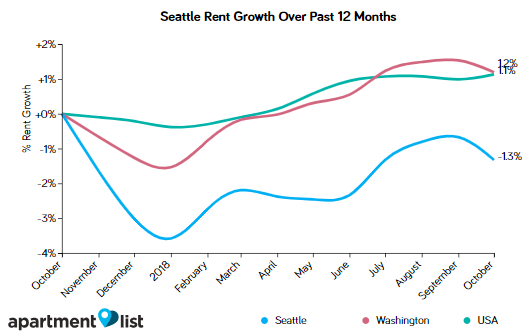
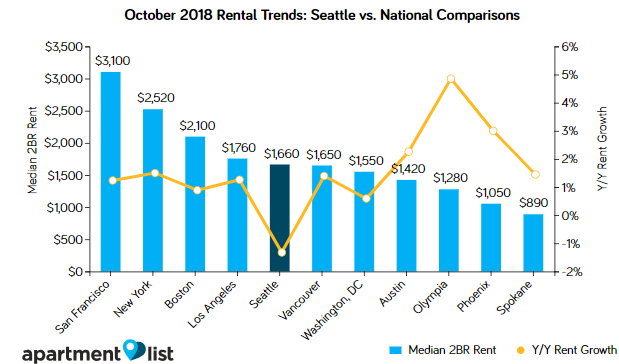
Seattle rents have declined 0.7% over the past month, and have decreased moderately by 1.3% in comparison to the same time last year, according to the November report from ApartmentList.com.

Currently, median rents in Seattle stand at $1,340 for a one-bedroom apartment and $1,660 for a two-bedroom. Seattle’s year-over-year rent growth lags the state average of 1.2%, as well as the national average of 1.1%.

Rents rising across the Seattle Metro

Seattle Rents Decline Sharply Over The Past Month While Other Cities In Metro Rise
Rents are rising outside the City of Seattle across the metro area.

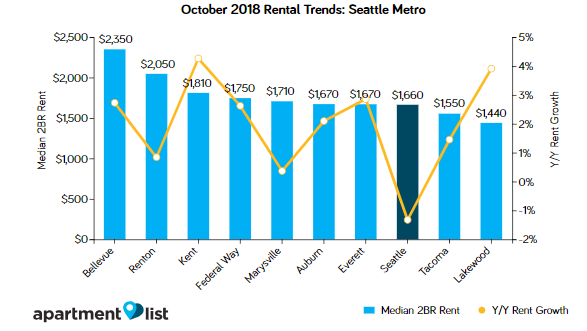
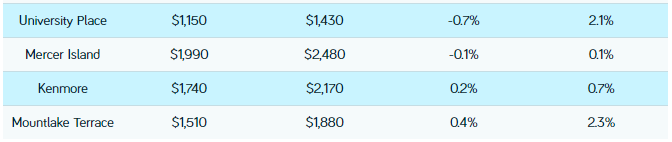
While rent prices have decreased in Seattle over the past year, the rest of the metro is seeing the opposite trend. Rents have risen in 9 of the largest 10 cities in the Seattle metro for which we have data. Here’s a look at how rents compare across some of the largest cities in the metro.

  • Lakewood has the least expensive rents in the Seattle metro, with a two-bedroom median of $1,440; additionally, the city has seen the fastest rent growth in the metro over the past month (0.9%).
  • Over the past year, Seattle proper is the only city in the metro that has seen rents fall, with a decline of 1.3%. Median two-bedrooms there cost $1,660, while one-bedrooms go for $1,340.
  • Bellevue has the most expensive rents of the largest cities in the Seattle metro, with a two-bedroom median of $2,350; rents went down 0.7% over the past month but rose 2.7% over the past year.

Seattle Rents Decline Sharply Over The Past Month While Other Cities In Metro Rise

Rents Up In Spokane And Vancouver

As rents have fallen moderately in Seattle, many similar cities nationwide have seen prices increase, in some cases substantially. Compared to most other large cities across the country, Seattle is less affordable for renters.

  • Other cities across the state have seen rents slightly increase, with Washington as a whole logging rent growth of 1.2% over the past year. For example, rents have grown by 1.4% in Spokane and 1.4% in Vancouver.
  • Seattle’s median two-bedroom rent of $1,660 is above the national average of $1,180. Nationwide, rents have grown by 1.1% over the past year compared to the 1.3% decline in Seattle.
  • While rents in Seattle fell moderately over the past year, many cities nationwide saw increases, including Phoenix (+3.0%), Austin (+2.3%), and New York (+1.5%).
  • Renters will generally find more expensive prices in Seattle than most similar cities. For example, Spokane has a median 2BR rent of $890, where Seattle is more than one-and-a-half times that price.
  • Seattle Rents Decline Sharply Over The Past Month While Other Cities In Metro Rise

Methodology:

Apartment List is committed to making our rent estimates the best and most accurate available. To do this, we start with reliable median rent statistics from the Census Bureau, then extrapolate them forward to the current month using a growth rate calculated from our listing data. In doing so, we use a same-unit analysis similar to Case-Shiller’s approach, comparing only units that are available across both time periods to provide an accurate picture of rent growth in cities across the country. Our approach corrects for the sample bias inherent in other private sources, producing results that are much closer to statistics published by the Census Bureau and HUD. Our methodology also allows us to construct a picture of rent growth over an extended period of time, with estimates that are updated each month.


California Company Buys Seattle Area Apartment Complex For $173 Million

California Company Buys Seattle Area Complex For $173 Million

Decron Properties has acquired Avana 522, a 558-unit multifamily property in the Seattle suburb of Bothell, WA for $173 million, according to a release.

The transaction marks the Los Angeles-based real estate firm’s entry into the Pacific Northwest real estate market.

The low-density 56-acre community was built in 1988 and expanded in 1999. Avana’s high unit count allows Decron, which owns close to 7,500 apartment units in California, to immediately enter the Seattle market with scale through a single acquisition and paves the way for additional investments in the Seattle MSA.

Company plans more Seattle acquisitions

Decron plans to invest approximately $400 million in the Seattle market over the next 36 months according to Daniel Nagel, Decron’s Chief Financial Officer.

“Seattle and its submarkets are a significant job creator market that benefits from a cluster of major employers with long-term growth prospects,” Nagel said in the release. “In addition, our concerns about the current regulatory environment in California heightened our focus on investing outside of our home state. Avana is the result of several years of due diligence by our investment team to understand the nuances of the market.”

California Company Buys Seattle Area Complex For $173 Million
Company plans more acquisitions in the Seattle metro area.

With immediate access to Highway 522 and Interstate 405, residents are within 20 miles of some of the area’s largest employers, including the Microsoft headquarters in Redmond, Boeing’s headquarters in Everett, and companies like Google, Facebook, and Amazon which have offices in Kirkland, Redmond, and Bellevue. The property is also located near two large business parks in Bothell, the North Creek Business Park and Canyon Park, which include tenants such as Google, AT&T, T-Mobile, and Philips Medical Systems https://cialtad.com.

Bothell has become one of the top apartment submarkets in Greater Seattle, attracting both millennials and dual income families. Current submarket occupancy is 94.7 percent and is projected to remain strong through the next several years, according to CoStar.

Decron is one of the largest privately owned real estate firms in California with 2017 revenues of $190 million. From ground up development to value-add/rehab to asset repositioning, Decron’s investment strategy focuses on opportunities that are supported by long term growth drivers, specifically job creation, supply and demand imbalance, and strong public school systems.

The garden-style community features a mix of one, two- and three-bedroom units. Avana includes a wide variety of amenities including two outdoor pools and one indoor pool, two clubhouses and two fitness centers, four playgrounds, indoor and outdoor basketball courts, tennis courts, picnic and barbecue areas, two pet parks and an indoor movie theater.

Decron will undertake a significant capital improvement program, including upgrading all unit interiors including upgraded stainless steel appliances, new kitchen cabinet doors and quartz countertops, and upgraded plumbing and electrical fixtures. The common community areas will also be upgraded, with the renovation of the club houses and pool areas, adding fire pits, new playground equipment, as well as modernizing the two dog parks. The company also plans to expand the capacity of the package locker facility.

About Decron Properties

Decron is one of the largest privately owned real estate firms in California with 2017 revenues of $190 million. Decron’s portfolio includes approximately 7,500 apartment units and 1.5 million square feet of office and retail centers.

Landlords Fined $2.25 Million For Running Illegal Airbnb Apartment Rentals

Landlords Fined $2.25 Million For Running Illegal Airbnb Apartment Rentals

Two landlords who own 17 buildings have been fined $2.25 million in penalties and investigation costs after unlawfully renting out 14 apartments on Airbnb, according to a release.

San Francisco City Attorney, Dennis Herrera said in a release that the landlord owners, “who, after being caught in 2014, returned to flouting the law and unlawfully rented out 14 other apartments on Airbnb until being caught again in a lengthy investigation that culminated in May 2018.

“This is a win for San Francisco residents,” Herrera said in the release. “Whether you’re a tenant or a landlord who has been following the law, this is a victory. This outcome frees up more homes for long-term tenants and stops unfair competition in the marketplace.”

The $2.25 million settlement will cover the costs of the investigation and fund future consumer protection enforcement, including of the city’s short-term rental law.

“These are not the type of hosts we want on our platform and are glad the City has the tools it needs to enforce the rules,” an Airbnb  spokesperson told TechCrunch. “We are proud home sharing is legal in San Francisco and look forward to continuing to work with the City.”

 Landlords fined for running an illicit hotel chain

“The defendants, landlords Darren and Valerie Lee, had been running an illicit hotel chain during San Francisco’s housing crisis rather than lawfully renting the units to residential tenants,” Herrera said in the release.

As part of the settlement, the Lees are prohibited from renting out any units as short-term rentals in the 17 San Francisco buildings they own or manage. That restriction is in place until at least May 2025, preserving the more than 45 units for use by long-term tenants. The settlement requires the couple to pledge their real estate as collateral to ensure compliance. A modified injunction was filed in San Francisco Superior Court  laying out these exacting requirements.

45 units preserved as apartment homes

“The serious financial penalty is an important deterrent. It sends a clear message to those looking to illegally profit off of San Francisco’s housing crisis: Don’t try it. We will catch you,” Herrera said in the statement.

“Most importantly, we preserved more than 45 housing units to be used as homes, not hotel rooms. We are fighting back against San Francisco’s housing crisis in every way possible. I also want to thank the Office of Short-Term Rentals for their invaluable work that helped us bring this case,” Herrera said in the statement.

“The Lees are some of the most egregious, repeat violators of the City’s short-term rental laws,” Office of Short-Term Rentals Director Kevin Guy said in the statement. “They have taken units off of the market that should be reserved for long-term San Francisco residents. It is extremely gratifying to see them being brought to account for their actions.”

Landlords booked more than $900,000 in short-term rentals

Herrera first sued the Lees in April 2014 after the couple evicted tenants from their property at 3073-3075 Clay St. using the Ellis Act and then unlawfully converted it into short-term rentals. The Lees settled in May 2015, agreeing to pay $276,000 and have a court-authorized injunction prohibiting them from maintaining any of their San Francisco properties as short-term rentals in violation of the law. The injunction covers 17 buildings with more than 45 units, according to the release.

“After a painstaking two-year investigation, the City Attorney’s Office found that in just the first 11 months that the injunction was in place, the Lees violated it more than 5,000 times, booking more than $900,000 in short-term rentals and pocketing more than $700,000 in illicit profits from 14 units.  It was only after this rash of later violations was uncovered that the Lees finally stopped their illegal conduct.” according to the release. “To ensure that the Lees did not get to keep their ill-gotten gains — and to send a message to anyone else considering this scheme” — Herrera filed a motion in court to enforce the injunction in May 2018, prompting the settlement.

San Francisco requires, among other things, that anyone renting a unit less than 30 days register with the City’s Office of Short-Term Rentals and be a permanent resident of that unit. If you own or rent a multi-unit building, you may only rent out one unit for short term rentals, and it must be the unit in which you reside. The rules are designed to prevent residential housing from being turned into de facto hotels.

Elaborate scheme of straw tenants and phony leases and staged apartments

None of the units in question were ever registered with the Office of Short-Term Rentals, making each short-term rental illegal and a violation of the injunction.

“The Lees concocted an elaborate scheme where friends, family and associates — none of whom lived at the properties — posed as straw tenants or Airbnb hosts to illegally advertise and rent 14 residential units for short-term stays. The scheme included drawing up phony leases and even staging the apartments to look like they were being lived in — complete with dirty dishes and damp towels — before City investigators inspected them.

“However, every apartment was staged in the same way. They had the same Costco food items scattered about, the same arrangement of dirty breakfast dishes in every kitchen sink, same personal products in each bathroom, same damp towels artfully draped over doors as though someone had recently showered, the same collection of shoes and clothes in closets, and the same houseplants in each apartment.

“An exhaustive investigation found that all but one of the different Airbnb “host” accounts for the properties were created from the same IP address, showing that the rental accounts were almost entirely created from a single computer, smart phone or similar device,” Herrera said in the release.

Resources:

Herrera secures $2.25 million from scofflaw property owners over illegal Airbnb rentals

SF fines two landlords $2.25 million for illegal Airbnb rentals

Portland Mayor To Take On Short-Term Fake Rental Owners And Airbnb

Landlords Fined $2.25 Million For Running Illegal Airbnb Apartment Rentals
The City Of San Francisco has fined two landlords $2.25 Million for running illegal Airbnb apartment rentals. Photo credit AVNphotolab via istockphoto.com

4 Ways A Landlord Can Improve Communication With Tenants

4 Ways A Landlord Can Improve Communication With Tenants

The maintenance checkup this week provided by Keepe focuses on the challenges of communication with tenants these days and some suggestions on how to improve.

Do you have a hard time reaching your tenants?

Do they complain you are hard to reach?

It might be time to upgrade and modernize your communication strategy with tech-based tools to better serve your customers.

1. Take a mobile-first approach

 Take advantage of the fact that most of your tenants use smartphones and adopt a mobile-friendly website to empower tenants and prospects to easily direct your business.

Optimizing your content for the web is a growing expectation and demand from tenants that will help you stay competitive within the rental market.

2. Be accessible via text message

 Before sending an email, ask yourself if the message you want to send to a tenant can be done via text message.

Texting often yields greater efficiency and effectiveness than other modes of communication. Build a stronger bond with your tenants by utilizing two-way text messaging as a channel for routine discussion.

3. Maintain your online presence

4 Ways A Landlord Can Improve Communication With Tenants
Maintain your online presence to better communicate with tenants.

  In addition to going mobile-friendly and utilizing SMS communications, speed up your productivity by maintaining and optimizing your digital presence.

Providing up-to-date information on your property will benefit your tenants and prospective tenants, and leave you with less repetitive inquires, leaving you more time to focus on other areas of your business.

4. Connect with Your Tenants

  Send a monthly email newsletter to your tenants to share things like property news, changes to rent payments and upcoming events in the community.

Use this channel to connect with your tenants and keep them in the loop for relevant news within your property and extended community.

Benefits of Going Digital

  • Trust: When you make it easy for renters to contact you when they have issues, and then resolve the issue in a timely manner, it helps build trust and loyalty.
  • Satisfaction: Enhancing communication and quickly resolving issues, helps improve renter satisfaction. In the long-term, this flow of communication allows for relationship building and encourages community spirit.
  • Efficiency: Using tech-based platforms allows property managers to quickly connect with tenants and reduces the chance for common manual-based error.
  • Security: Issues with payment are one of the most frequent issues property managers face today. Using an online platform to accept payments from tenants is a safer option for renters and managers.
4 Ways A Landlord Can Improve Communication With Tenants
Upgrade your communication with tenants to match their digital style of communication.

New tools can help you streamline your communication and the way you do business. By applying these tips, you will stay ahead within the digital market and keep your tenants happy

Other recent rental property maintenance Keepe posts you may have missed:

4 Outdoor Flooring Options For Your Rentals

20 Easy, Affordable Maintenance Projects To Update Your Rentals

7 Tech Gadgets For A Safer And More Efficient Rental Property

5 Maintenance Tips For Long-Lasting Rental Carpet Flooring

Is The Water Heater At Your Rental Property Ready For The Big One?

7 Types Of Kitchen Countertops For Your Apartments

Which Cooktop Is Best For Your Rental Property?

A Guide To 4 Types Of Flat Roof Systems

6 Ways To Trash Your Apartment Waste Management Issues

About Keepe:

Keepe is an on-demand maintenance solution for property managers and independent landlords. The company makes a network of hundreds of independent contractors and handymen available for maintenance projects at rental properties. Keepe is available in the Greater Seattle area, Greater Phoenix area, San Francisco Bay area, Portland, San Diego and is coming soon to an area near you. Learn more about Keepe at https://www.keepe.com


Portland Rents Continue Decline But Rents Rising In Some Cities Across The Metro

Portland Rents Continue Decline

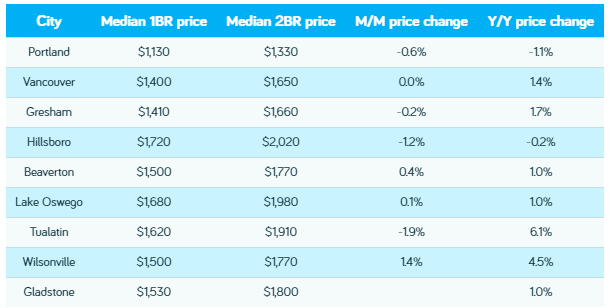
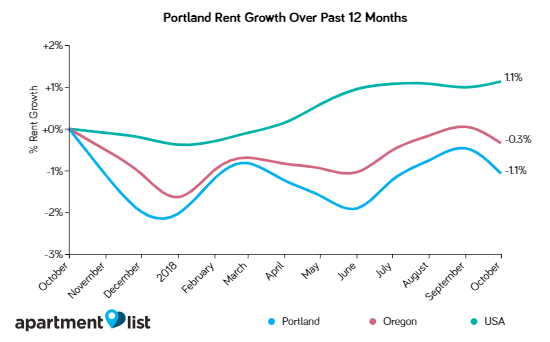
Portland rents have declined 0.6% over the past month, and are down moderately by 1.1% in comparison to the same time last year, according to a new report.

Currently, median rents in Portland stand at $1,130 for a one-bedroom apartment and $1,330 for a two-bedroom. Portland’s year-over-year rent growth lags the state average of -0.3%, as well as the national average of 1.1%, according to ApartmentList.com.

Rents rising across cities in the Portland metro

Portland Rents Continue Decline
Hillsboro and Beaverton rents most expensive in the Portland metro area.

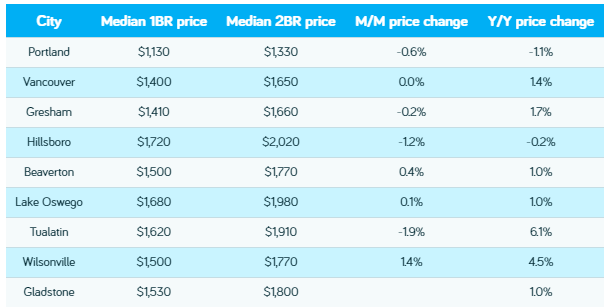
While rent decreases have been occurring in the city of Portland over the past year, cities in the rest of the metro are seeing the opposite trend.

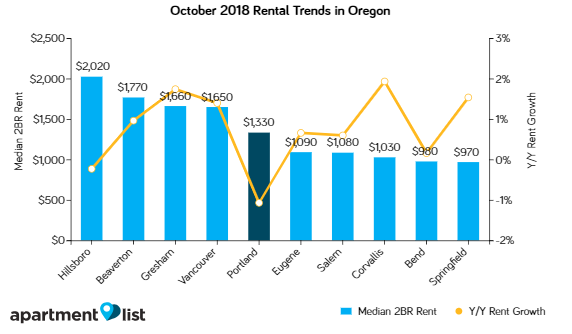
Rents have risen in 8 of the largest 10 cities in the Portland metro for which we have data. Oregon as a whole logged rent growth of -0.3% over the past year. Here’s a look at how rents compare across some of the largest cities in the metro.

  • Looking throughout the metro, Hillsboro is the most expensive of all Portland metro’s major cities, with a median two-bedroom rent of $2,020; of the 10 largest cities in the metro that we have data for, Hillsboro, where a two-bedroom goes for $2,020, is the only other major city besides Portland to see rents fall year-over-year (-0.2%).
  • Corvallis, Gresham, and Springfield have all experienced year-over-year growth above the state average (1.9%, 1.7%, and 1.5%, respectively).
Portland Rents Continue Decline
Rent prices around the metro.

Portland rents more affordable than many similar cities nationwide

Portland Rents Continue Decline
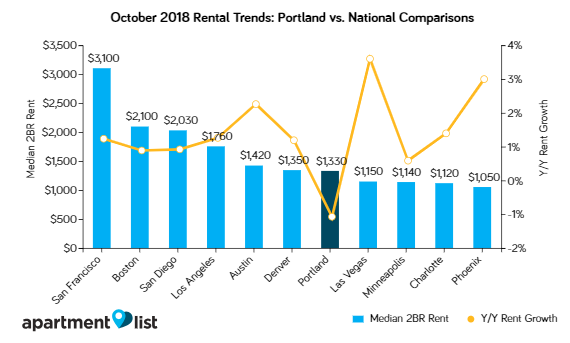
Portland rents compared to national rents.

As rents have fallen moderately in Portland, many other large cities nationwide have seen prices increase, in some cases substantially. Portland is also more affordable than most comparable cities across the country.

  • Portland’s median two-bedroom rent of $1,330 is above the national average of $1,180. Nationwide, rents have grown by 1.1% over the past year compared to the 1.1% decline in Portland.
  • While rents in Portland fell moderately over the past year, many cities nationwide saw increases, including Las Vegas (+3.6%), Phoenix (+3.0%), and Austin (+2.3%).
  • Renters will find more reasonable prices in Portland than most similar cities. For example, San Francisco has a median 2BR rent of $3,100, which is more than twice the price in Portland.

Eugene rents decline sharply over the past month

Eugene rents have declined 0.6% over the past month, but are up marginally by 0.7% in comparison to the same time last year. Currently, median rents in Eugene stand at $820 for a one-bedroom apartment and $1,090 for a two-bedroom. Eugene’s year-over-year rent growth leads the state average of -0.3%, but trails the national average of 1.1%.

Salem rents decline sharply over the past month

Salem rents have declined 0.9% over the past month, but are up marginally by 0.6% in comparison to the same time last year.

Currently, median rents in Salem stand at $820 for a one-bedroom apartment and $1,080 for a two-bedroom. Salem’s year-over-year rent growth leads the state average of -0.3%, but trails the national average of 1.1%.

Methodology:

Apartment List is committed to making our rent estimates the best and most accurate available. To do this, we start with reliable median rent statistics from the Census Bureau, then extrapolate them forward to the current month using a growth rate calculated from our listing data. In doing so, we use a same-unit analysis similar to Case-Shiller’s approach, comparing only units that are available across both time periods to provide an accurate picture of rent growth in cities across the country.

Our approach corrects for the sample bias inherent in other private sources, producing results that are much closer to statistics published by the Census Bureau and HUD. Our methodology also allows us to construct a picture of rent growth over an extended period of time, with estimates that are updated each month.

Rents Declined The Most In Portland Year-Over-Year


Apartment Residents Favor Living In A Green Apartment Community

Apartment Residents Favor Living In A Green Apartment Community

Apartments that pursue more environmental friendly practices will gain favor with a majority of apartment residents who believe global warming is a real danger and want to live in a green apartment community, according to a new survey.

The national survey by AMLI Residential shows that apartment residents are more likely to believe in global warning than the U.S. popular in general and it impacts where they choose to live.

Apartment residents would pay more to live in a green apartment community

The survey also found that 83 percent of respondents believe that living in a green community is beneficial to their health and 59 percent of respondents would pay more to live in a green/sustainable community.

The AMLI results are from the company’s second Sustainable Living index,  a survey of more than 4,200 apartment residents in their properties charting how their attitudes on environmentalism impact their choices on where to live.

Apartment Residents Favor Living In A Green Apartment Community
Residents would pay more to live in a green apartment community survey shows.

The 2018 survey indicated that 84 percent of respondents say they believe in global warming and/or climate change. This is significantly higher than the U.S. population at large according to recent data from the Yale Program on Climate Change Communications. According to the Yale research, which was published in July 2017, 70 percent of Americans believe global warming is happening with only 50 percent expressing certainty that global warming is happening.

Although the majority of the AMLI survey respondents were millennials (62 percent), belief in global warming was consistent across generations: roughly 89 percent of Gen Z, 88 percent of millennials, 80 percent of Gen X and 74 percent of baby boomers surveyed believe in global warming and/or climate change.

“This year’s survey shows apartment residents remain concerned about the environment and are committed to making lifestyle choices to reduce their carbon footprint,” Phil Tague, President of AMLI Residential, said in a release.

“The residents surveyed are mindful of how daily activities and where they live might impact their health as well as the environment. AMLI continues to invest in conscious and sustainable practices to make sure we deliver on what’s important to our residents. Our communities use land, water and energy more efficiently through clean-air initiatives and lifestyle amenities that enable residents to live more sustainably every day.”

The survey of AMLI residents was conducted in August 2018 at properties in Atlanta, Austin, Chicago, Dallas, Denver, Houston, Seattle, Southern California and Southeast Florida. AMLI expanded this year’s survey to help it better understand its residents’ interest in sustainable living compared to 2017 survey results. AMLI will utilize the results to further advance its sustainability efforts and improve residents’ wellness and living experiences.

About AMLI:

AMLI is a leader in multifamily sustainability. Thirty-two AMLI properties (almost half of the company’s portfolio) are LEED (Leadership in Energy and Environmental Design) certified and 25 AMLI communities are ENERGY STAR certified. AMLI’s goal is to grow its portfolio to more than 50 percent LEED-certified properties by 2019. Last month, AMLI received a LEED Power Builder Award from the U.S. Green Building Council (USGBC), which recognizes developers that certify at least 90 percent of their units built in the past year. AMLI Residential focuses on the development, construction and management of environmentally responsible, luxury apartment communities throughout the U.S. Founded in 1980, AMLI is owned by PRIME Property Fund, a core commingled institutional fund. AMLI currently owns and manages 61 apartment communities including more than 20,000 apartment homes and has over 5,100 additional apartment homes under development or in lease-up at 14 new properties, all of which are, or will be, LEED-certified. More information is available at www.amli.com.