Home Blog Page 186

Seattle Company Buys Beaverton Apartments For $84 Million

Seattle Company Buys Beaverton Apartments For $84 Million

Security Properties of Seattle has purchased  Beaverton apartments Arbor Creek, a 440-unit, Class-B garden-style community located in Beaverton, Oregon for $84 million marking the company’s ninth asset in the Portland metro, according to a release.

Around the Beaverton apartments the area is best characterized by its suburban neighborhood feel, 25 minutes west of downtown Portland, and convenient access to the largest employers in the Portland area.

Arbor Creek is close to SW Tualatin Valley Highway, the primary thoroughfare connecting Hillsboro and Beaverton. Within a 10 minute drive, residents have access to grocers, Regal Cinemas, a MAX line, and the Tualatin Hills Nature Park. The park, sitting directly adjacent to the property, offers 5 miles of scenic wetland walking trails spread out over 222 acres.

“Arbor Creek was a target for our portfolio because of the clear value-add opportunity,” Davis Vaughn, Senior Director of Investments at Security Properties, said in the release.

“Additionally, with a significant supply-demand imbalance due to the suburban Portland job creation, Arbor Creek is well positioned for future growth.  We look forward to implementing our business plan and creating value for our investors,” he said.

Company plans improvements at Beaverton apartments

Seattle Company Buys Beaverton Apartments For $84 Million
Security Properties will be improving the Beaverton apartments units by installing vinyl planks throughout and updating the clubhouse,

The units at Arbor Creek offer a mix of 1×1 and 2×2 floor plans.

Current ownership has renovated approximately 80% of the units with upgraded cabinets, resurfaced counters, vinyl flooring, faux stainless steel appliances, and upgraded light fixtures.

Security Properties will be improving the units by installing vinyl planks throughout, in addition to spraying the countertops. Security Properties will also be updating the clubhouse, revamping the pool deck and improving the outdoor common spaces, according to the release.

Beaverton is renowned globally for being the home of Nike whose world headquarters is located less than 10 minutes from the property.

Nike’s employment in Oregon has increased by almost 60% since 2007, bringing total employment in Beaverton to 8,500 and 56,500 worldwide. To accommodate the increased headcount, construction began on a $380 million, 3.2 million square foot expansion in January of 2015, and the project’s anticipated completion is slated for the end of 2018.

Additionally, the largest employer in Oregon, Intel, has four campuses within 15 minutes of the property. Ronler Acres, their most regarded campus, serves as their largest concentration of facilities and talent in the world.

The property will be managed by Security Properties-affiliate Security Properties Residential.

About Security Properties
Security Properties is a national real estate investment, development, and operating company headquartered in Seattle, Washington. For more than 48 years, Security Properties has provided quality housing to its residents as well as excellent financial performance for its investors. Since its founding, Security Properties has acquired or developed over 83,000 residential units at a cost of over $5.7 billion. Security Properties maintains a focused multi-family strategy supported by integrated teams of professional acquisition, development, construction, investment, and property management specialists. For more information, visit www.securityproperties.com

About Security Properties Residential
Security Properties Residential is the affiliated property management firm of Security Properties.


25-Story High-Rise Seattle Apartment Tower Opens

25-Story High-Rise Seattle Apartment Tower Opens

A Seattle apartment tower, South Lake Union’s first high-rise, has completed construction and opened welcoming new residents, according to a release.

Ascent South Lake Union by national multifamily developer Greystar, has 251 contemporary high-rise apartment homes inspired by the merging of modernity and nature in the 25-story building.

The apartment tower provides an all-inclusive living experience, signature interior design, unrivaled amenities, seamless resident services and 360-degree breathtaking views – all in one of Seattle’s most sought-after locations, according to the release.

“As we continue to experience strong demand in the high-end rental market in Seattle, particularly in the budding neighborhood of South Lake Union, we are thrilled to officially open the doors at Ascent South Lake Union and welcome our first residents to this distinguished building,” Aaron Keeler, Director of Development at Greystar, said in the release.

“We developed Ascent in response to the overwhelming market demand for condo-quality living in a high-rise apartment setting. With service and convenience as our key pillars, we have already received a strong response from prospective residents and anticipate a greater influx on the heels of opening our doors.”

Seattle apartment tower prices start at $2,600 per month

Designed by award-winning local architecture firm Weber Thompson, Ascent South Lake Union has one-, two- and three-bedroom residences and penthouses ranging in size from 669 square feet to 1,831 square feet.

Prices ranging from $2,600 to $9,355 per month.

All homes feature:

  • California Closets
  • Nest Thermostats
  • Blomberg stainless steel appliances
  • Custom kitchens
  • Gas ranges and marble inspired stone countertops

Penthouses feature hard wood floors, waterfall marble kitchen islands, Monogram 28-bottle wine reserve, charcoal filtered water with instant hot and cold settings, Brizo kitchen and bath fixtures, oversized windows, walk-in California Closets and smart home technology beyond Nest Thermostats including automatic window shades and light switches controlled by Amazon Alexa and secret TV screens embedded into the bathroom mirrors.

25-Story High-Rise Seattle Apartment Tower Opens
All Seattle apartment tower homes feature California Closets Nest thermostats Blomberg stainless steel appliances, custom kitchens, gas ranges and marble inspired stone countertops

Ascent South Lake Union features common areas styled by award-winning Seattle-based interior design firm Susan Marinello Interiors, whose notable work in Washington includes The Private Residences at The Four Seasons Seattle, Hotel Theodore and Woodmark Hotel.

The communal spaces were conceived to act as an extension of nearby Lake Union through the use of wood, stone and natural elements that are authentic to Seattle.

Nautical elements throughout the building, including custom imagery of seaplanes, polished chrome light fixtures, navy color accents and camel leather, marry the lake lifestyle in a contemporary and hospitality-inspired fashion. A modern reflection of Lake Union’s mirroring lake, the exterior of the high-rise was intentionally designed to resemble rain cascading down the building.

Seattle apartment tower deck features 360-degree views

Ascent South Lake Union offers residents a robust amenity collection highlighted by The Observatory, expansive rooftop lounge and open-air deck surrounded by captivating 360-views of the downtown skyline, Lake Union and the Space Needle. Designed to allow all-season outdoor-indoor living.

The Observatory features multiple indoor and outdoor social lounge areas with firepits, BBQ grills, overhead heaters, indoor entertainment kitchen complete with a Franke Espresso Cappuccino Machine espresso machine, a game room with life-size Scrabble board and a rooftop spa.

Additional resident amenities include a movement studio with virtual fitness classes, Luxer One package lockers, a 2,600-square-foot state-of-the-art fitness center with fitness courtyard and towel service, dedicated co-working space and a conference room, and 24-hour concierge service catering to resident’s every whim whether it’s dry cleaning or restaurant recommendations.

Seattle apartment tower pet friendly

The pet-friendly community also offers an industrial pet wash station and rooftop dog run.

Parking is also provided onsite with electric car charging stations and indoor bicycle storage.

As the base of the tower, a total of six different retailers will be among the new offerings coming to the building.

About Ascent South Lake Union

Developed by Greystar, Ascent South Lake Union is a 25-story luxury apartment tower in Seattle’s up-and-coming neighborhood of South Lake Union. Comprised of 251 modern residences and a full suite of amenities, Ascent South Lake Union is located adjacent to Amazon headquarters and within walking distance of major employers.

Did You Know Fair Housing Laws Apply To Vendors Working At Your Property?

Did You Know Fair Housing Laws Apply To Vendors Working At Your Property?

Apartment vendors and contractors should be provided with key points regarding fair housing laws so this week the Grace Hill training tip takes a look at this issue.

By Ellen Clark

Fair housing is a topic of great importance for anyone working in the multifamily industry.

In fact, it’s so important that fair housing law doesn’t just apply to your full-time employees.

If a vendor or contractor working on-site is accused of discrimination, there can be serious consequences for your community, property management company, and the individual accused of discrimination.

 How much do your vendors know about fair housing laws?

It is important that your vendors and contractors understand and comply with fair housing laws.

But you can’t teach a vendor everything there is to know about fair housing law – after all, you and your employees have spent years developing your understanding of the law and how to apply it.  What can you do?

 Consider making sure that, at a minimum, vendors and contractors know about the following topics

The basics of fair housing law:

  •         The purpose of the law and who is protected by it
  •         The definition of discrimination and some examples of discriminatory behavior
  •         The definition of harassment and some examples of harassing behavior
  •         What reasonable accommodations and modifications are

5 basic responsibilities of vendors on your property

It is important to follow the basic fair housing laws in every interaction. 

No. 1 – Don’t discriminate

Treat all residents fairly, equally, and consistently.

Treating one person differently from others could lead to a discrimination complaint.

 No. 2 – Be professional and watch out for unintended consequences

Maintain professionalism at all times.

What seems like a funny joke to one person can be offensive or threatening to another.

Something that is intended as a compliment can easily cross the line into inappropriate behavior.

No. 3 – Be careful with small talk

It’s easy to get into fair housing trouble simply by chatting with residents.

While there’s nothing wrong with being friendly, be very careful not to ask questions about any of the protected classes. In most situations, a polite smile and nod or “hello, how are you?” are sufficient.

 No. 4 – Don’t share information about residents

If someone asks you questions like, “What kind of people live here?” or “Does everyone speak English?” don’t give them specific information or invite them to walk around and see for themselves. Instead, let them know that anyone who meets the community’s qualification guidelines is welcome to live there. If pressed further, direct the individual to the leasing office.

 No. 5 – Don’t ask about a disability

Never ask about a resident’s disability, whether or not they have a disability, or what work an assistance animal performs.

More often than not, asking questions about a disability is a violation of the Fair Housing Act. It is best to avoid these types of questions altogether.

Most importantly, make sure vendors and contractors know that when in doubt, they should contact management with questions or concerns. This is truly a case of better safe than sorry!

Did You Know Fair Housing Laws Apply To Vendors Working At Your Property?
It is important that your vendors and contractors understand and comply with fair housing laws. Photo credit monkeybusinessimages via istockphoto.com

Read Ellen’s blog post here.

Recent Grace Hill training tips you may have missed:

Are You Confused By Requests For Service, Emotional Support And Assistance Animals?

What Do You Do When Assistance Animals Break The Rules?

7 Ways To Stay Out Of Trouble When Checking Criminal History

5 Ways To Protect Applicants, Residents And Employees From Sexual Harassment

Do You Have A Smoke-Free Policy That Adequately Protects Residents?

How To Handle Suspicious Documentation For Assistance Animals

How A No Pet Policy Can Be Discriminatory

Property Management Cyber attack Risks Overlooked, Underestimated

Do You Know How To Respond To a Sexual Harassment Complaint?

Have You Reviewed Your Criminal Background Checks Policy Lately?

Multifamily Managers And Marijuana: Caught In A Pot Crossfire

Fair Housing Discrimination Against Someone You’ve Never Talked To?

4 Ways To Avoid Screening Pitfalls With Applicants

Red Flags In Evaluating Documentation For Assistance Animals

About the author:

Ellen Clark is the Director of Assessment at Grace Hill.  Her work has spanned the entire learner lifecycle, from elementary school through professional education. She spent over 10 years working with K12 Inc.’s network of online charter schools – measuring learning, developing learning improvement plans using evidence-based strategies, and conducting learning studies. Later, at Kaplan Inc., she worked in the vocational education and job training divisions, improving online, blended and face-to-face training programs, and working directly with business leadership and trainers to improve learner outcomes and job performance. Ellen lives and works in Maryland, where she was born and raised.

About Grace Hill

For nearly two decades, Grace Hill has been developing best-in-class online training courseware and administration solely for the Property Management Industry, designed to help people, teams and companies improve performance and reduce risk. Contact Grace Hill at 866.472.2344 to hear more


Walking The Dog Leads To HUD Discrimination Charge Against Condo Association

Walking The Dog Leads To HUD Discrimination Charge Against Condo Association
Blind or visually impaired woman out for a walk helped by her guide dog. White cane in one hand while holding the dog with the other.

A resident walking her mother’s dog, an assistance animal, to a common area was fined $100 by a condo association and the U.S. Department of Housing And Urban Development (HUD) has filed a discrimination charge, according to a release.

Specifically, HUD’s charge alleges that the condo association only allowed the resident, who is sight and hearing impaired, to use the service door instead of the main entrance to the development or the common areas when accompanied by her assistance animal.

Rules said dog had to be in a crate

While the association, Hudson Harbour Condominium Association, Inc., in Newark, NJ,  waived the no pet policy, it would not modify requirements that demanded the 75-pound assistance animal be carried in a crate or carrier to common areas, according to the complaint.

HUD’s charge further alleges that the condominium association charged the resident’s daughter a $100 fee because she walked her mother’s assistance animal in the development’s common areas. Read the charge.

The Fair Housing Act prohibits housing providers from denying or limiting housing to persons with disabilities or from refusing to make reasonable accommodations in policies or practices.

“Subjecting someone to different residency requirements because they use an assistance animal prevents that person from fully enjoying their home and is against the law,” Anna María Farías, HUD’s Assistant Secretary for Fair Housing and Equal Opportunity, said in the release.

“Condo associations have an obligation to comply with the requirements of the Fair Housing Act when it comes to reasonable accommodations and HUD is committed to ensuring that they meet that obligation.”

Daughter had to walk the dog for the resident

The case came to HUD’s attention when the daughter of a condominium resident who uses an assistance animal filed a complaint alleging that the condominium association refused to waive its requirement that residents transport pets in carriers when in common areas. She was fined $100 for walking the animal in the development’s common areas.

Because of the resident’s mobility impairments, her daughter was primarily responsible for walking the dog. Additionally, when the resident was with her assistance animal, she was required to use the service door to enter and exit the building.

“Rules that limit access to condominium common areas for persons with disabilities who need an assistance animal violate the Fair Housing Act,” J. Paul Compton Jr., HUD’s General Counsel, said in the release. “This charge represents HUD’s commitment to ensuring that persons with disabilities are allowed to fully use and enjoy their homes.”

The charge will be heard by a United States Administrative Law Judge unless any party elects for the case to be heard in federal court. If the administrative law judge finds after a hearing that discrimination has occurred, he or she may award damages to the individual complainant for his or her loss as a result of the discrimination. The judge may also order other injunctive or equitable relief, as well as payment of attorney fees. In addition, the judge may impose civil penalties to vindicate the public interest.

Last April, HUD marked the 50th anniversary of the Fair Housing Act, joining local communities, housing advocates, and fair housing organizations across the country in a coordinated campaign to enhance awareness of fair housing rights.

Are You Confused By Requests For Service, Emotional Support And Assistance Animals?

Walking The Dog Leads To HUD Discrimination Charge Against Condo Association
Blind or visually impaired woman out for a walk helped by her guide dog. White cane in one hand while holding the dog with the other. Photo credit Reimphoto via istockphoto.com

Property Management Job Demand Up In Third Quarter

Property Management Job Demand Up In Third Quarter

Property management job demand was up during the third quarter, according to the National Apartment Association’s (NAA) Education Institute jobs report.

Austin, Portland and Denver had the greatest concentration of openings for property management professionals, each more than three times the U.S. average.

In Austin, a number of positions specifying “multi-site” or “floating” property managers was a testament to the talent shortage.

Overall apartment job openings increased

Property Management Job Demand Up In Third Quarter

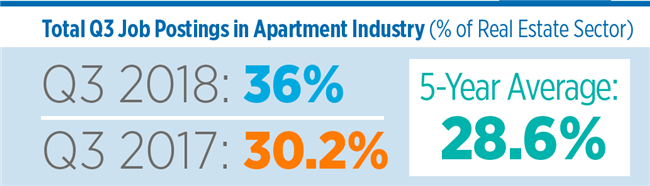
The apartment industry increased its share of job openings in the real estate sector during the third quarter, to 36 percent from 30.2 percent in Q3 2017, according to the NAA report.

New supply and a steady rate of demand contributed to strong growth and a pressing need for additional staffing.

Apartment jobs were available in markets of all sizes, but in terms of sheer numbers of job openings, Los Angeles, Dallas and Washington, D.C. came out on top. Over the past year, Denver and Atlanta dropped out of the top 5 for all types of positions. The pace of new deliveries in both markets slowed dramatically in 2018, according to CoStar data.

Property Management Job Demand Up In Third Quarter

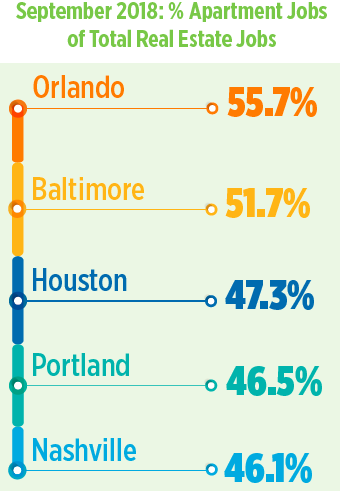
The NAAEI monthly ranking by city showed Orlando in the top 5 for the first time this year. Of these markets, Houston appeared the most frequently, four times during the first nine months of this year with increased activity post-Harvey and improving economic fundamentals.

The retail trade and hospitality sectors often compete for similar skill sets. The greatest share of job openings in those sectors fall within the lowest pay scale (below $35,000 per year). The apartment industry offered more competitive salaries with over 75 percent of jobs.

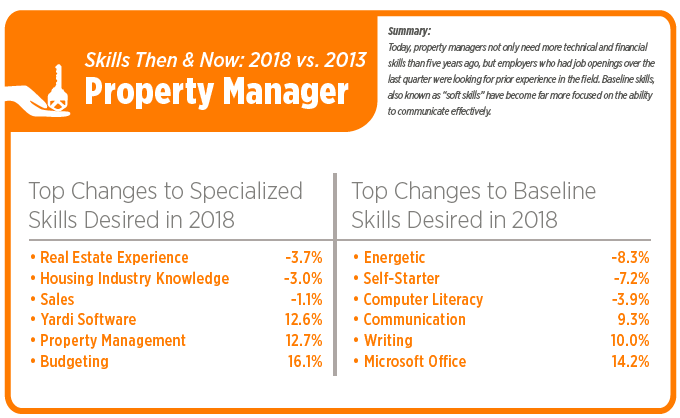
“Today, property managers not only need more technical and financial skills than five years ago, but employers who had job openings over the last quarter were looking for prior experience in the field. Baseline skills, also known as ‘soft skills’ have become far more focused on the ability to communicate effectively, the report said.

NAA a leader in education

The jobs report focuses on jobs that are being advertised in the apartment industry as being available, according to Paula Munger, Director, Industry Research and Analysis, for the National Apartment Association’s Education Institute.

“Our education institute is a credentialing body for the apartment industry. They hear often that one of the biggest problems keeping our industry leaders up at night is the difficulty in finding talent, attracting talent and retaining talent,” Munger said.

“Labor-market issues are happening in a lot of industries, certainly with the tight labor market we have.”

That is why NAA decided to partner with Burning Glass Technologies. “They have a labor-job posting database that is proprietary,” she said, and they can “layer on data from the Bureau of Labor Statistics (BLS).

We looked at that and thought we could do something that is really going to help the industry and help benchmark job titles and trends as we go forward,” she said.

Demand For Maintenance Techs Tops Apartment Jobs Need

About the National Apartment Association Education Institute:

NAAEI’s mission is to provide broad-based education, training and recruitment programs that attract, nurture and retain high-quality professionals and develop tomorrow’s apartment industry leaders.

Why Completing All Compliance Training Is Critical To Your Protection

Compliance training is important for landlords and property managers to keep up with ever-changing rental housing laws at federal, state and local levels. The Grace Hill training tip this week focuses on the second in the series on compliance training.

By Ellen Clark

Once I had a nagging running injury and was prescribed physical therapy.

In addition to sessions two times a week, the physical therapist gave me stretches to do daily, on my own.  Weeks went by and the injury still nagged.

Frustrated, I told the physical therapist, “This isn’t working.”

 Stretches don’t work if you are not actually doing them

She asked if I was doing the stretches every day.

After moment of thought, I told her I was doing the stretches almost every day. “Well,” she said, “we can’t say the stretches don’t work if you aren’t actually doing them.”

Ok, so she had a point.

Something similar can happen with training.

As trainers or administrators, we don’t see results and we get frustrated. We scrap what we’re doing for something new.

Are your employees actually completing the important compliance training?

But what we often don’t investigate first is, are people actually completing training, and are they completing it in the way it was designed to be completed?

In compliance this is particularly important to complete the training the way it was designed. Should you ever need to defend your training – in court, lawsuits, etc – the more you know about who did what and when, the better off you’ll be.

Measuring training implementation is the low hanging fruit of compliance training evaluation, but it is also one of the most important things to measure.

Here are some things to consider.

Track your employees’ training programs, both online and in real life.

Diligently track employee training via both your learning management system (LMS) and in-person training activities.

What’s Your Denominator? 

When tracking compliance training completion, absolute numbers are useful, but percentages are more informative.

It is generally more useful to know that 100% of people completed training than it is to know that 136 people completed training. Always track who is supposed to have completed training, so you have your denominator.

 Meticulously Track Participation

If you use online training, make sure employees are in the system correctly and that your LMS allows you to track training completion and retrieve the data at the employee level. Use a sign-in sheet for in-person training, and take roll call on a webinar. Always track the date training was completed.

Avoid pursuing a false path by collecting and evaluating complete information regarding your training program.

Collecting and evaluating compliance training implementation data helps to ensure you don’t get dragged down the wrong path when attempting to correct an issue or concern.

Go beyond Participation – Track Implementation 

In an ideal world, what are all the things a person would do to complete training the way you designed it?

    • Is there a follow-up assignment to an online training module?
    • Is there a role play activity during an in-person training?
    • List these things out and track who did them.

This will help you know how many people completed the training with fidelity. If your evaluation doesn’t show the results you’d hoped, maybe it isn’t that the stuff isn’t working, maybe it is that people aren’t doing all the stuff.

Collecting compliance training implementation data guards against drawing wrong conclusions about effectiveness. You don’t want to conclude that training didn’t work when, in fact, the issue was that people didn’t complete the training, or didn’t complete it with fidelity.

In compliance this is particularly important. Should you ever need to defend your training, the more you know about who did what and when, the better off you’ll be.

Next up, we’ll look at some basic tips for measuring learning in compliance training.

This is the second post in a series about how to measure the effectiveness of your compliance training program. Read Part 1 here.

Read Ellen’s full blog post here.

About the author:

Ellen Clark is the Director of Assessment at Grace Hill.  Her work has spanned the entire learner lifecycle, from elementary school through professional education. She spent over 10 years working with K12 Inc.’s network of online charter schools – measuring learning, developing learning improvement plans using evidence-based strategies, and conducting learning studies. Later, at Kaplan Inc., she worked in the vocational education and job training divisions, improving online, blended and face-to-face training programs, and working directly with business leadership and trainers to improve learner outcomes and job performance. Ellen lives and works in Maryland, where she was born and raised.


Compliance training is important to your protection as an owner, landlord and property manager


Photo credit Tumsasedgars via istockphoto.com


Company Fined $3 Million For False Tenant Screening Linking Apartment Applicants To Crimes

Company Fined $3 Million For False Tenant Screening Linking Apartment Applicants To Crimes

Property management company RealPage has agreed to pay $3 million to settle Federal Trade Commission charges the company failed to take reasonable steps to ensure the accuracy of tenant screening information provided to landlords and property managers, a violation of federal law that caused some potential renters to be falsely associated with criminal records, according to a release.

“In numerous instances, RealPage failed to follow reasonable procedures to assure maximum possible accuracy of the criminal record information in its tenant screening reports. Since at least Jan. 1, 2012, through Sept. 19, 2017 … RealPage failed to follow reasonable procedures to assure that the criminal record information contained in its tenant screening reports concerned the actual applicant for housing,” according to the FTC release.

RealPage said in a statement the FTC questioned the accuracy of a minuscule fraction of the company’s screening report results. The company is a provider of software and data analytics to the apartment industry and real estate industry and compiles screening reports through an automated system

The FTC’s complaint alleges that RealPage, Inc. violated the Fair Credit Reporting Act (FCRA) by failing to take reasonable steps to ensure the accuracy of tenant screening information provided to its clients.

The amount RealPage has agreed to pay as part of the settlement is the largest civil penalty the FTC has obtained against a background screening company.

Tenant screening reports associated potential renters with criminal records that did not belong to them

“You shouldn’t get turned down for an apartment because someone has the wrong information about you,” Andrew Smith, Director of the FTC’s Bureau of Consumer Protection, said in the release. “This case shows that, especially with today’s tight rental market, we will hold tenant screening companies responsible for the accuracy of their reports.”

The FTC alleges that from at least January 2012 until September 2017, RealPage used broad criteria to match applicants to criminal records and only applied limited filters to the results, and did not have policies or procedures in place to assess the accuracy of those results.

RealPage compiled screening reports through an automated system that used the applicant’s first name, middle name when available, last name, and date of birth when searching for criminal records.

Its matching criteria only required an exact match of an applicant’s last name along with a non-exact match of a first name, middle name, or date of birth, the FTC alleges. For example, if RealPage searched an applicant named Anthony Jones born on Oct. 15, 1967, it would deem a match if it found a criminal record for Antony Jones 10/15/67, Antonio Jones 10/15/67 and Antoinette Jones 10/15/67, according to the FTC.

RealPage disagrees with FTC assertions

In a statement the company said, “During its investigation, the FTC questioned the accuracy of a minuscule fraction of RealPage’s screening report results. The FTC’s investigation centered on certain ‘soft’ matching practices for consumers with common last names. The FTC was unable to identify any prior industry or regulatory guidance or other clear legal precedent that RealPage should have followed. No judicial findings of fact were made and, as set forth in the Stipulated Order, RealPage makes no admission of wrongdoing. All of the practices identified by the FTC predated RealPage’s release of innovative new matching logic in September 2017.

“We were disappointed that the FTC singled out RealPage for an issue that has confronted the entire screening industry, namely how to match applicants with common last names to public records when most courts do not make Social Security or driver’s license numbers available as part of those records. We believe our newest matching technology provides market-leading accuracy in spite of these challenges. While we disagree with the FTC’s assertions, we agreed to settle this matter in order to avoid the expense and distraction of litigation,” the company said in a release.

Tenant screening reports to landlords and property managers had records of individuals other than the applicant

“RealPage would provide reports containing records of several different individuals with different names and, in some instances of sex offender registry information, would provide reports containing photographs of several different individuals with different names,” the complaint says.

“RealPage provided consumer reports to clients, including landlords and property managers, that included criminal records of individuals other than the applicant, including:

  1. individuals with a different name from the applicant (including names that are not common nicknames or slight misspellings of the applicant’s name);
  2. individuals with a different date of birth from the applicant;
  3. multiple individuals with different names, dates of birth, and differences in other identifiers such as gender or race;
  4. multiple individuals with different photographs.

Renters may have been turned down for housing after tenant screening

Because RealPage’s screening reports associated some potential renters with criminal records that did not belong to them, those renters may have been turned down for housing or other opportunities, according to the complaint.

In addition to the civil penalty, the proposed settlement also requires RealPage to maintain reasonable procedures to assure the maximum possible accuracy of the information it includes about individuals in its consumer reports. In addition, RealPage is subject to compliance and reporting requirements.

The Commission vote authorizing the staff to file the complaint and stipulated final order was 5-0. The FTC filed the complaint and final order in the U.S. District Court for the Northern District of Texas, Dallas Division. NOTE: The Commission files a complaint when it has “reason to believe” that the law has been or is being violated and it appears to the Commission that a proceeding is in the public interest. Stipulated final orders have the force of law when approved and signed by the District Court judge.

RealPage has been expanding and this month announced that it has entered into an agreement to acquire Rentlytics, which will expand the company’s business intelligence and performance analytics platform by nearly 900,000 additional multifamily units. Rentlytics provides owners and operators with normalized data across multiple third-party systems, resolving system incompatibility, data accuracy issues and time-to-analysis delays.


Resources:

Texas Company Will Pay $3 million to Settle FTC Charges That it Failed to Meet Accuracy Requirements for its Tenant Screening Reports

RealPage FTC Settlement Statement

FTC vs. RealPage Stipulated Order For Permanent Injunction And Civil Penalty

FTC vs. RealPage Complaint

Fair Credit Reporting Act

Richardson’s RealPage to pay $3 million fine for falsely linking apartment applicants to crimes


Property Management Company Databases Can Be Targets For Hackers

Property Management Company Databases Can Be Targets For Hackers

Hackers typically target databases that store information about many people, which makes property management company databases attractive targets so this week the Grace Hill training tip takes a look at the issue.

By Ellen Clark

Cybersecurity is critical to the property management industry because of the type, and amount of data collected and used on a daily basis.

The topic of cybersecurity was one of the key themes of the 2017 National Multifamily Housing Council annual conference, and property management companies are looking at new ways to safeguard residents’ privacy and protect personal data.

Cybersecurity and property management company databases how safe are you?

Personally Identifiable Information (also known as PII) is any information which can be used, either alone or with other data, to uniquely identify, contact or locate a person. Although you might think that credit card numbers would be the most valuable information for cybercriminals, it turns out that PII is the most attractive information to cybercriminals.

Property management companies collect, use and store huge amounts of highly sensitive, personal, private data about prospective residents, employees, vendors, and current residents. This includes information found in leases, rental applications and other documents such as Social Security numbers, insurance information, addresses, employment history, and financial records.

Unfortunately, the most commonly collected and stored data in the property management industry is also the most sought after by criminals.

Hackers tend to look for the biggest reward for the least amount of effort, so they typically target databases that store information about many people. The wealth of valuable personal information stored, therefore, makes every property management company a very attractive potential target for hackers.

Like many challenges companies experience, strong cybersecurity traces back to one factor — the people. Many of the costliest data breaches are the result of human error and negligence—either someone clicking on a link in a phishing email without thinking, linking an infected phone or tablet to a company network, or simply losing or having stolen a device containing sensitive data.

How are you training your employees who are the first line of defense against cybercrime?

 If you don’t have a training solution in place, there’s no time like the present to think about it.

All employees play an important role in creating a culture of cybersecurity within your company.

Cybersecurity is a risk for companies of all sizes and is becoming increasingly important to pay attention to. Cybersecurity can no longer be seen as a concern for only the “IT” department or specialist. All employees play an important role in creating a culture of cybersecurity within your company and protecting the sensitive personal information of all residents, vendors, and co-workers.

The cybersecurity landscape will keep changing as will the threats, vulnerabilities and security challenges created by an increasingly connected world. This is why cybersecurity awareness is so important and implementing best practices can help property management companies keep their own and their residents’ data more secure.

Read Ellen’s blog post here.

Recent Grace Hill training tips you may have missed:

What Do You Do When Assistance Animals Break The Rules?

7 Ways To Stay Out Of Trouble When Checking Criminal History

5 Ways To Protect Applicants, Residents And Employees From Sexual Harassment

Do You Have A Smoke-Free Policy That Adequately Protects Residents?

How To Handle Suspicious Documentation For Assistance Animals

How A No Pet Policy Can Be Discriminatory

Property Management Cyberattack Risks Overlooked, Underestimated

Do You Know How To Respond To a Sexual Harassment Complaint?

Have You Reviewed Your Criminal Background Checks Policy Lately?

Multifamily Managers And Marijuana: Caught In A Pot Crossfire

Fair Housing Discrimination Against Someone You’ve Never Talked To?

4 Ways To Avoid Screening Pitfalls With Applicants

Red Flags In Evaluating Documentation For Assistance Animals

About the author:

Ellen Clark is the Director of Assessment at Grace Hill.  Her work has spanned the entire learner lifecycle, from elementary school through professional education. She spent over 10 years working with K12 Inc.’s network of online charter schools – measuring learning, developing learning improvement plans using evidence-based strategies, and conducting learning studies. Later, at Kaplan Inc., she worked in the vocational education and job training divisions, improving online, blended and face-to-face training programs, and working directly with business leadership and trainers to improve learner outcomes and job performance. Ellen lives and works in Maryland, where she was born and raised.

About Grace Hill

For nearly two decades, Grace Hill has been developing best-in-class online training courseware and administration solely for the Property Management Industry, designed to help people, teams and companies improve performance and reduce risk. Contact Grace Hill at 866.472.2344 to hear more

Portland Mayor To Take On Short-Term Fake Rental Owners And Airbnb

Portland regulators, through the city’s revenue department,t have reached a memorandum of understanding with Airbnb

Back in August Portland auditors found about 80 percent of short-term rentals operate illegally, and now the Portland Tribune in an excellent article has exposed a fictitious Airbnb host named Nadia who claimed to live in Portland, Seattle and San Diego and had hundreds of short-term rental listings.

Portland’s short-term rental regulations require hosts to get a Type A or Type B permit depending on the size of the rental and follow certain restrictions:

  • The host must occupy the residence at least nine months of the year
  • The rental property must be the primary residence of the host
  • A maximum of 25 percent of units in a multi-family building may be rented
  • Rentals must be for less than 30 days

“Nadia claimed on the Airbnb website to live in Portland, Seattle and San Diego. The photo of Nadia used with her listings, the Tribune discovered, is the exact same image used by a model for web pieces such as “100 Pretty Back to School Outfits” and “Becoming a Preppy Girl in High School.” Nadia’s listings also use the same photos repeatedly to depict multiple Airbnb listings in Portland and other cities,” the Tribune reported.

The Tribune reported that the fraudulent host, Nadia still had 120 Portland properties listed on Airbnb, plus nearly 500 in five other cities even after they exposed her as a fictitious host.

Short-term rental companies operating like the Wild West

As a result of the Tribune’s reporting, Portland Mayor Ted Wheeler told the newspaper “Airbnb and other short-term rental companies have been operating like ‘the Wild Wild West’ in Portland, but now ‘there’s a new sheriff in town.’ ”

Wheeler told the Tribune a pending deal being negotiated with Airbnb will make it easy to eliminate illegal or bogus listings on the short-term rental website by allowing the company to register its own hosts online, if they attest that they are meeting city rules. The city would end mandatory inspections of potential Airbnb properties by the Bureau of Development Services, while retaining the right to do spot inspections.

In exchange, Airbnb would have to divulge the names and addresses of its hosts to the city.

The Bureau of Development Services conducts home inspections before issuing permits to ensure the safety of visitors renting the units. Development Services also investigates complaints and enforces short-term rental regulations.

Portland reached agreement with short-term rental company HomeAway

Hosts are required to obtain a business license from the Bureau of Revenue and Financial Services and pay City taxes and fees. Those taxes include the lodging tax also required of hotels, and a business tax if rental and other business income combined exceeds $50,000 per year. Recent changes to city tax codes also added fees specific to short-term rentals. Online booking agents may remit lodging taxes and fees on behalf of hosts.

The city’s audit in August said, “Of approximately15 booking agents active in Portland, none regularly provide data to the City, citing privacy protections for hosts. The City recently reached an agreement with one booking agent, HomeAway, to provide data on hosts as soon as Airbnb also agrees to provide data to the City. At the time of this audit, the City had not yet reached agreement with other booking agents.”

Resources:

City looks to rein in ‘Nadia,’ other fictional rental owners

Host or Hoax? Meet Nadia . . .

80 percent of Portland Airbnb-style rentals operate illegally, audit finds

SHORT-TERM RENTAL REGULATION: Enforcement is lax and effect on housing crisis unknown

Portland Mayor To Take On Short-Term Rental Problem
Photo credit Artur via istockphoto.com

Goodbye LA, Hello Phoenix As Residents Move To Find Affordable Housing Solutions

Goodbye LA, Hello Phoenix As Residents Move To Find Affordable Housing Solutions

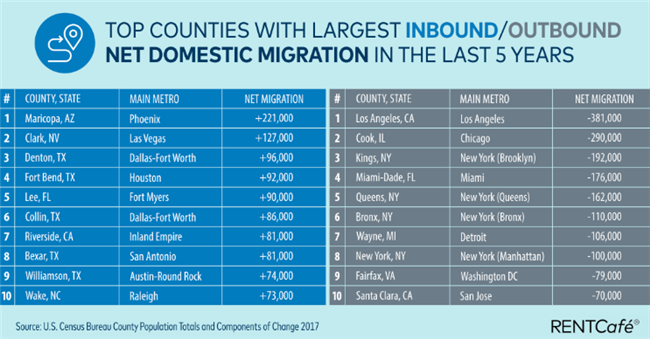
The Phoenix metro area and Dallas-Fort Worth top the list of areas where people are moving to find more affordable housing solutions and a less expensive metro to live in, according to a study from RentCafe.

Maricopa County with a median income just $3,000 less than that in Los Angeles and a rent $1,000 cheaperhas become increasingly popular among those fleeing hot markets like the ones in California. Same goes for the top Texas counties where the median income is above that in Manhattan ($83,500).

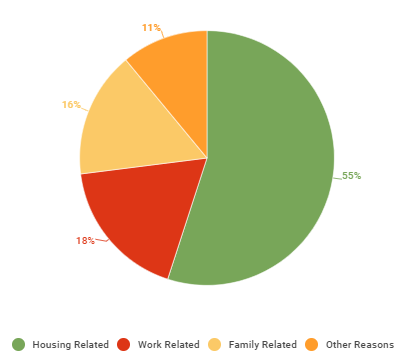
According to the US Census Bureau, 55% of the U.S. residents who decide to move do so for a housing-related reason. Leaving an expensive, first-tier metro for a more affordable one has become a major trend. With this in mind, we wanted to see which US metros are affected the most by a new kind of population movement: affordable migration.

“With the middle-class squeezed by the rising cost of living, particularly housing costs, many average-earners find it an onerous endeavor to create a decent life for themselves and their families. Living in a big metro like New York or Los Angeles may come with a high income and more opportunities, but the cost of housing in these expensive areas can place a middle-class lifestyle too far out of reach,” RentCafe says in the report.

Why Phoenix And Maricopa County Are Tops in Affordable Housing

To better understand what makes Maricopa County the top destination to move to and what role housing affordability plays, Rent Cafe asked for the opinion of Mark Stapp, Fred E. Taylor Professor of Real Estate, Executive Director of Masters of Real Estate Development, and Director of the Center for Real Estate Theory and Practice at Arizona State University in Tempe, Arizona.

“Housing is a critical element in population expansion and economic development in Maricopa County as in all places. There is currently an affordability issue because the cost of housing has increased faster than incomes. But it’s more than just looking at an affordability index to determine the impact of housing on people’s decision to move to Maricopa County,” Stapp told RentCafe.

“More important is the total housing burden, the desirability of the area (quality of the place) and the type of jobs being created. Key reasons people typically give for moving to Phoenix metro area are:

  • Climate (no natural disasters, many days of clear skies and low humidity and ability to live an active outdoor lifestyle)
  • Amenities (natural/open space and many activities)
  • Cost of living (transportation, heating and cooling, property and income tax, etc)
  • Employment opportunities (type and amount of jobs)

“Phoenix does have important advantages that in the long run should help resolve, or at least keep in check, affordability issues. These advantages include a regulatory environment that is less onerous than many states making new development faster and less expensive to entitle and build, few constraints to future growth, relatively new transportation infrastructure, sufficient domestic water supply (diverse sources and most advanced water laws have made metro Phoenix much more resilient to shortage than most of its competitive metro areas) and available land that is easy to develop.

“These facts mean that adding median priced homes is relatively easy and less expensive which will help resolve the affordability issue over time,” Stapp told RentCafe.

Goodbye LA, Hello Phoenix As Residents Move To Find Affordable Housing Solutions

Methodology

  • Report prepared by RENTCafe.com, a nationwide apartment search website. 
  • Population data source: U.S. Census Bureau County Population Totals and Components of Change 2012-2017.
  • Domestic migration, also known as internal migration, is defined by the U.S. Census Bureau as the movement of people within national boundaries. It does not include changes in population caused by international immigration or by natality. 
  • In this report, we analyzed the net domestic migration changes (inbound migration minus outbound migration) in the U.S. across county lines from 2012 to 2017 (a 5-year period). 
  • Income data source: 2018 median household income estimations by RENTCafe based on historical data from the U.S. Census Bureau. 
  • Home sale price data source: 2018 median home sale price for all residential sales provided by Redfin, a national real estate brokerage.
  • Rent price data source: 2018 average rent provided by Yardi Matrix, a RENTCafe sister company that offers comprehensive apartment market data for properties of 50 units or larger.