
Home Blog Page 184

What Do Your Apartment Employees Know About Discrimination And Retaliation?

What Do Your Apartment Employees Know About Discrimination And Retaliation?

Apartment employees who complain about discrimination or harassment and how that relates to retaliation is the topic this week of the Grace Hill training tip.

By Ellen Clark

If an employee complains to you about discrimination or harassment, you must treat that employee with care because any action you take which the employee could view as punishment or retaliation for the complaint might be construed as illegal retaliation, and result in legal action against you and your company.

Recently, the U.S. Equal Employment Opportunity Commission (EEOC) announced preliminary sexual harassment data from the 2018 fiscal year (FY).

Based on the preliminary data, in FY 2018:

  • The EEOC filed 66 harassment lawsuits, including 41 that included allegations of sexual harassment. That reflects more than a 50 percent increase in suits challenging sexual harassment over FY 2017.
  • In addition, charges filed with the EEOC alleging sexual harassment increased by more than 12 percent from FY 2017.
  • Overall, the EEOC recovered nearly $70 million for the victims of sexual harassment through litigation and administrative enforcement in FY 2018, up from $47.5 million in FY 2017.

Anti-retaliation laws ensure that people are not discouraged from speaking out against discrimination.

According to the EEOC, “Retaliation is the most frequently alleged basis of discrimination in the federal sector and the most common discrimination finding in federal sector cases. “

The increase in charges filed with the EEOC, along with the heightened awareness brought about by the #MeToo movement and the promotion of prevention strategies such as bystander intervention, make it more important than ever that employees and supervisors are aware of another illegal behavior: retaliation.

Property manager cannot act in a way that appears to retaliate for a complaint

A manager may not fire, demote, harass or otherwise retaliate against an individual for filing a complaint of discrimination, participating in a discrimination proceeding, or otherwise opposing discrimination. This type of behavior is called retaliation and it is illegal.

Anti-retaliation laws serve important purposes. Not only do they protect employees from retaliatory behavior, but they also help ensure that people are not discouraged from speaking out against discrimination or participating in the EEOC’s administrative process or other employment discrimination proceedings.

To address retaliation, organizations must recognize the potential for retaliation and also make sure supervisors know the acceptable and unacceptable responses to protected activity under the law.

If you are in a multifamily supervisory role, here are some important things to know about discrimination 

  • Any employee who voices a concern about discrimination or harassment must be treated equally.
  • Make sure that no one is treated differently for voicing a concern, and don’t avoid an employee who has done so. This might create a retaliation claim instead of preventing one.
  • It is also important to have thorough and timely communications with HR, and document all supervisor actions involving employee counseling and discipline, complaints, or other possible situations which could be used to create a retaliation claim.

While it may be difficult not to take an Equal Employment Opportunity (EEO) allegation personally, it is important, if you are involved in such a situation, to take a step back to consider your reactions.

A negative change of behavior toward an employee after an EEO allegation can be perceived as retaliatory.

Ways a manager can prevent retaliation

Here are some ways you, as a supervisor, can prevent retaliation:

  • Avoid publicly discussing the allegation
  • Do not share information about the EEO activity with any other managers or subordinates
  • Be careful not to isolate the employee
  • Avoid reactive behavior such as denying the employee information, equipment, or benefits provided to other employees who are performing similar duties
  • Do not interfere with the EEO process
  • Provide clear and accurate information to the EEO staff, EEO Investigator, or judge
  • Do not threaten the employee, witnesses or anyone else involved in the processing of a complaint

Read Ellen’s full blog post here.

Recent Grace Hill training tips you may have missed:

Are You Confused By Requests For Service, Emotional Support And Assistance Animals?

What Do You Do When Assistance Animals Break The Rules?

7 Ways To Stay Out Of Trouble When Checking Criminal History

5 Ways To Protect Applicants, Residents And Employees From Sexual Harassment

Do You Have A Smoke-Free Policy That Adequately Protects Residents?

How To Handle Suspicious Documentation For Assistance Animals

How A No Pet Policy Can Be Discriminatory

Property Management Cyber attack Risks Overlooked, Underestimated

Do You Know How To Respond To a Sexual Harassment Complaint?

Have You Reviewed Your Criminal Background Checks Policy Lately?

Multifamily Managers And Marijuana: Caught In A Pot Crossfire

Fair Housing Discrimination Against Someone You’ve Never Talked To?

4 Ways To Avoid Screening Pitfalls With Applicants

Red Flags In Evaluating Documentation For Assistance Animals

Did You Know Fair Housing Laws Apply To Vendors Working At Your Property?

About the author:

Ellen Clark is the Director of Assessment at Grace Hill.  Her work has spanned the entire learner lifecycle, from elementary school through professional education. She spent over 10 years working with K12 Inc.’s network of online charter schools – measuring learning, developing learning improvement plans using evidence-based strategies, and conducting learning studies. Later, at Kaplan Inc., she worked in the vocational education and job training divisions, improving online, blended and face-to-face training programs, and working directly with business leadership and trainers to improve learner outcomes and job performance. Ellen lives and works in Maryland, where she was born and raised.

About Grace Hill

For nearly two decades, Grace Hill has been developing best-in-class online training courseware and administration solely for the Property Management Industry, designed to help people, teams and companies improve performance and reduce risk. Contact Grace Hill at 866.472.2344 to hear more.

Photo credit Siphotograhy via istockphoto.com
Multifamily Rent Gains In Many Metros Overshadow Seasonal Decline

Multifamily Rent Gains In Many Metros Overshadow Seasonal Decline

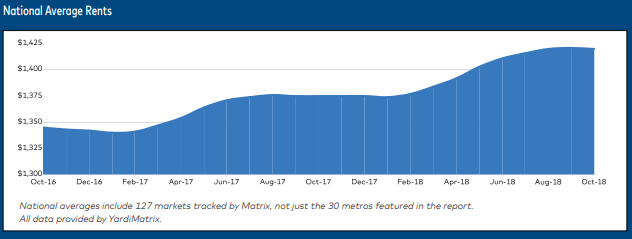
U.S. multifamily rent dropped by $1 to $1,420 in October 2018, the second straight month of decline, according to a survey of 127 markets by Yardi® Matrix Multifamily.

The 3.3% year-over-year multifamily rent growth for the month was unchanged from September.

The overall slowdown follows an anticipated seasonal trend. Two highlights from the Yardi Matrix report which says:

  • “Nationally, rent growth is hitting its seasonal slowdown phase, but there is a wide discrepancy in metro performance.
  • Rent gains have accelerated over the last three months in warm-weather markets that include Las Vegas, Phoenix and Atlanta, while Seattle, Boston and San Jose have cooled off.
  • We expect that the full-year rent increase for 2018 will remain near the year-to-date figure of 3.3%, with occupancy rates stable at current high levels.”

Multifamily Rent Gains In Many Metros Overshadow Seasonal Decline

Sizzling rent growth in the Southwest as gains accelerate in Phoenix and Las Vegas

Rent gains have accelerated recently in warm-weather markets such as Las Vegas, Phoenix and Atlanta.

“The strength of the national market is demonstrated by the fact that rent growth is less than 2% in only a handful of metros, and the lowest is Houston at 1.6%. No market is even remotely in trouble,” the report says. “The market’s groove will be hard to knock off course as long as employment and wage growth maintain their current path.”

Year-over-year rent growth leaders for October were Las Vegas, Phoenix, Orlando, Fla., and the Inland Empire and San Jose metros in California.

Phoenix and Las Vegas strong for job growth

Both Las Vegas and Phoenix have seen strong acceleration since the beginning of the year. Las Vegas leads U.S. metros with 7.4% year-over-year growth through October, up from 5.8% in January, while Phoenix rose to 7.0% in October from 4.0% in January.

Both markets benefit from their long-term population shifts and healthy job growth.

Affordability and the impacts of 2017 tax reform have positioned Las Vegas to benefit from the outmigration of people and businesses from California and other high-cost regions.

Phoenix is attractive due to its weather, while its economy increasingly attracting a diverse set of businesses.

Download the full report here.

About Yardi

Yardi® develops and supports industry-leading investment and property management software for all types and sizes of real estate companies.  Established in 1984, Yardi is based in Santa Barbara, Calif., and serves clients worldwide.  For more information, visit www.yardi.com.

Top 25 Most Bed-Bug Infested Cities

Top 25 Most Bed-Bug Infested Cities

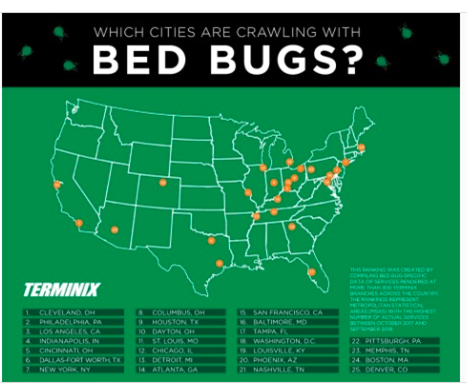
With many people starting to travel for the holidays, the annual list of the top 25 most bed-bug infested cities is out with cities in Ohio taking four of the top 10 spots.

Cleveland crawled its way to the top of the list for a second consecutive year, followed by Philadelphia and Los Angeles, according to a release from Terminix.

Ohio had the most cities on the list, taking four of the top ten spots. Texas, Tennessee and Pennsylvania each had two cities make the list.

Terminix based its rankings on the number of services rendered in each city from October 1, 2017 to September 30, 2018.

Top 25 most bed-bug infested cities

  1. Cleveland
  2. Philadelphia
  3. Los Angeles
  4. Indianapolis
  5. Cincinnati
  6. Dallas-Fort Worth
  7. New York
  8. Columbus, Ohio
  9. Houston
  10. Dayton, Ohio
  11. Louis
  12. Chicago
  13. Detroit
  14. Atlanta
  15. San Francisco
  16. Baltimore
  17. Tampa
  18. Washington, D.C.
  19. Louisville
  20. Phoenix
  21. Nashville
  22. Pittsburgh
  23. Memphis
  24. Boston
  25. Denver

Contrary to their name, bed bugs can be found in many household places in addition to bedding, including upholstered furniture, in curtain rods or even behind baseboards.

These pests can easily hitchhike from place to place by crawling into personal belongings such as jackets, purses and luggage.

As Americans travel for the upcoming holidays, they should be aware of the increased potential for bed bugs to join them on their journey through airports, mass transit, hotels and rental vehicles, according to the release.

Take precautions when traveling

Travelers who believe they may have come into contact with bed bugs during their holiday vacations should take precautions to reduce their risk.

Bed bugs can be killed with heat, so travelers who suspect a bed bug infestation when arriving home should launder clothing and other belongings as recommended on the clothing label, or use a portable heat chamber for non-heat sensitive items such as luggage as soon as possible.

In addition, tenants as well as homeowners can place potentially compromised luggage in a plastic bag to prevent bed bugs from spreading among other belongings.

Bed bugs are most active at night, so infestations can be difficult to spot.

The bloodsucking insects are oval-shaped, wingless and reddish-brown. In lieu of spotting the pests themselves, travelers can look for signs of an infestation, which can include shed bed bug skins and blood spots on mattresses or sheets. Anyone who suspects a bed bug infestation should schedule an inspection with a pest control company as soon as possible.

“At Terminix, our mission is to deliver seamless experiences for our customers,” Matthew Stevenson, President of Terminix Residential, said in the release.

“When we do so, this allows our customers to focus on spending time with their families this holiday season, rather than worrying about combating bed bugs.”

Methodology of the survey:

The ranking was created by compiling bed bug-specific data of services rendered at more than 300 Terminix branches across the country. The rankings represent Metropolitan Statistical Areas (MSAs) with the highest number of actual services between October 1, 2017 and September 30, 2018.

How To Measure The Effectiveness Of Your Compliance Training

The Grace Hill training tip this week focuses on the fifth in the series on compliance training. Compliance training is important for landlords and property managers to keep up with ever-changing rental housing laws at federal, state and local levels.

 By Ellen Clark

The great hope of training is that it results in behavior changes that improve employees’ job performance and ultimately positively impact your business.

The ability of an employee to successfully apply what was learned in training to his or her job is called transfer.

To successfully transfer lessons learned in training to an employee’s activity on the job is the ultimate goal of training.

In this series on measuring training effectiveness we’ve looked at:

    • Measuring implementation – Did employees complete the training?
    • Learning – Did employees master the learning objectives?
    •  Reaction – Did employees find the training valuable and feel they benefitted from it?

To help reinforce new learnings, consider a post-training plan that focuses on measuring and supporting transfer of what they’ve learned.

How do you measure what happens in the weeks and months after compliance training?

Employees may leave training excited about transferring new skills to their job, but when back on the job it is easy to get caught up in the day-to-day and fall into old habits.

To guard against this, consider a post-training plan that focuses on both measuring and supporting transfer.

Here are some tips for a post-training plan to gather information on how employees are using strategies learned in training and simultaneously create an environment that supports and reinforces transfer.

To measure use of strategies learned in training, leverage mechanisms you already have in place.  Instead of creating a new set of measurement tools, think about aligning existing performance review forms, mystery shops, or observation protocols with training.  This allows you to gather information without putting extra tasks on the busy managers and employees.

Use informal tools to measure and support transfer.

By positioning training as ongoing, rather than a one-time event, learnings are more apt to stay fresh in their minds as they are regularly reinforced.

Regular, structured discussions between managers and employees can provide insights into implementation of training strategies. They are also an opportunity to signal that the things addressed in training are important, and to offer support to employees who are having trouble applying what they learned on the job.

Hold employees accountable for behavior not just leasing rates or satisfaction scores

Hold employees accountable for behaviors in addition to outcomes.

It is common to track outcome such as leasing rates, customer satisfaction scores or incident/claims rates.

Think about also holding people accountable for the behaviors that influence those outcomes. For example, choose a few observable strategies from training, and make them an element of performance reviews.

Position training as ongoing, rather than a one-time event. Think about a post-training plan that regularly reviews job aids or key points from training to ensure things stay fresh in employees’ minds. Consider running employees through practice scenarios to help show or reinforce the application of skills in real-life scenarios.

For many learners, applying what they learned in training will take ongoing encouragement and reinforcement. Having a post-training plan in place to measure and support the use of strategies learned in training will increase the likelihood of transfer, and ultimately the overall impact of your training.

If you missed the previous Part 1, Part 2, Part 3 and Part 4 here they are:

Part 1 –  Is Your Property Management Compliance Training Working?

Part 2 – Why Completing All Compliance Training Is Critical To Your Protection

Part 3 – Ask Key Questions To Be Sure Your Employees Have Mastered Compliance

Part 4 – Want To Know If Your Training Is Working? – Ask Your Employees

Read Ellen’s full blog post here.

About the author:

Ellen Clark is the Director of Assessment at Grace Hill.  Her work has spanned the entire learner lifecycle, from elementary school through professional education. She spent over 10 years working with K12 Inc.’s network of online charter schools – measuring learning, developing learning improvement plans using evidence-based strategies, and conducting learning studies. Later, at Kaplan Inc., she worked in the vocational education and job training divisions, improving online, blended and face-to-face training programs, and working directly with business leadership and trainers to improve learner outcomes and job performance. Ellen lives and works in Maryland, where she was born and raised.

About Grace Hill

For nearly two decades, Grace Hill has been developing best-in-class online training courseware and administration solely for the Property Management Industry, designed to help people, teams and companies improve performance and reduce risk.


online compliance training from grace hill


New Short-Term Multifamily Rental Player In Portland, Seattle

short-term multifamily rentals
Vacasa Multifamily has launched in top urban markets Including Portland and Seattle.

A Portland based vacation rental management company has launched a new short-term multifamily rental site that claims it is “ready to become your most reliable tenant,” according to a release.

Vacasa, the largest vacation rental management company in North America, announced the launch of Vacasa Multifamily, a new initiative dedicated to building its rental inventory for guests seeking short-term stays in urban city centers.

Vacasa Multifamily will partner with leading real estate developers and property managers to provide short-term rental management services for vacant units, resulting in stable and reliable revenue for the properties.

“The industry has seen an increase in guest demand for urban short-term rentals, and we’ve been approached by developers and property managers seeking our vacation rental management services,” Joshua Viner, senior manager of Vacasa Multifamily, based in Portland,  said in the release.

“We’re excited to bring our decade-long property management experience to the multifamily space and offer diverse inventory for business and leisure travelers, as well as families looking to stay in urban destinations.”

Vacasa Multifamily enters into long-term lease agreements with real estate developers and property managers that are looking to turn their vacant units into short-term rentals that adhere to regulations. From navigating complex local regulations and increasing operational efficiencies, to driving bookings and optimizing nightly rates, according to the release.

Demand for short-term multifamily rental accommodations

“As the demand for alternative accommodations has grown, so has the opportunity for Vacasa,” Eric Breon, CEO and founder of Vacasa, said in the release.

“The multifamily industry is on the rise and to be successful, property managers need to deliver a high-quality and consistent experience for guests, while providing stable revenue for building developers and landlords. What we’ve traditionally brought to the vacation rental industry, we’ll be offering in the multifamily space: provide great guest experiences and increased revenue for our owners.”

Over the last year, Vacasa has launched new programs and services to help homeowners and guests in every aspect of the vacation rental process. In July, the company launched Vacasa Real Estate to connect vacation home buyers and sellers with the most qualified local real estate agents. Earlier this month, Vacasa Community Association Management began providing management services to vacation rental homeowners through their community associations. Vacasa Multifamily is the next step in the fast-growing company’s evolution.

Real estate developers and property managers that enter into agreements with Vacasa Multifamily will be working with a partner to drive stable revenue for the property or assist during lease-up. Additionally, partners will have access to Vacasa’s breadth of resources, including:

  • Dedicated compliance and legal team: The short-term rental industry is evolving daily and it can be difficult to keep up with changing regulations. We work closely with our legal and compliance team to ensure we have the necessary permits and licenses for each unit.
  • Property automation partners: Vacasa currently works with NoiseAwarePointCentral and VirtualKEY and will offer these industry leading property automation solutions in its urban short-term rentals. These technologies enable Vacasa to better screen guests and monitor noise levels without imposing on the guests’ stay, all while creating a safer, more secure experience for other residents in the buildings, according to the release.
  • On-site and local teams: In every market where Vacasa manages vacation rentals, there’s a local team of employees ready to care for our properties and serve our guests, homeowners, and partners. All full-time Vacasa employees are paid a minimum hourly wage of $15 and provided free health and dental benefits.
  • Interior design experts: Vacasa’s in-house interior design team will work with developers to furnish rental units to meet guests’ expectations when booking an urban short-term rental. Our team can also work directly with developers to help design purpose-built rentals with travelers in mind from day one.
  • Booking platform partnerships: Vacasa partners with the industry’s leading booking platforms – such as Booking.com, Airbnb, and HomeAway – to drive year-round bookings for our more than 10,600 properties around the world.

Vacasa Multifamily operates in seven urban markets, Boise, Chicago, Dallas, Houston, Portland, San Antonio, and Seattle, with more to come in 2019. To learn more about partnering with Vacasa Multifamily visit: www.vacasa.com/multifamily.

About Vacasa

Vacasa is the largest vacation rental management company in North America and offers property management and other real estate services directly and through licensed subsidiaries. Leveraging industry-leading technology, Vacasa maximizes revenue for homeowners and its partners, and provides unforgettable experiences for guests. Founded in 2009 and headquartered in Portland, Oregon, Vacasa and its subsidiaries manage a growing portfolio of more than 10,600 vacation homes in the U.S., Europe, South and Central America, and Africa. In nine years, Vacasa has grown to more than 2,500 employees, has been honored as the Oregon Better Business Bureau Large Business of the Year and was ranked ninth on the Inc. 5000 Fastest-Growing Companies list. For more information, visit www.vacasa.com.


Portland Apartment Technology Company Cozy Sells For $68 Million

Portland Apartment Technology Company Cozy Sells For $68 Million

CoStar Group has acquired Portland apartment technology company Cozy Services Ltd., and plans to integrate its Innovative renter screening and rent payments solutions into Apartments.com, according to a release.

Cozy is considered an industry leader in the online rental property market, with more than 50,000 landlords using the Cozy platform, according to the release.

Cozy provides a broad spectrum of services to both landlords and tenants, including property listings, rent estimates, rental applications, tenant screening, online rent payments, and expense tracking. There are currently over 120,000 tenants making online payments through the Cozy platform, totaling over $1.4 billion in payments over the past 12 months.

“We believe that if we continue to focus on delivering a fantastic renter experience on Apartments.com, we will continue to be the most heavily trafficked website offering the most valued advertising solutions,” Andrew C. Florance, CoStar Group Founder and Chief Executive Officer, said in the release.

“Cozy’s technology makes the renting and payments process simple, secure, and intuitive. When combined with Apartments.com, the 40 million prospective renters that visit our network each month will be able to effortlessly locate, apply, lease and pay for their new rental home completely online.”

Portland Apartment Technology Company Cozy Sells For $68 Million

CoStar expands capability to multifamily

Currently, CoStar is a leading solution provider in online lease management for commercial real estate through its Real Estate Manager products. Over 200,000 commercial leases for office, retail and industrial clients are managed through the Real Estate Manager platform, which represents approximately $30 billion in lease payments on an annual basis.

Extending this capability to multifamily properties, CoStar expects to fully integrate the Cozy technology into the Apartments.com platform in the first half of 2019.

This integrated online rental solution is expected to create significant value and efficiency in the rental process for independent rental owners. These owners operate over 22 million rental units in properties that contain five units or less – representing a significant “long tail” opportunity for CoStar, according to the release.

Based on what property owners are currently willing to pay to fill their properties with a qualified renter, CoStar believes the total addressable market is well over $8 billion.

In addition, once integrated with Apartments.com, renters will be able to use the platform to save time and money by leveraging a single rental application and credit check across multiple properties. This, in turn, creates a large population of quality renters for landlords to access for future vacancies.

Gino Zahnd, Founder and Chief Executive Officer of Cozy said in the release, “We are excited to be able to bring our landlord and renter services to a larger audience by joining the CoStar team and the Apartments.com network.

The combination of CoStar’s leadership in multifamily marketing with our integrated solutions for renters and landlords makes for a very exciting future for all of us.”


4 Ways To Make Your Apartments Senior Friendly

4 Ways To Make Your Apartments Senior Friendly

The maintenance checkup this week provided by Keepe focuses on how to make your apartments senior friendly.

Do you have a property that attracts multi-generational groups and especially are your apartments senior friendly?

You can win more bookings by making simple changes in your apartment with seniors in mind.

Small upgrades can make seniors, and all your tenants, happier and more comfortable in your building. Here are some tips to make your apartment property senior friendly.

What do seniors want out of your rental?

No. 1 – Safety

  • Replace traditional locks with smart locks to help seniors enter the building without having to struggle with small keys. Some smart locks can unlock when a key fob is simply tapped on the device–no need to push buttons to enter a code.
  • A simple change you can make to increase safety for senior tenants is lowering the water heater temperature to 120⁰ to reduce the chance of burns.
  • Other safety measures such as security cameras and panic buttons are other features that can easily attract older tenants in your apartments.
4 Ways To Make Your Apartments Senior Friendly
Make sure your multistory buildings are accessible.

No. 2 – Lighting

  • Install lights across your property outdoors. In unlikely areas, use motion-activated lights to ensure tenants can safely get inside the building.
  • In the building, consider adding motion-activated lights in areas like an entryway or kitchen to reduce risk of falls or bumps.
  • In general, lighting in the building should be enhanced for all areas. Increased lighting will allow seniors to see obstacles and allow for optimal safety.

No. 3 – Accessibility means elevators

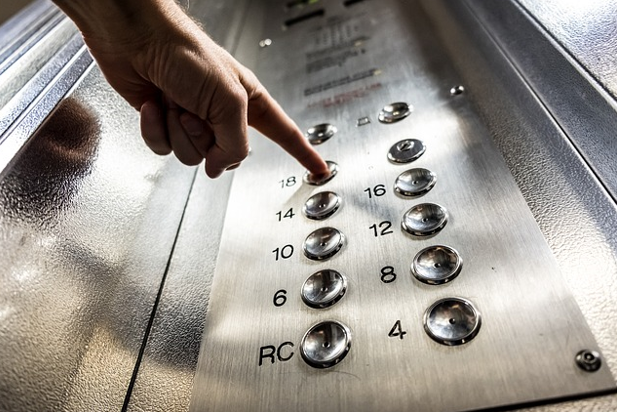
  • Make sure your building and apartments are accessible for seniors with mobility restrictions such as wheelchairs. Ramps outdoors and elevators in multi-story buildings are a must for elderly living.
  • Bathrooms in your property must have the ability to be easily converted to handicapped-friendly options with grab bars and sturdy tub flooring when needed.

No. 4 – Community and amenities

  • Organize special events for tenants to get to know one another and foster a sense of community.
  • Consider keeping the apartment pet friendly. Older adults enjoy companionship, and pets provide emotional comfort for the elderly. Allowing small cats and dogs in your property can make your property much more appealing for those who already have pets.
  • Amenities such as a pool, on-site laundry facilities, fitness center and outdoor areas are great amenities to have when attracting the elderly. Tenants will be happiest if there are fun activities to do and plenty of places to meet up with friends.

Your apartment should be a safe and easy place to live in for all tenants, especially seniors. Take these tips into consideration if you are providing housing to senior tenants.

4 Ways To Make Your Apartments Senior Friendly

Other recent rental property maintenance Keepe posts you may have missed:

4 Outdoor Flooring Options For Your Rentals

20 Easy, Affordable Maintenance Projects To Update Your Rentals

7 Tech Gadgets For A Safer And More Efficient Rental Property

5 Maintenance Tips For Long-Lasting Rental Carpet Flooring

Is The Water Heater At Your Rental Property Ready For The Big One?

7 Types Of Kitchen Countertops For Your Apartments

Which Cooktop Is Best For Your Rental Property?

A Guide To 4 Types Of Flat Roof Systems

6 Ways To Trash Your Apartment Waste Management Issues

About Keepe:

Keepe is an on-demand maintenance solution for property managers and independent landlords. The company makes a network of hundreds of independent contractors and handymen available for maintenance projects at rental properties. Keepe is available in the Greater Seattle area, Greater Phoenix area, San Francisco Bay area, Portland, San Diego and is coming soon to an area near you. Learn more about Keepe at https://www.keepe.com


Amazon To Spark Apartment Boom With New Second Headquarters Locations

Amazon To Spark Apartment Boom With New Second Headquarters Locations

Amazon is expected to spark an apartment boom in the Long Island City and Crystal City areas of New York and Washington where the company has announced it will place its additional headquarters locations.

So RentCafe put together a look at what will be the impact in terms of rents and apartment supply in these two areas that are hubs for millennial workers.

Here are the apartment boom main findings:

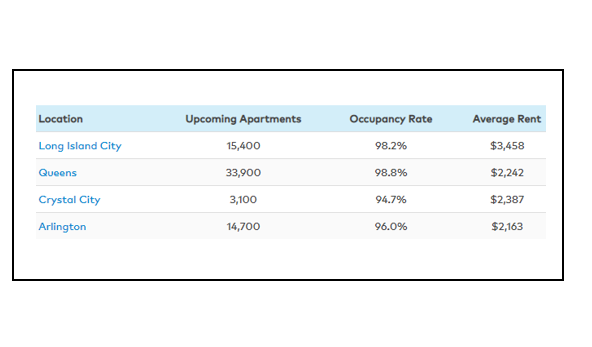
  • With a high occupancy rate of 98.2% in Long Island City (LIC), future Amazon employees may have a hard time finding an apartment for rent near work. There’s a silver lining, though: a total of approx. 15,400 units are under construction, planned or in a prospective phase in LIC.
  • Amazon’s announcement is definitely bound to speed up the apartment construction in the area, which is already seeing an increased number of units entering the market. LIC is New York City’s hottest neighborhood, but also in the US, with the most new apartments delivered after the recession, 12,500 units.
  • In Crystal City there were no major developments in the last couple of years. However, besides the 3,100 units under construction, planned or prospective, future Amazon employees would have access to more than 205K units currently in the entire metro.
  • What type of employees is Amazon expected to find in the two neighborhoods? As of 2016, Crystal City boasts a 52% share of Millennials. Long Island City, on the other hand, has a Millennial population of 43%.
  • The percentage of people holding a Bachelor’s degree or higher in Crystal City is a whopping 85%, while in LIC it’s about half that, 45%.
  • Both neighborhoods have witnessed above-average increases in the monthly rent over the past year. The average rent in Crystal City is currently $2,387, up 5% y-o-y. Meanwhile, Long Island City apartments are already seeing steep prices, $3,458 as of October 2018, up 5.1% y-o-y.

The average rents and supply data comes from Yardi Matrix, RentCafe sister company, which monitors the apartment market. You can find the full report here: https://www.rentcafe.com/blog/rental-market/long-island-city-and-crystal-city-expecting-an-apartment-boom/

What Is The Right Way To Offer An Apartment Rent Special?

What Is The Right Way To Offer An Apartment Rent Special?
When offering an apartment rent special be sure to know what units you want to offer specials on. Photo credit Fizkes via istockphoto.com

When you need to move quickly to fill some units, is a rent special the right way to go and what is the right way to do it?

So you may have these questions:

  • How long do you run a rent special?
  • How do you know what rent special to offer that will work?
  • How do you do it exactly?

Sometimes the rent special is the quick fix you need and our friend Jake Meador over at Rentping.com has some ideas to think about.

So what makes a good rent special involves two things:

  1. It will offer the prospect something valuable enough to motivate them to rent.
  2. It will minimize the damage done to your bottom line both by long-term vacancy and by the special itself.

“Because of the different needs of different properties, it is hard to be more specific than that in terms of defining a good rent special. However, there are three questions we generally recommend client communities ask themselves when they are trying to move from a general idea of a good rent special to a specific special they wish to offer,” Meador writes on RentPing.com.

What are you offering as incentive?

You can dangle any number of different carrots as rent specials in order to attract prospects. What specific thing does your community have to offer?

It is good to identify all the options and then work backwards by asking yourself what is the easiest for your community to offer and what would be most valued by your residents. When you identify the offer that checks both of those boxes, you probably have identified the benefit you should offer as part of the special.

There are many possible answers to this question:

  • Temporary rent reduction
  • Waived deposit
  • Waived application fee
  • Waived pet deposit
  • Free month of rent
  • Free offers:
    • cable
    • internet
    • parking
  • Special offer:
    • Gift card to area business
    • Discounted membership at a local gym

Does this incentive apply to specific floorplans or units?

Rent specials can become very expensive if you offer them on all vacant units in your community.

On the other hand, they can become very complex and lose their appeal if you offer them more narrowly.

So figuring out what units to offer the special on is an important question for every community to figure out.

When does the rent special end?

If you have a system for tracking occupancy that accounts for both currently occupied units on notice and vacant units that are leased but not yet occupied, then you will have an accurate picture of your occupancy situation at the community.

With that information in hand, you can make informed, sound decisions about when you need a rent special and when you do not, which also means you will know when you can stop using a given rent special.

Summary

Rent specials can be a powerful tool to help make fast changes at a struggling property. But it’s an emergency option rather than something you should be leaning on regularly.


Read Jake Meador’s full blog post on this issue here.


7 Upgrades To Your Apartments To Keep Tenants Happy

Upgrading Your Apartments To Keep Tenants Happy
Just a few apartment upgrades like a nice kitchen can keep tenants happy and renewing their leases. Photo credit monkeybusinessimages via istockphoto.com

Every landlord knows how hard it is to find good, responsible tenants who will pay the rent on time and take care of their rental home, so your goal should be to keep tenants like this happy.

That’s why it’s crucial for you to put in some effort in order to keep the good tenants living at your property.

And guess what? No matter how impossible that may sound, the truth is that it’s quite an easy task. All you have to do is become a good property manager whose actions will keep tenants who renew their leases.

If you want to keep tenants, respond to their requests

It’s very important that you don’t ignore the complaints from your tenants.

Answer when they call you and listen to the problems they have in their rental home. Sometimes, it may sound like they are stressing over trifles, but if you ignore them, it may become a serious problem. You’ll agree that it would be wise to change that leaking pipe before it causes a flood, right?

Be responsible and communicative, ask your tenants what problems they have in their rental home and find a way you both can contribute to a solution. Regular upgrading will keep big problems at bay and keep tenants.

No. 1 – Let the light in

Is there a place in your rental home that you want to emphasize to your tenants?

That can be easily achieved with a smart choice of the lights. Of course, the most important is the general lighting of the apartment that will enable your tenants to feel comfortable in their rental home. However, there are more types of lighting that can add a bit more to your rental apartment and make everyday tasks much easier for your tenants.

No. 2 – Upgrade kitchen appliances

The kitchen is one of the most important rooms for every person that moves into your property. If you want to keep the tenants happy, then you must invest a bit.

High-quality kitchen appliances will speak volumes of your care for the tenants’ comfort and happiness, but accomplishing this goal doesn’t necessarily have to cost you an arm end a leg. For instance, you can upgrade your rental home with a contemporary Bosch microwave that will make mealtimes simpler with the function that weighs an item to figure out the time it will take to warm it up accordingly.

A hungry tenant who comes home after a busy day at the office will certainly appreciate this.

No. 3 – Reinvigorate the bathroom

Besides the kitchen, the bathroom is another room in the apartment that plays a vital role in whether your tenant will renew the lease or not.

You don’t need to turn the bathroom into a spa by bringing in a Jacuzzi and a little sauna. Small cosmetic changes will breathe a brand new life into the outdated bathroom. Change that leaking faucet, install a new showerhead and put on a new shower curtain. You can even refresh the bathroom with tile stickers.

No. 4 – Fix the floor

Creaky floorboards can be very annoying. If pieces of old parquet fall out from time to time, your tenant can become very annoyed and move out.

And, believe it or not, bad flooring can put your tenants on the mercy of noise from the neighborhood. Based on the amount of money you can spend to fix this problem, you have two options – cork flooring or high-quality carpets. Consider the pros and cons of both options and choose what would be the best solution for you and your tenants.

No. 5 – Consider a safety system

One very important thing for every tenant is that they feel safe in their rental apartment.

It doesn’t matter if the apartment is in a dodgy neighborhood or not because break-ins happen in all parts of the world. That’s why you have to add an alarm service and safety locks. By doing this, you will show your tenants that you care about their safety.

No. 6 – Keep track of periodic tasks

Upgrading your apartment doesn’t mean that you need to bring in shiny new things all the time. As a landlord, you should have a home inspection on a regular basis, e.g. every three months.

Your job is to check whether the insulation is in good shape and if the smoke detectors, heating, ventilation and air conditioning are functioning properly. Your tenants will appreciate your concern and won’t look for a new rental home.

No. 7 – Be cooperative

Even if you do all the things mentioned above, there will be some tenants that will constantly ask for more.

Of course, you don’t have to fulfill every caprice they have. However, if they are expecting a baby, then you have to try to be cooperative and allow them to redecorate one room into a nursery, especially if they are very good and responsible tenants. In case they move out in a few years, you can easily turn the nursery into a regular room with a coat of fresh paint on the walls.

As you can see, simple, cost-effective upgrades can mean a world of difference in your tenant’s eyes. If you have the same tenants for years that are very responsible and take care of your rental, then you can also reward them with a discount on rent, but you shouldn’t offer that benefit to the new tenants until they prove to you that they are worth it, not just in the sense of reviewing the lease. Build their confidence one step at a time and eventually both sides will benefit.

Resources:

http://time.com/money/2897067/the-top-5-ways-to-make-more-money-on-your-rental-properties/

https://www.carpetcaptain.com/flooring-options/carpet-vs-cork-flooring/

https://www.propertyware.com/blog/8-ways-to-retain-your-best-tenants/

https://www.nytimes.com/2018/05/24/smarter-living/8-cheap-landlord-friendly-ways-to-upgrade-your-rental.html

https://www.mysmartmove.com/SmartMove/blog/5-ways-keep-your-best-tenants-from-leaving.page

https://www.baymgmtgroup.com/blog/4-renovations-keep-tenants-happy-complaint-free/

https://www.propertyware.com/blog/8-ways-to-retain-your-best-tenants/

https://www.mysmartmove.com/SmartMove/blog/what-tenants-look-for-rental-property.page

About the author:

If one thing is true about Lillian Connors, her mind is utterly curious. That’s why she can’t resist the urge to embark on a myriad of green living/home improvement projects and spread the word about them. She cherishes the notion that sustainable housing and gardening will not only make us far less dependent on others regarding the dwellings we inhabit, but also contribute to our planet being a better place to live on. You can check her out on Twitter and LinkedIn.