Home Blog Page 169

Solving The Pet Pee Needs In An Urban High-Rise Apartment

How to solve pet pee needs in the middle of the night when you live in a high-rise apartment can be a real challenge. A San Diego start-up company has come up with a unique product that helps both property managers and tenants.

By John Triplett
Rental Housing Journal

As an individual living in a high rise condo or apartment, one can imagine how difficult it can be when your pet needs to go out to pee in the middle of the night.

Tenants don’t have the option of opening the back door to a large grass backyard. It requires getting dressed, leaving the unit, going in the elevator, and eventually outside.

In a city like San Diego and other metro areas embracing and building denser multifamily housing, moving from suburban environments to urban neighborhoods creates issues and difficulties for dogs and their owners when they need a grassy spot.

Some dogs handle the adjustment to high rise living without incident. For others, it can be a challenge.

Solving the pet pee needs in apartments

A start-up company in San Diego has come up with a unique approach to pet pee issues that offers property managers and tenants the “backyard alternative for high rise living pooches.”  Urban Dog Solutions is subscription service that provides San Diego high rise dog owners with a fresh grass pee patch delivered to the door. In addition, a member of their team returns in person to clean and replace the grass on a weekly basis.

Founders Tricia Crespin and Oscar Urteaga started Urban Dog Solutions originally as  92101 Dog Solutions but changed the name of the business as it grew.

‘I changed the name to Urban Dog Solutions from 92101 Dog Solutions because our growth came very quickly. I never imagined to have grown so quickly. 92101 Dog Solutions was a need I saw when I moved to San Diego, but then I realized the need was much bigger than just Downtown San Diego,” Crespin said.

Here is the story on how it got started


How to solve pet pee issues in high-rise apartments
Example of the pet pee pad.


“I met Tricia, my business partner and co-founder, shortly after she moved to San Diego from Arizona and brought her elderly dog with her. The dog had a heart murmur and had to take medicine that caused the dog to frequently urinate.

“Living in high-rise condo in East Village, she was having to get up multiple times in the middle of the night, take him to the elevator, then downstairs outside where there were a lot of homeless people and it was not necessarily safe to take out the dog,” he said.

“So I recommended to her some different products. Most were dog pee trays you can buy at pet stores and online. We tried every product and service we could find, and nothing met our expectations, and the dog did not utilize it at all.

“One day we decided to buy a piece of sod and put it on one plastic tray. Given the texture and scent of real grass, the dog ended up going potty immediately. We realized that we needed real grass to curb the dog’s bathroom needs,” he said.

“Unfortunately after a couple days of use, it started attracting some flies. Tricia’s brother worked on a farm in Washington State and we collaborated with him to formulate a deodorizer – we call it the, ‘secret sauce’ to reduce smells and flies.  We can’t say what is in it, but we place the deodorizer under the grass to absorb all the liquids, prevent flies and it doesn’t smell.

“After much trial and error to develop our own real grass pee patch, our friends and neighbors started to inquire how to get one of their own and at that moment we realized we had a business idea,” he said.

How do property managers and leasing agents feel about this?


How to solve pet pee issues in a high-rise apartment building


“The property managers and leasing agents we have interacted with support our service because they see it as a way to help keep their existing units clean and prevent damage caused by dog residents,” Urteaga said.

“Unlike our competitors that just provide a product, our business is unique because we actually service and replace the grass patch. The grass patch has a five-layer system, so no liquids make it through to the floor or carpet.

“You would be very surprised, but some of our customers – the first time we walk into their unit and all they had put down newspapers and pee pads. It was pretty gross. So we believe 92101 Dog Solutions helps property managers and leasing agents keep their units much cleaner with residents that have dogs,” he said.

“Our business is nothing new. We are not re-inventing the wheel,” Urteaga said.

“What we did was we saw a need and a demand. We looked at some existing services and products that are out there and we figured out a way to make it better,” he said.

He said right now they only service San Diego and will soon be announcing plans to expand their service offerings to include a full service dog concierge list of amenities, such as dog walking, dog sitting and vet appointment pick up/drop offs.

“Before we decided to pursue it as a legitimate business, we looked at the market and numbers. We found that in the 92101 downtown zip code, there are approximately 35,000 residents, and about one-third of them have pets, mostly dogs. One of the biggest downsides of living in downtown San Diego is that there is not a lot of grass space and open parks. There are very few open parks or dog parks to allow these animals to do their business. So that is the demand we had identified.

“This service does not replace dog walking – all dogs need exercise but rather offers an easy and convenient option for the bathroom needs of high rise living pooches,” he said.

How does the service work?

Urban Dog Solutions uses high quality Fescue grass that is dense and lush which dogs really enjoy. Customers can choose deliveries to occur on Saturday mornings, typically between 10:00 a.m. and 12:00 p.m., or on Monday evenings between 5:30 and 7:00 p.m.

“Most of our customers are busy working professionals, so we arrive at our customers units and change/replace the pee patch in less than 5 minutes,” he said. They have a growing customer base.

Some of the top questions about the service


How to solve the pet pee issue in a high-rise apartment building


Question: Do tenants have to get property manager approval for this product? Have any apartments refused your service?

Answer: No. We have not ever needed property manager approval, and we have not received any critical feedback either. We have met with several leasing agents and property managers, and all welcomed our services. And now property managers/owners are calling us for our services.

Question: How much does the service cost?

Answer: For dogs 25 pounds or less, our standard size is $130 per month, which includes the pick up and delivery of the fresh grass pee patch for four weeks. For dogs between 25 pounds and 50 pounds there is an XL version that costs $180 per month. For dogs bigger than 50 pounds we can now customize their patches; for pricing please contact us.

Question: Should I pick up the poop from the grass pad?

Answer: We provide our customers with poop bags to clean up after their dogs.

Question: I have two dogs, do I need two pads? How many dogs can one pad handle?

Answer: Depending on the breed of the dog, some may become territorial of their grass patches. But most of our customers that have two or three small dogs typically share the grass pee patch. We always offer advice and solutions for any requests our customers bring us.

Question: Do I keep it inside or can it go on my outside balcony?

Answer:  Yes, you can keep it indoors or leave it on your balcony. Our unique five-layer system absorbs all liquids, and does not attract flies or create smells. Obviously, the grass eventually dies off after a full week of use, but we replace it the following week

Question: Do you plan to expand from San Diego?

Answer: Yes! July 2019 we launched Nationwide Shipping!

We still offer our in person service here in San Diego all the way up the coast to Los Angeles and launched our in service in Arizona.

  About Urban Dog Solutions

Here is a link to the website, or phone is 619-796-3647 or contact them here.



California Assembly Passes 7 Percent Rent-Cap Bill

California Passes Rent Cap Bill 0f 5 Percent

The California Assembly has passed a rent-cap bill that would limit annual rent increases to seven percent plus the annual increase in the cost of living, according to reports and it now heads to the Senate.

There were several last-minute amendments to the rent-cap bill including those that would:

  • Exempt property owners with no more than 10 single-family homes
  • Exempted properties that are less than 10 years old
  • Set the law to expire in 2023

“It’s a very moderate measure that will guard against some of the more egregious practices that we’re seeing,” Assemblywoman Buffy Wicks, D-Oakland, told the San Jose Mercury News before the vote.

The bill’s author, Democratic Assemblyman David Chiu, argued the measure would protect tenants from big rent increases while still allowing property owners to get a fair return on investment.

“We’re saying we’re in a housing emergency. And we’re saying while we’re in this emergency, we’re going to impose a reasonable cap to prevent rent-gouging,” Chiu, of San Francisco, told ABC 7 and reporters after the bill passed.

Rent-Cap Simply Rent Control With Another Name

Some lawmakers spoke against the bill, saying they felt it was not the answer to the housing crisis.

And that such steps would discourage investment in rental housing.

“This is rent control,” Assemblywoman Melissa Melendez, R-Lake Elsinore, told the newspaper. “I don’t care how you say it. I don’t care how you spin it.

“This is a disincentive for people to build and what we need is to build,” she said.

The bill now heads to the Senate

If the bill, AB-1482, clears the Senate, California could join Oregon as the second state in the nation this year to limit annual rent hikes, covering millions of properties not covered by local rent control rules.

The bill passed the Assembly 43-28.

California residents voted down a ballot measure last year that would have allowed cities to expand rent control.

Resources:

California Assembly Passes Rent-Cap Bill

California Rent Cap: How It Was Changed What It Would Do

Bill to cap rent increases in California advances

Governor Kate Brown Signs Landmark Oregon Rent Control Bill

7 Ways To Stay Out Of Trouble When Checking Criminal History

When you are reviewing your screening policies to avoid any discriminatory effects, especially criminal history, be sure to avoid your gut feelings. The Grace Hill training tip of the week focuses on tenant screening and the right way to do it especially when checking criminal history.

By Ellen Clark

The National Fair Housing Alliance’s recent publication, Making Every Neighborhood a Place of Opportunity: 2018 Fair Housing Trends Report  is full of useful information about the state of fair housing in our nation, 50 years after the passage of the Fair Housing Act.

Remember to review your screening policies to avoid any appearance of discrimination.

How to use criminal history

One of the things in the National Fair Housing Alliance publications is the highlighting of the U.S. Department of Housing and Urban Development’s (HUD) guidance on how to use criminal history if you are a housing provider.

“In 2015, HUD’s Office of Public and Indian Housing issued a notice that prohibits Public Housing Authorities and owners of federally-assisted housing from applying blanket exclusions of applicants with an arrest record in their housing decision.

“In 2016, HUD’s Office of General Counsel issued guidance on how the Fair Housing Act applies to the use of criminal history by housing providers and, specifically, how the discriminatory effects and disparate treatment methods of proof apply to fair housing cases in situations when a housing provider justifies an adverse housing decision based on someone’s criminal record.

In issuing this important policy guidance, HUD has helped provide housing stability for people with criminal records, a critical step toward the successful reintegration of people with criminal records into society.”

Here are a few practical tips to ensure your screening policies are in line with HUD guidance

7 Ways To Stay Out Of Trouble When Checking Criminal History

Keep these tips in mind at all times.

Everyone involved in the leasing process should be trained in screening policies. Everyone should consistently follow these policies, rather than make decisions based on assumptions or gut feelings.

    1. Do not deny an application based solely on an arrest record. An arrest is not the same as a conviction.
    2. Do not automatically exclude applicants just because they have a criminal history.
    3. Consider criminal history only after the applicant’s other qualifications are verified. If you do need to consider criminal history, conduct an individualized assessment that looks at several factors.
    4. The nature and severity of the crime.
    5. The time since the arrest or conviction.
    6. The applicant’s recent rental history.
    7. The applicant’s rehabilitation efforts.
  1. When consistently applied, policies that follow these guidelines are less likely to have a discriminatory effect.  Take time to review your applicant screening policies and procedures, particularly those relating to background checks, with your supervisor and legal counsel today.

Read Ellen’s full blog post here.

Resources:

Recent Grace Hill training tips you may have missed:

Have You Reviewed Your Criminal Background Checks Policy Lately?

Landlords Sue Seattle Over Criminal Background Check Restrictions

Related story: 7 Issues And Answers About Renting To Felons

About the author:

Ellen Clark is the Director of Assessment at Grace Hill.  Her work has spanned the entire learner lifecycle, from elementary school through professional education. She spent over 10 years working with K12 Inc.’s network of online charter schools – measuring learning, developing learning improvement plans using evidence-based strategies, and conducting learning studies. Later, at Kaplan Inc., she worked in the vocational education and job training divisions, improving online, blended and face-to-face training programs, and working directly with business leadership and trainers to improve learner outcomes and job performance. Ellen lives and works in Maryland, where she was born and raised.

About Grace Hill

For nearly two decades, Grace Hill has been developing best-in-class online training courseware and administration solely for the Property Management Industry, designed to help people, teams and companies improve performance and reduce risk.

7 Ways To Stay Out Of Trouble When Checking Criminal History

Photo credit thecrimsonribbon via istockphoto.com


Sign Up For Our Newsletter And Get Apartment News And Helpful, Useful Content Each Week.

* indicates required


Portland Putting Housing Crisis On Backs Of Landlords

Allowable Fees Under The Landlord Tenant Act

A Portland landlord shares her opinion.

By Sue Scott

The city is using legislation and threats of huge penalties, fines and fees to put the housing crisis on the backs of those who provide housing.

The proposed regulations for tenant screening and security deposits are 40-plus pages of verbiage and mandate huge fines only to rental providers. This will greatly increase risks for landlords.

It’s not fair.

Worse, the new proposals hit small investors hardest. That’s all wrong too. It is the mom-and-pop Portland landlords who are consistently most flexible with tenants. The big out-of-state providers are already here, and evictions are part of best practices for them in protecting their investors and bottom lines.

There are no risks here for the city. It makes the rules and dictates fines. It doesn’t offer to share the risk and gives us little or no respect Senate Bill 608, which imposed statewide rent control and prohibited landlords from ending most leases flew through all public hearings, and its legislative backers accepted no changes. While the proposed screening and security deposit regulations have had some small changes, it seems the policy as a whole is going down this same intractable path, which will only make the market worse for renters.

Portland City Commissioner Chloe Eudaly especially seems to enjoy pitting renters against the “evil” landlords that maintain the homes and safe places renters live in. We are apparently the biggest easy target. As landlords, we do not have enough political power or numbers. The us against them attitude needs to stop. A workable and sustainable solution needs to be a shared solution.

Writers of these regulations should include all sides. Tenants, housing providers (large and small), financial institutions, and non-profits. The changes must result in sustainable housing for our great city.

And what about property rights?

The city now says we must accept applicants who may not be able to afford the rent or are felons in our properties.

Felons are not a protected class, like race, gender, religion, families with kids, sexual preferences, service dogs, disabilities etc. etc. And tenants who are financially vulnerable are a great risk for any landlord.

As property owners, responsible for the debts and expenses related to those properties, we should have protected rights to assess the financial risk we are willing to take. We pay taxes, mortgages, repairs, legal and all other costs. It takes several years to break even on most properties. For most of us, the big financial rewards come only at the end of our careers and are part of our retirement.

There are more equitable, broader-based solutions that the city should consider.

I was asked what broad-based ideas I suggest so here is my list

  • Check out how Mercy Housing does affordable housing. Provide job resources, job training, life skills classes, budgeting help etc., so tenants are successful and have long term tenancies.
  • Provide more housing. Incentivize developers, especially “impact investors”, (community-oriented investors who take smaller returns and no public subsidies, but still provide affordable units in their projects). City should give commitments priority in development, decreased development costs and hurdles, or tax credits.
  • Spreading this housing solution throughout the city is a much better result than just building large tenements is “poor” neighborhoods, destined to be future ghettos, and shunned by all. Europe has this kind of model; it works well and makes for a healthier and more diverse city.
  • City should create more home ownership. Help residents become or stay home owners. Grants for down payments, repairs, and to develop ADUs (alternate dwelling units).
  • City should legislate that employers follow same rules as landlords; hire felons.
    The State could expunge felony records when there has been no new offenses after 3 or 7 years.
  • Legislate ways to reign in price increases at grocery stores, pharmacies, health insurances, and schools doing business in our city or state.
  • Encourage/incentivize subsidized tenants to respect the properties they live in. Encourage them to work more, or volunteer, or when successful, perhaps do peer counseling. . This would leave more money to help others.

Build more housing.  Stop Rent Control, it’s only driving out investors.

About the Portland landlord author:

A Portland landlord opinion: Portland Putting Housing Crisis On Backs Of Landlords
Sue Scott is a Portland landlord and owns 25 rental housing units in Portland. She lives in Happy Valley. She wrote this letter to Oregonlive.com.


4 Air Conditioning Maintenance Best Practices For Summer

4 Air Conditioning Maintenance Best Practices For Summer

Here are 4 air conditioning maintenance best practices for the upcoming summer from rental property maintenance company Keepe.

Air conditioning issues pose one of the top maintenance items in rental housing every year. Now is the time to check your air conditioning maintenance before you get that call from a tenant.

1. Don’t Defer Air Conditioning Maintenance

Prevention is key to keeping your air conditioning in working order.

Don’t defer regular inspections and air conditioning maintenance requests. Deferred maintenance issues are more expensive to repair later down the road. It’s best to keep up efficient operation and ensure your property is performing well by having an expert take a look at problems you may have otherwise missed.

2. Strive for Energy Efficiency

Energy efficiency is a key indicator for determining your air conditioning system’s performance.

Increasing the energy efficiency of your systems will extend the life cycle of your infrastructure and keep energy-related utility costs under control.

3. Add a Smart Thermostat

4 Air Conditioning Maintenance Best Practices For Summer

Consider adding a smart thermostat to allow your tenants to program the temperature settings in their units. This can save energy over time.

A programmable thermostat makes it easy to match your cooling needs to your schedule. It offers more flexibility and ease for tenants to minimize air conditioning use.

4. Remove Obstructions Around the Exterior System

4 Air Conditioning Maintenance Best Practices For Summer

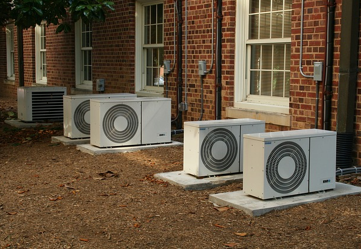
Regularly inspect the air conditioner system outdoors at least twice a month. Remove any loose vegetation, yard waste, and other debris from the system.

A clear zone allows your air conditioner to pull in the air it needs to control the temperature in your property.

A simple maintenance checkup can make all the difference in the world.

Utility bills jump in the summer as tenants increase their air conditioning system use. Be ready. Put in place efficient systems and processes in your maintenance strategy to ensure optimal efficiency.

Other recent rental property maintenance Keepe posts you may have missed:

 How To Pick The Perfect Exterior Paint Color For Your Rental Property

4 Outdoor Flooring Options For Your Rentals

20 Easy, Affordable Maintenance Projects To Update Your Rentals

7 Tech Gadgets For A Safer And More Efficient Rental Property

5 Maintenance Tips For Long-Lasting Rental Carpet Flooring

Is The Water Heater At Your Rental Property Ready For The Big One?

7 Types Of Kitchen Countertops For Your Apartments

Which Cooktop Is Best For Your Rental Property?

A Guide To 4 Types Of Flat Roof Systems

6 Ways To Trash Your Apartment Waste Management Issues

Top 5 Apartment Maintenance Emergencies vs. Maintenance Requests

5 Tips for Preparing Your Apartments for the Summer Season

About Keepe:

Keepe is an on-demand maintenance solution for property managers and independent landlords. The company makes a network of hundreds of independent contractors and handymen available for maintenance projects at rental properties. Keepe is available in the Greater Seattle area, Greater Phoenix area, San Francisco Bay area, Portland, San Diego and is coming soon to an area near you. Learn more about Keepe at https://www.keepe.com


Arizona Governor Signs Bill Putting Some Restrictions On Short-Term Rentals

Arizona Re-Thinking Short-Term Rental Laws After Sedona Uproar

Putting some restrictions on short-term rentals, Arizona Governor Doug Ducey has signed Arizona House Bill 2672 which prohibits homeowners from allowing properties to be used for special events and parties that create noise in neighborhoods.

However, some legislators feel the bill did not go far enough to protect neighborhoods.

The sponsor of HB 2672, Rep. John Kavanagh, R-Fountain Hills, said that the bill will put an end to “party houses” where a home in a residential neighborhood suddenly becomes the site for dozens and dozens of guests.

There were a number of failed attempts to amend the bill during the session to deal with the number of guests permitted in a house. However, the main part of the bill that made it through prohibits vacation rentals from being used for non-residential purposes, like special events, retail operations, restaurants or banquet space.

Short-term rentals bill does not go far enough

“What originally was sold as a way for empty-nesters and other owner-occupants to make extra money by renting a spare bedroom to a foreign tourist has become a multi-billion dollar industry that heavily caters to large groups and special events where entire homes are rented out and treated like bars and concert halls,” Rep. Isela Blanc, D-Tempe, told the Arizona Capitol Times.

Blanc said the bill doesn’t go far enough. She suggested that cities be permitted to limit these rentals to houses where the owner is the resident or the house is a second home.

“However, if you are just a capital investor coming in and changing the neighborhood completely by buying up as many homes as possible so you can continue to profit by calling yourself an Airbnb business, then you should be treated as a hotel,” Blanc told the Arizona Capitol Times.

Data from the Denver-based research firm AirDNA shows the Airbnb market has exploded in Arizona during the past five years, according to the Arizona Republic.

In late 2014, Phoenix only had 687 properties for rent listed on Airbnb, and only 245 of them were rented even one night in December of that year.

By March of this year, that number had boomed to 4,224 listed properties.


Are You Confused By Requests For Service, Emotional Support And Assistance Animals?

Are You Confused By Requests For Service, Emotional Support And Assistance Animals?

Consider the scenario where a prospective resident who is blind makes an accommodation request for her service dog or assistance animal to live in her apartment, even though your property doesn’t allow pets. Are you required to grant this request? This week the Grace Hill training tip takes a look at this issue.

By Ellen Clark

The FHA prohibits discrimination based on disability and requires housing providers to make reasonable accommodations for people with disabilities.

You probably know that you would need to grant this request. But what if the prospect requested an emotional support bird in addition to a service dog? What if she gave you an online “certification” for the emotional support bird? What if the requested service dog was a restricted breed in your county?

Accommodation requests related to assistance animals are prevalent, yet they cause much confusion. This is understandable – multiple laws apply and use different terms and definitions, there are many kinds of assistance animals that help people with many types of disabilities (some of which are not obvious), and online sites have surfaced offering questionable documentation.

Are You Confused By Requests For Service, Emotional Support And Assistance Animals?

So, what you can you do? First, you can download The Multifamily Property Manager’s Guide to Handling Assistance Animals for a handy primer on this tricky topic. Then follow these suggestions for reducing your risk of discrimination when it comes to assistance animals.

Know the laws on assistance animals, service and emotional support animals

Three laws relate to rental housing and service and assistance animals:

  • The Fair Housing Act (FHA)
  • Section 504 of the Rehabilitation Act of 1973 (Section 504)
  • The Americans with Disabilities Act (ADA).

The FHA applies to almost all rental housing. Among other things, it prohibits discrimination based on disability and requires housing providers to make reasonable accommodations for people with disabilities, such as making an exception to a no-pet policy or a breed restriction.

Housing that receives federal financial assistance from HUD must also comply with Section 504. Like the FHA, Section 504 prohibits discrimination based on disability and requires housing providers to make reasonable accommodations for people with disabilities.

Whereas the FHA and Section 504 prohibit discrimination in housing, the ADA prohibits discrimination based on disability in all areas of public life, including schools, transportation, and all public and private places that are open to the public. The ADA requires you to let service dogs accompany their owners in any area of the community that is open to the public, such as the leasing office.

Are You Confused By Requests For Service, Emotional Support And Assistance Animals?

Know assistance animals terminology and definitions

An assistance animal may be any type of animal and is not required to have specific training.

The FHA and Section 504 use “assistance animal” as a broad term to describe any animal that works, provides assistance, or performs tasks for the benefit of a person with a disability or provides emotional support that alleviates one or more symptoms or effects of a person’s disability.

Under the FHA and Section 504, service animals, emotional support animals, and companion animals are all considered assistance animals. An assistance animal may be any type of animal and is not required to have specific training.

The ADA uses the term “service animal” and defines it specifically as a dog that has been individually trained to do work or perform tasks for people with disabilities. Emotional support animals, companion animals and animals other than dogs (and sometimes miniature horses) are not considered service animals under the ADA.

You cannot deny a reasonable accommodation request because an animal does not meet the ADA definition of a service animal. Under the FHA and Section 504, reasonable accommodations must be granted for assistance animals, which include service animals, emotional support animals, and companion animals.

Residents making accommodation requests are not required to use specific terminology

If an animal works, assists, or performs tasks for the benefit of a person with a disability or provides emotional support that alleviates one or more symptoms or effects of a person’s disability, it doesn’t matter what term someone uses, it is an assistance animal under the FHA and Section 504.

Think of assistance animals as working animals, not pets

Thinking of assistance animals as working animals, not pets, can prevent confusion. Under the FHA and Section 504, assistance animals may be cats, dogs, birds, turtles, rabbits, hamsters, fish, or nearly any other type of animal. It is not the type of animal that matters, but rather the function the animal serves.

Are You Confused By Requests For Service, Emotional Support And Assistance Animals?

Understand assistance animal documentation

Currently, there are no legally recognized organizations for registering service or assistance animals. Sites that claim to be certifying bodies or that offer official registrations are misleading because there is no such thing.

Under the FHA, there is no requirement that assistance animals be trained. Documentation only needs to establish that the person has a disability and that the animal provides disability-related assistance or emotional support. An animal’s training is not relevant when evaluating a reasonable accommodations request.

HUD states that you are entitled to documentation from a reliable third party that is in a position to know about the individual’s disability. If the organization or person who issued the documentation has never talked to or met with the person requesting the accommodation, it is likely reasonable to ask for supplemental information.

No matter what source the documentation is from if you are suspicious, do not immediately deny the accommodation request. Instead, start a conversation with the resident to gather more information, and consult your legal counsel.

Know how to handle accommodation requests

Remember these three criteria when considering accommodation requests:

  1. Under the FHA, there is no requirement that assistance animals be trained. The person must have a disability. If the person’s disability is obvious, you may not ask questions. If the disability is not obvious, you may ask for reliable documentation that the person has a disability. Never ask for details of a person’s physical or mental disability.
  2. The animal must serve a function directly related to the person’s disability. If the disability-related need is obvious, you may not ask questions. If the need is not obvious, you may ask for reliable documentation that the animal provides disability-related assistance or emotional support
  3. The request must be reasonable. You are not obligated to grant every request.

Continuously educate yourself

The best way to avoid confusion is to read as much as you can and get exposure to the scenarios that come up in real life. This is the best way to learn things like:

  • A resident may be entitled to multiple assistance animals.
  • You can deny a request if that particular animal has harmed someone in the past.
  • You can usually take action when residents with assistance animals violate community rules.
  • And more!

This stuff is complicated – and serious. You’ll find that The Multifamily Property Manager’s Guide to Handling Assistance Animals answers a lot of your questions about assistance animals, including how to tackle conversations with other residents. But when in doubt, ask your supervisor or legal counsel.

Read Ellen’s blog post here.

Recent Grace Hill training tips you may have missed:

What Do You Do When Assistance Animals Break The Rules?

How To Handle Suspicious Documentation For Assistance Animals

How A No Pet Policy Can Be Discriminatory

Red Flags In Evaluating Documentation For Assistance Animals

About the author:

Ellen Clark is the Director of Assessment at Grace Hill.  Her work has spanned the entire learner lifecycle, from elementary school through professional education. She spent over 10 years working with K12 Inc.’s network of online charter schools – measuring learning, developing learning improvement plans using evidence-based strategies, and conducting learning studies. Later, at Kaplan Inc., she worked in the vocational education and job training divisions, improving online, blended and face-to-face training programs, and working directly with business leadership and trainers to improve learner outcomes and job performance. Ellen lives and works in Maryland, where she was born and raised.

About Grace Hill

For nearly two decades, Grace Hill has been developing best-in-class online training courseware and administration solely for the Property Management Industry, designed to help people, teams and companies improve performance and reduce risk. Contact Grace Hill at 866.472.2344 to hear more


Good Landlord Pac Supports Landlord Efforts In Oregon Housing Issues

Ron Garcia Responds To Landlord Leaving the Business Good Landlord Pac Supports Landlord Efforts In Oregon Housing Issues

By Ron Garcia

My name is Ron Garcia. I am an Oregon landlord and property manager. I am the Past President of The Rental Housing Alliance Oregon and currently serve as its  Legislative Director. Several years ago I co-founded “The Good Landlord PAC” (www.goodlandlordpac.com)  which has supported pro-landlord lobbying efforts locally and statewide. I have worked many hours both in the background and in the foreground for local and statewide property rights in a highly charged political climate.

As I read Carlos Garcia’s “A Good Landlord’s Open Letter on Why He Is Getting Out of Business” in the Rental Housing Journal I felt compelled to respond. Although he and I are unrelated and we have never met, we seem to share some common background and sentiments. But we have some differences.

I applaud his commitment to being a “good landlord”; I empathize with his frustration towards new tenant protection laws; and I congratulate him on his decision to sell.

I am equally certain that he, (like so many other property owners today who are making that same decision to liquidate), has been able to cash in on the substantial gains and profits accumulated due to the great residential investment market Oregon has experienced in recent years.

This is a far cry from what we landlords and property owners were experiencing 10 years ago while in the midst of the “great recession”.  In 2009 anyone would have sold to any buyer for any price that would have pulled them out from being under water in their real estate investments. Today we can casually reflect on the notion (or cliché) that “real estate is cyclical” and chalk up our newfound wealth to some inherent truth that financial gains in real estate are a “divine right” and are ours to be expected.

From a tenant advocate’s viewpoint, landlords have been the entitled class for too long. Now they want to inject parity into the marketplace. Tenant advocates have the attention of the liberal party. The liberal party has a Super-Majority in our state government. They see a housing crisis in what owners view as a great housing market. They believe it needs to change. Government affects change through legislation. All legislation has “unintended consequences.” And as our society continually learns through the empirical science of economics, the market makes corrections.

I was told years ago that there is no such thing as a bad real estate investment…. But there is such a thing as bad real estate timing.

We are seeing many landlords today that are following Carlos Garcia’s reasoning and are “getting out of the business” – at least in Oregon. It is a rising tide and it will have an effect. The question is to what end?

For every unit we see go on the market, we see a new buyer ready, willing and able to perform. Our core issue of housing supply and demand is heavily weighted on demand with no relief in sight. Landlords have exasperatedly testified against rent control because it ultimately shuts down supply, while demand continues to grow and thus RAISES PRICES. We know this is true! So now we can all experience that truth together. Check every major city that has ever enacted rent control in the past and you will find the highest appreciation rates in the country.

Rent control creates a new reality: cap rates plummet yet values soar.

In Oregon, tenant regulations have created new business management realities. Have they gone too far? Most landlords don’t need much time to answer that. The real question is how will they affect our investments?  What time does our real estate clock say it is?

My watch says this: It’s time to work in our new reality. It is a hard time to be a rental housing provider and a great time to be a residential housing owner.

Ron Garcia is Principal Broker for The Garcia Group www.garciagrp.com

Ron Garcia, Principal Broker
The GARCIA Group
OR & WA Real Estate Service
Rental Property Management

Good Landlord Pac Supports Policy Makers’ Efforts In Oregon Housing Issues

Related story:

A Good Landlord’s Open Letter on Why He Is Getting Out of The Business

The Pros And Cons Of Renting to College Students And Maintenance Tips

The how and why of renting to college students is a practice that deserves special attention and precautions and is the maintenance checkup from Keepe this week.


In most cases, properties located on or near college campuses are extremely profitable.


As new students come and graduates go, the need for practical housing remains.


Most college-age renters prioritize proximity and accessibility to convenient transportation when looking for a place to live in while attending school. Also a large number of universities report a growing trend for graduates to remain in their college towns as opposed to relocating home whenever possible.


Simply put, being able to cater to a local student demographic can almost guarantee continued demand from new renters. And, in high-demand locations where the number of students looking for housing surpasses availability of affordable or available properties. This means a property without particularly appealing features or amenities can still be feasibly rented.


The pros of renting to college students


The Pros And Cons Of Renting to College Students And Maintenance Tips


    • Low vacancy – properties located nearby colleges attract a steady stream of prospective renters. As new students join the university and graduates depart, there will always be students looking for housing that allows them to live nearby their school.


    • Leveraging value – while this changes from college town to college town and is largely dependent on the overall size of the student body of a particular university, in most cases homeowners and/or property managers can easily demand higher rent prices for properties that would typically be worth for far lower (as far as size, amenities and special features are considered). In high-demand years, in which a particularly high number of students is looking for off-campus housing, it is possible to tailor rent to demand and secure particularly high profits.


    • Necessity – students are rather low-maintenance. Their top priority is their ability to easily travel to their university and be able to enjoy greater freedoms than they would in their family home or in a college-owned dormitory. Keeping college-age tenants satisfied should be fairly easy and does not require being able to offer a property with high-end features.


The cons of renting to college students


The Pros And Cons Of Renting to College Students And Maintenance Tips


    • Turnarounds –  If a landlord or property manager wants the stability of having a long-term renter, students are unlikely to fulfill this expectation. For most properties, it is rare enough for the same renter – or group of renters – to live in the same property for all four years of their college experience. Most renters only stick around for one school year at a time.


    • Inexperience and Immaturity – college students are new to renting. They have no rental history or references to evaluate. They often do not know what committing to a lease really means.


    • Lifestyle – college students may be inconsiderate of their surroundings as they are too busy with school or enjoying themselves a little too much. They can throw parties or play loud music.  Keeping the space clean and tidy is not a priority for many of them. They can compromise the actual conditions of a property.


    • Damage – their unique lifestyle brings wear and tear. A property viewed by tenants as a very temporary space can lead to it being damaged by accidents or disregard.


5 maintenance tips for renting to college students


If you are a landlord or property manager who thinks renting to college students is a good idea, here are some helpful maintenance tips to consider:


1. Demand Higher Deposits and Guarantees: when it comes to opening a property to unreliable tenants, it’s definitely better to be safe rather than sorry. Higher security deposits and even the involvement of parents or guardians who can co-sign to cover repair costs is one of the best ways to stay protected.


2. Rethink Pet-Friendly Policies: for some college-age renters, being able to own their very own, first pet is one of the freedoms they seek alongside independently living in a place of their own. While allowing pets in a property – even with a higher security deposit to match – can make it stand out as the ideal place for pet-loving students, it can easily increase the gravity of damages that might occur. Younger pet owners are not always the most responsible. Remember they are busy with academics and extracurricular interests. Think twice about your pet policy and college students.


3. Invest in Regular Checkups: schedule regular maintenance checkups. It is the best way to avoid suddenly finding damage at the end of the lease. Do not wait until the very end of a tenant’s occupancy period to check. Tenants should be informed from the start of their occupancy that seasonal checkups and inspections will be performed in the property. This will help holding them accountable.


4. Structural Upgrades Come First: when thinking about upgrading or touching-up a certain part of the property – especially as a part of a “rental turn” – it’s important to think of what would be most helpful in adding an extra line of protection for the property. While tenants might love a brand-new stove, your money will probably be better spent turning a “damage-magnet”  – like carpet flooring, which is prone to stains, discoloration, bad odors and tears – into a low-maintenance, practical feature.


5. Consider a New Maintenance Solution: with inexperienced tenants come a lot of emergencies, from accidental damage to practical, everyday concerns. Some tenants might have no idea how to operate a garbage disposal system or change a lightbulb. This cam mean frequent calls for help. Property managers overseeing a large number of properties will likely benefit from relying on a maintenance professional who can be on-call and step in when needed.


The Pros And Cons Of Renting to College Students And Maintenance Tips


Summary on renting to college students


College students remain a one-of-a-kind tenant demographic that should not be underestimated. Their age, lifestyle, and overall needs are all important factors that a homeowner and/or property manager must take into consideration.


Other recent rental property maintenance Keepe posts you may have missed:


4 Outdoor Flooring Options For Your Rentals


20 Easy, Affordable Maintenance Projects To Update Your Rentals


7 Tech Gadgets For A Safer And More Efficient Rental Property


5 Maintenance Tips For Long-Lasting Rental Carpet Flooring


Is The Water Heater At Your Rental Property Ready For The Big One?


7 Types Of Kitchen Countertops For Your Apartments


Which Cooktop Is Best For Your Rental Property?


About Keepe:


Keepe is an on-demand maintenance solution for property managers and independent landlords. The company makes hundreds of independent contractors and handymen available for maintenance projects at rental properties. Keepe is available in the Greater Seattle area, Phoenix, San Francisco Bay and San Diego areas.


Seattle Rents Edge Up Slightly Over the Past Month

Seattle Rents Edge Up Slightly Over the Past Month

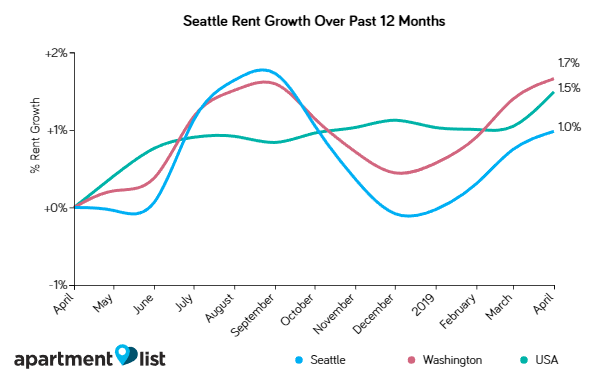
Seattle rents increased 0.2 percent in April, and are up slightly by 1.0% in comparison to the same time last year, according to the latest report from Apartment List.

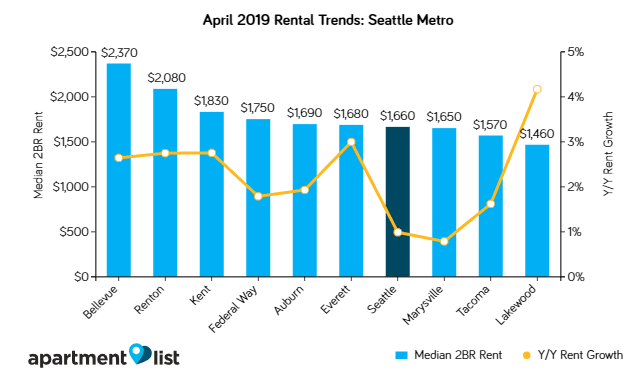
Currently, median rents in Seattle stand at $1,340 for a one-bedroom apartment and $1,660 for a two-bedroom.

This is the fourth straight month Seattle rents have increased after a decline in December of last year.

Seattle’s year-over-year rent growth lags the state average of 1.7%, as well as the national average of 1.5%.

Rents rising across the Seattle metro

Throughout the past year, rent increases have been occurring not just in the city of Seattle, but across the entire metro.

Of the largest 10 cities that Apartment List has data for in the Seattle metro, all of them have seen prices rise.

Seattle Rents Edge Up Slightly Over the Past Month

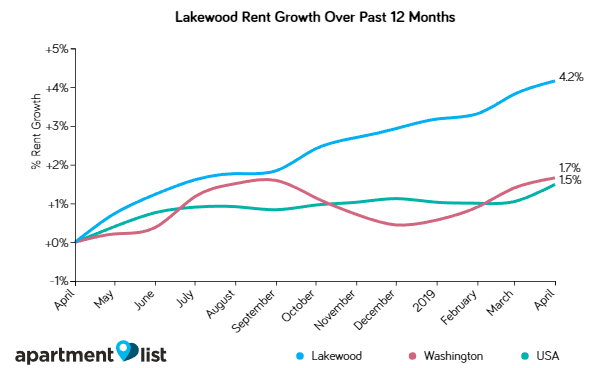
Lakewood rents increased moderately over the past month

Lakewood and Seattle Rents Edge Up Slightly Over the Past Month

Lakewood rents increased 0.3% over the past month, and have increased significantly by 4.2% in comparison to the same time last year.

Currently, median rents in Lakewood stand at $1,180 for a one-bedroom apartment and $1,460 for a two-bedroom.

The city’s rents have been increasing for 18 straight months; the last time rents declined was in January 2015. Lakewood’s year-over-year rent growth leads the state average of 1.7%, as well as the national average of 1.5%.

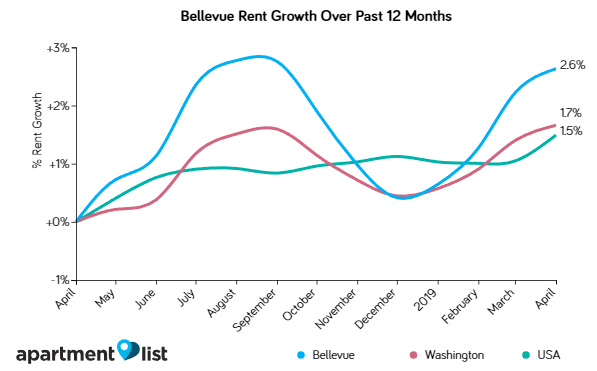
Bellevue rents increased significantly over the past month

bellevue and Seattle Rents Edge Up Slightly Over the Past Month

Bellevue rents have increased 0.4% over the past month, and are up moderately by 2.6% in comparison to the same time last year.

Currently, median rents in Bellevue stand at $1,900 for a one-bedroom apartment and $2,370 for a two-bedroom. This is the fourth straight month that the city has seen rent increases after a decline in December of last year.

Bellevue’s year-over-year rent growth leads the state average of 1.7%, as well as the national average of 1.5%.

Seattle rents less affordable than other cities

Seattle Rents Edge Up Slightly Over the Past Month

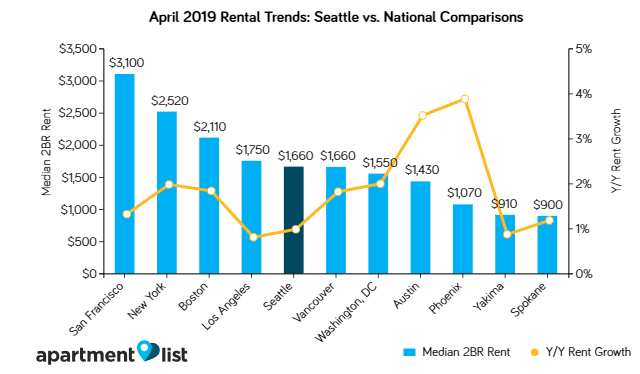
As rents have increased marginally in Seattle, a few other large cities nationwide have also seen rents grow modestly. Compared to most similar cities across the country, Seattle is less affordable for renters.

  • Rents increased slightly in other cities across the state, with Washington as a whole logging rent growth of 1.7% over the past year. For example, rents have grown by 1.8% in Vancouver and 1.2% in Spokane.
  • Seattle’s median two-bedroom rent of $1,660 is above the national average of $1,180. Nationwide, rents have grown by 1.5% over the past year compared to the 1.0% rise in Seattle.
  • While Seattle’s rents rose marginally over the past year, many cities nationwide also saw increases, including Phoenix (+3.9%), Austin (+3.5%), and Denver (+2.0%).
  • Renters will generally find more expensive prices in Seattle than most other large cities. For example, Spokane has a median two-bedroom rent of $900, where Seattle is more than one-and-a-half times that price.

Methodology

Data from private listing sites, including Apartment List’s own data, tends to skew towards luxury apartments, introducing sample bias. In order to address these limitations and provide the most accurate rent estimates available, Apartment List  now starts with reliable median rent statistics from the Census Bureau, then extrapolates forward based on its own rental listing data, using a same-unit analysis similar to Case-Shiller’s approach, which compares only units that are available across both time periods to provide an accurate picture of rent growth in cities across the country.

Apartment List

Apartment List is a growing online apartment rental marketplace on a mission to make finding a home an easy and delightful process.

Mayor Says New “Renting in Seattle” Program to Provide Resources for Landlords and Renters