Before you advertise your next apartment vacancy, here are three ways to maximize rents that many property managers and investors in multifamily properties are looking to do.
No. 1 – Do the little things to maximize rents
Tenants don’t want to show up to a property where the landscaping is overrun, paint is peeling, or trash is strewn about.
Take the time to address these low-cost fixes. First impressions matter when you are trying to achieve market rents.
Just as you wouldn’t want to show up to your own home in this condition, tenants feel the same way. They will reward you with fair rents and longer-term tenancy.
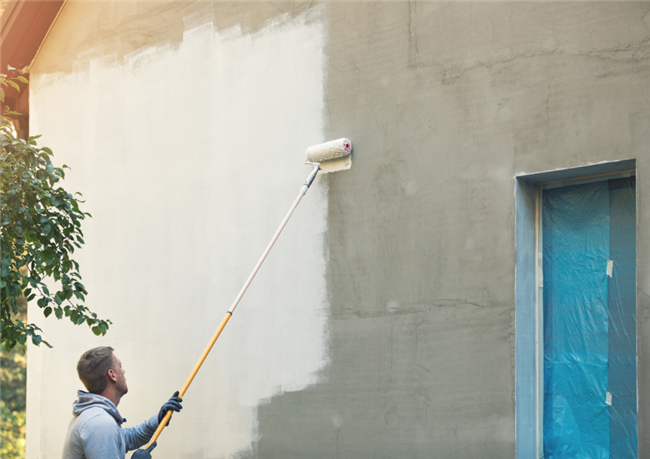
Exterior paint is a key to letting tenants know you take care of the property.
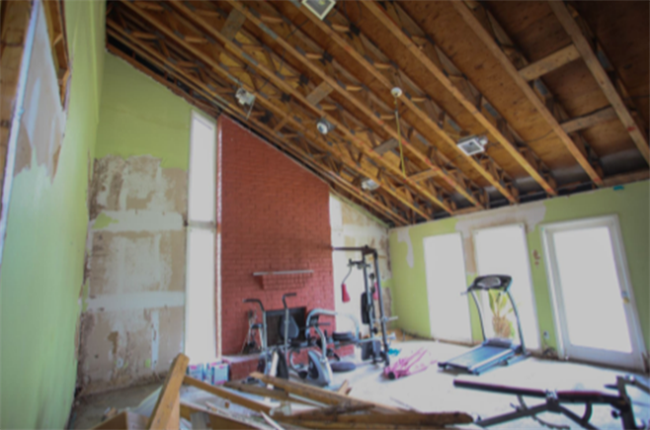
No. 2 – Complete a thorough renovation of an older or dilapidated unit
Could your rent be $100, $200 or even $500 higher if the apartment was remodeled?
If so, you may be missing out on a great opportunity to gain a high return on your investment.
Many owners look at the time it will take to recover the cost of the remodel and get discouraged. However, if you invest $10,000 into a unit that allows you to achieve $200 more per month, that is a whopping 24 percent annual return on your investment!
A $200 rent bump also translates into almost $50,000 in value at a 5 percent capitalization rate. Now that’s a great investment!
If you invest $10,000 into a unit that allows you to achieve $200 more per month, that is a whopping 24 percent annual return on your investment!
No. 3 – Understand your market’s rents
A wise person once said, “If you don’t know where you’re going, then you don’t know where you are.”
In other words, how can you tell if your rents are below or even far below the market if you don’t know where market rents are?
Market rents will vary between quality, condition and location even within the same neighborhood.
You can do your own research by going online and see what others are asking and what they are offering. For insider info, you can consult with a local property manager or an apartment real estate broker.
Carlos Azucena is a real estate broker with 15 years of experience in apartment sales, representing buyers and sellers. He serves the San Francisco Bay Area and can be reached at 650-391-1746 or [email protected]. Find out more at www.cfapropertyadvisors.com.
Multifamily submetering is quickly becoming the standard for utility management in the industry and Dwelo has announced an integration partnership with NextCentury to provide a solution for multifamily communities.
Dwelo, provider of smart-home solutions purpose-built for apartments, and NextCentury, the first and only completely cloud-based submetering solution, announced an integration partnership in a release.
Utility submetering is a system that allows a landlord, property management firm, condominium association, homeowners association, or other multi-tenant property to bill tenants for individual measured utility usage. The approach makes use of individual water meters, gas meters, or electricity meters.
Multifamily submetering becoming the standard
The partnerships will allow owners and managers to have more information and control over their communities specifically through increased smart utility management and leak detection and mitigation.
“We believe bringing submetering into the next century is critical to the success of multifamily communities,” Mike Clements, CEO at NextCentury Meters, said in the release.
“NextCentury provides owners the ability to bill residents for exact utility consumption while also providing custom reporting and timely alert notifications to managers. Like Dwelo, we aim to give owners more data and control over their communities. This partnership continues our focus on creating the future of submetering, passing tremendous savings back to the owners and adding value for residents.”
Submetering is becoming the standard and states like California, Texas, and Georgia require submeters in all new construction projects.
“Partnering with Next Century continues Dwelo’s mission of offering managers and owners increased efficiency through access to more data and control of their communities,” Mike Rovito, CEO at Dwelo, said in the release.
“We are excited to provide submetering alerts to our customers. Poor utility management can result in costly occurrences that can be better prevented with this partnership with Next Century.”
Submeter systems capture water data on a unit level. Capturing this data is a win-win for both residents and management staff, according to the release.
How Dwelo and NextCentury Meters Work Together
Residents win because they can now be billed for their exact water usage which typically results in conservation. Management wins through the ability to monitor and mitigate water leaks with this data.
Non-catastrophic leaks are common in multifamily communities.
Examples of non-catastrophic leaks include:
Constantly running toilets
Slowly dripping faucets
Leaky pipes in less frequently visited areas like mechanical rooms or crawl spaces.
These types of leaks often go undetected for days or weeks, resulting in wasted money – in the form of wasted water – and in some cases, costly water damage or mold.
The following are typical costs that a property could expect to incur due to non-catastrophic leaks and inefficient utility management:
$10 per day for undetected running toilets and faucets.
$10,000 average in damage for typical appliance or plumbing leaks.
The partnership between Dwelo and NextCentury offers owners, managers, and maintenance, the necessary tools and notifications to significantly mitigate the costs caused by these occurrences, according to the release.
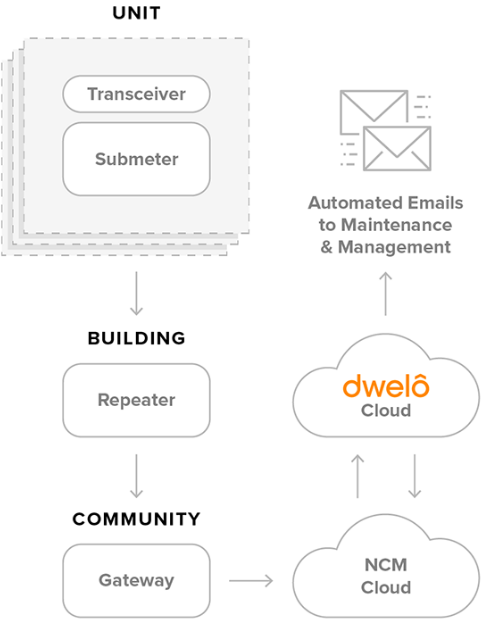
It works by allowing property management and maintenance staff to receive notifications in the event that a water leak or water temperatures that could cause freezing pipes are detected. Staff are notified of the community and unit that these events are occurring.
Dwelo provides simple, seamless, smart apartments to the owners and managers of multifamily communities. Dwelo connects popular smart devices from Z-Wave, Nest, Kwikset, Yale, and voice platforms like Amazon Echo and Google Home. Dwelo’s platform enables residents to enjoy the benefits of a smart home in a rental setting, while helping managers run their communities more efficiently
Utah apartments and their residents contribute $17.1 billion to the state economy annually, supporting 95,000 jobs, according to the new Hoyt Advisory Council study.
Apartment demand is growing and the industry needs to keep up. However, producing enough new apartments to meet demand requires new development approaches, more incentives and fewer restrictions.
More Utah apartments needed
Utah needs to build 3,000 new apartment homes each year to meet demand. Apartment construction contributes $1.3billion to Utah’s economy annually, creating 7,000 jobs.
Overall, apartments contribute $3.4 trillion to the U.S. economy and support 17.5 million jobs, according to the report.
Resident spending contributes $3.0 trillion to the U.S. economy, while operations adds $175.2 billion. New construction contributes $150.1 billion and renovation and repair adds $68.8 billion.
Highlights from the report include:
All four sectors of the industry have posted very strong growth, punctuated by the construction industry ramping up to meet the unprecedented demand for apartments this cycle – reaching a height of 346,900 completions in 2017, up from 129,900 in 2011.
Previous research by Hoyt Advisory Services found that we need to build an average of 328,000 apartments per year at a variety of price points to meet existing demand, which would bring continued economic activity. This number of multifamily completions has only been surpassed twice since 1989.
Hoyt research also found that a significant portion of the existing apartment stock will need to be renovated in the coming years, boosting spending in the renovation and repair sector.
The combined contribution of apartment construction, operations, renovation, and resident spending equals $3.4 trillion per year, or more than $9.3 billion daily.
“The apartment industry’s contribution is one that has grown in recent years, fueled by increased rental demand overall as population and employment growth continue and renting becomes a preferred tenure choice for millions of Americans,” Eileen Marrinan, Managing Director of Eigen 10 Advisors, which partnered with Hoyt, said in a release.
“Construction is still moving ahead, as there’s a need for additional apartments in many states. And, due to an abundance of aging stock, there’s a growing need for renovations and improvements on existing apartment buildings. Construction and renovation/repair will provide a sizable boost in jobs – and the economy – nationwide, and will continue to be a hefty contribution to the country’s economy for decades,” NMHC President Douglas M. Bibby said in the release
“The multifamily industry is an economic engine powering the economy very significantly at the national, state and local levels,” NAA President Robert Pinnegar said in the release. “This clearly illustrates the tremendous positive impact our apartments have on the communities they serve.”
Visit www.WeAreApartments.org and view the data, which is broken down by state and metro area. Visitors can also use the Apartment Community Estimator (ACE), a tool that allows users to enter the number of apartment homes of an existing or proposed community to determine the potential economic impact within a particular state or metro area.
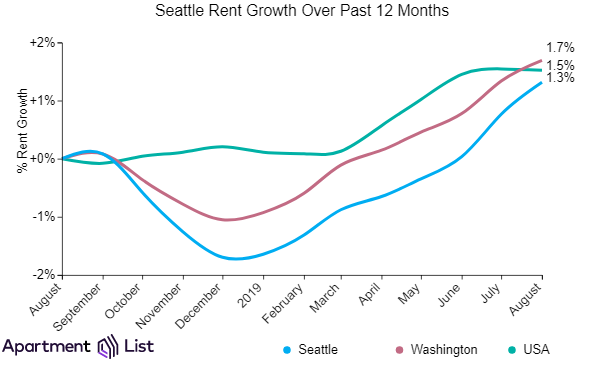
Seattle rents have increased again for 0.5 percent over the past month, and have increased slightly by 1.3 percent in comparison to the same time last year, according to the most recent report from Apartment List.
Currently, median rents in Seattle stand at $1,362 for a one-bedroom apartment and $1,696 for a two-bedroom. This is the eighth straight month that the city has seen rent increases after a decline in December of last year.
Seattle’s year-over-year rent growth lags the state average of 1.7 percent, as well as the national average of 1.5 percent.
Rents rising across the Seattle metro
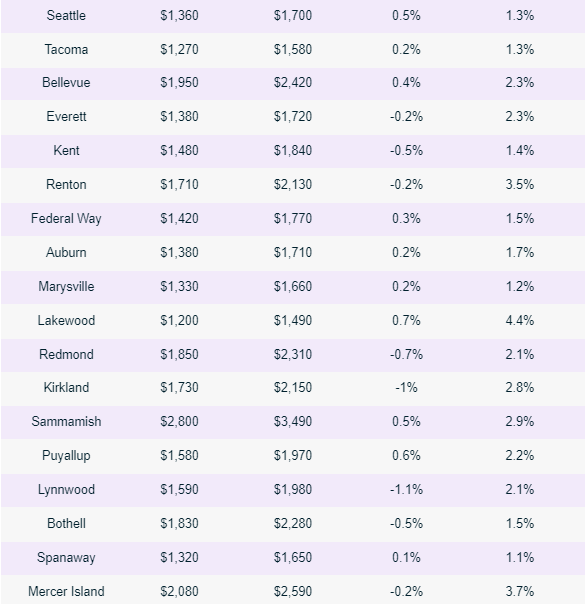
Throughout the past year, rent increases have been occurring not just in the city of Seattle, but across the entire metro. Of the largest 10 cities that Apartment List has data for in the Seattle metro, all have seen prices rise.
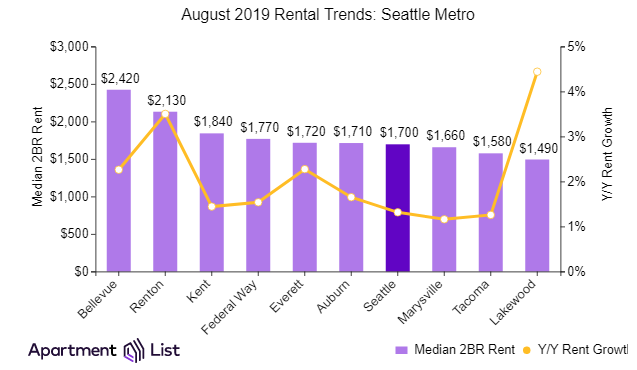
Here’s a look at how rents compare across some of the largest cities in the metro.
Lakewood has the least expensive rents in the Seattle metro, with a two-bedroom median of $1,493; the city also has experienced the fastest rent growth in the metro, with a year-over-year increase of 4.4 percent.
Over the past month, Kent has seen the biggest rent drop in the metro, with a decline of 0.5 percent. Median two-bedrooms there cost $1,842, while one-bedrooms go for $1,479.
Bellevue has the most expensive rents of the largest cities in the Seattle metro, with a two-bedroom median of $2,424; rents grew 0.4 percent over the past month and 2.3 percent over the past year.
Similar cities nationwide show more affordable rents compared to Seattle
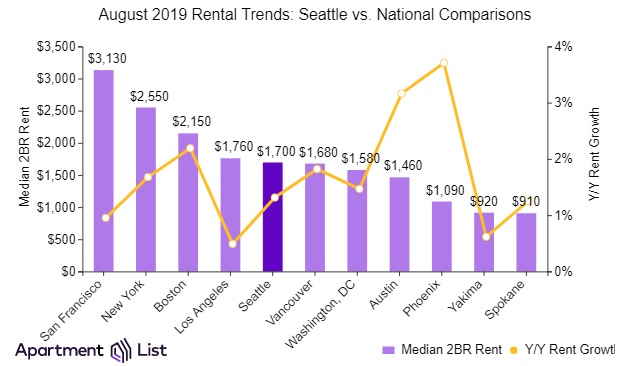
As rents have increased slightly in Seattle, a few similar cities nationwide have also seen rents grow modestly. Compared to most other large cities across the country, Seattle is less affordable for renters.
Rents increased slightly in other cities across the state, with Washington as a whole logging rent growth of 1.7 percent over the past year. For example, rents have grown by 1.8 percent in Vancouver and 1.3 percent in Spokane. Spokane has a median two-bedroom rent of $905, where Seattle is more than one-and-a-half times that price.
Seattle’s median two-bedroom rent of $1,696 is above the national average of $1,191. Nationwide, rents have grown by 1.5 percent over the past year compared to the 1.3 percent increase in Seattle.
While Seattle’s rents rose slightly over the past year, many cities nationwide also saw increases, including Phoenix (+3.7 percent), Austin (+3.2 percent), and Boston (+2.2 percent).
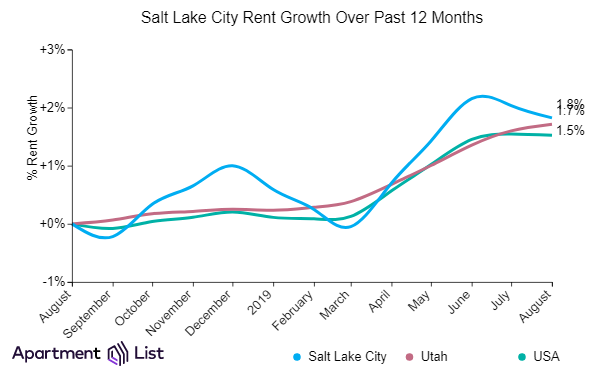
Salt Lake City rents have declined 0.2% over the past month, but have increased slightly by 1.8% in comparison to the same time last year, according to the latest report from Apartment List.
Currently, median rents in Salt Lake City stand at $873 for a one-bedroom apartment and $1,083 for a two-bedroom.
This is the second straight month that the city has seen rent decreases after an increase in June. Salt Lake City’s year-over-year growth leads the state average of 1.7%, as well as the national average of 1.5%.
Ogden rents increased slightly over the past month
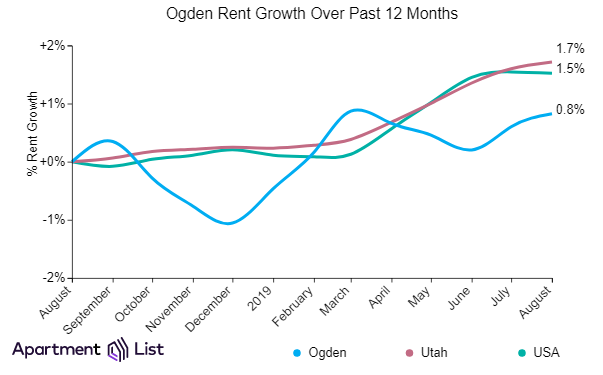
Ogden rents have increased 0.2% over the past month, and are up marginally by 0.8% in comparison to the same time last year.
Currently, median rents in Ogden stand at $697 for a one-bedroom apartment and $893 for a two-bedroom.
This is the second straight month that the city has seen rent increases after a decline in June. Ogden’s year-over-year rent growth lags the state average of 1.7%, as well as the national average of 1.5%.
Salt Lake City more affordable than many large cities nationwide
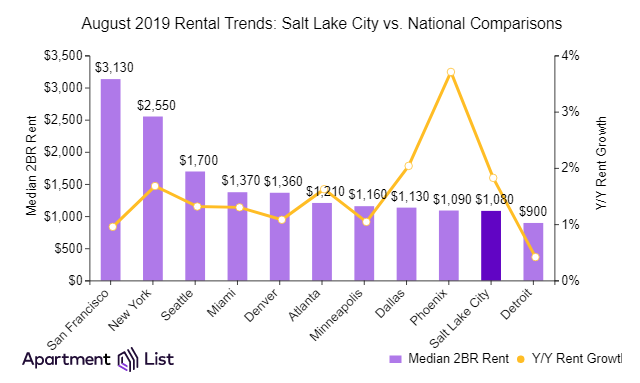
As rents have increased slightly in Salt Lake City, a few large cities nationwide have also seen rents grow modestly. Salt Lake City is still more affordable than most large cities across the country.
Salt Lake City’s median two-bedroom rent of $1,083 is below the national average of $1,191. Nationwide, rents have grown by 1.5% over the past year compared to the 1.8% increase in Salt Lake City.
While Salt Lake City’s rents rose slightly over the past year, many cities nationwide also saw increases, including Phoenix (+3.7%), Dallas (+2.0%), and New York (+1.7%).
Renters will find more reasonable prices in Salt Lake City than most large cities. For example, San Francisco has a median 2BR rent of $3,133, which is more than two-and-a-half times the price in Salt Lake City.
Apartment List is committed to making rent estimates the best and most accurate available. To do this, they use reliable median rent statistics from the Census Bureau, then extrapolate them forward to the current month using a growth rate calculated from their listing data. They use a same-unit analysis similar to Case-Shiller’s approach, comparing only units that are available across both time periods to provide an accurate picture of rent growth in cities across the country.
Portland Attorney Brad Kraus takes on the issue of qualifying repair and renovation landlord exemption under SB 608 and urges landlords to think like a tenant.
Senate Bill 608 is in full force and effect. Many Landlords are wrestling with SB 608’s language and meaning, along with its effect on landlords’ rights, if any they still have.
Many Landlords’ biggest fear over SB 608 was its purported elimination of Landlords’ rights to serve No Cause Notices of Termination. While SB 608 has significantly undermined Landlords’ rights to serve No Cause Notices, certain exemptions remain which still allow for No Cause Notices. One such exemption – the Repair/Renovation Exemption – functions by placing Landlords in the intriguingly awkward position of arguing that their premises are uninhabitable. In other words, it causes Landlords to think like a Tenant, when assessing the magnitude of their habitability problems during the repairs/renovations.
If you’re thinking, “I’ve had tenants raise habitability allegations in an effort to avoid paying rent,” you’re already familiar with habitability disputes. Oregon’s “habitability statute” lists several items that, if substantially lacking, render the premises uninhabitable. For example, if there’s no water supply, no functional roof, no heating, or no electricity (see the theme here?), the premises likely are unsafe or unfit for occupancy. Think of habitability strategies from a tenants’ perspective: if the rented premises substantially lacks water, heat, electricity, etc., a tenant could successfully (a) contend that the premises isn’t habitable, and (b) avoid owing you rent for the timeframe during which the premises was uninhabitable.
Brad Kraus
SB 608 repair/renovation exemption
Many Landlords encounter habitability defenses in their eviction actions. However, Senate Bill 608’s repair/renovation exemption flips the habitability script, by requiring Landlords – not Tenants – to make the Tenant-like argument that the premises are (or will be) uninhabitable. Fortunately, seasoned Landlords can use their habitability knowledge in order to salvage No Cause Notice termination strategies under SB 608.
SB 608’s Repair/Renovation Qualifying Landlord Exemption requires that the Landlord “intends to undertake repairs or renovations to the dwelling unit within a reasonable time and: (a) The premises is unsafe or unfit for occupancy; or (b) The dwelling unit will be unsafe or unfit for occupancy during the repairs or renovations.” The statute’s operative words, “unsafe” and “unfit,” are not defined. Alas, your habitability knowledge can supplant those definitional gaps by knowing what it takes to meet the statutory threshold: The more your repairs/renovations make the place uninhabitable, the more likely you are to defeat a tenant’s argument that you didn’t qualify for the Repair/Renovation Qualifying Landlord Exemption. In other words, the worse off your property is (or will be), the better off your Exemption argument will be.
Remember that SB 608 is state law and does not universally preempt local jurisdictional laws. For example, Portland has its own rules, requirements and exemptions that often differ from those crafted by the state legislature. Accordingly, regardless of your right to serve No Cause Notices under SB 608’s Repair/Renovation Landlord Exemption, make sure you comply with local laws.
The penalties for failing to serve valid notices that fall neatly within the Repair/Renovation Landlord Exemption can be costly, so understand your rights, know when to think like a tenant, and contact a skilled Landlord/Tenant attorney, should you have any questions.
About the author:
Brad Kraus is an attorney at Warren Allen LLP. His primary practice area is Landlord/Tenant law, but he also assists clients with various litigation matters, probate matters, real estate disputes, and family law matters. A native of New Ulm, Minnesota, he continues to root for Minnesota sports teams in his free time. He is an avid sports fan, enjoys exercise, spending time friends and his fiancée, Vicky. You can reach Mr. Kraus via email at [email protected], or by phone at 503-255-8795.
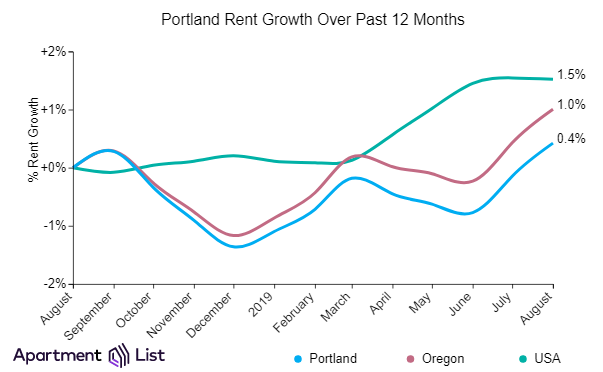
For the second month in a row Portland rents have increased, this time 0.6% over the past month, but have been relatively flat at 0.4% in comparison to the same time last year, according to the August report from Apartment List.
Currently, median rents in Portland stand at $1,137 for a one-bedroom apartment and $1,342 for a two-bedroom. This is the second straight month that the city has seen rent increases after a decline in June. Portland’s year-over-year rent growth lags the state average of 1.0%, as well as the national average of 1.5%.
Rents rising across cities in the Portland Metro
Throughout the past year, rents have remained steady in the city of Portland, but other cities across the entire metro have seen rents increase. Of the largest 10 cities that Apartment List has data for in the Portland metro, all of them have seen prices rise. Oregon as a whole logged rent growth of 1.0% over the past year.
Here’s a look at how rents compare across some of the largest cities in the metro.
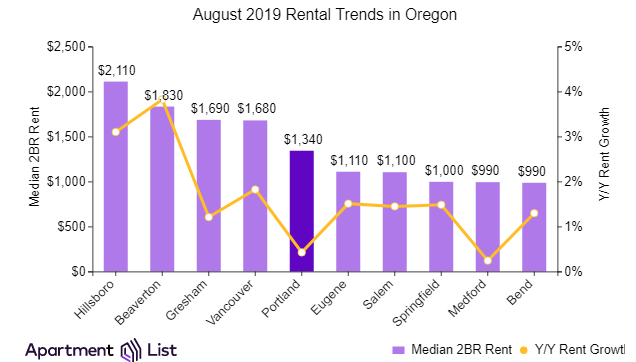
Looking throughout the metro, Hillsboro is the most expensive of all Portland metro’s major cities, with a median two-bedroom rent of $2,110; of the 10 largest Oregon metro cities that we have data for, all have seen rents rise year-over-year, with Beaverton experiencing the fastest growth (+3.8%).
Hillsboro, Vancouver, and Eugene have all experienced year-over-year growth above the state average (3.1%, 1.8%, and 1.5%, respectively).
Rents more affordable than many comparable cities nationwide
Rent growth in Portland has been relatively stable over the past year – some other large cities have seen more substantial increases. Portland is still more affordable than most other large cities across the country.
Portland’s median two-bedroom rent of $1,342 is above the national average of $1,191. Nationwide, rents have grown by 1.5% over the past year compared to the stagnant growth in Portland.
While rents in Portland remained moderately stable this year, similar cities saw increases, including Las Vegas (+3.9%), Phoenix (+3.7%), and Austin (+3.2%); note that median 2BR rents in these cities go for $1,187, $1,089, and $1,465 respectively.
Renters will find more reasonable prices in Portland than most similar cities, the report says.
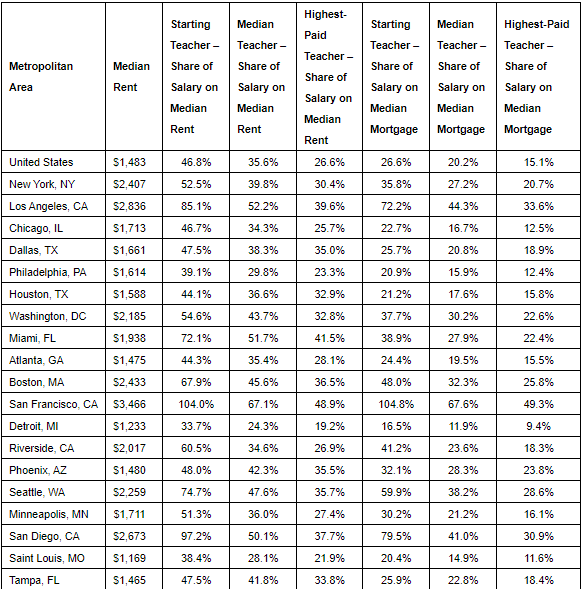
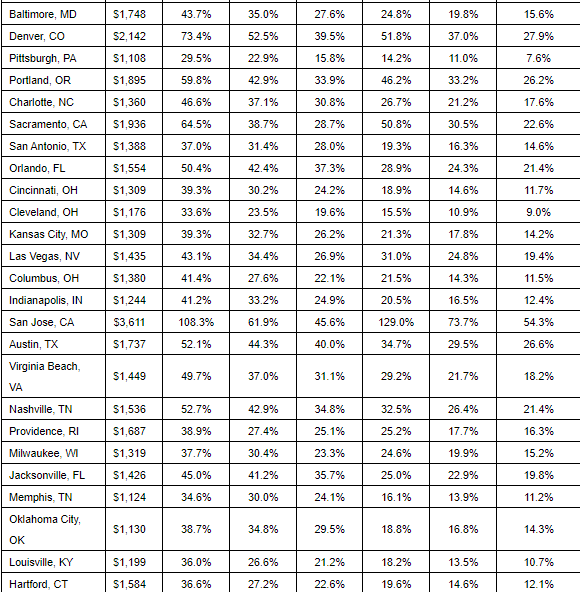
New teachers will find the typical rent unaffordable in 49 of the 50 largest metro areas in the United States, according to new analysis from Zillow.
The median-market-rate rent payment would take 46.8 percent of a typical starting teacher’s salary, 35.6 percent of a mid-career teacher’s salary and 26.6 percent of the highest-paid teacher’s salary.
Pittsburgh is the only large U.S. metro where market-rate-rent prices are affordable for entry-level teachers.
Mortgage payments are relatively more affordable, taking 26.6 percent of a typical starting teacher’s salary – assuming a 20 percent down payment.
“Most acknowledge that building more homes is required to address the root cause of eroding housing affordability,” said Skylar Olsen, Zillow’s director of economic research, in the release.
“Without that new influx to take the pressure off rent and aggressive home value growth, it’s the public servants, like teachers, firefighters, and nurses – the professions that keep us safe, our kids smart, and our families healthy – that often feel the pinch most. So don’t think of housing affordability policies as a choice between change and the status quo. Crowded, job-rich communities will change — and it will be either the buildings that change or the mix of people who can afford to live in them,” Olsen said.
It is not only the most expensive markets where teachers are cost burdened. New teachers spend more than half of their income on market-rate rent in some broadly affordable metros, such as Salt Lake City, Minneapolis and Raleigh.
Of the 50 largest metro areas, only Pittsburgh offers affordable rent for starting teachers. And even the highest-paid teachers would find the typical rental affordable in just over half of large metros.
Teachers who own a home are in a better position, due in part to the benefit of low mortgage interest rates and decades-long terms that lock in payments even as home prices rise, the Zillow report said.
As a new or experienced landlord, you probably know that there are all kinds of things (both big and small) that can cause problems and consume your precious time. Between dealing with building maintenance, difficult tenants, and financial concerns, being a rental property owner can be exceptionally stressful.
There are certainly some pitfalls that you are more likely to encounter than others. Here are three of the top traps that property owners commonly find themselves stuck in. We’ll also discuss some of the ways you can escape these traps and make your job easier.
1. Trusting a Tenant Based on Their Word Alone
Unfortunately, there’s a reason that seasoned property owners always, always conduct background checks on their rental applicants. They want to know as much as possible to ensure that they’re accepting a tenant who will be responsible and trustworthy.
Many landlords, at some point in their careers, get burned for trusting a tenant without the proper evidence to support their claims. It’s a common trap and one that can get messy really quickly.
In some cases, you might rent to someone who feels like a friend (or who actually is). You wind up leasing to a tenant who you don’t actually know that well, and in the end, your assumption about their character could backfire dramatically. Never assume that someone will make a good tenant just because they’re friendly or they tell you a believable story about their life.
At the end of the day, you should never accept a tenant based on their word alone. You need hard evidence that they haven’t committed any crimes and are going to be a good renter. The only way you can get this evidence is by requesting it from all applicants.
Don’t just ask your tenant about their history – confirm it by gathering the following information:
Their full name and social security number
Their age
Current and previous addresses
Information from previous landlords
Their current income (and proof of payment)
Their employer’s contact information
Banking and credit references
Personal references you can follow up with (not family)
Besides following up with references, employers, and previous landlords, you should also pull a background check on your applicant from a verified tenant screening company. Services like My Smart Move and My Rental are fairly inexpensive – but will quickly help you identify your top candidates.
As much as you’d like to think you can trust the word of your current applicants, it’s your job as a rental property owner to take that extra step and do some research behind the scenes. Otherwise, you run the risk of falling into the common trap of working with bad, untrustworthy tenants.
2. Taking on the Accounting Jobs By Yourself
As a rental property owner, your job isn’t to make sure that dollars and expenses don’t slip through the cracks.
Regardless of how organized or experienced you may be; you’ll juggle a lot as a property owner. Too many landlords find out later that they can’t actually handle everything at once, at least not without proper assistance.
If you repeatedly find yourself swamped with issues in the finance sector of your business, you might be dealing with tasks that a real accountant should be handling. Whether you have one tenant or 100, it’s a smart idea to hire an accounting partner that can prevent problems, including:
Bookkeeping mistakes
Poor account and finance records
Failure to deduct expenses properly
Inconsistent salary management
Wondering why you would need an accountant if you can manage all of the finances on your own? As a rental property owner, your job isn’t to make sure that dollars and expenses don’t slip through the cracks. Your job is to keep the property running smoothly, and an accountant can help you do that more accurately.
Outsourcing your accounting tasks is likely easier than you think it is. You don’t necessarily have to hire an accountant full time. Instead, you could use a service like Ardem or RSM to handle the issues you don’t have the time or knowledge to tackle.
3. Collecting Rent in Too Many Forms
One tenant pays by cash. One pays by check. One sends you funds on Venmo whenever they get around to it.
Does this sound like your rent payment situation?
If so, you’re likely stuck in the trap of complicated rent collection. This can lead to accounting problems, as well as stress and frustration due to confusing interactions with your tenants.
In order to maintain a consistent cash flow that you can easily keep track of, you should automate your rent collection process ASAP. This will lead to better, clearer interactions with your tenants, and you won’t waste time chasing after the rent payments you’re owed as a rental property owner.
The best way to automate your rent collection is to set up a central tenant platform where they can pay all of their fees, including their rent and any late payments. There are dozens of services available at your fingertips that will allow you to build a clean, simple tenant portal that all of your renters can use.
Some reliable tenant payment platforms for rental property owners include:
Centralizing your payment system won’t just make things easier for you. It will also completely change how your tenants manage their payments, and overall, the process will become easier for everyone.
Centralizing your payment system won’t just make things easier for you. It will also completely change how your tenants manage their payments.
Rental property owners summary and conclusion
Many rental property owners fall into the traps listed above without even realizing it. If you’re wasting your time with challenging tenants, complicated accounting problems, or late rent payments, then you’re taking away time from your most important tasks as a landlord.
If you learn one thing from this article, let it be this: it’s often smart to ask for help as a property owner.
Use tools to thoroughly evaluate your tenants instead of taking their word as proof. Outsource your accounting issues so that you can feel secure in your finances. Simplify and automate your rent collection process so you experience fewer issues.
There are many resources out there that can help you escape these common traps. Don’t be afraid to try them, regardless of how old or new you may be to owning rental properties.
About the Author:
Eric D. Davis is the Founder of Davis Property Management; we help property managers and potential tenants looking for Seattle Property Management and Maintenance services. We have been the front-runners in providing best-in-class property management services in the Puget Sound
Tenants love decks, so the 8 rental property deck maintenance do’s and don’ts is the maintenance checkup from Keepe this week, and some of the don’ts may surprise you.
Decks are a unique feature that adds both value and living space to a property’s exteriors, and alongside pools and playgrounds, tops the charts as one of the most beloved amenities among tenants.
This week’s article will provide a helpful series of contractor-approved guidelines for keeping decks in top-shape as well as overviewing common mistakes that are actually damaging to a deck’s materials and structure.
Four Do’s of Rental Property Deck Maintenance
Here are the top 4 things you should think about when it comes to rental property deck maintenance.
No. 1 – Schedule an Annual Deep Cleaning Procedure
A deep cleaning procedure works as an “exfoliator” that both cleans the deck and also allows for the wood’s surface to become better primed for treatments.
Scrubbers and pressure washers can be used for this procedure, which apply proper friction for the porous surface to “open up” and better absorb sealants and treatments. Our experts warn that being mindful about exterior temperatures is fundamental: for example, when it’s too hot, cleaning solutions and treatments lose efficacy as they evaporate more quickly. Deep cleaning should be performed when it’s dry and about 60-70 degrees Fahrenheit outside.
No. 2 – Familiarize Yourself With Available Treatments and Treat Accordingly
Sealing decks is essential for protecting their look and structure and thus prolonging their lives.
Untreated wood is vulnerable to surface damages, cracking, rotting and discoloration caused by weather, water, pest and UV rays. Available sealants include natural and synthetic sealants, stains and paint.
Certain characteristics contribute to making some of those treatments more ideal than others. For instance, natural sealants can include oils that pests and algae find appealing. Paint is known to chip and bubble over time instead of aging well like stains do. It’s always best to consult an expert before settling with a treatment that has never been applied to a deck before.
No. 3 – Allow for Proper Drying
After being cleaned, sanded and treated, decks need time to thoroughly dry.
Checking the weekly forecast and keeping tenants from using the deck too soon are final but vital steps to ensure time spent treating was time well spent
No. 4 – Pay Attention and Inspect Seasonally
Decks should be inspected regularly to ensure that any damage, cracks, rusting and loose components are noted and repaired as soon as possible.
If a problem is noticed in the wintertime, it’s not ideal to wait until the warmer season to address it as it might then not only be completely forgotten about – and thus allow for injuries to occur once the deck is used more often – but could potentially be worsened by being exposed to harsh seasonal weather for several weeks.
Remember your rental property deck maintenance checklist because a sealed deck is not maintenance-free.
4 Don’ts of Rental Property Deck Maintenance
OK, here are some of those things you should not do when it comes to deck maintenance.
No. 1 – Be Overconfident After Sealing
A sealed deck is not maintenance-free. While sealing takes care of protecting the deck from most elements, areas that are not covered are still exposed and thus prone to damage and wear.
It’s important to keep the deck clean and free of debris and dirt to prevent staining, and still inspect the deck with regularity.
No. 2 – Go the Do-It-Yourself Route
For major procedures – sanding, sealing, deep cleaning – it’s always best to turn to a professional, as botched maintenance job almost always results in visibly damaged areas that require being completely replaced. Sanding and pressure washing can permanently warp the surface of the wood.
No. 3 – Get Too Aggressive With Cleaning
Cleaning is supposed to complement the protective and nurturing purpose of sealants. It’s important to avoid utilizing harsh chemicals, like bleach. These can permanently stain and ruin the natural coloration of the wood.
Pressure washing can also do more harm than good when it’s used too much or incorrectly, which is why maintenance professionals emphasize keeping in mind that it has the ability to strip off the wood.
No. 4 – Forget About Nearby Vegetation
The products utilized for cleaning and treating wood are typically not plant-friendly. It’s important to cover surrounding vegetation with a plastic or cloth tarp – the latter allows for better ventilation and is recommended for longer projects – to keep it from being killed by the chemicals.
Resources: Other recent rental property maintenance Keepe posts
Keepe is an on-demand maintenance solution for property managers and independent landlords. The company makes hundreds of independent contractors and handymen available for maintenance projects at rental properties. Keepe is available in the Greater Seattle area, Portland, Phoenix, San Francisco Bay and San Diego areas.