Home Blog Page 158

4 Ways You Can Spot Water Damage Early In Your Rentals

4 Ways to Reduce Rental Property Maintenance and Repair Costs

Fixing water damage in rentals  was one of the most popular maintenance jobs this past month performed by Keepe, so here are some tips to help.

Water damage in your rental can be a small annoyance or a really big problem. So the hot maintenance job lately has been around water damage and leaks, perhaps due to the recent wet weather in several parts of the country, according to Keepe.

 With more weather potentially on the way this fall and some rainy days ahead, it pays for property managers and maintenance folks to do a quick checkup.

The best time to check for leaks is after heavy rainfall or on hot humid days because pipes tend to sweat in high temperatures.

However, it is certainly beneficial to take a more preventative approach by inspecting rentals more routinely for water leaks and damage.

4 Ways You Can Spot Water Damage In Rentals Early

 Make sure to look at windows, sinks, showers, roofs, and toilets first as these are usually the most common origins of water leaks.

No. 1 – An increased water bill

An uptick in the water bill for you or your tenants would strongly suggest a leak somewhere in your plumbing system. Unfortunately a big bill can be a helpful way to find leaks that are in places that are rarely visited, such as leaks in attics or crawl spaces.

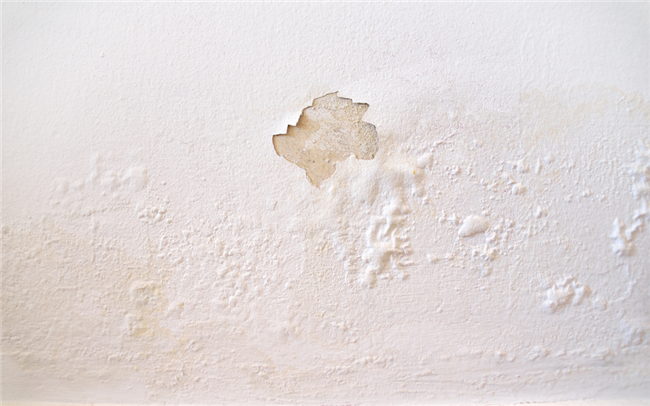
 No. 2 – Peeling or bubbling paint damage in rentals
4 Ways You Can Spot Water Damage Early In Your Rentals

 This could strongly suggest that the pipes behind the walls might be leaking, causing water to seep through the wall and paint.

No. 3 – Mold buildup

 If you see mold building anywhere in your rental, this could be a strong indicator of a water damage and leak. This is potentially caused by a moisture problem that has been accumulating for a long period of time.

4 Ways You Can Spot Water Damage Early In Your Rentals

No. 4 – Damage indicators like soft spots on roofs, ceilings and walls

 Identifying these soft spots early on could save you a lot of time and money before letting it spread to other areas, causing a bigger, more expensive problem.

Identify and mitigate early

It is extremely crucial to identify a water leak early because an ongoing leak can severely damage walls, ceilings, or even tenants’ belongings.

In addition, when mold starts to form, this will also start to become a very expensive problem, especially if it is more than 10 square feet in size.

The Environmental Protection Agency (EPA) has particular guidelines and requirements to deal with these larger moldy surfaces, most of which are very costly.

Here are other recent rental property maintenance Keepe posts you may have missed:

 How To Pick The Perfect Exterior Paint Color For Your Rental Property

4 Outdoor Flooring Options For Your Rentals

20 Easy, Affordable Maintenance Projects To Update Your Rentals

7 Tech Gadgets For A Safer And More Efficient Rental Property

5 Maintenance Tips For Long-Lasting Rental Carpet Flooring

Is The Water Heater At Your Rental Property Ready For The Big One?

7 Types Of Kitchen Countertops For Your Apartments

Which Cooktop Is Best For Your Rental Property?

A Guide To 4 Types Of Flat Roof Systems

6 Ways To Trash Your Apartment Waste Management Issues

Top 5 Apartment Maintenance Emergencies vs. Maintenance Requests

5 Tips for Preparing Your Apartments for the Summer Season

4 Air Conditioning Maintenance Best Practices For Summer

About Keepe:

Keepe is an on-demand maintenance solution for property managers and independent landlords. We make hundreds of independent contractors and handymen available for maintenance projects at rental properties. Keepe is available in the Greater Seattle area, Greater Phoenix area, San Francisco Bay area, and Portland area, and we are continuing to expand. Learn more at http://www.keepe.com
 

Portland Rents Continue Upward Trend for Third Straight Month

Portland Rents Continue Upward Trend for Third Straight Month

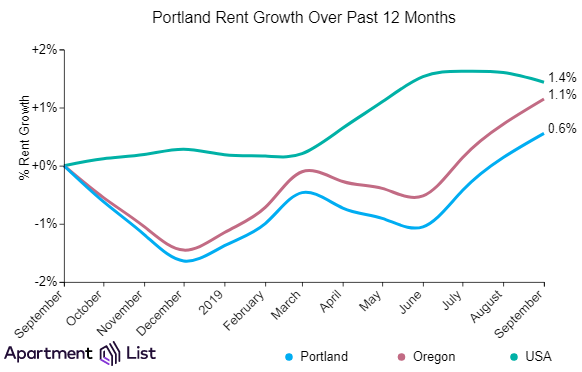
Portland rents rose again in September and continued the upward trend seen for the past three months, according to the September report from Apartment List. The last decline was in June.

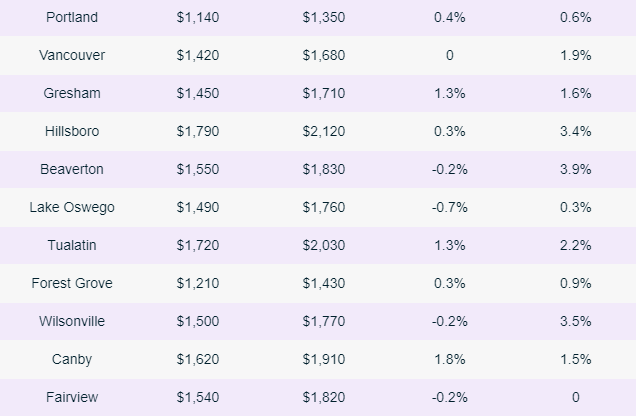
Median rents in Portland stand at $1,142 for a one-bedroom apartment and $1,347 for a two-bedroom, according to the report.

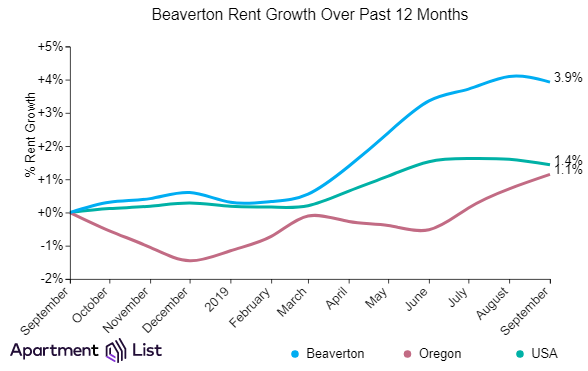
Despite the recent months’ increases, overall Portland’s year-over-year rent growth lags the state average of 1.1 percent, as well as the national average of 1.4 percent.

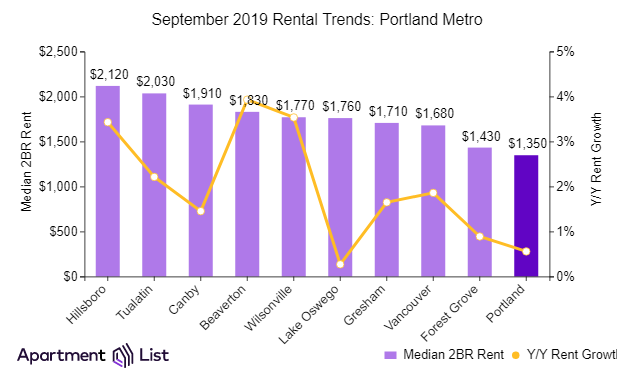
Rents rising across the metro area

How rents have grown in Beaverton, Oregon

Lately, Beaverton has seen the fastest rising rents in the metro area, with a year-over-year increase of almost 4 percent.

In Beaverton now, the median two-bedroom costs $1,829, while one-bedrooms go for $1,551.

Here is what is going on across the metro area:

Portland and Oregon rents rising

  • Over the past month, Lake Oswego has seen the biggest rent drop in the metro, with a decline of 0.7 percent. Median two-bedrooms there cost $1,760, while one-bedrooms go for $1,492.
  • Portland proper has the least expensive rents in the Portland metro showing the prices listed above. Rents were up 0.4 percent over the past month and 0.6 percent over the past year.
  • Hillsboro has the most expensive rents of the largest cities in the Portland metro, with a two-bedroom median of $2,118; rents increased 0.3 percent over the past month and 3.4 percent over the past year.

Portland rents

Across the state of Oregon, rents grew more slowly, showing only 1.1 percent over the past year. For example, rents have grown by 1.6 percent in Salem and 1.4 percent in Eugene.

Last month:

Portland Rents Increase Over The Past Month


Preparing Your Furnace For Winter To Protect Your Rental Property

The weather is getting colder and colder out there but before you turn on your furnace or heater, winterizing your investment properties (especially the HVAC system) should be at the top of your to-do list. Your tenants will rely on the heater throughout the cold months of winter, so it’s important to prepare the system for the upcoming winter days. Here are some helpful tips on how to get it ready.

Tip #1: Clean and replace filters

Did you know that dirty and clogged filters can cause big problems? Furnace filters are incredibly important parts of the overall system and if they’re clogged with dirt, pet hair or debris, the flow of warm air can be hindered, which means that the heating system will work harder to keep areas warm and comfortable. If this happens for extended periods of times, the system could break down. Make sure the furnace filters are checked on a routine basis to ensure they are clean and they are replaced on a regular basis as needed.

Tip #2: Clean the inside of the furnace

The inside of the furnace, often at the base of the heater, is where dust and other debris will start accumulating. You should consistently make sure this area is clean through routine maintenance of your heating system.  Once it’s clean, it will function efficiently and will be less prone to breaking down in the future.

Tip #3: Keep vents clear of obstruction

Obstructing furnace vents could cause your whole system to not work effectively and could cause it to break down so make sure vents are clear of furniture like couches or bookcases. While you’re looking at the vents, be sure to open them up and clean the insides so they are free of dust or other debris that may cause clogging or potential break down.

Tip #4: Get a professional furnace tune-up

Hiring a professional heating and cooling company to complete an annual maintenance of the heating system is a great investment and one that should be done at the turn of the season.  An annual maintenance will ensure the furnace is in proper working conditioning and the HVAC technician can identify potential problems that are unseen that could cause expensive repairs down the road.

Rental properties require a little bit of attention to detail during the bitter cold of winter and taking the extra time to do that will keep your tenants comfortable and allows for the heating system to stay in good working order so you don’t have to plan for any unexpected repairs or premature replacement of the system.

About the author:

Written by Brooke Strickland, freelance writer for Specialty Heating & Cooling.  Specialty Heating & Cooling is a full service heating and cooling company in Tigard, OR

5 Steps To Take Care Of Your Rental Property Heating System In Winter


Sign Up For Our Newsletter And Get Rental Housing and Apartment News And Helpful, Useful Content Each Week.

* indicates required

Ask The Utah Attorney: My Tenant Is Asking To Change The Locks Because Of Domestic Violence

A federal judge has ruled a landlord did not have to automatically waive its animal fee for a tenant with an emotional support animal

Dear Attorney: My tenant is asking to change the locks because they are a victim of domestic violence. What should I do?

Answer:  First, you will always want to show compassion and make sure you are doing what you can to keep all of your tenants safe.

If any tenant feels their safety is in jeopardy, they should call the police and seek help.

Second, under Utah law, victims of domestic violence have certain protections when dealing with leases. They can choose to either:

(1) Have the landlord change the locks to exclude the perpetrator, or

(2) Terminate the lease (only as to the victim) by paying 45 days of rent.

When tenant is asking to change locks what happens?

Either way, the victim tenant should (1) clearly tell the landlord what they are requesting, (2) provide documentation (either a police report or protective order) showing they are a victim of domestic violence, and (3) pay for the costs of what they have decided (either pay for the locks to be changed or pay 45 days of rent).

If the locks are changed, the perpetrator tenant cannot enter the property but they remain liable for paying rent as it comes due.

We recommend that you keep copies of everything to document your file.

Jeremy Shorts, ESQ Utah Eviction Law

Ask the Utah Attorney Jeremy Shorts

Ask The Utah Attorney: What To Do With Tenant Shed Left Behind?

Apartment Mystery Maintenance Call Of The Week: Hornets In My Rental

Apartment Mystery Maintenance Call Of The Week: Hornets In My Rental

The apartment mystery maintenance call of the week came from Portland again this week when the property manager of a Portland rental called Keepe with an unusual work order.

“There are hornets inside my house, and it seems to be coming out from inside  my drywalls. Please send keepers now!” the property manager said.

As our workers came in, they were able to assess that somehow, a hornet nest has been accumulating inside the drywall.

Hornets in my rental

As they explored further, it was discovered that the nest has been building for at least three months before the work order was called in. Our workers determined that it originated from a tiny hole beside the front door, which allowed the hornets to go into the hollow dry walls and build their homes from there.

This unique problem took a full day to solve, with the help of a separate pest control crew to exterminate the hornets and clear out the nest.

The maintenance crew had to cut open a large portion of the drywall, which pest control would need to clean the inside of the drywall.

Once everything has been cleared out, the wall had to be fully patched, a job that took about three to four hours.

After a long day of completing this odd job request, not only does the drywall look good as new, but more importantly, no more hornets in my rental.

Other rental property maintenance help from Keepe.

4 Outdoor Flooring Options For Your Rentals

20 Easy, Affordable Maintenance Projects To Update Your Rentals

7 Types Of Kitchen Countertops For Your Apartments

13 Ways To Pet Proof Your Rental Property

About Keepe:

Keepe is an on-demand maintenance solution for property managers and independent landlords. The company makes hundreds of independent contractors and handymen available for maintenance projects at rental properties. Keepe is available in the Greater Seattle area, Portland, Phoenix, San Francisco Bay and San Diego areas.


Money For Nothing: Getting The Most From Your Tenant Settlement Strategies

Getting The Most From Your Tenant Settlement Strategies

I’m amazed by the number of landlords who give money or rent concessions to tenants, thinking they just settled a dispute, only to find themselves at the wrong end of subsequent claims for those same disputes.

Rather than giving up money for nothing, let’s make sure you’re getting the most from your tenant settlement strategies.

Landlord/Tenant relationships are like many other contractual relationships. Parties must comply with their end of the agreed upon terms/conditions/obligations, and a failure to do so can lead down the path towards litigation.

Whether, for example, a tenant seeks damages for a defective toilet or an unlawful entry, many landlords give tenants money, thinking the damage claims are thereby resolved. The landlord’s goal in making the payment is obvious: pay the money, make the problem go away.

However, those same landlords may not realize that, without solid settlement documents, they may have created more headaches than solutions.

Tenant settlement strategies

A landlord’s payment of money to a tenant without a signed settlement agreement often occurs as a result of several faulty assumptions.

The landlord may incorrectly assume that:

(a) The tenant has agreed that the money fully compensates the tenant for that claim.

(b) The tenant has no other potential claims against the landlord.

(c) The tenant won’t pursue those claims (and seek more money) on a later date.

The faulty nature of the foregoing assumptions often raises its ugly head when the tenant files a lawsuit, for it is at that moment the landlord discovers that money was handed out for nothing.

To add insult to injury, the landlord may also discover that litigation costs can dwarf the initial payment to the tenant.

The forgoing “money for nothing” scenario is wholly avoidable: in consideration for any payment of money to a tenant, have the tenant execute a settlement agreement releasing any and all claims that may exist.

In other words, utilize a written contract that protects you.

The necessity of a document evidencing the parties’ settlement agreement—and the complete release of any and all claims—derives directly from contract law: Settlement agreements are contracts, and they are subject to the basic rules of contract law. Well written settlement agreements contractually waive and release existing claims; eliminate disputes regarding the nature of the parties’ settlement; and rebut tenants’ subsequent efforts to contend that no such waivers and releases exist. In other words, a well written settlement agreement provides a landlord with a solid defense to any lawsuit brought by the tenant for the previously resolved claims.

So… money for nothing? It’s a great song title, but let’s make your money work for you and get you something in return: create and execute well-written settlement agreements, put past disputes in the past, and avoid allowing the past to tarnish your future.

Related story from Brad Kraus:

Think Like A Tenant: Qualifying Repair and Renovation Landlord Exemption Under SB 608

Think Like A Tenant: Qualifying Repair and Renovation Landlord Exemption Under SB 608

 Getting The Most From Your Tenant Settlement Strategies
A landlord’s payment of money to a tenant without a signed settlement agreement often occurs as a result of several faulty assumptions. Photo credit undefined undefined via istockphoto.com

2020 Oregon Allowable Rent Increase Cap is 9.9 Percent

2020 Oregon Allowable Rent Increase Cap is 9.9 Percent

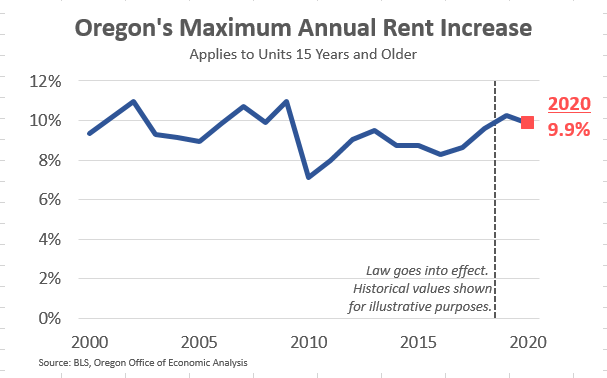
The Oregon allowable rent increase percentage for the 2020 calendar year is 9.9 percent, down slightly from 10.4 percent in 2019, announced by the Oregon Office of Economic Analysis (OEA).

Oregon’s new rent control law, SB 608, passed in February 2019, ushering in the first-in-the-nation statewide rent control.  SB 608 created two major changes to the Oregon Residential Landlord Tenant Act by limiting the scope of termination notices without stated cause and implementing rent control.

Each year, the OEA is responsible for calculating and publishing, by September 30, the maximum annual rent increase percentage allowed by statute SB 608 for the upcoming year.

The OEA calculates this amount as 7 percent plus the Consumer Price Index (CPI) for All Urban Consumers, West Region (All Items), based on the most recent published data from the Bureau of Labor Statistics for the period September thru August.

The CPI went down slightly from 3.4% to 2.9 percent.  This results in the annual allowable statewide rent increase cap of  9.9 percent for 2020, and will go into effect on January 1st, 2020.

Attorney and Rental Housing Alliance Oregon Board Member Charles Kovas cautions, “Landlords with outstanding 90-day notices should be aware that those notices may need to be hand-delivered in order to comply with the January 1st rate change.”

The cap on rental increases applies to all renewals and to all rent-increase notices delivered on or after February 28, 2019.  Under this law, if landlords terminate tenancy of a prior tenant with a notice of termination without cause during the first year of occupancy, the landlord may not increase rent for that unit by more than 7 percent plus CPI when the subsequent tenant moves in.

The only exemptions to this Oregon allowable rent increase limit are:

  1. Properties with a certificate of occupancy less than 15 years old, or
  2. Properties providing reduced rent to the tenant as part of any federal, state or local program or subsidy.

For more information, contact Attorney Charles Kovas at [email protected] or call 503-496-5543.

Resources:

Governor Kate Brown Signs Landmark Oregon Rent Control Bill

Senate Bill 608 Explained

Kay Properties Real Estate Offering Goes Full Cycle on Behalf of Investors

Kay Properties and 1031 and 1033 exchanges and eminent domain options details

Kay Properties and Investments has announced that one of their joint venture private placement real estate offerings has gone full cycle. The offering consisted of an opportunity to participate in an Absolute Triple Net Leased (NNN) hospital in the Kansas City Metro Area.

The offering generated a 22.27% Return on Investment (ROI)* in approximately 1 year and was made available to accredited investors under Regulation D Rule 506(c) at 25k minimum investments.

Dwight Kay, CEO and Founder of Kay Properties commented, “We are extremely pleased with the opportunity to provide these returns for our investors in such a short time period and look forward to continuing to provide future real estate investments for those in 1031 exchanges as well as direct cash investors.”

* Past performance does not guarantee or indicate the likelihood of future results. Diversification does not guarantee profits or protect against losses. All real estate investments provide no guarantees for cash flow, distributions or appreciation as well as could result in a full loss of invested principal. Please read the entire Private Placement Memorandum (PPM) prior to making an investment.

*The Return on Investment (ROI) represents the ratio of total sales proceeds and distributions through the life of the asset over the total initial equity invested, net of fees. The ROI represents a return to an individual investor. No representation is made that any investment will or is likely to achieve profits or losses similar to those achieved in the past or that losses will not be incurred.

About Kay Properties and Investments, LLC:

Kay Properties and Investments, LLC is a national Delaware Statutory Trust (DST) investment firm with offices in Los Angeles, San Diego, San Francisco, Seattle, New York City and Washington DC. Kay Properties team members collectively have over 114 years of real estate experience, are licensed in all 50 states, and have participated in over $9 Billion of DST real estate. Our clients have the ability to participate in private, exclusively available, DST properties as well as those presented to the wider DST marketplace; with the exception of those that fail our due-diligence process. To learn more about Kay Properties please visit: www.kpi1031.com

This material does not constitute an offer to sell nor a solicitation of an offer to buy any security. Such offers can be made only by the confidential Private Placement Memorandum (the “Memorandum”). Please read the entire Memorandum paying special attention to the risk section prior investing. This material contains information that has been obtained from sources believed to be reliable. However, Kay Properties and Investments, LLC, WealthForge Securities, LLC and their representatives do not guarantee the accuracy and validity of the information herein. Investors should perform their own investigations before considering any investment. IRC Section 1031, IRC Section 1033 and IRC Section 721 are complex tax codes therefore you should consult your tax or legal professional for details regarding your situation. This material is not intended as tax or legal advice.

There are material risks associated with investing in real estate, Delaware Statutory Trust (DST) properties and real estate securities including illiquidity, tenant vacancies, general market conditions and competition, lack of operating history, interest rate risks, the risk of new supply coming to market and softening rental rates, general risks of owning/operating commercial and multifamily properties, short term leases associated with multi-family properties, financing risks, potential adverse tax consequences, general economic risks, development risks and long hold periods. There is a risk of loss of the entire investment principal. Past performance is not a guarantee of future results. Potential cash flow, potential returns and potential appreciation are not guaranteed. For an investor to qualify for any type of investment, there are both financial requirements and suitability requirements that must match specific objectives, goals and risk tolerances. Securities offered through WealthForge Securities, LLC. Member FINRA/SIPC. Kay Properties and Investments, LLC and WealthForge Securities, LLC are separate entities.


Rental Housing Deposit Alternatives Drive More Leases Survey Says

Rental Housing Deposit Alternatives Drive More Leases Survey Says

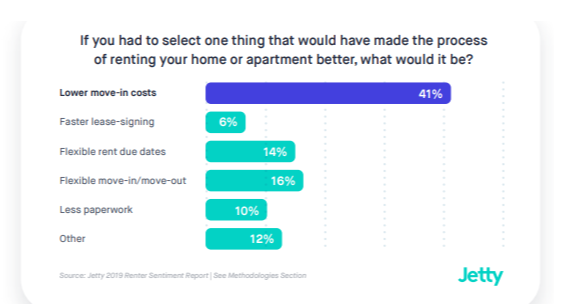
High up-front costs are preventing renters from moving into the homes they want nationwide, and many of these renters believe that lower fees are the solution for a better leasing experience, according to survey of renters.

The nationwide survey of 667 renters found that affording the up-front costs of signing a new lease is the biggest worry in the context of renting, according to a release from financial services and rent guarantee company Jetty.

“Today’s renters are stressed. They worry about making monthly rent payments, they struggle to afford up-front move-in costs—and they’re ready for change,” the company said in the release.

Key findings of rental housing deposit alternatives survey

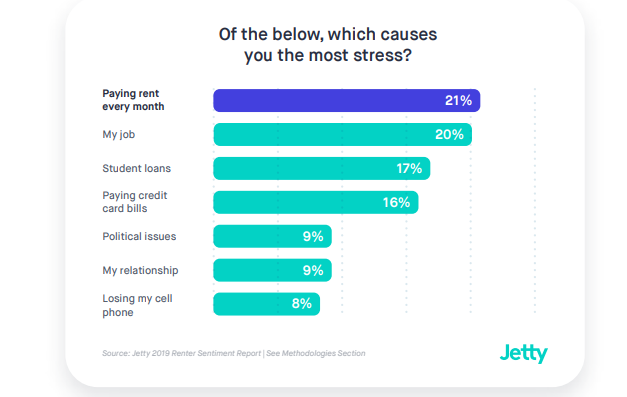
  • Paying rent causes more stress than jobs, student loans, credit card bills, and political issues.
  • Most renters worry that they won’t be able to pay rent.
  • High up-front costs are preventing renters from moving into the homes and apartments they want.
  • Almost half of renters wouldn’t be able to afford a cash security deposit right now—but security-deposit alternatives could be a game-changer for them.


Most renters worry they won’t be able to pay the rent at some point

Rental Housing Deposit Alternatives Drive More Leases Survey Says

There are many costs involved with renting, but monthly payments weigh the heaviest on renters.

When asked about their most burdensome renting expenses, almost half of renters (44 percent) cited monthly rent payments, followed by security deposits (26 percent), utility bills (16 percent), movers (8 percent), and broker fees (5 percent).

In fact, almost two-thirds of renters surveyed worry that they won’t be able to make their rent payments at some point during their lease cycle. Of those, 18 percent said that they worry about making rent every month or most months, and 46 percent said they worry about it at least two months out of the year.

Rental Housing Deposit Alternatives Drive More Leases Survey Says

Rental housing deposit alternatives

According to a report in MarketWatch, as many metros are seeing a flood of new rental apartments ease the supply crunch, rents remain high — up 3.6% compared to a year ago, according to fresh CPI data – and the barriers to entry, for many people, formidable. Now a new wave of start-ups is trying to apply fintech principles to helping ease some of the angst of getting into a rental agreement, even if it can’t do much about the rent itself.

Some consumer advocates are wary about innovations like the ones TheGuarantors – and competitors like Jetty and Insurent – offer, according to reports. Also there are others such as Suredeposit and Leaselock.

Typically renters pay a non-refundable fee and percentage to the companies.

Rental Housing Deposit Alternatives Drive More Leases Survey Says

Renters feel up-front move-in expenses are too high

High up-front costs are preventing renters from moving into the homes and apartments they want, according to the release.

Despite the stress renters feel about monthly payments, being able to make rent isn’t what they’re most fearful of in the renting process.

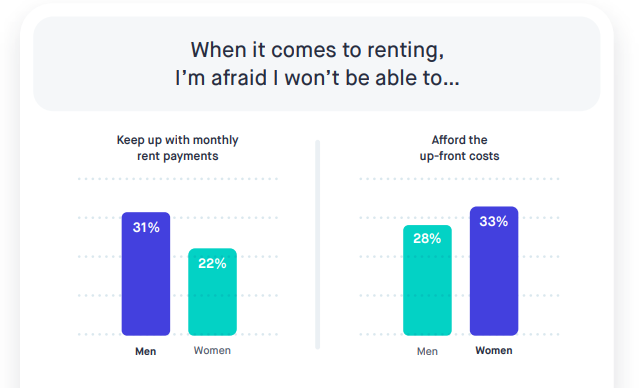
According to the survey, when asked what they’re most afraid of in the context of renting, 30 percent of renters ranked affording up-front costs, while 26 percent said keeping up with rent payments.

Almost 60 percent of renters have been prevented from moving into the rental homes or apartments they wanted because the up-front expenses were too high, the survey says.

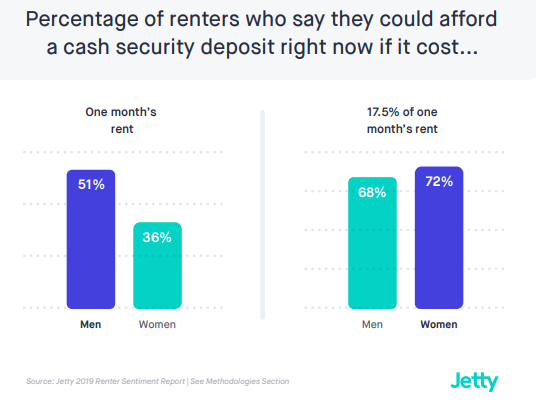
Almost half of renters wouldn’t be able to afford a cash security deposit of one month’s rent right now. Survey respondents said security-deposit alternatives could be a game-changer for them.

While less than half of renters would be able to afford a cash security deposit of one month’s rent right now, 70 percent of those renters could afford a security deposit alternative.

Methodology

This data was collected through a survey by Jetty designed to discover how renters feel about renting and what challenges they face in the process. The company used a third-party survey tool to reach a sample of U.S. renters, balanced for age, gender, and geographic region, and gathered a total of 667 responses.

Resources:

When the rent isn’t too high — but the security deposit is

With rent surging, these startups offer to pay the security deposit

A Passion For Helping Tenants With Poor Credit Get Apartments And Homes


The Most Expensive Zip Codes For Renters In 2019

The Most Expensive Zip Codes For Renters In 2019

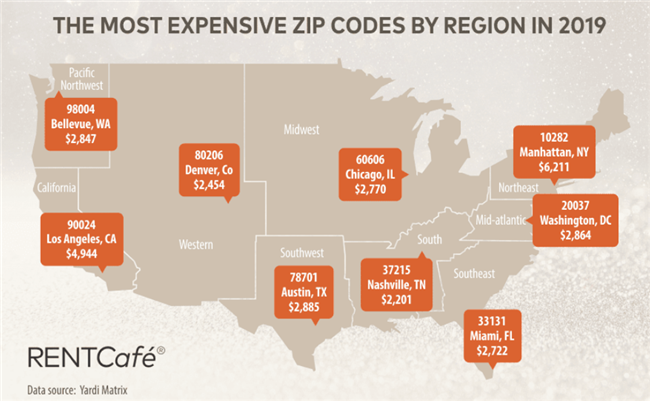
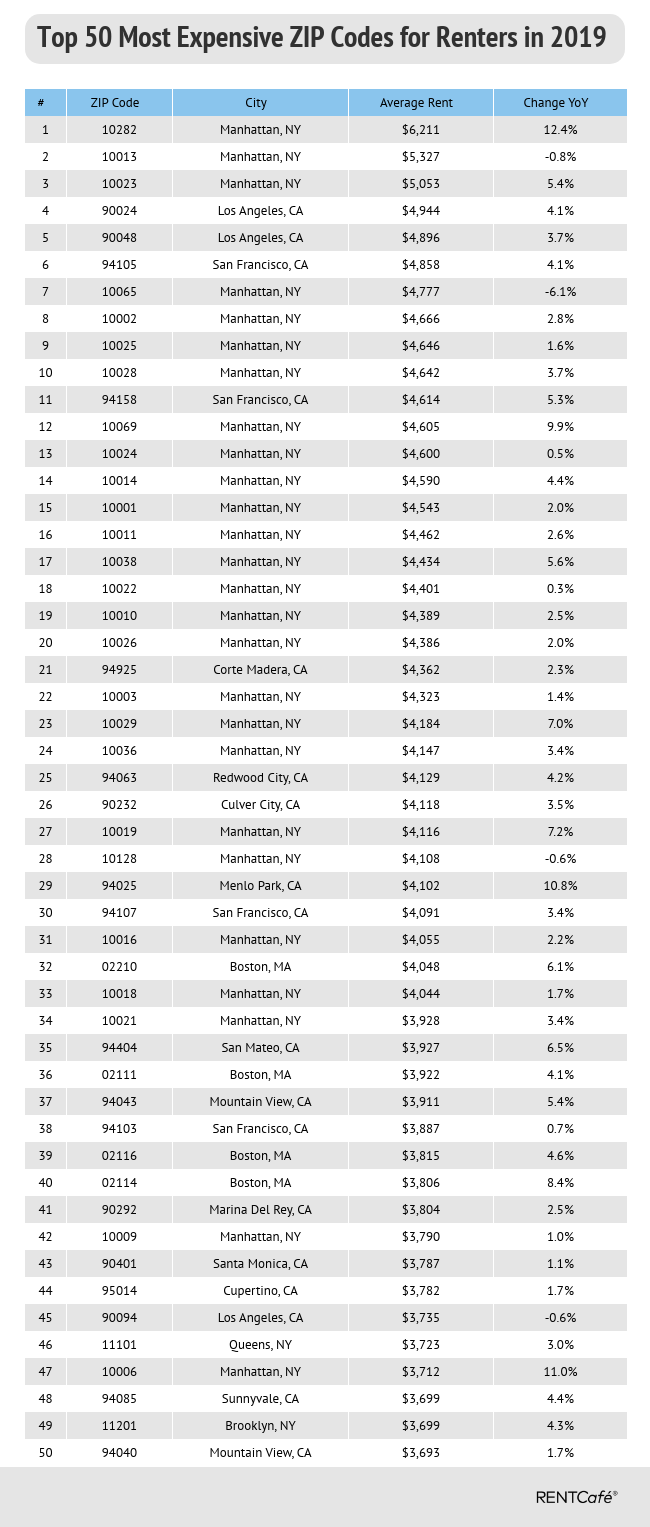
The most expensive zip codes for renters in 2019 are dominated by New York City, the San Francisco Bay area, Southern California and Boston, according to a new report from RentCafe.

“As the peak rental season has come to an end, we wanted to see which neighborhoods charged the priciest rents this summer and which high-end areas saw the most significant rent changes,” RentCafe said in the release.

The most-coveted locations for high-paying jobs and endless opportunities, New York City and California grab the most spots in the top 50 as priciest places to live in the U.S.

Out of the 50 most expensive ZIP Codes for renters, 28 are in New York City, with 26 in Manhattan and one each in Queens and Brooklyn. The ranking is completed by 18 California ZIP codes and 4 ZIP codes from Boston.

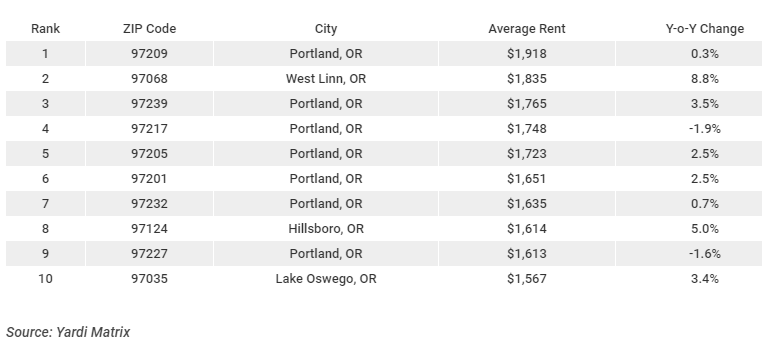
Oregon’s most expensive

Oregon's most expensive zip codes for renters

Los Angeles’ 90024 is the most expensive ZIP code for renters in sunny California

With 18 ZIP Codes across Los AngelesSan Francisco, Corte Madera, Redwood City, Culver City, Menlo Park, San Mateo, Mountain View, Marina Del Rey, Santa Monica, Cupertino and Sunnyvale, California apartments aren’t too far behind those in New York.

In fact, among the top 10 most expensive ZIP Codes 3 alone are in California, split between two in Los Angeles and one in San Francisco.

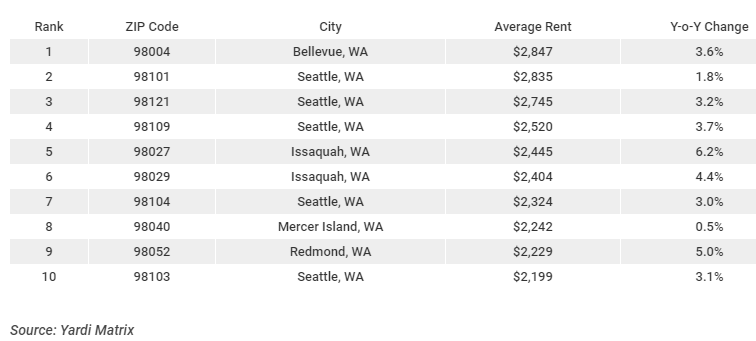
Washington’s most expensive

Washington's most expensive zip codes for renters

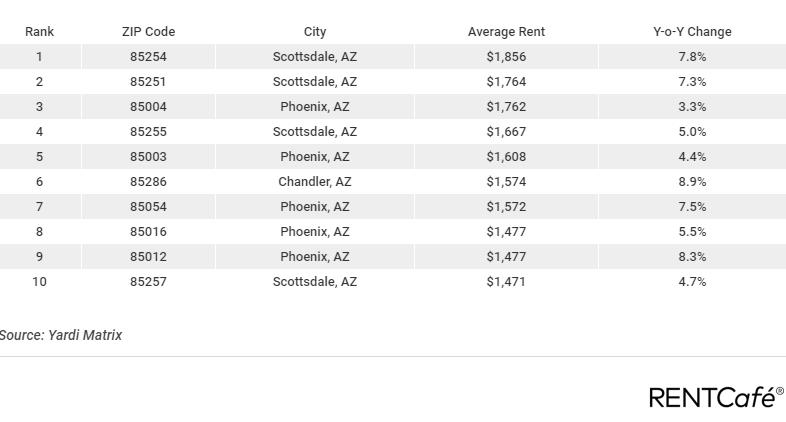
Arizona’s most expensive

Arizona's most expensive zip codes for renters

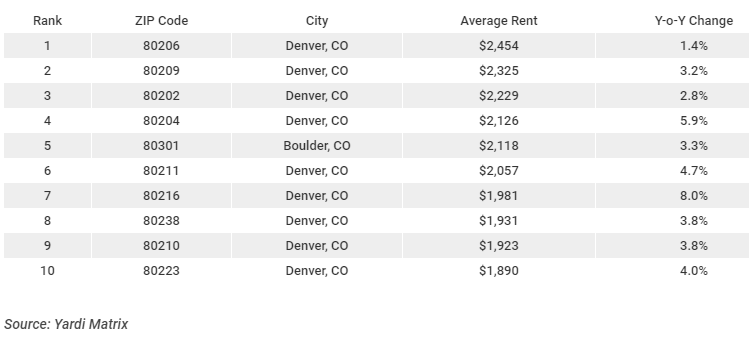
Colorado’s most expensive

Colorado's most expensive zip codes for renters

Where are the least expensive?

The ZIP Code with the smallest average rent is in Wichita, 67213, with $423. It is followed by Memphis ZIP Code 38106 with an average rent of $471.

On the list, in 16th place is Saint Louis ZIP Code 63137 with an average rent of $548. Another large city ZIP Code, in 38th place, is 48234 in Detroit, where rent averaged out at $585. There are also 10 Ohio ZIP Codes spread across Toledo, Girard, Youngstown, Canfield, Warren and Dayton, which all have apartment rents in the $500s. Kansas has 9 ZIP Codes covering the Wichita and Hutchinson areas, with average rent ranging between $423 and $581. Tennessee has 8 ZIP Codes in the top, in Memphis, Louisville and Maryville, with apartments under $600.

The Most Expensive Zip Codes For Renters In 2019