Home Blog Page 109

Real Estate Investors – Is Your Tax Sheltering Plan Bulletproof?

Real Estate Investors - Is Your Tax Sheltering Plan Bulletproof?

Whether you are in the business of fix & flips or rental properties, we are all sitting in a world of unknowns right now. However, all politics aside, there are two things that are certain. First, is that the trillions of dollars in government aid will need to be paid back. Second, is that this expectation foreshadows what recourse will most likely be taken, taxes. So, in anticipation of this impending tax event, does your real estate investment strategy also include an optimal tax shelter plan?

If your answer was “no”, then let Preferred Trust Company introduce you to one of the most dynamic tax-sheltering tools you can fold into your portfolio, the Self-Directed IRA. You are receiving an exclusive invitation to attend the Virtual Seminar “Self-Directed IRAs: Fact and Fiction” on Wednesday, July 28th at 9:00AM PST.

At this virtual seminar you will learn the benefits of Self-Directed IRA accounts, how to open an account, and how to direct your investments in alternative assets, like real estate, with an IRA.

CTA – REGISTER HERE

If you are interested in adding a Self-Directed IRA to your retirement strategy, Click Here to schedule a no obligation consultation at your convenience. Now until December 31st, 2021, Preferred Trust Company will waive the establishment fee and first year administration fee for all new accounts. Give us a call at 888.990.7982 or visit our website and apply online to take advantage of this offer today!

Real Estate Investors - Is Your Tax Sheltering Plan Bulletproof? Preferred Trust

Purchase Your Next Property at Auction with a Retirement Account

New Resident Expectations Accelerate Rise in Smart Communities

New Resident Expectations Accelerate Rise in Smart Communities

Property managers may want to consider investing in the right technologies to create smart communities as nearly half of prospective renters say smart building products increase their interest in a potential apartment, according to a 2021 study by Assurant. Renters are even willing to lose out on floor space if it means enhanced digital features.

By Dean Compoginis
VP of Business Development, Nomadix Inc.

Imagine controlling the lights, thermostat, security system and community gates all with a tap on your smartphone or through voice commands. After spending countless hours at home over the past 16+ months, we’ve learned new habits and shifted our preferences for comfort, efficiency and seamless connection while working, learning and relaxing in our homes.

With the promise of continued hybrid work options – as seen with the U.K. looking to make work-from-home the “default” choice, the new smart-home requirements will only continue to increase. In fact, 40 percent of all U.S. apartments are expected to have connected devices by 2025, with smart apartment revenue to exceed $9B.

Aligning with this new demand, multifamily property managers and owners should invest in internet-of-things (IoT) technologies and smart functionality to ensure higher tenant satisfaction and lease renewals. Let’s take a look at a few key areas that not only benefit the resident but also improve operational efficiencies and create higher values for the property.

Connected Entry

Did you know that 61 percent of millennials are more likely to rent an apartment specifically because of its electronic access features? For individual apartments, property gates, fitness rooms, pools and more, connected entry and access controls make it easy for residents to let friends or service people in from a distance via mobile apps or digital-key technology.

For property managers, they can increase the security of the property by instant authorization and restriction of access as residents move in and out. It’s more efficient than changing locks, simple to manage, and eases the tension of onboarding during peak transitions times.

Energy Management

Smart thermostats, outlets, lighting and other energy-smart IoT solutions offer smart-home conveniences residents want. It provides joy to many to start cooling down their apartment 20  minutes before they arrive home on a sweltering day! It’s also easy to turn on lights with sensors or voice commands when walking into a room or sitting on the couch when the sun starts to go down.

 Meanwhile, IoT energy-management systems can deliver significant savings. Many operators report that heating and cooling alone accounts for half or more of their monthly energy costs. Using IoT sensors to track and analyze energy consumption and air quality optimizes energy use and improves response times if any problems arise. Leak detection, for example, can instantly alert maintenance before catastrophic damage occurs.

Mobile Apps

Today’s residents want a home that offers comfort and  community, and which eases their everyday lifestyle. Mobile apps provide the glue that pulls it all together. From staying in touch with other residents with messaging apps, to paying rent and utility bills, package notification, maintenance orders, and controlling the lighting and temperature, investing in an integrated, customized mobile app really helps build the community.

Owners and managers see substantial benefits from the adoption of a customized mobile app. From touring a property at lease-up, to staying in touch with residents over the course of their tenancy, and continuing the relationship after they move out, mobile apps deliver what all property owners and managers need: continuous engagement with their most important resource – their customers.

Connection via mobile apps can also allow residents to immediately notify property managers of a leaky faucet, faulty light switch or other maintenance issues. Open communication through the app can help property managers keep residents aware of important updates or community events. Property managers can also collect rent and notify residents about overdue payments digitally.

Wi-Fi as a Service

 Managed Wi-Fi offers the support necessary for all these IoT devices and gives residents instant access to fast, high-quality connectivity. Residents can manage their own connections with individual network passwords and controls, and benefit from seamless access across the property. This powers all of the smart technologies across the community, not to mention the smart TVs, computers and other devices they use to work and relax in their homes.

Offering managed Wi-Fi also opens up many opportunities for property owners. It can be quite common to generate an additional $20-$30 per month per apartment for just internet services alone. Beyond generating additional monthly revenue, the managed Wi-Fi network will also provide outstanding opportunities to improve operational efficiencies and add ancillary revenue streams.

There is a wide range of IoT and smart technologies available today to support smart-apartment initiatives. Where you focus your resources depends entirely on your specific situation, competitive set, local market variables and portfolio management imperatives. For example, in some markets, a $20 monthly savings on electricity due to smart thermostats may be highly valued, while in another market, smart apps and access control for dog walkers and delivery people may be of higher interest.

Residents have shown they are willing to pay for the latest digital features in smart communities, with millennials paying about 20 percent more and staying longer in buildings that offer modern lifestyle conveniences. Now’s a great opportunity to build a solid foundation to align to the new expectation of residents. Happy residents create happy communities, and offering modern, smart conveniences will continue to create positive returns with resident satisfaction and increased revenue opportunities.

About Dean Compoginis

New Resident Expectations Accelerate Rise in Smart Communities

Dean is a global sales and marketing executive who most recently served as director of MDU business development & sales at Ruckus Networks. Before that, he was the director of the hospitality business unit at Meru Networks. Dean has a proven track record in multiple industries, including networking, hospitality, MDU, software, telecommunications, broadcast, major retail, marine products, computer hardware. He currently serves as VP of Business Development of Nomadix

Sign Up For Our Newsletter And Get Rental Property And Apartment News And Helpful, Useful Content Each Week.

* indicates required


Will You Be Ready When the Eviction Moratorium Ends?

Everything Landlords Should Know About Emotional Support Animals

No Guns In My Apartments: Can A Landlord Say That And Put It In A Lease?

Can I Say “No Pot In My Apartments” When It’s Legal In My State?

Portland Rents Continue 5-Month Climb

Portland Rents Continue 5-Month Climb

Portland rents have increased 1.7 percent over the past month, and are now up 2.5 percent year-over-year, according to the June report from Apartment List.

Now, median rents in Portland are $1,197 for a one-bedroom apartment and $1,396 for a two-bedroom.

These increases are part of the fifth straight month that the city has seen rent increases. The last decline in rents came in January.

However, Portland’s year-over-year rent growth lags the state average of 7.3 percent, as well as the national average of 8.4 percent.

Portland Rents Continue 5-Month Climb

Rents Rising in All Major Cities Across Portland Metro

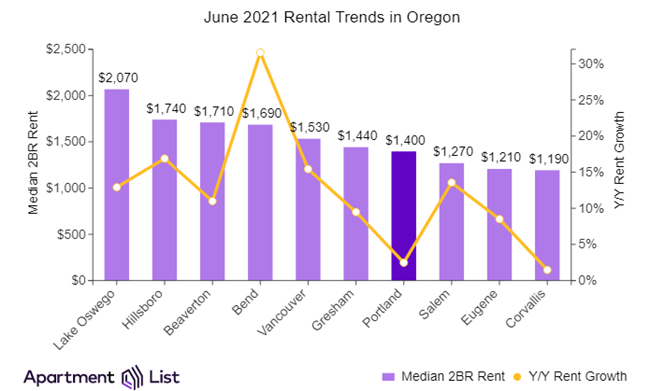
Of the 10 largest cities in the Portland metro for which Apartment List has data, all have seen prices rise. Oregon as a whole logged rent growth of 7.3 percent over the past year.

Here’s a look at how rents compare across some of the largest cities in the metro.

  • Lake Oswego is the most expensive of all Portland metro’s major cities, with a median two-bedroom rent of $2,068.
  • Hillsboro rents have increased 4.4 percent over the past month, and have increased sharply by 16.9 percent in comparison to the same time last year. Currently, median rents in Hillsboro are at $1,585 for a one-bedroom apartment and $1,740 for a two-bedroom.
  • Beaverton rents have increased 2.4 percent over the past month, and have increased sharply by 11.0 percent in comparison to the same time last year. Currently, median rents in Beaverton stand at $1,409 for a one-bedroom apartment and $1,710 for a two-bedroom.
  • Vancouver rents have increased 2.0 percent over the past month, and have increased sharply by 15.4 percent in comparison to the same time last year. Currently, median rents in Vancouver stand at $1,298 for a one-bedroom apartment and $1,533 for a two-bedroom.

Across the state rent increases:

  • Bend had the fastest growth in Oregon up 31.5 percent.
  • Eugene rents have increased 1.6 percent over the past month, and have increased sharply by 8.5 percent in comparison to the same time last year.

Sign Up For Our Newsletter And Get Rental Property And Apartment News And Helpful, Useful Content Each Week.

* indicates required


Will You Be Ready When the Eviction Moratorium Ends?

National Rent Prices Jump Again in June, As Upward Trend Continues

What Are First Steps In Plumbing Emergencies In Rental Property?

What to Do During Plumbing Emergencies In Rental Property

How to handle plumbing emergencies in rental property is this week’s maintenance tip from Keepe, the on-demand maintenance company.

If you manage rental property, you and your tenants are bound to experience plumbing emergencies at some point. The problems can include broken pipes, gas leaks, blocked drains, faulty taps and tenant-caused issues that can lead to plumbing disasters.

Being prepared and knowing what to do when this happens is your first step to reducing damages and repair costs.

While having a professional plumber on call is the most important factor for having your plumbing issues promptly fixed, here are the steps you should take to minimize damage in a plumbing emergency.

Examples of plumbing emergencies

Plumbing emergencies in rental property are those that require immediate action now, especially when your tenants call, such as:

  • Clogged sinks, toilets, bathtubs or shower drains
  • Leaky faucets, toilets, water heater, hoses
  • Broker water lines
  • Burst or frozen water pipes
  • Sewer system backups

First steps to take in plumbing emergencies in rental property

Turning off the water supply is the first step, as the most common plumbing emergency in residential rental housing is water leaks or water flooding an area.

Do you know where all the water shut-off valves are?  Many times a property manager may not even know the main source of a water leakage. It could be sewage water or domestic water leaking into your rental from another source.

Find your shutoff valves ahead of time so you know where they are when you need to quickly shut off the water. The valve could be in the building somewhere or out by the street.

Sewage Backups: Call a Professional Plumber

Sewage backups usually happen when there is something wrong with the sewage pipes under your foundation. Tree roots can sometimes lead to a blockage, or an incorrect installation may lead to serious problems.

If you see a pool of brown smelly water in your yard, the first thing you should do is to shut off the water. Don’t try to fix a sewage-related problem yourself; you could expose yourself to harmful bacteria. Call the water utility company or septic company, who will send a trained professional to investigate and fix the problem.

Overflowing Toilets: Turn off the Water Supply

A clogged toilet can quickly overflow when flushed, leading to unsanitary issues and immense water damage. Caution your tenants about paper towels, tissues, wrappers and even baby wipes, all of which can all easily clog your plumbing and cause toilets to overflow.

Your first step is to find and turn off the water-supply valve beneath the toilet tank to prevent more water from entering the bowl. Then, deal with the clog or call the plumber.

Broken Water Heater: Flush the Water Tank/Call a Professional

As a water heater begins to malfunction, your tenants may experience water that’s too cold or too hot or has a strange color or odor. Having a professional flush the hot-water tank may solve color and odor problems as well as improve the heater’s efficiency. If you notice a leak, it may be time for replacement.

In conclusion

Acting fast can save your rental property from major damage and prevent any significant costs.

Keep your emergency plumber’s contact number close, and be prepared with these essential steps to avoid damage during a plumbing emergency.

Best of all, be sure your tenants notify you immediately when there is a plumbing emergency, as the longer they wait, the more damage to your property.

Sign Up For Our Newsletter And Get Rental Property And Apartment News And Helpful, Useful Content Each Week.

* indicates required

6 Ways To To Rid Smoke Smells From Rental Units

Salt Lake City rents increase sharply over the past month

Salt Lake City rents increase sharply over the past month

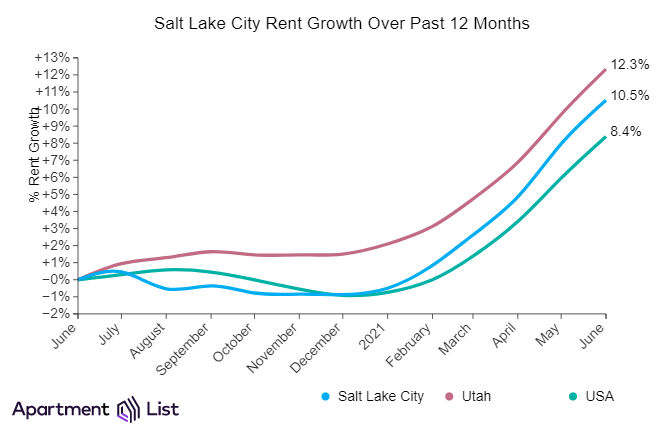
Salt Lake City rents have increased 2.4 percent over the past month, and have increased sharply by 10.5 percent year-over-year according to the June report from Apartment List.

Median rents in Salt Lake City stand at $1,019 for a one-bedroom apartment and $1,303 for a two-bedroom.

This is the sixth straight month that the city has seen rent increases after a decline in December of last year.

Salt Lake City’s year-over-year rent growth lags the state average of 12.3 percent, but exceeds the national average of 8.4% percent.

West Valley City rents increase sharply over the past month

Salt Lake City rents West Valley City rents increase sharply over the past month

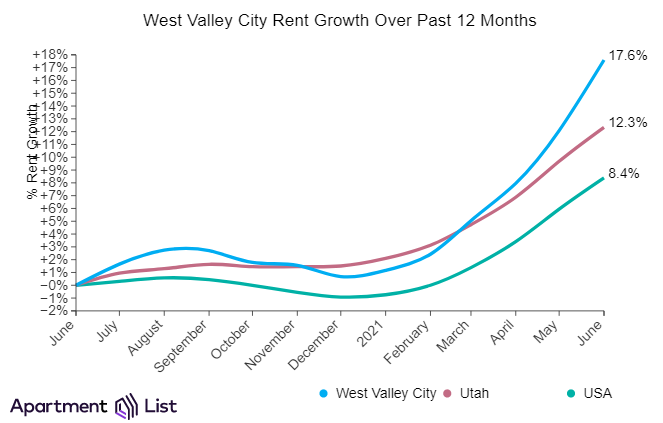
West Valley City rents have increased 4.9 percent over the past month, and are up sharply by 17.6 percent in comparison to the same time last year.

Currently, median rents in West Valley City stand at $1,222 for a one-bedroom apartment and $1,441 for a two-bedroom.

This is the sixth straight month that the city has seen rent increases after a decline in December of last year.

Sign Up For Our Newsletter And Get Rental Property And Apartment News And Helpful, Useful Content Each Week.

* indicates required


Will You Be Ready When the Eviction Moratorium Ends?

Everything Landlords Should Know About Emotional Support Animals

No Guns In My Apartments: Can A Landlord Say That And Put It In A Lease?

Can I Say “No Pot In My Apartments” When It’s Legal In My State?

National Rent Prices Jump Again in June, As Upward Trend Continues

National Rent Prices Jump Again in June, As Upward Trend Continues

National rent prices jumped again in June by 2.3 percent and now are up 9.2 percent so far in 2021, according to the latest report from Apartment List.

In previous years, rent growth from January to June is usually just two to three percent, the report said.

“Although the pandemic created some softness in the rental market last year, 2021 brought the fastest rent growth we have on record in our data. Nationally, and in many individual cities across the country, rents have now surpassed the level where they would have been if rent growth had not been disrupted by the pandemic,” said housing economists Chris Salviati, Igor Popov, and Rob Warnock in the report.

The report said that individual cities have also seen “pandemic pricing” come and go.

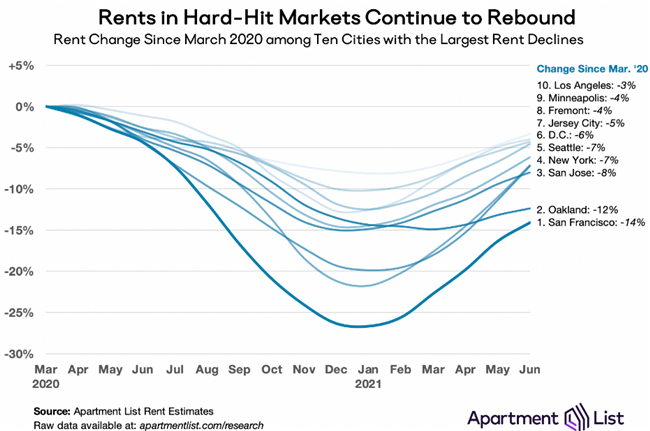
“This month, rents caught up with pre-pandemic expectations in a handful of major markets including Austin and San Diego. Meanwhile, prices remain below the pre-pandemic trend in some of the hardest-hit markets, like New York and San Francisco.”

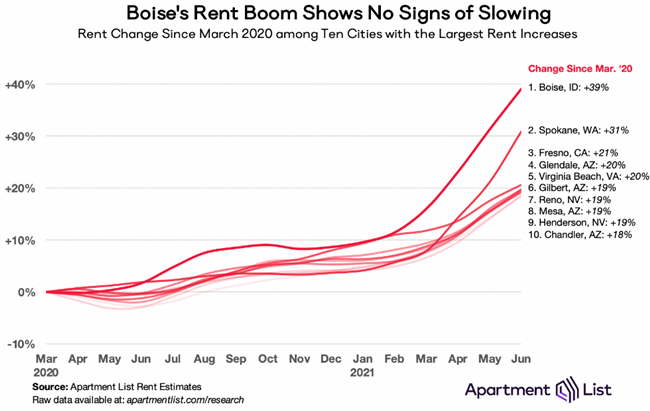
Boise, Gilbert and Chandler lead mid-sized rent-price growth

The report says mid-sized cities continue to boom.

“As expensive coastal cities watched rents plummet throughout 2020, another group of mid-sized markets were heating up.  The pandemic and remote work spurred demand for the space and affordability that these cities offered, and in response, rent prices grew even as the surrounding economy struggled. Even while rent declines in expensive markets have reversed course, the cities where rents have been growing fastest are continuing to boom,” the Apartment List report says.

Rent Prices Jump Again in June, As Upward Trend Continues

In addition, the pandemic “did not start a new trend in these markets, so much as accelerate an existing one. For example, from 2017 through 2019, rents in Mesa, Ariz., increased 25.5 percent, the fastest growth in the nation over that period. Similarly, Fresno, Calif., ranked third for fastest rent growth, while Chandler, Ariz., ranked sixth.”

Conclusion

The national rent prices report concludes by saying, “More broadly, rental inventory across the nation remains tight, and as vaccine distribution continues to gain momentum, we may be seeing the release of pent-up demand from renters who had been delaying moves due to the pandemic. Whereas last year’s peak moving season was halted by the pandemic, this year’s seasonal spike appears to be making up for lost time.”

Sign Up For Our Newsletter And Get Rental Property And Apartment News And Helpful, Useful Content Each Week.

* indicates required


Will You Be Ready When the Eviction Moratorium Ends?

Everything Landlords Should Know About Emotional Support Animals

No Guns In My Apartments: Can A Landlord Say That And Put It In A Lease?

Can I Say “No Pot In My Apartments” When It’s Legal In My State?

Multnomah County Extends Tenant Rent Relief Application Period To 90 Days

Multnomah County Extends Tenant Rent Relief Application Period To 90 Days

The Multnomah County Commission has voted to add another 30 days to the time tenants have to apply for rent relief as there are more than 10,000 pending applications currently.

The commission, meeting in a virtual session, voted to approve an ordinance adding one month to the 60 days of protection approved by the Oregon Legislature in SB 278 before the statewide eviction moratorium ended on June 30. Tenants must apply for the rental assistance during the 90 day period and then  have until February of 2022 to pay back rent.

Most of the applications for rent relief assistance in Oregon have come from Multnomah County.

The ordinance says, “Of the estimated 15,148 households who have applied for state-funded rent assistance, approximately 10,202 reside in Multnomah County. The average total annual amount of short-term rent assistance distributed in Multnomah County under pre-pandemic conditions was approximately $10 million. The County and its partners are now responsible for distributing almost $100 million, requiring a significant reorganization
and expansion of its systems. The scale of projected need as compared to other Oregon counties requires additional time for service providers to process applications,and to meet the legislative intent of Senate Bill 278.”

In terms of how landlords feel about the extension, Liam Frost, senior policy advisor, said he spoke with Deborah Imse, Executive Director of Multifamily NW who said she is opposed to the extension.

One property manager told the commission that the extension to 90 days would introduce more risk for landlords into the equation. She explained there are five main pots of money all with different requirements for tenants to access to pay landlords.

Tenants must provide their landlords with documentation that they have applied for the assistance, and must still pay all of their back rent by February 2022 to avoid being evicted.

The additional 30 days on top of the state’s 60 days was approved “to help ensure that all applications filed in Multnomah County can be processed on time. Also, many tenants who start applications abandon the application commissioners said.

Commissioner Susheela Jayapal said according to a study from Portland State there are an estimated 60,000 households across the state that say they cannot pay next month’s rent. She said there continues to be an overlapping public health and economic crisis.

“I am concerned that while the extension is necessary, it is still not sufficient,” Jayapal said. She said SB 278 protections for renters and payments for landlords is “complicated and confusing.”

“I sympathize whole hardily with landlords who are concerned our action will create further delay for them – especially small landlords,” she said but rental assistance will ultimately flow to landlords where they can get 100 percent of back rent from the landlord reimbursement fund.

Sign Up For Our Newsletter And Get Rental Property And Apartment News And Helpful, Useful Content Each Week.

* indicates required


Will You Be Ready When the Eviction Moratorium Ends?

Senate Bill 278: Additional Tenant Protections (But Appropriate Burdens)

Senate Bill 278: Additional Tenant Protections (But Appropriate Burdens)

Oregon SB 278 moves some of the burden from landlords to tenants, and tenants must provide to the landlord documentation verifying they are seeking rental assistance as attorney Brad Kraus explains here.

Bradley S. Kraus
Attorney at Law, Warren Allen LLP

During nearly every month over the past year, executive or legislative discussions or actions were in motion to change Oregon landlord-tenant law in response to the COVID-19 pandemic. Couple these with the multitude of often different local laws enacted during those same months, and how anyone expected everyday landlords to keep up is unclear.

This past month was no different. The Oregon legislature, deciding the tenant protections they just enacted in Senate Bill 282 were not enough, subsequently passed Senate Bill 278.

This new law creates an opportunity for a tenant to put off any non-payment eviction notice, or enforcement action of the same, if one has been served, for 60 days if certain conditions are met. However, unlike previous tenant protections, the burden to invoke these protections is now properly placed within SB 278—on the tenant. Further, SB 278 makes up for some shortcomings in prior laws related to the Landlord Compensation Fund, correcting the same via this subsequent legislative action.

As an overview, Senate Bill 278 does not change the fact that July’s rent is due and owing on time. Senate Bill 278 creates an odd “if/then” framework related to tenant protections, depending on where a landlord is in the eviction process. To invoke the protections provided by SB 278, the tenant must provide to the landlord documentation verifying they are seeking rental assistance. This documentation can be provided through nearly any method to the landlord, including email or text message.

If a landlord receives this verification, then a 60-day stay to the process commences, and further action is either prohibited—or required—of the landlord. For example, if the landlord has not yet served a Non-Payment of Rent notice and documentation consistent with SB 278 is provided, the landlord is prohibited from serving that notice for 60 days. If no rental assistance is received for 60 days covering the amounts due and owing for that period and the preceding 60-day period, the landlord may serve a Non-Payment Notice thereafter, and no further stays may be invoked by the tenant.

If the landlord has served a Non-Payment Notice—or has commenced eviction proceedings—the tenant may still invoke the protections by providing the landlord documentation at any time, including at or before the first appearance. If this occurs, the landlord cannot continue with the eviction if it is filed, and the court must stay the eviction and schedule a new first appearance no earlier than 60 days later. If rental assistance is procured and the landlord receives the rent, the eviction must be dismissed. If rental assistance is not procured, the landlord may continue with the eviction process at the reset date.

The above protections properly place the burden on the tenant—not the landlord—to seek out, and provide verification of, rental-assistance efforts. This is one correction that was desperately needed, as prior versions of COVID-related laws required no proof, documentation, or evidence of economic hardship, and were ripe for abuse. As an appropriate concession for these protections, Senate Bill 278 also corrected compensation issues that were built into HB 4401 and the Landlord Compensation Fund. It retroactively compensates landlords the 20 percent unpaid rent they were forced to waive in conjunction with access to the Landlord Compensation Fund monies.

Far too often throughout the past year, the executive and legislative actions taken during COVID-19 placed burdens on landlords for a situation not of their making.

I spoke to many landlords over that time, and none took issue with assisting those who were actually affected by the pandemic. While it is unfortunate that the legislature enacted this law due to its inability to get rental assistance out the door, SB 278’s protections require the appropriate party to act to invoke the same. Further, it assists with making landlords whole, correcting HB 4401’s rent-waiver requirements.

About the Author:

Oregon Senate Bill 278 moves some of the burden from landlords to tenants, and tenants must provide to the landlord documentation verifying they are seeking rental assistance
Bradley Kraus, Portland attorney

Brad Kraus is a partner at Warren Allen LLP. His primary practice area is landlord/tenant law, but he also assists clients with various litigation matters, probate matters, real estate disputes, and family-law matters. A native of New Ulm, Minnesota, he continues to root for Minnesota sports teams in his free time. You can reach him via email kraus@warrenallen.com or 503-255-8795.

Fair Housing Matters – Landlord Liability for Tenant-on-Tenant Discrimination

Sign Up For Our Newsletter And Get Apartment News And Helpful, Useful Content Each Week.

* indicates required


How Do You Tell A Routine Maintenance Request from a Real Emergency?

How Do You Tell A Routine Tenant Maintenance Request from a Real Emergency Landlord Hank?

How do you tell when a tenant has a routine maintenance request or a real emergency is the question this week for Ask Landlord Hank. Remember Hank is not an attorney and he is not offering legal advice. If you have a question for him please fill out the form below.

Dear Landlord Hank:

What the tenant thinks is an emergency needing repair and the landlord considers an emergency repair are often two different things. How do you as a landlord decide what is a real emergency vs. just a pesky tenant request? –Sam

Dear Landlord Sam:

In the beginning of the landlord/tenant relationship, when I’m giving tenants their keys, I explain what is an emergency and who to call (not text or email).

An emergency is an issue that can cause damage or injury to human life or the property, like a fire, flood, loss of air conditioning in Florida in the summer, sparking electrical outlets or circuit breakers, etc.

If there is a fire, call 911 and then me.

If there is a flood (meaning water running outside the area it is supposed to be in, like a toilet-supply line leaking on the floor, not a toilet “running,” or a tub with water coming out around it, not a drip from the faucet), then CALL ME, not text or email as I’m usually driving, so I can walk the tenant through turning off the water to the property to limit damage to the building and its contents.

We take tenant maintenance requests seriously and the requests are handled as quickly as possible.

Sincerely,

Hank Rossi

How Do You Tell A Routine Tenant Maintenance Request from a Real Emergency?
Landlord Hank says, “In the beginning of the landlord/tenant relationship, when I’m giving tenants their keys, I explain what is an emergency and who to call (not text or email).”

Ask Landlord Hank Your Question

Ask veteran landlord and property manager Hank Rossi your questions from tenant screening to leases to pets and more! He provides answers each week to landlords.

  • This field is for validation purposes and should be left unchanged.

Do I Have to Paint and Replace Flooring for a Long-Term Tenant?

Sign Up For Our Newsletter And Get Rental Housing And Apartment News And Helpful, Useful Content Each Week.

* indicates required

Everything Landlords Should Know About Emotional Support Animals

No Guns In My Apartments: Can A Landlord Say That And Put It In A Lease?

Can I Say “No Pot In My Apartments” When It’s Legal In My State?

CFPB Warns Landlords: Report Rental and Eviction Information Accurately

CFPB Warns Landlords: Report Rental and Eviction Information Accurately

Accuracy when landlords report rental information and eviction information, and accurate reporting by debt collectors and others is going to come under increasing scrutiny from the Consumer Financial Protection Bureau (CFPB) as the eviction moratorium comes to an end.

The agency is warning in a bulletin to landlords and others of their obligations to accurately report rental information and eviction information.

“As the federal eviction moratorium and other pandemic rental protections come to an end, the CFPB wants to protect families from being denied housing on the basis of inaccurate information,” the agency said in a release. “Inaccurate rental and eviction information on a tenant-screening report or a credit report can unfairly block a family from safe and affordable housing.”

Consumer Financial Protection Bureau warns landlords

The CFPB said it plans to look carefully at whether landlords, property-management companies and debt collectors are furnishing accurate information to credit-reporting agencies (CRAs) and complying with their dispute-handling obligations under the Fair Credit Reporting Act (FCRA). The CFPB plans to pay particular attention to whether data furnishers are reporting arrearages that include:

  • Amounts already paid on behalf of a tenant through a government grant or relief program; and
  • Fees or penalties prohibited by CARES Act section 4024(b) or other laws.

The bulletin also puts CRAs on notice that the CFPB will be looking at whether companies are:

  • Following appropriate procedures to include only accurate rental information in individuals’ consumer reports;
  • Reporting rental information that belongs to the consumer who is the subject of the report;
  • Reporting accurate and complete eviction information, including having reasonable procedures to include the disposition of the eviction, prevent the inclusion of multiple entries for the same eviction action, and prevent the inclusion of eviction records that have been expunged or sealed; and
  • Properly investigating when consumers report inaccuracies.

“Errors in your tenant-screening report shouldn’t hold you back from having a place to call home,” said CFPB Acting Director Dave Uejio in the release. “For families already struggling to make ends meet, an inaccurate report can be the difference between homelessness or settling into a safe and affordable home.

“Landlords and consumer-reporting agencies have clear obligations under federal law, regarding the accuracy of information reported about tenants, and to conduct timely investigations when consumers dispute information. They need to get this right. The CFPB will closely monitor their compliance, and we will use all the tools at our disposal, including enforcement, to protect consumers during this critical time.”

In the event the CFPB identifies CRAs or other data furnishers not meeting their obligations under the FCRA, the CFPB will take appropriate action to address violations and seek all appropriate corrective measures, including remediation of harm to consumers.

You can find the compliance bulletin on the Compliance Resources section of the CFPB’s website.

As of May 2021, an estimated 6.7 million renter householders were behind on their rental payments, according to the CFPB.  Consumers contacting the CFPB reported financial distress caused by the pandemic.  Many of these consumers reported that they were current on rental payments before the pandemic, only to fall behind after losing their jobs due to the pandemic.

The agency said consumers reported multiple issues with debt-collection practices related to eviction, such as receiving notices for outstanding account balances – in some cases for amounts higher than their rent payments – for apartments they had been evicted from earlier in the pandemic. Other consumers reported receiving collection notices for charges they viewed as questionable, such as fees for damaged property or outstanding utility balances.

Also the agency said some consumers have reported receiving debt-collection notices following an eviction for outstanding account balances for apartments they had been evicted from earlier in the pandemic. Other consumers reported concerns that their eviction would have detrimental effects on their ability to secure future housing.

U.S. Supreme Court Declines Landlords Appeal To End CDC Eviction Moratorium

Sign Up For Our Newsletter And Get Rental Property And Apartment News And Helpful, Useful Content Each Week.

* indicates required


Will You Be Ready When the Eviction Moratorium Ends?

Everything Landlords Should Know About Emotional Support Animals

No Guns In My Apartments: Can A Landlord Say That And Put It In A Lease?

Can I Say “No Pot In My Apartments” When It’s Legal In My State?