
Home Blog Page 108

July Apartment Market Showed Improvement in All Metrics

July Apartment Market Showed Improvement in All Metrics

Renter migration due to the pandemic and job changes or losses, government stimulus, and a hot housing market have all contributed to great apartment market conditions, according to a release from the National Multifamily Housing Council (NMHC).

“Robust demand across the country is reflected in growing optimism in the fundamentals of the apartment industry,” The NMHC said in the report.

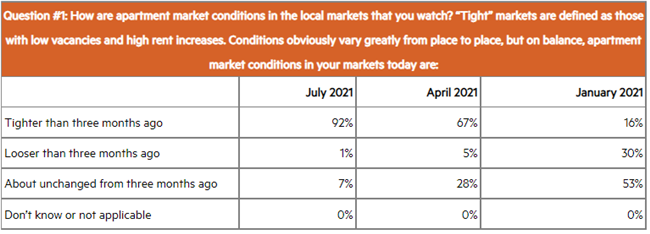
For the first time since October 2015, the NMHC Quarterly Survey of Apartment Market Conditions for July 2021 had all indexes come in above the breakeven level of 50: market tightness (96), sales volume (79), equity financing (69), and debt financing (71).

“We are witnessing strong, broad-based demand for apartments as the U.S. economy continues to recover,” said NMHC Chief Economist Mark Obrinsky in the release. “Many U.S. gateway metros, which were among those hardest hit during the coronavirus pandemic, have now seen their occupancy rates return to near-pre-pandemic levels. Meanwhile, rent growth remains particularly strong in a number of Sun Belt and mountain markets.”

“Nearly all (92 percent) respondents this quarter observed tighter conditions in their apartment markets, signaling that the worst of the pandemic could be behind us. Apartment sales volume is strong as well, bolstered by continued low interest rates and strong availability of equity financing,” Obrinsky  said.
July Apartment Market Showed Improvement in All Metrics

  • The Market Tightness Index increased from 81 to 96 – the highest index number on record – indicating widespread agreement among respondents that market conditions have become tighter. Nearly all (92 percent) respondents reported tighter market conditions than three months prior, compared to only one percent who reported looser conditions. Seven percent of respondents felt that conditions were no different from last quarter.
  • The Sales Volume Index increased from 77 to 79, signaling continued increases in apartment sales volume. More than half (60 percent) of respondents reported higher sales volume than three months prior, while 31 percent deemed volume unchanged. Just three percent of respondents indicated lower sales volume from the previous quarter.
  • The Equity Financing Index increased from 68 to 69. While 41 percent of respondents reported that equity financing was more available than in the three months prior, the same share of respondents (41 percent) believed equity financing conditions were unchanged during the same period. A smaller portion (three percent) of respondents indicated equity financing was less available.
  • The Debt Financing Index increased from 44 to 71, surpassing the breakeven level of 50 for the first time in three quarters. Forty-five percent of respondents reported better conditions for debt financing compared to three months prior, while 39 percent felt that financing conditions were unchanged. Only three percent of respondents signaled that conditions worsened in the debt market, the report said.

View the full survey data online

About the Survey:

The July 2021 Quarterly Survey of Apartment Market Conditions was conducted July 12-19, 2021; 118 CEOs and other senior executives of apartment-related firms nationwide responded.

Sign Up For Our Newsletter And Get Rental Property And Apartment News And Helpful, Useful Content Each Week.

* indicates required


Average National Monthly Rent Tops $1,500 For 1st Time

Will You Be Ready When the Eviction Moratorium Ends?

Everything Landlords Should Know About Emotional Support Animals

No Guns In My Apartments: Can A Landlord Say That And Put It In A Lease?

Can I Say “No Pot In My Apartments” When It’s Legal In My State?

4 Ways to Reduce Rental Property Maintenance and Repair Costs

6 signs your rental property air conditioner may not be ready for this heat so check up now because air conditioning repair is not a surprise you want when tenants call.

Rental property repair and management costs are one of the many expenses that you cannot escape when managing a rental property, so this week’s maintenance tip from Keepe shows some ways to save.

From a sudden breakdown of the HVAC unit to termite infestation, rental properties require continuous maintenance.

While it is essential to embark on regular property maintenance, this doesn’t come cheap. Sometimes, maintenance may cost you thousands of dollars, which eats deep into your potential rental income.

In this article, we will discuss four ways you can reduce your rental property maintenance and repair costs.

No. 1 – Regulate Tenant Selection 

While this may seem like a reasonable thing to do, you’d be surprised at the number of property managers that rarely carry out full background checks on their potential tenants. Some tenants are fond of trashing their rented apartment and losing the deposit. A simple call to a tenant’s previous landlord may save you thousands of dollars in repair costs. You can also request credible references before renting out your property to tenants.

No. 2 – Do Preventive Maintenance

As a property manager, engaging in preventive maintenance is a must. Not only does it help you reduce maintenance costs, but it also helps in preventing future repair issues. Take time out of your busy schedule to test the smoke and fire detectors, maintain heating/cooling systems, clear the gutters, and check for water or gas leaks. By being proactive in your property maintenance duties, you save your property and tenants from unexpected home-related disasters.

4 Ways to Reduce Rental Property Maintenance and Repair Costs

No. 3 – Work with a Reliable Vendor

It is important that you collaborate with reputable vendors if you are looking to cut down on maintenance cost. By working with a reputable vendor, you have access to experienced, vetted, and reliable contractors.

No. 4 – Respond to Maintenance Requests Quickly

This is the most essential factor to consider in reducing your rental property maintenance costs. Tenants expect to live in a property that contributes positively to their overall welfare and quality of life. When a tenant signs a lease, the expectation is that the unit he or she has agreed upon is both functional and habitable for them to live in. Therefore, if a tenant returns home from a busy day at the office and the shower or cooling system doesn’t seem to be functional, it would certainly affect tenant satisfaction and retention rate moving forward.

As a property manager, responding on time to your tenant maintenance or repair request not only saves you money but prevents the escalation of repair issues. You can start by creating a maintenance hotline/email, or you can adopt a digitized maintenance platform that updates in real-time. In addition, it is advisable that you have a reliable handyperson that your tenants can reach in the case of an emergency repair issue, such as a gas leak.

Rental property maintenance conclusion

Reducing your rental property maintenance and repair cost is a deliberate effort that offers you long-term rewards.

Applying the above-listed tips will help you reduce your average monthly expenses.

About Keepe:

Keepe is an on-demand maintenance solution for property managers and independent landlords. The company makes a network of hundreds of independent contractors and handymen available for maintenance projects at rental properties. Keepe is available in the Greater Seattle area, Greater Phoenix area, San Francisco Bay area, Portland, San Diego and is coming soon to an area near you. Learn more about Keepe at https://www.keepe.com.

Sign Up For Our Newsletter And Get Rental Property And Apartment News And Helpful, Useful Content Each Week.

* indicates required


Average National Monthly Rent Tops $1,500 For 1st Time

Will You Be Ready When the Eviction Moratorium Ends?

Everything Landlords Should Know About Emotional Support Animals

Landlords Agree to Pay $100,000 To Settle Sexual Harassment Lawsuit

Landlords Agree to Pay $100,000 To Settle Sexual Harassment Lawsuit involving harassment of female tenants

A group of Ohio landlords have agreed to settle a Fair Housing Act lawsuit over sexual harassment of female tenants, according to a release from the U.S. Department of Justice.

The Justice Department said in the release that Toledo, Ohio, landlords Anthony Hubbard, Ann Hubbard, Jeffery Hubbard, PayUp LLC and No Joke Properties Inc. have agreed to pay $100,000 to resolve a Fair Housing Act lawsuit “alleging that Anthony Hubbard sexually harassed female tenants at rental properties he owned or managed with the other defendants.”

The release says Anthony Hubbard made “unwelcome sexual advances and comments to female tenants; sending them unwanted sexual text messages, videos and photos; offering to reduce or excuse their monthly rental payments, security deposits and utility fees in exchange for sex acts; and entering the homes of female tenants without their consent and without prior notice.”

“The Justice Department will not tolerate landlords who abuse their power by sexually harassing their tenants, and we will continue to vigorously enforce the Fair Housing Act against landlords who engage in this conduct,” said Assistant Attorney General Kristen Clarke of the Justice Department’s Civil Rights Division in the release.

Acting U.S. Attorney Bridget M. Brennan for the Northern District of Ohio said in the release, “Exploiting any person’s basic housing needs as a way to sexually harass, demean and control them violates the law. We remain committed to rooting out homeowners and landlords who target vulnerable residents seeking safe and affordable housing opportunities for them and their families.”

The settlement, which must still be approved by the U.S. District Court for the Northern District of Ohio, requires that defendants pay a total of $90,000 to three female tenants who were harmed by Hubbard’s harassment and a $10,000 civil penalty to the United States

Others Liable for Anthony Hubbard’s Actions

The suit also said that Anthony Hubbard carried out some of this sexual harassment while managing properties on behalf of the other defendants — Ann Hubbard, Jeffery Hubbard, PayUp LLC and No Joke Properties Inc. — making them liable for the harassment he carried out while acting as their agent.

The settlement also:

  • Prohibits Anthony Hubbard from continuing to manage rental housing;
  • Requires Anthony Hubbard to retain an independent property manager to manage any rental properties he owns now or in the future; and
  • Requires defendants to receive fair-housing training and implement comprehensive non-discrimination policies and complaint procedures to prevent sexual harassment at their properties in the future.

The Justice Department’s Sexual Harassment in Housing Initiative is led by the Civil Rights Division, in coordination with U.S. Attorney’s Offices across the country. The goal of the department’s initiative is to address and raise awareness about sexual harassment by landlords, property managers, maintenance workers, loan officers or other people who have control over housing. Since launching the initiative in October 2017, the Department of Justice has filed 21 lawsuits alleging sexual harassment in housing and recovered more than $2.5 million for victims of such harassment.

Sign Up For Our Newsletter And Get Rental Property And Apartment News And Helpful, Useful Content Each Week.

* indicates required


Will You Be Ready When the Eviction Moratorium Ends?

Everything Landlords Should Know About Emotional Support Animals

Investments Growing In Build-To-Rent Single-Family Homes

Investments Growing In Build-To-Rent Single-Family Homes

Many investment groups are getting into the growing single-family rental market with build-to-rent communities, a segment rejuvenated due to COVID-19, Yardi Matrix reports in a special bulletin.

“Increasingly, the way institutions are growing their presence is to build their own communities. Some 12 percent of new single-family construction in 2021 is being done for rentals,” according to John Burns Real Estate Consulting.

“With so much capital looking to invest in the sector and the demand for rentals rising, we would expect build-to-rents to increase rapidly for at least the next several years,” the report says.

Why is Build-to-Rent Investment Growing?

The trend of build-to-rent investment by large institutional investors started after the housing bubble and crash in the early 2000s. The pandemic has revived this niche segment, as homebuilders are now working to develop the single-family homes-to-rent market.

The pandemic created this growing investment niche, the report says, because, “Families wanted more space and the privacy of a detached home, but without the inherent limitations of a mortgage and homeownership.”

Yardi Matrix says this desire by families for more space and privacy without a mortgage “has prompted many institutional players to jump into the niche, with more than $10 billion allocated to the sector by institutions over the last few years, according to corporate announcements and news reports.”

While there are challenges to build-to-rent, such as finding enough available land to put together a large group of homes, there are also advantages, such as:

  • Ease of managing properties close together
  • Renters preferring a new home and willing to pay more for it
  • Control of the construction and quality of homes

Yardi Matrix says this niche of build-to-rent “does offer a more stable environment in which to grow. Although much can still go wrong and space to build remains limited, there are advantages.

“It enables investors to control the product from start to finish, to create a ‘brand’ as opposed to a random pool of assets, to concentrate a larger number of holdings in fewer locations, and possibly to improve liquidity by adding to the potential number of market participants.

“As such, build-to-rent is likely to flourish in the next economic cycle,” write Paul Fiorilla, director of research, and Casey Cobb, senior analyst, with Yardi Matrix.

New Build-To-Rent Community Coming to Phoenix South Mountain

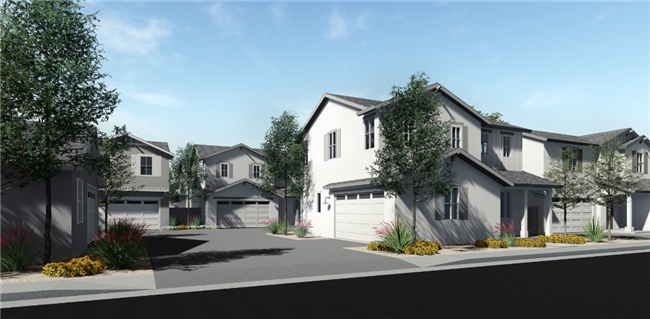
A build-to-rent developer is now pre-leasing 72 single-family homes designed as rentals near South Mountain in Phoenix with attached two-car garages and fenced back yards.

The new community built by Curve Development, called Cyrene at South Mountain, is located just west of 16th Street and north of Baseline Road. The development is part of 3,500 rental homes the company has in the developmental pipeline, spread across 26 communities in multiple states, according to a release.

Investments Growing In Build-To-Rent Single-Family Homes
Inside a gated community, each home has an attached two-car garage and a fully fenced private back yards.

The community is estimated to be complete by the first quarter of 2022.

Cyrene at South Mountain will offer three- or four-bedroom design plans featuring multiple modern farmhouse-style elevations.  Inside a gated community, each home has an attached two-car garage and a fully fenced private back yards. The three-bedroom homes start at $2,400 a month rent, the four-bedrooms start at $2,665 a month rent. Two plans have one unit still available; the other three plans are waitlisted.

Community amenities include a private dog park, a ramada with barbecue, a multi-purpose event lawn, outdoor seating with fireplace and more.

The homes feature SMART home technology and covered patios with views of South Mountain. Each single-family detached home is pet-friendly with a dog door.

For more information about Cyrene at South Mountain, visit https://cyreneatsouthmountain.com/.

About Curve Development 

Curve Development is a national developer/builder based in Arizona developing single-family rental projects coast to coast. Funded by JEN Partners, LLC, a New York-based private equity fund.


House Panel Asks Landlords to Explain Evictions During Moratorium

House Panel Asks Landlords to Explain Evictions During Moratorium

A House panel studying evictions during the COVID-19 moratorium has asked four large corporate landlords to explain and provide documentation on 5,000 evictions they filed, according to The Washington Post.

Invitation Homes, Pretium Partners, Ventron Managemen,t and the Siegel Group were all asked to provide documentation on evictions filed while the federal eviction moratorium was place, in letters sent from Rep. James E. Clyburn (D-S.C.), the Select Subcommittee on Coronavirus Crisis panel’s chairman to the landlords.

Some of these companies “refused to accept rental-assistance funds” as an alternative to eviction, the letters stated, while others have accepted funds and moved to evict families anyway. As a result, such practices have had a “substantial negative impact” on struggling American families, the letters said, according to The Washington Post.

The Federal Trade Commission (FTC) and Consumer Financial Protection Bureau (CFPB) on March 29 announced they would investigate evictions by “private equity firms” and “major multistate landlords,” amid “reports that major multistate landlords are forcing people out of their homes despite the government prohibitions or before tenants are aware of their rights.”

The Las Vegas Review–Journal in June reported on The Siegel Group. The Review-Journal investigation found The Siegel Group had evicted hundreds of tenants at its Siegel Suites and Siegel Select during the pandemic last year. The Siegel Group declined comment. The House panel cited the newspaper’s reporting in letters from Clyburn to company CEO Stephen Siegel, informing him of the inquiry.

The Private Equity Stakeholder Project (PESP) published a report in April detailing how Progress Residential and Front Yard Residential, owned by the private equity firm Pretium Partners, have filed to evict more than 1,300 residents during the COVID-19 pandemic, with the companies filing most evictions after the Centers for Disease Control and Prevention (CDC) Eviction Moratorium went into effect in September 2020.

In Pandemic Evictor: Don Mullen’s Pretium Partners Files to Evict Black Renters, Collects Billions From Investors,” PESP writes that despite the CDC Eviction Moratorium that took effect on September 4, 2020 and was later extended, Progress Residential and Front Yard Residential have filed to evict growing numbers of residents.  Pretium Partners is the top evictor since the beginning of the year within the seven states that the Private Equity Stakeholder Project has been tracking.

The companies filed more than 500 eviction actions in the first 10 weeks of 2021. Almost half (246) of these filings were in two Georgia counties – DeKalb and Clayton – which have majority Black populations.

Also, Sen. Sherrod Brown (D-OH) has asked for answers from a corporate landlord according to an NPR report after the report by PESP found the firm has been filing for eviction much more often in predominantly Black neighborhoods during the pandemic.

“While evictions can have long-lasting, damaging effects on renters in normal times, they are especially troubling during a pandemic where safe, stable housing can literally mean the difference between life and death,” Brown wrote in his letter to Don Mullen, a former Goldman Sachs partner and founder and CEO of Pretium Partners, NPR reported.

In response to Brown’s letter, a spokesperson for Pretium Partners said in a statement that the company can “unequivocally confirm that no individual covered by a valid CDC declaration has been evicted from our properties.”


Sign Up For Our Newsletter And Get Rental Housing and Apartment News And Helpful, Useful Content Each Week.

* indicates required


Will You Be Ready When the Eviction Moratorium Ends?

Everything Landlords Should Know About Emotional Support Animals

No Guns In My Apartments: Can A Landlord Say That And Put It In A Lease?

Can I Say “No Pot In My Apartments” When It’s Legal In My State?

Out-of-Town Movers Outbidding Local Phoenix Renters

Out-of-Town Movers Outbidding Local Phoenix Renters

So many out-of-town people are moving to and searching for apartments in Phoenix that they are putting pressure on rent prices for local Phoenix renters, according to a report from Apartment List.

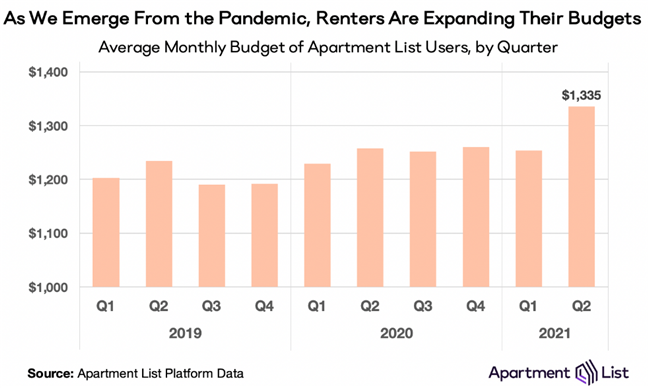
“This migration flow is putting pressure on local rent prices because these movers have budgets that are 10 percent higher than the existing residents who are also searching for a new apartment,” Apartment List housing economists and experts  Chris SalviatiRob Warnock, and Igor Popov write in the report.

On average, Phoenix residents looking for a new home have a monthly budget of $1,213, while renters searching from a different metro have a budget of $1,332.

“Our newest Quarterly Migration Report finds that not only are more people moving, but movers today have higher incomes and higher budgets than ever before. This is putting added pressure on already-competitive markets and contributing to rising rent prices across the country,” the report says.

People moving from higher-rent locations driving up prices

Rents in Phoenix have increased by $200 overall in the last year.

In Yardi Matrix’s latest multifamily report, the company says “many people moving into Phoenix are coming from higher-cost locations, where they are accustomed to higher rents. But for longtime residents of Phoenix, the swift price increases are driving them to downsize or find a lower-cost location to live.”

This migration to Phoenix is coming largely from higher-cost California, the report says.

Out-of-Town Movers Outbidding Local Renters in Phoenix

The single-family housing market is performing equally as strong as the rental housing market, with prices up almost 22 percent on a year-over-year basis, according to the S&P Case Shiller Index.

Limited new supply in Phoenix is one factor contributing to the spike in rental and home prices. As of June, 3.2 percent of stock had been delivered in the last 12 months. “Even though this falls in the top 10 of our 30 largest metros, it is not enough to keep up with the demand,” Yardi Matrix said in its report.

Sign Up For Our Newsletter And Get Rental Property And Apartment News And Helpful, Useful Content Each Week.

* indicates required


Average National Monthly Rent Tops $1,500 For 1st Time

Will You Be Ready When the Eviction Moratorium Ends?

Average National Monthly Rent Tops $1,500 For 1st Time

Average National Monthly Rent Tops $1,500 For 1st Time

The average monthly national rent hit $1,513, topping the $1,500 mark for the first time in 150 metros that were reviewed, according to the National Apartment Association (NAA).

In addition to the average national monthly rent increases, occupancy and demand are also at all-time highs.

“According to separate reports from RealPage, all three have surged forward to levels last recorded in at least the early 2000s,” the NAA says in the report.

“I think we’re going to see increases for the next 12 to 18 months,” said Robert Pinnegar, president of the National Apartment Association, in an interview with The Washington Post.

“We’ve never had three generations in the rental housing space, at least not in the numbers we’re seeing now,” Pinnegar said.

Here is what is going on with those three indicators:

  • NAA reported that nationally, asking rents increased 2 percent in June and are up 6.3 percent year over year—the largest 12-month growth since 2001.
  • Occupancy is at 96.5 percent, the highest it has been since the later part of 2000.
  • Demand also skyrocketed in the second quarter from the same time last year, with the biggest quarterly jump in RealPage’s database dating back to the early 1990s.

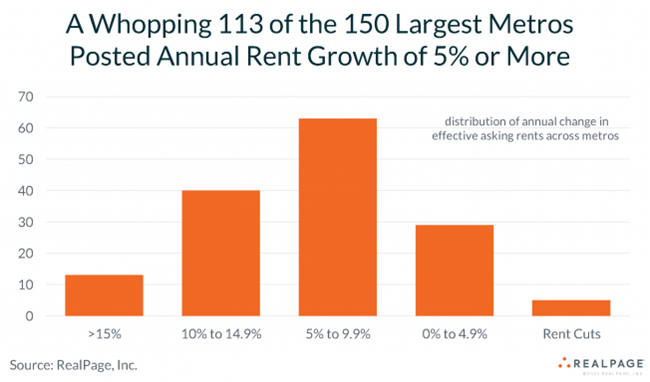
The RealPage report says of the 150 largest metros reviewed, 113 saw an annual rent growth increase of  least 5 percent. Larger locations with at least 100,000 apartment homes—Phoenix, Las Vegas and Atlanta, among others—witnessed double-digit annual rent growth.

Average National Monthly Rent Tops $1,500 For 1st Time
Chart courtesy of RealPage.

New apartment construction continues in many parts of the country. It is unclear what the impact of new apartments coming online will be on demand in the future.

Greg Willett, RealPage economist, said in the report that annual growth in effective asking rents comes in at more than 10 percent in 53 of the country’s 150 largest metros, including 13 spots where year-over-year price increases are at 15 percent or more.

Willett said Boise, Idaho posts the most aggressive annual rent growth in that 150-metro group of markets, with pricing there up 21.2 percent. In larger cities with at least 100,000 apartment units, Phoenix registers 19.2 percent annual rent growth, and Las Vegas rents are up 16.7 percent. Other big markets recording yearly price increases that top 15 percent are West Palm Beach, Riverside/San Bernardino and Tampa.

Sign Up For Our Newsletter And Get Rental Property And Apartment News And Helpful, Useful Content Each Week.

* indicates required


Will You Be Ready When the Eviction Moratorium Ends?

Everything Landlords Should Know About Emotional Support Animals

No Guns In My Apartments: Can A Landlord Say That And Put It In A Lease?

Can I Say “No Pot In My Apartments” When It’s Legal In My State?

Bill Kay New Managing Director of Ashcroft Capital Markets

Bill Kay New Managing Director of Ashcroft Capital Markets

Real estate industry veteran Bill Kay has been hired as the new managing director of capital markets for Ashcroft Capital, according to a release.

The hiring of Kay will support Ashcroft’s continued emergence in the rental-housing sector as the company continues to acquire assets in its existing markets in the Sunbelt and seeks to enter new markets.

Kay will lead all capital markets activities at Ashcroft, with a focus on equity relationships with institutional investors such as real estate funds, endowments, foundations, major insurers, sovereign wealth funds, pensions and family offices. He will also actively participate in the investment and asset management processes across the company, according to the release.

“With more than two decades of experience in private real estate and private equity, it was quickly apparent that Bill is the perfect fit to lead our institutional investor relations and fundraising efforts,” Frank Roessler, founder and chief executive officer of Ashcroft Capital, said in the release.

“He has a proven track record of helping to build world-class institutional investment management companies, and we could not be more excited about having his leadership, knowledge and experience as part of the Ashcroft team.”

Prior to joining Ashcroft, Kay held senior leadership roles at Lubert-Adler Real Estate, Apollo Global Management, Morgan Stanley AIP and others. A Dartmouth College graduate with an MBA from The Fox School of Business and Management at Temple University, he has extensive global experience advising investors in tactical and strategic portfolio construction. His strategic acumen encompasses an extensive array of private strategies in fund, direct and co-investment formats.

“I’m thrilled to join the Ashcroft Capital team, which has established itself as a major player in the multifamily industry and is committed to aggressive but highly strategic growth,” Kay said in the release.

Bill Kay New Managing Director of Ashcroft Capital Markets
Bill Kay said on joining Ashcroft Capital, “I’m eager to lend my expertise to help an on-the-rise company continue to thrive,”

“I am thoroughly impressed with the company’s proven track record of creating value through the rebranding, renovating and repositioning of its acquired properties, as well as its history of delivering strong returns to investors and improving the resident experience. The company already has done an outstanding job of developing funding, and I’m eager to lend my expertise to help an on-the-rise company continue to thrive,” Bill Kay said.

Since its inception, Ashcroft Capital has acquired more than 11,500 units totaling more than $1.3 billion in value. Until this year, the company’s portfolio consisted of apartment communities in Jacksonville, Fla., Dallas-Fort Worth, Orlando, Fla., and Tampa, Fla. Ashcroft, which acquired just under $300 million of assets in 2020, recently entered the metro Atlanta market and is also seeking acquisition opportunities in the Charlotte, N.C., Raleigh-Durham, N.C., and Phoenix metros. Many of Ashcroft’s 2021 investments have been purchased through the company’s new $150 million Value Add Fund.

Birchstone Residential, Ashcroft Capital’s in-house property management company, manages all of Ashcroft’s owned multifamily communities. Birchstone was created to provide best-in-class service that attracts new residents, enriches the lifestyles of current residents and drives the operational performance of the Ashcroft portfolio, leading to targeted rates of return. Birchstone promotes a culture of authenticity, transparency and empowered associates.

About Ashcroft Capital

Founded in 2015, Ashcroft Capital has acquired over $1.3 billion of assets and more than 11,500 units. The firm focuses on capital preservation while striving to return strong, risk-adjusted cash-on-cash to investors. Ashcroft is capitalized with high net worth, family office and institutional capital. Within the real estate industry, Ashcroft specializes in value-add real estate and exhibits an expertise in extracting maximum value from every asset it acquires. Rather than attempting to play market timing, the firm strives to acquire excellent apartment communities within well-located submarkets of large and growing U.S. metroplexes.


Top 4 Best Cities with Least Environmental Risk For Investors

Portland among Top 4 Best Cities with Least Environmental Risk For Investors

Four metro areas, including Portland, stand out as having the least overall environmental risk for investors in commercial real estate and multifamily, according to a new rating from Yardi Matrix.

The company said they did the study because events over the past year “have brought environmental, social and governance (ESG) front of mind for investors and experts in commercial real estate. “

Yardi Matrix said more and more weather-related disasters “that produce billions of dollars of property damage, changes in work practices spurred by the COVID-19 pandemic, and recognition of the need for equity and diversity have created an urgency for businesses to act” on environmental, social and governmental criteria.

The report also cites the 2020 Urban Land Institute report on Climate Risk and Real Estate: Emerging Practices for Market Assessment.  That study by real-estate investment-management firm Heitman and the Urban Land Institute said,  “Leading real-estate investment managers and institutional investors are increasingly recognizing climate risk as a core real-estate issue that is beginning to affect their decisions at the market level as well as at the asset level. As this market-scale analysis of climate risks and cities’ resilience strategies advances, investors will better assess both the economic impact of climate-related events and the cost and ability of cities to mitigate the impact of climate change through their resilience strategies.”

Ranking of factors for environmental risk for investors

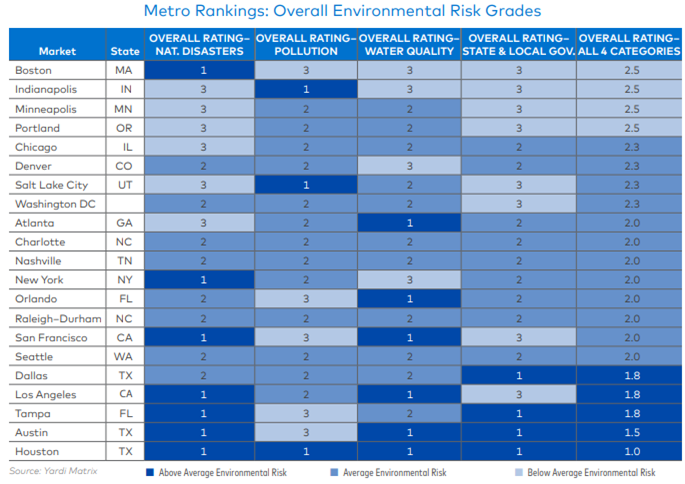
Yardi Matrix graded and ranked 21 top metros for risk for commercial real estate investing using natural disasters, pollution, water quality and state and local government investment.

Combing these four risk factors, Yardi Matrix said the top four metros with the least risk were Boston, Indianapolis, Minneapolis and Portland.

“The commonality for all was being in states that are taking environmental risk seriously. Boston and Indianapolis received the highest grades in three categories and the lowest grade in one, while Minneapolis and Portland received high marks for government action and propensity for natural disasters and middle grades for pollution and water quality,” Yardi Matrix said in the report.

Top 4 Best Cities, including Portland, with Least Environmental Risk For Investors
Chart courtesy of Yardi Matrix

The 5 bottom ranked metros for environmental risk for investors

The Yardi Matrix report said the bottom five metros “include three in Texas: Houston, Austin, and Dallas, along with Tampa and Los Angeles. The Texas metros’ grades were dragged down by low scores in the “natural disasters” and “government-response” categories.

The severe winter storm that hit Texas causing massive power outages was a key factor in the ranking, including lack of government response.

“The Texas storms are a demonstration of the stakes. Texas has reaped the benefits of deregulation and low taxes/utility costs, but utility providers’ lack of investment to winterize the power grid left the state unprepared to handle extreme weather. Without collective action to mitigate environmental risk, such disasters with high damages will recur,” Yardi Matrix said in the report.

Conclusion

“Some will no doubt question the categories we chose, the methods we used to grade metros, or what constitutes a proper response to environmental risk. This is our intention,” the report noted.

“Our rankings are not meant as a final word on the topic, but rather, a first attempt to understand the issues and develop a model for how to approach the topic—which is of increasing importance for commercial real estate.

“We encourage all to develop their own views about which metrics will have the most impact on the property sector and the appropriate response” in regards to environmental, social and governance factors, wrote Paul Fiorilla, director of research, and Claire Anhalt and Maddie Harper, senior analysts, for Yardi Matrix.

About Yardi Matrix:

Yardi Matrix researches and reports on multifamily, office and self-storage properties across the United States, serving the needs of a variety of industry professionals. Yardi Matrix Multifamily provides accurate data on 18+ million units, covering more than 90 percent of the U.S. population. Contact the company at (480) 663-1149.

Sign Up For Our Newsletter And Get Rental Housing and Apartment News And Helpful, Useful Content Each Week.

* indicates required


Will You Be Ready When the Eviction Moratorium Ends?

Everything Landlords Should Know About Emotional Support Animals

No Guns In My Apartments: Can A Landlord Say That And Put It In A Lease?

Can I Say “No Pot In My Apartments” When It’s Legal In My State?

Seattle Area Market Rebounds, Marches On

Seattle Area Market Rebounds, Marches On

Veteran property manager Cory Brewer weighs in on how the Seattle area market rebound is going and how the pendulum is swinging.

By Cory Brewer

Perhaps the most prevalent 2020 trend in housing was the “migration” of demand. COVID-19 issues, coupled with civil unrest, led prospective renters away from dense in-city multi-family properties to more spacious suburban single-family homes.  When I wrote about this before, I covered these issues in detail (health concerns, telecommuting, etc.).  As we look back on market activity for the first half of 2021, I’ll focus on how the pendulum is swinging back toward downtown Seattle and also take a look at surrounding areas.

By far, the hardest hit local sub-market in our region was downtown Seattle.  Average rents dropped more than 20% in some circumstances, and concessions such as 2-3 free months on a new lease became common.  Market time, or in other words absorption rate, slowed by 35% and the number of condos unsuccessfully offered for lease (listing cancelled or expired without ever finding a tenant) nearly doubled the five-year historical average (statistics gathered from Northwest Multiple Listing Service data).

Now that the numbers are in for the first half of 2021, as the economy has started to re-open and vaccination rates are climbing, we are again seeing demand return to downtown Seattle.  Concession offers have faded away, and rents have begun to tick up (though remain below pre-pandemic levels).  For units listed on the NWMLS, I took a look at the average number of new leases signed per month dating back to 2017.  What a difference!  The monthly frequency of new Seattle condo/multi-family leases signed is up 42.7% over last year, and is by far the highest it’s been over the past five years.

So what is going on in downtown Seattle?  Haven’t people found that they like working from home?  Haven’t they decided to live further outside the city where they don’t have to worry about a daily commute and can enjoy more space for a home office, home classroom, and recreation?  Well, yes, they have.  It’s being reported that the magnet effect of downtown Seattle is attracting younger renters in particular at this time.  It’s not only that amenities, bars, restaurants, shops, stadiums, and artistic venues are re-opening … but these renters also realize that pricing is still relatively depressed, and now is the time to get in before rent levels fully recover.  It probably doesn’t hurt that as a city, Seattle is among the national leaders in vaccination rates, offering a buffer against many of the health concerns that cooled interest in city living last year.  Some of the buzz is returning, and I can attest personally that it was an amazing feeling to recently attend a Mariners game after a year off (even though we lost!).

How is the rest of the Seattle Metro area faring at the 2021 mid-way point? 

We are seeing some continuance of 2020 trends, especially with single-family homes on the Eastside.

When people stopped looking for a condo or apartment in Seattle last year, clearly they shifted gears in hopes of finding a rental house, often times on the Eastside.  We saw sharp gains in absorption rate (24%) and not-insignificant gains in pricing (6.5%) across the Eastside single-family submarket.  So far this year, absorption rate has sped up by an additional 12% and pricing is up an additional 9.7%.  Part of the reason for this goes back to the statistic that I referenced earlier, which is number of new leases signed per month.  While we see that the frequency of new leases in downtown Seattle is shattering historical averages in a major way, it is quite the opposite with Eastside single-family homes where opportunities are scarce and competition is fierce.  Availability is down 8% from last year, and down a substantial 34.4% from five years ago.  We are also seeing price appreciation and reduced availability among single-family homes throughout Seattle, Snohomish County, and South King/Pierce County, though not as pronounced as what is happening on the Eastside.  So, if you maintain rental housing in the region, there is strong demand for what you’re offering.

Our resident tech giants (Amazon, Microsoft, Google, etc.) continue to bring in new hires from around the world, and they need places to live.  With very tight sales inventory available, renting is not only the preferred option for many relocating to the region but it’s often the only available option, and even then it can be competitive.

While it has been a hot seller’s market, some of this supply loss can be attributed to legal policies that have come down over the last several years.  It can be difficult to pinpoint exactly why someone sells their rental home as it’s often a combination of factors, but plenty of them are doing so in response to legal changes that they fear are too risky to absorb.  I hear this on a regular basis not only from clients at my own firm, but from other property managers that I network with from around the state.  It’s a real issue – single-family rental housing supply loss, that is – and our elected officials had better wake up to the inevitable long-term effects of their very near-sighted decisions.  My hope is that the real estate exemption for the newly introduced state capital gains tax will encourage investors to remain in the housing sector.  I am also hopeful that as we head into an election season, particularly in Seattle, voters have an appetite for a pendulum swing as it relates to housing policy.

About the author:

Cory Brewer Seattle Area Market Rebound Marches On
Cory Brewer

Cory Brewer is the general manager at Windermere Property Management / Lori Gill & Associates. He oversees a team of property managers in the greater Seattle area who manage approximately 1,500 rental properties. Brewer can be reached via www.wpmnorthwest.com or coryb@windermere.com

Sign Up For Our Newsletter And Get Rental Property And Apartment News And Helpful, Useful Content Each Week.

* indicates required


Average National Monthly Rent Tops $1,500 For 1st Time

Will You Be Ready When the Eviction Moratorium Ends?