
Home Blog Page 95

The End of the Grace Period, and How Landlords Should Approach it

The End of the Grace Period, and How Landlords Should Approach it

The end of the grace period and how landlords should deal with unpaid rent is something they should discuss with their attorneys.

By Bradley S. Kraus
Partner, Warren Allen LLP
[email protected]

It’s now February, a month many have waited for since last year. February 28, 2022 is officially the last day of the grace period as it is defined in the COVID laws passed last year. Until that date, any debts from the Emergency Period—defined from April 1, 2020 until June 30, 2021—are protected, leaving landlords unable to recover this balance until that time. That frustration has escalated for many landlords, as rent-assistance organizations no longer seem concerned about those balances when tenants apply for rent assistance.

As of March 1, and assuming no additional legislative changes, the Emergency Period Balance becomes due and owing once again. How landlords deal with these balances is something to discuss with their attorneys, as missteps (and current laws) can still provide some obstacles.

One approach, assuming those with a balance are still current tenants, is to serve a Notice of Termination for Cause with respect to the unpaid balance. While this notice cannot turn into any form judgment that could be utilized to garnish or collect those monies it can prompt the tenant to pay the amount owing or vacate.  Even though some of these debts are very old at this point, waiver under ORS 90.412 is not a concern, as there is an express carve-out in the current renter-protection laws on that issue.

The important thing to keep in mind with respect to the above approach is that tenants are still allowed to apply for rent assistance pursuant to SB 891, unless they have already done so under that law. Assuming a tenant follows the proper procedure, SB 891 would cause a stay to remain in place while the tenants’ application for rent assistance is “pending.” It is unclear how rent-assistance organizations will handle these issues. Further, given the factual differences of every notice and balance ledger, it is difficult to predict how those issues will play out. Ultimately, readers of this column will remember that anything received from a tenant should be scrutinized with your attorney to evaluate whether or not it qualifies as “documentation” that could affect your rights.

Alternatively, another option for landlords is to simply exercise their civil remedies with respect to a small claims case or lawsuit. Once the law’s protections expire, the Emergency Period Balance becomes a debt that can be pursued civilly. This goes for both current tenants and former tenants who have moved out. While landlords are allowed to withhold security deposits for unpaid debts and damages under the current COVID laws, those deposits rarely (if ever) cover the entirety of the rent arrears left behind.

Many landlords continue to carry large balances from tenants. Those same landlords were not afforded the protections, grace periods, or other benefits afforded to other individuals affected by COVID. That was unfortunate, and further eroded the relationships between landlords and their tenants that current laws seem to continually exacerbate. Landlords will have additional rights and options at their disposal in the coming months, and unless rent-assistance agencies begin writing checks for these unpaid balances, landlords should prepare to assert them.

Bradley S. Kraus is an attorney at Warren Allen LLP. His primary practice area is landlord/tenant law, but he also assists clients with various litigation matters, probate matters, real estate disputes, and family law matters. You can reach him at [email protected] or at 503-255-8795.

The End of the Grace Period, and How Landlords Should Approach it
Bradley Kraus, Portland attorney
Senate Bill 282 – Oregon’s Newest COVID-19 Landlord/Tenant Changes

Sign Up For Our Weekly Newsletter And Get Apartment News And Helpful, Useful Content Each Week.

* indicates required

4 Ways Technology Can Keep Onsite Staff Happier During the Great Resignation

4 Ways Technology Can Keep Onsite Staff Happier During the Great Resignation with online showings of rentals

Here are four ways technology can keep multifamily employees and onsite staff happier during the great resignation.

By Rachel Richardson

The Great Resignation has served up greater responsibility for onsite staff left to manage multifamily apartment communities. Like other industries nationwide, the multifamily industry has been hit hard by this period where record numbers of employees are leaving their current positions.

Rental owners and operators have reported up to 70 percent of their workforce resigning, a contrast to historical employee turnover of 30-50 percent annually. In roles that often require “wearing many hats” to keep up with prospective renters and resident requests, this puts added pressure on already busy leasing teams.

With technology solutions that alleviate daunting tasks for onsite staff, you can save your staff valuable time and unnecessary manual effort. Your leasing team can simplify tour scheduling, automate routine communication and set up seamless multifamily marketing campaigns that free up time to better connect with renters.

Automate apartment tour scheduling

The first step to helping your team thrive during this spike in demand is understanding where your team can easily automate communication in the early stages of a renter’s search. Online tour scheduling options on your apartment listings and property website take the back and forth out of finding the perfect time to showcase your unit.

Instead of the leasing agent having to reach the prospect directly and coordinate meeting times, find options that allow the renters to automatically schedule an appointment while they browse. Many ILS (internet listing sites) like Apartment Guide offer the option for renters to request a tour, select the most opportune times or even tour the apartment virtually.

Quickly qualify new leads with online applications and forms

Give renters the option to complete online applications early on in their evaluation of your property. This will allow your team to quickly screen new tenants and focus on quality leads that are most likely to become new residents. Tenant screening services like RentSpree automate the process of credit and background checks so leasing staff can focus on critical tasks like apartment tours, resident requests and answering in-depth questions from renters.

4 Ways Technology Can Keep Onsite Staff Happier During the Great Resignation
Give renters the option to complete online applications early on in their evaluation of your property to save onsite staff time later in doing background and credit checks.

Online applications can often be selected by the resident when they request a tour on ILS listings as well, so onsite staff can identify tenants that are most interested before they even show the unit.

For onsite teams that could use extra support, there are also options that fully cover prospect communication and early lead qualification. Virtual leasing centers like Contact Center offer services to book in-person and virtual appointments as well as qualifying leads on behalf of the property. These services are often available 24/7 to communicate with prospects via call centers, chat and email.

Advertise without duplicating efforts

Your team spends time gathering quality photos, descriptions, 3D videos and other content to showcase your vacant listings. Once all of the assets are ready, it can be daunting to duplicate efforts when it comes time to create the advertisements. That’s where integrated marketing solutions can help property marketers, or leasing staff, avoid unneeded busy work.

Automated advertising solutions integrate with your property’s ILS listings to source graphics and descriptions. So, ads are created without your team having to slog through countless revisions and come up with campaigns on the fly.

Solutions like Search Ads Express and Social Ads Express offer turn-key advertising services that target in-market renters based on ILS data, so your budget goes toward those who are actively looking for an apartment in your area. Finding a Fair Housing compliant advertising tool will also take the stress out of ensuring that your property’s audience targeting is within regulation.

Effortlessly communicate with renters

From your property’s voice mailbox to the inbox, inquiries can stack up while the team juggles multiple tasks. Training employees to keep up with these tasks can also be costly. According to Bersin by Deloitte, the average cost of onboarding a new employee is close to $4,000. For multifamily specifically, properties can also spend $2,500 to $3,500 a month on salary for each staff member that manages onsite communication.

Brainstorm ways that your team can cut down on manual communication and automate the most common requests that come through. An easy way to do this is through renter communication platforms that integrate with your PMS (property management system) and allow you to monitor and respond to email and texts in one place. Common ways that leasing teams use this is to automatically send a video tour, survey residents’ satisfaction, generate new reviews, and opt renters into marketing communications.

Recent resignations have brought on challenges for onsite staff but removing repetitive and monotonous tasks can free up your best talent to focus on the most rewarding aspects of their job. Without the burden of these simple and time-consuming tasks, your multifamily employees team’s skills can be better served, not to mention they will be happier. With more efficient processes, owners and operators can get more done while saving valuable dollars that can be invested in sustaining a strong, satisfied onsite team.

About the author:

Rachel Richardson is a Demand Generation Specialist with a mission to bring RentPath’s social media, marketing and communication efforts to life. She holds an MS in Brand Communications from the University of Colorado – Denver. Visit: https://www.rentpath.com/blog/

Potential Tenants Like Self-Guided Rental Housing Tours Without The Agent

Sign Up For Our Weekly Newsletter And Get Rental Property And Apartment News And Helpful, Useful Content Each Week.

* indicates required

5 Ways to Keep Plumbing Systems Up And Running In Winter

5 Ways to Keep Plumbing Systems Up And Running In Winter

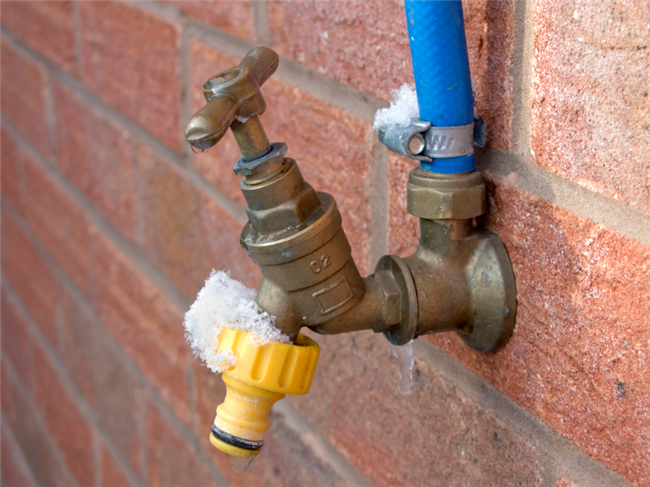
Being proactive to fight the winter cold in plumbing systems is the best way to avoid those unpleasant calls from tenants about frozen pipes, which is this week’s maintenance tip from Keepe.

No. 1 – Seal cracks near pipes

Survey the entire exterior of the building for small air leaks. Small air leaks, sometimes leaking around insulation, are often the first culprits leading to a frozen pipe. Seal the cracks using insulation or caulk.

No. 2 – Set indoor air temperatures of at least 65 degrees

Have your tenants keep an eye on indoor air temperatures. Make sure it doesn’t fall below 65 degrees to avoid freezing the pipes. See item No. 5 below in regards to this.

No. 3 – Put away outdoor hoses

And remember to completely shut off their indoor valve during the winter season. Before covering the hose bibs, make sure all water is completely drained out of them. Then once this is done, store the hose.

No. 4 – Let faucets drip with warm water

This is essential especially on nights when temperatures drop to an all-time low level. This practice  prevents pipes from freezing.  Just a trickle of warm water – dripping for hours on end – is enough to save the pipes from freezing during winter.

No. 5 – Leave cabinet doors open

Pipes under bathroom sinks and kitchen sinks are susceptible to cold air when the cabinet doors are closed. So leave them open to allow circulation of warm air in and around the pipes.

If your plumbing systems and pipes succumb to freezing during the winter season, turn off the main water supply first, and call professional plumbing services as soon as possible.

About Keepe:

Keepe is an on-demand maintenance solution for property managers and independent landlords. The company makes a network of hundreds of independent contractors and handymen available for maintenance projects at rental properties. Keepe is available in the Greater Seattle area, Greater Phoenix area, San Francisco Bay area, Portland, and San Diego. Learn more about Keepe at https://www.keepe.com

Sign Up For Our Newsletter And Get Apartment News And Helpful, Useful Content Each Week.

* indicates required


Another Bullish Year For Multifamily In 2022?

Another Bullish Year For Multifamily In 2022?

Multifamily appears poised for another bullish year in 2022 as healthy economic growth, rising apartment occupancy and capital flowing into multifamily, Yardi Matrix says in their winter report.

“We anticipate demand for apartments will remain robust, highlighted by strong economic growth and household formation. Meanwhile, capital conditions will be favorable, driven by investors’ insatiable appetite for stable income and low mortgage rates,” Yardi Matrix writes in the report.

The report says that supporting the multifamily performance is the economy, which grew by 6 percent in 2021, the highest rate in 40 years, driven by federal government stimulus and the increase in consumer wealth.

“While growth will almost certainly decelerate in 2022, the outlook for the economy remains bullish,” the report says.

Rent Growth Expected To Be Solid in 2022

“After asking rents rose 13.5 percent nationally in 2021, it’s an easy call to forecast a moderation in rent increases. However, we still expect overall U.S. rent growth to reach 4.8 percent in 2022, well above the long-term 2.7 percent average.

“The conditions that drove higher rents in 2021—including pent-up demand coming out of the pandemic, strong job growth, soaring home prices and healthy consumer savings—have not fully subsided,” Yardi Matrix says in the report.

The report points out that “headwinds” remain in 2022 such as labor force participation and inflation.

However the capital outlook is still strong.

“The amount of investment capital chasing multifamily, both equity and debt, is enormous. Property values are rising rapidly, driven by lower acquisition yields and increases in net income as asking rents shoot higher.

“Some $166 billion of multifamily transactions were completed in 2021, up 75 percent from 2020, and the only limit is the number of properties put up for sale. Debt availability is also robust, led by Fannie Mae and Freddie Mac, which have increased capital allocations in 2022. Multifamily debt has also driven record levels of lending by private equity funds,” the report says.

Conclusion

“We have every reason to believe, and expect, another two years of growth, until interest rate and monetary policy tightening designed to rein in inflation induce a recession in either 2024 or 2025.”

Get the full report from Yardi Matrix here.

About Yardi Matrix:

Yardi Matrix researches and reports on multifamily, office and self-storage properties across the United States, serving the needs of a variety of industry professionals. Yardi Matrix Multifamily provides accurate data on 18+ million units, covering more than 90 percent of the U.S. population. Contact the company at (480) 663-1149

Sign Up For Our Weekly Newsletter And Get Rental Property And Apartment News And Helpful, Useful Content Each Week.

* indicates required

Multifamily Had A Record Year In 2021; What’s in Store for 2022?

Single-Family Build-to-Rent Expected to Hit All-time High In 2022

Single-Family Build-to-Rent Expected to Hit All-time High In 2022

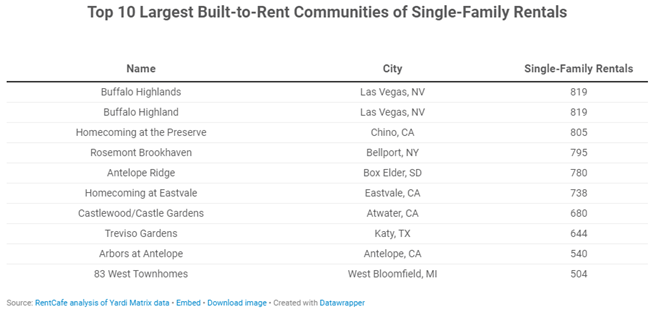
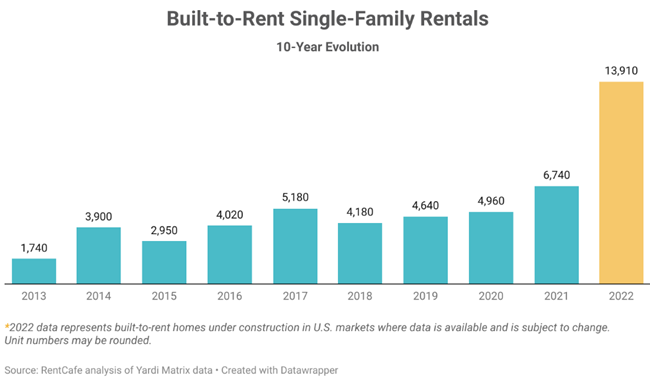
The popularity of single-family build-to-rent homes continues to grow and is expected to hit an all-time high in 2022, according to a new study from RentCafe.

The pandemic has pushed renters to look for more space and developers are responding by constructing more build-to-rent communities in cities such as Phoenix, Dallas and Columbus, Ohio.

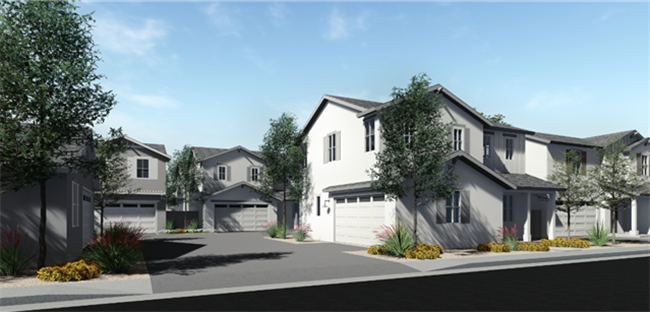
Sometimes called “horizontal apartments,” the communities feature single-family homes with professional property management.

Single-Family Build-to-Rent Expected to Hit All-time High In 2022

More Popular Than Apartments?

Single-Family Build-to-Rent Expected to Hit All-time High In 2022

  • Single-family rentals are becoming more popular than apartments, RentCafe says in the report. There are about 90,000 existing single-family homes in built-to-rent communities with an occupancy rate of 97 percent, while multifamily occupancy is at 95 percent.
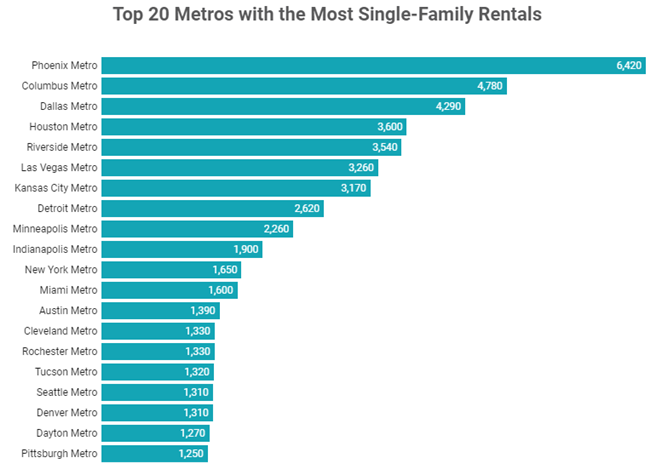
  • The top metro areas with the most single-family rentals reflect their ideal conditions for expanding on the horizontal. Phoenix metro takes first place with 6,420 homes for rent. It’s followed by Columbus metro – 4,780, and the Dallas metro area – 4,290 homes.
  • However, most rental communities are prevalent in low-density areas outside of the big cities – 61 percent of single-family rentals are spread out in the suburbs, particularly in the Midwest and Northeast. Meanwhile, in areas where land availability allows urban expansion, such as Texas and in the Southwest, built-to-rent communities are in urban locations.

Renting Provides More Flexibility Than Buying

The report says the appeal of built-to-rent homes as a trend combines the financial and leasing flexibility of a rental with the amenities and convenience of a professionally managed property, all while living a single-family-home lifestyle.

As a result, everyone is interested, according to Shannon Hersker with Walker & Dunlop: “There is a misconception that the majority of renters are millennials when, in reality, you have everyone — including college students, empty nesters, families with kids, pet owners, and those wanting to downsize,” she said.

Because builders need large parcels of land to build on, rental-home communities are prevalent in low-density areas, with the majority (61 percent) located in suburbs.

“Undoubtedly, coronavirus has also impacted upon this increased popularity,” said Christopher Michael, architect and founder of archisoup. “Many are now moving out of the cities and apartment living to seek out more space in rural and suburban locations.”

Single-Family Build-to-Rent Expected to Hit All-time High In 2022

Beyond its potential to become a sizeable force in the rental-housing market, built-to-rent houses are also a welcome alternative for those who want to move up from renting an apartment or those who are unable to buy in a highly competitive market, but who are willing to pay more for a rental, Hersker said. “Typically, BTR units are larger than the average apartment, and renters see the value in paying more for increased space and additional storage.” She adds: “Living in a BTR community allows the renter to socialize and share amenities, but also have their own yard and space to entertain.”

RENTCafe.com is a nationwide apartment-search website featuring apartments and houses for rent throughout the United States. It regularly analyzes rental data from across the United States.

What Are Tenant Preferences In Single-Family Build-For-Rent?

Investments Growing In Build-To-Rent Single-Family Homes

Sign Up For Our Weekly Newsletter And Get Rental Property And Apartment News And Helpful, Useful Content Each Week.

* indicates required

Paying Rent in Bitcoin? Why Forward-Thinking Multifamily Operators Should Consider Cryptocurrency

Paying rent in bitcoin is what forward-thinking multifamily operators should consider as consumer interest in cryptocurrency is rising.

Paying rent in bitcoin is what forward-thinking multifamily operators should consider as consumer interest in cryptocurrency is rising.

By Daniel Berlind

Earlier last year, American billionaire and real estate magnate Rick Caruso announced that a portion of his real estate portfolio is accepting bitcoins—a cryptocurrency—for residential and commercial rent payments. Caruso’s bold move is considered an industry first.

The real estate sector is well known as a laggard in adopting new technology. Accepting rent payments in a cryptocurrency, such as Bitcoin, is undoubtedly a step toward the future, but it is scarily experimental by today’s real estate industry standards.

That said, evolving market factors and shifting consumer sentiment and behavior suggest that moving toward the crypto future may hold genuine promise for growing numbers of CRE and multifamily property owners.

What is Crypto?

Cryptocurrency is a relatively new form of digital payment that consumers use to exchange goods and services online. Cryptocurrencies rely on what is termed blockchain technology, in which a computer network tracks and records digital transactions in a decentralized way through a distributed ledger.

For both consumers and commercial entities, the appeal of cryptocurrency lies in its strong privacy and user security, decoupling from government-controlled financial institutions, transparent record-keeping through blockchain technology, and freedom from added “middleman” transaction fees and costs.

Bitcoin, the world’s first cryptocurrency, debuted in 2009. Twelve years later, consumers can choose from over 7,800 cryptocurrencies that boast a combined market cap of $324.716 billion. Among the most popular are Ethereum, Litecoin, Binance Coin, Cardano, Tether, Stellar, and Solana.

Cryptocurrency holds tremendous promise for virtually every commercial industry in the world. Consumers are jumping on board, investing in and using crypto for all kinds of transactions, including buying and selling merchandise (even from top brands that support crypto sales), online investing, money transfers, travel, lodging … and, as Mr. Caruso has shown, even paying rent.

Crypto’s upside goes beyond the convenience of simple financial transactions for both consumers and businesses. It facilitates secure data sharing, streamlines collection and payment, provides secure due diligence, improves operational efficiency, and saves time and costs.

Its appeal is highly compelling, and consumers, merchants, and financial payment firms alike are boarding the crypto bandwagon, signaling an impending industry shift. CRE and multifamily property owners should, at the very least, participate by considering the benefits that crypto may offer the industry.

Crypto and Millennials

Consumer interest in (and adoption) of cryptocurrency is rising. Across all consumer demographics, millennials are currently the largest group investing in crypto.

Millennials make up history’s largest demographic of individuals aged 24 to 39. As consumers, they are entering their prime spending years and, by Wall Street standards, are poised to reshape the economy. These driven digital natives have an immense affinity for technology, which explains their avid interest and engagement in the world of cryptocurrency.

The following points are critical to the CRE and multifamily industry.

A recent study from Piplsay found that “49% of millennials polled own cryptocurrency compared to 38% of Gen Xers and 13% of Gen Z,” and millennials are more likely to use crypto for payments, with 53% saying they are “very likely” to purchase products or services with crypto. According to the study, millennials own more crypto than any other generation.

A September 2021 consumer survey by digital asset platform provider Bakkt Holdings found that “37% of survey respondents ages 18–29 and 30–44 who have not purchased cryptocurrency in the past six months are ‘somewhat’ or ‘very interested’” in investing in cryptocurrency. Furthermore, says Bakkt Holdings, the ubiquity of digital assets and cryptocurrency is revolutionizing consumer buying habits and driving a new, increasingly dynamic economy.

 Millennials – CRE and Multifamily’s Bread and Butter

Matching these findings to U.S. renter demographics reveals an important overlap.

According to an annual rent report from Apartment List, the share of millennials expected to rent forever has nearly doubled in two years to almost one-fifth. The rental listing site’s 2021 Millennial Homeownership Report found that, in 2020, 18.2% of millennials who did not then own homes expected to rent forever, up from 12.3% in 2019 and 10.7% in 2018. The report combined data from the U.S. Census Bureau’s Current Population Survey and Apartment List’s annual renter survey.

Millennials, the bread-and-butter tenants of multifamily property owners, are embracing crypto en masse. Multifamily owners and operators need to take note and think about accepting cryptocurrencies.

This may not mean diving into the digital currency pool today but rather taking proactive steps to understand their tenants’, potential tenants’, and property managers’ perspectives on cryptocurrency and, at the very least, considering the pros and cons of this exploding new industry.

About the author:

Daniel Berlind is the Founder and Chief Executive Officer (CEO) of Snappt – a Los Angeles-based software company that helps multifamily housing companies prevent tenant and financial fraud. A former real estate executive, innovator and entrepreneur, Dan founded Snappt in 2017 after running his own property management company where he recognized a significant, industry-wide financial issue in the billion-dollar apartment rental industry. The company’s technology aids and streamlines the apartment rental process by reducing bad debt, increasing asset value and minimizing the application review process.

Bank Account Linking Does Not Equal Tenant Fraud Detection

Property Management Apartment Jobs In High Demand

Property Management Apartment Jobs In High Demand

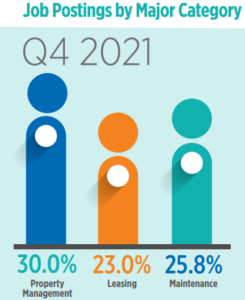
Job postings for skilled property managers accounted for 30 percent of all apartment jobs in the fourth quarter of 2021, according to the National Apartment Association.

Robust apartment demand led to only an 0.7 percentage points increase in leasing job postings. In contrast, hard-to-fill maintenance jobs significantly declined by 2.2 percentage points, signally that companies have decided to hire vendors due to maintenance talent shortages and high turnover rates.

In fourth quarter 2021 edition of NAAEI’s Apartment Jobs Snapshot, apartment job listings comprised nearly 37.0 percent of available real estate positions during the fourth quarter of 2021, well above the five-year average of 33.1%.

”Amid the Omicron variant surge apartment job postings declined compared to the fourth quarter of 2020. The downward shift could represent the fact that companies are delaying the hiring process to reduce risk,” the report said.

“Yet, healthy occupancy levels and rent growth during the quarter resulted in job postings exceeding the five-year average by 3.6 percentage points. According to RealPage, occupancy rates stood at 97.4 percent and average effective rent soared to $1,629.

Dallas, Los Angeles, Seattle, Washington, D.C. and Denver ranked highest in concentration of apartment job availabilities.

Demand for student housing property management professionals was greatest in Austin, Columbus, Gainesville, College Station and Houston.

Property Management Apartment Jobs In High Demand

7 Top Challenges Facing Rental Housing Property Managers

Sign Up For Our Newsletter And Get Rental Property And Apartment News And Helpful, Useful Content Each Week.

* indicates required

Renter Preferences Survey Shows Residents Desire More Space

Renter Preferences Survey Shows Residents Desire More Space

A new renter preferences survey says residents are reporting a great desire for more space, better amenities and in-home creature comforts as the pandemic caused residents to evaluate their housing needs.

The 2022 Renter Preferences Survey Report from the National Multifamily Housing Council (NMHC) and Grace Hill included 221,000 renters living in 4,564 communities nationwide, with data available in 79 markets.

The report provides a look at the home features and community amenities that renters say they cannot live without, how much they are willing to pay and what matters during their home search.

Space is a priority for residents

The report says the pandemic lockdowns led to a strong desire for additional space. While tenants regularly seek lower rents, the survey said 28 percent of renters who said they intend to move to a different rental community when their lease expires cited “additional living space” as a reason, up from just 19 percent two years ago.

This was the third-most-common reason for wanting to move after “seeking lower rent” (49 percent of renters) and “seeking better community amenities” (29 percent).

Most important amenities now desired

Renters have a great desire—and are willing to pay a premium in additional monthly rent—for certain amenities. The top ones are with additional monthly premium:

  • Washer/dryer in-unit (92 percent of renters interested / $54.73 monthly premium);
  • Air conditioning (91 percent / $54.73);
  • Soundproof walls (90 percent / $46.21);
  • High-speed Internet access (89 percent; $47.93); and
  • Walk-in closet (88 percent; $43.46).

Also, when asked which types of rental homes renters considered during their last home search, the majority said traditional apartment homes (57 percent). However, townhomes and single-family rentals were also in the mix at 23 percent and 19 percent of responses, respectively, “supporting the desire for more space and validating industry and investor eyes on these property types,” the report said.

“The pandemic caused many renters to reevaluate their housing priorities, with a striking example being one-quarter of all moves we tracked were specific to changes in teleworking,”  Sarah Yaussi, vice president, business strategy, NMHC, said in a release.

“Whether it’s digital nomads looking to join a flexible membership club, pet amenities dog owners won’t rent without or the insatiable appetite for more packages, the NMHC/Grace Hill Renter Preferences Survey reveals all that has changed since 2019. And what we’ve seen overall are renters reporting a great desire for more space, better amenities and in-home creature comforts,” Yaussi said.

Renter Preferences Very Specific In Some Markets

  • A gear wall, for home storage and organization, is a sought-after home feature in Honolulu, where 45 percent of renters say they are interested or won’t rent without one.
  • Rental dwellers in Savannah, Ga. show the least interest (11 percent) in a gear wall but show more interest than any other market in a makerspace/DIY room (39 percent).
  • More interest in hot tubs in Boulder, Colo. (70 percent) than in Philadelphia (41 percent).
  • Covered parking is more important in Minneapolis (80 percent) than in Gainesville, Fla. (47 percent).

“It’s important to note that, beyond national trends, there are several market-level nuances affecting renter preferences,” said Kendall Pretzer, CEO of Grace Hill, in the release.

“National data paints an overall picture for the industry, but it is vital for operators to keep a finger on the pulse of each individual market in their portfolios. Trends vary by region, by state and by municipality and may stray significantly from national averages. A program that regularly polls prospects and solicits resident feedback is essential to successfully meeting renter preferences and expectations,” Pretzer said.

Sign Up For Our Weekly Newsletter And Get Rental Property And Apartment News And Helpful, Useful Content Each Week.

* indicates required

Student Housing Leasing Surpasses Pre-Pandemic Levels

Student Housing Leasing Surpasses Pre-Pandemic Levels

The student-housing industry has largely recovered from the pandemic as student housing leasing has passed pre-pandemic levels despite news of decreased enrollments, according to the latest report from Yardi Matrix.

The preleasing period for the fall 2021 term ended stronger than in 2019, and leasing is off to another hot start for the upcoming fall term, at 26.7 percent as of November.

Annual rent growth is also nearing pre-pandemic levels, at 2.2 percent as of December, just below 2019 levels of 2.4 percent rent growth.

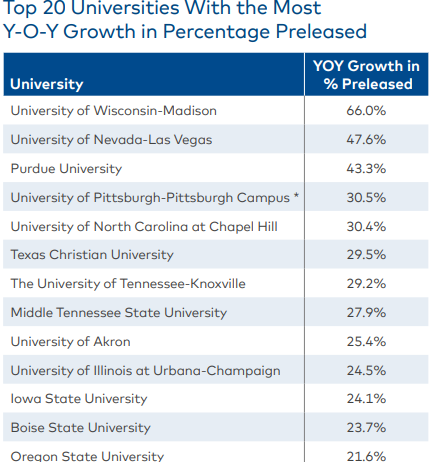
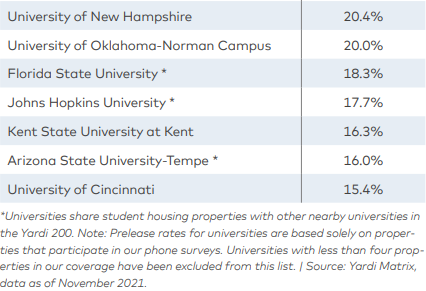
Yardi Matrix says all of the Power Five conferences are experiencing growth in preleasing for the upcoming fall term compared to the previous year, particularly the Big Ten conference. Universities in the Big Ten had the highest percentage preleased (40.0 percent) and the highest prelease growth (18.7 percent) as of November.

Also, universities with the most annual prelease growth as of November tend to be bigger schools—of the top 20 universities with the most prelease growth, the average total enrollment was more than 30,000 students.

Student Housing Leasing Surpasses Pre-Pandemic Levels

  • The 200 universities included, called the Yardi 200, showed strong rent growth in pre-leasing for fall 2022.
  • The average rent per bedroom at Yardi 200 universities for the fall 2022 school year was $791 as of December. “This is the highest average rent for off-campus dedicated student housing we’ve seen in years and $2 over the previous month’s high-water mark,” Yardi Matrix said in the report.
  • The average rent per bedroom as of December represents a 2.2 percent increase over the previous year and a 0.3 percent increase over the previous month. That’s up from December 2020’s 0.9 percent annual rent growth and a bit below 2019’s annual rent growth of 2.4 percent. Nonetheless, it’s a positive sign for the industry to see rent growth inching toward pre-pandemic levels.

Sign Up For Our Weekly Newsletter And Get Rental Property And Apartment News And Helpful, Useful Content Each Week.

* indicates required

Rent Prices Turn a Corner as Rent Growth Slows

Rent Prices Turn a Corner as Rent Growth Slows

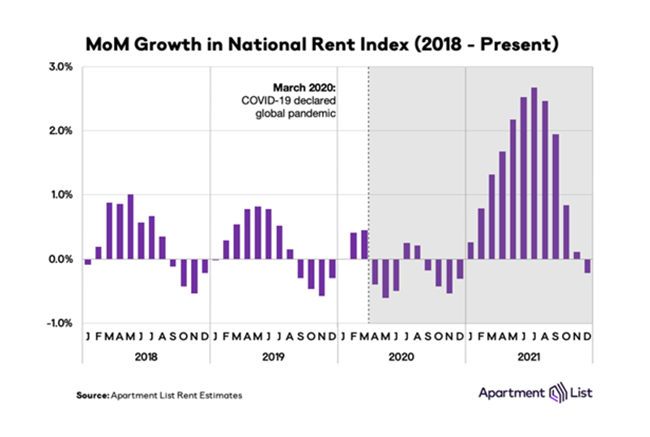
Across the nation, rent prices fell 0.2 percent last month, representing the country’s first measurable price decline since 2020 rent growth records, according to the January report from Apartment List.

Last year was a period of tremendous rent growth, with prices rising nearly 18 percent in less than a year, so while prices remain high they may have turned a corner.

Apartment List economists Chris Salviati, Igor Popov, Rob Warnock, and Lilla Szini write that, “Sixty-one of the nation’s 100 largest cities saw rents fall this month, indicating a widespread rental market cooldown.

“In particular, Seattle and San Francisco both landed in the top five for largest month-over-month declines, signaling that these pricey tech hubs may be entering a second phase of COVID-related rental market softness.  More broadly, our national vacancy index ticked up again for the fourth straight month, as we enter 2022 amid an easing of the tight market conditions that characterized 2021.”

While this is the time of year to see typical rent growth slowing, the report says the current slowdown is coming after 2021’s unprecedented price increases.

For example, in December of 2021 rent growth fell in line with pre-pandemic trends – rents also fell by 0.3 percent in December 2019, and by 0.2 percent in December 2018.

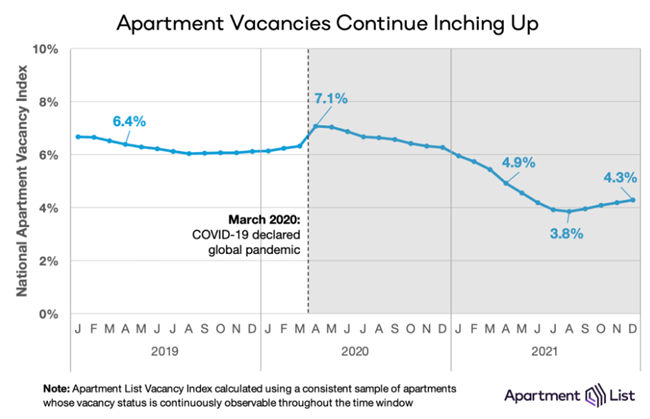
The Vacancy Index Is Trending Up

strong rent growth also shows vacancies increasing

After bottoming out at 3.8 percent in August 2021, Apartment List writes, “Our vacancy index has ticked up slightly for four consecutive months and stands at 4.3 percent at the end of the year.

“Although the recent vacancy increase has been modest and gradual, it represents an important inflection point, signaling that tightness in the rental market is finally beginning to ease.

“If our vacancy rate continues this trend in the coming months, it’s likely that rent growth will also continue to cool.”

Affordability Still an Issue In Rent Prices

Affordability is still an issue in rent growth and rent prices

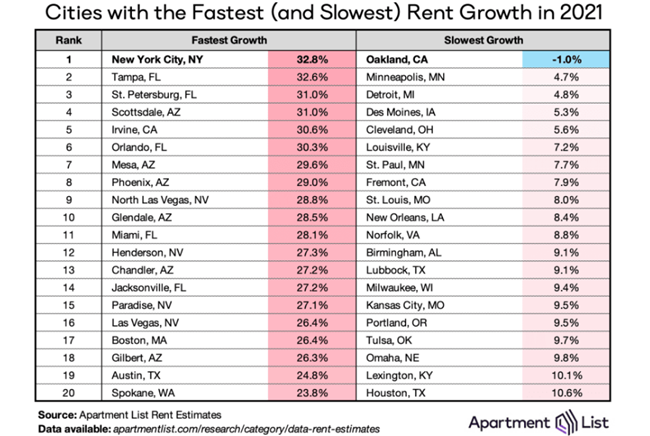
The report says it’s important to bear in mind just how much affordability has dissipated in 2021; 99 of the nation’s 100 largest cities saw rents jump more than 10 percent over the year, and the national median apartment cost eclipsed $1,300 for the first time ever. So despite a recent cool-down, many American renters will remain burdened throughout 2022 by historically high housing costs.

Sign Up For Our Weekly Newsletter And Get Rental Property And Apartment News And Helpful, Useful Content Each Week.

* indicates required