
Home Blog Page 94

Welcoming Pets Is a Smart Financial Move In Rental Housing

Welcoming Pets Is a Smart Financial Move In Rental Housing

To maximize appeal to today’s pet owners, here is why welcoming pets in rental housing is a smart financial move.

By Judy Bellack

According to the American Pet Products Association, 70 percent of American households own a pet, and pet owners in the United States spent more than  $100 billion on their animals in 2020. The popularity of pets and the amount of money we are willing to invest in them indicates that the traditional definition of a pet has changed dramatically from a cute and cuddly addition to the household to a treasured member of the family who is an integral part of our emotional well-being.

It’s a happy coincidence that multifamily communities can embrace this reality while also boosting their bottom lines significantly. The 2021 Pet-Inclusive Housing Report, which was conducted by Michelson Found Animals and the Human Animal Bond Research Institute, reveals the powerful financial and operational benefits operators can experience by making their communities as pet-inclusive as possible.

The Gains from Being Pet-Friendly

When pet owners find a welcoming environment, they want to stay. According to the PIHI report, residents in pet-friendly rental housing stay about 21 percent longer than those in non-pet-friendly housing (the report defined pet-friendly housing as any housing that allows residents to have at least one pet, regardless of other restrictions). Residents tend to become familiar and dependent on their pet-friendly neighbors and communities, particularly as 72 percent of renters say pet-friendly housing is hard to find. When residents know their neighbors and communities support their pets, why make a change?

If residents are staying longer, that’s fewer units for the leasing team to fill, which means reduced marketing and turn costs. And even when these units are vacated, they’re not on the market for long, resulting in significantly lower vacancy loss. In the PIHI report, 83 percent of surveyed owner/operators state that pet-friendly units are filled faster, and 79 percent say that they are easier to fill. These dynamics free up leasing managers and teams to support and grow communities in other beneficial ways. All of this adds up to more net operating income.

Welcoming Pets Is a Smart Financial Move In Rental Housing
If residents are staying longer, that’s fewer units for the leasing team to fill, which means reduced marketing and turn costs.

The Losses from Restrictions and Not Being Pet-Friendly

Apartment communities can really shoot themselves in the foot if they’re not hospitable to pets. For starters, if a potential resident encounters any issue with being a pet owner, there’s little chance they’ll rent from that community. This is an issue that very few pet owners are flexible on since nobody wants to give up a member of their family.

Furthermore, communities often are housing unauthorized pets when they have restrictive pet policies and, in turn, are losing out on potential pet-driven income. According to the PIHI report, about 11 percent of pet owners reported leasing with unapproved pets. As a result, owner/operators are missing out on more than $1.5 billion in potential revenue each year in the form of pet fees and deposits from pets already residing in the community.

Restrictions on size and breed continue to be one of the biggest struggles pet owners face. While 76 percent of owner/operators say their units are pet-friendly, only 8 percent of those are free of restrictions. That stance can definitely have a negative impact on a community’s revenue. Consider this: of the top 10 breeds in the United States according to the American Kennel Club, six would be excluded due to typical multifamily weight and/or breed restrictions.

Broadly speaking, it’s time for operators to consider relaxing their breed and weight restrictions for pets in rental housing. Many restrictions are based on decades-old research that has been denounced even by the organizations that conducted it. In addition, there are services available that run background checks on specific pets and owners to give communities a better understanding of the individual animals renters are bringing with them.

If residents are staying longer, that’s fewer units for the leasing team to fill, which means reduced marketing and turn costs
Consider increasing the number of pets permitted in each unit.

Ways to Make Communities More Pet Inclusive

Even with many communities considering themselves pet-friendly, more than 70 percent of pet-owning residents reported difficulty in finding suitable housing, largely due to restrictions. Clearly, this presents a huge opportunity for rental-housing operators.

To maximize appeal to today’s pet owners and to enjoy the resulting financial benefits, consider the following steps for pets in rental housing:

Rework pet deposits: Fewer than 10 percent of pets cause any damage, so consider using regular security deposits, or raise them slightly, to pay for the relatively little damage they do cause. And if you can’t entirely eliminate these fees, offer to waive the pet deposit or offer a free month of pet rent for first-time residents.

Remove/reduce breed and weight restrictions, and consider increasing the number of pets permitted in each unit. This is not to suggest allowing a resident to have 12 dogs, but it could be beneficial to increase your allowable pets to two per household, for instance. To pave the way for changes like these, check with your insurance company and secure a policy that is more pet-friendly. On the resident side, mandatory renter’s insurance policies can help with any pet-related claims. Again, there are many misconceptions about large dogs and certain dog breeds; the rule of thumb is that concerns are associated with individual dogs, not a category.

Implement an easy-to-use screening process: New services make it easier for communities to screen individual owners and pets for issues. Using these technologies also assures all residents that you’re working to have a community with safe and well-behaved pets. Make sure your process is easy to use. Furthermore, getting residents to sign agreements that outline acceptable pet (and owner!) behaviors, policies and disciplinary action can protect the overall well-being of the community and ensure that any pet-related issues are handled promptly.

Embrace pet amenities: There are countless amenities that create a more pet-friendly community. Dog parks, washing stations, waste stations and pet events are all great ways to let residents know you care. Consider partnering with a local shelter to connect your residents with opportunities to adopt or foster pets and waive any pet fees if they do.

Apartment owners and operators are always looking for an edge over the competition and the next thing that’s going to boost a community’s performance. In today’s pet-obsessed world, creating a truly welcoming environment for pets is a great way to attract and retain residents and boost the bottom line.

About the author:

To maximize appeal to today's pet owners, here is why welcoming pets in rental housing is a smart financial move for landlords.

Judy Bellack is the industry principal for the non-profit Michelson Found Animals Foundation, helping to advance the Pet-Inclusive Housing Initiative. She is a 30-year veteran of the multifamily industry, holding various executive leadership positions with some of the foremost supplier companies. Judy has served both as Chair of NAA’s National Suppliers’ Council and NMHC’s Supplier-Partner Alliance and was the recipient of NAA’s Outstanding Supplier in 2010. She currently operates a consulting practice advising start-up technologies in the multifamily space.

Sign Up For Our Weekly Newsletter And Get Rental Property And Apartment News And Helpful, Useful Content Each Week.

* indicates required

Who Is Responsible For Replacing Dead Smoke Detector?

A landlord wants to know who is responsible for replacing dead smoke detector in his rental property and tenants are not telling him about it

A landlord wants to know what to do if there is a dead smoke detector in his rental property and tenants are not telling him about it or fixing it is question this week for Ask Landlord Hank. Remember Hank is not an attorney and he is not offering legal advice. If you have a question for him please fill out the form below.

Hi Hank,

Who is responsible for replacing a dead smoke detector, tenant or landlord? If the landlord is, what actions can I take, as landlord, if the tenants know about it and won’t replace it? — Travis

Dear Landlord Travis,

This question comes down in part to your lease.

Is the responsibility for a working smoke detector clearly defined as tenant responsibility?

My lease indicates the tenant is responsible for smoke detector batteries and, if the detector is not working, to notify the landlord.

If smoke-detector responsibility is not addressed in the lease, then, in my opinion, you can’t blame the tenant for its functionality.

If tenants are responsible for batteries and it is a dead detector, then I as the landlord would buy new ones and install them.

If the lease states the smoke detectors are clearly tenant responsibility, I would talk to them and then put a seven-day notice on non-compliance on their door, since they are in default on the lease and could be evicted.

This is a serious issue for the health and safety of your tenants, not to mention that your property could be at serious risk of fire with no warning. Move quickly on this – it -seems a small issue but it could be life-threatening.

Sincerely,
Hank Rossi

Each week I answer questions from landlords and property managers across the country in my “Dear Landlord Hank” blog in the digital magazine Rental Housing Journal.    https://rentalhousingjournal.com/asklandlordhank/
Ask Landlord Hank -A landlord wants to know who is responsible for replacing dead smoke detector in his rental property and tenants are not telling him about it
Landlord Hank says, “My lease indicates the tenant is responsible for smoke detector batteries and, if the detector is not working, to notify the landlord.”

Ask Landlord Hank Your Question

Ask veteran landlord and property manager Hank Rossi your questions from tenant screening to leases to pets and more! He provides answers each week to landlords.

  • This field is for validation purposes and should be left unchanged.

Do I Have to Paint and Replace Flooring for a Long-Term Tenant?

Sign Up For Our Newsletter And Get Rental Housing And Apartment News And Helpful, Useful Content Each Week.

* indicates required

Rent Controlled Markets Feel Reduction in Multifamily Investments

Rent Controlled Markets Feel Reduction in Multifamily Investments

A new survey shows that almost 60 percent of multifamily firms indicate they are reducing or avoiding investment in rent-controlled markets, according to the National Multifamily Housing Council (NMHC).

An additional 15 percent say are considering cutting back in those markets. Conversely, only a quarter (27 percent) of firms are willing to keep their current or add new investments in rent-controlled markets.

“Policymakers in places like Boston, Minneapolis, Florida, Colorado and others continue to pursue counterproductive rent-control policies, causing a reduction in housing investment and exacerbating the very problem rent control purports to solve,” the NMHC said in the statement.

The survey also asked about specific cities or states with existing rent-controlled markets or those threatening rent control in the future.

A majority of the respondents said they were avoiding specific markets in California, or Califonia as a whole.

Other markets and the percentage indicating they have the potential to be markets where developers are avoiding the area:

  • New York – 29 percent
  • Minnesota – 23 percent (Minneapolis/St. Paul in particular)
  • Washington or Seattle – 19 percent
  • Portland or Oregon specifically – 16 percent

Additional markets mentioned that are concerning and may be avoided as they could become rent-controlled markets: Illinois (Chicago), Maryland, Massachusetts (Boston), Connecticut, and Colorado (Denver).

The statement said “NMHC has been making the case for decades that rather than improving the availability of affordable housing, rent-control laws only exacerbate shortages, cause existing buildings to deteriorate and disproportionately benefit higher-income households.

“And as some states and localities continue to pursue counterproductive rent-control policies, this data will be an important tool as we continue to set the record straight and advocate for more effective solutions to the housing shortage and resulting affordability crisis.”

Additional information is available at www.growinghomestogether.org and www.nmhc.org/rentcontrol.

Los Angeles Won’t Allow Rent Increases for Most Apartments Until 2023

Sign Up For Our Weekly Newsletter And Get Rental Property And Apartment News And Helpful, Useful Content Each Week.

* indicates required

Promising Start in January for Multifamily Fundamentals

Rents were up moderately in most markets in January, when rent growth is normally slow, indicating multifamily fundamentals are still strong Yardi Matrix reports

Rents were up moderately in most markets in January, when rent growth is normally slow, indicating that the multifamily fundamentals are still strong, Yardi Matrix says in its latest report.

Multifamily fundamentals appear strong as “demand drivers remain healthy, producing strong rent and occupancy performance and attracting debt and equity investors into the sector.

“Property sales, pricing and mortgage origination are at all-time peaks,” the report says.

How hot is the market?

Seasonality in rents is normal in January, a traditionally weak month for rent. However, multifamily asking rents bucked the usual trend, rising $8 during the month to an all-time high of $1,604.

It took only seven months for the average asking rent to hit $1,600 from $1,500, and only 10 months to reach $1,500 from $1,400.

Highlights of the report:

  • Year-over-year growth increased to 13.9 percent, a new high and up 30 basis points over December, but that number will decline as monthly increases decelerate compared to a year ago.
  • An $8 monthly increase pales in light of the $22 average monthly gains between March and October 2021, but January’s strong seasonal performance is a sign that the sector’s fundamental drivers have not been exhausted.
  • Single-family rentals also started the year strong. SFR rents are up 13.5 percent year-over-year through January. The national occupancy rate increased by 0.2 percent year-over-year through January.

The report cites Freddie Mac’s 2022 strong multifamily outlook

Freddie Mac’s 2022 multifamily outlook sums up the solid circumstances. “The strong economic conditions along with unprecedented levels of demand for multifamily housing have combined to create robust apartment market conditions in 2021,” the report said.

“While there are still uncertainties, such as increasing inflation or more transmissible variants of the COVID-19 virus … the multifamily market is expected to be on solid ground in the short term.”

Capital flowing into multifamily

Yardi Matrix says multifamily capital markets conditions “are exceptional entering 2022. Investors are seeking to deploy debt and equity in assets with strong fundamentals, while property owners want to take advantage of rock-bottom interest rates.”

Added together, that has produced record-high transaction flow and prices. Acquisition yields continue to shrink even as Treasury yields rise.

“Every capital source has a really strong appetite for placing (multifamily) mortgage debt this year,” says Jamie Woodwell, vice president of research and economics for the Mortgage Bankers Association, in the report.

About Yardi Matrix:

Yardi Matrix researches and reports on multifamily, office and self-storage properties across the United States, serving the needs of a variety of industry professionals. Yardi Matrix Multifamily provides accurate data on 18+ million units, covering more than 90 percent of the U.S. population. Contact the company at (480) 663-1149.

Sign Up For Our Weekly Newsletter And Get Rental Property And Apartment News And Helpful, Useful Content Each Week.

* indicates required

Oregon State Auditor to Review Rental Assistance Funds Payments

Oregon State Auditor to Review Rental Assistance Funds Payments Oregon Emergency Rental Assistance Program funds will be audited by the director of the office’s audit division following criticism

The audit division of the Oregon secretary of state’s office says in a statement that the Oregon Emergency Rental Assistance Program funds will be audited by the director of the office’s audit division, Kip Memmott, according to reports.

The Portland Business Journal first reported the audit after a records request.

In an email to the state housing agency, Memmott said his office would release an audit plan to the public after briefing legislators. Memmott heads the audit division under Secretary of State Shemia Fagan.

“The state is facing criticism for stopping the application process for these funds even though it has been reported that Oregon was one of the timeliest states issuing rental assistance,” a description of the audit provided by Memmott said. “Issues cited by legislators and other stakeholders include technical challenges with rental-assistance software and public communication challenges.”

Oregonlive.com reported that while the program has sent funds to 38,000 households, distributing more than $268.1 million since June, the state has yet to pay out funds to another 32,000 applicants.

Both landlords and tenants have been waiting for weeks with pending requests for rental assistance and no communication or updates on the status of their applications.

Sen. Kayse Jama, D-Portland and Rep. Julie Fahey, D-Eugene, chairs of the legislative housing committee, called for an audit of the program during the December special session to address evictions. The lawmakers wrote to Fagan at the time that they were “deeply troubled” by the lack of communication from the agency to landlords and renters and the inconsistent distribution of funds across counties.

Deborah Imse, executive director of Multifamily NW, wrote in December that failed state software for emergency rental assistance was hurting families in Oregon.

“As with the landlord fund, the emergency rental-assistance program has been plagued by system crashes, ineffective notification processes and a serious lack of clear communication from administrators. Applications have piled up, leaving renters’ requests for help in limbo for months. And landlords have spent hours — if not days – online, with no assurance that their renters’ applications had even made it into the program,” Imse wrote.

Sign Up For Our Weekly Newsletter And Get Rental Property And Apartment News And Helpful, Useful Content Each Week.

* indicates required

Kay Properties & Investments Has Record Year With $610 Million In Equity Placed

Kay Properties & Investments Has Record Year With $610 Million In Equity Placed for investors

Kay Properties, which operates one of the nation’s largest 1031 exchange property and real estate investment marketplaces, announced today it had posted another record year after successfully placing $610 million in equity for accredited investors participating in 1031 exchanges and direct cash investments.

This continued record growth represents a 49.5 percent increase over last year’s $408 million in equity placements.

Year-End Highlights:

  • Kay Places $610 Million of Equity Investments in 2021
  • Kay Grows Its Fully Integrated Real Estate Team and Robust Online Real Estate Investment Platform

Founded by CEO Dwight Kay, Kay Properties & Investments is considered one of the most experienced and knowledgeable investment firms in the country specializing in Delaware Statutory Trust (DST) and private equity real estate investments. The firm was established in 2010 with the emphasis on providing real estate investment options to high-net-worth clients looking for passive real estate ownership. In addition, Kay Properties believes it has created one of the largest 1031 exchange and real estate investment online marketplaces in the country that generates some of the largest DST 1031 investment volume in the United States. In 2021, for example, Kay Properties clients participated in thousands of transactions, and the $610 million of equity invested through the Kay Properties platform was invested in more than $8 billion of real estate offerings totaling approximately 50 million square feet of multifamily, manufactured housing, single tenant net lease, industrial, self-storage and medical properties nationwide.

Unparalleled Online 1031 Exchange Real Estate Marketplace Platform

“The kpi1031.com online marketplace has truly become a best-in-class robust platform connecting high-net-worth investors with quality real estate offerings as well as a place for real estate sponsors and operators to connect with tens of thousands of high-net-worth investors seeking to deploy capital into real estate offerings. We think the platform creates a perfect match for all sides of the 1031 exchange and real estate investment equation. This success over the years comes from hard work and dedication to our clients and team members as well as ultimately, beyond anything else, from the Lord,” said Dwight Kay, Founder & CEO of Kay Properties & Investments.

Kay explained that most investments made on the Kay Properties platform are for DST 1031 exchange replacement properties followed by a growing number of cash investments into real estate funds and other vehicles. DST investments are an allowable option for replacement properties for investors who have recently sold other real estate assets and are seeking to defer taxation on their gains, enter a passive management structure, and potentially broaden their geographic and real estate asset diversification* by reinvesting the proceeds in qualifying properties. So-called “like-kind exchanges” are allowable under U.S. Internal Revenue Code Section 1031 and DST investments have grown in popularity among accredited investors over the past decade.

“While it is true that a large amount of people investing through the kpi1031.com marketplace are seeking like-kind exchange properties, it is also true that the platform attracts many high-net-worth investors who are interested in participating in the offerings on the company’s marketplace with direct cash investments, a trend that we are seeing growing tremendously,” stated Kay.

Remarkable Year for Delaware Statutory Trust 1031 Exchange Investors

According to Kay, 2021 was a remarkable year for both Kay Properties and the entire 1031 exchange property market, including DSTs.

“Investment properties have gone through significant changes over recent years, and in many cases, owners have been faced with challenges they have never seen before, including the COVID-19 pandemic. For property owners who were motivated to sell during 2021 and were facing capital gains, reinvesting the proceeds via a 1031 exchange into qualifying properties including DSTs allowed them to not only defer capital gains taxes but also become part of a diversification* strategy with the potential for appreciation and monthly income*,” explained Kay.

Client-Centric and Emphasis on Educating Investors

2021 also extended and reinforced the established success of the Kay Properties business model that emphasizes both client relations and DST education.

“When I started Kay Properties, I had a vision of creating a hyper-client-centric business model that emphasized the utilization of tax efficiencies afforded to investors through the 1031 exchange and real estate investments and potentially reduced risk for investors through a fully-integrated real estate investment platform. This platform includes a growing team of DST 1031 experts and back-end support specialists that provide Kay clients deal sourcing, due diligence, transaction coordination, investor relations, in-house accounting, legal, finance and asset analysis. We also support potential investors through exclusive educational programs that are presented in an effort to keep investors fully informed of opportunities and potential risks that they must be aware of. The model has worked out well, and the year-end results of 2021 proves this out,” said Dwight Kay, Founder and CEO.

The result has been that Kay Properties has assisted thousands of high-net-worth investors across the country successfully complete 1031 exchange and direct investments, into real estate opportunities via the Kay online real estate marketplace at kpi1031.com.

“We also would like to thank all of our loyal and many times repeat investors from over the years as well as the numerous DST sponsor companies and other real estate operators with whom we have worked closely. We will continue to work tirelessly on behalf of all of our thousands of investors, team members and industry sponsor partners to, God willing, continue this great path forward in 2022 and many years to follow,” said Kay.

Ask Bill Exeter

Ask Bill Exeter and his team your questions about 1031 exchanges and he and his team will get back to you.

Name

Investors can view current offerings on the Kay Properties online marketplace at www.kpi1031.com.

*Diversification does not guarantee profits or protect against losses. Potential cash flow, potential returns and potential appreciation are not guaranteed.

About Kay Properties and www.kpi1031.com

Kay Properties had a record year after placing $610 million in equity for accredited investors participating in 1031 exchanges

Kay Properties is a national Delaware Statutory Trust (DST) investment firm. The www.kpi1031.com platform provides access to the marketplace of DSTs from over 25 different sponsor companies, custom DSTs only available to Kay clients, independent advice on DST sponsor companies, full due diligence and vetting on each DST (typically 20-40 DSTs) and a DST secondary market. Kay Properties team members collectively have over 150 years of real estate experience, are licensed in all 50 states, and have participated in over $30 Billion of DST 1031 investments.

This material does not constitute an offer to sell nor a solicitation of an offer to buy any security. Such offers can be made only by the confidential Private Placement Memorandum (the “Memorandum”). Please read the entire Memorandum paying special attention to the risk section prior investing. IRC Section 1031, IRC Section 1033 and IRC Section 721 are complex tax codes therefore you should consult your tax or legal professional for details regarding your situation. There are material risks associated with investing in real estate securities including illiquidity, vacancies, general market conditions and competition, lack of operating history, interest rate risks, general risks of owning/operating commercial and multifamily properties, financing risks, potential adverse tax consequences, general economic risks, development risks and long hold periods. There is a risk of loss of the entire investment principal. Past performance is not a guarantee of future results. Potential cash flow, potential returns and potential appreciation are not guaranteed.

Nothing contained on this website constitutes tax, legal, insurance or investment advice, nor does it constitute a solicitation or an offer to buy or sell any security or other financial instrument. Securities offered through FNEX Capital , member FINRA, SIPC.

Delaware Statutory Trusts & Investing Across Real Estate Market Cycles

7 Things You Didn’t Know Your Landlord Insurance Policy Covers

7 Things You Didn’t Know Your Landlord Insurance Policy Covers

Here are 7 things you may, or may not know, that your landlord rental insurance policy covers.

By Kara McGinley

Landlord insurance is similar to homeowners insurance, except it’s designed to protect those who rent out their properties for passive income. Also called rental-property insurance, landlord policies offer coverage in case your rental property is damaged, becomes unlivable after a bad storm or fire, or if someone is hurt on your property. But there’s more to it than that. We dig deeper into seven things you may not have known your landlord insurance policy covers.

1. Protection for your rental property against different types of damage

If your rental building or other structures on your property like a fence or shed are damaged in a fire or hailstorm, your landlord policy can help pay to repair them.

While you’ll need to check your specific policy to see what perils are included, here are the most common causes of loss that are typically covered:

  • Fire and lightning
  • Smoke
  • Wind and hail
  • Damage from falling objects
  • Freezing of plumbing and heating
  • Damage by vehicle or aircraft
  • Explosions
  • Civil commotion and riot

Depending on your policy, accidental property damage caused by your tenants may even be covered, for example if someone accidentally causes a kitchen fire that damages your property unit.

Just keep in mind you have to first pay a deductible for a property-damage claim before your insurer will reimburse you. A deductible is the amount you’re responsible for paying out of pocket before insurance kicks in. You choose your deductible when you purchase your policy, and it can typically be set at anywhere from $500 to $2,000.

2. Protection against certain types of sudden water damage

Your landlord policy may reimburse you if your rental property is damaged by a burst pipe or water heater.

That said, landlord policies exclude coverage for water damage from sum-pump or drain backups. But you may be able to add additional coverage, called an endorsement, to your policy for this. Landlord insurance also excludes coverage for flood damage — you’ll need a separate flood insurance policy for that protection.

3. Loss of your rental income

If your rental property is badly damaged and your tenants aren’t able to stay there while it’s being repaired after a covered loss, your landlord policy can help cover that loss of rental income while your property is being repaired.

Called fair rental-value coverage, it’s typically 20 percent of your property’s dwelling coverage limit. Your payments end once your property is repaired and can be rented out again, or after 12 months — whichever comes first.

4. Payment for minor medical bills if someone is injured and you’re responsible

If a tenant or their guest is injured while on your property and you’re responsible — say a loose handrail results in someone falling down the stairs — your landlord policy’s premises medical protection can help pay for their reasonable medical expenses, like x-rays, first aid, or an ambulance.

5. Payment for legal fees and expensive medical bills if you get sued over someone’s injury

If a tenant or their guest is very badly injured on your property and needs extensive medical attention — say they need surgery — your landlord policy’s liability coverage can help cover those costs if you’re found responsible. And if the injured person sues you over the matter, your liability coverage can help pay for the legal fees.

6. Some coverage for burglary and vandalism to your rental property

Landlord insurance may offer some protection against burglary and vandalism, but it won’t cover you if your tenant vandalizes or steals your stuff. You can typically purchase additional vandalism and burglary coverage if you want to better protect your property with higher coverage limits.

7. Protection for your rental property appliance and equipment used for upkeep

Equipment you own that’s essential to your rental property or used for maintenance is also covered by your landlord policy. This typically includes:

  • Dishwashers
  • Washers and dryers
  • Refrigerators
  • AC units
  • Lawnmowers
  • Snowblowers
  • Leaf blowers

But property like clothing or your guitar collection that you left in a rental unit likely wouldn’t be. Your tenants’ personal property is also not covered — they’ll need their own renter’s insurance policy to protect their belongings.

About the author

Kara McGinley is an editor and licensed home insurance expert at Policygenius, where she writes about homeowners and renters’ insurance. As a journalist and as an insurance expert, her work and insights have been featured in Kiplinger, Lifehacker, MSN, WRAL.com, and elsewhere.

Is Your Rental Housing Burglary Proof?

Sign Up For Our Weekly Newsletter And Get Rental Property And Apartment News And Helpful, Useful Content Each Week.

* indicates required

5 Proven Methods to Enhance Your Apartment Community’s Digital Reputation

5 Proven Methods to Enhance Your Apartment Community’s Digital Reputation

5 proven methods to enhance your apartment community’s digital reputation as residents are increasing choosing their next rental online.

By Dustin Lacey

Across the multifamily housing industry, there is a heightened focus on establishing a positive rapport with residents online. Why the shift? While computers and smartphones have been around for a while, residents are showing an increasing appetite for choosing their next home online, even without an in-person visit. So much so that today’s potential multifamily community residents are turning to online reviews to make the final apartment decision.

US Digital Partners suggest that “In 2021, 93 percent of customers read online reviews before buying a product and 94 percent of all purchases are made for products with an average rating of four stars and above.”

Therefore, it is more crucial than ever that communities are establishing, maintaining, and improving their digital reputations year-round.

We at Mark-Taylor focus on five important brand management practices when interacting with online reviews to emulate their industry-leading digital reputation in an ever-growing marketplace.

1. Infuse your values into online interactions

Your brand’s online reputation is all about first impressions—are potential residents getting a good grasp on your community’s values and overarching commitment to its residents? Whether a review is positive or negative, your brand can be strategically crafted into a thoughtful response that displays and reinforces who you are as a community or organization.

By infusing your values into each online interaction, you are on your way to becoming a trusted brand to potential residents. You can also benefit from widespread awareness/understanding and a highly competitive edge in the marketplace.

Key takeaway: The way your community or organization interacts online sets the tone for how your consumer will perceive it.

2. Look and Sound Consistent

It is highly recommended to treat your brand, or said community, as a person. How would you want them to look, sound, interact? The language used in review responses should directly follow an established brand voice. This legitimizes a community’s brand reputation and further assists in making a direct connection with current and potential residents.

Key takeaway: Your brand voice is a direct representation of your community; consistency helps consumers identify with you and easily understand your brand wherever, whenever.

3. Respect Established Response Times

A tried-and-true rule of thumb is to respond to positive reviews within 24 hours and within 48 hours to a negative review. While these timeframes strictly serve as a reference point, it is important to define an internal response system that is not only timely but can be achieved with staff members on hand. Respecting such a system has the potential to build a good rapport with potential, existing or prior residents, as well as improve your community’s online ranking. All of which allows individuals to build a better connection to the community and its staff members.

Key takeaway: Response times can enhance or diminish your digital reputation.

 4. Choose Quality Over Quantity

There will be times when a mass influx of online reviews occurs. While it’s important to keep up with the demand, it’s also vital that time is being taken to give each reviewer a 5-star, personalized response. For those with positive reviews, it means responding to them with gratitude and regard. Negative reviews require one to become educated on the ins and outs of a particular issue or concern, brainstorm practical solutions, and respond in a manner that doesn’t cut corners. The response should be personal, comprehensive and overwhelmingly understanding.

It’s all about quality control—the quality of a review response should never be sacrificed because of the desire to conduct a mass response for the sake of responding.

Key takeaway: The quality of your response directly reflects upon the character of your community. At the end of the day, thoughtful (and strategic) responses are more beneficial than quick, generic responses that don’t offer a personalized experience.

5. Have an Adaptable Attitude

Innovation on a continuous basis is key, including with online reviews. Regular strategy refreshes are important to consider and conduct to better connect with residents; brand awareness can assist apartment communities in effectively leasing up. One’s digital reputation can make or break it for someone on the fence, just as it can directly affect someone’s current living experience.

Key takeaway: Refreshing your digital strategy on a regular basis can continue to elevate your digital footprint by building top-of-mind awareness, attracting desirable consumers, and even reinforcing positive interactions with current residents.

Overall, consistent and effective brand management online creates an effective digital reputation for your apartment community in the competitive multifamily housing landscape, creating opportunities for exponential growth.

Dustin Lacey is VP of Technology & Marketing for Mark-Taylor Companies. He provides strategic direction for Mark-Taylor’s marketing, communications and technology, which reaches more than 20,000 units of residents across Arizona and Nevada. Lacey utilizes his expertise to embrace innovation and take a data-driven approach to advancing the Mark-Taylor brand while overseeing a talented team.

3 Best Practices for Communicating with Residents

Sign Up For Our Weekly Newsletter And Get Rental Property And Apartment News And Helpful, Useful Content Each Week.

* indicates required

Delaware Statutory Trusts & Investing Across Real Estate Market Cycles

Delaware Statutory Trusts & Investing Across Real Estate Market Cycles

By Jason Salmon
Senior Vice President, Kay Properties & Investments

Key Takeaways:

  • What are the Four Stages of a Real Estate Cycle?
  • What are some Current Macro Real Estate Trends Impacting Investment Real Estate?
  • Why Should Delaware Statutory Trust Investors Be Aware of Current Real Estate Trends?

One of the common topics that frequently pops up in investment conversations these days involves questions about what stage of the “real estate cycle” is the market currently in, and how does the current real estate market cycle impact the world of Delaware Statutory Trust 1031 exchanges?

The first caveat that must be iterated here is that nobody can predict the future of any market, and there are always material risks associated with investing in real estate, which investors should carefully consider with their own tax and legal advisors. However, by taking a closer look at typical real estate cycles and why these cycles are important to understand, investors can be better prepared for the future, and maybe recognize why more and more real estate owners are selling their properties and moving into DST 1031 exchanges.

What is a Real Estate Cycle?

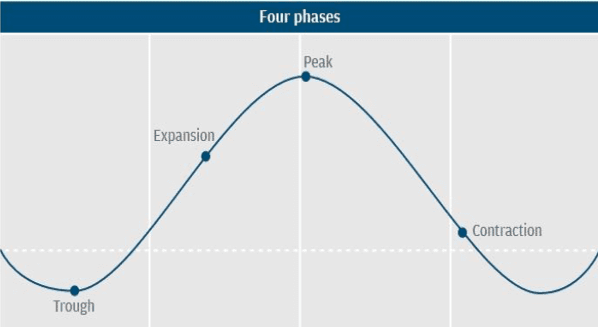
A market cycle basically refers to the periodic ebbs and flows that occur in the economy and across individual sectors, such as technology, stocks and bonds, and real estate. Real estate cycles typically include a wave pattern that moves across the four phases of trough, expansion, peak, and contraction. Understanding the real estate cycle can help people anticipate shifts in the market and make more informed decisions relating to their real estate asset, whether it’s single-family home, multifamily building, commercial building, or net leased property.

Understanding the Four Real Estate Cycles:

  • Trough/Recession: In the recession phase, supply has over-exceeded demand, and demand drops—causing downward pressure on values, high vacancy rates and negative rent growth. Anyone who owned real estate during the “Great Recession” faced dramatic events such as loan defaults, massive layoffs, and vacated homes that owners abandoned after property values plummeted. Still, some speculative investors look at this cycle phase as a good time to buy as property values will be at rock bottom. Some of the advantages of buying real estate during recessions include lower prices, less competition, and many sellers might be more willing to offer provisions as improvements and amenities. If successfully executed, a buyer who purchases during a trough or recession will wait and hold the investment property until the real estate cycle circles back, and the downturn is over—as the market begins to recover and eventually expand.
  • Recovery/Expansion: English theologian and historian Thomas Fuller once famously said, “It’s always darkest before the dawn”, which many real estate investors apply to the earliest moments of a recovery. In the recovery phase, the real estate market begins at a low point from the recession and gradually rises in strength. Some people who invest in the recovery phase look at Core real estate assets that will generate stable income with very low risk. These assets include a NNN property with a long-term lease or a fully leased office building in a prime location. Other assets that savvy investors target during a recovery phase of real estate investment include value-add real estate, and opportunistic investments like distressed properties or even raw land. While many people have a hard time identifying when the trough stage segues into the recovery phase, experts look at trends like gradual occupancy increases or growing demand to identify when the recovery stage has begun. The recovery phase is a popular time for real estate investment and speculation since prices of properties are typically high, which helps the potential for a solid return upon the sale of the asset.
  • Peak: The peak phase will be when supply catches up with and even exceeds demand pushing prices up. During this phase, assets are fully priced, and some real estate investors feel eager to sell at attractive prices and reap profits. However, the peak market can also be a good time for savvy investors to refinance any leverage while interest rates are low and fixed.
  • Contraction: The contraction phase generally occurs after the business cycle peaks, but before it becomes a trough. If growth stalls or becomes negative, it can fall into a recession, which is usually defined as two consecutive quarters of negative growth. During this period, investors need to act very cautiously while simultaneously  monitoring the market for opportunities – because while contraction cycles can be difficult, they can also coincide with some great opportunities. For example, in a recessionary environment, the worst-performing assets are those that are highly leveraged, very speculative, and fraught with risk. For many years, Kay Properties has avoided the sectors of hospitality, senior care, and oil & gas for this exact reason.

Delaware Statutory Trusts & Investing Across Real Estate Market Cycles

While this cycle pattern is widely accepted to view the real estate market over the long-term, there are many variables that come into play with real estate. For example, real estate is a highly localized industry with different conditions in every state, market, and sub-market making real estate a constantly moving target.

Record-breaking expansion cycle and DST Investment Opportunities

Timing investments correctly may potentially help to increase returns. Yet getting market timing exactly right is never easy unless you happen to be a fortune teller. Right now, the length of the current economic expansion has many people suspecting that we are close to a peak market cycle. However, others suggest current slow and steady growth may be sustainable, and there doesn’t appear to be anything imminent that could derail that pattern. The peak could very well turn out to be more of a plateau than the beginning of the end. Even if there is a contraction or trough ahead, it could be a slight downturn rather than a sharp drop off a cliff. There are numerous variables that contribute to the shape of market cycles that range from Fed monetary policy to market bubbles that pop, such as the housing and Dot.com booms that caused the last two recessions.

But real estate experts point to several macro real estate trends that suggest it might be a good time for investment property owners to consider selling their buildings and consider DST 1031 investments.  Even if we cannot know if we are currently experiencing a peak in the real estate market cycle, many real estate investors have seen their properties appreciate significantly and recognize an opportunity to sell and potentially unlock trapped equity.

Some Macro Real Estate Trends That Could Benefit DST Investors

Macro Real Estate Trend #1: Low Inventory

According to the National Association of Realtors, inventory of available homes was down nearly 30% in 2021 compared to a year ago, multifamily buildings are attracting institutional real estate investors, and according to real estate firm CBRE in is first quarter 2021 report on the industrial and logistics market, demand for this type of asset is through the roof, after nearly 100 million square feet was absorbed during the first quarter – the third highest absorption rate on record.

  • How This Could Benefit DST Investors? Whether you are talking about a multifamily apartment building or a single-family home, low inventory means higher selling prices and shorter sales cycle – all good news for the seller’s position. However, this low inventory could also cause trouble for a seller who will find it hard to purchase a replacement property to avoid a large capital gains tax bill at the end of their sale. The DST marketplace allows sellers to easily find a 1031 like-kind exchange for nearly every level of transaction, providing sellers a strategy to not only defer their capital gains taxes but also gain access to a much more diversified portfolio with monthly cash flow potential. DST 1031 specialty advisory firms like Kay Properties & Investments has access to the largest menu of DST 1031 exchange properties in the nation and works with more than 25 different sponsor companies.

Macro Real Estate Trend #2: Rising Real Estate Asset Prices-

 While real estate prices have slowed slightly in recent months, they have still grown by nearly 20% compared to last year, and according to a recent report on net leased real estate  points out that net leased real estate is experiencing its highest level of demand in history, with billions of dollars flooding in from seemingly everywhere.

  • How Could This Benefit DST Investors? Rising real estate prices might indicate the real estate cycle is nearing its peak, and so it could be a good opportunity for investors to sell their multifamily investment buildings. However, selling in an expansion market cycle could trigger a significant capital gains tax bill! DST 1031 exchange investments help sellers defer their capital gains taxes while gaining access to institutional quality real estate assets with the potential for monthly income. DST 1031 exchanges can be structured with leverage for replacing debt, or all-cash/debt-free eliminating the risk of lender foreclosure..

Macro Real Estate Trend #3: Low Interest Rates

With historically low interest rates in place, buyers are more motivated and capable of financing investment property more quickly.

  • How Could This Benefit DST Investors? According to the Quantity Theory of Money, any time the money circulation increases (either through government spending or lower interest rates) inflationary pressures tend to surface. DST 1031 properties may potentially help investors reduce the negative effects of inflation. For example, many DST investments have access to properties that have historically shorter lease terms that allow the investor to pass along any inflationary pressures to their tenants. On the other hand, most single-tenant net leased investment properties commonly have 20–25-year leases that generates flat to minuscule rental increases over the course of the lease term. Over time this flat rental structure could be devastated by inflationary pressures.

Today’s Real Estate Cycle Could Be a Good Time to 1031 Exchange into DST Properties

There is no doubt that mature market cycles are fueling an increase in property sales and 1031 tax deferred exchanges. Property owners who believe values may be at or near peak see it as a good time to take chips off the table and sell real estate that has experienced good appreciation. DST Properties are blessed by the IRS for use in a 1031 tax-deferred exchange. Individuals also have an opportunity to reinvest proceeds into a variety of different property types and geographic markets. For example, Kay Properties has DST opportunities with a minimum investment amount of $100,000 for investors with offerings that span multifamily, self-storage, net lease (NNN), industrial and medical office properties.

The Delaware Statutory Trust 1031 exchange vehicle can be a potentially smart strategy for investors who want to take advantage of the current real estate trends and leverage the tax deferral aspects of the 1031 exchange process.

About the author:

Jason Salmon, Senior Vice President with Kay Properties, a Commercial Real Estate Industry Leader and DST 1031 Exchange Expert

Delaware Statutory Trusts & Investing Across Real Estate Market Cycles
Jason Salmon

Jason Salmon is Senior Vice President Managing Director of Real Estate Analytics for Kay Properties & Investments New York City office where he applies his more than 20 years of commercial real estate and financial advisory experience in assisting thousands of property owners as they navigate their 1031 exchange transactions and direct acquisitions of securitized real estate investments. He is considered one of commercial real estate industry’s leading experts in providing high-net-worth clients DST 1031 exchange investment strategies, tax advantaged exit strategies and estate planning solutions.

Jason takes his deep and diverse expertise in identifying good real estate investment opportunities across multiple sectors including commercial, industrial, medical, and multifamily and combines it with Kay Properties & Investments’ dynamic platform that includes a full menu of DST properties and a complete team of 1031 exchange experts to provide his clients the best advisory and execution practices in the industry.

About Kay Properties and www.kpi1031.com

Kay Properties & Investments is a national Delaware Statutory Trust (DST) investment firm. The www.kpi1031.com platform provides access to the marketplace of DSTs from over 25 different sponsor companies, custom DSTs only available to Kay clients, independent advice on DST sponsor companies, full due diligence and vetting on each DST (typically 20-40 DSTs) and a DST secondary market. Kay Properties team members collectively have over 150 years of real estate experience, are licensed in all 50 states, and have participated in over 30 Billion of DST 1031 investments

Diversification does not guarantee profits or protect against losses.

There are material risks associated with investing in real estate, Delaware Statutory Trust (DST) properties and real estate securities including illiquidity, tenant vacancies, general market conditions and competition, lack of operating history, interest rate risks, the risk of new supply coming to market and softening rental rates, general risks of owning/operating commercial and multifamily properties, short term leases associated with multifamily properties, financing risks, potential adverse tax consequences, general economic risks, development risks and long hold periods. All offerings discussed are Regulation D, Rule 506c offerings. There is a risk of loss of the entire investment principal. Past performance is not a guarantee of future results. Potential distributions, potential returns and potential appreciation are not guaranteed. For an investor to qualify for any type of investment, there are both financial requirements and suitability requirements that must match specific objectives, goals, and risk tolerances. Securities offered through Growth Capital Services, member FINRA, SIPC Office of Supervisory Jurisdiction located at 2093 Philadelphia Pike Suite 4196 Claymont, DE 19703.

Delaware Statutory Trust Investing Across Market Cycles

National Rents Edge Back Up into Positive Territory in January

National Rents Edge Back Up into Positive Territory in January

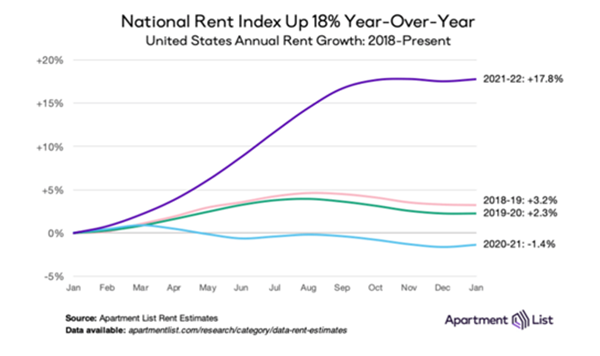
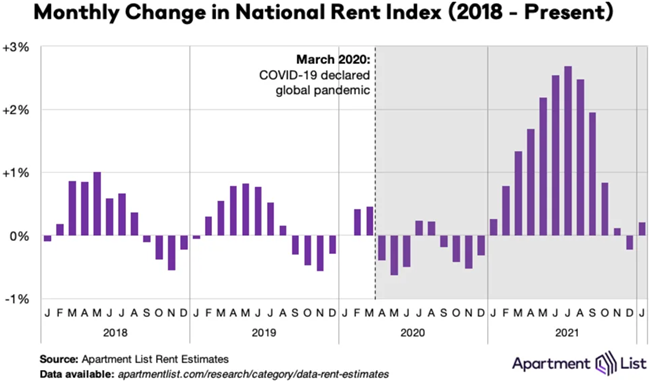
January rents inched back up into positive territory nationally overall, but many metros are still seeing declining rents, according to the Apartment List February report.

The national index was up a slight 0.2 percent over the course of January but 41 metros still saw falling rents in January. The report says even though month-over-month growth has moved back into positive territory, rent growth has still cooled substantially from last year’s peak.

However, not every city has seen a dip in rents. Many Sun Belt cities continue to show rent increases.

“Even though rent growth has been essentially flat over the past three months, it’s still pacing a bit ahead of the pre-pandemic trend. It’s likely that rent growth will pick back up in the coming months, though it’s still unclear just how much we should expect rents to rise in the year ahead,” write housing economists Chris Salviati, Igor Popov, Rob Warnock, and Lilla Szini in the Apartment List report.

January rents inched back up into positive territory nationally overall, but many metros are still seeing declining rents, according to the Apartment List February report.

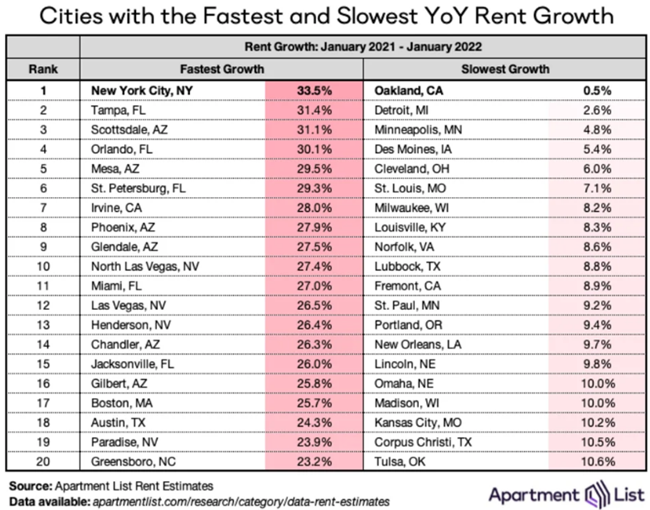
New York City had fastest rent growth last year

The nation’s largest city is also the place where rent prices rebounded from the pandemic and have grown the fastest over the past 12 months.

In New York City, the median price for an apartment increased from $1,575 one year ago to $2,101 today, a massive rent jump of 33.5 percent.

New York City narrowly edged out a number of smaller but rapidly-growing cities that absorbed significant rental demand throughout the pandemic, including Tampa, Fla., where rents grew at 31.4 percent, and Phoenix, Ariz., at 27.9 percent.

National Rents Edge Back Up into Positive Territory in January

Vacancy rates continue gradual climb

The report says the vacancy increase has been modest and gradual, but “it represents an important inflection point, signaling that tightness in the rental market is finally beginning to ease. The vacancy situation remains historically tight, but the gradual easing of recent months has likely been contributing to the slowdown in rent growth.”

January Rents Summary

January brought a return to positive rent growth, with a modest 0.2 percent increase.  “While the apartment market remains tight – the national vacancy rate sits just above 4 percent compared to 6 percent pre-pandemic – the winter season continues to bring signs that pressure is gradually beginning to ease.

“That said, at least part of the recent slowdown in rent growth is attributable to seasonality in the market, and the spring is likely to bring with it a return to faster price increases. Despite a recent cool-down, many American renters are likely to remain burdened throughout 2022 by historically high housing costs,” Apartment List says in the report.

Sign Up For Our Weekly Newsletter And Get Rental Property And Apartment News And Helpful, Useful Content Each Week.

* indicates required

Multifamily Had A Record Year In 2021; What’s in Store for 2022?