Home Blog Page 83

Portland, Seattle Rent Growth Up As Growth Cools In July Nationally

National rents grew at 1.1 percent in July showing the continued slower rent growth that has been expected, Apartment List August report says

Portland and Seattle beat the national average as nationally rents grew at 1.1 percent in July showing the continued slower rent growth that has been expected, Apartment List says in their August report.

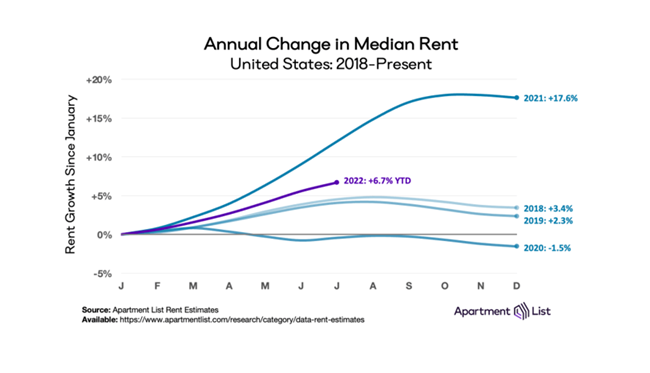
“Over the first seven months of 2022, rents have increased by a total of 6.7 percent, compared to an increase of 12.0 percent over the same months of 2021. Year-over-year rent growth currently stands at 12.3 percent, but has been trending down since the start of the year from a peak of 18 percent,” the report says.

However the report points out that rents are still growing faster than they did in pre-pandemic years. Rents increased in July in 87 of the 100 largest metros.

Portland rents increase sharply over the past month

Portland rents have increased 1.6 percent over the past month, and have increased sharply by 7.2 percent in comparison to the same time last year.

Currently, median rents in Portland stand at $1,295 for a one-bedroom apartment and $1,512 for a two-bedroom. This is the sixth straight month that the city has seen rent increases after a decline in January. Portland’s year-over-year rent growth lags the state average of 10.7percent, as well as the national average of 12.3 percent.
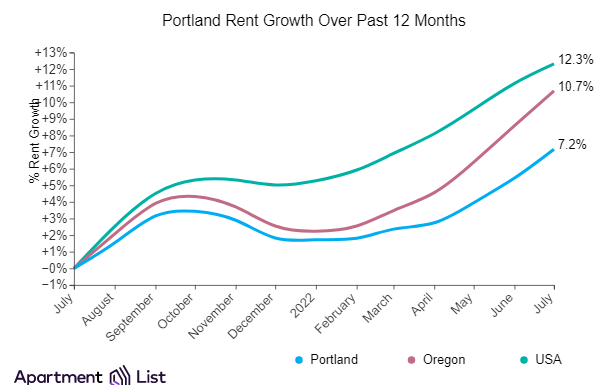
Portland rents grew in July topping national rents grew at 1.1 percent in July showing the continued slower rent growth that has been expected, Apartment List August report says

Seattle rents increase sharply over the past month

Seattle rents have increased 2.2 percent over the past month, and have increased sharply by 9.1 percent in comparison to the same time last year. Currently, median rents in Seattle stand at $1,710 for a one-bedroom apartment and $2,066 for a two-bedroom. This is the sixth straight month that the city has seen rent increases after a decline in January.
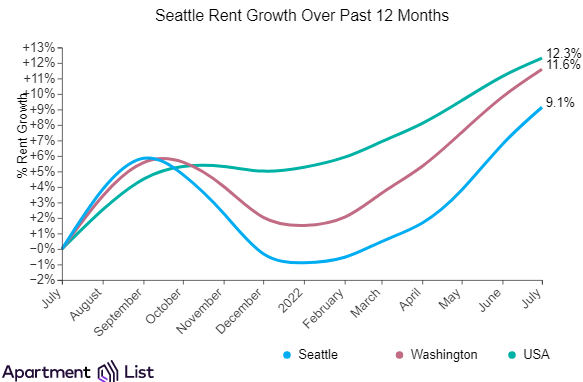
Seattle rent growth tops national as national rents grew at 1.1 percent in July showing the continued slower rent growth that has been expected, Apartment List August report says

Month-Over-Month Rent Growth Cools – Slightly

The rapid growth in rent prices over the past year as contributed to the overall inflation the country is facing.

“With inflation top-of-mind for policymakers and everyday Americans alike, our rent index is particularly relevant, since movements in market rents lead movements in average rents paid. As a result, our index can signal what is likely ahead for the housing component of the official inflation estimates produced by the Bureau of Labor Statistics. Thankfully for the country’s renters, our index shows that rent growth in 2022 has cooled from last summer’s peaks.

“This month’s slowing rate of growth is consistent with the timing of seasonal trends that we have observed in the past, and it is likely that growth will cool further in the coming months, as the fall and winter tend to bring a slowdown in rental market activity,” the Apartment List report says.

Vacancy Index Held Steady In July
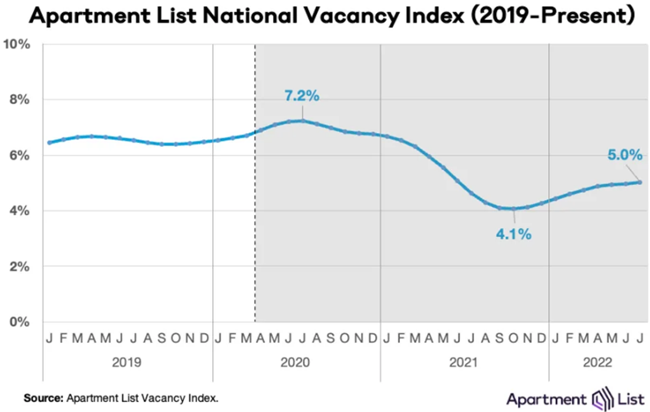
National rents grew at 1.1 percent in July showing the continued slower rent growth that has been expected, Apartment List August report says

The national vacancy index held steady at 5 percent this month.

“Our vacancy index has been gradually easing from a low of 4.1 percent last fall, but that easing now appears to be leveling off at a rate that remains well below the pre-pandemic norm.

“This may be at least partially attributable to spiking mortgage rates, which can contribute to tightness in the rental market by sidelining potential first-time homebuyers from the for-sale market and keeping these households in rental units for longer.”

Summary

The July slowdown in the pace of rent growth “signals that the market is following its typical seasonal trend.

“As we enter the fall and winter months, rental activity tends to slow, and we are likely to see rent growth continue to cool.”

However there is no indication that rental prices will actually decline “in any meaningful way,” the report says.

See the full report here.

Rate Of Rent Growth Slows At Midyear But Multifamily Still Poised For Strong Year

With Traditional Multifamily Rent Drivers Disrupted What Is The Future?

Another Bullish Year For Multifamily In 2022?

Sign Up For Our Weekly Newsletter And Get Rental Property And Apartment News And Helpful, Useful Content Each Week.

* indicates required

FTC Charges Online Home Buyer with Deceptive Practices

FTC Charges Online Home Buyer Opendoor with Deceptive Practices

The Federal Trade Commission has charged the online home buyer Opendoor with using misleading and deceptive practices and information and ordered the company to pay $62 million in a settlement agreement.

The FTC said in a release that it took the action against the company “for cheating potential home sellers by tricking them into thinking that they could make more money selling their home to Opendoor than on the open market using the traditional sales process.”

“In reality, most people who sold to Opendoor made thousands of dollars less than they would have made selling their homes using the traditional process,” the FTC said. Under a proposed administrative order and settlement, Opendoor, known also as Opendoor Labs, Inc., will have to pay $62 million and stop its deceptive tactics.

“Opendoor promised to revolutionize the real estate market but built its business using old-fashioned deception about how much consumers could earn from selling their homes on the platform,” said Samuel Levine, director of the FTC’s Bureau of Consumer Protection, in the release. “There is nothing innovative about cheating consumers.”

Opendoor, headquartered in Tempe, Arizona, operates an online real estate business that, among other things, buys homes directly from consumers as an alternative to consumers selling their homes on the open market. Advertised as an “iBuyer,” Opendoor claimed to use cutting-edge technology to save consumers money by providing “market-value” offers and reducing transaction costs compared with the traditional home sales process.

Opendoor said in a release, “While we strongly disagree with the FTC’s allegations, our decision to settle with the Commission will allow us to resolve the matter and focus on helping consumers buy, sell and move with simplicity, certainty and speed.

“Importantly, the allegations raised by the FTC are related to activity that occurred between 2017 and 2019 and target marketing messages the company modified years ago. We are pleased to put this matter behind us and look forward to continuing to provide consumers with a modern real estate experience.”

The FTC investigation showed Opendoor also violated the law by misrepresenting that:

  • Opendoor used projected market-value prices when making offers to buy homes, when in fact those prices included downward adjustments to the market values;
  • Opendoor made money from disclosed fees, when in reality it made money by buying low and selling high;
  • Consumers likely would have paid the same amount in repair costs whether they sold their home through Opendoor or in traditional sales; and
  • Consumers likely would have paid less in costs by selling to Opendoor than they would pay in traditional sales

Opendoor has agreed to a proposed order that requires the company to:

  • Pay $62 million: The order requires Opendoor to pay the commission $62 million, which is expected to be used for consumer redress.
  • Stop deceiving potential home sellers: The order prohibits Opendoor from making the deceptive, false, and unsubstantiated claims it made to consumers about how much money they will receive or the costs they will have to pay to use its service.
  • Stop making baseless claims: The order requires Opendoor to have competent and reliable evidence to support any representations made about the costs, savings, or financial benefits associated with using its service, and any claims about the costs associated with traditional home sales.

Sign Up For Our Weekly Newsletter And Get Rental Property And Apartment News And Helpful, Useful Content Each Week.

* indicates required

Everything Landlords Should Know About Emotional Support Animals

Emotional Support Animals and the Fair Housing Act

What a Pet-Friendly Apartment Community Truly Looks Like

Washington Landlords Sue Over State Eviction Dispute Centers

Washington landlords sue the state eviction-dispute resolution centers that are not working to get rent paid in a timely manner

Washington landlords have filed suit in Spokane over the issue of eviction-dispute resolution centers that are not working to get rent paid in a timely manner according to landlords.

“We’re stuck. We’re really at the mercy of these non-judicial entities … to give us the magic ticket to be able to go to court,” said Sean Flynn, vice president of the Washington Business Properties Association, to the Seattle Times. “And they’re not doing it. When they are doing it, it’s not timely.” He said delays are a state-wide problem.

Landlords who want to evict a tenant for nonpayment of rent must first notify a dispute-resolution center in their county and wait for the center to issue them a certificate. Landlords say the dispute-resolution centers can be slow to issue the certificates, sometimes taking six months or longer.

Resolution Washington, the statewide coalition of dispute-resolution centers, denied the charge that delays are widespread. From November through June, the median case took 22 days, according to the organization.

Eviction Dispute Resolution Pilot Program

The resolution-dispute centers, operating under something called the  Eviction Resolution Pilot Program (ERPP), were created by the state in an attempt to avoid mass evictions when the state lifted the eviction moratorium. The mandate that landlords get certificates from the resolution centers in nonpayment cases does not expire next July.

Meanwhile “the process has drawn criticism from both tenant and landlord groups, who say it can be opaque or slow,” the Seattle Times reported.

“We firmly believe that while well-intentioned, this process shuts off access to the justice system with convoluted, ill-defined rules and an unrealistic process controlled by unaccountable third parties,” said Chester Baldwin, CEO of the Washington Business Properties Association, in a post on the association site.

He said at issue is how eviction cases are being diverted into a quasi-judicial, non-binding process that requires a certification by a private, third-party mediator before actual legal proceedings can begin in an unlawful detainer action.

“Our state is facing a myriad of challenges when it comes to housing access and affordability. This process is making it worse, driving up rents and driving out providers,” Baldwin said. “The justice system should not have a private gatekeeper making this crisis worse.”

The association asks the eviction-prevention program be declared unconstitutional.

One housing provider sent a 14-day notice to vacate and ERPP forms in April and still has not received a certificate allowing them to appear before a court. “It’s these kinds of costly and unconstitutional delays that must stop,” Baldwin said in late July.

Court Upholds Law Requiring Landlords Pay Rent To Evicted Tenants

Sign Up For Our Newsletter And Get Rental Housing and Apartment News And Helpful, Useful Content Each Week.

* indicates required

Ask Attorney Brad: Why Can’t A Landlord Give a 30-Day Notice to Vacate?

Understanding a Landlord’s Rights, Obligations in Domestic Violence Situations

Ask Attorney Brad: Tenants Want to Know Why There’s a Dog in No-Pet Building?

Seven DST 1031 Exchange Terms Every Real Estate Investor Should Know (updated)

Some of the most important investment terms that all Delaware Statutory Trust 1031 Exchange investors should know Kay Properties says

By Betty Friant
Senior Vice President, Kay Properties & Investments

Kay Takeaways:

  • Knowing key terms for a 1031 Exchange is important for investors
  • What is the definition of “beneficial interest” and how does it relate to DST’s?
  • What is a Tenant In Common Investment?
  • Do you know what a Qualified Intermediary is?

Becoming a serious 1031 Exchange real estate investor can involve a significant learning curve. For example, there are many investment terms that every investor should  know and understand in order to better understand the nuances surrounding 1031 Exchange real estate investments and help find success as an investor.

Therefore, Kay Properties thought it would be a good idea to present some of the most important investment terms that all Delaware Statutory Trust 1031 Exchange investors should know.

  1. DST: This term stands for “Delaware Statutory Trust” which is an entity that is used to hold title to investment real estate. A DST is also a powerful real estate planning tool because it allows “beneficial interest” ownership where multiple investors can share ownership of a single property or an entire portfolio of properties. A DST is often paired with the 1031 Exchange. Pairing these two entities together allows for individual investors to diversify* their investment dollars into multiple properties and potentially mitigate concentration risk of over-concentration in their investment properties. This can potentially be accomplished by investing in DSTs with properties in different geographies, in many of the asset classes, and with various property managers, asset managers, and sponsoring companies.
  2. TIC: This term means “Tenancy in Common”, and refers to an investment arrangement where two or more individuals share the ownership rights of a property that qualifies under the rules to be used as like-kind in a 1031 Exchange. TIC investments must comply with IRS Rev Proc 2002-22 which has a limit on the number of investors. This gives the TIC entity unique challenges where each investor is named on the mortgage and each investor has the right to vote on decisions concerning the property which can be cumbersome in a co-ownership arrangement. This property can be commercial or residential. TIC allows investors to own different percentages of a property. Tenants in common can leave their share of the property to anyone of their choice upon their death.

3.  NNN: Anytime you see three N’s in a row when referring to real estate, it will invariably be referring to the concept of triple net lease investing. This is a lease agreement where the tenant promises to pay all expenses of the property. This includes real estate taxes, building insurance, and maintenance. Typically, these are expenses of the landlord. However, in a NNN lease agreement, the tenant pays these expenses along with rent and utility fees. Tenants generally pay a lower rent charge by taking on these additional expenses. Triple net leases have become popular as they have the potential to provide low-risk steady income to investors.

4.  1031s: Section 1031 is probably one of the most familiar passages in the Internal Revenue Code (IRC). These numbers refer to an IRS provision that allows individuals to defer tax on qualifying exchanges of like-kind real estate. To utilize this tax strategy investors must take certain steps when selling and buying real estate. The replacement real estate must be like-kind, tax must be paid on any boot in the year of the exchange, and replacement real estate must be identified within 45 days and acquired within 180 days to utilize the 1031 exchange.

5. QI: The letter  “QI” typically refer to a Qualified Intermediary. The Qualified Intermediary is an accommodator or facilitator that works as an entity that facilities 1031 tax-deferred exchanges. They act like the glue that puts the buyer and seller of property together into the form of a 1031 Exchange. A QI is an individual who enters into a written agreement with the taxpayer of a property. The QI acquires the relinquished property from the taxpayer, transfers the relinquished property to the buyer, acquires the replacement property from the seller, or transfers the replacement property to the taxpayer.

6. PPM: Anytime an investor is  involved with a private or public investment vehicle, a Private Placement Memorandum (PPM) will be involved. A PPM is a document that divulges everything an investor needs to know before investing in a Regulation D Offering. The PPM is very beneficial to an investor as it details the investment opportunity, disclaims legal liabilities, and explains the risk of losses. All real estate investors are strongly advised to carefully read the PPM and consult their tax attorney or CPA prior to investing.

7. IOI: When real estate investors become interested in a particular real estate asset or portfolio, they will usually request more information on the property in question. In many cases, the seller will provide a document called an Indication of Interest (IOI). An IOI is an informal proposal that is non-binding and designed to provide the investor more information on the investment. For example, IOI’s typically include property details like leasing data, square footage, and market overview. An IOI might also include due diligence plans, aerial photos, and site maps. Finally, the IOI will typically include information about the sponsoring seller of the real estate asset.

Knowing and understanding these acronyms will help in placing you on a path of success in the investment world. You might want to keep this list of the alphabet soup of acronyms handy as you research the world of investment real estate.

Ask Bill Exeter

Ask Bill Exeter and his team your questions about 1031 exchanges and he and his team will get back to you.

Name

About Kay Properties and www.kpi1031.com

Kay Properties is a national Delaware Statutory Trust (DST) investment firm. The www.kpi1031.com platform provides access to the marketplace of DSTs from over 25 different sponsor companies, custom DSTs only available to Kay clients, independent advice on DST sponsor companies, full due diligence and vetting on each DST (typically 20-40 DSTs) and a DST secondary market.  Kay Properties team members collectively have over 150 years of real estate experience, are licensed in all 50 states, and have participated in over $30 Billion of DST 1031 investments.

This material does not constitute an offer to sell nor a solicitation of an offer to buy any security. Such offers can be made only by the confidential Private Placement Memorandum (the “Memorandum”). Please read the entire Memorandum paying special attention to the risk section prior investing.  IRC Section 1031, IRC Section 1033 and IRC Section 721 are complex tax codes therefore you should consult your tax or legal professional for details regarding your situation.  There are material risks associated with investing in real estate securities including illiquidity, vacancies, general market conditions and competition, lack of operating history, interest rate risks, general risks of owning/operating commercial and multifamily properties, financing risks, potential adverse tax consequences, general economic risks, development risks and long hold periods. There is a risk of loss of the entire investment principal. Past performance is not a guarantee of future results. Potential cash flow, potential returns and potential appreciation are not guaranteed.

Nothing contained on this website constitutes tax, legal, insurance or investment advice, nor does it constitute a solicitation or an offer to buy or sell any security or other financial instrument. Securities offered through FNEX Capital , member FINRA, SIPC.

How this investor closed 15 DST 1031 Exchanges in 30 Days… without a hitch!

Six Ways to Ensure Your 1031 Exchange is Successfully Completed

Kay Properties & Investments Has Record Year With $610 Million In Equity Placed

Earthquakes And Water Heaters: Are Your Rental Properties Ready?

Are the water heaters in your rental housing earthquake ready and and legally secured in the event of an earthquake?

Are the water heaters in your rental housing earthquake ready and and legally secured in the event of an earthquake?

Everyone has heard of the “big one,” the big earthquake that could strike but few think of the water heater in their rental property when this subject comes up. The recent small earthquake southeast of Hillsboro, Oregon, got some rental property owners thinking about the issue.

While the extreme versions of earthquake-driven “big one” disaster as depicted in Hollywood movies might be pure fiction, it is important for rental housing professionals and landlords to address this risk no matter how remote.

Even though the construction industry has made tremendous progress in making homes earthquake-resistant, one major weakness remains, especially for homes constructed before 1995 – water heaters are either not strapped properly or at all.

Why are water heaters not properly secured?

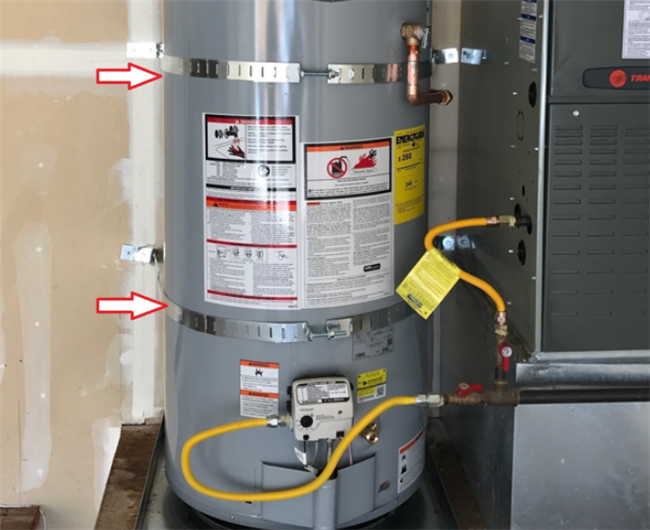
Before the 1994 Northridge earthquake in California, water heaters were generally secured with one strap of plumbers’ tape.

This turned out to be insufficient to hold the tanks upright during the earthquake.

So, experts modified the recommendation to secure both the top and bottom rather than just the middle, and to use heavy-gauge metal strapping.

Steve Gemmell of Earthquake Tech says, “Installing seismically activated gas shut off valves has become standard practice along with strapping water heaters down to keep them in place during earthquakes here in the Pacific Northwest. These are both great ways to keep your rentals intact, preventing fire and water damage which can end up totaling your property if not costing thousands in damage.”

Seismic straps for water heaters recommended In some states

Seismic straps are a requirement for water heaters in areas that may be subject to earthquakes.

In a number of states, it is recommended that water heaters be strapped so that they do not shift about during a quake.

Naturally, legal requirements vary from jurisdiction to jurisdiction and from state to state. It is important to remember that you should always read the manufacturer’s installation recommendation if you’re setting up your own water heater.

So, do you need seismic straps on your water heater? It depends.

For example, they are required by law in California and Washington, which makes sense since the states are earthquake-prone. Oregon Plumbing Specialty Code (OPSC) requires water heaters to be anchored or strapped in seismic categories C, D, E, and F.

The Uniform Plumbing Code requires that water heaters be strapped on both the lower one-third and the top one-third of the tank. However, numerous building jurisdictions, as well as the state’s architects office also require a third or even fourth strap for heaters up to 100 gallons in volume. A quick call to your local building department should provide you with enough information on the number of water heater straps required in your area of residence.

Summary

Bottom line, since a water heater system is crucial you should always make sure any and all installations and repairs are done by experienced and licensed professionals.

Depending on the area of residence, type and number of straps, strapping and bracing a water heater will typically cost between $100 and $150 or more.

As we’ve seen, even though money is the first thing everyone thinks about when discussing the true cost of a failed water heater, there’s more to it than that. The time spent deciding what to do, as well as the stress of the problem itself are also important factors. Why? Because, ultimately, you won’t just be fixing a burning problem; you’ll be buying peace of mind and a sound sleep, as well.

About Earthquake Tech:

Owner Steve Gemmell says the company is a dedicated seismic retrofit contractor in Portland with core values of progressive thinking, quality craftsmanship, referrals from our clients, and attention to detail.

Sign Up For Our Newsletter And Get Apartment News And Helpful, Useful Content Each Week.

* indicates required

3 Common Plumbing Emergencies In Rental Properties And What To Do

Rental Property Maintenance: 6 Items to Troubleshoot in Your Crawl Spaces

How to Waterproof Your Basement


How to Calculate Monthly Cash Flow Income Projections

How to Calculate Monthly Cash Flow Income Projections

Real estate investors analyzing a property to hold and rent need to calculate monthly cash flow income projections to measure the property’s ability to make money.

By Marco Napoli

Some investors get into trouble and lose money because they don’t take into consideration the monthly cash flow of a property before they purchase. The importance of calculating monthly cash flow is to help with the decision to either purchase a property or not based on the amount of cash left over after all the expenses and financing.

When analyzing a property to hold and rent you’ll need to calculate your cash flow to measure the property’s ability to make money (positive cash flow) or lose money (negative cash flow). If the property has positive cash flow it means that after all of the expenses, you have cash left over, but if the property has negative cash flow, you need to make up the difference out of pocket to cover the expenses, meaning you lose money every month since the property does not generate enough cash flow to cover the expenses.

Another place real estate investors can make a wrong assumption is in analyzing commercial and multi-family (five units and above) properties. It is important to correctly calculate the Effective Gross Income by only applying the Vacancy Factor to the Gross Rental Income then adding any Other Income, like vending machines, billboards and so on.

Therefore, to analyze a property effectively you take into consideration the Effective Gross Income, Operating Expenses, Net Operating Income, Financing and finally calculate the Cash Flow to make an educated decision if the property is worth purchasing and at what price. The following are the formulas on how to analyze and calculate your Cash Flow.

How to Calculate Monthly Income Projections

 Gross Income – Total income of rent received from tenants to pay for the space.

 Vacancy Rate % – The percentage of time rental income is lost due to a property not being rented. Usually between 5% to 10% of the Gross Income.

 Other Income – Any miscellaneous income other than rent like Vending Machines, Laundry Machines, Billboard, Signage, etc.

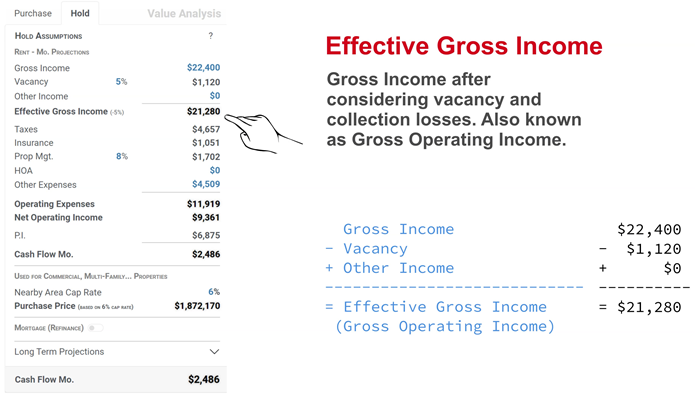
 Effective Gross Income – Gross Income after considering vacancy and collection losses. Also known as Gross Operating Income.

Gross Income
– Vacancy
+ Other Income
—————————————–
= Effective Gross Income (Gross Operating Income)

Property Management % – Usually between 6% to 10% of the Gross Rent. Other Income is not part of the calculation.

Other Expenses – Can be used for any other expenses. For example, the Landlord might be responsible for lawn maintenance, pool cleaning, water…

Operating Expenses – Excluding loan payments, it’s all of the property expenses. For example Taxes, Insurance, Property Management, HOA, and any Other Expenses.

Taxes
+ Insurance
+ Property Management
+ HOA (Homeowners Association Fees)
+ Other Expenses
—————————————–
= Operating Expenses

 Net Operating Income – Excluding loan payments, it’s the Net Operating Income for the property after all Expenses. It is used to compare rental properties without the use of financing.

Effective Gross Income
– Operating Expenses
—————————————–
= Net Operating Income

How to Calculate Monthly Income Projections

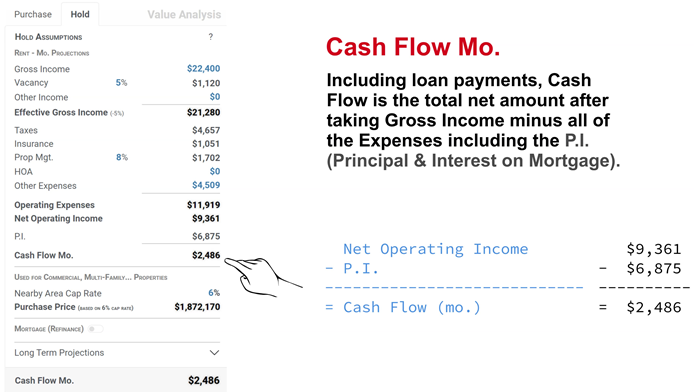
 Cash Flow Mo. – Including loan payments, Cash Flow is the total net amount after taking Gross Income minus all of the Expenses including the P.I. (Principal & Interest on Mortgage).

Net Operating Income
– P.I. (Principal & Interest on Mortgage)
——————————
= Cash Flow (mo.)

Now that you have these crucial financial assumptions, real estate investors can make an educated decision to purchase a property (or not) for passive income.

About the Author:

Marco Napoli has been investing in Real Estate for both the Residential and Commercial markets for 25+ years. “I have been involved in both flipping for a quick payout and holding investments for passive income. I have been involved with Section-8 to luxury multi-family units in the Residential sector and flipping Commercial.  I am also a Software Developer which gives me a unique position to create custom tools to evaluate Real Estate Investments quickly and easily.” Contact me at [email protected].

How to help real estate investors Calculate Monthly Cash Flow Income Projections
Marco Napoli

Twitter: @JediPixels
Web: propertyfliporhold.com

Can I Insist A Long-Term Tenant Fill Out A New Application?

Can I Insist A Long-Term Tenant Fill Out A New Application?

Should a landlord require a long-term tenant to fill out a new application is the question this week for Ask Landlord Hank. Remember Hank is not an attorney and is not offering legal advice. If you have a question for him please fill out his form below.

Dear Landlord Hank:

Can I insist that a long-term tenant fill out a new application?

Not for the purposes of “applying” (they’ve lived there for 11 years) but for the purpose of updating employment and other information.

Thank you. -Janeese

Dear Landlady Janeese,

Great to hear you have long-term tenants of 11 years. You are apparently doing everything right to keep them happy for so long.

I would think that your tenants wouldn’t mind you updating your contact info in case you need to reach them in an emergency situation.

If they are reluctant to fill out a standard information form, maybe you could just ask them verbally for the information. If the tenants still won’t comply with this simple request, I’d ask them what objection they have.

If the objection doesn’t make any sense, it may be time to seek out new tenants.

Sincerely,

Hank Rossi

Each week I answer questions from landlords and property managers across the country in my “Dear Landlord Hank” blog in the digital magazine Rental Housing Journal.    https://rentalhousingjournal.com/asklandlordhank/


Should a landlord require a long-term tenant to fill out a new application to update employment information is the question for Hank
Landlord Hank working on one of his rentals. Hank says, “I would think that your tenants wouldn’t mind you updating your contact info in case you need to reach them in an emergency situation.”

Ask Landlord Hank Your Question

Ask veteran landlord and property manager Hank Rossi your questions from tenant screening to leases to pets and more! He provides answers each week to landlords.

  • This field is for validation purposes and should be left unchanged.

Do I Have to Paint and Replace Flooring for a Long-Term Tenant?

A Tenant Poured Grease Down Drain Who Is Responsible?

Sign Up For Our Newsletter And Get Rental Housing And Apartment News And Helpful, Useful Content Each Week.

* indicates required

Analysis: Renters Increasingly Unhappy With Sky-High Rents

Renters are increasingly unhappy with sky-high rents according to a new survey and analysis of renters’ reviews, ratings and conversations on social media sites.

Renters are increasingly unhappy with sky-high rents according to a new survey and analysis of renters’ reviews, ratings and conversations on social media sites.

The survey shows that sky-high rents have created unhappy renters and increasingly negative sentiment among renters and raises the specter of rent controls in major cities, according to Reputation, an online reputation-management company, which did the survey.

In addition, rising interest rates are eating into property owners’ profits and could pressure them to raise rents, which “would most certainly worsen an already contentious relationship with renters,” the report says.

The company analyzed nearly 600,000 reviews of more than 80,000 multifamily residential properties.

“In it, we’ve seen review volume is up 7 percent compared to 2021, but sentiment is down 0.2 stars. In addition, reviews about rent specifically have increased by 3.5 percent year over year, with sentiment dropping by 0.12 stars. Renters are as motivated as ever to talk about their experiences, and they’re growing less happy,” according to a release about the report.

The research found that:

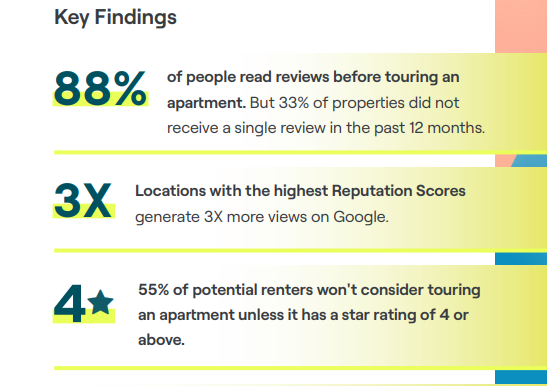
  • Reviews are gold but must be current. 88 percent of people read reviews before touring an apartment, but 33 percent of properties did not receive a single review in the past 12 months. Property managers need to protect their reputations by asking for reviews, so public feedback remains up to date.
  • Review volume is up, but sentiment is down. Quality and speed of customer service drive positive sentiment, while the responsiveness of the rental office, quality of the residence, and surcharges drive negative sentiment.
  • Renters demand four stars or more. Property managers must use sentiment feedback to make improvements, as 55 percent of potential renters will not consider touring an apartment unless it has a rating of 4 stars or higher. The average star rating is between 3.8 and 4.1 stars, so there is some room for improvement in the industry.
  • A strong reputation pays off. Locations with the highest Reputation Scores generate three times  more views on Google. Additionally, a 100-point increase in Reputation Score adds $150,000 (for 500 units managed) to $3 million (for 10,000 units managed) to your top line annually.

“Data from our property management report shows that now is the time for leaders in the multi-family housing business to solidify their customer experience and carefully communicate major changes to renters. Property managers must invest in closing the customer loop with reviews – this means proactively eliciting feedback, learning from it, and implementing changes that will improve renters’ experiences over time,” said Joe Fuca, CEO of Reputation, in a release.

Renters are increasingly unhappy with sky-high rents according to a new survey and analysis of renters’ reviews, ratings and conversations on social media sites.

Read the full report here.

Average Rents Rise To All-Time High In June

Rate Of Rent Growth Slows At Midyear But Multifamily Still Poised For Strong Year

With Traditional Multifamily Rent Drivers Disrupted What Is The Future?

Another Bullish Year For Multifamily In 2022?

Sign Up For Our Weekly Newsletter And Get Rental Property And Apartment News And Helpful, Useful Content Each Week.

* indicates required

Multifamily Outlook Still Hopeful With Volatile Economy

The multifamily outlook is still hopeful as rent increases are starting to slow as rent growth is getting moderated by soaring inflation, Yardi Matrix says in a summer report.

The multifamily outlook is still hopeful as rent increases are starting to slow as rent growth is getting moderated by soaring inflation, Yardi Matrix says in a summer report.

So the outlook is still hopeful for the rest of the year, but shows multifamily may have reached a point where potential change is coming in what has been robust growth, the report says.

The report says the economy “features some strong fundamental metrics that are being overshadowed by inflationary pressures that stem from soaring energy and housing prices, global supply-chain issues, and the hangover from post-COVID-19 monetary expansion.”

However, the report points out that the economic picture “is not bleak for multifamily” as job growth and consumer spending are still strong, and debt service low by historical standards.

“All these economic measures contribute to strong growth in household formation and demand for multifamily,” the report says.

Multifamily outlook still hopeful some highlights of the report:

  • Growth will decelerate in the second half, but the question is by how much, as persistently high inflation threatens to roil the economy.
  • The Federal Reserve’s bid to reduce demand through rising rates and quantitative easing will cut growth, with the odds of a recession in 2023 or 2024 increasing rapidly in recent weeks.
  • Multifamily rents are decelerating from 2021’s record highs but remained at double-digit percentage growth levels through mid-year. “We expect average asking rents to increase by 7.9 percent by year-end.”
  • Lenders are becoming more conservative, focusing on cash flow rather than income growth. Many investors and lenders are taking a step back to digest where the market is headed before they resume activity.
The multifamily outlook is still hopeful as rent increases are starting to slow as rent growth is getting moderated by soaring inflation, Yardi Matrix says in a summer report.
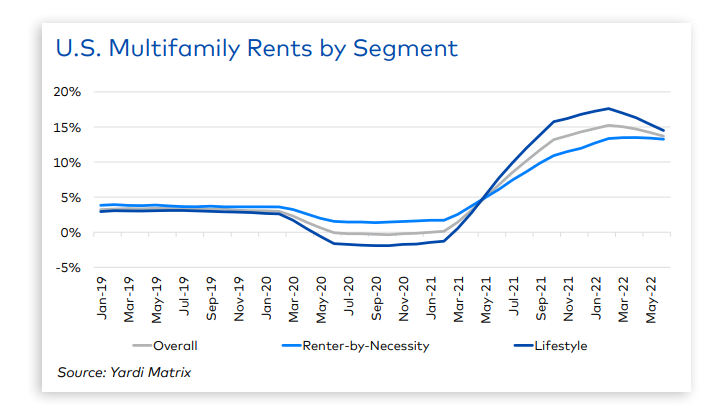
Chart courtesy of Yardi Matrix

Rent Growth Will Moderate Later In 2022

“Coming off record-high rent growth of 14.7 percent in 2021, deceleration in multifamily rents in 2022 was inevitable, but the question was how much?

“Rent growth has started to come down, but slowly as the conditions that produced strong gains have persisted. Average national asking rents increased 5.7 percent in the first six months of the year. Year-over-year rent growth at the year’s midpoint was 13.7 percent, down 100 basis points from the end of 2021 and 150 basis points from the February peak of 15.2 percent.

“While growth is moderating, we expect gains will continue to remain well above trend, with average asking rents increasing by 7.9 percent nationally by the end of 2022,” the Yardi Matrix report says.

Get the full report here.

About Yardi Matrix

Yardi Matrix researches and reports on multifamily, office and self-storage properties across the United States, serving the needs of a variety of industry professionals. Yardi Matrix Multifamily provides accurate data on 18+ million units, covering more than 90 percent of the U.S. population. Contact the company at (480) 663-1149.

Rate Of Rent Growth Slows At Midyear But Multifamily Still Poised For Strong Year

With Traditional Multifamily Rent Drivers Disrupted What Is The Future?

Another Bullish Year For Multifamily In 2022?

Sign Up For Our Weekly Newsletter And Get Rental Property And Apartment News And Helpful, Useful Content Each Week.

* indicates required

HUD Charges HOA With Discrimination Over Assistance Animal Rules

HUD Charges HOA With Discrimination Over Assistance Animal Rules

A homeowners association that decided to impose restrictions and assistance animal rules on dogs belonging to two homeowners and then retaliating against them after they filed a Fair Housing complaint, has been charged with discrimination by the U.S. Department of Housing and Urban Development (HUD).

The homeowners association published rules saying they preferred residents without support animals and “and impermissibly sought to limit the owners of support animals from enjoying shared community resources,” HUD said in the discrimination charge.

The Spring Creek Homeowners Association, the governing body of approximately 131 residential housing units in Jackson, Wyoming, was charged with putting in place discriminatory rules “permitting assistance dogs to be walked only outside the Spring Creek property and to relieve themselves on property only in the early morning or late evening.”

HUD said it was a Fair Housing Act violation by denying the dog owners “a reasonable accommodation to keep their support animals when they conditioned approval on requirements that are beyond what is allowable under the Act including imposing conditions on where, when, and how (the dog owners) could take their support animals in the community.”

The letter stated the dog regulations and rules that residents must submit a veterinarian statement that the dog has been vaccinated and that the owner assumes liability for the dogs. It then added, “If you declare that your dog is an emotional support animal you also need to submit a letter or certificate from a licensed health care professional who has a legitimate ongoing relationship with you stating that you require an emotional support animal. See airline documentation requirements from American, Delta and United airlines for the substance required in this documentation, which can be provided in any reasonable format.”

The letter also stated, “Please also remember that many Spring Creek Ranch homeowners do not like to see dogs within Spring Creek Ranch. Please do your part by complying with the aforementioned dog regulations and also by walking your dog off the butte at the many wonderful dog-friendly locations around Teton County. … Letting your dog out briefly to relieve itself in the immediate vicinity of your residence during the early morning and late evening are reasonable exceptions to this, but otherwise please minimize the presence of your dog within Spring Creek Ranch.”

After the home owners with assistance animals challenged the rules, the HOA “sent a letter to all residents in the community admonishing the homeowners for attempting to circumvent the HOA’s arbitration provisions and publicly questioning the homeowners’ need for their assistance dogs.”

“The letter also described the dog owners’ support animals as ‘two large dogs which they contend are emotional support animals’ even though HOA had approved the support animal accommodation request many months before the letter was sent and the dogs’ support animal status was no longer in question.”

The HUD action “should remind housing providers, including HOAs, that they must make exceptions to restrictive pet rules for individuals with disabilities in need of assistance animals,” HUD General Counsel Damon Smith said in a release.

“HUD will continue to enforce the Fair Housing Act to ensure that individuals with disabilities have equal access to housing and are not subjected to retaliation for exercising their fair housing rights.”

Everything Landlords Should Know About Emotional Support Animals

Sign Up For Our Newsletter And Get Apartment News And Helpful, Useful Content Each Week.

* indicates required


Welcoming More Pets Can Lead To Better Retention, More Revenue

Emotional Support Animals and the Fair Housing Act

What a Pet-Friendly Apartment Community Truly Looks Like