
Home Blog Page 57

7 Important Rental Property Preventative Maintenance Steps

Here are the 7 most important preventative rental property maintenance steps to protect your rental property investment and keep tenants happy.
Keeping the gutters cleaned and well-maintained can further prevent serious water damage .

Here are the 7 most important preventative rental property maintenance steps to protect your rental property investment and keep tenants happy.

By Bri Hilton

A survey shows 64 percent of respondents said their landlord was slow to make repairs, while more than one-third of respondents said that repairs were done badly, according to a survey of more than 1,000 tenants by the legal document company Legal Templates.

While getting the call for needed repairs can be a challenge, keeping up with preventative maintenance tasks is a fantastic way to keep the property up to par while keeping tenants happy. From checking in on the roof to pest control and beyond, here are just seven simple rental property maintenance steps that are beneficial in the long run.

No. 1 – Regularly cleaning out the gutters

Keeping the gutters cleaned and well-maintained can further prevent serious water damage to your rental and its foundation, thus making it a simple task worth setting time aside for.

According to The Spruce, regularly cleaning gutters maintains water flow from the roof to the ground (and as such, away from the house). While getting the ladder out and carefully removing any debris from the gutters is one way to get the job done, The Spruce highlights other ways to do so. Vacuuming the leaves from the gutters is just one option (which will require a 2-½-inch gutter cleaning accessory kit ‘specifically designed for wet/dry vacuums’), which will allow you to clean the gutters while standing on the ground.

However, it’s noted that this method isn’t the best option for wet leaves, in which case another route would involve blowing the leaves from the gutter with a pressure washer (though this will involve a lot of clean up).

No. 2 – Inspecting the roof

When looking to further prevent leaks and ensure that the rental is able to withstand the elements, regularly checking in on the roof will allow you to be in-the-know and up to date on its condition.

According to Build Magazine, it’s important to inspect the roof once every three months, “looking for signs of wear and tear such as broken or missing shingles, cracks in the flashing, or loose nails.” Looking for moss or algae growth is another thing to look out for, as they can cause damage to your roof over time.

Build Magazine later goes on to stress the importance of having your roof inspected by a professional each year, which will help greatly in identifying problems “before they become major issues.”

Here are the 7 most important preventative rental property maintenance steps to protect your rental property investment and keep tenants happy.
Have your roof and roof caps inspected by a professional.

No. 3 – Preventing leaks

Leaks in the home can bring a variety of issues to the table, from water damage to mold.

In addition to the cost involved, there’s no question that preventative rental property maintenance steps are key in preventing leaks and subsequent issues. In addition to keeping up with roof maintenance to prevent leaks, keeping drains clear and pipes up to date are further ways to prevent leaks.

Recognizing telltale signs of leaks when doing an inspection is another way to prevent further damage — according to one Forbes Home post, these signs include damp, dark spots on the floor, wall, ceiling and pipes, while leaks can come from several sources, such as toilets, sinks, washing machines, dishwasher, and the like.

In the case of water damage, addressing the matter as quickly as possible is imperative.

This is largely due to the fact that the longer materials are wet, the more extensive the damage can be — wood can warp, carpet can delaminate, etc. The presence of mold can also become a health and safety issue as well. While shutting off the water and fixing the issue that caused the water damage are the first steps, the water damage restoration process involves several steps to address the situation properly.

From removing any standing water using specialized pumps to removing damaged materials, involving a professional water damage restoration service is ideal in going about the matter properly and with the right tools.

No. 4 – Keeping pests at bay

About 2.9 million reported sightings of both roaches and rodents in their homes, according to the 2019 American Housing Survey (AHS).

While a variety of factors can create a pest problem (such as a dirty kitchen), keeping up with regular pest control and maintenance can be a great way to ensure that pests are kept at bay. According to RentPrep.com, preventative pest control should be done at least seasonally by landlords.

Hiring pest control professionals is a great way to go about the matter stress-free, with pest prevention treatments often involving “spraying around the exterior of the house, looking for signs of infestation, and treating the baseboards inside,” highlights RentPrep.

7 most important rental property maintenance steps to protect your rental property investment and keep tenants happy.
Pest control should be done seasonally.

No. 5 – Appliance maintenance

Maintaining a home’s appliances will not only keep them running smoothly, but will ensure they last longer, too.

In addition to checking in on the air conditioning and heating system, one Apartment Therapy post highlights the value of draining the hot water heater. “Minerals in your water will build up over time at the bottom of your tank, which also causes the tank to work harder, which often causes the hot water heater to fail, causing water damage,” explains John Bodrozic, co-founder of HomeZada, a digital home management site.

Bodrozic goes on to advise draining your tank from the bottom at least once a year (to get the sediment out) before refilling it.

No. 6 – Smart landscaping techniques

Regarding situations where landscaping responsibilities fall on the landlord, there are a variety of preventative maintenance tasks that can keep the lawn healthy and presentable.

In addition to taking advantage of low-maintenance plants, regularly pruning trees is a great way to care for the landscape as well as the property as a whole. “Pruning will help ensure the tree stays healthy by increasing airflow and light penetration.

By pruning the tree, you will also remove dead, damaged, and dying branches,” The Spruce points out, going on to note that this can work to remove hazards to people and structures around the plant. For example, a tree’s branches can scratch the siding of a home, not to mention create issues when it comes to potentially blocking gutters or preventing proper drainage.

No. 7 – Rental Property Maintenance Steps – Safety first 

A comprehensive checklist is a great way to keep track of maintenance tasks, especially when it comes to important safety maintenance such as testing the smoke alarms, carbon monoxide detectors, fire extinguishers, etc.

If you have multiple rental properties to keep up with, streamlining maintenance can be a great way to keep things up to date and lasting longer.

For example, one Zillow post highlights the value that automation can have. “Consider investing in fixtures with long battery lives or automatic features, like exterior motion lights, programmable thermostats, a bathroom fan connected to the light switch to prevent mold, or small solar lights to brighten a pathway.”

Making repairs to a property can be a stressful endeavor, though taking on preventative maintenance is a great way to keep future repairs to a minimum while improving the tenants’ stay.

From keeping up with appliances and pests to checking up on the roof, there are a variety of tasks that are well worth the effort and time in these rental property maintenance steps.

About the author:

Bri Hilton  worked in property management for almost a decade before taking a step back to start a family. She has since rediscovered her teenage talent for writing and enjoys contributing to a range of print and online publications.

Sign Up For Our Weekly Newsletter And Get Rental Property And Apartment News And Helpful, Useful Content Each Week.

* indicates required

Rental Property Maintenance Checklist, Part One: Plumbing
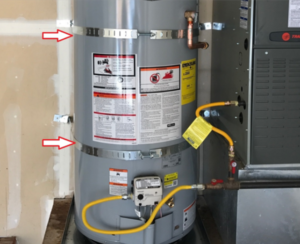
rental property maintenance plumbing and water heater secured with straps in earthquake prone areas of the country

3 Common Plumbing Emergencies In Rental Properties And What To Do

Rental Property Maintenance: 6 Items to Troubleshoot in Your Crawl Spaces

How to Waterproof Your Basement</

Part 2 – Rental Property Maintenance: Security, Pest Control, & Exteriors


Finding Vendors Shouldn’t Feel Like A Game

Here are a couple of methods you can use to ensure your projects are noticed and not neglected, by vendors who know and serve our industry

Here are a couple of methods you can use to ensure your projects are noticed and not neglected, by vendors who know and serve our industry as finding vendors should not feel like a game.

By Scot Aubrey

Recently as my granddaughters are getting older, we’ve started playing a favorite childhood game of hide and seek.  Either I am really good at hiding or their 4- and 2-year-old minds aren’t the best at seeking, but I find myself having to give them clues to my hiding spots.

It usually starts with a small whistle or something and then as they get closer, I’ll even whisper their names so I can be found. Then I have to react with great enthusiasm once I’ve been discovered, only to reset the game and do it all over again.

As a housing provider, I feel like this same type of game takes place whenever I have a service need at a property, only this time it is the vendor for a particular service who seems to be hiding and I’m trying desperately to find them. Unfortunately for me, they aren’t always wanting to be found and aren’t really giving me any clues to their whereabouts.

One of the challenges that we as small to midsize housing providers face on a regular basis is finding vendors that will work on our projects. In a world where private equity seems to be gobbling up small businesses with regularity, we are often forced to use large vendors who treat us more like a number and less like a customer they are trying to acquire.

In an economy and workforce where these things are so challenging, here are a couple of methods you can use to ensure your projects are noticed and not neglected, by finding vendors who know and serve our industry.

JOIN A LOCAL ASSOCIATION

For most of us, there are associations in and around our local areas that are dedicated to promoting and supporting people just like you.

These associations share market updates and best practices to help everyone from the newest landlord to the seasoned veteran. One other great thing about associations is that they almost always have a supportive group of local vendors that belong to their association, vendors who can repair just about anything that can go wrong on your property.

By being part of an association, they are already showing their commitment to our industry and using them when things break at your property can be a reward for their loyalty to housing providers. These smaller vendors provide the same quality of work for a better price since they are not trying to satisfy the shareholders involved with private equity.

ASK YOUR FELLOW HOUSING PROVIDERS

One of the best parts of being an investor and housing provider is the great community that exists among us.

If you are new to the business or new to an area, find a local person who is in the same situation and start asking questions.  Who do you use for (fill in the blank)?  Why do you use them?  How much on average do they charge for this type of service?  How are they when interacting with tenants?  You’ll quickly find the vendors that you want to seek and also those you may want to hide from.

USE A VENDOR MANAGEMENT SERVICE   

We’ve all seen or heard the ads for vendor management services; they seem to be on most channels of communication multiple times a day.  When looking for vendors this way, be cautious.

Always read the reviews and when necessary, call the vendor and ask about specific reviews that you may have seen. Ask questions about both professional and criminal background qualifications that they use when hiring employees to represent them.  Incorporating the first two principals, ask if they are part of any local associations or if they provide service to other housing providers in the area.

In short, exercise your due diligence in procuring the right vendors for you and your jobs, not just ones that pay the price for national or local advertising.  As a company, we have developed a service called VendorVIP that is focused on identifying the right contractors and then connecting them with housing providers.

No more closing your eyes and counting to ten; when it comes to managing your property, leave the games to others and get serious about finding the best vendors available.  By using the resources available to you in your local community, you can more easily find the vendors that will most benefit your investment and your bottom line.

About the author:

Scot Aubrey is Vice-President of Rent Perfect, a private investigator, and fellow landlord who manages short-term rentals.  Subscribe to the weekly Rent Perfect Podcast (available on YouTube, Spotify, and Apple Podcasts) to stay up to date on the latest industry news and for expert tips on how to manage your properties.  To learn about VendorVIP, visit web.vendorvip.com/vvweb/

Sign Up For Our Newsletter And Get Rental Property And Apartment News And Helpful, Useful Content Each Week.

* indicates required

Why I Like My Rental Properties’ Nosy Neighbors

Three Steps to Becoming a Successful, Lazy Landlord

Seattle City Council Votes Down Rent Control

The Seattle rent-control bill failed in committee by a vote of 3-2, but will now go to the full city council in August, according to reports

The Seattle City Council voted down a rent-control bill that would have allowed rent control in the city if the state lifted the ban on rent control, according to reports at King5.com.

The council voted 6-2 against it. One of the two members who voted in favor of the bill is its sponsor Kshama Sawant.

The bill proposed the creation of rent-control provisions, regulations against rent increases, and establishing a board to authorize exceptions. It would have capped the maximum rent increase based on annual inflation rates.

“According to the real estate industry’s own figures, the shortage of apartments is not the problem. The problem is the shortage of affordable housing,” Sawant has said.

Sara Nelson was among the six council members who voted against the proposal.

“I’m concerned that this proposal will decrease existing housing supply because rental revenues won’t keep pace with increasing maintenance costs and property taxes which will result in housing providers either just selling their properties or converting them into condominiums,” Nelson told King5.

Washington state law must be repealed

The bill sponsored by Sawant was a trigger law.

If it had passed, the bill would have gone into effect in Seattle only if the Washington state law RCW 35.21.830 was repealed. The current law prohibits rent-control regulations, stating that “no city or town of any class may enact, maintain, or enforce ordinances…which regulate the amount of rent to be charged.”

The legislature convenes for a new session in January, when it could again consider proposals to allow local rent control measures.

Sign Up For Our Weekly Newsletter And Get Rental Property And Apartment News And Helpful, Useful Content Each Week.

* indicates required

National Rent Growth Turned Negative Year-Over-Year

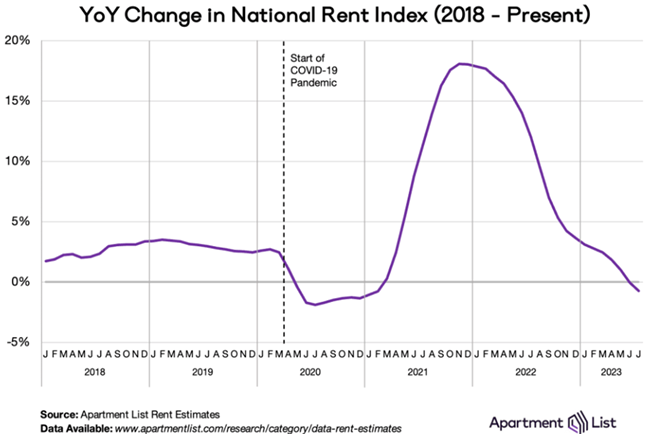
National rent growth turned negative for the first time since early in the pandemic, according to Apartment List’s August rent report.

“This means that on average across the nation, apartments today are renting for less than they did one year ago. This marks a major deceleration from recent years, when annual rent growth neared 18 percent nationally and soared to over 40 percent in a handful of popular cities,” write Apartment List economists in the report.

While some rents in some markets inched up slightly in July, “Rent growth in 2023 has come in at a much slower pace than previous years, thanks to a combination of sluggish demand and increasing supply.”

National rent growth turned negative for the first time since early in the pandemic as apartments today rent for less than one year ago

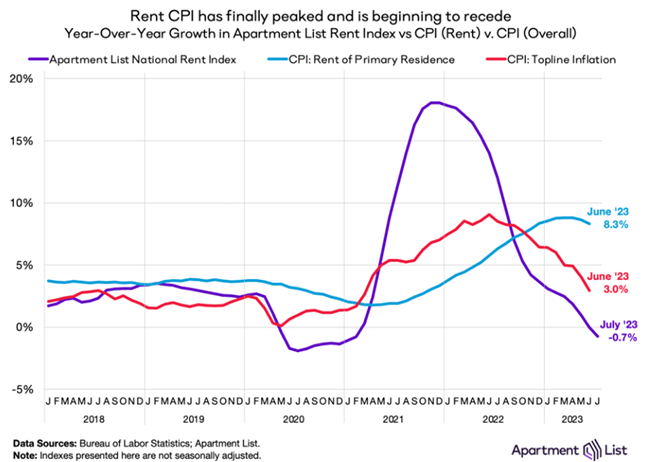
The Apartment List National Rent Index has proven to be a strong leading indicator of the CPI (Consumer Price Index) housing and rent components, “as we capture price changes in new leases, which eventually trickle down into price changes across all leases (what the CPI measures).

“As the CPI housing component now gradually begins to reflect the cooldown that we’ve long been reporting, it will help to further curb topline inflation in the months ahead,” the report says.

While rent growth turned negative, as mentioned above, some rents inched up in July, 0.3 percent month-over-month, but are down 0.7 percent year-over-year. Rents increased modestly in July in 71 of the nation’s 100 largest cities, but prices are down year-over-year in 67 of those 100 cities thanks to sluggish rent growth throughout the past 12 months,

“July is peak moving season and a month where we typically measure some of the fastest rent growth each calendar year. In pre-pandemic years, July rent growth averaged 0.6 percent. But in 2023, July rent growth came in at just 0.3 percent and is trending down for the season. This stagnation indicates that the market cooldown that started in the second half of 2022 is continuing, even as prices rise modestly month-over-month,” Apartment List economists write.

National rent growth turned negative for the first time since early in the pandemic as apartments today rent for less than one year ago

Seattle, Portland see some of nation’s slowest growth

The Seattle, Portland, and San Francisco metro areas also are experiencing some of the nation’s slowest year-over-year growth, signaling that the market downturn is not limited to just sprawling, high-growth metros.

These denser markets were the ones that slowed first in 2020, and are slowing again today; all three rank in the top 10 for slowest rent growth over the past 12 and 36 months.

San Francisco is the only metropolitan area where rents today are comparable to where they were at the start of the pandemic.

Vacancies continue to climb

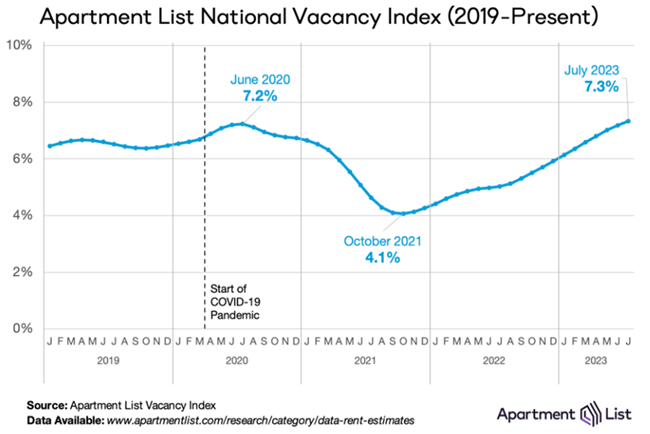
“Our vacancy index has reached 7.3 percent, surpassing the peak vacancy rate measured at the height of the COVID-19 pandemic,” the report says.

With a record number of multifamily apartment units currently under construction, this vacancy rate will remain elevated in the near future. For the first time since the early stages of the pandemic, property owners will compete for a smaller pool of tenants instead of the other way around.

Even if the end of this summer brings a resurgence in demand, that strong construction pipeline should temper rent growth for the remainder of the year, Apartment List economists write in the rent report.

National rent growth turned negative for the first time since early in the pandemic as apartments today rent for less than one year ago

Sign Up For Our Weekly Newsletter And Get Rental Property And Apartment News And Helpful, Useful Content Each Week.

* indicates required

2023 Rent Update: Midsize Markets Grow, Pandemic Boomtowns Struggle

Rents are behaving as expected so far this year, Yardi Matrix says in a special Multifamily Rent Forecast Update, with some rent deceleration but mid-market is strong

Rents are behaving as expected so far this year, Yardi Matrix says in a special Multifamily Rent Forecast Update, with some rent deceleration happening in two geographic areas.

Yardi Matrix says the decline in asking rents was driven by actual decreases in asking rents in markets that mostly fall into two categories:

  • Florida markets that saw unbelievable growth during the pandemic are now facing major affordability problems. Five of the 10 worst-performing markets were in Florida – Southwest Florida Coast, Miami, Orlando, Jacksonville and West Palm Beach.
  • Some California markets are still struggling to find their post-pandemic footing. Of the remaining markets that saw month-over-month declines, six were in California – as Metro Los Angeles, Sacramento, East Los Angeles County, and the Bay Area: East Bay, Orange County, and the Inland Empire (Riverside).

“While there will always be month-to-month fluctuations and outlier markets, rents so far this year are behaving essentially as expected: Midsize markets, especially in the Midwest and Northeast, are seeing very strong growth in asking rents, while Western, Southwestern and many pandemic boomtown markets are struggling to regain (or gain) traction after the seasonal slowdown last winter,” writes Andrew Semmes, Senior Research Analyst for Yardi Matrix, in the bulletin.

Some struggling markets could still turn around later this year, but there are issues to watch. While the job market is strong, consumer sentiment remains down despite some positive economic news. With pandemic cash gone and student loan payments upcoming due to the recent Supreme Court decision, some renters could be left in a tighter financial situation than they expected.

Some markets will perform

“We have raised our expectations for many midsize markets throughout the Midwest, Northeast and parts of the South,” the report says.

“As affordability continues to be a concern across the country and economic uncertainty prevails, these smaller markets will continue to be more attractive, as they can provide many of the same benefits and amenities their larger siblings do at significantly lower price points.

“Furthermore, federal investments in manufacturing and infrastructure will bring many of these areas good jobs and better economic prospects moving forward,” Semmes writes in the bulletin.

See the full report here.

About Yardi Matrix

Yardi Matrix researches and reports on multifamily, office and self-storage properties across the United States, serving the needs of a variety of industry professionals. Yardi Matrix Multifamily provides accurate data on 18+ million units, covering more than 90 percent of the U.S. population. Contact the company at (480) 663-1149.

Sign Up For Our Weekly Newsletter And Get Rental Property And Apartment News And Helpful, Useful Content Each Week.

* indicates required

How Property Managers Can Do More with Less

5 ways to maximize financial efficiency so property managers can do more with less and become good at resource management

5 ways to maximize financial efficiency so property managers can do more with less and become good at resource management in the short and long term.

By Allison DiSarro
Enterprise Bank & Trust

Many property management companies have endured challenging issues with managing ongoing expenses — a result of rising costs, competition in the market, and staffing difficulties.

In the quest to do more with less and maintain high levels of service with limited resources, industry leaders have already identified ways to trim costs first. When options are exhausted there, partnership with a financial services provider can help identify proactive strategies to make the most of available assets.

Solutions will take time because increasing operational efficiency and maximizing revenues can seem like competing interests, but there are helpful considerations to address pressures of costs, competition and staffing. Property management continues to be heavily associated with maintenance expenses and advice, but that addresses only a portion of the financial picture when balancing resources. For example, budget and asset review can reveal new opportunities to adapt, targeted marketing can counteract tightening prices and retention strategies can mitigate hiring costs over time.

No matter the size of the management portfolio, there are essential components to consider for efficient resource management in the short and long term. Beyond practical cuts, property management companies should start by reviewing well-rounded approaches to the financial picture of their businesses.

5 ways to maximize financial efficiency

Efficient changes can be a great alternative to having to make extreme cuts, but some of the opportunities likely require smart financial investment to combat inflation and the ever-present talk of recession.

When focused on reducing costs, considering broader investment choices alongside immediate operations choices can seem counterintuitive. However, strategic responses to economic factors can potentially drive higher revenues and strengthen business relationships. How can a business, along with its bank and other financial advisors, partner together to find ways to build financial flexibility both directly and indirectly?

1. Examine workforce costs

The higher prices of goods take a toll on take-home pay, and employees may want to renegotiate compensation based on the current market and outside of the annual review schedule. Prepare for this by revisiting the budget in an effort to have a plan to respond to an influx of requests. Wage pressure can happen at any level, and clear and transparent conversations about what’s being done can make a big difference. This can include talking with a compensation specialist to evaluate the status of the current wage scale and receive objective data to help align compensation levels.

Conversely, there are property management companies struggling to fully staff their organizations that are involuntarily operating with a reduced staff. A solution growing in popularity is hiring remote employees or virtual assistants to fill accounting, maintenance coordination and business development roles. While property managers can recruit remote hires on their own, many are turning to staffing companies that specialize in the property management space to help find top talent across the globe at a lower cost.

Many successful companies have implemented “lean management,” a set of principles created to improve the efficiency of processes and reduce perceived inequities between leadership and associates. Nonessential roles on a team may be taking up too much budget, and clients may not be seeing enough return on investment.

As property managers look to acquire other companies as part of a business growth strategy, a decisive factor is the size of the team they will have to put on the ground as a result of the acquisition. Property management companies making acquisitions where they already have a geographic presence may not need to make as many new hires as a company that is entering a new market through an acquisition. A sound growth strategy should determine a minimum number of units a company needs to acquire in a new city in order to make the purchase a sound investment and scrutinize the accompanying hiring implications, consolidating when possible.

2.  Revisit financial investments

Property management companies with an abundance of cash may consider investing in higher-yield assets with growth potential to keep pace with inflation. Investments in property and equipment assets historically keep pace with rising costs during inflationary periods.

To invest in growth through an acquisition or another expansion strategy, consider a line of credit through a bank that specializes in property management. With higher interest rates, many banks may be willing to lend, but that doesn’t ensure the rate will be consistent. A banking partner established in the property management space can help secure financing that fits a company’s long-term needs.

Both property management companies that are in a financial place to invest in growth and those that are not can explore other avenues to boost financial efficiency. A banking partner should help analyze opportunities to optimize. If a company’s state doesn’t allow property managers to earn interest on trust accounts, their banking partner may be able to help identify potential ways to offset banking and third-party costs through an earnings credit rate program. Banks that specialize in property management work with vendors to do this, and help clients earn credits that lower costs and maximize every dollar.

3. Evaluate pricing and marketing strategies

Remember to consider the big picture when making tactical shifts to business plans as the current economic environment is unlikely to persist long term. Rather than implementing an across-the-board price hike, consider limiting price increases to targeted components or where particularly necessary, potentially within application or other management fees.

Conduct competitor research to gauge the processes of competitors and better align with the marketplace. Rather than paying owners the earliest or charging the lowest fees, consider the financial benefits of maintaining a higher monthly average account balance and the ways to leverage financial credit earned, all while still following a standard payment timeline.

 4. Trim expenses through strategic consolidation

If property managers don’t have the expertise in-house, work with a consultant to find other expenses that can be reduced. A major expense — which affects other operating expenses as well — is a company’s software stack. Consolidating software may not only be more cost-effective, but also more convenient and functional. Consolidating accounting software with a maintenance coordinator is one example of a way to do this. Migrating to a new software provider is not a small undertaking but can be a smart financial decision that pays off in the long run.

 5. Fine-tune communication

Encourage open communication between leadership and employees. Never underestimate the power of transparent and empathetic communication in increasing employee retention. Additionally, many clients and vendors will be reconsidering expenses, and maintaining and strengthening connections during instability is crucial to the bottom line. Consider scheduling meetings to nurture the relationship base, and look into profit-sharing programs with vendors.

Reliable partners are essential during changing phases of a market and can help reduce pressure while operating a business with limited resources. Property managers should tap into their resources and network to build partnerships with specialists — from a banker to an auditing consultant — who can help find additional ways to maximize efficiencies, through deep understanding of an organization and its financial situation, and the industry as a whole. Together, a team of advisors can help property management companies find strategic ways to adapt to new circumstances and set themselves up for future financial success.

About the author:

Allison DiSarro is a senior vice president and specialty banking relationship manager at Enterprise Bank & Trust.

Sign Up For Our Weekly Newsletter And Get Rental Property And Apartment News And Helpful, Useful Content Each Week.

* indicates required

Overcoming Today’s Economic Obstacles in the Multifamily Sector

How to Attract and Retain Team Members Within the Multifamily Industry

3 Best Practices for Communicating with Residents

4 Ways to Balance the Needs of Pets and Residents in Multifamily Communities

Why Renters Want Smoke-Free Housing

People increasingly want their living environment to be smoke-free housing to protect their short- and long-term health and safety.

By The Department of Health and Human Services
Tobacco Prevention and Control

People increasingly want their living environment to be smoke-free to protect their short- and long-term health and safety.

If you’re looking to attract new residents and retain your current ones, creating a smoke-free housing policy is essential.

When it comes to ensuring healthy housing, protecting health and preventing fires, renters know that the only sustainable option is to search for properties with a strict no-smoking policy.

Secondhand Smoke Makes for Unhealthy Housing

Renters are aware of the damaging effects of secondhand smoke.

According to a 2019 survey conducted by the American Housing Survey and the U.S. Census Bureau, approximately 43.9 million residences, or 31.4% of housing today, is multifamily.

Of those renters, 1 in 3 nonsmoking renters are exposed to secondhand smoke, and 2 out of 5 children are exposed to secondhand smokers.

The surgeon general has concluded that there is no safe level of secondhand smoke exposure.  Being around secondhand smoke causes heart disease, lung cancer and stroke in adults. It impacts children’s overall developmental health, and imposes health risks such as asthma attacks, lung problems, and even sudden infant death syndrome (SIDS).

The only way to keep nonsmoking residents safe from the effects of secondhand smoke is the full elimination of smoking indoors.

According to the CDC: 

  • About 8 in 10 multiunit housing residents have chosen to make their own homes smoke-free.
  • Approximately 1 in 3 multiunit housing residents are covered by smoke-free building policies.
  • A majority of multiunit housing residents want smoke-free building policies.

The numbers show that renters and property owners are prioritizing health and safety first, making smoke-free policies less of an anomaly and more of a necessity for ensuring community protection.

Smoking Increases Fire Risks and Jeopardizes Resident Safety

Aside from detrimental damages to your residents’ health, smoking on property brings a slew of safety issues, smoking-related fires being among the most concerning.

According to the U.S. Fire Administration: 

  • Properties that allow smoking have an increased risk of fire with an estimated 7,600 smoking-related fires occurring in U.S. residential buildings each year.
  • Fires caused by smoking are the leading cause of residential fire deaths in the U.S.
  • Smoking-related fires affect more than just the smoker: One in 4 casualties are the children, friends and neighbors of the smoker who caused the fire.

Smoking-related fires are preventable. Protecting all residents begins with a smoke-free policy.

Put Health and Safety First 

If you are ready to implement a smoke-free policy and would like resources and support,

visit tobaccofreeutah.org. For free resources to help you quit, visit waytoquit.org.

Sources:

1Multifamily housing. National Association of Home Builders (NAHB) (2019), Accessed September 2022.

2Secondhand Smoke, CDC, Accessed September 2022.

3The Health Consequences of Involuntary Exposure to Tobacco Smoke: A Report of the Surgeon General. U.S. Department of Health and Human Services (2006), Accessed September 2022.

4Going Smokefree Matters, CDC 2014, Accessed September 2022.

5Health Effects of Secondhand Smoke, CDC, Accessed September 2022.

6Smoking-related fires in residential buildings (2008-10), U.S. Fire Administration, Accessed September 2022.

How Smoke-Free Policy In Housing Saves You Money

5 Steps To Going Smoke-Free In Your Multiunit Housing

How Thirdhand Smoke Affects Your Properties


Apartment Conversions Stall, but Interest Remains High

Apartment conversions seem to have stalled, as the office market is stuck between the expectation that workers will return and hybrid work

Apartment conversions seem to have stalled, as the office market is stuck between the expectation that workers will return and the increasing popularity of hybrid work, according to a RentCafe report.

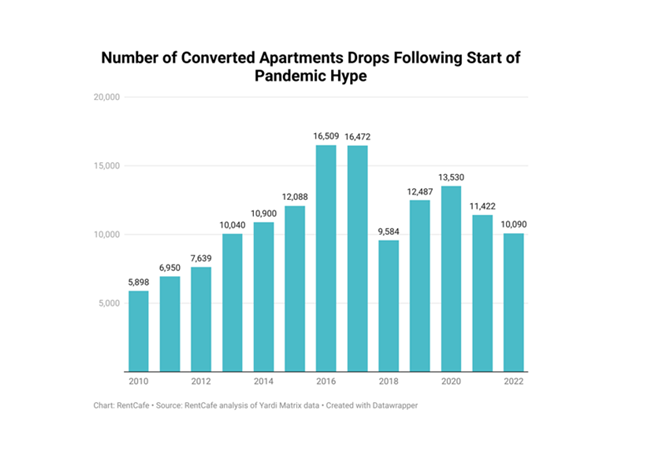
Apartment conversions of office buildings or adaptive reuse, emerged after the pandemic as the solution to the increased demand for housing and the rejuvenation of deserted downtown areas. However, after a brief surge in conversions, there was a big drop-off in 2021 and 2022, the report says.

“Even so, interest in converting older buildings into residences remains high. In fact, our analysis of Yardi Matrix data shows that adaptive-reuse apartments are poised for impressive growth in the upcoming years. A whopping 122,000 rental apartments are currently undergoing conversion, 45,000 of which are the result of office repurposing,” the report says.

Apartment conversions seem to have stalled, as the office market is stuck between the expectation that workers will return and hybrid work

Highlights of the apartment-conversions report

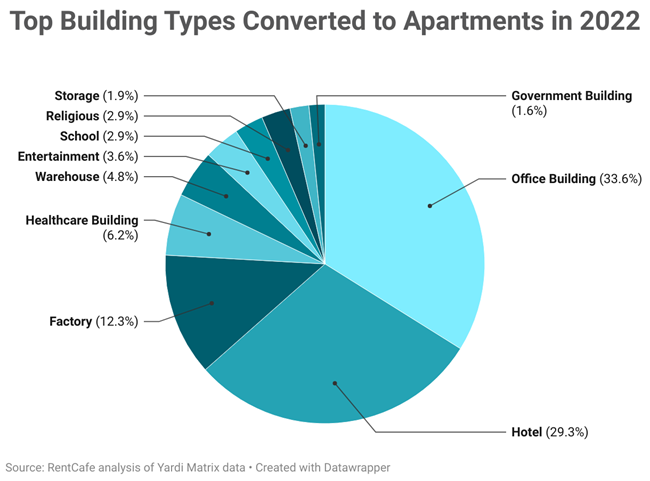
  • Office conversions are anticipated to lead the way, representing 37 percent of the total, followed by hotel conversions (23 percent of future projects). Factory conversions come in third place with 14 percent.
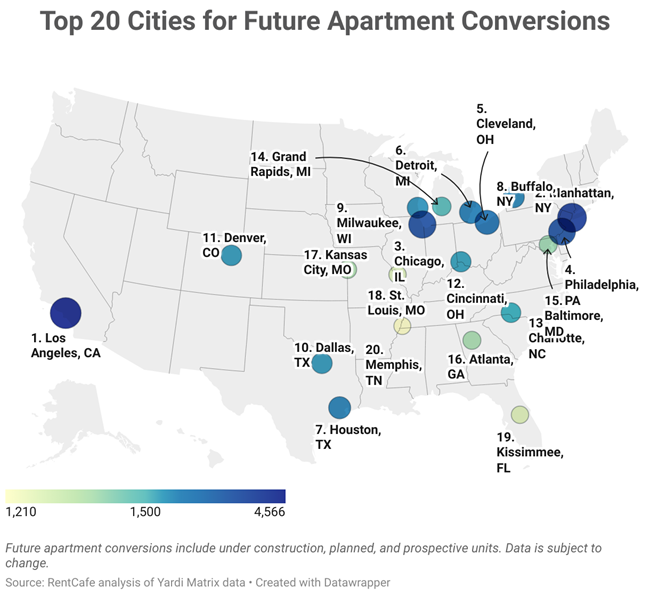
  • At the city level, Los Angeles is predicted to continue to ride the adaptive-reuse wave in the future, with 4,566 apartments expected to be created through conversion. New York is set to see the creation of 3,987 apartments, while Chicago follows closely behind with 3,519 apartments.
  • 10,090 new rentals were delivered nationwide in 2022, a decrease of 12 percent compared to one year prior and 25 percent fewer than in 2020. Los Angeles, Kissimmee, Fla., and Alexandria, Va. led the way in the number of repurposed buildings during this period. In these cities alone, the conversions make up 20 percent of the total nationwide. This indicates continued interest in adaptive reuse despite market uncertainties.
  • Despite office conversions slowing down 15 percent, with 3,390 apartments delivered in 2022, they still represent a substantial part of the adaptive-reuse sector. Los Angeles converted the most offices into residential in an effort to revitalize its downtown area. As a result, 692 apartments entered the market. Office-to-apartment conversions made up 100 percent of the adaptive-reuse projects in Alexandria, Va. (435 apartments) and Baltimore (395 apartments).
  • In a significant shift, former hotels experienced a record-breaking 2,954 new apartments resulting from conversion, a 5-year high. This building type’s easier, more straightforward transformation guaranteed a 43 percent increase in 2022 compared to 2021, almost mirroring office conversion.

“Office-to-multifamily conversions target smaller, older properties, yielding limited sector effects. Based on the latest research by real-estate company CBRE, the conversion of office spaces into multifamily units will primarily be restricted to smaller, older office properties due to factors such as construction costs and regulations related to residential construction,” said Doug Ressler, senior analyst and manager of business intelligence for Yardi Matrix.

“Market conditions that favor such projects include significant multifamily demand or government incentives, specifically aimed at promoting historic restoration efforts,” Ressler said.

Apartment conversions seem to have stalled, as the office market is stuck between the expectation that workers will return and hybrid work


Read the full report here.

Sign Up For Our Weekly Newsletter And Get Rental Property And Apartment News And Helpful, Useful Content Each Week.

* indicates required

Should I Renew Tenant’s One-Year Lease Or Go Month-To-Month?

Whether to renew tenant's one-year lease or go month-to-month is the question this week for Ask Landlord Hank who answers landlords questions

Whether to renew tenant’s one-year lease or go month-to-month is the question this week for Ask Landlord Hank. Remember Hank is not an attorney and is not offering legal advice. If you have a question for him please fill out his form below.

Dear Landlord Hank:

My tenants’ first year lease on my rental townhouse expires Oct 1, 2023.

Should I offer them a one-year lease renewal or switch them to month-to-month lease?

What are the pros and cons of yearly lease renewal vs month-to-month?

-Rome

Dear Landlord Rome,

Let me tell you how I look at my rental properties and why I like one-year leases.

I see my rentals as a money tree. I take care of them with regular maintenance, respond to tenant issues promptly and act fairly with tenants and treat them with respect.

I like to have my money trees producing fruit (MONEY) every month, and I know if I have an annual tenant I can count on that money for every month of the coming year because I’ve taken time to do proper background screening of my tenants and I know they are “normal” people who pay their bills and will take care of my property.

If I have a tenant that has fulfilled a 12-month lease and can’t sign for another year due to possible job transfer or maybe they are building a new home and it’s not ready yet, etc., I will extend a lease on a month to month basis BUT I require 60 days notice of the tenants last day so that I have enough time to find a good quality replacement.

If you are thinking about selling the property you might want to go month-month.  Just FYI, my longest lasting tenant moved in in 1998.

Sincerely,

Hank Rossi

Rent Sarasota

Owner/Broker

1000 East Avenue N.

Sarasota, Fl 34237

www.rentsrq.com

Each week I answer questions from landlords and property managers across the country in my “Dear Landlord Hank” blog in the digital magazine Rental Housing Journal.    https://rentalhousingjournal.com/asklandlordhank/


Whether to renew tenant's one-year lease or month-to-month lease is the question this week for Ask Landlord Hank who answers landlords questions
Landlord Hank says, “I will extend a lease on a month to month basis BUT I require 60 days notice of the tenants last day so that I have enough time to find a good quality replacement..”

Ask Landlord Hank Your Question

Ask veteran landlord and property manager Hank Rossi your questions from tenant screening to leases to pets and more! He provides answers each week to landlords.

Can I Monitor Tenant Smoking In My No-Smoking Rental?

Can I Limit the Number of People in My Rental?

Do I Have to Paint and Replace Flooring for a Long-Term Tenant?

A Tenant Poured Grease Down Drain Who Is Responsible?


Sign Up For Our Newsletter And Get Rental Housing And Apartment News And Helpful, Useful Content Each Week.

Governor Signs Revised Oregon Rent Control Law

Oregon Gov. Tina Kotek signed a revised rent control law, SB 611, which caps rents and prohibits landlords from charging more than 10 percent
Governor Tina Kotek

Oregon Gov. Tina Kotek has signed a revised rent control law, SB 611, which caps rents and prohibits landlords from charging a rent increase annually of more than 10 percent regardless of inflation.

The new Oregon rent control aw makes key changes to how the maximum-allowable annual rent increase percentage is calculated for residential tenancies.

The bill was passed in the recent legislative session. It was designed to fix the current rent control law that limited rent hikes to seven percent plus inflation. But when the Consumer Price Index showed high inflation, some recent cases resulted in 14 percent rent increases.

SB 611 states that the maximum allowable annual rent increase percentage is calculated as the lesser of:

  1. Ten percent; or
  2. Seven percent plus the September annual 12-month average change in the Consumer Price Index for all urban customers, according to the Portland Housing Bureau Rental Services Office.

SB 611 also clarifies that during any tenancy, other than week-to-week, the landlord may not increase the rent more than once during any 12-month period.

SB 611 takes effect immediately, applying to all notices of rent increase delivered on or after July 7, 2023.

Oregon was the first state in the nation to pass a statewide Oregon rent control law.

While rent control appears to help housing providers in the short run, in the long run it affects their investment and development plans, according to new research by the National Apartment Association (NAA).

“While the notion of rent-control policies may appear as an appealing solution to housing affordability, it is critical to acknowledge their potentially counterproductive and damaging consequences. Rent control has been proven to negatively impact renters, housing providers and even entire communities.

“This research shows that rent control policies can inadvertently lead to reduced housing supply, lower property values and decreased quality of available properties. Additionally, rent control disincentives new construction, which could exacerbate the housing affordability crisis,” the NAA research said.

Portland Update: Changes to FAIR Ordinance Bring (Some) Necessary Changes

Dealing with Habitability issues and Substitute Housing