Home Blog Page 55

Rental Growth Rates Return To Pre-Pandemic Levels

Rental growth rates are returning to pre-pandemic levels in line with historic standards even though asking rents are increasing slowly

Rental growth rates are returning to pre-pandemic levels in line with historic standards even though “asking rents are increasing at a slower rate than the last two years,” Yardi Matrix says in a special bulletin.

“With a mild recession looming, rent growth will be suppressed at the higher end, with demand falling to lower-end units,” Andrew Semmes, Senior Research Analyst, writes in the report.

Why A Difference In Growth Rates?

The report says the biggest difference in rental growth rates between this year and the years preceding the pandemic is geography.

“Markets that had been performing very well before the pandemic are generally not performing as well post-pandemic because their cost of living had already risen commensurately with rent increases and then work-from-home allowed people to relocate to areas with a lower cost of living while maintaining their income.

“Conversely, markets that had been fairly stagnant pre-pandemic were relative bargains and saw strong growth during the pandemic; that growth is continuing in smaller and midsize markets across the Midwest, South and Northeast,” Semmes writes.

New supply will limit rapid growth

Many new apartments in markets that saw rapid growth during the pandemic “will limit the magnitude of rent increases in the short and medium term, but so far absorption rates have held up, and we expect that to continue.

“High mortgage rates will continue to constrain the single-family market, as homeowners are reluctant to move, and the barriers to homeownership will remain elevated for the foreseeable future, propping up demand for multifamily housing,” the report says.

Conclusion

“There were no major changes to the forecast for this update, and our overall economic outlook has also not changed. We still anticipate a minor recession once interest rate hikes have managed to work their way through the economy, and the restart of student loan payments will financially stress a meaningful number of renters.

“This will likely limit the demand for higher-end rental properties and suppress rental growth in those properties. However, much of that demand will fall to mid-range and workforce housing, which will likely continue seeing strong growth, helping support the overall health of the market,” Semmes writes in the report.

Read the full report here.

About Yardi Matrix

Yardi Matrix researches and reports on multifamily, office and self-storage properties across the United States, serving the needs of a variety of industry professionals. Yardi Matrix Multifamily provides accurate data on 18+ million units, covering more than 90 percent of the U.S. population. Contact the company at (480) 663-1149.

Now Is The Time to Promote Mental Health In Multifamily

Now is the time to promote mental health in multifamily for owners and operators to understand the mental health challenges of their teams

“Multifamily experienced an improvement in mental health last year, but the number of people who reported less stress in 2023 fell to nearly the same level that multifamily experienced during the pandemic, according to the National Apartment Association 2023 Mental and Emotional Health Study.”

By Stephanie Anderson

If you’re in crisis, help is available by calling or texting the 988 Suicide & Crisis Hotline, where trained counselors are available 24/7. Call or text to 988 or visit 988lifeline.org to chat with someone.

 In the U.S., there are more than 45,000 deaths by suicide every year, making it the 12th leading cause of death. There is a mental health crisis in America, and it affects more than 50 million people and nearly 55% are receiving no treatment. While addressing mental health in multifamily and commercial real estate is always important, the need for it is highlighted during September, which is National Suicide Prevention Month.

Multifamily experienced an improvement in mental health last year when more people reported a decrease in their stress levels, according to the National Apartment Association 2023 Mental and Emotional Health Study. Unfortunately, the number of people who reported less stress in 2023 fell to nearly the same level that multifamily experienced during the pandemic. NAA utilizes an Agreement/Importance algorithm to score stress levels. For 2021, that score for “Overall, I feel less stressed than I did a year ago” was 56. It increased to 63 in 2022 and has now dropped back to 57. The lower the score, the fewer people agree with the statement.

Now is the time for owners and operators to better understand the mental health challenges of their teams and utilize the available resources to help not just their employees, but their residents as well.

Mental Health in Multifamily

The statistics on mental health in multifamily are not much better than the national figures. Stress about heavy workload was reported by 40% of respondents in the study and an equal number stated they had taken time off work because of stress. Sadly, 28% reported not even knowing if their company offered mental health assistance.

Some of the stressors that respondents shared included the need to work outside normal hours and on their off days to keep pace with their workload; too few employees for the required work; pressure to ignore a work-life balance and put their company first; and companies making them feel guilty for taking personal days. One of the most alarming concerns expressed in the study was the fact that companies will provide a mental health program but fail to support actions that would reduce employee stress.

This is where as an industry we have an opportunity to walk the walk by implementing regular mental health training, encouraging mental health checkups, sharing resources with employees during high-stress periods, along with communication and follow-up with employees about how they are doing. Owners and operators should also evaluate the efficiencies and technology of communities in their portfolio to locate any missed opportunities to reduce stress.

Addressing Mental Health Concerns

Fortunately for the multifamily industry, there are numerous resources and training to help address mental health issues before they become a larger issue, as well as help deal with situations that are more critical.

Mental Health First Aid Instructors: Identifying, understanding and responding to mental health issues is key to providing effective assistance. The Mental Health First Aid program is an eight-hour, skills-based training program developed by the National Council for Mental Well-Being. The course is considered to be one of the elite mental health programs in the nation, even receiving recognition by the U.S. Senate. More than 2.6 million people have taken the course since its introduction in 2001. The NAA recently sponsored 12 instructors who can be connected to multifamily communities for help with mental health needs.

On-Demand Webinars and Articles: In addition to information on responders, NAA also provides an extensive library of on-demand webinars that address a wide range of mental health challenges, including hoarding, coping and managing onsite challenges, burnout and self-care, dealing with trauma, maintenance team stress and challenges in today’s workforce. Articles that examine the stigma surrounding mental health, important things to know and mental health in the workplace are also available through this resource.

Online Resources: A catalog of mental health training courses designed to help all levels of employees. The NAA site provides courses on Visto (list starts below webinars and articles) that cover stress management, using empathy to connect with others, understanding and managing emotions and more.

Mental Health Policy: Grace Hill offers clients the ability to craft mental health policies and has even designed a best-practice mental health policy template to help multifamily companies create one regarding their employees. Grace Hill has partnered with NAA to make this free template available to all.

9-18-23 Grace Hill_Q3 Mental Health_In The WorkPlace_Infographic (1)

Mental Health Best Practices Concerning Residents

NAA has a helpful guide for dealing with mental health issues and multifamily residents, which offers steps and recommendations during a mental health crisis. Here are a few considerations for teams to aid in suicide prevention:

Develop a Preventative Individual Crisis Plan: Management should develop a plan with a case manager or mental health skill builder before a crisis occurs or is imminent based on the individual needs of your organization This should include a way for a resident near or in-crisis to get assistance.

Put a Plan in Place for a Crisis Situation and Put Safety First: A plan of action is needed during a mental health crisis in order to ensure a swift and appropriate resolution. This may include evacuation plans, the layout of the leasing office and providing exits for teams. Steps for staff to calmly engage agitated residents should be spelled out. This would also include emergency contacts and resources.

Become Familiar with Mental Health Diagnosis: Managers should become familiar with the symptoms of mental health issues, including depression, anxiety, bipolar disorder and post-traumatic stress disorder (PTSD).

Become Familiar with Resources in Your Community: Become familiar with your local, regional and state mental health agencies. They will also be able to provide assistance in dealing with a crisis.

Regularly Train Staff: Make sure that your onsite teams are always up-to-date on your policies and plans regarding mental health, as well as information and resources.

Multifamily cannot afford to only address mental health during the months it’s observed. Effective change will happen only if the multifamily industry addresses these issues every day. Take the time to understand the issues facing your teams and those that residents are dealing with. We owe it to each other to offer assistance whenever possible, provide ample resources, recognize the warning signs and bring an end to this ongoing crisis.

 About the Author

Stephanie Anderson is Senior Director of Communication and Social Media for Grace Hill. She is an advocate for the implementation of mental health policy and access to resources. Stephanie is a certified Mental Health First Aid (MHFA) instructor, as well as a member of the National Apartment Association Operations Committee and NAA’s Mental Health Committee.

About Grace Hill

Grace Hill provides industry-leading SaaS technology solutions designed to make a positive impact in real estate and improve the lives of people where they work and live. Harnessing years of real estate experience and the understanding that people are better together, Grace Hill helps owners and operators increase property performance, reduce operating risk and grow top talent. More than 500,000 professionals from over 1,700 companies rely on Grace Hill’s talent performance solutions covering policy, training, assessment, survey, and data-driven insights. Visit us at gracehill.com or on LinkedIn.

Sign Up For Our Weekly Newsletter And Get Apartment News And Helpful, Useful Content Each Week.

* indicates required


Fostering a Self-Starter Culture to Unleash Employee Potential

Top Considerations for Multifamily Training and Compliance

Why Verification Forms are Critical in Property Management

Verification forms play a pivotal role in property management offices, particularly when handling requests for reasonable accommodations

See why verification forms are so important in property management and how to stay in compliance with Fair Housing rules.

By The Fair Housing Institute

Verification forms play a pivotal role in property management offices, particularly when handling requests for reasonable accommodations or modifications under the Fair Housing Act. This article delves into the nuanced world of verification forms, shedding light on their significance, considerations, and best practices for optimal use.

Understanding Verification Forms

Verification forms serve as essential tools for property management when dealing with requests for reasonable accommodations or modifications. They are designed to ascertain whether a resident qualifies as disabled under the Fair Housing Act and genuinely requires the requested accommodation or modification. Often, disabilities may not be readily apparent, necessitating the involvement of a third-party verifier to establish eligibility.

Expanding on this point, it’s essential to recognize that the Fair Housing Act is a federal law that prohibits discrimination in housing based on disability, among other factors. Verification forms are instrumental in ensuring compliance with this law by validating disability-related requests.

The Necessity of Using Verification Forms

Property management entities are not legally mandated to employ verification forms. However, adopting a well-defined process for handling accommodation or modification requests, which includes the use of verification forms, is highly recommended. While some residents may provide letters from their verifiers that contain all the requisite information, having standardized verification forms streamlines the process and ensures consistency.

Common Issues in Processing Verification Forms

One common challenge arises when verification forms or letters lack essential information. To qualify for a reasonable accommodation or modification, residents must substantiate their disability and the associated need for the requested change. In cases where documentation falls short, property managers should seek clarification from the verifier, with written consent from the resident.

Another prevalent issue in processing verification forms is the credibility of the verifier. In instances where the verifier’s qualifications or knowledge of the resident’s condition are questionable, seeking legal counsel from a fair-housing attorney is advised. This ensures that the appropriate course of action is determined within the boundaries of fair housing laws.

Best Practices for Verification Forms

While many property managers employ generic forms, customization can significantly enhance the effectiveness of verification forms. Customized forms can include targeted questions that provide detailed information about the accommodation request.

For example, consider this scenario:  A resident has requested to move to another apartment due to a claim that their neighbor’s candles bother their asthma. Having pre-prepared forms that deal specifically with allergies and chemical sensitivities can help speed up the process by asking all the right questions that a generic form might miss. In addition, having this additional information facilitates a more informed evaluation of the request’s legitimacy.

It is also critical that housing providers establish robust follow-up policies. Timely responses and proper documentation of all interactions, including dates and discussion details, serve as valuable evidence in demonstrating due diligence and will protect the property if a fair-housing claim were to arise.

Training and Forms

Having an assortment of well-prepared forms is just the beginning. Staff training is a necessity to make sure that they have a thorough understanding of what the forms require and what they legally can request. Along with this, role-playing common situations that arise when a resident is asked to fill out a form will help staff know how to reply properly and help avoid any appearance of discrimination.

In conclusion, verification forms are indispensable assets for property management companies in ensuring compliance with the Fair Housing Act and efficiently processing reasonable accommodation or modification requests. Customized forms and well-defined follow-up procedures, along with training, can significantly enhance the utility of verification forms.

Property management offices should strive to stay current with policies and procedures while tailoring forms to address various accommodation requests effectively. Ultimately, the careful use of verification forms contributes to a fair and equitable housing environment for all residents.

About the author:

In 2005, The Fair Housing Institute was founded as a company with one goal: to provide educational and entertaining fair-housing compliance training at an affordable price at the click of a button.


2 Background Check Providers to Pay $5.8 Million Over Inaccurate Reports

The FTC is making two background check report providers pay $5.8 million to settle charges they deceived consumers over criminal reports

The Federal Trade Commission (FTC) will require background check report providers TruthFinder and Instant Checkmate to pay $5.8 million to settle charges that they deceived consumers about whether consumers had criminal records, according to a release. Both companies are owned by PeopleConnect.

The FTC charged the companies violated the Fair Credit Reporting Act (FCRA) by operating as consumer reporting agencies while, among other things, failing to ensure the maximum possible accuracy of their consumer reports.

The companies had advertised and marketed themselves as “best background check for landlords” according to the complaint, for landlords doing background screening checks on tenants.

Earlier this year, the FTC and the Consumer Financial Protection Bureau (CFPB) asked for comment on tenant background screening checks especially use of criminal and eviction records and algorithms

“Companies that compile personal information and sell background reports are on notice: Don’t make false claims about the contents of your reports,” said Samuel Levine, director of the Bureau of Consumer Protection, in the release.

“And, if you market your reports to be used to screen tenants or employees, you are a consumer reporting agency and you must follow the requirements of the FCRA.”

Earlier this year, Samuel Levine, Director of the FTC’s Bureau of Consumer Protection said,  “No one should be shut out of housing because of inaccurate or unfair background screening practices. We are proud to be part of a whole-of-government effort to ensure fairness and equity in the rental market, and we are looking forward to hearing from the public on this vital issue.”

“Error-ridden background checks are increasingly used by corporate landlords to deny housing to Americans,” Rohit Chopra, Director of the CFPB, said earlier this year. “We will continue to work together to protect the integrity of our credit reporting system from sloppy background check companies.”

California-based Instant Checkmate and TruthFinder market people-search services, allowing users to search unlimited background reports on individuals, and charge monthly subscription fees to view the full reports. In 2014, Instant Checkmate agreed to settle FTC charges that the company previously violated the FCRA by failing to take reasonable steps to make sure that its background reports were accurate and that its users had a permissible reason to have them.

In a complaint, the FTC says Instant Checkmate and TruthFinder made millions from their monthly subscriptions using push notifications and marketing emails that claimed that the subject of a background report had a criminal or arrest record, when the record was merely a traffic ticket. All the while, the companies touted the accuracy of their reports in online ads and other promotional materials, claiming that their reports contain “the MOST ACCURATE information available to the public.” The FTC says, however, that all the information used in their background reports is obtained from third parties that expressly disclaim that the information is accurate and that Truth Finder and Instant Checkmate take no steps to verify the accuracy of the information.

The companies also deceived customers by providing “Remove” and “Flag as Inaccurate” buttons that did not work as advertised, according to the complaint. The “Remove” button removed the disputed information only from the report as displayed to that customer; however, the same item of information remained visible to other customers who searched for the same person. In addition, the FTC also says that, when a customer flagged an item in the background report as inaccurate, the companies never took any steps to investigate items flagged by consumers as inaccurate, to modify the reports, or to flag to other customers that the information had been disputed.

Despite disclaimers on their websites, according to the complaint, TruthFinder and Instant Checkmate have operated as consumer reporting agencies (CRAs) because they have assembled and evaluated information on consumers into background reports and have marketed and sold those reports for employment and tenant-screening purposes. And, as CRAs, they were required to comply with the FCRA. For example, the complaint charges that the companies used search-engine advertising keywords that relate to employment and tenant screening, such as “best background check for landlords” and “pre-employment screening.” The FTC noted that Instant Checkmate was already under an FTC order for engaging in similar conduct, which implicated it as a CRA, and therefore was aware that it was required to comply with the FCRA.

The FTC says that, in addition to failing to ensure the accuracy of their reports, the companies violated the FCRA by providing background reports to people who did not have a permissible purpose to obtain them and failing to implement reasonable procedures to limit who could obtain their background reports. The FTC also says the companies failed to investigate and respond to consumer complaints about inaccuracies in their reports, as required by the FCRA.

TruthFinder and Instant Checkmate tried to increase the number of positive user reviews, and decrease the prominence of negative user reviews, by offering customers one free premium background report in exchange for posting a review of their products on the review site HighYa, which warns that such practices violate the site’s terms and conditions, according to the FTC. TruthFinder and Instant Checkmate, however, failed to advise customers to disclose that they were being compensated for their review.

Under the proposed order, which must be approved by a federal judge before it can go into effect, TruthFinder and Instant Checkmate and their affiliated companies will be required to pay a $5.8 million penalty.

Read the full FTC release here.

Tenant Background Screening Checks Under Federal Scrutiny

Sign Up For Our Weekly Newsletter And Get Rental Property And Apartment News And Helpful, Useful Content Each Week.

* indicates required

Expense Growth Clouds Future Multifamily Performance

Expense growth clouds future multifamily performance as operators are now facing the rapidly growing expense side of the ledger

While economic growth and a strong job market have helped multifamily asking rents grow nationally in August, operators are now facing the rapid expense growth on that side of the ledger, led by mushrooming property-insurance costs, Yardi Matrix says it in its national report for August.

“With rent growth slowing, property owners increasingly must implement strategies to pare expense growth to maintain and grow net income,” the report says.

“After several years of stellar income growth, multifamily is facing headwinds that include not only decelerating rent gains but a rapid uptick in expenses. During the trailing 12-month period ending June 2023, expenses for multifamily properties nationally grew by an average of 9.3%, up 63% from the 5.7% increase during the previous 12 months,” according to Yardi Matrix data.

“During that period, the average property operating expense rose $740 per unit to $8,694, according to Matrix. Costs rose significantly in most categories, led by insurance, which increased by an average of 18.8% in the 12 months ending June 2023, per Matrix. Insurance is rising because of the growing number of significant weather-related events, such as hurricanes, extreme temperatures and wildfires, that have created large insurer payouts, particularly in the Southeast, California and Texas,” the report says.

Highlights of the August report

Asking rent growth in August was concentrated in the renter-by-necessity segment, which increased by 0.1%, while lifestyle rents declined 0.1%. The composition of rent growth reflects a substantial supply increase in some areas, as most deliveries are lifestyle units, which increases competition within the segment.

  • Multifamily performance continues to hold up well, as rents and occupancy were relatively flat in August. The average U.S. asking rent rose $1 to $1,728 during the month, while year-over-year growth fell to 1.5%, down 20 basis points from July.
  • In the short term, supply growth remains a driving factor in metro-level rent growth. Most metros with the highest year-over-year asking rent growth, such as New York, Chicago, Indianapolis and San Diego, benefit from a weak new supply pipeline.
  • Single-family rents (SFR) fell slightly, down $6 nationally to $2,104. Year-over-year, national SFR rent growth fell 70 basis points to 0.5%. SFR demand remains strong overall, but there is some evidence of deceleration in the high-end segment.

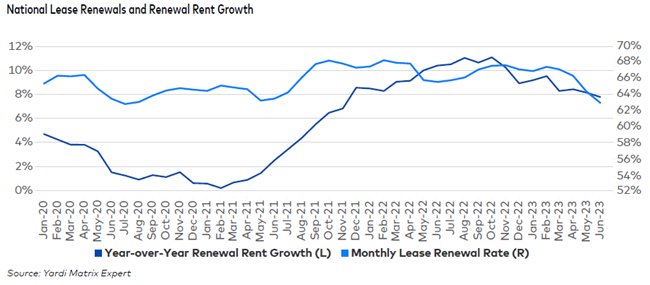
Lease renewal rates continue to slow

Renewal rent growth fell to 7.8% year-over-year as of June, down 40 basis points from May.

Renewal rents, the change for residents that are rolling over existing leases, has slowed since peaking at 11.1% in 4Q 2022 as more tenants get caught up to asking-rent rates. Only a handful of metros continue to see double-digit growth in renewal rents. Miami has had the largest renewal rent growth at 12.4% while San Francisco had the smallest at 1.8%. Growth was between 5.6% and 9.7% year-over-year in 26 of the top 30 markets in the report.

National lease renewal rates were 62.9% in June.

“Renewal rates have been steadily declining since mid-2022, which is attributable to the large amount of new supply that has come online. As new deliveries are made available, occupancy rates decline, which compels properties to offer greater concessions and consequently creates the incentive for more renters to move,” Yardi Matrix says in the report.

Expense growth clouds future multifamily performance as operators are now facing the rapidly growing expense side of the ledger
Chart courtesy of Yardi Matrix

Read the full Yardi Matrix report here.

About Yardi Matrix

Yardi Matrix researches and reports on multifamily, office and self-storage properties across the United States, serving the needs of a variety of industry professionals. Yardi Matrix Multifamily provides accurate data on 18+ million units, covering more than 90 percent of the U.S. population. Contact the company at (480) 663-1149.

Lawsuit Charges 18 Property Management Companies with Rent Price Fixing

A lawsuit is charging 18 property management companies and Yardi Systems of rent-price fixing to increase rent prices across the country

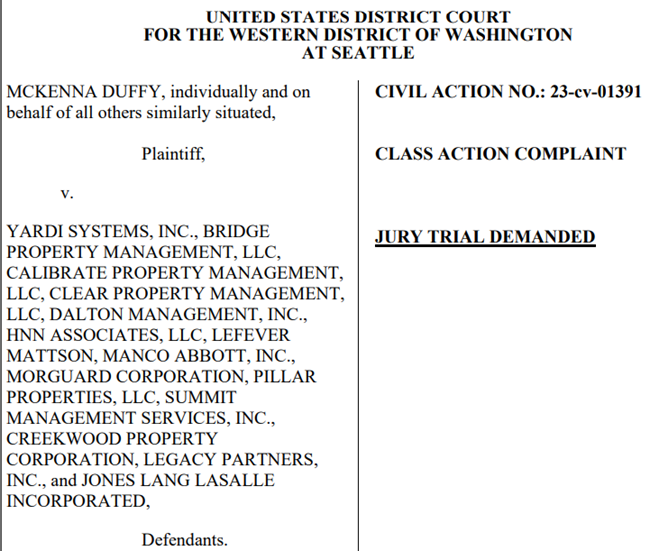
An antitrust class-action lawsuit is charging 18 property management companies and Yardi Systems of rent price fixing by colluding to increase the cost of rent in cities across the country, according to a release from the law firm that filed the suit.

The lawsuit says the property management companies used Yardi’s centralized, automated pricing software, “RENTmaximizer,” to raise costs in lockstep while maintaining occupancy. This is similar to another lawsuit filed against RealPage.

“Through Yardi’s complex software, otherwise-competing rental companies teamed up to outsource pricing decisions to Yardi, artificially eliminating any competition between them,” attorneys say in the release.

The lawsuit cites two confidential witnesses and former employees of defendant companies who divulge details of the organized scheme.

The lawsuit was filed in the U.S. District Court for the Western District of Washington and accuses the conspirators of “colluding to coordinate pricing through the usage of a centralized, automated pricing software, ‘RENTmaximizer,’ created by Yardi Systems in 2011.” By 2013, the software was used to price 8 million residential units. The new lawsuit falls on the heels of the law firm’s class action against RealPage alleging similar rent price-fixing tactics.

The new class action names as defendants or co-conspirators the following property management companies using Yardi’s RENTmaximizer and “Revenue IQ” revenue management software:

  • Alco Management Inc.
  • Bridge Property Management LLC
  • Calibrate Property Management LLC
  • Clear Property Management LLC
  • Creekwood Property Corporation (Tonti Properties)
  • Dalton Management Inc.
  • HNN Associates LLC
  • Jones Lang Lasalle Incorporated (JLL)
  • KRE Group Inc.
  • LeFever Matson, Manco Abbott Inc.
  • Legacy Partners Inc.
  • McWhinney Property Management LLC
  • Manco Abbott Inc.
  • Morguard Corporation
  • Pillar Properties LLC
  • Summit Management Services Inc.
  • Towne Properties
  • Tribridge Residential LLC.

“Our antitrust legal team has uncovered what we believe to be a clear gaming of the system through controlled, lockstep algorithmic increases to fix the cost of rent — one that has affected millions of renters,” said Steve Berman, managing partner and co-founder of Hagens Berman, in the release. “Housing is a basic human need. What these companies have done is both legally and morally bankrupt.”

In a related case, late last year 17 Democratic members of the U.S. House of Representatives sent a letter to the Department of Justice and the Federal Trade Commission asking the agencies to investigate another property management company, RealPage, and it’s rent-setting software, according to ProPublica.

RealPage has said the data fed into its pricing tool is anonymized and aggregated. It said the company “uses aggregated market data from a variety of sources in a legally compliant manner.”

ProPublica is reporting that RealPage, a Texas-based real estate tech company, is facing a new barrage of questions about whether its software is helping landlords coordinate rental pricing in violation of antitrust laws.

In an Oct. 15 story, ProPublica detailed how RealPage’s pricing algorithm uses competitor data to suggest new prices daily for available apartments. ProPublica raised concerns that the software, sold by RealPage, is potentially pushing rent prices above competitive levels, facilitating price fixing or both.

Read the full lawsuit complaint here.

Sign Up For Our Weekly Newsletter And Get Rental Property And Apartment News And Helpful, Useful Content Each Week.

* indicates required

Rental Market: August Rent Slows, Annual Fall Decline is Early

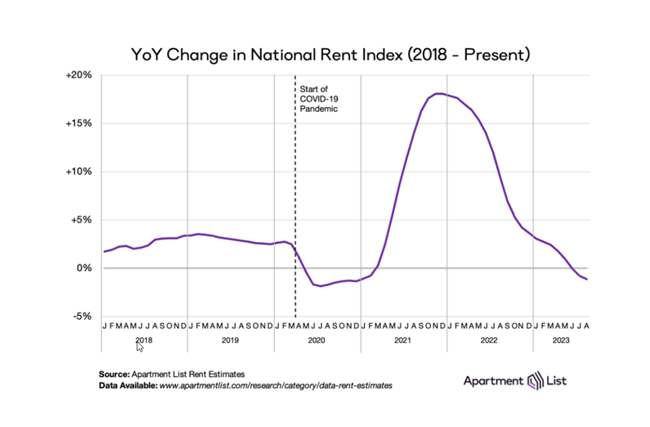
The rental market continued slowing down in August as both monthly and annual rent growth turned negative, according to Apartment List.

The rental market continued slowing down in August as both monthly and annual rent growth turned negative, according to the September report from Apartment List.

Rent growth typically follows a seasonal pattern with rents up in spring and summer and down in fall and winter, but 2023 seems to be showing an early decline in rents already down heading into the fall and winter period.

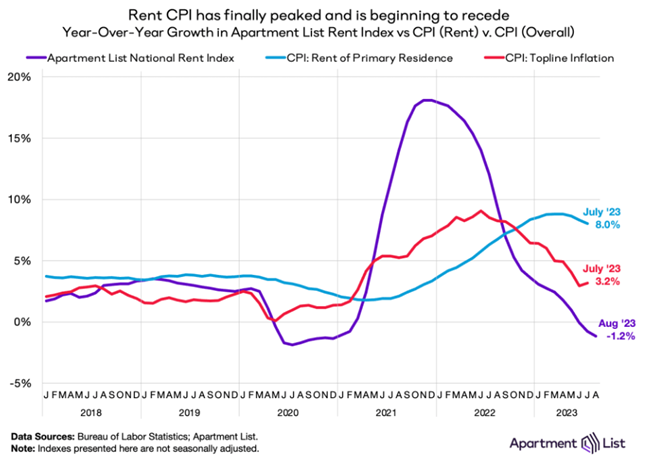
“Annual rent growth turned negative last month, for the first time since the beginning of the pandemic. Today it stands at -1.2 percent, meaning that on average, apartments across the country are 1.2 percent cheaper today than they were one year ago,” Apartment List research team writes in the report.

“This is a major deceleration from recent years, when annual rent growth neared 18 percent nationally and soared to over 40 percent in a handful of popular cities.

“Additionally, monthly rent growth turned negative this month, marking the beginning of the rental market’s slow season. Our national rent index decreased 0.1 percent in August, flipping negative one month earlier than it did last year.”

Overall Apartment List says rents fell month-over-month in August in 53 of the nation’s 100 largest cities. With sluggish rent growth throughout the past 12 months, prices are down year-over-year in 72 of these 100 cities.

Rental slowdown finally reflected in inflation numbers

The primary measure of inflation in the United States is the Bureau of Labor Statistic’s Consumer Price Index (CPI), which is heavily influenced by changes in housing prices.

“Our index shows that the rental market has been cooling rapidly for a year, but the CPI housing component has just recently hit its peak. Despite the CPI’s measure of housing inflation remaining elevated, topline inflation has already meaningfully cooled. As the CPI housing component now gradually begins to reflect the cooldown that we’ve long been reporting, it will help to further curb topline inflation in the months ahead.”

The rental market continued slowing down in August as both monthly and annual rent growth turned negative, according to Apartment List.

Vacancies continue growing

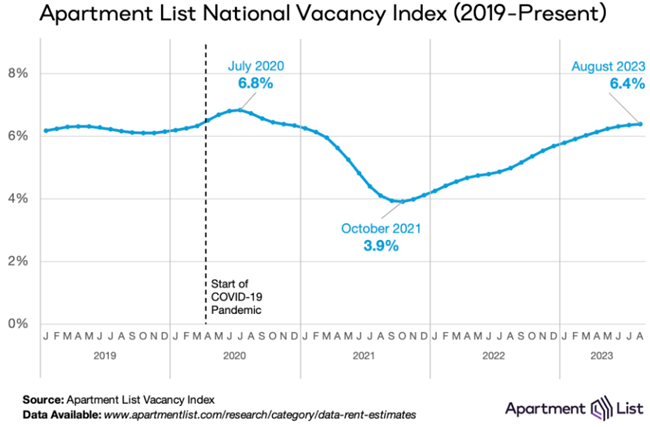
“Our vacancy index has increased for 22 consecutive months and now sits at 6.4 percent, slightly above the pre-pandemic average. Additionally, with a record number of apartments under construction, we expect vacancies to remain strong in the coming months.

“New apartment construction is recovering from pandemic-related disruptions, and there are now more multifamily units under construction than at any point since 1970. As this new inventory continues to hit the market over the remainder of this year and into next, we are now entering a phase in which property owners are beginning to compete for renters to fill their units, a marked change from the prevailing conditions of the past two years, in which renters had been competing for a limited supply of available inventory.”

The rental market continued slowing down in August as both monthly and annual rent growth turned negative, according to Apartment List.

Summary

August’s 0.1 percent rent decline marks an early start to the rental market’s slow season, and brings year-over-year rent growth to a low that has not been seen since early in the pandemic.

“As apartment demand wanes throughout the remainder of the year, and apartment supply improves through a strong construction pipeline, expect rent growth to cool further for the remainder of the year,” the report says.

Read the full rental market report here.

Operational Efficiencies Top Challenge For Property Managers

Operational efficiencies that can reduce costs are now the top challenge for rental property managers a new report from the NAA says

Inflation has spoken “loud and clear” says a new report and operational efficiencies that can reduce costs are now the top challenge for rental property owners and property managers.

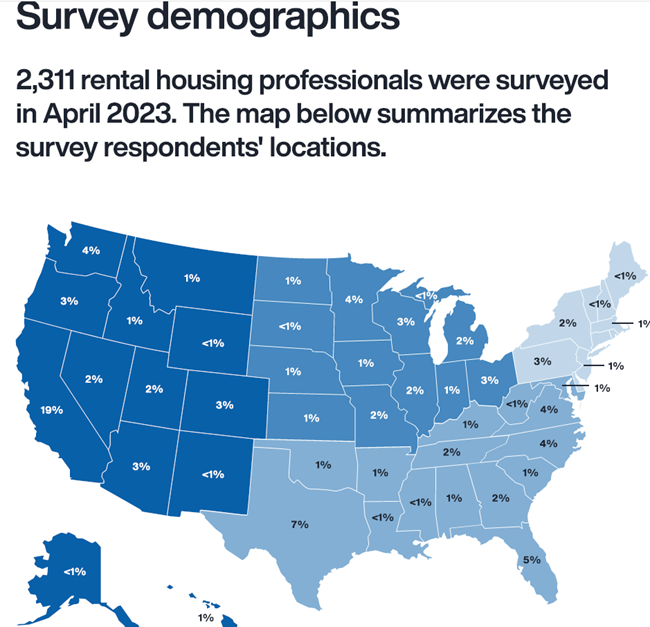
The National Apartment Association (NAA) along with AppFolio conducted a survey for their Property Management Industry Report of more than 2,000 property management industry professionals in April 2023.

Key Points From The Survey

  • The top challenge facing housing providers was operational efficiencies, which comprised 76% of responses.
    • The most challenging activity within this group was reducing costs, as cited by 57% of respondents.
    • Although inflation has eased in recent months, insurance and property taxes have been skyrocketing in recent years, while costs of capital and wage increases are adding to the upward pressure on costs.
  • Operational efficiencies were followed closely by maximizing revenue and profits (61%) and HR, staffing and recruitment (42%).
  • The results mark a significant contrast from 2021, when HR, staffing and recruitment was reported as the top challenge for apartment professionals at 74%.
Operational efficiencies that can reduce costs are now the top challenge for rental property managers a new report from the NAA says
Charts courtesy of the National Apartment Association and AppFolio

Operational efficiencies that can reduce costs are now the top challenge for rental property managers a new report from the NAA says

“Across the country, monumental cost increases – from insurance premiums and utilities to property taxes – are impacting operations for housing providers who by and large operate on narrow profit margins,” NAA President and CEO Bob Pinnegar said in a release.

“This year’s survey importantly elevates the voice of property management companies and provides important takeaways for the kinds of solutions the industry can implement to ease these challenges and remain viable for generations to come.”

This year’s results notably reveal a significant change from how owners and operators ranked their most pressing concerns in 2021. Two years ago – amid record-breaking rent growth and historic demand for apartment living – property management professionals ranked HR/staffing/recruitment as their top challenge (74%).

“Inflation has spoken loud and clear in this year’s survey, touching many of the industry’s most pressing challenges,” NAA Vice President of Research Paula Munger said in the release.

“This doesn’t mean that the industry’s labor woes have disappeared, but it is a testament to the impacts of a high interest rate and high inflationary environment.”

The Challenge Of Maximizing Revenue

“New supply pressures in some markets coupled with a dip in demand caused mainly by an uncertain economic climate are behind the lackluster rent growth, which is negative in some markets, so it’s not surprising that strengthening alternative sources of revenue came in fourth place

“In addition to a focus on top-line revenue, industry leaders are also maintaining margins by negotiating with suppliers, adjusting bonus programs, or changing suppliers altogether.

“Others are using incentives for on-site teams, including maintenance staff, and tying bonuses to resident retention. Some said they were willing to prioritize stable occupancy over rent growth for the remainder of the year, and to that end are not being overly aggressive on renewal increases.

“A big concern in minimizing expenses is to not dilute the resident experience in the process — an outcome that may prompt renters to look to move elsewhere and take advantage of concessions increasingly being offered in some markets,” the report says.

Operational efficiencies that can reduce costs are now the top challenge for rental property managers a new report from the NAA says

Some closing thoughts from the report

“With inflation moving in the right direction and recession fears receding, owners and operators may see relief on the horizon for some of these challenges. The many non-economic challenges, however, may very well continue, highlighting the need for all rental housing stakeholders to work together in finding solutions to keeping the industry responsible for housing millions of Americans vital and profitable,” the report says.

Read and download the full report here.

Operational efficiencies that can reduce costs are now the top challenge for rental property managers a new report from the NAA says

Rents Are Falling But Falling Slower In The Suburbs

Rents are falling in most parts of the country but falling slower in many suburban communities than the rent drops seen in urban areas

Rents are falling and down year-over-year in most parts of the country but many suburban communities, which experienced dramatic rent inflation in 2021 and 2022, are seeing slower rent drops than urban areas, according to a new report from Apartment List.

“The rental market is taking a deep breath in 2023. Double-digit annual rent growth persisted in 2021 and 2022, but has swiftly fallen to -0.7% as of our most recent estimates for July, meaning apartments are renting for less today than they did one year ago. This is the first year-over-year price drop the rental market has experienced since the early days of the COVID-19 pandemic,” writes Apartment List senior research associate Rob Warnock.

Rents are falling in most parts of the country but falling slower in many suburban communities than the rent drops seen in urban areas

Urban-suburban rent gap

The urban-suburban gap has widened steadily for the past eight months because rent drops have been slower in the suburbs than in core cities, the report says.

In some metro areas, the urban-suburban gap is more than twice the national average. This includes a handful of dense, coastal metros like Seattle, Portland, Los Angeles and Washington, DC; where core cities experienced deep rent cuts early in the pandemic are just now returning to pre-pandemic prices.

Rents are falling in most parts of the country but falling slower in many suburban communities than the rent drops seen in urban areas

What’s Next for Suburban Rental Markets?

Rent growth should continue to cool in the coming months, as fewer moves take place during the winter and a strong construction pipeline creates new apartment vacancies.

But it remains to be seen if forthcoming rent drops will remain concentrated in urban centers or if they will proliferate outwards to the suburbs.

As more workers return to downtown offices, some apartment demand should shift inward towards core cities. And a recent study found that the majority of last year’s new building permits were issued in suburban areas. These trends suggest that we are moving in the direction of better supply-demand balance in the suburbs. Nevertheless, rents in many suburbs are over 20 percent higher today than they were in 2020, so strong supply growth must be maintained for years to reclaim some of the affordability that was lost during the pandemic.

Read the full report here.

Accessing Utah’s Home Energy Rebate Programs

The U.S. Dept. of Energy announced states can apply for funding allocations through the Inflation Reduction Act Home Energy Rebate programs.

Ryan Kristoff

The U.S. Dept. of Energy (DOE) recently announced that States can apply for their funding allocations through the Inflation Reduction Act (IRA)-created Home Energy Rebate programs.

Utah’s Office of Energy Development (OED) will administer the funds in Utah. Once the program is underway, multifamily affordable housing (MFAH) will be able to receive rebates of up to $14 thousand per apartment to install heat pump-based HVAC and water heaters, and to upgrade their property’s electrical infrastructure. They can tap up to $8 thousand per apartment for other efficiency solutions.

Heat pumps for space conditioning and water heating are several times more efficient than the business-as-usual alternatives, such as gas-fired furnaces and water heaters and central air conditioners. Switching to heat pumps can reduce operational costs and improve property value while creating healthier, safer, more comfortable, and affordable homes for the low-income tenants. Growing demand for these systems has been slowly but surely driving down costs.

DOE has given states significant flexibility in designing their Rebate programs. MFAH needs to push Utah’s OED to design a program that can effectively serve MFAH, otherwise the State may create a program that ultimately favors the single-family market.

History shows that programs designed around single-family without taking MFAH into account will ignore that market segment.  For guidance, OED should collaborate with the Rocky Mountain Power (RMP) Multifamily Energy Efficiency Program in Utah. RMP’s program offers a one-stop-shop approach that includes outreach and education, income-qualification, project design and management, and reporting. It was crafted in collaboration with multifamily stakeholders, and it is one of the country’s leading electrification programs.

About the author:

Ryan Kristoff is the Grants Director at ICAST, a national nonprofit that designs holistic retrofits solutions for MFAH. He works with local government, utility, state, and federal partners to design and launch clean energy programs to benefit MFAH.