What to do with tenant’s mail after move out is the question this week for Ask Landlord Hank. Remember Hank is not an attorney and is not offering legal advice. If you have a question for him please fill out his form below.
Dear Landlord Hank:
Is it the responsibility of the landlord to forward mail to a previous tenant?
This tenant already said, before she left/ended her lease, that she would take care of the mailbox, yet her mail continues to be delivered in this address.
Please advise as to landlord’s responsibility re: mail. Thank you.
–Priscilla
Dear Landlady Priscilla,
As landlord, you do have responsibility for a tenant’s mail, and cannot just throw it away.
I would contact my former tenant and ask that they submit a change-of-address form to the post office.
Then I would contact the post office to let them know that the tenant is no longer at this address and ask that mail be forwarded.
Sincerely,
Hank Rossi
Each week I answer questions from landlords and property managers across the country in my “Dear Landlord Hank” blog in the digital magazine Rental Housing Journal. https://rentalhousingjournal.com/asklandlordhank/
Landlord Hank says, “As landlord, you do have responsibility for a tenant’s mail, and cannot just throw it away.”
Ask Landlord Hank Your Question
Ask veteran landlord and property manager Hank Rossi your questions from tenant screening to leases to pets and more! He provides answers each week to landlords.
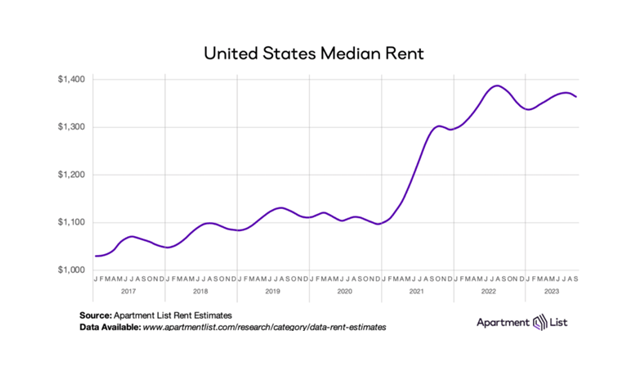
The U.S. saw a second consecutive month of negative rent growth in September, according to the October report from Apartment List.
The nationwide median rent fell 0.5 percent to $1,364 and “we are now squarely in the rental market’s slow season,” the report says.
“Annual rent growth remains at -1.2 percent, meaning that on average, apartments across the country are 1.2 percent cheaper today than they were one year ago. This is a major deceleration from recent years, when annual rent growth neared 18 percent nationally and soared to over 40 percent in a handful of popular cities, the Apartment List Research Team writes.
Rent Cool Down Is Widespread
Negative rent growth continued as rents fell month-over-month in September in 85 of the nation’s 100 largest cities, and thanks to sluggish rent growth over the past 12 months, prices are down year-over-year in 71 of these 100 cities.
As the Consumer Price Index housing component now gradually “begins to reflect the cooldown that we’ve long been reporting, it will help to further curb topline inflation in the months ahead.”
Apartment vacancies are back above pre-pandemic levels
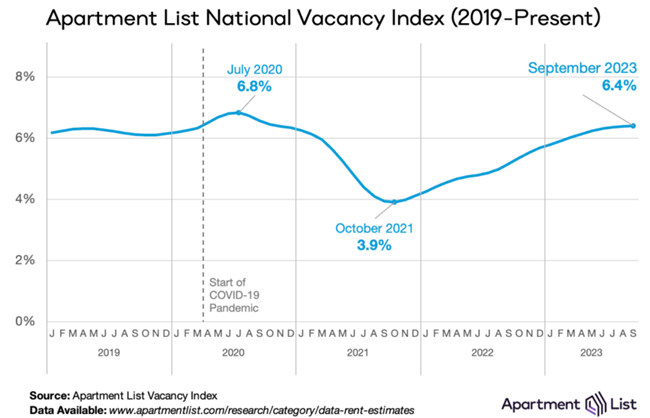
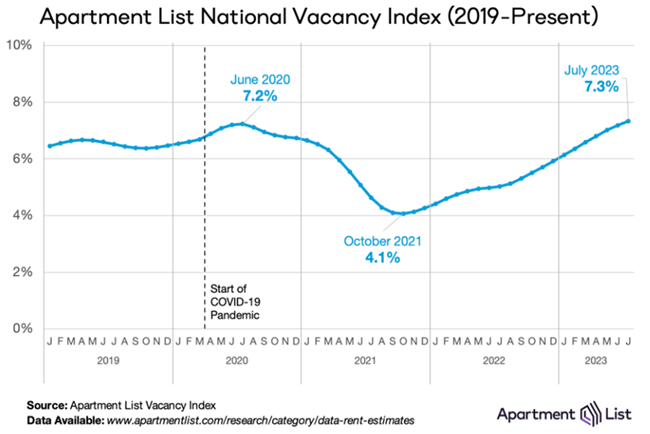
Apartment vacancies have increased for 23 consecutive months, and in September the index hit 6.4 percent, reaching pre-pandemic levels and approaching the pandemic peak set in 2020. There is still a good chance that the vacancy rate will continue trending upward in the months ahead.
“New apartment construction is recovering from pandemic-related disruptions, and there are now more multifamily units under construction than at any point since 1970. As this new inventory continues to hit the market over the remainder of this year and into next, we are now entering a phase in which property owners are beginning to compete for renters to fill their units, a marked change from the prevailing conditions of the past two years, in which renters had been competing for a limited supply of available inventory,” the Apartment List research team write.
Conclusion
September’s 0.5 percent rent decline puts us squarely in the rental market’s slow season, and keeps year-over-year rent growth at a low -1.2 percent. As apartment demand wanes throughout the remainder of the year, and apartment supply improves through a strong construction pipeline, expect rent growth to cool further for the remainder of the year.
The Inflation Reduction Act and Bipartisan Infrastructure Law have created a once-in-a-generation opportunity for multifamily affordable housing (MFAH) to leverage tax credits, rebates, and other incentives for holistic upgrade projects.
Technologies like solar and heat pumps can improve net operating income; reduce operations and maintenance costs; and create healthier, safer, more comfortable, and more affordable homes for the low-income tenants.
The Solar and Storage Investment Tax Credit (ITC) was increased to 30%, and MFAH can tap certain bonus credits. ITCs can be transferred to third parties and nonprofits can claim them as cash (“direct pay”). They can also be stacked with other financial resources which, though varied across states, can include:
Low-Income Housing Tax Credits,
Energy Efficient Commercial Buildings Deduction (179D),
Utility rebates
IRA Grant Funding such as EPA Solar for All,
Weatherization Assistance Program (WAP) funds, and
Solar Renewable Energy Credits
Holistic, successful upgrade projects rely on (1) developers’ ability to create sophisticated capital stacks, and (2) supportive policy, regulatory, and administrative infrastructure. For example, MFAH can only access WAP dollars if their state has multifamily-focused weatherization services. Statewide community solar programs can enable MFAH owners to subscribe entire properties to shared solar projects, thus keeping the benefits with the property regardless of tenant turnover (seen in New Mexico). Onsite solar is most cost-effective when projects can benefit from virtual net metering, which “virtually” allocates the solar from one large install to each apartment on the property.
Unfortunately, supportive frameworks for solar-in-MFAH are underdeveloped or nonexistent in most states. However, the MFAH market constitutes an economic heavyweight, meaning the industry has the power to advocate and push for a change.
About the author:
Ryan Kristoff is the Grants Director at ICAST, a national nonprofit that designs holistic retrofit solutions for MFAH. He works with local government, utility, state, and federal partners to design and launch MFAH-focused clean energy programs.
Landlords may not realize that, without a proper settlement document over tenant disputes and payments, they may cause headaches for themselves down the road.
The landlord/tenant arrangement is no different than any other contractual relationship.
Disputes often arise with accusations that one party is not living up to their obligations under the contract or applicable laws. Whether, for example, the tenant alleges their toilet wasn’t fixed quick enough or that the landlord unlawfully entered the premises without notice, money often changes hands as a result. The goal of this is obvious: pay money, make the problem go away. Many landlords mistakenly pay their tenants when a dispute arises, doing so through simply cutting a check and, at best, a “thank you” from their tenant. These landlords do not realize that, without a proper settlement document, they may have only caused more headaches for themselves down the road.
Payment of monies to a tenant without an agreement in place as to “why” and “for what” rests on several faulty assumptions: First, that the tenant agrees that they have been fully compensated for that claim or issue; second, that the tenant has no other claims or issues they feel need compensation; and third, that they won’t bring those claims later seeking further compensation.
In essence, the landlord assumes that their payment fully contracts their problems away entirely. If/when their tenant files suit alleging those claims, the landlord is usually shocked to learn that their money was handed out almost for nothing, as litigation costs usually dwarf that initial payment. What should happen, along with that exchange of that money, is the execution of a settlement agreement releasing any claims that may exist.
The necessity of a document evidencing the agreement is found in principles of contract law. Settlement agreements are contracts, subject to the basic rules of contract law. If you have reviewed a written settlement agreement, they usually contain waivers and releases dealing with any/all claims that exist as of the date of that agreement. As you can imagine, broad waivers and releases (which would protect the landlord) are usually not something non-lawyers discuss during conversations related to compensation. Even if those discussions arguably took place, in my experience, they would likely be denied/rejected by the tenant and disregarded by the court due to the lack of a document evidencing the same. Thus, verbal agreements are rarely enforceable and therefore not recommended.
A basic component of contract law is that the parties’ intent controls. For any release to be valid, there must be both knowledge of the existence of a claim and an intention to relinquish it, in the absence of a specific promise to release liability for unanticipated claims. Without a document evidencing such an intention, there is no evidence that the payment covers/releases every claim available. The court likely won’t save the landlord from the new claims filed by the tenant, barring unusual circumstances, leaving the landlord footing the bill for a fight they likely thought they had resolved.
While it’s easy to throw money at a problem, it’s important to make that money work.
If you have a dispute with a tenant in need of resolution, settlement documents related to these discussions are common. If a tenant refuses to sign any documents addressing the compensation provided, you may want to reconsider that payment until they are ready to properly document the understanding of the parties. At a minimum, you should document your efforts to settle the matter in writing, so that if the issue escalates, it can be helpful in the future.
Without these things in mind, you may be throwing your money down the drain.
About the author:
Brad Kraus
Bradley S. Kraus is an attorney at Warren Allen LLP. His primary practice area is landlord/tenant law, but he also assists clients with various litigation matters, probate matters, real estate disputes, and family law matters. You can reach him at kraus@warrenallen.com or at 503-255-8795.
I have a neighbor who over a year ago received a call from the FBI, seeking her assistance in targeting a group of individuals who were performing illegal wire transfers.
Over the year she had assisted with other tasks and had become a trusted ally of the FBI.
Then recently, the FBI asked her to increase her involvement after having gained the trust of the illegally operating group. The agency told her they had set a trap to finally catch these guys and that they would keep her updated on their every move. They thanked her for her willingness to do her part to catch the bad guys. Then the call came in with her FBI contacts directing her to transfer $700,000.00 to this group, where they could then track the money to see where it went and then make an arrest after 18 months of work. The FBI guaranteed the return of the money once the transfer was completed and they were able to make the bust. She agreed, transferred the $700k, and waited… and waited. After a few days she began to wonder when the money would be returned. Not understanding how long the arrest might take, she was patient. After a couple of weeks went by, she decided to call the FBI and ask about her money…. And as you have already guessed, they had no idea what she was talking about or even who she was.
Stories of fraud are becoming all too common. The minute details and the elaborate amount of work these fraudsters are going through to trick you are amazing. We used to worry about our mail being stolen, then our email being hacked, but we are entering all unfamiliar territory. The need to stay vigilant is more important than ever; consider these six vital tools in your fight to protect what is yours.
With your file frozen, others will not be able to access credit in your name. When you need to access your credit for real, simply login to Experian and put a “Thaw” on your file. This is completely free, and you can do it as often as you like. As a private investigator, I am often asked how to protect yourself from identity theft or people opening fraudulent accounts in your name. This is my first go-to.
2. Treat your bank account number like your Social Security number
For years we passed out a piece of paper called a check which contained routing numbers and account numbers. But today, with electronic ACH transfers and wire transactions, your bank account information has become the new gold standard for criminals.
3. Use a credit card for most transactions
There are protections that credit cards offer. If something is fraudulent, you can dispute, and the company involved with that transaction is usually found at fault for letting a fraudulent transaction go through its system.
4. Expect your bank to be more diligent when it comes to wire fraud
What used to be an email request for me now requires an in-person, ID-scanning, code-giving experience. A little frustrating, but these financial institutions are only trying to protect you.
5. Be specifically cautious when buying a home and going through a title company
There are countless stories about fraudulent wiring, where the down payment you thought was going to the title company actually went to the Congo. Check the URL and make a phone call to the title company to clarify the wire. Don’t hesitate to go back to a certified cashier’s check right from your bank.
6. Verify the URL on all emails that require you to change your password
Verify the URL on email to your financial institution or any website. Fraudsters know we use the same passwords on many online sites. Getting your email account and the password you use at Starbucks could unlock your account at Bank of America. I always suggest having sole and separate passwords on all websites. It is hard to remember, so if that’s too much, at least change the financial institution credentials to be unique.
I could not possibly cover all the ways you can get scammed today.
With AI and Chat GPT, the spelling is getting better on the emails and the graphics are looking more legit. I can promise you with all the data breaches, your identity is most likely out on the dark web, so treat your transactions as if everyone is fraudulent at first. This country was founded on innocent until proven guilty, your transactions should be considered fraudulent until proven legitimate.
About the author:
David Pickron
David Pickron is President of Rent Perfect, a private investigator, and fellow housing provider who manages several short, mid, long-term rentals. Subscribe to his weekly Rent Perfect Podcast (available on YouTube, Spotify, and Apple Podcasts) to stay up to date on the latest industry news and for expert tips on how to manage your properties.
Oregon Secretary of State auditors unearthed millions of misappropriated dollars and a lack of oversight and accountability in four state agencies including emergency rental assistance spending at the Oregon Housing and Family Services, according to an audit released Wednesday.
Auditors determined the emergency rental assistance spending program, run by Oregon Housing and Family Services, lacked the necessary safeguards to prevent or detect misspent money.
The agency, for example, did not monitor community organizations that received rent payments and overpaid landlords. The auditors identified $11.2 million in questionable spending, including overpayments, across the state, the report said.
In its response, the housing agency blamed the misspending on the pandemic, short-staffing and the rapid launch of the program to prevent homelessness.
“The work required unprecedented action that sometimes fell short of our usual standards for client-assistance payment compliance,” the agency said. “OHCS will use these lessons moving forward, should we operate future emergency programs, to move towards best practices,” the Oregon Capital Chronicle reported.
In all, state auditors flagged $35.2 million of questionable spending within the Oregon Department of Human Services, the Oregon Health Authority, Oregon Housing and Community Services and the Higher Education Coordinating Commission. Auditors found suspect expenditures in federally funded programs that provide emergency rental assistance, help with utility bills, and grants for drug addiction treatment programs.
“Our financial audits are a critical part of keeping Oregon government accountable to its people,” said Audits Director Kip Memmott in a statement. “This year’s statewide audits found some significant issues that we think are important to bring to the attention of Oregonians, the governor and the legislature.”
The review of federally funded programs comes after the pandemic, when federal funding to Oregon grew and state officials scrambled to get money to help people stay in their homes and have access health care. In fiscal year 2022, Oregon received $21 billion in federal aid, nearly double what the state usually received.
The $35.2 million – called “questioned costs” – includes expenditures that were paid with federal dollars and should have been funded by the state. They include overpayments to landlords, misappropriated money for renovations, and money that’s not tracked appropriately.
“It serves as a flag for federal funding agencies to review the findings and then decide whether the costs are allowable,” said Tracey Gates, a principal auditor, in a statement.
Oregon landlords can increase rents by 10% in 2024 under Oregon’s revised rent control law, according to the calculations by the Oregon Office of Economic Analysis.
This amount is 7% plus the Consumer Price Index (CPI) for All Urban Consumers, West Region (all items), as most recently published by the Bureau of Labor Statistics, or 10%, whichever is lower.
Under Oregon law, only one rent increase may be issued in any 12-month period.
The allowable rent increase percentage for the previous year, 2023, was 14.6% if the increase was issued before July 6th, or 10.0% if issued after July 6.
The Office of Economic Analysis will publish the maximum annual rent increase for 2025 by Sept. 30, 2024.
Oregon Gov. Tina Kotek signed the new revised rent control law, SB 611, which caps rents and prohibits Oregon landlords from charging a rent increase annually of more than 10 percent regardless of inflation.
The new Oregon rent control law makes key changes to how the maximum-allowable annual rent increase percentage is calculated for residential tenancies.
The bill was passed in the recent legislative session. It was designed to fix the current rent control law that limited rent hikes by Oregon landlords to seven percent plus inflation. But when the Consumer Price Index showed high inflation, some recent cases resulted in 14 percent rent increases.
SB 611 states that the maximum allowable annual rent increase percentage is calculated as the lesser of:
SB 611 also clarifies that during any tenancy, other than week-to-week, the landlord may not increase the rent more than once during any 12-month period.
SB 611 takes effect immediately, applying to all notices of rent increase delivered on or after July 7, 2023.
Oregon was the first state in the nation to pass a statewide Oregon rent control law. The new rent limit covers most people who live in properties that have been rentals at least 15 years, which is the majority of the rentals in Oregon.
While rent control appears to help housing providers in the short run, in the long run it affects their investment and development plans, according to new research by the National Apartment Association (NAA).
“While the notion of rent-control policies may appear as an appealing solution to housing affordability, it is critical to acknowledge their potentially counterproductive and damaging consequences. Rent control has been proven to negatively impact renters, housing providers and even entire communities.
“This research shows that rent control policies can inadvertently lead to reduced housing supply, lower property values and decreased quality of available properties. Additionally, rent control (disincentivizes) new construction, which could exacerbate the housing affordability crisis,” the NAA research said.
Here’s everything you need to know about identifying and avoiding contractor scams:
Do Your Research
Perform due diligence to ensure you only work with reliable contractors. Here are a few tips:
Check the company’s website and consider visiting the office in person to ensure everything adds up. Some scammers have fake websites with no real presence; they book online appointments and disappear after receiving a fee.
Check licenses and permits and only work with authorized contractors. In most cases, you will have the option to verify licenses online.
Run a background check and avoid contractors with a lot of complaints. Verify with your local Better Business Bureau (BBB) to read what others say about a contractor before working with them.
Moreover, it might be a good idea to stay away from random people calling or visiting you simply because they are in the neighborhood or have a special offer.
Ask for References and Check Reviews
Your safest bet is to work with a contractor with whom you have prior experience or to ask a trustworthy source, such as a friend or family member, for references. However, that may not always be possible.
If you’re not able to receive a referral, then do not shy away from asking the contractor for details, including past projects and references. Also, don’t blindly trust what you see on their social media pages or official sites. Remember that about 30% of online reviews are fake. Scammers are known to publish fake reviews to lure clients, so you must proceed with caution.
Always check third-party platforms such as Trustpilot for reviews, and avoid companies that do not look legitimate.
Do NOT Sign Contracts Until You’re Sure
Always get everything in writing, from estimates to what is included in the package you select. This will help you avoid issues such as a contractor saying, “I never agreed to do this.” Avoid companies that insist on solely verbal agreements.
Also, do not make the mistake of signing contracts until you have read everything. Get in touch with a professional if you do not understand the legal terms, and do not be afraid to ask for revisions.
Most contractors are willing to make changes. Companies that decline to edit the contract are usually not honest, hence it’s best to keep away from them.
Avoid Deals That Look Too Good to Be True
If it looks “too good to be true,” then it probably is. Some untrustworthy companies run special discounts and offers to attract innocent customers, only to come up with excuses like “we ran into unexpected problems,” “the permit is taking too long,” etc.
Some will even offer a low rate because they have “materials left from the previous job” or “because they like you.” Keep an eye out for red flags such as companies that encourage you to start the job right away or ask for cash payments.
To be safe, compare multiple bids and don’t automatically choose the lowest estimate, especially if it looks too cheap.
Never Pay Up Front in Full
Beware of contractors who ask for a full down payment. It’s a major red flag, and is also illegal in some situations. For example, in most cases, out-of-town contractors cannot ask to be paid in full (in advance) after a disaster.
The key to avoiding contractor scams lies in being careful and doing thorough research. Don’t rush into things and only work with contractors you can trust.
About the author:
Matt DiBara
Matt DiBara, the owner of DiBara Masonry, is the founder of The Contractor Consultants. He’s the fourth generation of Italian immigrant-built masonry that is ranked five stars on Google, Yelp, and HomeAdvisor. He’s known as the “undercover contractor” who works with celebrity clients and everyday homeowners to provide advice and insight about how to manage construction projects.
What to do about unauthorized pets in my rental is the question this week for Ask Landlord Hank. Remember Hank is not an attorney and is not offering legal advice. If you have a question for him please fill out his form below.
Dear Landlord Hank,
My name is Carolyn and I am a landlord.
I understand the need for pets, but I am wondering about a tenant who brought in two dogs – and now I’m seeing a cat in the window a couple of years later, and there may be even two cats.
She said she told my husband about the cats but my husband passed away and never mentioned it to me. The gentleman is wheelchair-bound, I don’t know if you needed to know that. Thanking you in advance for your time.
-Carolyn
Hi Carolyn,
Normally, in most leases, there is a clause stating that tenants shall NOT keep any animal or pet in or around the premises without the landlord’s PRIOR written approval, and then a pet addendum to the lease is filled out and made part of the lease.
The pet addendum states that the tenant is responsible for the pet, that they can’t be a nuisance (barking, annoying neighbors, running free), the tenant must clean up after the pet, a pet deposit is required in case of damage, and whether the number of pets, types and breeds are restricted.
It sounds like your tenant has a small zoo at your place. I would make arrangements to do a home inspection, right away, and then you can decide the best way to handle this.
The tenant’s home may be spotless with no sign of any pet damage or maybe not, but check it out ASAP.
Sincerely,
Hank Rossi
Each week I answer questions from landlords and property managers across the country in my “Dear Landlord Hank” blog in the digital magazine Rental Housing Journal.https://rentalhousingjournal.com/asklandlordhank/
Landlord Hank says, “Normally, in most leases, there is a clause stating that tenants shall NOT keep any animal or pet in or around the premises without the landlord’s PRIOR written approval.”
Ask Landlord Hank Your Question
Ask veteran landlord and property manager Hank Rossi your questions from tenant screening to leases to pets and more! He provides answers each week to landlords.
The U.S. Department of Housing and Urban Development (HUD) is charging Lakeview Avenue LLC in Rensselaer, New York, and its employees with violating the Fair Housing Act by refusing a tenant’s request for a disability-related reasonable accommodation to keep an assistance animal and subjecting the tenant to retaliation for requesting a reasonable accommodation, according to a release.
HUD’s charge alleges that the multifamily housing providers refused a tenant’s request to allow her disabled child to have an assistance animal, a dog, in her unit.
After the tenant requested a reasonable accommodation, the housing providers responded saying, “I recognize you have a right to the dog, but I also recognize my right as your landlord to refuse having one in my building. I’m so sorry but I can’t permit a dog on the property and I can’t make an exception for one resident. I understand your need to get one, but if you are set in stone about it, you may have to look for a new place. Sincerest apologies,” according to the HUD charge.
“The Fair Housing Act requires housing providers to make reasonable accommodations when necessary for an individual with disabilities to have equal enjoyment of housing,” said Damon Smith, HUD’s general counsel, in the release. “That includes waiving a ‘no pets’ policy to permit a needed assistance animal.”
Although the tenant provided medical documentation supporting the minor’s need for an assistance animal, the housing provider continued to deny the reasonable accommodation and to impose onerous and discriminatory conditions.
Shortly after her latest request for a reasonable accommodation, the tenant received a notice to vacate her unit and had to move to another, more expensive, apartment within her daughter’s school district.
The Fair Housing Act prohibits discrimination and retaliation based on disability, which includes failing to grant reasonable accommodations and interfering with tenants’ exercise of rights protected by the act.