Home Blog Page 47

Arizona Sues RealPage and Landlords For Price-Fixing

Arizona Attorney General Kris Mayes has filed a lawsuit against RealPage, Inc. and nine major residential apartment landlords operating in Arizona for price-fixing and conspiring to illegally raise rents for hundreds of thousands of Arizona renters in the Phoenix and Tucson metro area
Arizona Attorney General Kris Mayes, above, sued RealPage and nine apartment landlords for price-fixing and conspiring to illegally raise rents.

Arizona Attorney General Kris Mayes has filed a lawsuit against RealPage, Inc. and nine major residential apartment landlords operating in Arizona for price-fixing and conspiring to illegally raise rents for hundreds of thousands of Arizona renters in the Phoenix and Tucson metro areas, according to a release.

RealPage is a software company that offers what it calls “revenue management” to its clients, including those named as its co-defendants in this lawsuit.

“The conspiracy allegedly engaged in by RealPage and these landlords has harmed Arizonans and directly contributed to Arizona’s affordable-housing crisis,” Mayes said in the release.

“In the last two years, residential rents in Phoenix and Tucson have risen by at least 30% in large part because of this conspiracy that stifled fair competition and essentially established a rental monopoly in our state’s two largest metro areas,” Mayes said. “RealPage and its co-defendants must be held accountable for their role in the astronomical rent increases forced on Arizonans.”

RealPage used its revenue management algorithm to illegally set prices for all participants,” the Arizona Attorney General’s office told Azfamily.com. Specifically, the state alleges that the defendants “conspired to enrich themselves during a period when inflation was at historic highs and Arizona renters struggled to keep up with massive rent increases.”

Price-fixing training alleged

Mayes alleged RealPage provided training to the landlords and instructed them not to mention RealPage or pricing algorithms when explaining rent increases to tenants. Instead, she claims leasing companies were taught by RealPage to lie and to say that units were “individual” and “concessions” were built into the price. In reality, prices were set by RealPage in Phoenix and Tucson.

“RealPage and their co-conspirators concealed this illegal price-fixing scheme from potential renters,” Mayes said.

The attorney general also said RealPage used what they called “revenue management software,” where they compiled competitively sensitive data on unit pricing and occupancy provided by the nine defendant competitors.

“They were not competing at all. They were colluding with one another. Using this sensitive data,  RealPage directed the competitors which units to rent, when to rent them and at what price. This was not a fair market at work, this was a fixed market,” she said.

The attorney general’s lawsuit specifically alleges that:

  • The defendant landlords illegally colluded with RealPage to artificially raise rents and concealed their conspiracy from the public. By providing highly detailed, sensitive, non-public leasing data with RealPage, the defendant landlords departed from normal competitive behavior and engaged in a price-fixing conspiracy. RealPage then used its revenue management algorithm to illegally set prices for all participants.
  • RealPage’s conspiracy with the landlord co-defendants violates both the Arizona Uniform State Antitrust Act and the Arizona Consumer Fraud Act. Arizona’s antitrust law prohibits conspiracies in restraint of trade and attempts to establish monopolies to control or fix prices. The State’s consumer-fraud statute makes it unlawful for companies to engage in deceptive or unfair acts or practices or to conceal or suppress material facts in connection with a sale, in this case apartment leases.
  • The illegal practices of the defendants led to artificially inflated rental prices and caused Phoenix and Tucson-area residents to pay millions of dollars more in rent.  Defendants conspired to enrich themselves during a period when inflation was at historic highs and Arizona renters struggled to keep up with massive rent increases.

The landlords named in the lawsuit are: Apartment Management Consultants, L.L.C., Avenue5 Residential, L.L.C., BH Management Services, L.L.C., Camden Property Trust, Crow Holdings, L.P./Trammell Crow Residential, Greystar Management Services, L.P., HSL Properties, Inc., RPM Living, L.L.C., and Weidner Property Management, L.L.C.

One of the companies named in the lawsuit, Apartment Management Consultants, is denying these claims. They say of the 85 properties they own in Arizona, only one uses the software, according to Azfamily.com.

State officials say such pricing methods violate the Arizona Uniform State Antitrust Act and the Arizona Consumer Fraud Act. The law states that entities cannot establish monopolies to control or fix prices. In 2023, ProPublica revealed that the RealPage software used algorithms to maximize profits, which experts stated could violate antitrust laws.

After the ProPublica report the  Department of Justice filed a statement in support of tenants. “Algorithms are the new frontier,” federal prosecutors said in their filing. “And, given the amount of information an algorithm can access and digest, this new frontier poses an even greater anticompetitive threat than the last.”

RealPage has said it “strongly denies the allegations and will vigorously defend against the lawsuit.”

Sign Up For Our Weekly Newsletter And Get Rental Property And Apartment News And Helpful, Useful Information Each Week.

* indicates required

FCC Proposes Ban on Exclusive Broadband Deals in Apartments

The Federal Communications Commission is proposing to ban exclusive apartment broadband deals which force tenants to use only one provider
The FCC proposes a ban on exclusive broadband apartment deals to give consumers and opportunity to choose a broadband provider.

The Federal Communications Commission (FCC) is proposing a plan to ban exclusive broadband deals in apartments and eliminate arrangements imposed on tenants that force them to stick to a specific broadband service provider, according to a release.

FCC Chairwoman Jessica Rosenworcel said tenants in apartments, condos, public housing and other multi-tenant buildings are too often “forced to pay high prices with limited choices for internet or other services.”

The proposal would seek to eliminate “bulk-billing” arrangements imposed on tenants that impose a specific broadband service provider for their household.

Proposal To Ban Exclusive Apartment Broadband Deals

Specifically, the Notice of Proposed Rulemaking would propose banning bulk-billing arrangements by which tenants are required to pay for broadband, cable, and satellite service provided by a specific communications provider, even if they do not wish to take the service or would prefer to use another provider.

It proposes allowing tenants to opt out of bulk-billing arrangements.  The proposal would also increase competition for communications service in these buildings by making it more profitable for competitive providers to deploy service in buildings where it is currently too expensive to serve consumers because tenants are required to take a certain provider’s service.

The FCC would also seek comment on other practices that may limit consumer choice in multi-unit buildings.

“Everyone deserves to have a choice of broadband provider,” Rosenworcel said in the release. “That is why it is not right when your building or apartment complex chooses that service for you, saddling you with unwanted costs, and preventing you from signing up for the plan and provider you really want.  This proposal shuts down these practices.  It boosts competition and consumer choice and builds on our ongoing efforts to improve broadband transparency.”

Sign Up For Our Weekly Newsletter And Get Rental Property And Apartment News And Helpful, Useful Content Each Week.

* indicates required

Process Server, Police Officer Killed During Eviction Attempt

A court employee trying to serve an eviction notice and a police officer who tried to help him were shot and killed during an eviction over unpaid back taxes

A court employee trying to serve an eviction notice and a police officer who tried to help him were shot and killed during an eviction over unpaid back taxes in Independence, Mo., according to reports.

Three Independence police officers were met with gunfire while coming to the aid of court employee Drexel Mack, 42, the man who had been trying to serve the eviction notice.

Mack, or another civil process server also at the home, had called 911 saying Mack had been shot, Independence Police Chief Adam Dustman told reporters during a press conference. The officers responded at about 1:10 p.m. and approached Mack to help him when someone shot at them, he said.

“I’m very tragically sorry to report that we lost one of our own,” Dustman said, identifying the officer as Cody Allen, 35. The second officer, whose name wasn’t released, underwent surgery and is expected to recover, Dustman said. A third officer also “took gunshot rounds” and had minor injuries, the police chief said.

“We are devastated that a court employee, who is a public servant, was shot by a member of the public while performing their job,” said Presiding Judge Jalilah Otto in a statement. “Our hearts are heavy and our thoughts are with our employee, our entire court family, and the Independence Police Department.”

The man inside the house who allegedly opened fire was identified by police as Larry D. Acree, the home’s former owner. Acree, 69, has been charged with two counts of first-degree murder, assault in the first degree for wounding a police officer and three additional counts of armed criminal action. The eviction order involved several instances of back taxes that were owed over several years and he no longer had a legal right to the property when the two officers were killed during eviction.

The new owner, records show, bought the property on Aug. 14, 2023, for $260,000 in a delinquent tax sale. The sale was confirmed on Nov. 20. On Feb. 22, records show the new owner paid the $18,543 in back taxes, according to the Kansas City Star.

Jackson County Prosecutor Jean Peters Baker told the Kansas City Star that according to the probable cause affidavit explaining the charges, a “notice to vacate” was posted in a conspicuous place on the premises on Feb. 23. It said the notice was a result of a request for a “writ of possession” that was completed Feb. 9. “Basically, what led us here is a year-long eviction process,” Baker said. A court process ordering Acree to vacate the premises, she said, “had been ongoing for some time.”

Baker said that on the day of the shootings, “they took multiple steps to make sure that that property was secured and safe to go into. They knocked and announced their presence.” No one answered. That’s when the process servers began to remove locks, she said. The probable cause statement said that a property maintenance contractor drilled out the lock on the front door. “They were there for a time, having those locks cut and drilled out so that they could enter,” Baker said. “But as Drexel and others were entering … the front door of the residence, he was met with gunfire.”

Sign Up For Our Weekly Newsletter And Get Rental Property And Apartment News And Helpful, Useful Content Each Week.

* indicates required

Strong Delivery Of New Apartments Levels Off Rents

Multifamily rents leveled off nationally as the apartment supply pipeline has counteracted ongoing strong demand, Yardi Matrix says

Multifamily rents nationally have leveled off as a strong apartment supply delivery pipeline has counteracted ongoing strong demand, Yardi Matrix says in the January Multifamily Housing Report.

The national average asking rent was unchanged at $1,710 in January, with the year-over-year growth rate rising slightly to 0.5%.

The report says the topic of the supply of new apartments coming on line in 2024 dominated the National Multifamily Housing Council’s annual conference, held Jan. 29 to Feb. 1 in San Diego.

Highlights of the report:

  • Ongoing strong demand is keeping U.S. multifamily rents steady, even as supply growth exerts downward pressure.
  • The Northeast and Midwest continue to outperform in the short term. Demand is created by the strong economy and job growth, while large urban markets are benefiting from two years of high immigration inflows.
  • Single-family rental performance remains robust. U.S. average single-family rents rose $2 in January to $2,130, while year-over-year growth rose 20 basis points to 1.5%. Seven of the top 13 metros for rent growth are in the Midwest.

“Another year of weak growth is expected in 2024, largely due to the rapid increase in deliveries that stems from the sector’s strong performance, high liquidity, and favorable treatment in the 2017 tax bill. Yardi Matrix forecasts a record 540,000 units to be delivered in 2024 and another 460,000 units completed in 2025,” the report says.

Fewer new starts in 2024

Completions will peak in 2024, but starts are declining as debt capital grows more expensive.

“Per Matrix, multifamily starts peaked at 678,000 units in 2022.  Then, after waning in the second half of 2023, they finished the year at roughly 500,000 starts. Starts will continue to decline in 2024, especially in market-rate apartments,” the report says.

Lease renewals decline

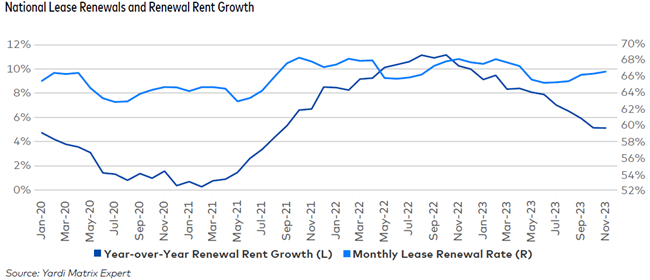
Growth for rent renewals is continuing a downward trend.

Multifamily rents nationally have leveled off as the apartment supply pipeline has counteracted ongoing strong demand, Yardi Matrix says

“Renewal rents, the change for residents that are rolling over existing leases, fell to 5.1% nationally year-over-year in November, down 10 basis points from October,” the report says. “The national lease renewal rate averaged 66.6% in November. Lease renewal rates have settled into a range, having been between 65.2% and 67.0% for the last seven months.”

Read the full report here.

About Yardi Matrix

Yardi Matrix researches and reports on multifamily, office and self-storage properties across the United States, serving the needs of a variety of industry professionals. Yardi Matrix Multifamily provides accurate data on 18+ million units, covering more than 90 percent of the U.S. population. Contact the company at (480) 663-1149.

Sign Up For Our Weekly Newsletter And Get Rental Property And Apartment News And Helpful, Useful Content Each Week.

* indicates required

Property Protection Starts With The Crime-Free Lease Addendum

Proper protection of your rental property starts with the crime-free addendum you should have in each lease.

Proper protection of your rental property starts with the crime-free addendum you should have in each lease.

By Denny Dobbins

It’s 1:00 am and the phone rings; you recognize the number as your old neighbor Rob, who now lives next door to your tenants since you turned your former home into a rental property.

He tells you that SWAT just kicked in the front door of your property and is dragging the tenant and about 20 other people out onto the front lawn in handcuffs. You ask out loud to no one in particular, “Could I have prevented this?”

Although tenants can and will do just about anything in your property, utilizing a Crime-Free Addendum in every lease can help deter this type of damaging behavior right from the start.

Why is it so vitally important for owners, landlords and property managers to use this well-established crime-free management tool to keep criminal activity away from your properties?

First, I will discuss what those tools are and then why they are so vitally important.

1.  The Crime-Free Tool

Owners, landlords and property managers need to use the basic crime free language in your rental criteria, in your lease and as a separate addendum.  Overkill?  Hardly!

This language immeasurably aids you in being highly successful in easily avoiding a plethora of costly pitfalls.  It is an essential and critical safeguard to deter criminal activity, thereby saving you money, time, and significant headaches.  The great thing is it is so simple to implement.

The following basic crime-free language should be presented to your prospective tenant as part of the rental criteria, prior to entering into a lease and at the earliest possible convenience in the relationship:

“Tenant shall ensure that Tenant, Tenant’s occupants, Tenant’s guests, and Tenant’s invitees shall not engage in, perpetrate, permit, encourage, intend to facilitate, or actually facilitate, any criminal activity of any kind, on, near or off of the premises.  If Tenant fails to ensure that no criminal activity occurs, whether or not Tenant knew of such criminal activity, any such criminal activity is a material violation of the lease subjecting the Tenant and occupants to immediate termination and eviction.  If there is a separate crime-free addendum, the full language of the crime-free addendum to the lease shall be controlling.”

2. Why is it so important for you to use the Crime-Free language?

A.  When you introduce the crime-free language to the prospective tenant early in the relationship, the prospect quickly learns that crime will not work at the property.

B. The language helps ensure immediate, appropriate, and comprehensive communication about expectations. The tenant understands early on that management is keenly aware of the issue and takes a proactive, educated approach to what they are doing.

C. Prospective tenants who are planning on being involved in criminal activity in your unit, or think crime may be an issue for them, will simply find another place to live, thereby saving you time, money, and heartache.

D. It is a proven and established deterrent to criminal activity that has effectively been working for 32 years.

E. If you ever have to go before a court because of criminal activity, the crime-free language is fatally damning to the tenant. It is clear and unambiguous that if the tenant, tenant’s occupant, guest, or invitee is involved in criminal activity in, on, near or off of the premises, the entire household can be evicted by a preponderance of evidence.  It provides zero wiggle room for a tenant when it comes to criminal activity and provides a quicker remedy in many jurisdictions.

F. You may also qualify for insurance discounts when you show you implement crime-free principles in your leasing. You need to ask your insurance company what discounts are available to you when you implement the use of the crime-free language.

Working in concert with Officer Tim Zehring of the Mesa, Ariz. police department, I wrote the original private sector crime-free language in 1992.  It has been used since, with documented results nationally and internationally by owners, landlords and property managers.

Please check with your attorney in your local jurisdiction as to whether you are legally permitted to use the crime-free language prior to a tenant qualifying for the lease based on other, non-crime-related criteria.  Using best practices like this, maybe next time the phone rings with a call from your old neighbor they’ll be telling you about your amazing new tenant.

About the author:

Denny Dobbins is legal counsel for Rent Perfect and a private investigator.  Subscribe to the weekly Rent Perfect Podcast to stay up to date on the latest industry news and for expert tips on how to manage your properties. 

No Guns In My Apartments: Can A Landlord Say That And Put It In A Lease?


Managing Conflicting Accommodation Needs In Fair Housing

Managing conflicting accommodation requests demands a balanced approach that respects the rights and needs of all residents.

Managing conflicting accommodation requests demands a balanced approach that respects the rights and needs of all residents.

By The Fair Housing Institute

Navigating the complexities of accommodation requests under the Fair Housing Act is essential for creating inclusive and equitable living spaces.

When these requests conflict, as in the case of competing accommodation needs among residents, the challenge intensifies for those overseeing housing policies and compliance.

This article offers insights and strategies for effectively managing such situations, ensuring that all decisions are made with a keen sense of fairness, legality, and sensitivity. By focusing on the intricacies of accommodation requests, we aim to provide a comprehensive guide to addressing these challenges, promoting an environment where every resident’s needs are met with understanding and respect.

Understanding and Addressing Competing Accommodation Requests

Accommodation requests are essential adjustments or exceptions to a property’s standard rules, policies, or services that enable residents with disabilities to fully enjoy their living environment.

These requests can range from allowing assistance animals to making structural modifications. However, complexities arise when the accommodation needs of one resident clash with those of another, leading to what are known as competing accommodation requests.

A classic example is one resident requiring an assistance animal for their disability, while another has severe allergies to animals. Handling these situations requires a nuanced approach that balances the needs of all parties involved, ensuring no individual’s rights are overshadowed by another’s.

Strategic Approach to Resolution

The process begins with an impartial evaluation of each request, emphasizing the importance of thorough documentation and verification from medical professionals.

This foundational step ensures that decisions are informed and equitable, providing a clear record of compliance with fair-housing laws. Open lines of communication are vital. By discussing needs directly with the involved parties, property managers can often identify straightforward solutions, such as the non-allergenic nature of a specific assistance animal. When direct resolutions are not feasible, creative problem-solving comes to the fore. Alternatives might include relocating a resident to a different unit or enhancing air filtration systems to accommodate both parties’ needs without undue hardship.

Throughout the process, it is crucial to navigate these challenges without inadvertently discriminating against any party. The aim is to find a resolution that acknowledges and accommodates the needs of all residents, thereby avoiding the potential for disputes or claims of discrimination.

Key Takeaways for Property Managers

Handling competing accommodation requests demands a balanced approach that respects the rights and needs of all residents.

Property managers must strive for solutions that not only address the specific issues at hand but also reinforce the broader principles of inclusivity and fairness in housing. At the heart of resolving these complex situations is a combination of empathy for the individuals involved and creativity in finding solutions that work for everyone. This approach not only resolves the immediate conflict but also builds a stronger, more inclusive community.

Ensuring that staff members are well-trained in handling such requests and maintaining meticulous records of the process can prove invaluable. This not only aids in finding resolutions but also provides a robust defense should any legal challenges arise. In conclusion, the ability to effectively manage competing accommodation requests is a crucial skill for property managers, underscoring their role in upholding the values of fairness and inclusivity mandated by the Fair Housing Act. By adopting a methodical, compassionate approach to these challenges, property managers can ensure that their properties remain welcoming environments for all residents, regardless of their individual needs.

About the author:
In 2005, The Fair Housing Institute was founded as a company with one goal: to provide educational and entertaining fair-housing compliance training at an affordable price at the click of a button.

Oregon Supreme Court Reduces Jury Award Against Landlord

The Oregon Supreme Court has reduced a $20 million jury award against a landlord, calling it a “grossly unfair” amount of money,

The Oregon Supreme Court has reduced a $20 million jury award against a landlord, calling it a “grossly unfair” amount of money, according to reports.

According to the lawsuit, a tenant, Robert Trebelhorn, hurt his knee when his leg punched through a walkway that his apartment complex had allowed to fall into disrepair.

While Trebelhorn did undergo surgery and suffered prolonged knee pain, the court said penalizing the large corporation that owns the complex to the tune of $20 million was “grossly excessive,” Oregon Live reported.

The court reduced the jury award against the landlord to about $5.3 million in punitive damages, plus about $300,000 in compensatory damages.

Under Oregon law, only 30 percent of punitive damages “is payable to the prevailing party,” in this case Trebelhorn. The rest goes to state criminal victims’ assistance funds.

The Oregon Supreme Court has stated opposition before to what the court sees as excessive punitive damages awarded by juries.

The court has previously stated that punitive damages that so greatly dwarf a plaintiff’s compensatory damages should be reserved for “all but the most exceptional of cases,” Oregon Live reported.

Prime Wimbledon and Prime Administration own and manage the Wimbledon Square apartments, located north of Reed College in Southeast Portland.

Matthew Casey, an attorney for the apartments, argued during the trial in 2018 that there was no “evil intent” by the complex’s owners to hurt people.

“We agree that this event happened,” Casey said at the time. “We’re sorry that it happened, and we’re taking responsibility that it happened.”

In its ruling the court said that the apartment complex “was aware that the walkway and other structures at the complex had deteriorated to the point that required ‘life-safety’ repairs, but they had chosen not to repair the walkway” on which Trebelhorn was injured.

According to court documents, on the night of the incident at the apartment Trebelhorn was walking across the second-story concrete walkway connecting his apartment building to a parking structure when a portion of the concrete gave way under his right foot, creating a hole in the walkway of nine inches by 18 inches. His right leg dropped into the hole up to his thigh and he landed in a sitting position on the walkway.

Lower courts had previously reduced the award, but Trebelhorn’s lawyers appealed to the state supreme court to reinstate the full $20 million amount.

Portland Rents See Smaller Decline In January


Sign Up For Our Weekly Newsletter And Get Apartment News And Helpful, Useful Content Each Week.

* indicates required

Fair Housing Matters: Landlord Liability for Tenant-on-Tenant Discrimination

Rent Control Will Stand In New York Supreme Court Says

The U.S. Supreme Court has declined to hear challenges to New York’s rent-control laws so rent control will stand in New York

The U.S. Supreme Court has declined to hear challenges to New York’s rent-control laws, according to reports.

Two cases were brought by owners of apartment buildings or individual units that are subject to the laws. The challengers had asked the justices to overturn the rent regulations has governed more than one million units in the city for decades and provided some of the nation’s most tenant-friendly rules.

The apartment owners told the justices that the 1969 law and its related regulations “amount to the most onerous rent-control provisions the United States has ever seen” and that they lead to “an unconstitutional taking without just compensation,” according to reports.

The New York Rent Stabilization Law, which dates back to 1969, requires landlords to renew leases except in limited circumstances, including a failure to pay rent, and lets family members take over a lease if they have lived in the unit for at least two years, Crain’s New York Business reported.

The law also gives the city’s Rent Guidelines Board authority to set maximum rent increases every year. The board considers a list of factors, including the economic condition of the residential real estate industry, vacancy rates and the cost of living in the area. The law applies to buildings that were built before 1974 and have six or more units.

Justice Clarence Thomas did issue a short statement saying that the “constitutionality of regimes like New York City’s is an important and pressing question,” which could give rent-control critics some hope the court would consider the issue in the future.

Rent Control Contributes To Affordable Housing Shortage

Governor Signs Revised Oregon Rent Control Law

Sign Up For Our Weekly Newsletter And Get Apartment News And Helpful, Useful Content Each Week.

* indicates required

Fair Housing Matters: Landlord Liability for Tenant-on-Tenant Discrimination

Arizona Bill Seeks to Stop Landlord Dog Breed Discrimination

Arizona lawmakers have advanced Senate Bill 1439, which would bar landlords from dog breed discrimination against dogs such as pit bulls and German Shepherds pictured here

Arizona lawmakers have advanced Senate Bill 1439, which would bar landlords from dog breed discrimination against certain dogs such as pit bulls and German shepherds.

For landlords who allow dogs on their properties, Senate Bill 1439 requires them to allow tenants to have any type of breed.

Sen. Brian Fernandez (D-Yuma), the bill’s sponsor, said the idea was brought to him by his assistant. The bill has several Democratic and one Republican co-sponsors.

“We recently had a client of ours who’s a veteran, she actually now works with an organization that helps other veterans with housing-related issues,” Arizona Pet Project CEO Leanna Taylor told KJZZ. “When we met her, she was living in her car. She had been there for six months with her two pit bulls because she could not find housing that would accept her and her dogs.”

Dog breed discrimination by landlords

Several animal welfare groups support the bill, but the Arizona Multihousing Association opposes it.

Sen. J.D. Mesnard (R-Chandler) said he’s concerned that if the bill becomes law, landlords will stop allowing dogs altogether. “Not sure this leads to the outcome the sponsor would hope,” Mesnard said.

Rebecca Cline writes on Butterflymx that, “Breed restrictions for apartments are rules that dictate which types of dogs a resident can have in their unit. Restrictions are enforced in multifamily housing because they absolve managers and owners of liability should a type of dog become aggressive. In fact, an apartment with no breed restrictions could be vulnerable to legal repercussions if the dog attacks on the property.

“For this reason, many property insurance companies require strict enforcement of breed restrictions. These restrictions often center around a well-known list of the most aggressive dog breeds. However, this list can sometimes differ by area,” Cline writes.

Dog Breed restrictions are policy decisions at the level of the property management company, insurance company or even the city or county.

Sign Up For Our Weekly Newsletter And Get Rental Property And Apartment News And Helpful, Useful Content Each Week.

* indicates required

Rampant, Increasing Fraud Impacting Rental Housing Costs

Fraud impacting rental housing costs throughout the country is on the rise and includes incidences of fraudulent rental applications and more

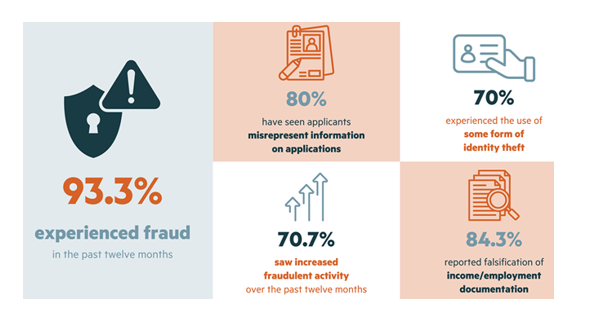
Fraud impacting rental housing costs throughout the country is on the rise and includes incidences of fraudulent rental applications, financial and identity fraud, and is often fueled by social media, the National Multifamily Housing Council (NMHC) says in a new survey.

“Driven in part by social media platforms such as TikTok and Instagram, the rise in false rental housing applications is exacerbating rental costs, fueling the housing affordability challenges facing communities across the country and undermining the credibility of eviction data. These fraudulent incidents consist of a wide range of wrongdoing, including criminal behavior,” the NMHC says in a release about the survey.

The NMHC Pulse Survey on Operational Impact of Rental Application Fraud and Bad Debt was done from November 5, 2023 to January 9, 2024 of NMHC members and National Apartment Association members representing 75 leading apartment owners, developers and managers.

Fraud impacting rental housing costs highlights of the survey:

  • 84.3% of respondents have seen applicants falsifying or fabricating pay stubs, employment references or other income documentation;
  • 80.0% observed prospective renters misrepresenting information on applications;
  • 70.0% reported identity theft, fraudulent ID documents or use of another individual’s personal information;
  • 67.1% experienced unauthorized cohabitants, illegal subletting or other actions to evade application or the leasing process; and
  • 62.9% of respondents reported the use of fraudulent checks or other payment methods.

Sixty seven percent of those who experienced an increase in fraudulent applications and payments said that this varied by jurisdiction, and many (46.9%) called out Atlanta specifically as a jurisdiction where increases in fraud were most concentrated.

Fraud impacting rental housing costs throughout the country is on the rise and includes incidences of fraudulent rental applications and more

“There has been anecdotal evidence of the rise in fraudulent activity over recent years, but now we have clear evidence of the staggering impact of these crimes on the rental housing market,” said NMHC President Sharon Wilson Géno said in the release.

“While most renters are honest, those who are not are causing the cost of rental housing to increase for everyone. Additional delays in many jurisdictions in the lease enforcement process, even when there is clear fraud, incentivizes bad actors and means that this illegal behavior costs responsible renters even more. We call on lawmakers and courts to take action that will address this problem,” she said.

See the full survey detail here.

6 Vital Tools You Need To Fight Fraud

Sign Up For Our Weekly Newsletter And Get Rental Property And Apartment News And Helpful, Useful Content Each Week.

* indicates required