
Home Blog Page 48

Landlords Ordered To Pay $500,000 In Damages in Sexual Harassment Lawsuit

Two landlords have been ordered to pay $500,000 in damages in a sexual harassment lawsuit settlement with the U.S. Department of Justice

The U.S. Department of Justice has secured an agreement for landlords to pay $500,000 in damages in a sexual harassment lawsuit involving the sexual harassment of female tenants over a period of 20 years.

The Justice Department said in a release that Richard and Mary Donahue, landlords who own more than 100 residential rental units in and around Janesville, Wisconsin, have agreed to pay $500,000 in monetary damages and a $123,965 civil penalty to the government to resolve a Fair Housing Act (FHA) lawsuit concerning Richard Donahue’s sexual harassment of female tenants over more than 20 years.

“A home should be one’s sanctuary, not a place where you are subjected to dehumanizing and prolonged periods of sexual harassment,” said Assistant Attorney General Kristen Clarke of the Justice Department’s Civil Rights Division. “When landlords sexually harass their tenants, they deprive them of the ability to feel safe and secure in their own homes. This agreement sends a strong message that the Justice Department will continue to enforce federal civil rights laws to ensure all tenants are protected from unlawful discrimination.”

“The lengthy course of sexual harassment and retaliation against female tenants in this case is disturbing and unacceptable,” said U.S. Attorney Timothy M. O’Shea for the Western District of Wisconsin. “Our office remains committed to holding landlords accountable for violations of the Fair Housing Act.”

Under the terms of the proposed consent decree, which still must be approved by the court, Richard and Mary Donahue will pay $500,000 in monetary damages to 13 female tenants harmed by Richard Donahue.

“The defendants are also required to seek to vacate any retaliatory eviction judgments obtained against these tenants and to take steps to correct the tenants’ credit histories. The defendants are also permanently enjoined from managing residential rental properties in the future and must retain an independent property manager to manage their rental properties for the duration of the decree. Finally, the defendants must pay a $123,695 civil penalty to the government, the maximum civil penalty allowed under the FHA,” the Justice Department said in the release.

The lawsuit alleged that, since at least 2000, Richard Donahue harassed female tenants by making repeated and unwelcome sexual comments, touching tenants’ bodies without their consent, demanding sexual activity in exchange for rent and housing-related benefits and taking adverse actions against tenants who resisted his sexual advances or complained about the harassment.

The suit was filed in May 2022.

The Justice Department’s Sexual Harassment in Housing Initiative is led by the Civil Rights Division, in coordination with U.S. Attorney’s Offices across the country. The goal of the department’s initiative is to address, deter and raise awareness about sexual harassment by landlords, property managers, maintenance workers, loan officers or other people who have control over housing. Since launching the initiative in October 2017, the department has filed 38 lawsuits alleging sexual harassment in housing and recovered more than $11.8 million for victims of such harassment.

Advanced Fair Housing Training – A Professional Resolution

Sign Up For Our Weekly Newsletter And Get Rental Property And Apartment News And Helpful, Useful Content Each Week.

* indicates required

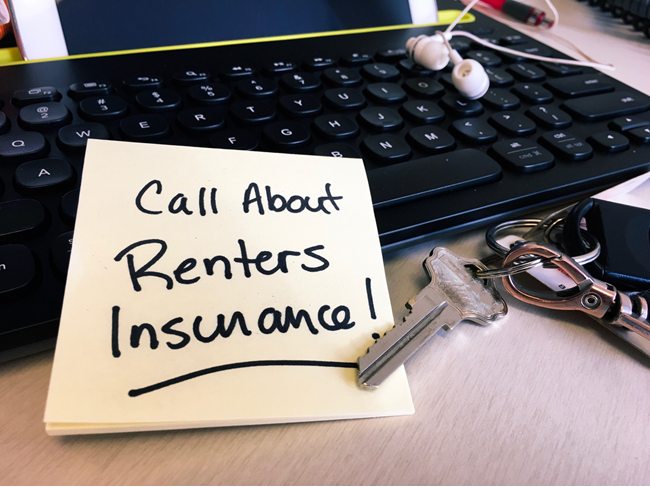
The Easiest & Least Expensive Small Landlord Hack: Require Renters Insurance

Require renters insurance as it solves a lot of problems when there has been a fire or when someone has been hurt on your property

At Anderson Insurance Group, we have been through experiences where landlords call, their rental property has been involved in a fire, their tenant has nowhere to go, no coverage for their “stuff,” and the landlord is left with the hassle of rebuilding their property and big claim on their insurance policy. A $15.00 per month renters insurance policy can solve a lot of problems when there has been a fire or when someone has been hurt on your property. We see this 1-2 times a year and the claims are normally around $250,000 which is too often and too much. Landlords need to better protect themselves by requiring their tenants to carry renters insurance.

Large apartment complexes require renters insurance, and while it may require a little more work, it’s something that every Utah landlord, large or small, should require. There are a few benefits for a landlord when you require renters insurance, here are just a few:

  1. A renters insurance policy provides a layer of liability insurance between you, the tenants and their visitors. If the tenant’s mother-in-law drops by to visit, trips and falls the renters insurance may respond before your landlords insurance providing an additional layer of liability coverage. This is especially important if your tenant has a dog. The average dog bite claim across the nation is $50,000! make sure your tenant’s policy does not limit dog bite claims or exclude certain breeds. We recommend you require your tenants to carry at least a $300,000 limit of liability coverage.
  2. Fire Legal Liability is part of every renter’s insurance policy and will pay for damage to your property if the tenant is negligent or responsible for starting a fire. Accidents happen – if your tenant leaves something cooking on the stove or their grill causes a fire, their renter’s insurance will pay for the damage. It will also pay for the damage to other structures, so if your rental is a condo or townhome, this coverage becomes even more important.
  3. Renters Insurance will help pay for your renter to relocate if the dwelling is damaged from a covered loss. As landlords, sometimes we develop relationships with our renters and feel a need to help them, and a renters insurance policy will pay for them to find a new home.
  4. Tenants with renters insurance are more responsible. Some tenants don’t care about renters insurance, so they probably also don’t care about their things or your property. Mention your requirements during the interview process to help find better renters.

The cost of renters insurance can be as low as $10.00 per month, and if your tenant combines renters insurance with their auto insurance, it normally discounts the cost of their auto insurance, so the net cost of the renters insurance is zero.

Make sure you are listed as Certificate Holder on your tenant’s renters insurance policy. A certificate holder will receive notice of the coverage limits, renewal notices and most importantly a notice if the renters insurance cancels. If your tenant cancels their renters insurance and you receive notice you should issue a three notice to comply or vacate.

Call us for more information on renters insurance and any questions you have about land lording, we love helping our customers be successful Utah landlords. Call our office at 801-262-1551 or Click Here for a for a consultation with our experienced team. Find out more about renter’s insurance.

Avoid Costly Coinsurance Penalties with Proper Insurance Coverage for Your Investment Properties

For a full review of your apartment or rental property insurance, contact a knowledgeable Anderson Insurance Group agent today.

Secure Your Monthly Cash Flow With One Easy-to-Miss Coverage: Business Income Insurance for Utah Landlords

Avoid Costly Coinsurance Penalties with Proper Insurance Coverage for Your Investment Properties

Advanced Fair Housing Training – A Professional Resolution

Advanced fair housing training looking at domestic violence, criminal history, emotional support animals and sexual harassment training.

Advanced fair housing training looking at domestic violence, criminal history, emotional support animals and sexual harassment training.

By The Fair Housing Institute

What’s your New Year’s resolution? Save money? Exercise more? Typically we focus on personal goals, but what about professional development? A career in property management is truly dynamic and requires us all to stay up to date on the latest trends as well as training. This is especially true when it comes to fair housing.

Now is an excellent time to review our team members’ and our basic understanding of the intricacies of the Fair Housing Act, along with ensuring that we all have a thorough understanding of the more complicated aspects. This article will share the top five fair housing topics that continue to be a cause of fair housing complaints and require an advanced level of knowledge and training.

Review the scenarios and questions to see if you might need to brush up on a few of the more challenging situations that can arise in property management.

Domestic Violence – A Complicated Topic

Domestic violence, unfortunately, is on the rise and is an incredibly sensitive topic.

That being said, it still needs to be addressed. First of all, when we discuss domestic violence, many will immediately think of The Violence Against Women Act. Remember, though, that the laws that protect victims of domestic violence apply to all types of housing providers. No one is exempt.

Consider the following scenarios and ask yourself how you or your company would handle them:

  • A public instance of domestic abuse has occurred on your property? What are the next steps?
  • A prospect has disclosed that they were evicted from their prior residence due to the fact that they were a victim of domestic violence. Now what?

As you can see, domestic violence raises all kinds of questions about whether you are dealing with the victim or the perpetrator. Specialized training and clear company policies will help everyone stay compliant while tactfully managing these types of situations.

Is Your Marketing Fair Housing Friendly?

Is your marketing handled in-house, or do you outsource it?

Does your company have clear marketing policies?  Is every staff member that is involved with marketing aware of how fair housing laws can affect marketing? Marketing can take a very broad range past the standard pamphlet or advertisement. It can include things like pictures in the leasing office to what employees may be posting on company social media.  Added to that, even the type of funding your property receives can impact what kind of marketing you are required to do.

As we start to move into 2023, now is a good time to review your marketing strategy and ensure that everyone involved knows how to keep it fair housing friendly.

Criminal History Screening – Can You Just Say No?

Criminal history screening has also seen a recent uptick in complaints and lawsuits due to its complex nature.

One of the more common mistakes we see when it comes to criminal history screening is when leasing agents try to dissuade a prospect from filling out an application and paying the standard fees associated with it due to their criminal history. While this may seem like they are doing the “right” thing, it can land a company in all kinds of legal trouble.

This is just one of the scenarios that might happen. Blanket policies of just saying “no” are never a good idea, and once again, every person that is involved in the application process needs to have training to help them navigate this complex and sensitive process.

Emotional Support Animals –  A Potentially Hairy Situation

“Oops, did I forget to tell you about my emotional support animal when I applied?

Meet Kujo, my one-hundred-pound furry friend.” What’s the saying… if I only had a nickel? The number of requests and subsequent complaints regarding emotional support animals only grows year after year. Hurdles like misinformation, online certification and verifiers, and many other variables create a potential minefield for most housing providers.

The best protection from a potential fair housing claim of discrimination is to make sure that everyone has received training to understand the law, the resident’s rights, and the rights of the property itself. Along with that having clear policies and specific forms will aid in handling the ever-growing reasonable accommodation requests for an emotional support animal.

Sexual Harassment Prevention Doesn’t Stop in the Office

Sexual harassment training is needed within the workplace, but it shouldn’t end there. What about training in regard to employee and resident relations? Consider some of these more common scenarios that can end in a fair housing claim if not handled properly:

  • Employees and residents are friends and socialize outside of work.
  • Employees dating residents.
  • Access to a unit is needed, but only a child is home.

To avoid a potential fair housing claim, every company needs to include additional sexual harassment training that provides clear policies regarding employee/resident relationships.

So how did you do?

These are just a few of the more complicated fair housing situations that can arise. If you found yourself struggling or unsure how to handle any of these issues, or perhaps you are personally aware of others that you are not clear on how to handle, we strongly encourage you to make continued fair housing training one of your New Year’s resolutions.

About the author:
In 2005, The Fair Housing Institute was founded as a company with one goal: to provide educational and entertaining fair-housing compliance training at an affordable price at the click of a button.

Sign Up For Our Weekly Newsletter And Get Rental Property And Apartment News And Helpful, Useful Content Each Week.

* indicates required

Record 2024 Apartment Supply Coming, May Limit Rent Growth

There is a record amount of new apartment supply coming in 2024 that will limit rent growth, Yardi Matrix says in a multifamily rent report.

There is a record amount of new apartment supply coming in 2024 that will limit rent growth, Yardi Matrix says in a special multifamily rent report.

However, it might take a year or two for some markets that are doing well handling the new supply to absorb all the new units.

“The main story of 2024 will be one of record supply coming online that will depress rent appreciation in many of the markets that saw explosive growth during the pandemic, and a handful of markets could end the year in negative growth territory,” writes Andrew Semmes, Senior Research Analyst for Yardi Matrix, in the report.

The new apartments coming online are almost all in the higher-level, more luxury apartments called Class A properties, directly in competition with one another.

“So, we expect to see less growth in asking rents at the top of the market, and stronger growth in workforce and renter-by-necessity units,” Semmes says.

Asking rents versus in-place rents

The second trend Yardi Matrix sees coming in 2024 is the gap closing between asking rents and in-place rents.

“Asking rents are almost a perfect leading indicator of in-place rents, and most markets still have a large gap between the two, which will continue to shrink as asking rent increases remain muted in the near term,” Semmes says.

Rent increases have been tamed and supply absorption will take time

Semmes says the rent increases that occurred in 2021 and 2022 has been tamed.

“We expect modest growth of 0.8%— with large variance across markets and time—in average national asking rents in 2024 as a historically large amount of supply gets added to the housing stock.

“It will take time for that supply to be completely absorbed, but it will get absorbed, and once that occurs, we expect a return to the usual 3-4% yearly growth in asking rents that we experienced before the pandemic,” he writes.

Read the full report here.


Top 10 Cities To Watch For Rentals In 2024

Sign Up For Our Weekly Newsletter And Get Rental Property And Apartment News And Helpful, Useful Content Each Week.

* indicates required

Attracting Federal Investment to Multifamily Housing

The federal investment in multifamily housing enables multifamily affordable housing properties (MFAH) to pursue high-impact upgrades

Ravi Malhotra

The Bipartisan Infrastructure Law (BIL) and Inflation Reduction Act (IRA), signed into law in 2021 and 2022, respectively, enable multifamily affordable housing (MFAH) properties to pursue high-impact upgrades largely on the federal government’s dime. The MFAH segment can tap free money for weatherization, beneficial electrification, solar, and health and safety solutions. These kinds of green solutions can reduce operating costs; increase net operating income; and increase affordability, health, comfort, and safety for the low-income households.

However, the time to benefit from these funds is finite, and quickly disappearing. This year, many funds are moving from the federal government to the states, and then on to communities. A crucial step for MFAH stakeholders will be persuading federal and state agencies that MFAH offers a path to addressing agencies’ pain points when it comes to IRA and BIL: getting their allocations spent in a manner that is cost-effective, simple, scalable, deeply impactful, and in alignment with the federal Justice40 initiative.

At ICAST, a national 501c3 nonprofit with a 22-year history of scaling green solutions in MFAH, we are working at the same task. In the process, we have created a library of resources that the MFAH segment can utilize for its advocacy efforts. ICAST provides research, insights, and case studies, as well as key guidance including:

  • For myriad reasons, the same program design cannot serve single-family and multifamily, and MFAH is a different animal altogether.
  • Programs should take advantage of established strategies for the MFAH segment to simplify the qualification, intake, processing, invoicing, and reporting process.
  • Programs should leverage a “one-stop-shop” approach, where the program implementer offers a simple, yet turn-key solution that is hassle-free for the MFAH customers.
  • Programs should offer leveraging of funds from various programs to reduce or eliminate the investment needed from property owners.
  • Programs should have a “mass customization” approach wherein every project is tailored to drive the highest benefits based on each property’s specific needs.
  • Programs should lean on existing successful programs and partnerships.

 About the author:

Ravi Malhotra is the Founder and President of ICAST, a national nonprofit that creates holistic retrofit solutions for MFAH. He has 30+ years of experience designing, launching, and managing programs to benefit this segment.

Race Against Time: Seizing an Unprecedented Opportunity for Affordable Housing

Planning for Funding Opportunities Through the Inflation Reduction Act and Bipartisan Infrastructure Law

Accessing Solar for Multifamily Affordable Housing

Accessing Utah’s Home Energy Rebate Programs

Portland Rents See Smaller Decline In January

Portland rents saw a smaller decline in January, dropping a small 0.2%, after several months of larger declines.

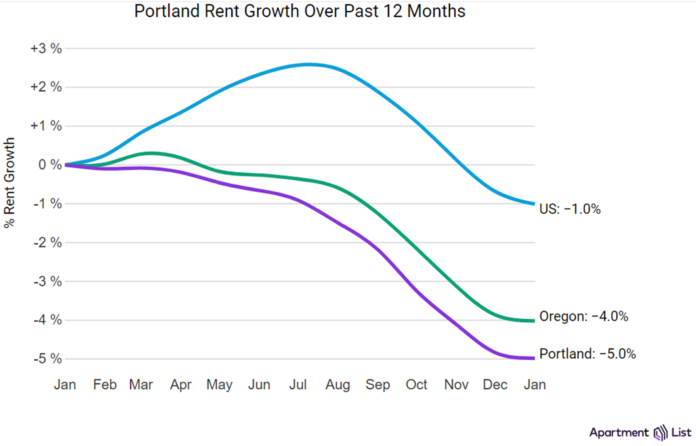
Portland rents saw a smaller decline in January, dropping a small 0.2%, after several months of larger declines, according to the February report by Apartment List.

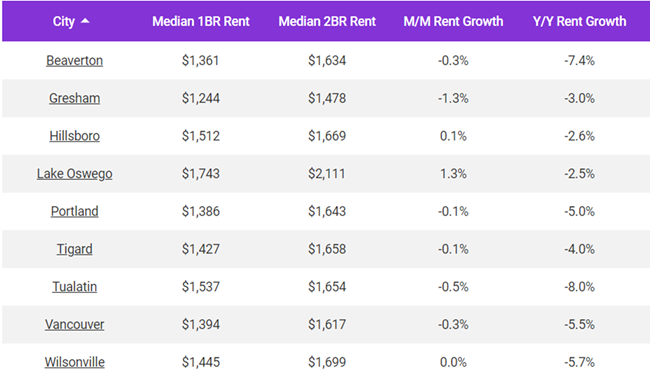
The overall median rent in the city across all bedroom sizes is $1,526, roughly the same as last month in December and prices are now down 5.0% year-over-year. Median rent for a one-bedroom in Portland is $1,386 and $1,643 for a 2-bedroom.

Portland’s rent growth over the past year has is similar to the state average (-4.0%) but has fallen below the national average (-1.0%). January rent growth in Portland ranked #35 among large U.S. cities.

Rents lower in Portland proper

Outside the city the median rent is $1,624 meaning that the median price in Portland proper ($1,526) is 6.0% lower than the price across the metro as a whole. Metro-wide annual rent growth stands at -4.5%, above the rate of rent growth within just the city.

The table below shows the latest rent stats for 9 cities in the Portland metro area that are included in our database. Among them, Lake Oswego is currently the most expensive, with a median rent of $1,990. Gresham is the metro’s most affordable city, with a median rent of $1,458. The metro’s fastest annual rent growth is occurring in Lake Oswego (-2.5%) while the slowest is in Tualatin (-8.0%).

Portland rents saw a smaller decline in January, dropping a small 0.2%, after several months of larger declines,

Portland, Metro Area Rents Continue Decline


Portland Update: Changes to FAIR Ordinance Bring (Some) Necessary Changes

Dealing with Habitability issues and Substitute Housing


Salt Lake City Utah Rents Up In January

Salt Lake City rents rose by 0.9% over the course of January, according to the February report from Apartment List, after falling in December

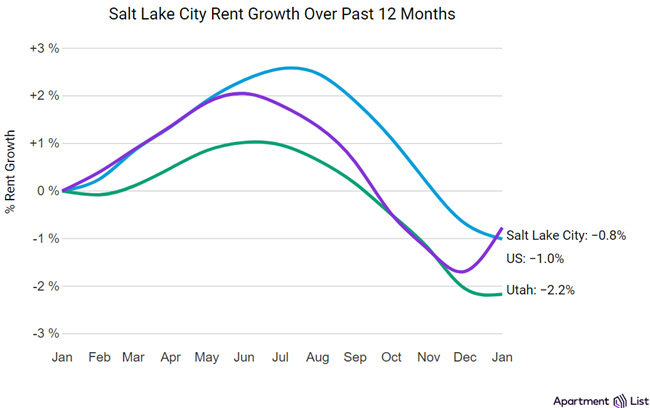
Salt Lake City Utah rents rose by 0.9% over the course of January, according to the February report from Apartment List.

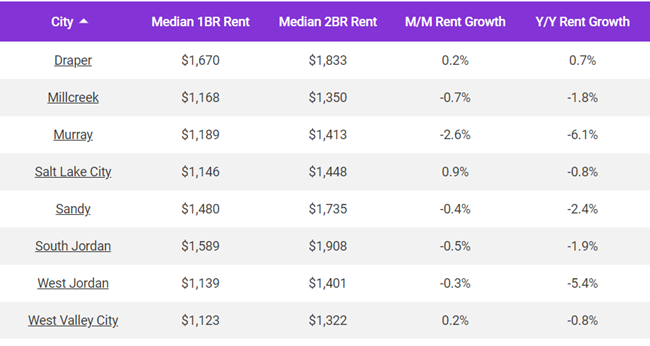
While January saw an increase in rents, the city has seen rents decrease by a total of 0.8% over the past 12 months. Salt Lake City’s rent growth over the past year has outpaced the state average (-2.2%) and is similar to the national average (-1.0%).

Salt Lake City rents are 11.1% lower than the metro-wide median

Utah rents across the metro area, the median rent is $1,489 meaning that the median price in Salt Lake City proper ($1,324) is 11.1% lower than the price across the metro as a whole.

Metro-wide annual rent growth stands at -2.6%, below the rate of rent growth within just the city.

The table below shows the latest rent stats for 8 cities in the Salt Lake City, Utah metro area that are included in our database. Among them, Draper is currently the most expensive, with a median rent of $1,889. Salt Lake City is the metro’s most affordable city, with a median rent of $1,324. The metro’s fastest annual rent growth is occurring in Draper (0.7%) while the slowest is in Murray (-6.1%).

Salt Lake City rents rose by 0.9% over the course of January, according to the February report from Apartment List, after falling in December

Salt Lake City Rents Dip In December

NAA Announces 2024 Diversity Leadership Program Candidates

The National Apartment Association (NAA) has selected the participants for the Diversity Leadership Program (DLP) Class of 2024.

The National Apartment Association (NAA) has selected the participants for the Diversity Leadership Program (DLP) Class of 2024.

Founded in 2020, the DLP annually provides up to 15 individuals from diverse backgrounds an opportunity to grow and learn from leaders in the rental housing industry. Participants, who are considered junior to mid-level (3-7 years in rental housing), gain leadership experience through mentorship and training as part of the yearlong program. The program is a crucial aspect of NAA’s leadership diversification strategy intended to identify, mentor and engage individuals from underrepresented minority groups.

“Over the past four years, NAA has seen some of the most dedicated young professionals strive to advance both their careers and the rental housing industry as a whole,” said NAA President and CEO Bob Pinnegar. “It’s my pleasure to welcome the next Diversity Leadership Program class and further our mission for a more diverse and inclusive workforce. I have no doubt that this group of future leaders will cultivate an industry in which every individual is valued and given the opportunity to thrive.”

The DLP Class of 2024 will meet virtually from March through November. Throughout the year, participants will take part in education sessions, reading discussions and mentor meetups. The program will conclude with a virtual graduation and capstone project presentation, where participants work in small groups to develop and identify a real solution for advancing diversity, equity and inclusion in rental housing.

Members of this year’s class are listed below. Additional details on the program and the Class of 2024 participants can be found. More information on NAA’s diversity, equity and inclusion (DE&I) efforts can be found here.


Joelis Barandica

CONAM Management

Florida Apartment Association

Stacey Bradley
Case & AssociatesApartment Association of Greater Wichita
Patricia Chesser-Martinez
Property Management CompanyApartment Association of Central Oklahoma
Rochelle Cole
Essential Property ManagementDetroit Metropolitan Apartment Association
David Daily

Fairfield Residential

South East Florida Apartment Association

Jennifer Joseph
Realsource PropertiesAtlanta Apartment Association
Patton Locke
AMLIApartment Association of Great Dallas
Melody Miles
Student QuartersAtlanta Apartment Association
Khalil Muhammad
Essential Property ManagementDetroit Metropolitan Apartment Association
Lauren Niziol
Red Cedar Advisory ServicesDetroit Metropolitan Apartment Association
Rocio Simon
GreystarMassachusetts Apartment Association
Lenora Woods
BGSFAtlanta Apartment Association


About NAA
The National Apartment Association (NAA) serves as the leading voice and preeminent resource through advocacy, education, and collaboration on behalf of the rental housing industry As a federation of 141 state, local and global affiliates, NAA represent more than 12 million apartment homes globally. NAA believes that rental housing is a valuable partner in every community that emphasizes integrity, accountability, collaboration, community responsibility, inclusivity and innovation. To learn more, visit www.naahq.org. NAA thanks its Strategic Partners: The Home Depot Pro, Lowe’s Pro Supply and Yardi.

Winter Rent Dip Continues In January

The winter rent dip continued in January as the nationwide median rent fell by 0.3 percent to $1,373 for six months of decline

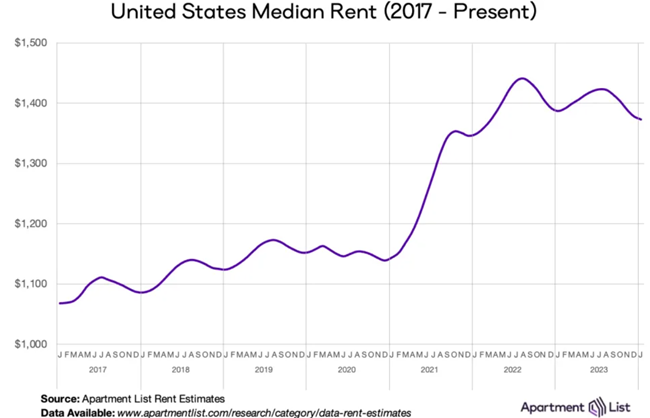
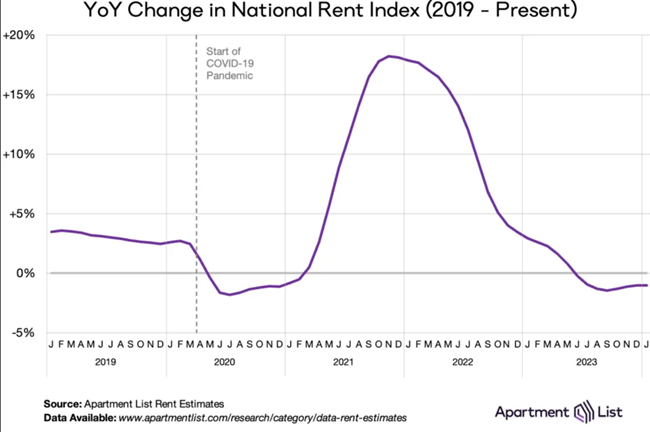
The winter rent dip continued in January with the sixth straight month of negative rent growth, as the nationwide median rent fell by 0.3 percent to $1,373, according to the February report from Apartment List.

“The recent declines are in line with the rental market’s typical seasonal pattern, as fewer renters are looking to move in the fall and winter, although this year’s dip has been a bit sharper and more prolonged than what we normally see,” Apartment List economists write in the monthly report.

On average apartments across the country are cheaper than they were a year ago.

The winter rent dip continued in January as the nationwide median rent fell by 0.3 percent to $1,373 for six months of decline

However, prices are still high. The national median rent is still more than $200 per month higher than it was just three years ago.

“Regionally, rents fell in January in 73 of the nation’s 100 largest cities, and prices are down year-over-year in 53 of these 100 cities. The sharpest rent decline over the past year has been in Oakland, CA, where rents are down by 9.1% year-over-year. Boise, ID; Austin, TX; Atlanta, GA; Nashville, TN; and Portland, OR have all also seen rents fall by 5 percent or more,” the report says.

The winter rent dip continued in January as the nationwide median rent fell by 0.3 percent to $1,373 for six months of decline

May be light at the end of the tunnel for rents

The January rent decline, while it was the sixth straight month of declines, was “modest compared to the declines we’ve been seeing in recent months, indicating that we’re approaching the end of the market’s slow season.

“Even though the timing of the recent slowdown has been in line with what we typically expect, its magnitude has been a bit more pronounced. The nation’s median rent has fallen by a total of 3.5 percent since last summer’s peak, the second sharpest seasonal dip that we’ve seen in the history of our index (going back to 2017).

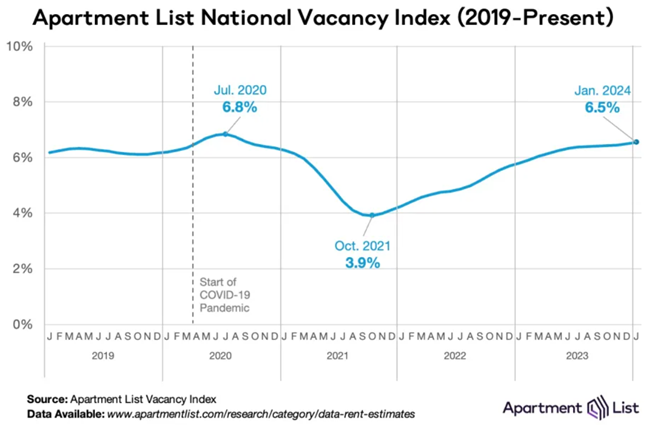
Apartment vacancies are back above pre-pandemic levels

The number of new apartments under construction continues to push up supply in many markets impacting the vacancy index.

“As of January, our vacancy index sits at 6.5 percent, the highest reading since September 2020. And there’s good reason to expect that it could rise even further in the year ahead,” the report says.

The winter rent dip continued in January as the nationwide median rent fell by 0.3 percent to $1,373 for six months of decline

Conclusion

While the typical winter dip is nearing an end, “it’s possible that rent growth could turn positive again as soon as next month. But even when positive rent growth returns, it should be moderated by a robust construction pipeline delivering strong supply growth throughout 2024.

“With consumer sentiment about broader macroeconomic conditions beginning to improve, it’s possible that rental demand will also rebound in the year ahead, but likely not to an extent that would outweigh the impact of all the coming supply,” the Apartment List economists write.

Read the full February report here

Harvard’s America’s Rental Housing Report Shows Cost-Burdened Renters

The Joint Center for Housing Studies of Harvard University has released their annual rental housing report showing a cooling rental market

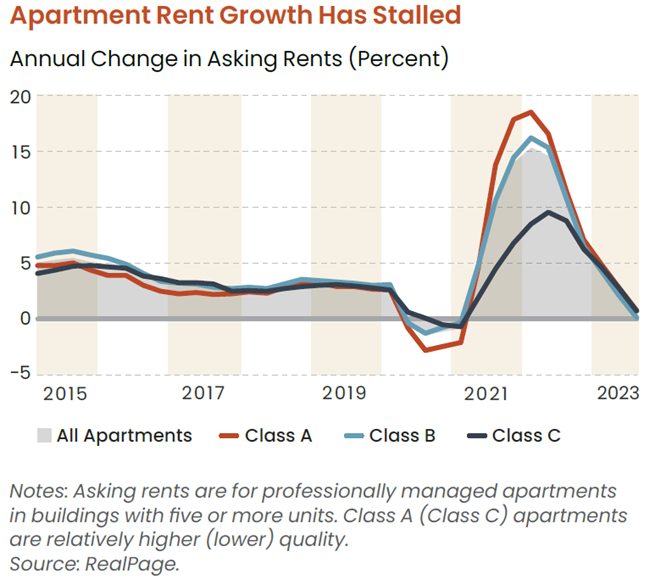
The Joint Center for Housing Studies of Harvard University has released their annual rental housing report and it shows a cooling rental market with many new apartments becoming available but at the high end of rents which is not helping cost-burdened renters.

“What we are building is at the high end, because of the increased cost of construction and because we have a lot of demand from higher-income renters,”  Whitney Airgood-Obrycki, a senior research associate with the center and the report’s lead author, told NPR. Most new apartments over the last decade have gone for $1,400 a month or higher, “and that’s not affordable to the majority of renters.”

The Joint Center for Housing Studies of Harvard University has released their annual rental housing report showing a cooling rental market

“More renter households are cost burdened than ever before, and a record number of people are experiencing homelessness. Pandemic resources temporarily shored up the housing safety net, but the need for rental assistance remains greater than ever,” the report says.

Older apartments which in many cases are more affordable “require significant investment to address structural inadequacies, inaccessibility, and climate risks.

“Making these investments is challenging, given the current market environment of increasing operating expenses and high interest rates. Despite today’s difficult conditions, strong demand from the Gen Z, millennial, and baby boom generations should ensure that the rental market slowdown is short lived,” the report says.

A record number of people are also homeless

About 653,000 people reported experiencing homelessness in January of 2023, up roughly 12% from the same time a year prior and 48% from 2015.

“That marks the largest single-year increase in the country’s unhoused population on record,”  Harvard researchers said.

Rent increases outpace income gains

Harvard says the dwindling supply of low-rent apartment units is only wors­ening cost burdens.

“In 2022, just 7.2 million units had contract rents under $600—the maximum amount affordable to the 26 percent of renters with annual incomes under $24,000. This marks a loss of 2.1 million units since 2012 when adjusting for inflation. The spike in asking rents during the pandemic accelerated the trend, with more than half a million low-rent units lost just between 2019 and 2022,” the study says.

“Median rents have risen nearly continu­ously since 2001 in inflation-adjusted terms and are 21 percent higher as of 2022. Meanwhile, renters’ incomes have risen just 2 percent during the same period.”

Aging Rental Stock Will Require Reinvestment

The report says the stock of rental housing available is older than it has ever been.

“The median age was 44 years in 2021, up from 34 years two decades ago. Although building construction standards and repairs to existing units have helped to minimize the problem of structural inadequacy, a large number of rental units still fall short of baseline habitability and safety,” the report says.

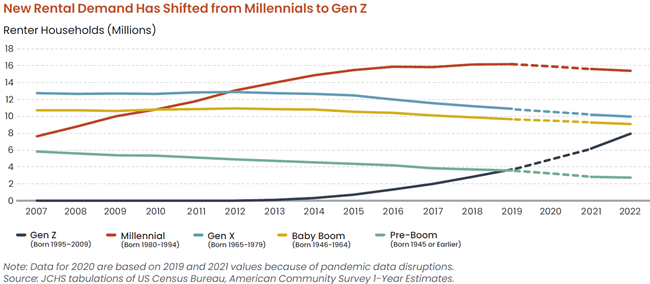
A new generation is driving rental demand

The report says “millennials will remain a large source of rental demand in coming years, they are no longer fueling the growth in renter households. Rather, they are aging into prime homeownership years, a transition that markets are already witnessing.

“Instead, members of the slightly smaller but still large Gen Z, individuals born between 1995 and 2009, are driving rental demand\,” the report says.

The Joint Center for Housing Studies of Harvard University has released their annual rental housing report showing a cooling rental market

Read the full Harvard report here.


Top 10 Cities To Watch For Rentals In 2024

Sign Up For Our Weekly Newsletter And Get Rental Property And Apartment News And Helpful, Useful Content Each Week.

* indicates required